Privy Purses in India: History, Abolition and Legacy
The history of privy purses in India, from princely-state integration and Article 291 to Indira Gandhi's 1971 abolition and the Supreme Court rulings.
Latest Story
When the princely states joined India in 1947-49, their rulers gave up their thrones, armies and treasuries. In return they were promised a fixed, tax-free annual allowance for life and for their heirs. These privy purses in India were then written into the Constitution of 1950. Twenty years later, Indira Gandhi’s government set out to end them. Its first attempt failed twice in 1970, once by a fraction of a vote in the Rajya Sabha and once in the Supreme Court. Its second, the Twenty-sixth Amendment of 1971, succeeded and was upheld by the Supreme Court in 1993. This timeline follows the whole arc, from the 3 June 1947 plan to the 2023 Article 370 judgment that restated the rules. Every date and figure is checked against the judgments themselves.
The total was about Rs 5.8 crore a year, not Rs 58 crore. The 1993 Supreme Court judgment gives Rs 5.8 crore; a single line in the 1970 judgment prints ‘58 crores’, which is widely repeated. The Nizam of Hyderabad was given Rs 50 lakh a year under his 1950 agreement, not Rs 20 lakh. The White Paper on Indian States came out on 5 July 1948, with a revised edition in 1950. And the Mysore royal family’s challenge was filed in 1992, not 1972; the 1972 petitions came from Kurundwad Junior and Malerkotla.
💡 Short Answer
Privy purses were annual, tax-free payments to the former rulers of India’s princely states, agreed when they merged their states into India in 1947-49 and guaranteed by Article 291 of the Constitution from 1950. They totalled about Rs 5.8 crore a year. Indira Gandhi’s government tried to abolish them in 1970, but the amendment failed in the Rajya Sabha and the Supreme Court struck down the President’s derecognition order on 15 December 1970. The Constitution (Twenty-sixth Amendment) Act abolished them on 28 December 1971, and the Supreme Court upheld it on 4 February 1993.
Privy Purses in India: Key Questions
Privy Purses in Ten Lines
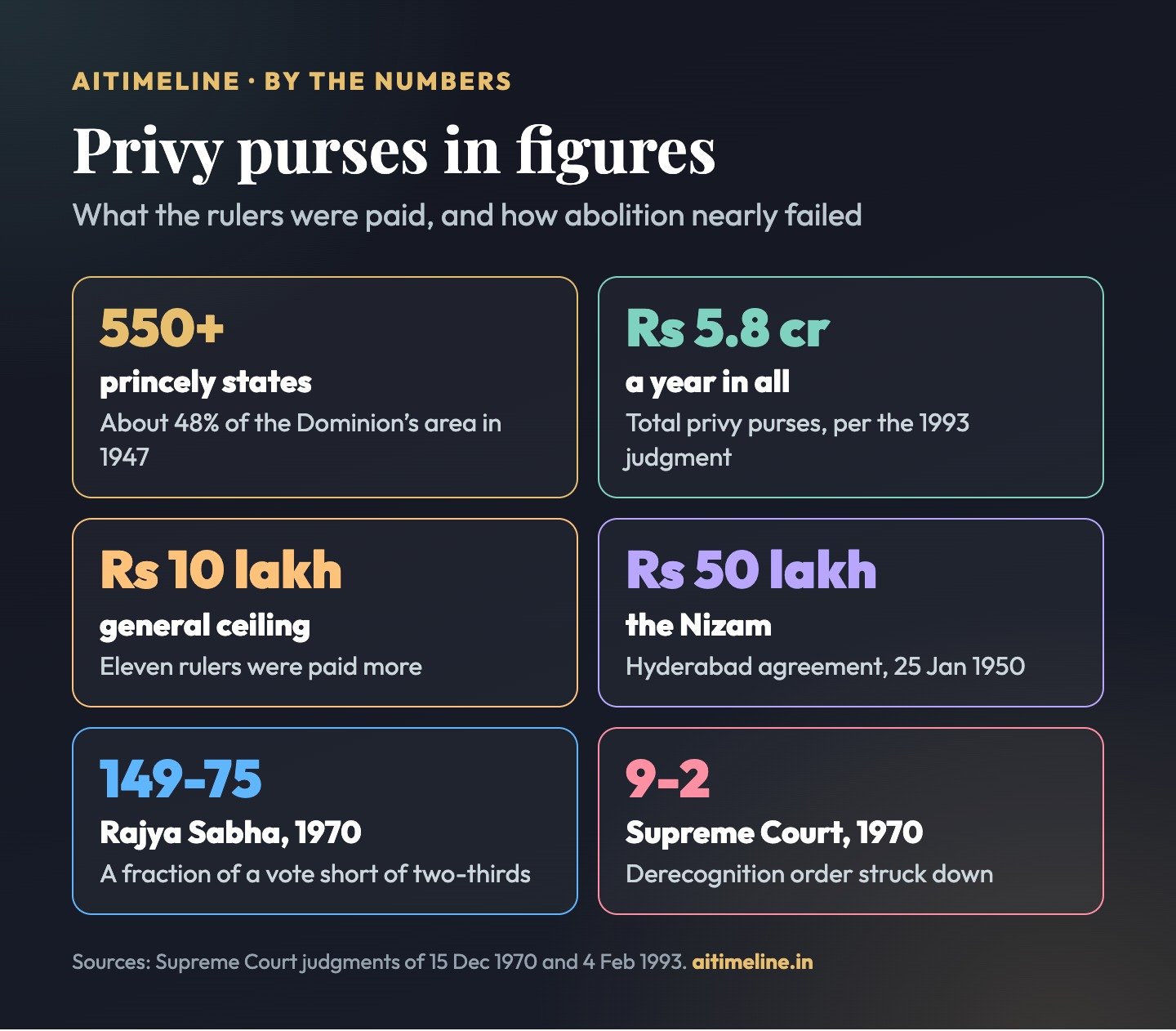
- The bargain: rulers of more than 550 states surrendered their powers in 1947-49 for a purse, privileges and guaranteed succession.
- The amounts: fixed state by state under a Rs 10 lakh ceiling; about Rs 5.8 crore a year in all.
- The extremes: Rs 50 lakh for the Nizam, Rs 26 lakh for Mysore, Rs 192 for the Ruler of Kotodia.
- The guarantee: Articles 291, 362 and 366(22) of the 1950 Constitution.
- The turn: a Congress resolution of 25 June 1967 called for abolition.
- The near miss: on 5 September 1970 the Rajya Sabha vote was 149 to 75, a fraction of a vote short.
- The shortcut: that night the President derecognised every ruler by executive order.
- The rebuff: on 15 December 1970 the Supreme Court struck the order down, 9 to 2.
- The amendment: after the March 1971 landslide, the Twenty-sixth Amendment took effect on 28 December 1971.
- The last word: the Supreme Court upheld it in 1993 and restated both rulings in 2023.
What Were Privy Purses?
Not a pension, and not a salary: the price of a merger, written into the Constitution.
A privy purse was an annual payment by the Government of India to a recognised former ruler of a princely state, or his recognised successor. The term was borrowed from Britain, where the privy purse is the sovereign’s private income. In India it meant the sum a ruler kept for himself and his household once he had handed over his state’s government, revenues and property to the Union.
The amounts were negotiated in the covenants and merger agreements of 1948-50. According to the Supreme Court, they were fixed with regard to each ruler’s income before integration, under a general ceiling of Rs 10 lakh a year; eleven rulers were allowed more. Many agreements named a higher sum for the ruler who signed and a lower one for his successors, so the total was designed to shrink with each generation. The purse came with guaranteed succession according to custom and a list of personal privileges, from the use of titles to exemptions from certain laws.
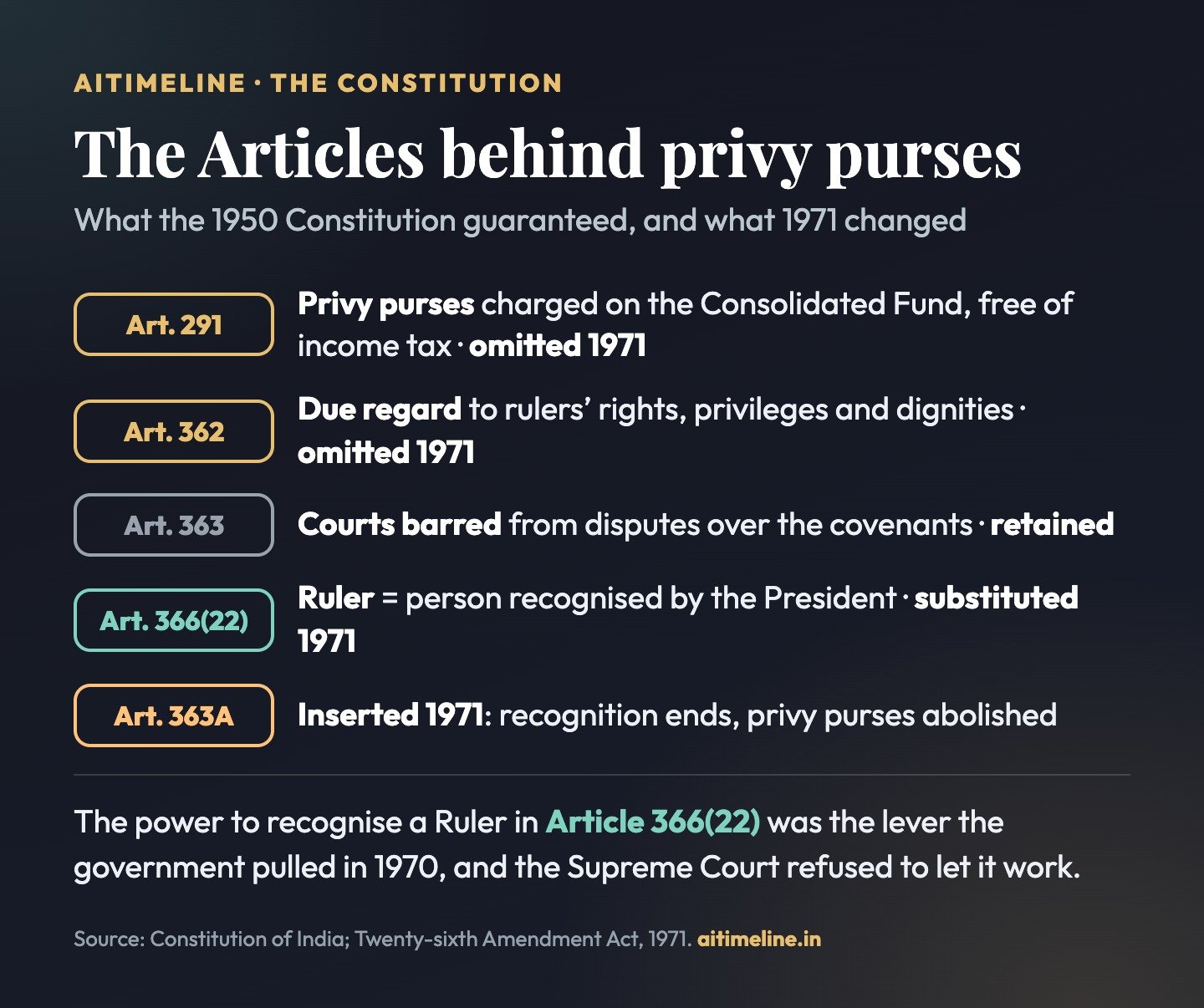
The 1950 Constitution turned these political promises into constitutional guarantees. Article 291 charged the purses on the Consolidated Fund of India and exempted them from income tax. Article 362 asked Parliament, legislatures and governments to have due regard to the rulers’ personal rights and privileges. Article 363 kept disputes arising from the covenants out of the courts, and Article 366(22) defined a ‘Ruler’ as the person recognised by the President.
The Four Stages, at a Glance
Promise, guarantee, failed shortcut, constitutional abolition.
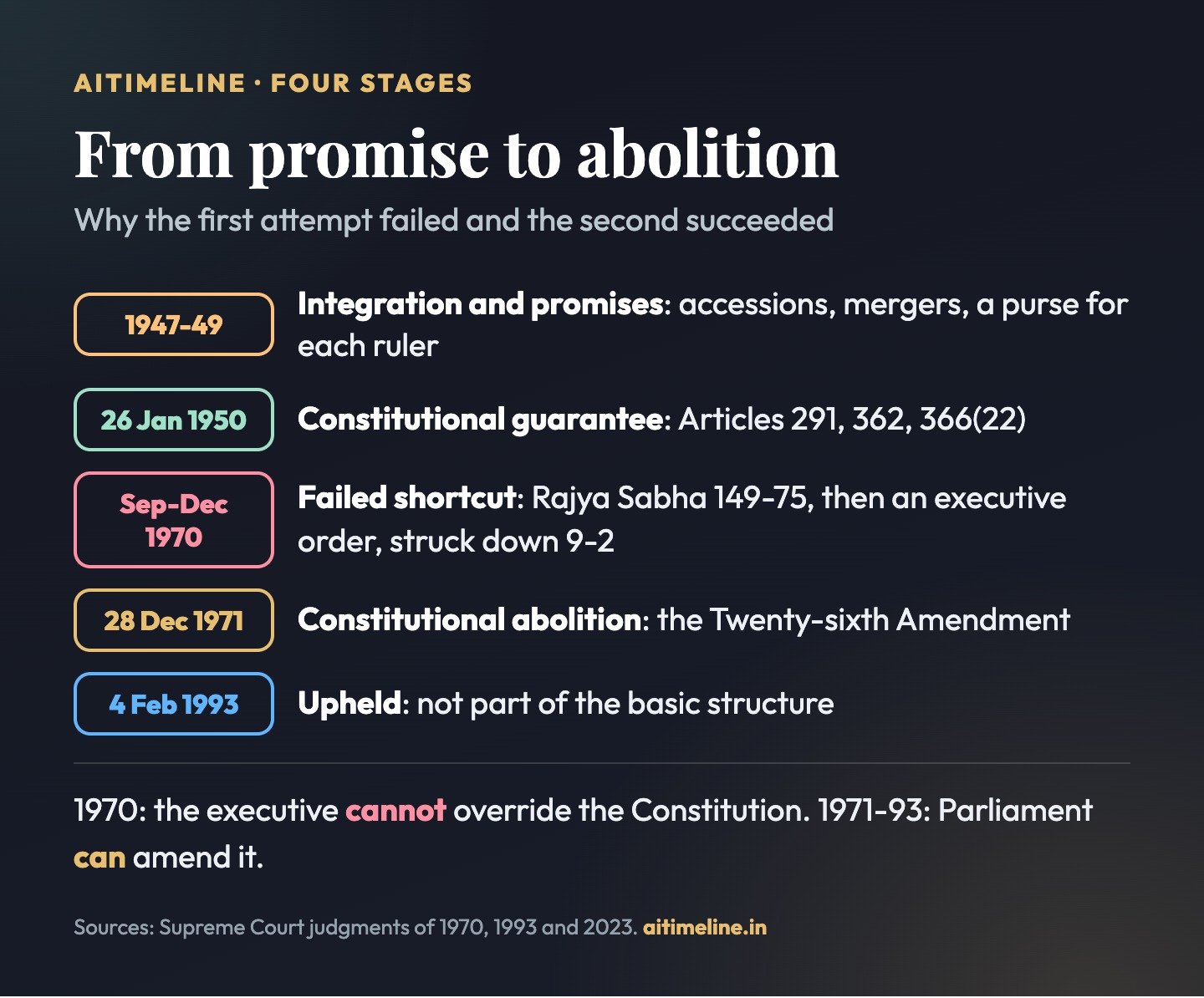
The first two stages built the guarantee; the last two dismantled it. The difference between stage three and stage four is the key to the whole story. In 1970 the government tried to end the purses by executive order while the Constitution still promised them, and the Supreme Court said no. In 1971 it changed the Constitution itself, and in 1993 the Court said that was within Parliament’s power.
Privy Purses Timeline, 1947 to 2023
Newest first. Each entry is tagged by type.
The Article 370 judgment restates the privy purse rulings Supreme Court
What happened: Deciding the challenge to the 2019 changes in Jammu and Kashmir, the Supreme Court reviewed the two privy purse judgments at length and set out seven principles drawn from them.
What it said: The guarantee came from the text of the Constitution (Articles 291 and 366(22)), not from the merger agreements. While Article 291 stood, it could not be ended by an executive act of derecognition. Once Parliament deleted it by constitutional amendment, both the right and the obligation ended. Privy purses were not a quid pro quo for surrender of sovereignty, and Articles 291 and 366(22) were not part of the basic structure.
Supreme Court upholds the Twenty-sixth Amendment in full Supreme Court
What happened: A Constitution Bench dismissed the challenges to the 1971 amendment and held it “valid in its entirety”. Justice S. Ratnavel Pandian wrote for himself, Chief Justice L.M. Sharma and Justices B.P. Jeevan Reddy and S.P. Bharucha; Justice S. Mohan concurred separately.
Why it matters: The bench held that abolishing privy purses and ending the recognition of rulers did not damage the basic structure of the Constitution. Justice Mohan noted that calling Articles 291 and 366(22) an ‘integral part’ of the Constitution in 1970 did not make them basic features. The judgment ended 21 years of litigation.
Mysore’s royal successor joins the challenge Supreme Court
What happened: The successor of Jaya Chamaraja Wadiyar, the last ruling Maharaja of Mysore, filed a writ petition challenging the Twenty-sixth Amendment on the same grounds as the 1972 petition from Kurundwad. It was heard with that case.
The Mysore terms: Mysore’s agreement of 23 January 1950 gave the Maharaja Rs 26 lakh a year, tax-free, from 1 April 1950. A proviso made that sum payable only to him for his lifetime; provision for his successor was to be made separately.
The challenge is sent back after Kesavananda Bharati Supreme Court
What happened: The rulers’ 1972 petitions had been listed with the Kesavananda Bharati case. When the 13-judge bench delivered its judgment on 24 April 1973, it upheld the Twenty-fourth Amendment and directed that a Constitution Bench decide the validity of the Twenty-sixth Amendment “in accordance with law”.
Why it matters: Kesavananda created the test the princes would have to meet: Parliament can amend any part of the Constitution, but not its basic structure. Their case would now turn on whether privy purses were part of that structure.
A former co-ruler of Kurundwad challenges the amendment Supreme Court
What happened: Raghunathrao Ganpatrao, co-ruler of the small state of Kurundwad Junior, petitioned the Supreme Court for a declaration that the Twenty-fourth, Twenty-fifth and Twenty-sixth Amendments were void and that he was still entitled to his privy purse and privileges. The Nawab of Malerkotla filed a similar petition, No. 352 of 1972.
His privy purse: Kurundwad Junior had signed a merger agreement on 19 February 1948 and handed over its administration on 8 March 1948. His privy purse was Rs 49,720 a year, tax-free, as set by the agreement and amended by a 1956 order.
The Twenty-sixth Amendment abolishes privy purses Constitution and law
What happened: The President gave his assent and the amendment came into force the same day. It omitted Articles 291 and 362, inserted Article 363A and substituted a new clause (22) in Article 366.
What Article 363A did: It provided that every person recognised as a Ruler, or as a Ruler’s successor, before the amendment “shall, on and from such commencement, cease to be recognised”, and that privy purses were abolished and all rights, liabilities and obligations in respect of them extinguished.
Rajya Sabha passes the abolition bill Parliament and politics
What happened: Fifteen months after defeating the 1970 bill, the Rajya Sabha passed the new one with the required two-thirds majority. The vote is reported as 167 for and 7 against.
What had changed: The Congress that Indira Gandhi led had won a large majority in the Lok Sabha in March 1971, and support for abolition in the upper house had firmed up.
Lok Sabha passes the bill by a wide margin Parliament and politics
What happened: The Lok Sabha passed the bill after debate, with a reported 381 votes for and 6 against.
The argument: The government’s case was the one it had made in 1970: that rulership, with privy purses and special privileges “unrelated to any current functions and social purposes”, was incompatible with an egalitarian social order.
The Twenty-fourth Amendment restores Parliament’s amending power Constitution and law
What happened: After ratification by 11 State legislatures, the President assented to the Twenty-fourth Amendment. It declared that Parliament could amend any provision of the Constitution under Article 368, overriding the 1967 Golak Nath ruling.
Why it matters here: It cleared the legal ground for the Twenty-sixth Amendment. The new number for the privy purse bill is the reason the 1970 ‘Twenty-fourth Amendment Bill’ and the 1971 Twenty-fourth Amendment Act are different laws.
Indira Gandhi wins a landslide Parliament and politics
What happened: Indira Gandhi called an early general election after the setbacks of 1970. Her Congress won a two-thirds majority in the Lok Sabha.
Why it matters: The abolition of privy purses was part of a broader programme, alongside bank nationalisation, that the government presented as a move towards social and economic equality. The result gave it the numbers to amend the Constitution.
Supreme Court strikes down the derecognition order, 9 to 2 Supreme Court
What happened: The Court held the President’s orders of 6 September 1970 “illegal, ultra vires and inoperative”. The majority judgment was written by Justice J.C. Shah for seven judges; Chief Justice Hidayatullah and Justice K.S. Hegde wrote concurring opinions. Justices G.K. Mitter and A.N. Ray dissented.
The reasoning: The power to recognise a Ruler under Article 366(22) could not be used for the collateral purpose of abolishing the whole order of Rulers while Article 291 still guaranteed their privy purses. The rulers were declared entitled to their purses and privileges, and payments were restored.
The Maharaja of Gwalior goes to the Supreme Court Executive action
What happened: Madhav Rao Scindia, recognised by the President as Ruler of Gwalior in 1961, asked the Court to declare the order of 6 September 1970 “unconstitutional, ultra vires and void” and to hold that he remained entitled to his privy purse and privileges. Other rulers filed similar petitions.
The government’s defence: It argued that recognition was a matter of State policy, that the covenants gave no enforceable rights, and that Article 363 barred the courts from hearing disputes arising out of them.
The government defends the order in Parliament Executive action
What happened: The day after the orders, the Finance Minister laid a statement before the Rajya Sabha. It claimed that the President’s power to withdraw recognition of the Rulers was unquestionable and that orders had been issued in pursuance of that decision.
The difficulty: The government had just failed to amend the Constitution. Doing by executive order what Parliament had refused to do invited the charge that the power was being used for a collateral purpose.
The President derecognises every former ruler Executive action
What happened: Hours after the Rajya Sabha vote, the President signed, in Hyderabad, an instrument withdrawing the recognition of all the Rulers. Separate orders dated 6 September were served on each one and published in the Gazette.
The intended effect: If no one was recognised as a Ruler, the government reasoned, no privy purse was payable under Article 291 and the privileges would lapse with it.
Rajya Sabha defeats the first abolition bill Parliament and politics
What happened: The bill received 149 votes for and 75 against. Under Article 368 an amendment needs two-thirds of members present and voting, which meant 150. It was declared lost.
Why it matters: The margin was a fraction of a single vote. The failure sent the government to the executive route the same night.
Lok Sabha passes the 1970 bill Parliament and politics
What happened: The Lok Sabha voted 332 to 154 for the bill, clearing the two-thirds threshold of members present and voting.
What the bill did: It had three clauses and a short Statement of Objects and Reasons, and would have removed Articles 291 and 362 and the recognition of Rulers under Article 366(22).
The first abolition bill is introduced Parliament and politics
What happened: The government introduced a bill to end privy purses and privileges. Its Statement of Objects and Reasons said the concept of rulership with privy purses and special privileges was “incompatible with an egalitarian social order”.
Background: Talks between the Home Ministry and representatives of the rulers after 1967 had not produced an agreed settlement.
Congress resolves to abolish privy purses Parliament and politics
What happened: The All India Congress Committee passed a resolution calling for the abolition of privy purses and privileges. The Union Home Ministry then held a series of talks with the rulers.
Why it matters: The Supreme Court in 1993 recorded that the 1970 bill was introduced “to implement the decision of the All India Congress Committee”. Several rulers had joined opposition parties, notably the Swatantra Party, in the 1967 elections.
Nehru asks the rulers for a voluntary contribution Parliament and politics
What happened: Jawaharlal Nehru told the Lok Sabha in November 1953 that he had written personally to rulers about their privy purses. His appeal was for a voluntary contribution from the larger purses towards development schemes, not a legal cut.
The result: There was no general agreement to reduce the payments, which remained fixed by the covenants and guaranteed by Article 291.
The Constitution guarantees the privy purses Constitution and law
What happened: The Constitution came into force. Article 291 charged guaranteed privy purses on the Consolidated Fund of India and exempted them from income tax. Article 362 required governments and legislatures to have due regard to the guarantees on personal rights, privileges and dignities. Article 363 kept disputes arising from the covenants out of the courts. Article 366(22) defined a ‘Ruler’ as the person recognised by the President.
Why it matters: The guarantee now rested on the Constitution itself. That was why, in 1970, the executive could not undo it, and why, in 1971, only a constitutional amendment could.
The last big agreements: Mysore and Hyderabad Integration
What happened: Days before the Constitution took effect, the Government of India signed agreements with the two largest states left territorially untouched by integration. The Maharaja of Mysore was to receive Rs 26 lakh a year from 1 April 1950; the Nizam of Hyderabad, Rs 50 lakh a year, both free of all taxes.
The successor clauses: Both sums were personal. Mysore’s was payable to the then Maharaja for his lifetime only, and for the Nizam’s successors provision was to be made later by the Government of India.
Patel defends the guarantees in the Constituent Assembly Constitution and law
What happened: Patel moved and defended the provisions on privy purses and rulers’ privileges. He argued that the guarantees were part of the settlement under which the rulers had given up their states, and the Assembly adopted them.
The numbers he could cite: V.P. Menon recorded that the rulers had handed over cash balances of about Rs 77 crore, and that “the price paid as Privy Purses was not too high for integration”. Both later Supreme Court judgments quoted him.
The White Paper on Indian States is published Integration
What happened: The Ministry of States published a White Paper surveying its first year: the accessions, the mergers and the terms given to rulers. A revised and expanded edition followed in 1950.
What it covered: The transfer of governing authority, privy purses, succession, personal privileges, and the line between state property and the rulers’ private property.
Merger agreements fix the privy purses Integration
What happened: Ruler after ruler signed agreements surrendering all governing powers. Some states merged into neighbouring provinces, some were grouped into unions such as Saurashtra, Rajasthan and Travancore-Cochin, and a few were run directly by the Centre. In return each ruler got a fixed, tax-free privy purse, guaranteed succession and personal privileges.
How purses were set: They were fixed with regard to each state’s revenue before integration, with a general ceiling of Rs 10 lakh a year; eleven rulers received more. The 1993 judgment put the total at about Rs 5.8 crore a year.
Independence: most rulers accede to India Integration
What happened: As British paramountcy lapsed, most rulers of states contiguous with India had signed Instruments of Accession. Accession transferred only three subjects; the rulers kept their internal authority for now.
The scale: The states covered about 48 per cent of the area of the Indian Dominion and 28 per cent of its population. Counts vary, but there were more than 550 of them.
Mountbatten addresses the Chamber of Princes Integration
What happened: The Viceroy urged the rulers to accede to India or Pakistan on defence, external affairs and communications, telling them that independence was not a practical option.
Why it matters: His speech set the framework for the Instruments of Accession signed over the next three weeks.
The States Department is created Integration
What happened: The States Department was set up under Patel, with V.P. Menon as its senior official, to handle relations with the princely states. It later became the Ministry of States.
Why it matters: Patel and Menon negotiated the accessions and then the mergers. The privy purse was one of the main inducements they offered.
The partition plan leaves the princes’ future open Integration
What happened: The British government announced that British India would be divided into two Dominions. The princely states were not part of either; with the end of paramountcy, their rulers would have to decide their own future.
Why it matters: It turned more than 550 rulers into negotiating parties, and made the terms offered to them, including privy purses, a matter of high politics.
1970: Why the First Attempt Failed
Ten weeks, two defeats: one in Parliament, one in court.
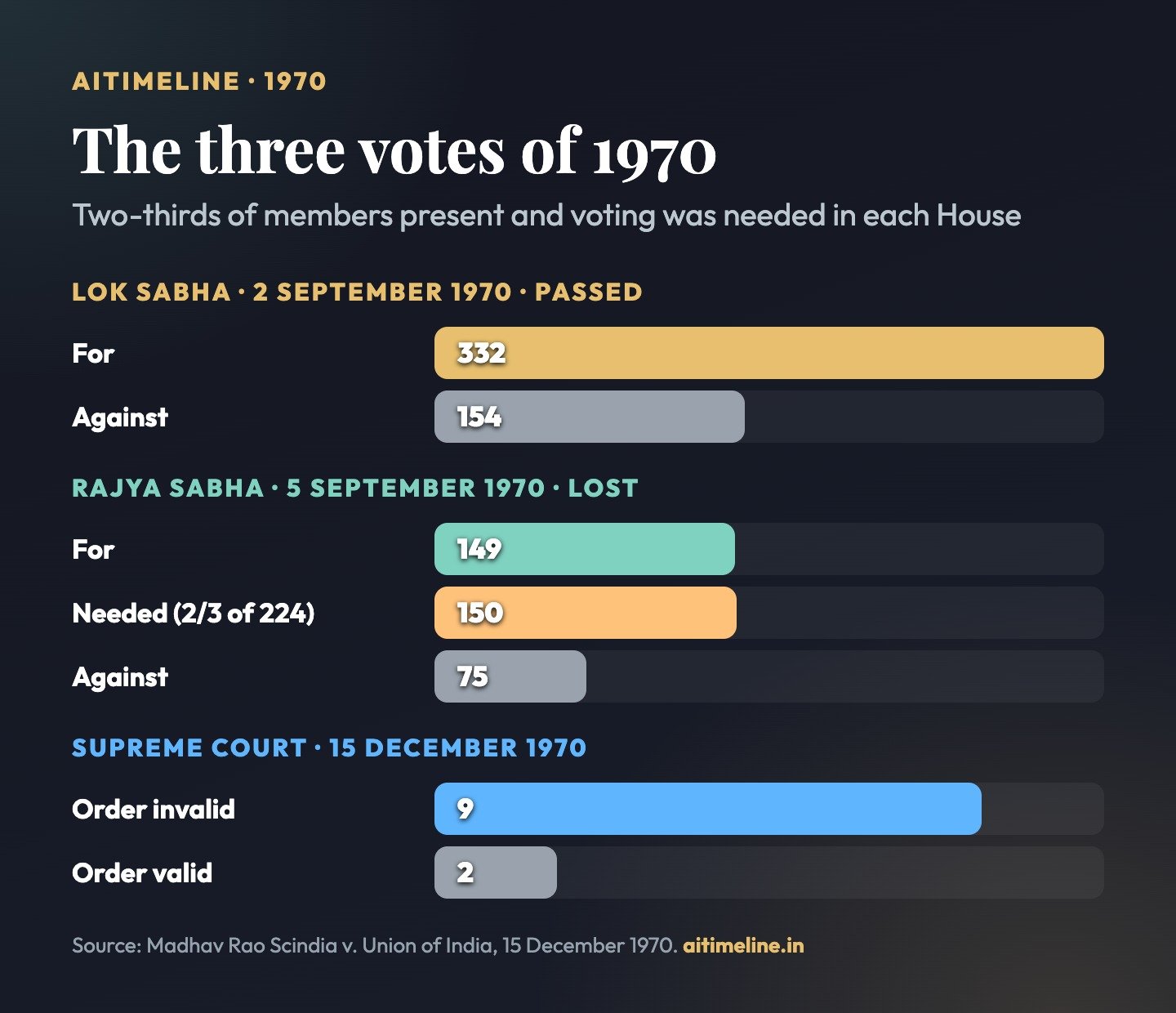
The Constitution (Twenty-fourth Amendment) Bill was introduced in the Lok Sabha on 14 May 1970 to remove Articles 291 and 362 and the recognition of Rulers. The Lok Sabha passed it on 2 September, by 332 votes to 154. Three days later the Rajya Sabha voted 149 to 75. An amendment needs two-thirds of the members present and voting; with 224 voting, that was 150. The bill failed by a fraction of a single vote.
The government did not wait. The same night, the President signed in Hyderabad an instrument withdrawing the recognition of every ruler, and orders dated 6 September were served on each of them. If nobody was recognised as a Ruler, the reasoning went, nobody was owed a privy purse under Article 291.
The Maharaja of Gwalior, Madhav Rao Scindia, petitioned the Supreme Court on 11 September, followed by other rulers. On 15 December 1970 an 11-judge bench held the orders illegal by 9 to 2. Justice J.C. Shah, writing for seven judges, said the recognition power in Article 366(22) could not be used to abolish the order of Rulers while Article 291 stood; Chief Justice M. Hidayatullah and Justice K.S. Hegde concurred separately, and Justices G.K. Mitter and A.N. Ray dissented. The majority also held that Article 363 was only a limited bar and did not stop the Court from asking whether an executive order was unauthorised. The purses were restored.
“The concept of rulership, with privy purses and special privileges unrelated to any current functions and social purposes, is incompatible with an egalitarian social order.”
Statement of Objects and Reasons, Constitution (Twenty-fourth Amendment) Bill, 1970
How the Twenty-sixth Amendment Abolished Privy Purses
This time the change was made to the Constitution itself.
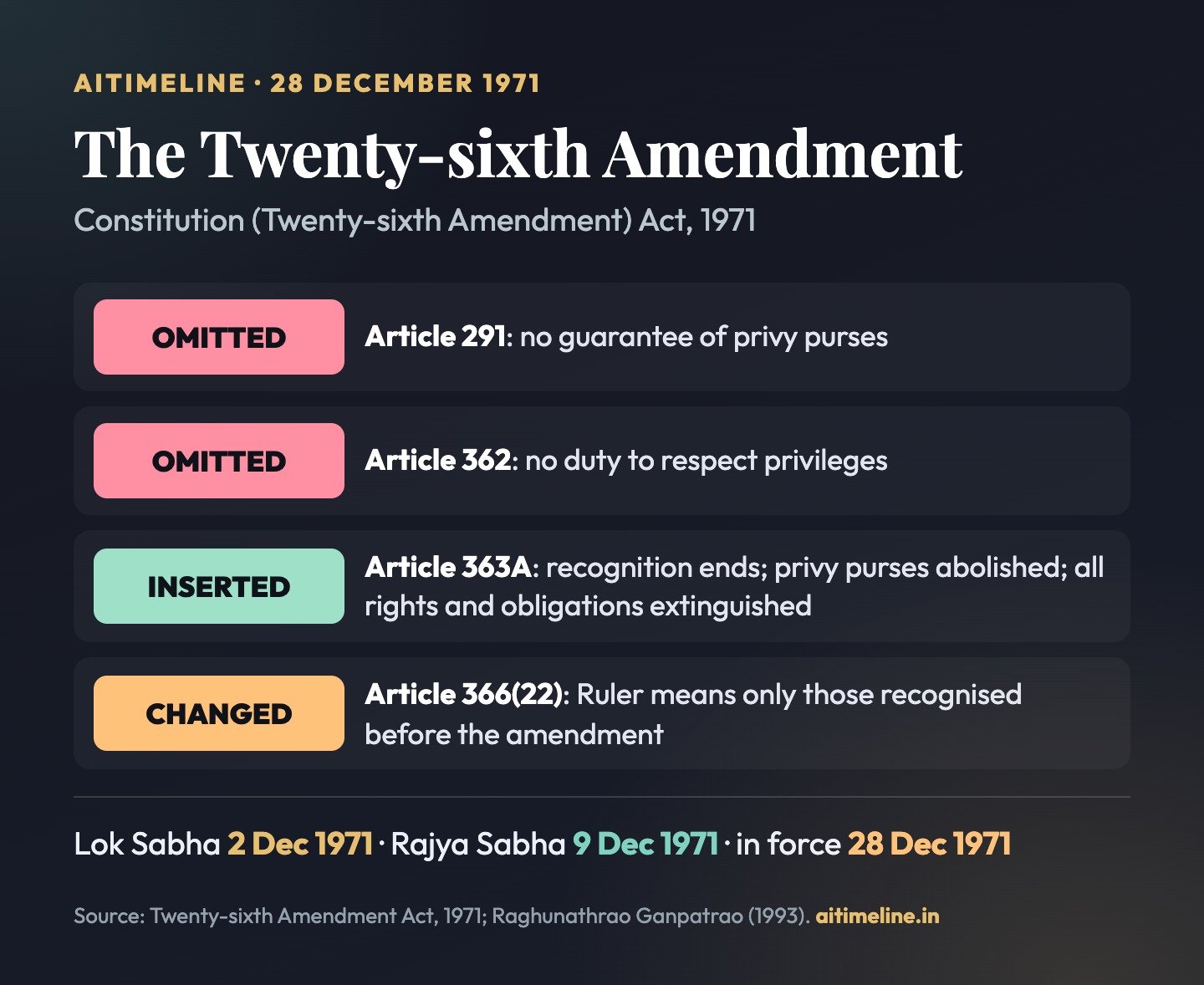
Indira Gandhi dissolved the Lok Sabha early and won a two-thirds majority in March 1971. The Twenty-fourth Amendment Act, which restored Parliament’s power to amend any part of the Constitution after the Golak Nath ruling, received assent on 5 November 1971. The privy purse bill followed under the next number, the Twenty-sixth. The Lok Sabha passed it on 2 December 1971 and the Rajya Sabha on 9 December, by reported votes of 381 to 6 and 167 to 7. It came into force with the President’s assent on 28 December 1971.
The new Article 363A did the work. Anyone recognised as a Ruler or successor before the amendment “shall, on and from such commencement, cease to be recognised”, and privy purses were “abolished and all rights, liabilities and obligations in respect of privy purse are extinguished”. Because the change was in the Constitution, there was no executive order left for a court to strike down.
| Provision | Before 28 Dec 1971 | After the 26th Amendment |
|---|---|---|
| Article 291 | Privy purses charged on the Consolidated Fund, exempt from income tax | Omitted |
| Article 362 | Due regard to rulers’ personal rights, privileges and dignities | Omitted |
| Article 363A | Did not exist | Recognition ends; privy purses abolished |
| Article 366(22) | Ruler = person recognised by the President | Ruler = person recognised before the amendment |
| Article 363 | Bar on court disputes over covenants | Retained |
How Much Did Former Rulers Receive?
From Rs 50 lakh a year to Rs 192: negotiated one state at a time.
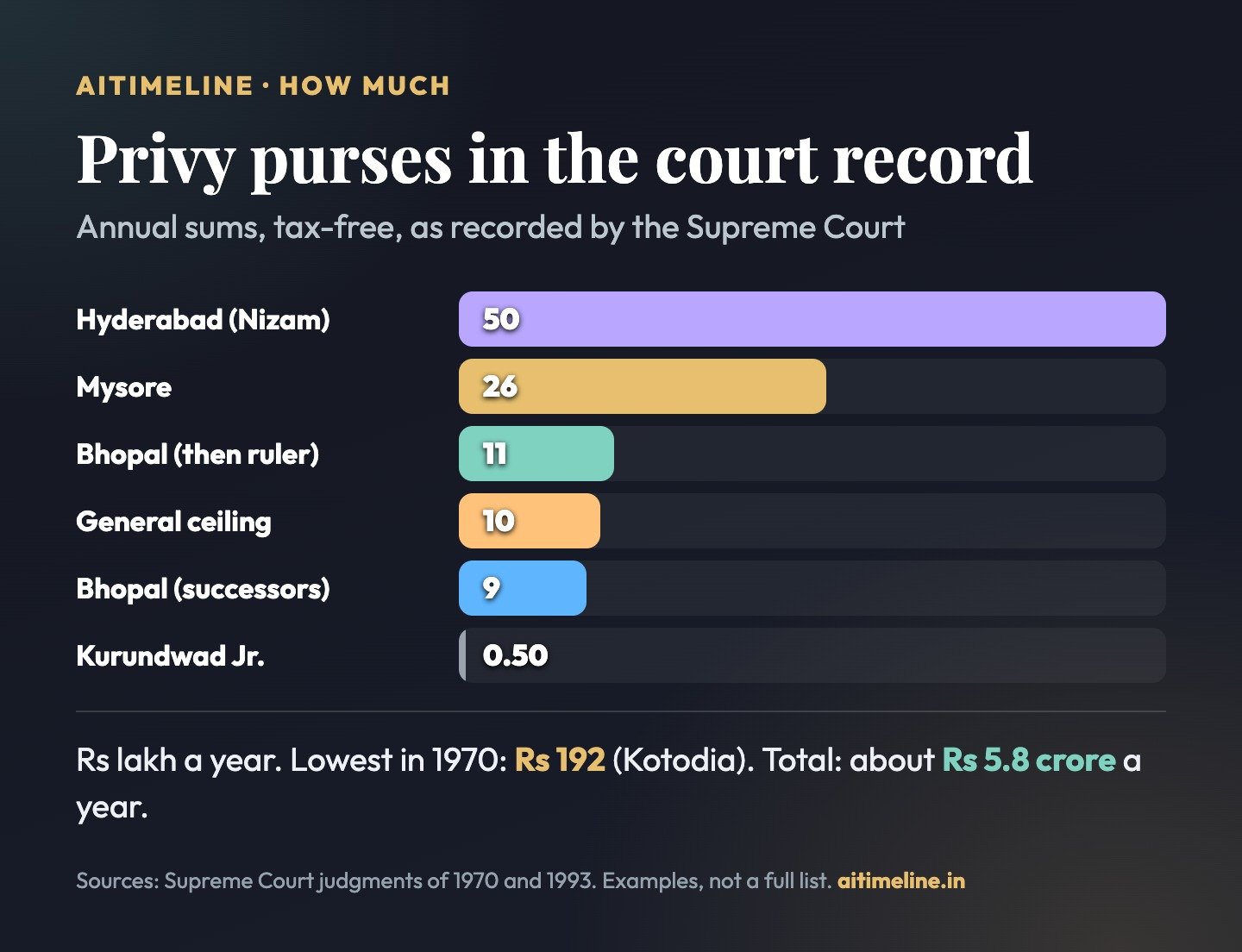
| State | Annual privy purse | Terms recorded by the Supreme Court |
|---|---|---|
| Hyderabad | Rs 50,00,000 | Agreement of 25 Jan 1950; successors’ purse to be fixed later |
| Mysore | Rs 26,00,000 | Agreement of 23 Jan 1950; for the then Maharaja’s lifetime only |
| Bhopal | Rs 11,00,000 | Then ruler; each successor Rs 9 lakh |
| General ceiling | Rs 10,00,000 | Exceeded by eleven rulers |
| Kurundwad Junior | Rs 49,720 | Merger agreement of 19 Feb 1948, amended 1956 |
| Kotodia | Rs 192 | The lowest privy purse in 1970 |
The figures above are examples taken from the judgments, not a complete list. The Supreme Court’s 1993 judgment put the total at about Rs 5.8 crore a year, liable to fall as successor rates took over. A single sentence in one of the 1970 opinions gives ‘Rs. 58 crores’; that figure is ten times the 1993 one and appears to be a misprint, but it is often repeated. Against the cost, V.P. Menon set what the rulers had handed over, including cash balances of about Rs 77 crore. In his view the purses were “not too high” a price for integration.
The Two Judgments That Decided It
Why the rulers won in 1970 and lost in 1993, without any contradiction.
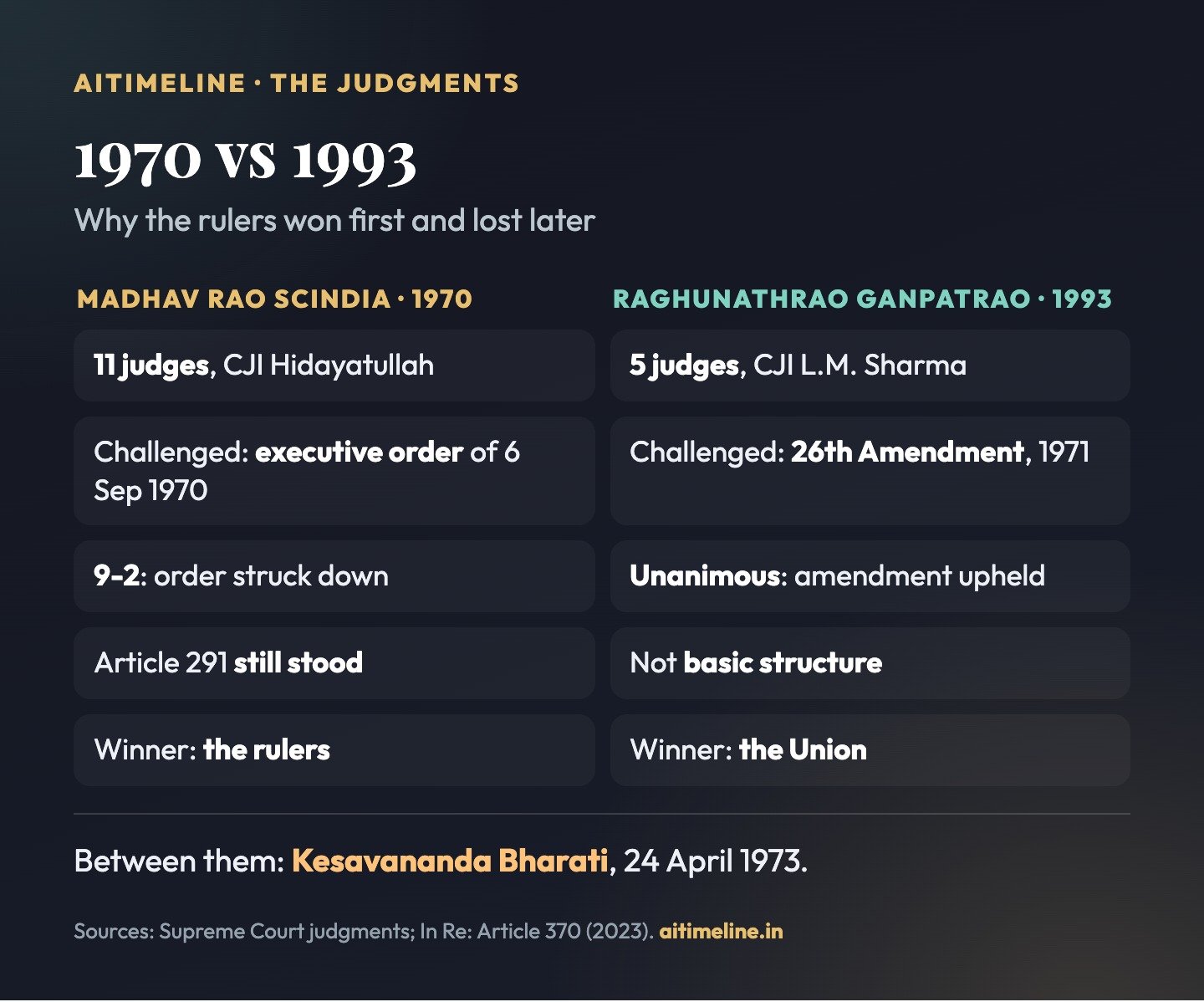
| Madhav Rao Scindia (1970) | Raghunathrao Ganpatrao (1993) | |
|---|---|---|
| Date | 15 December 1970 | 4 February 1993 |
| Bench | 11 judges, CJI M. Hidayatullah | 5 judges, CJI L.M. Sharma |
| What was challenged | President’s order of 6 Sep 1970 | Twenty-sixth Amendment, 1971 |
| Result | Order struck down, 9 to 2 | Amendment upheld, unanimously |
| Reason | Executive cannot override Article 291 | Not part of the basic structure |
| Who won | The rulers | The Union |
The two rulings fit together. In 1970 the Court enforced the Constitution as it stood; in 1993 it accepted that Parliament had validly changed it. Between them came Kesavananda Bharati (24 April 1973), which allowed any amendment that left the Constitution’s basic structure intact. The 1993 bench held that privy purses and rulers’ privileges were not part of that structure. Justice S. Mohan added that calling Articles 291 and 366(22) an ‘integral part’ of the Constitution in 1970 had not made them basic features.
The 1993 bench also rejected the rulers’ central claim, that the purses were a quid pro quo for surrendering sovereignty. It treated integration as a complex political process, driven as much by democratic movements inside the states as by bargaining with their rulers. On 11 December 2023, in the Article 370 judgment, the Supreme Court summed up the law: the guarantee came from the Constitution, not the agreements; the executive could not end it while Article 291 stood; and a constitutional amendment could.
Why Did India Abolish Privy Purses?
A promise made in 1947 against the idea of equal citizenship.
The Government vs the Former Rulers
- Hereditary rulership has no place in a democratic republic.
- Privileges unrelated to any public function are incompatible with an egalitarian social order.
- Public money should not fund an inherited status.
- Parliament can amend any part of the Constitution.
- The purses were the agreed price for surrendering their states.
- The Constitution itself guaranteed them.
- The executive cannot cancel a constitutional guarantee.
- Breaking a solemn promise damages the basic structure.
The courts separated the two halves of the argument. The rulers’ third point won in 1970: the executive could not cancel what the Constitution guaranteed. Their fourth lost in 1993: removing the guarantee by amendment did not damage the basic structure. The political case was settled at the ballot box in March 1971, when abolition was part of the programme on which Indira Gandhi won a two-thirds majority.
What Changed After Abolition?
The end of a constitutional status, not of families or their private property.
From 28 December 1971 no one in India was recognised by the Constitution as a Ruler, and no privy purse was payable. The privileges listed in the 1949 Ministry of States memorandum, 34 items in all, lost their constitutional backing with Article 362.
The amendment did not confiscate private property. What belonged to the state and what remained the ruler’s personal property had been settled in the merger agreements, and families kept palaces, estates, trusts and businesses as private owners, subject to ordinary law, including taxation and succession. Former royals continue to use their titles socially and ceremonially, and many entered politics as elected representatives, but the titles carry no legal status.
Key People
Sardar Vallabhbhai Patel
Deputy Prime Minister who led the integration of the princely states and defended the privy purse guarantees in the Constituent Assembly on 12 October 1949.
V.P. Menon
Secretary of the States Ministry who drafted and negotiated the accessions and mergers, and argued the purses were a low price for integration.
Jawaharlal Nehru
Appealed in 1953 to rulers with larger purses for voluntary contributions towards development; the guarantees stayed in place.
Indira Gandhi
Led the 1970 attempt and, after the March 1971 election, the Twenty-sixth Amendment, which she moved in the Rajya Sabha in December 1971.
V.V. Giri
Signed the derecognition order on the night of 5-6 September 1970 and gave assent to the Twenty-sixth Amendment on 28 December 1971.
Madhav Rao Scindia
Maharaja of Gwalior, recognised as Ruler in 1961, whose petition led to the 15 December 1970 ruling.
Raghunathrao Ganpatrao
Co-ruler of Kurundwad Junior, with a purse of Rs 49,720, whose challenge to the Twenty-sixth Amendment was decided in 1993.
J.C. Shah and S. Ratnavel Pandian
Authors of the main judgments: Shah for the 1970 majority, Pandian for the 1993 Constitution Bench.
Facts at a Glance
| Detail | Information |
|---|---|
| Subject | Privy purses in India |
| Origin | Integration of princely states, 1947-50 |
| Main negotiators | Sardar Vallabhbhai Patel and V.P. Menon |
| Constitutional guarantee | Articles 291, 362 and 366(22) |
| Approximate total | About Rs 5.8 crore a year (1993 judgment) |
| Congress resolution | 25 June 1967 |
| Failed amendment | Rajya Sabha, 5 September 1970 (149-75) |
| Derecognition order | 6 September 1970 |
| Order struck down | 15 December 1970 (9-2) |
| Abolition law | Constitution (Twenty-sixth Amendment) Act, 1971 |
| In force | 28 December 1971 |
| Key provision | Article 363A |
| Amendment upheld | 4 February 1993 |
Legacy: From Negotiated Monarchy to Republican Equality
The privy purse was the price of a peaceful merger: hundreds of states with their own armies and treasuries became part of one Union largely by agreement, and their rulers kept an income and a title. Two decades later the republic’s politics had changed, and Parliament removed the hereditary privileges by amending the Constitution.
The legal journey left two rules that still matter. The executive cannot bypass a guarantee that stands in the Constitution, as the Court held in 1970. Parliament can remove such a guarantee by a valid amendment, provided the basic structure is intact, as it held in 1993. The Supreme Court leaned on both in 2023.
Explore More Timelines
People Also Ask
Frequently Asked Questions
Based on the Supreme Court judgments of 1970, 1993 and 2023 and the text of the Twenty-sixth Amendment.
⚠️ Editorial Note: What We Checked
We checked the brief we started from against the Supreme Court’s judgments in Madhav Rao Jivaji Rao Scindia v. Union of India (15 December 1970), Raghunathrao Ganpatrao v. Union of India (4 February 1993) and In Re: Article 370 (11 December 2023), and the text of the Twenty-sixth Amendment. The total of privy purses is given as about Rs 5.8 crore a year (1993), not Rs 58 crore. The Nizam’s purse was Rs 50 lakh, not Rs 20 lakh. The White Paper on Indian States was first published on 5 July 1948. The 1972 challenges came from Kurundwad Junior and Malerkotla; Mysore’s petition was filed in 1992. We could not confirm from a primary record the date the 1971 bill was introduced, or a reported 10-15% figure for Nehru’s 1953-54 appeal, so neither is stated. The 1971 vote counts are as reported, not taken from the parliamentary debates. This article is a historical account and not legal advice.
Related Reading on AiTimeline
Sources & further reading
Every dated entry above was checked against these references. Last reviewed 20 November 2026.
- Supreme Court of India: H.H. Maharajadhiraja Madhav Rao Jiwaji Rao Scindia Bahadur v. Union of India, judgment of 15 December 1970 (Indian Kanoon)
- Supreme Court of India: Raghunathrao Ganpatrao v. Union of India, judgment of 4 February 1993 (Indian Kanoon)
- Supreme Court of India: In Re: Article 370 of the Constitution, judgment of 11 December 2023 (Indian Kanoon)
- The Constitution (Twenty-sixth Amendment) Act, 1971 (Indian Kanoon)
- Ministry of States: White Paper on Indian States, revised edition 1950 (Wikisource)
- Wikipedia: Privy purse in India