Gauri Lankesh Murder: Nine Years, 17 Accused and Still No Verdict
Follow the Gauri Lankesh murder timeline, from her 2017 assassination and Karnataka SIT probe to the chargesheet, bail orders and pending trial in 2026.
Latest Story
On the night of 5 September 2017 the journalist Gauri Lankesh was shot dead at the gate of her home in Bengaluru. Within a year a Karnataka Special Investigation Team had arrested the men it says planned and carried out the killing, and linked the gun to the murder of the scholar M.M. Kalburgi two years earlier. Nine years on, the Gauri Lankesh murder case is still on trial: 17 accused face charges of murder, conspiracy and organised crime, all of them are out on bail, and the case is before its eighth judge. This timeline sets out what the investigators allege, what the courts have decided so far, and what remains unproved.
💡 Short Answer
Gauri Lankesh was shot dead outside her Bengaluru home on 5 September 2017. A Karnataka SIT charged 18 people in 2018, alleging an organised conspiracy, and a forensic report tied the weapon to the 2015 Kalburgi murder. The trial began in July 2022. By November 2026 all 17 accused on trial were on bail, the case was before its eighth judge, and no verdict had been given.
Gauri Lankesh Murder Case: Key Questions
The Case in Ten Points
- 5 September 2017: Gauri Lankesh was shot dead at her gate in Rajarajeshwari Nagar, Bengaluru.
- 6 September 2017: Karnataka set up a Special Investigation Team.
- 2018: the SIT arrested the men it says planned and carried out the attack, starting with K.T. Naveen Kumar in March.
- June 2018: a forensic report said the same 7.65 mm pistol killed M.M. Kalburgi in 2015.
- 23 November 2018: a 9,235-page chargesheet named 18 accused and alleged an organised conspiracy.
- October 2021: the Supreme Court restored organised-crime charges against one accused; charges were framed against 17.
- 4 July 2022: the trial began.
- December 2023 to January 2025: every accused on trial was granted bail because of the delay.
- 2025 to 2026: hostile witnesses and three changes of judge slowed the trial further.
- November 2026: the case is before its eighth judge, with no verdict and guilt established for no one.
Timeline: From the Shooting to the Eighth Judge
Newest first. Colour shows which stage of the case each event belongs to.
Where things stand: no verdict Trial delays
The trial: The trial that began on 4 July 2022 was still under way, now before its eighth presiding judge. We found no report of a final judgment deciding whether the prosecution has proved murder and conspiracy against any accused.
The accused: All 17 accused facing trial were out on bail. An 18th person named by the SIT, Vikas Patil, was reported absconding and has not faced trial.
The eighth judge holds his first hearing Trial delays
The change: K.S. Bharath Kumar, the seventh judge, was elevated to the Karnataka High Court. Ravindra Hegde, a district judge and former High Court registrar, took charge on 5 October and held his first hearing in the case on 8 October to fix fresh dates.
The pace: The Wire, citing Indian Express reporting, said the trial had seen only seven hearings in the previous four months and that very few witnesses had been examined since June.
The seventh judge records the 216th witness Trial delays
The change: M. Chandrashekar Reddy, the sixth judge, moved to a senior administrative post in the Karnataka High Court. K.S. Bharath Kumar took charge of the principal sessions court on 1 June and resumed the trial on 10 June.
The evidence: His first act was to record the statement of a police constable, reported as the 216th of about 400 prosecution witnesses.
An accused wins a municipal election Trial delays
The result: Shrikant Pangarkar, who is out on bail and still on trial, won ward 13 in the first Jalna Municipal Corporation election with 2,661 votes, beating the BJP’s Raosaheb Dhoble by 184 votes.
His position: Pangarkar, a former Shiv Sena councillor, said the case against him was sub judice and the allegations unproven. In October 2024 he had briefly been given a Shiv Sena post that was put on hold after public criticism.
Trial resumes under a sixth judge Trial delays
The pause: Judge B. Muralidhara Pai was elevated to the Karnataka High Court on 30 September 2025, and the trial paused for about two months.
The new judge: The High Court named M. Chandrashekar Reddy, then a registrar in the Karnataka Lokayukta, as the new principal sessions judge, due to take charge on 5 November. Nearly 200 witnesses had been examined by then.
A witness on arms-training camps turns hostile Trial delays
The retraction: A 37-year-old witness who had told a magistrate in 2018 that he attended arms-training camps, and that Amol Kale invited him, denied those statements in court. The special public prosecutor declared him hostile.
The context: He was reported as the third hostile witness out of 183 examined to that point. In cross-examination he denied that pressure from the accused had made him change his account.
The last accused in custody gets bail Bail
The order: Sharad Kalaskar, in custody since September 2018, was granted bail on grounds of parity, since all 16 co-accused had already been released, and because the trial was unlikely to end soon.
The result: All 17 accused facing trial were now out on bail. The prosecution had opposed his release.
Sessions court bails eight more accused Bail
The order: The trial court granted bail to eight accused, including Amol Kale, Parashuram Waghmore, Ganesh Miskin and Manohar Edave, citing the long custody and the bail already given to co-accused.
The reaction: Waghmore and Edave were garlanded by Hindutva activists in Vijayapura on 11 October. Kavitha Lankesh called it shocking, and the state government said it would register a case against the organisers.
High Court bails four accused, including Pangarkar Bail
The order: The court granted bail to Shrikant Pangarkar, Bharat Kurane, Sujith Kumar and Sudhanva Gondhalekar, who had been in custody since 2018, noting that the trial was far from over.
The basis: The court relied on the length of detention and the Supreme Court’s August 2024 order on Mohan Nayak.
Supreme Court refuses to cancel Mohan Nayak’s bail Bail
The petitions: Kavitha Lankesh and the Karnataka government asked the court to cancel the bail the High Court had given Nayak in December 2023.
The order: The bench dismissed the pleas, noting that Nayak had cooperated and not sought adjournments, directed the trial court to proceed expeditiously, and allowed the state or the complainant to seek cancellation if he breached his conditions.
Mohan Nayak gets bail from the High Court Bail
The order: The High Court granted bail to Mohan Nayak, citing his long custody and the slow pace of the trial, in which only a fraction of the listed witnesses had been examined.
Why it mattered: Later bail orders for other accused relied on this order and the Supreme Court’s refusal to cancel it.
The trial begins Charges and trial
The start: The prosecution began examining witnesses almost five years after the murder. The case was to be heard daily.
The scale: The SIT had listed more than 500 witnesses. The prosecution later trimmed the list, and 2026 reports put it at about 400.
Charges framed against 17 accused Charges and trial
The charges: The court framed charges including murder, criminal conspiracy, offences under the Arms Act and the Karnataka Control of Organised Crimes Act. They were read out in Kannada and Marathi.
The plea: All the accused pleaded not guilty, and the case moved towards trial.
Supreme Court restores KCOCA charges against Mohan Nayak Charges and trial
The background: In April 2021 the Karnataka High Court quashed the organised-crime charges against Nayak. Kavitha Lankesh appealed.
The ruling: The Supreme Court set aside the High Court order and restored the KCOCA charges, saying the High Court had glossed over material in the chargesheet.
An absconding accused arrested in Jharkhand Charges and trial
The arrest: The SIT arrested Devdikar, named in the chargesheet as an alleged recruiter for the plot, who had been on the run since 2018.
What remained: Vikas Patil, another named accused, was still not traced.
A 9,235-page chargesheet names 18 accused Investigation
The allegation: The SIT alleged that the murder was planned and carried out by an organised network whose members it linked to right-wing Hindutva groups. The groups named have denied any role.
The wider claim: It said the network had prepared to target other writers and activists it saw as hostile to its ideology. These are allegations to be tested at trial.
Alleged motorcycle rider arrested Investigation
The arrests: The SIT arrested Ganesh Miskin, whom it accused of riding the motorcycle that took the shooter to Lankesh’s house, and Amit Baddi, accused of logistical support.
The count: This brought the number of people arrested in the case to about ten.
Alleged shooter arrested; forensic report links the Kalburgi gun Investigation
The arrest: The SIT arrested Waghmore and identified him as the man who fired at Lankesh. He denied the charge.
The forensic link: A state forensic laboratory report filed with the first chargesheet concluded that the bullets and cartridges in the Lankesh and Kalburgi murders were fired from the same 7.65 mm country-made pistol.
First chargesheet filed Investigation
The chargesheet: The SIT filed its first chargesheet against Naveen Kumar, alleging he was part of the conspiracy to kill Lankesh.
Still open: The SIT said at that point that the shooter had not yet been caught.
Arrests of the alleged coordinators Investigation
The arrests: The SIT arrested Amol Kale, Amit Degwekar and Manohar Edave. Investigators said diaries seized from Kale pointed to planning and reconnaissance of the attack.
The dispute: The accused and their lawyers disputed these claims. At this stage they were investigators’ allegations, not findings.
First arrest in the murder case Investigation
The arrest: Naveen Kumar, picked up in Bengaluru on 18 February with live cartridges, was formally arrested in the Lankesh case on 2 March.
Why it mattered: His questioning led investigators towards the people they later accused of planning the attack.
Early forensic analysis points to the Kalburgi gun The murder
The finding: Preliminary forensic analysis indicated that the 7.65 mm pistol used to kill Lankesh was the one used to kill scholar M.M. Kalburgi in Dharwad on 30 August 2015.
The limit: The formal laboratory report confirming the match came with the first chargesheet in 2018.
Special Investigation Team formed The murder
The order: The Karnataka government set up a Special Investigation Team the day after the killing.
The reaction: Protests were held in Bengaluru, Delhi and other cities, and the murder drew international criticism from press-freedom groups.
Gauri Lankesh shot dead at her gate The murder
The attack: Lankesh, 55, was shot as she reached her home after work. The gunman fired several rounds and escaped with an accomplice on a motorcycle.
The case: A murder case was registered at Rajarajeshwari Nagar police station on a complaint by her sister, Kavitha Lankesh.
Who Was Gauri Lankesh?
Gauri Lankesh was born in 1962, the daughter of the Kannada writer and editor P. Lankesh. She worked for English-language publications including The Times of India and Sunday magazine before returning to Bengaluru after her father’s death in 2000 to run his weekly, Lankesh Patrike. After a split with her brother she started her own edition, Gauri Lankesh Patrike, in 2005. Like her father’s paper, it carried no advertising.
Her writing attacked communalism, caste discrimination and Hindutva politics, and she backed Dalit and anti-caste movements. She also worked to bring Maoist insurgents back into the mainstream. She had critics and lawsuits, including a criminal defamation conviction in 2016 over a 2008 article, which she was appealing when she died. Her killing turned her into a national symbol of the dangers faced by outspoken journalists.
The SIT’s Case: What Investigators Allege
The prosecution’s theory, not a judicial finding.
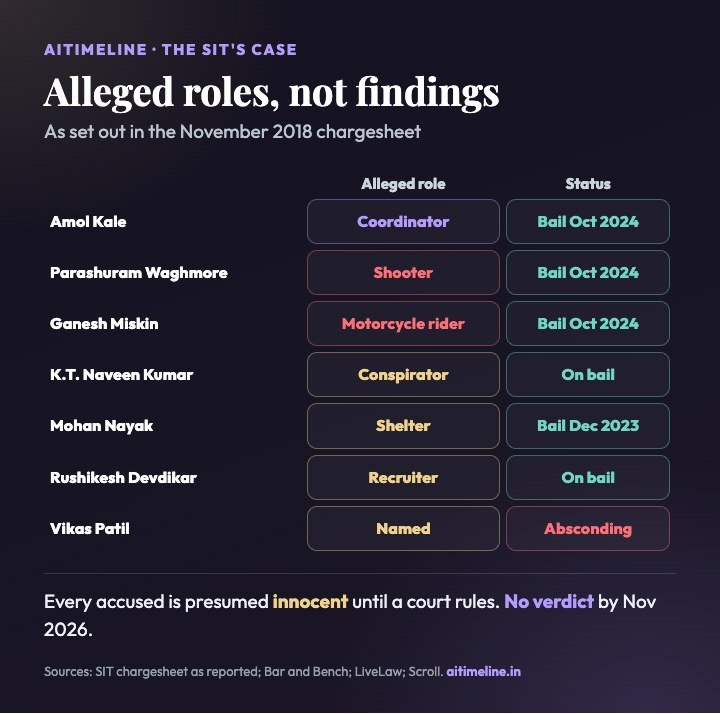
The SIT’s central claim is that the murder was not the act of a lone gunman but the work of a network that spent months planning it: recruiting and training members, scouting Lankesh’s house, arranging a weapon, a motorcycle and safe houses, and choosing the shooter. Investigators said diaries seized from Amol Kale pointed to that planning, and that the network had prepared to target other writers and activists it saw as hostile to its ideology. They linked its members to right-wing Hindutva groups, which have denied any role.
The accused deny the charges. Their lawyers have challenged the reliability of confessions, the diaries and witness statements, and several witnesses have retracted earlier accounts in court. Until the trial court rules, every person named below is entitled to the presumption of innocence.
| Accused | Role alleged by the SIT | Status, Nov 2026 |
|---|---|---|
| Amol Kale | Coordinated the plot | Arrested May 2018; bailed Oct 2024 |
| Parashuram Waghmore | Fired the shots | Arrested Jun 2018; bailed Oct 2024 |
| Ganesh Miskin | Rode the motorcycle | Arrested 22 Jul 2018; bailed Oct 2024 |
| K.T. Naveen Kumar | Part of the conspiracy | Arrested 2 Mar 2018; on bail |
| Mohan Nayak | Arranged shelter | Bailed 7 Dec 2023; upheld by Supreme Court |
| Shrikant Pangarkar | Part of the network | Bailed 4 Sep 2024; elected councillor Jan 2026 |
| Sharad Kalaskar | Part of the network | Last bailed, Jan 2025 |
| Rushikesh Devdikar | Recruiter | Arrested 9 Jan 2020; on bail |
| Vikas Patil | Named accused | Absconding; not on trial |
Why Were Four Killings Connected?
Dabholkar, Pansare, Kalburgi and Lankesh.
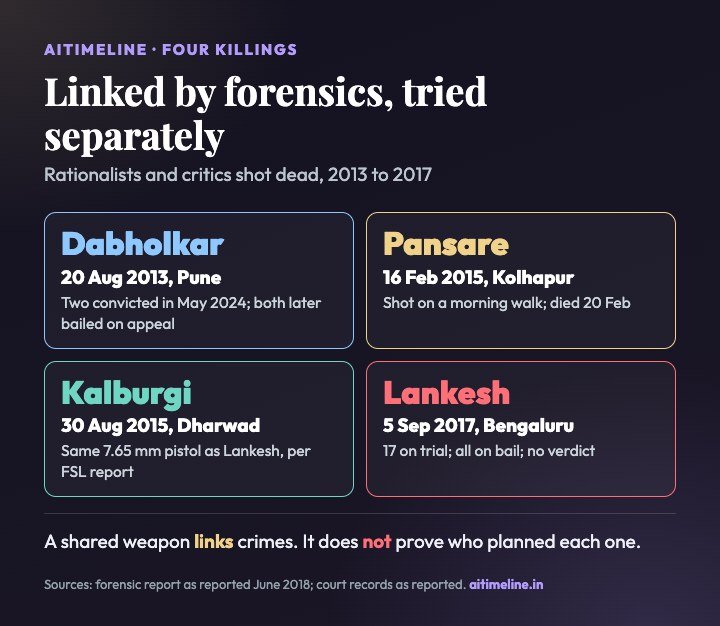
| Victim | Attacked | Place | Case status |
|---|---|---|---|
| Narendra Dabholkar | 20 Aug 2013 | Pune | Two convicted, May 2024 |
| Govind Pansare | 16 Feb 2015 | Kolhapur | No verdict found |
| M.M. Kalburgi | 30 Aug 2015 | Dharwad | No verdict found |
| Gauri Lankesh | 5 Sep 2017 | Bengaluru | Trial pending |
Within days of the murder, preliminary ballistic analysis suggested that the pistol used on Lankesh had been used two years earlier on Kalburgi. A state forensic laboratory report filed with the first chargesheet in 2018 confirmed it: the bullets and cartridges in both cases came from the same 7.65 mm country-made pistol. Investigators in Maharashtra and Karnataka also pointed to overlapping suspects between these cases and the Dabholkar and Pansare murders; Sharad Kalaskar, an accused in the Lankesh case, was convicted of Dabholkar’s murder in May 2024.
These links shaped the investigation, but they are not proof. A common weapon or a common suspect does not establish that the same people planned every killing. Each case must be proved separately on its own evidence, and of the four only the Dabholkar case has so far reached a verdict.
How Every Accused Came Out on Bail
Long custody, a slow trial and the rule of parity.
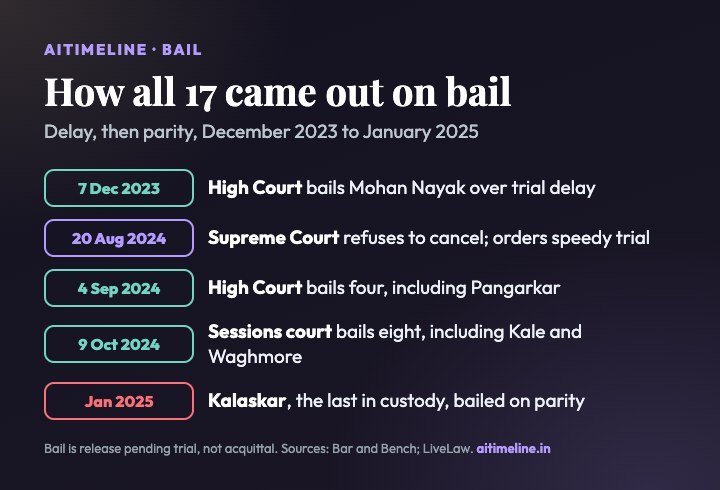
Most of the accused were arrested in 2018. By late 2023 they had spent five years in custody under an organised-crime law with stricter bail rules, while fewer than half of the prosecution’s witnesses had been heard. The High Court’s December 2023 order on Mohan Nayak, and the Supreme Court’s refusal to cancel it in August 2024, turned the delay itself into the main ground for release. Once some accused had bail, the others argued parity, and courts agreed. When Sharad Kalaskar was bailed in January 2025, no accused on trial remained in jail.
The bail orders say nothing about guilt. They reflect a constitutional principle that people cannot be held indefinitely without trial. The Supreme Court paired its August 2024 order with a direction to finish the trial quickly, a direction the record since then shows has not been met.
Eight Judges and a Slow Trial
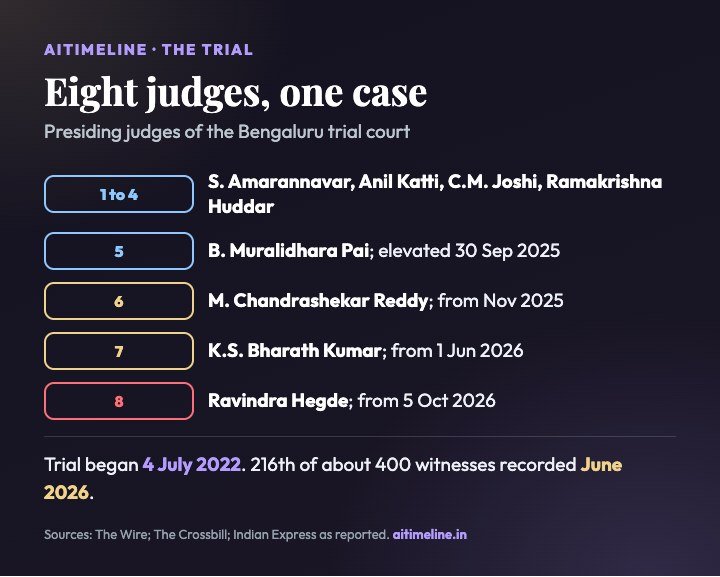
The case is heard by the Principal City Civil and Sessions Judge in Bengaluru, a post that has repeatedly been a stepping stone to the High Court. Five judges who handled the case were elevated, one moved to an administrative post, and each change brought a pause while the new judge took over a record running to thousands of pages. Reports in October 2026 said only seven hearings had been held in the previous four months.
The evidence has also proved fragile in places. At least three prosecution witnesses had turned hostile by May 2025, including a Belagavi man who had described attending arms-training camps, and police began perjury proceedings against one witness. A hostile witness weakens parts of a case without ending it: the court must still weigh all the evidence together.
Where the Case Stands
What has, and has not, been established as of 7 November 2026.
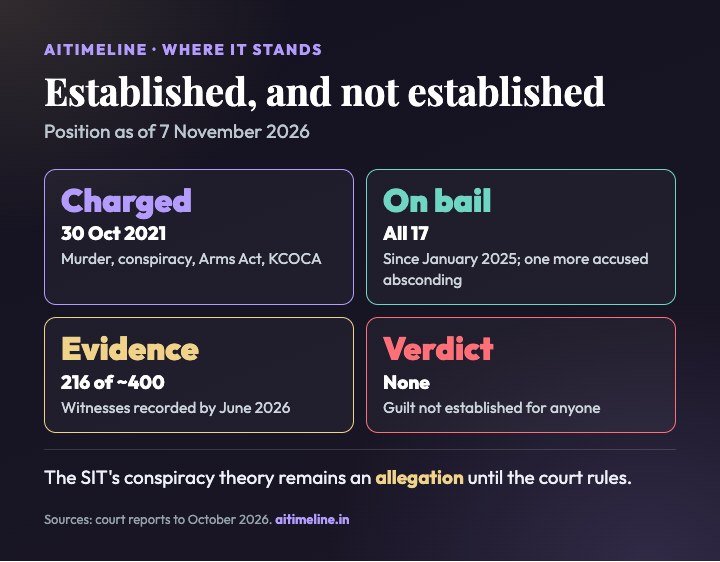
Established
- Lankesh was murdered outside her home on 5 September 2017.
- A forensic report links the weapon to the Kalburgi murder.
- Seventeen people face charges framed by the trial court.
- All of them are on bail; one more accused is absconding.
Not established
- Who fired the shots.
- Whether an organised network planned the killing.
- The role, if any, of each accused.
- Any link to other killings proved in court.
| Issue | Position as of 7 November 2026 |
|---|---|
| Investigation | Karnataka SIT, formed 6 September 2017 |
| Main chargesheet | 23 November 2018, 18 accused |
| Charges | Murder, conspiracy, Arms Act and KCOCA offences, framed 30 October 2021 |
| Accused on trial | 17, all on bail since January 2025 |
| Absconding | Vikas Patil |
| Witnesses | 216 of about 400 examined by June 2026 |
| Presiding judge | Ravindra Hegde, the eighth, since 5 October 2026 |
| Verdict | None reported |
Why the Case Still Matters
Safety of journalists
The killing became a symbol of the risks faced by reporters who challenge powerful political and ideological movements in India.
Room for critical speech
It renewed debate about how far a democracy protects people whose views provoke strong hostility.
Linked cases across states
Shared forensics and suspects showed the need for police in different states to work together when evidence crosses borders.
The cost of delay
Eight judges, hundreds of witnesses and years on bail show how long serious cases can take, for both victims’ families and the accused.
For Lankesh’s family and colleagues, the question at the heart of the case is still open: who was responsible for her death, and can the prosecution prove it? For the accused, the same delay means years under charges that have not been tested to the end. Only a verdict can settle either side’s claim.
Explore More Timelines
People Also Ask
Frequently Asked Questions
Dated facts from court orders and contemporary reporting, 2017 to 2026.
⚠️ Editorial Note
This account draws on reporting of court orders and proceedings by Bar and Bench, LiveLaw, The Wire, Scroll, Deccan Herald, The Statesman, The Crossbill and Madhyamam. It distinguishes the SIT’s allegations from findings of a court: bail orders are not acquittals, and no accused should be described as guilty unless a court establishes it. Checking the brief this page began from: the Supreme Court refused to cancel Mohan Nayak’s bail on 20 August 2024, not 21 August; the formal forensic report linking the Kalburgi weapon was reported in June 2018, after a preliminary finding reported in mid-September 2017; the seventh judge took charge on 1 June 2026 and first heard the case on 10 June; and the eighth judge took charge on 5 October 2026 and held his first hearing on 8 October. Status reflects published reports to 7 November 2026. This is not legal advice.
Related Reading on AiTimeline
Sources & further reading
Every dated entry above was checked against these references. Last reviewed 7 November 2026.
- Forensic report says same gun used to kill Gauri Lankesh and MM Kalburgi (June 2018)
- Two more arrested in Gauri Lankesh murder case: Ganesh Miskin and Amit Baddi (July 2018)
- Gauri Lankesh murder: Supreme Court restores KCOCA charges against accused Mohan Nayak (October 2021)
- Gauri Lankesh murder case: Charges framed against 17 accused (November 2021)
- Gauri Lankesh murder: Supreme Court upholds accused Mohan Nayak's bail (August 2024)
- Karnataka High Court grants bail to four accused in Gauri Lankesh murder case (September 2024)
- Gauri Lankesh murder: All accused out on bail after Bengaluru court grants bail to last one in custody (January 2025)
- Gauri Lankesh murder case: witness retracts earlier statements about arms training camps (May 2025)
- Gauri Lankesh murder trial to resume under sixth judge after two-month pause (November 2025)
- Maharashtra: Gauri Lankesh murder accused wins Jalna civic election (January 2026)
- Nearly nine years after Gauri Lankesh's murder, trial moves to seventh judge (June 2026)
- Nine years after 2017 murder of journalist Gauri Lankesh, trial moves to eighth judge (October 2026)