Kedar Nath Singh Case: Sedition Law Timeline in India
Explore the Kedar Nath Singh case, the 1962 Supreme Court ruling on sedition, Section 124A's repeal and the pending challenge to BNS Section 152.
Latest Story
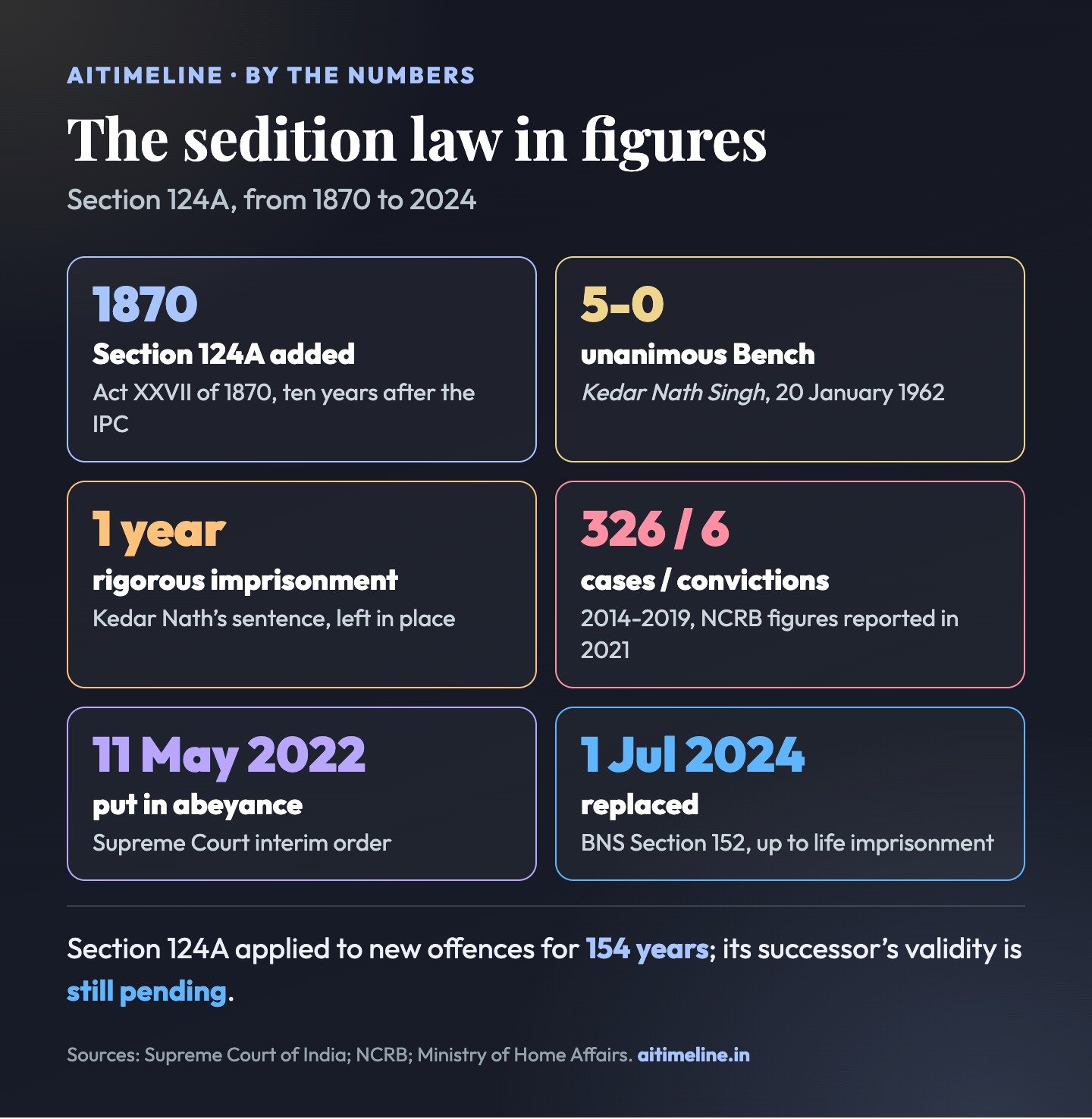
India’s sedition law was written by a colonial government in 1870 and used to jail Bal Gangadhar Tilak and Mahatma Gandhi. After Independence it survived because of one judgment. In Kedar Nath Singh v. State of Bihar, decided on 20 January 1962, a five-judge Supreme Court Bench upheld Section 124A of the Indian Penal Code but confined it to words or acts with an intention or tendency to cause public disorder or incite violence. Criticism of the government, however harsh, was not enough. This timeline follows the Kedar Nath Singh case from a 1953 speech in Bihar to the Constitution Bench, and the law it shaped from Macaulay’s 1837 draft to the 2022 freeze, the repeal of Section 124A in 2024 and the pending challenge to Section 152 of the Bharatiya Nyaya Sanhita. Dates and holdings are checked against the judgments and orders themselves.
Kedar Nath Singh lost. The Court upheld the law, dismissed his appeal and left his one-year sentence in place. He belonged to the Forward Communist Party, according to the judgment, not the CPI. The First Amendment (1951) added ‘public order’ to Article 19(2); ‘security of the State’ was there from the start. Allahabad’s ruling against Section 124A came on 16 May 1958, and the 1951 ruling came from the Punjab High Court; the Punjab and Haryana High Court did not exist until 1966. Parliament passed the revised BNS on 20 and 21 December 2023; it was introduced on 12 December.
💡 Short Answer
In Kedar Nath Singh v. State of Bihar (20 January 1962), a five-judge Supreme Court Bench led by Chief Justice B.P. Sinha upheld the sedition offence in Section 124A IPC but limited it to acts involving an intention or tendency to create disorder, disturb law and order or incite violence. Strong criticism of the government was held to be protected speech. The Court put Section 124A on hold on 11 May 2022, and the Bharatiya Nyaya Sanhita replaced it on 1 July 2024. Its Section 152, on acts endangering India’s sovereignty, unity and integrity, is now under constitutional challenge, with no final ruling as of November 2026.
The Kedar Nath Singh Case: Key Questions
Sedition Law in India in Ten Lines
- Colonial birth: Section 124A was added to the IPC in 1870 and rewritten in 1898.
- Famous targets: Tilak in 1897 and 1908; Gandhi in 1922, who called it the ‘prince’ of political sections.
- Dropped from the Constitution: ‘sedition’ was deleted from Article 19(2) in 1948.
- Public order added: the First Amendment of 1951 gave the State a new ground to defend the law.
- The speech: Kedar Nath called the ruling party ‘Congress goondas’ at Barauni in 1953.
- The judgment: on 20 January 1962 the Court upheld Section 124A, but only for incitement or a tendency to disorder.
- The irony: the narrowing saved the law, and Kedar Nath’s own conviction.
- The freeze: the Supreme Court put Section 124A in abeyance on 11 May 2022.
- The replacement: the BNS replaced the IPC on 1 July 2024; Section 152 took sedition’s place.
- Still open: neither Section 124A’s validity nor Section 152’s has been decided.
Two Tracks: The Law and the Courts
What legislatures wrote, and what judges made of it.
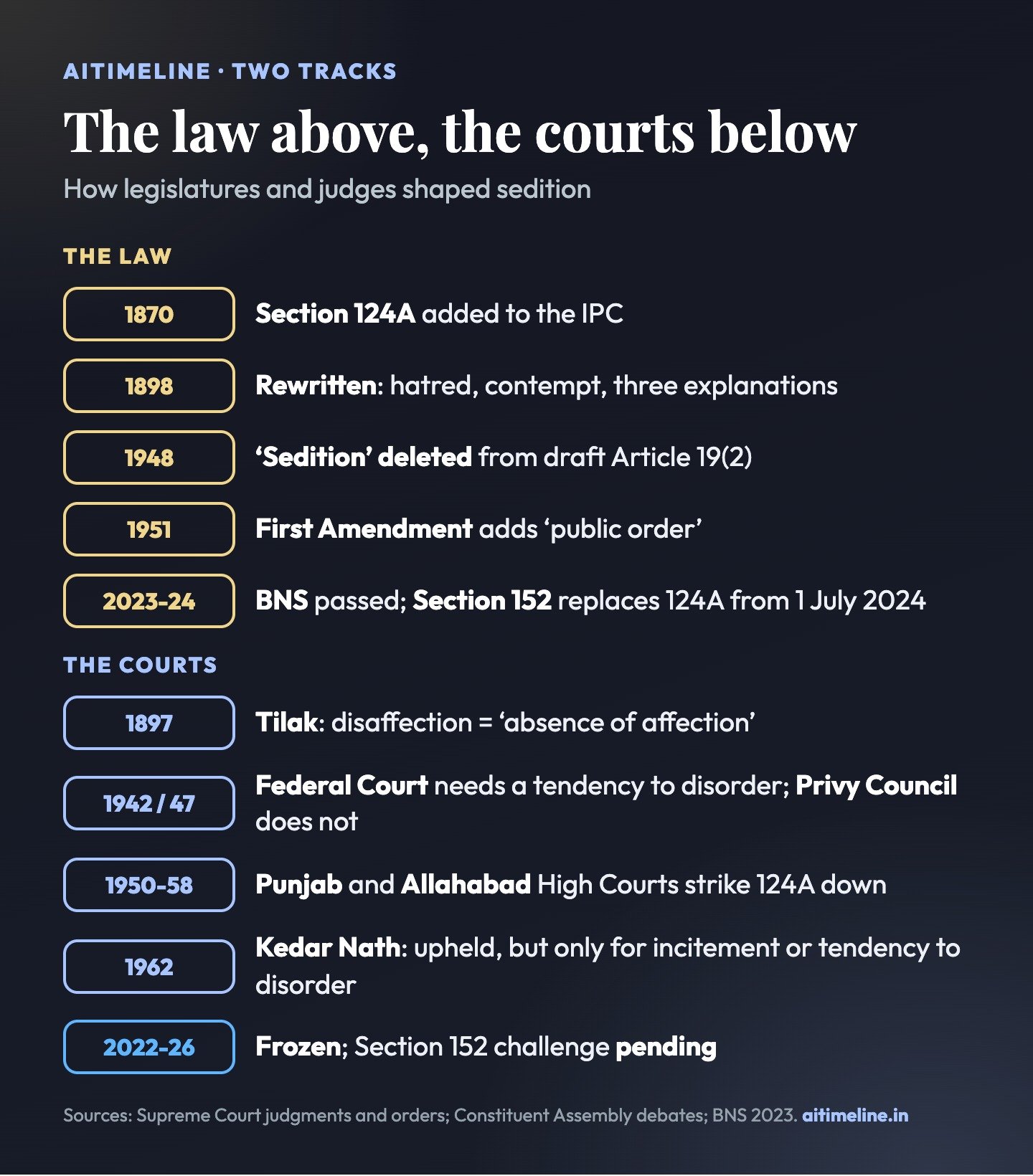
The history of sedition in India runs on two tracks. On one, legislatures kept the offence alive: the colonial government created it in 1870 and widened it in 1898; the Constituent Assembly dropped ‘sedition’ from the Constitution in 1948 but left Section 124A on the statute book; Parliament gave it a new constitutional footing with the First Amendment in 1951 and made it easier to use with the 1973 Criminal Procedure Code; and in 2023 it replaced it with Section 152 of the Bharatiya Nyaya Sanhita.
On the other track, courts argued over what the words meant. The colonial judges in Tilak’s 1897 trial said that disaffection meant the absence of affection. The Federal Court in 1942 said there had to be a tendency to public disorder, and the Privy Council in 1947 said there did not. Two High Courts struck the section down after Independence. Then, in 1962, the Supreme Court picked the Federal Court’s reading and used it to save the law. Since 2021 the courts have been back on centre stage, first freezing Section 124A and now examining its successor.
The Case: From Barauni to the Constitution Bench
A district-level speech that became the leading authority on free speech and sedition.
On 26 May 1953, Kedar Nath Singh addressed a meeting at Barauni, then in Bihar’s Monghyr district. According to the charge quoted in the judgment, he said ‘the dogs of the C.I.D.’ were in the audience, called the ruling party ‘Congress goondas’ who were ‘just like the Britishers’, and said the Forward Communist Party believed in a revolution in whose flames capitalists, zamindars and Congress leaders would be ‘reduced to ashes’.
A magistrate at Begusarai convicted him under Sections 124A and 505(b) and sentenced him to one year’s rigorous imprisonment. Justice Naqui Imam of the Patna High Court dismissed his appeal on 9 April 1956, calling the speech ‘full of incitements to revolution’. Only in his petition to the Supreme Court did Kedar Nath argue that the sections themselves violated Article 19(1)(a). A Division Bench sent the case to a Constitution Bench on 5 May 1959, and it was heard with three appeals by Uttar Pradesh against a 16 May 1958 Allahabad High Court ruling that had declared Section 124A void.
The judgment of 20 January 1962 answered the constitutional question in the State’s favour and then applied it to the facts. Because Kedar Nath’s lawyers had not argued that his speech fell outside sedition as now defined, his appeal was dismissed. The Uttar Pradesh appeals were allowed and sent back to the High Court to decide afresh.
The Kedar Nath Test
Where the Court drew the line in 1962.
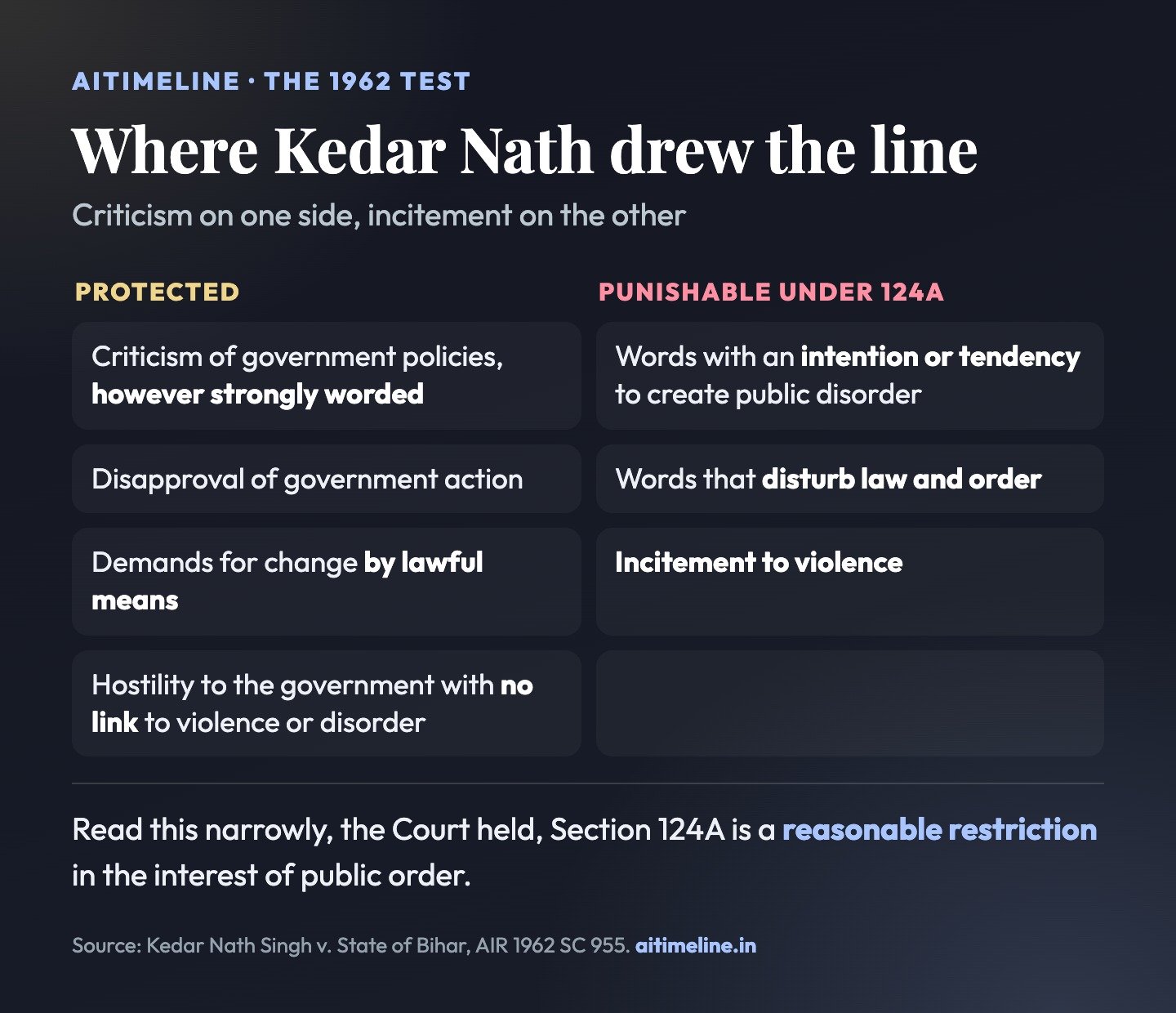
| Issue | Position under Kedar Nath |
|---|---|
| Criticism of government policies | Not sedition, however strongly worded |
| Demand for change by lawful means | Protected by the explanations to Section 124A |
| Disapproval of government action | Not an offence by itself |
| Incitement to violence | Can fall within Section 124A |
| Intention or tendency to create public disorder | Can fall within Section 124A |
| Hostility to the government with no link to violence or disorder | Not enough |
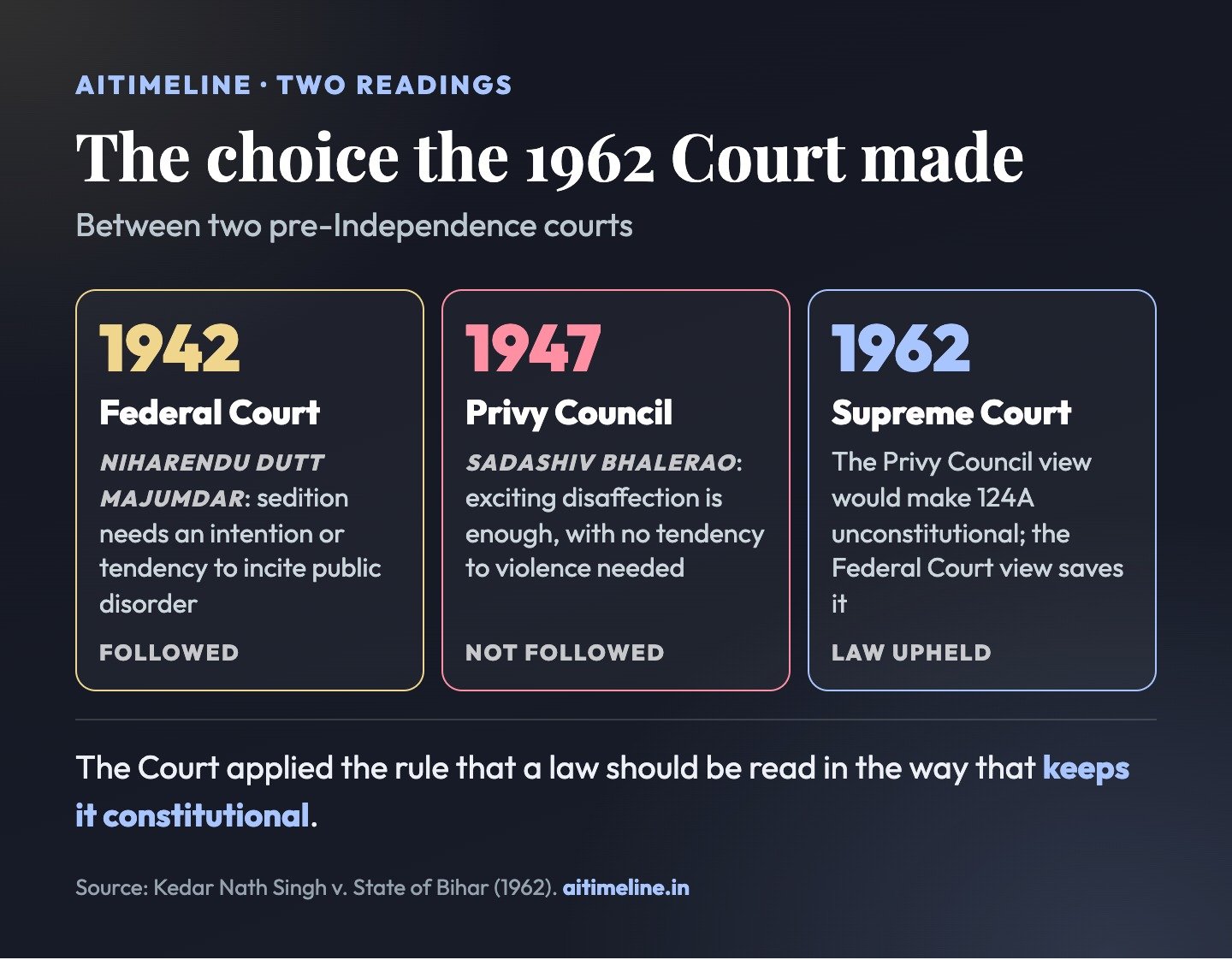
The Court reached this line by choosing between two readings it inherited. Chief Justice Sinha wrote that if Section 124A were read literally, as the Privy Council had read it, it would be unconstitutional; read as the Federal Court had read it in Niharendu Dutt Majumdar, it was a reasonable restriction in the interest of public order. Relying on the principle that courts should prefer the interpretation that saves a law, the Bench held that the section aimed ‘at rendering penal only such activities as would be intended, or have a tendency, to create disorder or disturbance of public peace by resort to violence’.
The judgment’s critics make two points. First, a ‘tendency’ to disorder is a loose standard, much wider than the ‘incitement’ test the Court later adopted for speech in Shreya Singhal (2015). Second, because the narrowing lived in a judgment rather than the text, police could still register cases on the section’s wide words and leave courts to apply Kedar Nath later. Its defenders reply that without it Section 124A would have been far broader for six decades.
Sedition Law Timeline, 1837 to 2026
Newest first. Each entry is tagged by type.
Both constitutional questions are still open New law
Where things stand: As of 20 November 2026 the Supreme Court has not decided whether Section 124A was unconstitutional, and it has not ruled on the validity of Section 152 of the Bharatiya Nyaya Sanhita. The 2023 reference of the old law to a larger Bench is still waiting for that Bench to be constituted, and the Section 152 petitions are tagged with it.
What that means in practice: Old sedition cases registered before 1 July 2024 stay frozen unless the accused asks for them to proceed. New conduct is prosecuted, if at all, under Section 152, which is fully in force and has not been stayed.
Supreme Court lets frozen sedition cases move if the accused agrees Courts
What happened: The Court clarified that its May 2022 order did not stop trials, appeals and other proceedings involving Section 124A from continuing where the accused has no objection. The petitioner had reportedly been in custody for about 17 years; he was sentenced to life in 2017 under Sections 122, 124A and 153A of the IPC, the UAPA and the Arms Act, and his appeal was stuck in the Madhya Pradesh High Court.
Why it mattered: The 2022 freeze was meant to protect the accused, but it also left people like the petitioner unable to get their appeals heard. The clarification gave them a way out. It did not decide whether Section 124A is valid.
Court says the Centre’s 2022 promise cannot bind Parliament Courts
What happened: Petitioners argued that the Union had told the Court in 2022 it would reconsider sedition and then re-enacted it as Section 152. The Bench observed that an undertaking given by the government in court could not bind Parliament’s legislative choices, while adding that the Court could still examine the new provision on judicial review.
What it was not: These were observations during a hearing. The Bench did not rule on whether Section 152 is constitutional, and the matter was listed for further hearing.
Supreme Court issues notice on the challenge to Section 152 Courts
What happened: Retired Major General S.G. Vombatkere, one of the petitioners who had challenged Section 124A, filed a fresh petition arguing that Section 152 is ‘repackaged sedition’ that violates Articles 14, 19(1)(a) and 21. The Court issued notice to the Centre and tagged the case with the pending challenge to the old law.
Related cases: In the following weeks the Court issued notice on similar challenges, including one by The Wire and its founding editor Siddharth Varadarajan, who were given interim protection from coercive action over an Assam Police FIR under Section 152, and one by journalist Abhisar Sharma, whose FIR challenge it sent to the High Court.
The Bharatiya Nyaya Sanhita comes into force; Section 124A is gone New law
What changed: The IPC, including Section 124A, stopped applying to offences committed from this date. The word ‘sedition’ does not appear in the BNS. Section 152 instead punishes anyone who ‘purposely or knowingly’, by words, signs, visible representation, electronic communication, financial means or otherwise, excites or attempts to excite secession, armed rebellion or subversive activities, encourages feelings of separatist activities, or endangers India’s sovereignty, unity and integrity.
Punishment: Imprisonment for life, or up to seven years, and a fine. Under Section 124A the alternatives were life, up to three years, or a fine alone. An explanation protects comments disapproving of government measures with a view to changing them by lawful means.
Commencement date notified New law
What happened: The Home Ministry notified 1 July 2024 as the date on which the BNS would take effect, except Section 106(2) on hit-and-run cases, which was held back after protests by truck drivers.
Why it matters: From that date Section 124A could no longer be used for fresh offences. Cases already registered under it continued under the old law.
Parliament passes the revised Bharatiya Nyaya Sanhita New law
What happened: The government withdrew the August Bill and introduced a revised version on 12 December 2023, incorporating changes suggested by a parliamentary standing committee. The Lok Sabha passed it on 20 December and the Rajya Sabha on 21 December. President Droupadi Murmu gave assent on 25 December 2023.
Correction: The revised Bill was introduced, not passed, on 12 December. It was passed during a session in which a large number of opposition MPs had been suspended.
Challenge to Section 124A referred to a larger Bench Courts
What happened: A three-judge Bench could not overrule a five-judge Constitution Bench, so it referred the challenge to a larger Bench. It refused the Union’s request to wait for the new criminal laws, reasoning that any new law would apply only prospectively and that prosecutions already brought under Section 124A would still have to be judged by its validity.
What is pending: According to Supreme Court Observer, the reference awaits a seven-judge Bench that has yet to be constituted.
Bharatiya Nyaya Sanhita Bill introduced New law
What happened: Amit Shah introduced three Bills to replace the IPC, the CrPC and the Evidence Act, and told the Lok Sabha that the offence of sedition was being repealed. The Bill dropped Section 124A but included a new clause on acts endangering the sovereignty, unity and integrity of India.
Reaction: Critics said the new clause was wider than the old one because it covered acts against the country, not just the government, and used undefined terms. The government said it targeted threats to the nation, not criticism of those in power.
Law Commission recommends keeping sedition, with changes Constitution and Parliament
What it said: The Commission advised the government to retain Section 124A, writing Kedar Nath’s test of a ‘tendency to incite violence or cause public disorder’ into the text and adding a procedural safeguard of a preliminary inquiry before an FIR. It also proposed raising the alternative jail term from three years to seven.
What happened next: The government did not adopt the recommendation in that form. Two months later it introduced a Bill that dropped Section 124A altogether.
Supreme Court puts Section 124A in abeyance Courts
What the order said: The Court expected the Centre and the States to refrain from registering FIRs, continuing investigations or taking coercive steps under Section 124A while it was being re-examined. Pending trials, appeals and proceedings on the sedition charge were to be kept in abeyance, though other charges could proceed if the accused would not be prejudiced. Anyone newly booked could approach the courts for relief.
What it was not: It was an interim order, not a ruling that Section 124A was unconstitutional. The Court said it was trying to balance the security of the State and civil liberties while the government reconsidered the law.
Centre tells the Court it will re-examine sedition Constitution and Parliament
What happened: On 7 May 2022 the government’s written submissions had defended Section 124A and argued that Kedar Nath was good law. On 9 May it filed an affidavit saying the Prime Minister wanted colonial-era laws reviewed and that it had decided to re-examine and reconsider the provision, and asked the Court not to hear the challenge in the meantime.
Why it mattered: The Court did not simply adjourn. Two days later it froze the law’s use until the review was done.
Supreme Court issues notice on the challenge to Section 124A Courts
What happened: Issuing notice, Chief Justice Ramana asked the Attorney General why a colonial law used against Mahatma Gandhi and Bal Gangadhar Tilak was still needed 75 years after Independence, and compared its misuse to a carpenter given a saw who cuts down the whole forest.
The argument: The petitioners said the words ‘disaffection’, ‘hatred’ and ‘contempt’ are vague, that Kedar Nath’s narrowing had not stopped misuse, and that the law chills legitimate criticism.
Supreme Court quashes sedition FIR against Vinod Dua Courts
What happened: A Himachal Pradesh FIR accused the journalist of sedition over a YouTube show criticising the government’s handling of the 2020 Covid lockdown. Applying Kedar Nath, the Court held that his statements were criticism of government action, not incitement to violence or public disorder, and quashed the case.
Why it matters: It is one of the clearest recent applications of the 1962 test, and a reminder that the judgment’s protection depended on courts applying it after an FIR had already been filed.
Court tells authorities to follow Kedar Nath Courts
What happened: Hearing a plea about misuse of the sedition law, the Court said authorities must follow the principles laid down in Kedar Nath when invoking Section 124A, and that it saw no need for fresh guidelines.
Why it matters: Petitioners later pointed to this order as proof that repeating the 1962 test had not been enough to stop arrests for speech.
JNU students arrested on sedition charges Prosecutions
What happened: After an event on campus on 9 February 2016 at which slogans were allegedly raised, Delhi Police arrested JNU Students’ Union president Kanhaiya Kumar under Section 124A; Umar Khalid and Anirban Bhattacharya surrendered later that month. Kumar got interim bail in March.
What followed: The police filed a charge sheet in January 2019, and the Delhi government granted sanction to prosecute in February 2020. The case became the most prominent national test of where slogans end and sedition begins.
Shreya Singhal strikes down Section 66A of the IT Act Courts
What happened: The Court struck down the online-speech offence in Section 66A as vague and overbroad. It distinguished three levels of speech: discussion and advocacy, however unpopular, are protected; only incitement can be restricted on grounds such as public order.
Link to sedition: The case did not decide the validity of Section 124A, but its discussion, advocacy and incitement distinction is cited in almost every argument that the sedition law and Section 152 are too broad.
New criminal procedure code makes sedition cognisable Constitution and Parliament
What changed: Under the 1898 Code, sedition was non-cognisable, so police needed a magistrate’s permission to investigate. The 1973 Code made it cognisable, allowing arrest without a warrant, while Section 196 required the sanction of the Central or State government before a court could take cognisance.
Why it matters: Arrests could now come first and sanction later. Critics have long pointed to this change, made under Indira Gandhi’s government, as a reason the law’s use grew despite Kedar Nath.
Kedar Nath Singh v. State of Bihar: sedition upheld, but narrowed Courts
The holding: Writing for a unanimous Bench, Chief Justice Sinha held that Section 124A was valid but must be confined to acts ‘involving intention or tendency to create disorder, or disturbance of law and order, or incitement to violence’. Criticism of public measures or comment on government action, ‘however strongly worded’, was protected. Read that way, the section was a reasonable restriction in the interest of public order under Article 19(2). Section 505 was upheld too.
The outcome for Kedar Nath: His own appeal was dismissed and his conviction stood. His counsel had not argued that his speech fell outside sedition as the Court now defined it. The connected Uttar Pradesh appeals were sent back to the Allahabad High Court to decide in the light of the new interpretation.
The appeal reaches a Constitution Bench Courts
What happened: Kedar Nath had not challenged the law’s validity in the High Court, but raised it in his petition to the Supreme Court. A Division Bench sent the case to a Constitution Bench on 5 May 1959. On 4 November 1960 that Bench issued notice to the Attorney General, and on 9 February 1961 it adjourned the case for States to decide their positions.
Connected cases: It was heard with three appeals by Uttar Pradesh against the Allahabad High Court’s ruling, one involving Mohd Ishaq Ilmi, prosecuted for a speech at Aligarh on 30 October 1953.
Allahabad High Court strikes down Section 124A Courts
What happened: A Full Bench held that Section 124A violated Article 19(1)(a) because it was not confined to the interest of public order and its restrictions were not reasonable. It acquitted the accused in the connected cases.
Correction: The judgment was delivered on 16 May 1958. It is often dated 1959 because that is the year of the law report.
Patna High Court upholds Kedar Nath’s conviction Courts
What happened: The High Court dismissed the appeal. It said the speech was ‘nothing but a vilification of the Government’, ‘full of incitements to revolution’ and, taken as a whole, ‘certainly seditious’.
Next step: Kedar Nath obtained special leave to appeal to the Supreme Court, where he raised the constitutional challenge for the first time.
Kedar Nath Singh’s speech at Barauni Prosecutions
What he said: Speaking for the Forward Communist Party, Kedar Nath said ‘the dogs of the C.I.D.’ were loitering around the meeting, called the ruling party ‘Congress goondas’ who were ‘just like the Britishers’, and said his party believed in a revolution in whose flames capitalists, zamindars and Congress leaders would be reduced to ashes.
The charge: He was prosecuted before a first-class magistrate at Begusarai under Section 124A and Section 505(b), convicted on both and sentenced to one year’s rigorous imprisonment.
First Amendment rewrites Article 19(2) Constitution and Parliament
What changed: Parliament added ‘public order’, ‘friendly relations with foreign States’ and ‘incitement to an offence’ as grounds for restricting speech, and required restrictions to be ‘reasonable’. ‘Security of the State’ was already in the original text.
Nehru on sedition: During the debate Prime Minister Jawaharlal Nehru said that Section 124A was ‘highly objectionable and obnoxious’ and that ‘the sooner we get rid of it the better’. His government did not repeal it.
Punjab High Court holds Section 124A void Courts
What happened: The Punjab High Court held that Section 124A was an unreasonable restriction on free speech under the Constitution as it then stood and was therefore void.
Why it matters: It was the first High Court ruling to strike down the sedition law after Independence, and helped prompt the First Amendment.
Romesh Thapar and Brij Bhushan Courts
What happened: In two rulings on the same day, the Court struck down orders against a left-wing journal in Madras and pre-censorship of an RSS weekly in Delhi. Under the original Article 19(2), speech could be restricted only to protect the ‘security of the State’, and the Court held that ordinary public-order concerns did not qualify.
Why it matters: The rulings suggested that a law penalising speech merely because it disturbed public order could not survive, and the government responded with the First Amendment a year later.
Constitution comes into force without ‘sedition’ as a ground Constitution and Parliament
What happened: The draft Constitution had listed sedition among the grounds on which speech could be restricted. In the Constituent Assembly on 1 December 1948, K.M. Munshi moved to delete it, arguing that criticism of government is the essence of democracy. The word was dropped from the final text.
Why it matters: Section 124A survived as existing law under Article 13, but its validity now depended on whether it fitted one of the grounds that remained.
Federal Court and Privy Council split on what sedition means Courts
Two readings: In 1942 the Federal Court, led by Chief Justice Maurice Gwyer, held that words were seditious only if they were intended, or tended, to incite disorder. In 1947 the Privy Council rejected that view and held that exciting disaffection was enough, with no need for any tendency to violence.
Why it matters: Fifteen years later, the Supreme Court said the Privy Council’s reading would make Section 124A unconstitutional and the Federal Court’s would save it. It chose the Federal Court’s.
Mahatma Gandhi’s ‘Great Trial’ Colonial era
What happened: Gandhi and the publisher Shankarlal Banker were tried under Section 124A over three articles in Young India. Gandhi pleaded guilty and asked for the severest penalty, calling Section 124A ‘the prince among the political sections of the Indian Penal Code designed to suppress the liberty of the citizen’. He was sentenced to six years’ simple imprisonment.
Afterwards: He was released in February 1924 on health grounds after about two years.
Tilak sentenced to six years’ transportation Colonial era
What happened: Tilak was convicted of sedition over Kesari articles on the Muzaffarpur bombing and sentenced to six years’ transportation. He served it in Mandalay, in Burma, where he wrote Gita Rahasya.
Why it matters: It was the best-known use of the law against the nationalist press. His defence counsel in the 1916 sedition case brought against him later was Muhammad Ali Jinnah.
Section 124A amended Colonial era
What changed: The amendment extended the offence to bringing the government into ‘hatred or contempt’, defined disaffection to include ‘disloyalty and all feelings of enmity’, and replaced the single explanation with three. Two of them protected comments disapproving of government measures or actions with a view to changing them by lawful means.
Why it matters: These explanations are the textual hook Kedar Nath used in 1962, and the explanation to Section 152 of the BNS repeats the same idea.
Tilak’s first sedition trial Colonial era
What happened: Tilak was prosecuted over Kesari pieces published after the murder of plague commissioner W.C. Rand in Pune. Justice Strachey directed the jury that disaffection meant ‘the absence of affection’ and that it did not matter whether any disturbance followed. Tilak was sentenced to 18 months’ rigorous imprisonment.
Why it matters: Strachey’s reading, that hostile feeling alone was enough, was the wide view the Privy Council later endorsed and Kedar Nath rejected.
Section 124A enters the Indian Penal Code Colonial era
What happened: Ten years after the IPC was enacted, the colonial government inserted Section 124A, ‘Exciting disaffection’, punishing anyone who excited or attempted to excite feelings of disaffection to the government established by law, with transportation for life or up to three years’ imprisonment.
The context: It came amid fears of Wahabi activity in British India. The 1962 judgment notes that the clause had been left out of the 1860 Code for reasons that are not clear.
Sedition appears in Macaulay’s draft Penal Code Colonial era
What happened: Macaulay’s draft code included a clause on exciting disaffection to the government. When the Indian Penal Code was finally enacted in 1860, the clause was missing.
Why it matters: Its omission and later return in 1870 are why the 1962 Court treated the history of the provision as key to reading it.
Colonial Origins: 1837 to 1947
A law written to protect the Raj from Indian opinion.
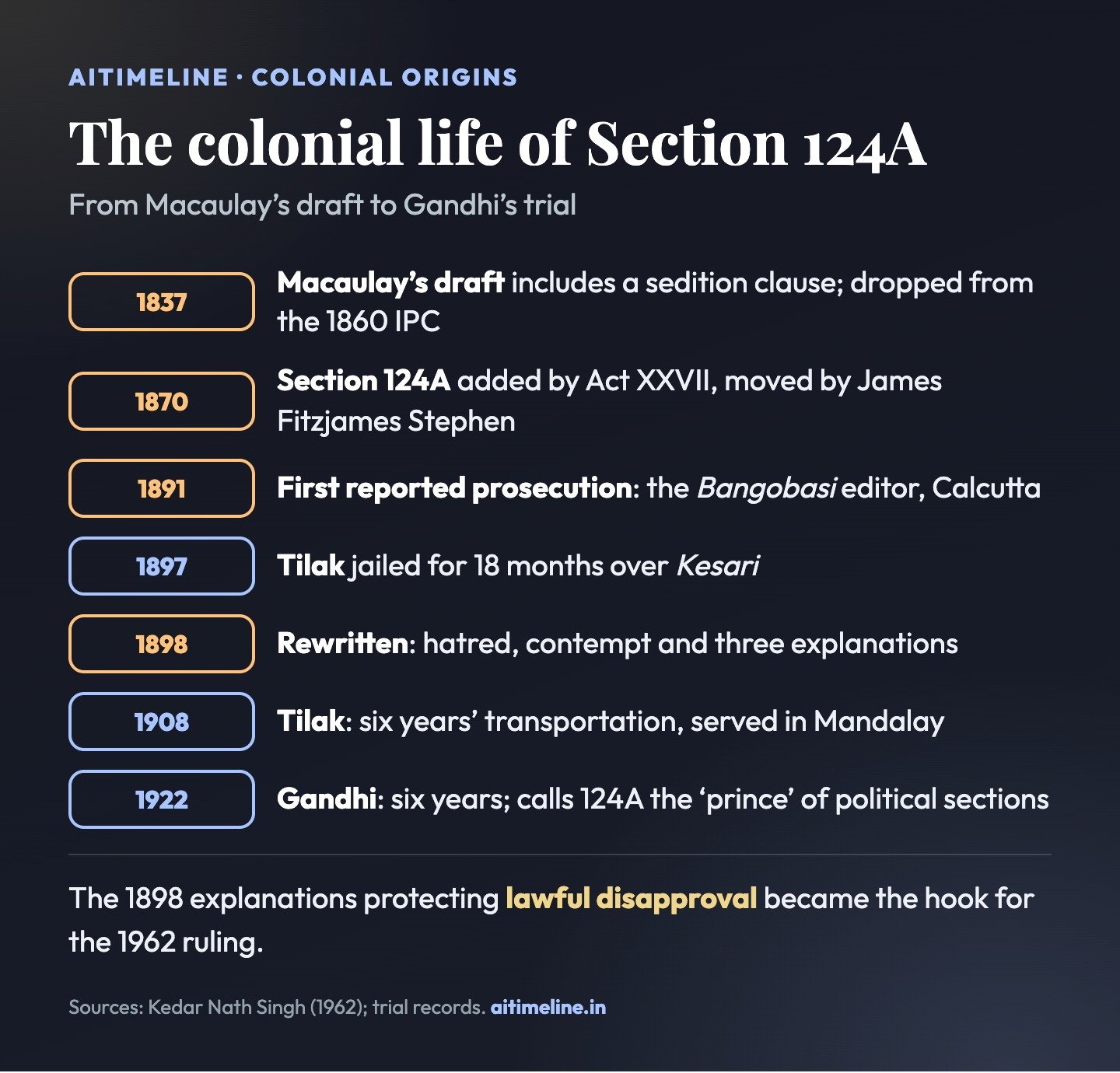
A sedition clause appeared in Thomas Babington Macaulay’s draft Penal Code of 1837 but was missing from the Code enacted in 1860. It was inserted ten years later, as Section 124A, by Act XXVII of 1870, introduced by Sir James Fitzjames Stephen. The Indian Penal Code (Amendment) Act of 1898 added ‘hatred or contempt’ to the offence and the three explanations that distinguished disaffection from lawful disapproval.
The section was used against the nationalist press almost from the start. Bal Gangadhar Tilak was jailed for 18 months in 1897 after Justice Arthur Strachey told the jury that disaffection meant ‘the absence of affection’, and was sentenced to six years’ transportation in 1908, which he served in Mandalay. Mahatma Gandhi, tried in Ahmedabad on 18 March 1922 for articles in Young India, pleaded guilty, called Section 124A ‘the prince among the political sections of the Indian Penal Code designed to suppress the liberty of the citizen’, and was sentenced to six years.
Sedition Meets the Constitution: 1948 to 1958
A word dropped, a ground added and two High Courts in revolt.
The Constituent Assembly deliberately left sedition out. On 1 December 1948, K.M. Munshi moved to delete it from the grounds for restricting speech, and Article 19(2) as adopted in 1950 allowed restrictions only for libel, slander, defamation, contempt of court, decency or morality, and matters undermining the security of, or tending to overthrow, the State. In Romesh Thapar and Brij Bhushan on 26 May 1950, the Supreme Court read that narrowly, and the Punjab High Court then held Section 124A void.
The First Amendment of 18 June 1951 changed the terms of the argument by adding ‘public order’, ‘friendly relations with foreign States’ and ‘incitement to an offence’. Nehru called Section 124A ‘highly objectionable and obnoxious’ during the debate but did not repeal it. Even with the new ground, the Allahabad High Court’s Full Bench struck Section 124A down on 16 May 1958, holding that it was not confined to the interest of public order. That set up the confrontation the Supreme Court resolved in 1962.
The Freeze and the Replacement: 2021 to 2026
From a Chief Justice’s question to a new law under challenge.
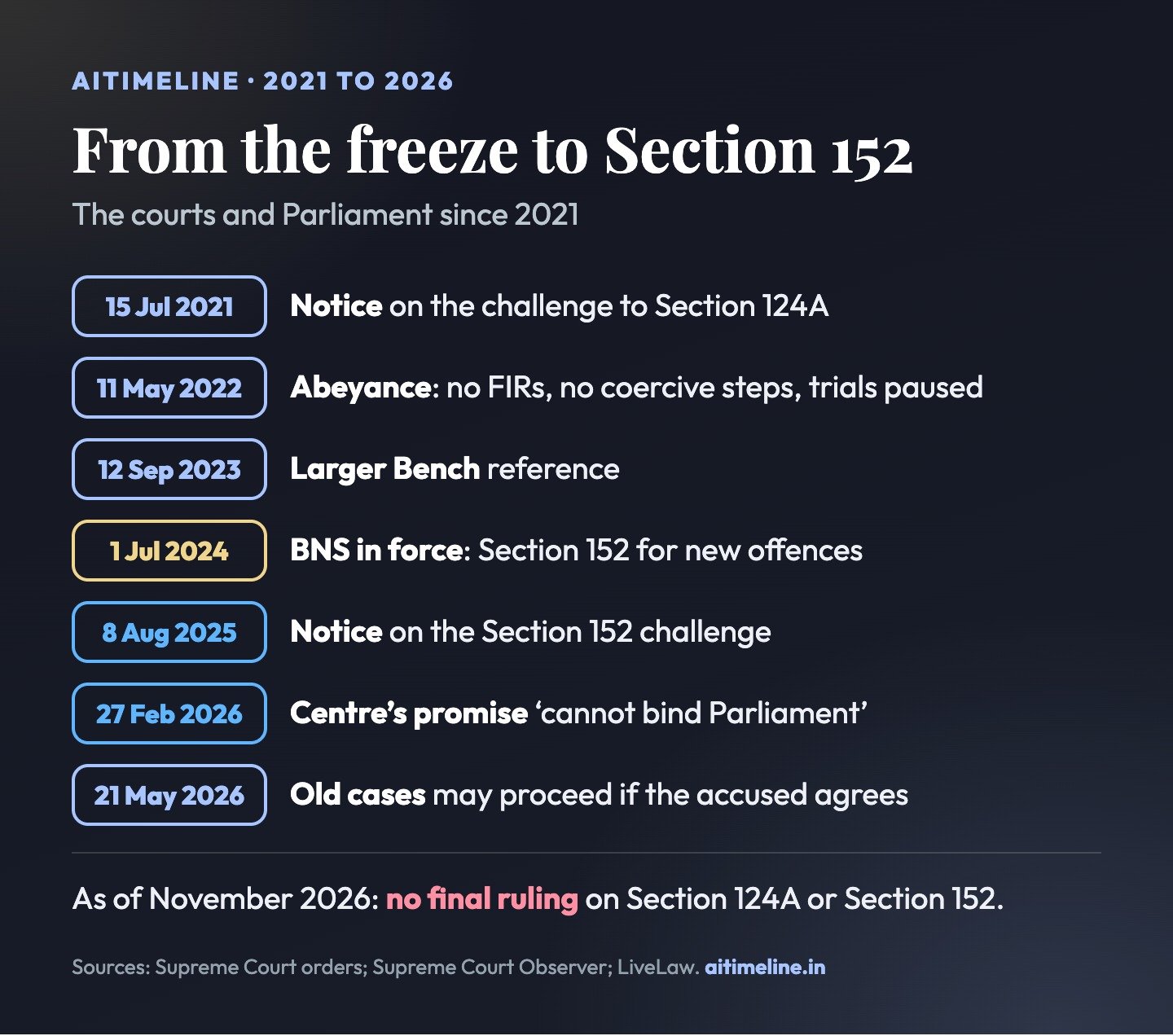
The challenge that ended Section 124A’s active life began in 2021. Issuing notice on 15 July 2021, Chief Justice N.V. Ramana asked why a law used against Gandhi and Tilak was still needed. The Centre at first defended Kedar Nath, then on 9 May 2022 told the Court it would re-examine the provision. Two days later, on 11 May 2022, the Court asked governments not to register FIRs or take coercive steps under Section 124A and put pending sedition proceedings in abeyance. On 12 September 2023 a Bench led by Chief Justice D.Y. Chandrachud referred the challenge to a larger Bench.
Parliament then replaced the IPC. The Bharatiya Nyaya Sanhita, introduced in August 2023 and passed in its revised form on 20 and 21 December 2023, came into force on 1 July 2024 without Section 124A. Its Section 152 was challenged almost at once. The Court issued notice on 8 August 2025, and on 27 February 2026 a Bench led by Chief Justice Surya Kant said the Centre’s 2022 promise to reconsider sedition could not bind Parliament, while keeping judicial review open. On 21 May 2026 the Court clarified that old sedition cases could proceed if the accused did not object. As of 20 November 2026 neither constitutional question had been decided.
Section 124A and Section 152: What Changed?
Not textually identical, and Section 152’s validity is still pending.
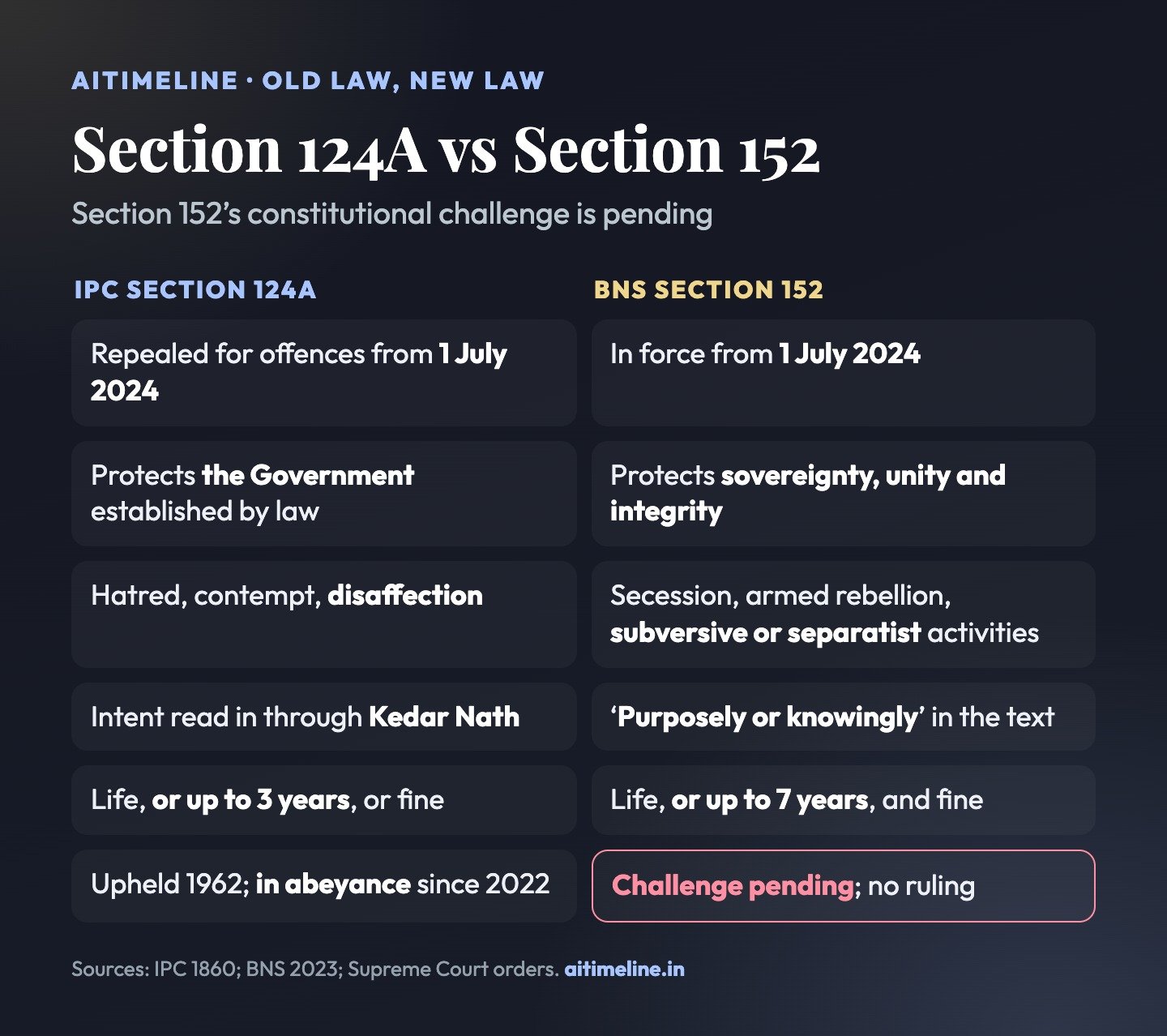
| Feature | Former IPC Section 124A | BNS Section 152 |
|---|---|---|
| Legal status | Repealed for offences from 1 July 2024; old cases continue | In force from 1 July 2024 |
| What it protects | The Government established by law | The sovereignty, unity and integrity of India |
| Core conduct | Bringing into hatred or contempt, or exciting disaffection | Exciting secession, armed rebellion or subversive activities; encouraging separatist feelings; endangering sovereignty, unity and integrity |
| Mental element | Not in the text; read in through Kedar Nath | ‘Purposely or knowingly’ |
| Means covered | Words, signs, visible representation or otherwise | Adds electronic communication and financial means |
| Punishment | Life with fine; or up to 3 years with fine; or fine | Life; or up to 7 years; plus fine |
| Protection for criticism | Explanations 2 and 3 | Explanation on lawful disapproval of government measures |
| Constitutional position | Upheld, narrowed, in 1962; in abeyance since 11 May 2022; larger Bench reference pending | Challenge pending; notice issued 8 August 2025; no ruling |
Section 152 is not a copy of Section 124A. It no longer protects the government of the day, it writes in a requirement of purpose or knowledge, and it lists specific harms such as secession and armed rebellion. Those changes answer some of the objections to the old law. But petitioners point out that ‘subversive activities’ and ‘encourages feelings of separatist activities’ are undefined, that the alternative sentence has more than doubled, and that the new offence covers online speech and funding expressly. Whether the courts will read Kedar Nath’s link to violence or public disorder into Section 152, or require Parliament to narrow it, is the question the pending challenge has to answer.
Key People and Institutions
| Name | Role |
|---|---|
| Kedar Nath Singh | Forward Communist Party worker whose 1953 speech led to the 1962 ruling; his conviction was upheld |
| Chief Justice B.P. Sinha | Wrote the unanimous 1962 judgment for the five-judge Bench |
| Justice Naqui Imam | Patna High Court judge who upheld the conviction in 1956 |
| Thomas Babington Macaulay | Prepared the 1837 draft Penal Code with an early sedition clause |
| James Fitzjames Stephen | Introduced Section 124A in 1870 |
| Bal Gangadhar Tilak | Convicted of sedition in 1897 and 1908 |
| Mahatma Gandhi | Sentenced under Section 124A in 1922 |
| K.M. Munshi | Moved the deletion of ‘sedition’ from the draft Constitution in 1948 |
| S.G. Vombatkere | Lead petitioner against Section 124A (2021) and Section 152 (2025) |
| Supreme Court of India | Narrowed Section 124A in 1962, froze it in 2022 and is examining Section 152 |
Conclusion: The Constitutional Question Continues
The Kedar Nath Singh judgment did two things at once. It kept a colonial offence alive for another six decades, and it fixed the line, criticism on one side and incitement or a tendency to disorder on the other, against which every prosecution under it was measured. Kedar Nath himself gained nothing from it; the people who benefited were the journalists, students and activists whose cases were later quashed because their words did not cross that line.
The repeal of Section 124A in 2024 did not end the argument. Section 152 is written differently, but it raises the same question the 1962 Court faced: whether a law that punishes words can be precise enough to leave room for dissent. Whatever the offence is called, the test is whether its wording and its use keep the distinction between opposing a government and threatening the State.
Explore More Timelines
People Also Ask
Frequently Asked Questions
Based on the 1962 judgment, Supreme Court orders and legislative records.
⚠️ Editorial Note: What We Checked
We checked the brief we started from against the text of the 1962 judgment, Supreme Court orders, the BNS and its commencement notification, and reports by Supreme Court Observer, LiveLaw and The Indian Express. Kedar Nath Singh’s party is given in the judgment as the Forward Communist Party, not the CPI. His appeal was dismissed; the brief did not say so. The First Amendment added public order; security of the State was in the original Article 19(2). The 1951 ruling came from the Punjab High Court, and the Allahabad Full Bench ruled on 16 May 1958, not 1959. The revised BNS was introduced on 12 December 2023 and passed on 20 and 21 December. We could not confirm the exact day in 1870 when Section 124A took effect, so only the year is given. Reports of the February and May 2026 hearings are based on court reporting, not full written orders. This article explains the law; it is not legal advice.
Related Reading on AiTimeline
Sources & further reading
Every dated entry above was checked against these references. Last reviewed 20 November 2026.
- Supreme Court of India: Kedar Nath Singh v. State of Bihar, judgment of 20 January 1962, AIR 1962 SC 955 (Indian Kanoon)
- Supreme Court of India: interim order in S.G. Vombatkere v. Union of India, 11 May 2022
- PRS Legislative Research: The Bharatiya Nyaya Sanhita, 2023
- Ministry of Home Affairs: BNS commencement notification, 23 February 2024
- Supreme Court Observer: Constitutionality of Sedition, case background
- The Indian Express: Supreme Court notice on the challenge to BNS Section 152 (8 August 2025)
- LiveLaw: Centre's undertaking to reconsider sedition law not binding on Parliament, Supreme Court (27 February 2026)
- The Indian Express: Courts can hear pending sedition cases if the accused have no objection (22 May 2026)
- Supreme Court Observer: Sedition in abeyance, but not in limbo (22 May 2026)