Jat Reservation Agitation: Timeline of a Movement
Jat reservation agitation timeline: the Haryana OBC demand, the 2015 Supreme Court ruling, the February 2016 violence, the frozen quota law and trials.
Latest Story
For almost two decades, Jat organisations in Haryana have demanded inclusion in the Other Backward Classes, the category that brings reservation in government jobs and education. The campaign won a state quota in 2013 and a place on the central OBC list in 2014, and lost both in 2015. In February 2016 it exploded: blockades turned into arson and clashes across Haryana, the Army was called in, Delhi’s water supply was cut, and 30 people died. This Jat reservation agitation timeline follows each track separately — the protests, the commissions, the court rulings, the 2016 law that has never been applied, and the criminal cases still being decided ten years on.
We keep apart three legal questions that are often blurred: Haryana’s 2013 Special Backward Classes quota, the 2014 central OBC notification, and the 2016 state Act. An inquiry finding is not a criminal verdict, an acquittal means guilt was not proved, and a single court case says nothing about the movement as a whole. Where the brief we worked from was wrong, we say so in the entry.
💡 Short Answer
The Jat reservation agitation is a campaign, centred on Haryana, for Jats to be classed as OBC. The Supreme Court struck down their 2014 inclusion in the central OBC list on 17 March 2015. In February 2016 protests turned violent; the Prakash Singh committee recorded 30 deaths and 208 injured. Haryana passed a 10% quota law in March 2016, but courts froze it, and it has never taken effect.
Jat Reservation Agitation: Key Questions
The Jat Agitation in Ten Points
- Roots: organised mobilisation began in 2007; AIJASS was formed in 2009.
- Mayyar: protesters were killed in police action there in 2010 and 2012.
- State quota: Haryana created a 10% Special Backward Classes quota in January 2013.
- Central list: the Cabinet overruled the NCBC on 2 March 2014 and notified Jats two days later.
- Struck down: the Supreme Court quashed the central inclusion on 17 March 2015; the High Court stayed the state quota in July.
- Violence: from 18 to 23 February 2016, arson and clashes swept Haryana and the Army was deployed.
- Toll: 30 dead, 208 injured and an estimated Rs 20,000 crore of damage, per the Prakash Singh report.
- Water: agitators seized the Munak canal, cutting Delhi’s supply.
- New law: the 2016 Act created a 10% Block C quota for six communities; it has never applied.
- Trials: most criminal cases have ended in acquittals, including 56 in the Capt Abhimanyu arson case in 2026.
How the Demand Took Shape, 2007 to 2013
Village meetings, two deadly clashes at Mayyar and a state quota.
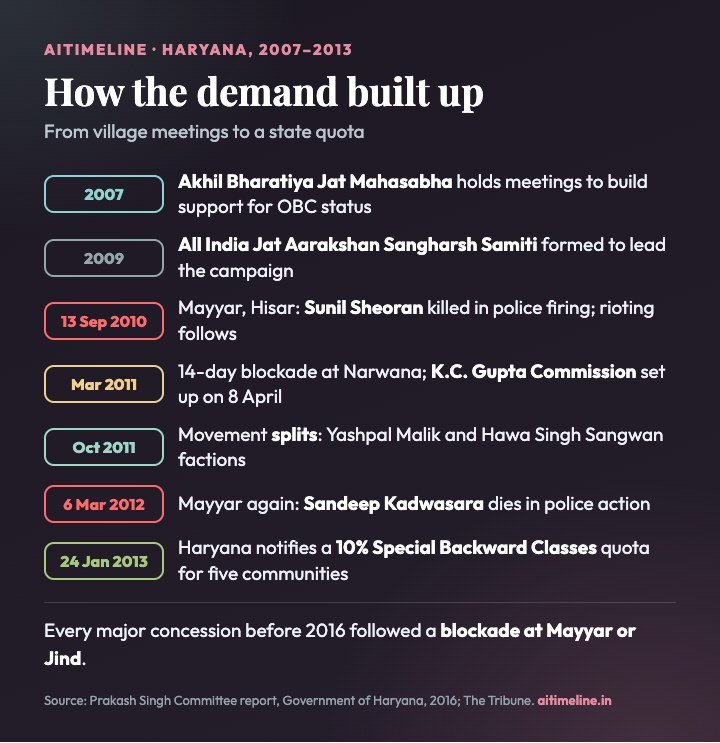
Jats were already on the OBC lists of Rajasthan, Uttar Pradesh, Delhi, Bihar, Madhya Pradesh and Himachal Pradesh by 2002, but not Haryana’s, where they are the largest single community. From 2007 Jat organisations pressed the case, and from 2010 they used a tactic that would define the movement: blocking roads and railway lines, often at Mayyar village in Hisar district. Two protesters died there in police action, in 2010 and 2012. Each round ended with a government promise, and in January 2013 Haryana created a separate 10% Special Backward Classes quota for Jats and four other communities. The quota fight echoes the 1990 protests over the Mandal Commission.
Three Legal Questions, Not One
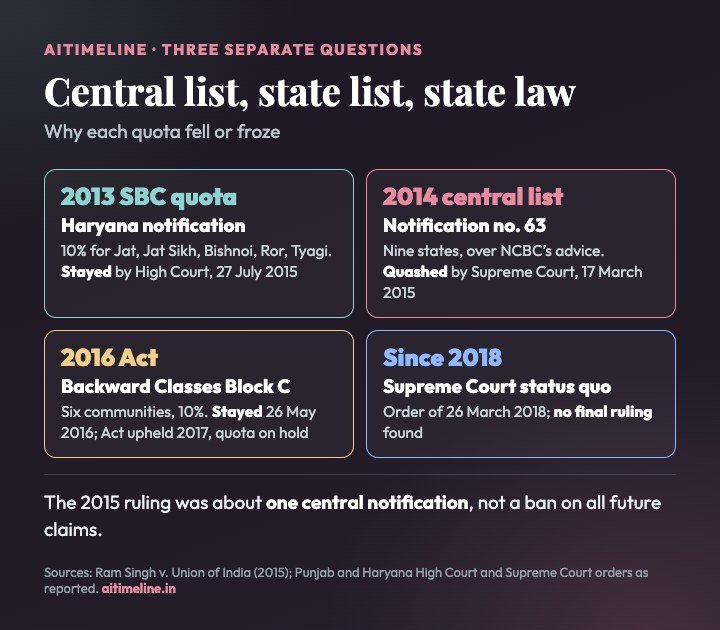
Why every quota granted to Jats in Haryana has fallen or frozen.
| Measure | What it did | What happened | Status |
|---|---|---|---|
| Haryana SBC notification, 24 Jan 2013 | 10% for Jat, Jat Sikh, Bishnoi, Ror, Tyagi beyond the 27% for BCs | Stayed by the High Court, 27 Jul 2015 | Replaced by the 2016 Act |
| Central OBC notification, 4 Mar 2014 | Jats in central list for nine states, over NCBC advice | Quashed by the Supreme Court, 17 Mar 2015; review dismissed 20 Jul 2015 | Void |
| Haryana BC Act, notified 12 May 2016 | Block C for six communities; 10% quota framework | Stayed 26 May 2016; Act upheld 1 Sep 2017 with quota on hold | Supreme Court status quo since 26 Mar 2018 |
The Supreme Court’s 2015 judgment in Ram Singh v. Union of India is the landmark. It held that the Union Cabinet could not brush aside the National Commission for Backward Classes’ reasoned advice, that backwardness must be shown with current data, and that caste alone cannot be the test. It decided the fate of one notification; it did not bar a fresh, evidence-based claim. The same tension between numbers, politics and the 50% ceiling runs through the Maratha reservation case.
Timeline: The Jat Reservation Agitation, 2007 to 2026
Newest first. Colour shows which track each event belongs to.
Where things stand Courts
Settled: The 2014 central OBC notification is gone: the Supreme Court quashed it on 17 March 2015 and dismissed the Centre’s review petition on 20 July 2015. The Punjab and Haryana High Court upheld the 2016 Haryana Backward Classes Act on 1 September 2017.
Not settled: The 10% Backward Classes (C) quota under the 2016 Act has never been applied. The High Court kept it on hold and sent the question of its size to the state commission; the Supreme Court ordered status quo on 26 March 2018. We found no later Supreme Court judgment. Criminal cases from February 2016 are still being decided one by one, mostly in acquittals.
CBI court acquits 56 in the Capt Abhimanyu arson case Violence & criminal cases
What happened: The special CBI court acquitted 56 accused in the case over the burning, looting and vandalism of the Rohtak home of Capt Abhimanyu, then Haryana’s finance minister. The Tribune reported that most prosecution witnesses turned hostile and the court found the evidence weak.
Why it matters: The attack on a minister’s house was the best-known single incident of the violence, and the CBI had taken over its investigation in 2016. An acquittal means guilt was not proved on this evidence; it is not a finding that the attack did not happen.
Jind court acquits 14 over a road blockade Violence & criminal cases
What happened: The court of Additional Chief Judicial Magistrate Pooja Singla acquitted all 14 people charged with rioting, blocking roads and damaging public property at Khokhri village during the agitation. The prosecution’s case faltered on inconsistencies and a lack of evidence linking the accused to the offences.
Context: The judgment was reported by The Tribune on 18 February 2025. Like most agitation cases, it concerned blockade and damage charges rather than violence against people.
Special Investigation Team seeks to close 986 cases Violence & criminal cases
What happened: The SIT set up in August 2017 to take over unfinished agitation investigations said it wanted to close 986 of the 1,205 cases entrusted to it. Police sources told The Tribune that many victims could not identify suspects, looted goods could not be traced, and mobile tower data did not help.
Why it matters: It showed how few of the February 2016 crimes would ever reach trial. The Tribune, citing the Prakash Singh committee, put the total number of criminal cases registered at more than 1,500, mostly for theft, arson and damage.
Eight AIJASS leaders acquitted over a 2015 blockade Violence & criminal cases
What happened: A Hisar court acquitted eight leaders of the All India Jat Aarakshan Sangharsh Samiti, including its state general secretary and spokesperson, in a case of rioting and blocking the national highway near Mayyar village in July 2015.
Context: Mayyar, in Hisar district, was the movement’s nerve centre from 2010 to 2016. The verdict came almost seven years after the FIR.
Rival group says it has removed Yashpal Malik Mobilisation
What happened: A general body meeting at the Jat dharamshala in Hisar announced that Yashpal Malik had been removed as national president and expelled. His supporters called the decision baseless and said Malik had already dissolved the organisation in October.
Why it matters: It showed that the dissolution had not ended the organisation’s internal disputes, which had split the movement since 2011.
Yashpal Malik announces AIJASS is dissolved Mobilisation
What happened: After a meeting in Delhi on 2 October attended by delegates from Punjab, Haryana, Uttar Pradesh, Madhya Pradesh, Rajasthan and Delhi, Malik announced that the All India Jat Aarakshan Sangharsh Samiti had been dissolved. A spokesperson said it would be reconstituted democratically.
Context: AIJASS was formed in 2009 and led the main agitations of 2010, 2011, 2012, 2016 and 2017.
Three sentenced to life for a killing near Dhani Pal Violence & criminal cases
What happened: A Hisar court sentenced Daljeet, Pawan and Surender to life imprisonment for killing Mintu Gujjar, 24, of Lalpura village, in a firing incident at Dhani Pal on 22 February 2016. The prosecution said the accused were part of the arson and looting in Dhani Pal village.
Context: The Prakash Singh report describes the clash: after rumours of an attack, Jat and Gujjar-Saini groups mobilised on 22 February 2016, firearms were used, Mintu Gujjar of Lalpura was killed, and 12 houses in Dhani Pal were burnt. PTI reported that Mintu and his brother were attacked by a mob of about 70 while visiting a relative.
Supreme Court orders status quo on the Haryana quota Courts
What happened: Hearing appeals against the High Court’s September 2017 judgment, the Supreme Court ordered that the status quo be maintained. On 2 April it continued the order and asked Haryana to file a reply.
Effect: The state Backward Classes Commission, which the High Court had asked to report on the size of the quota by 31 March 2018, could not finish that work. The BC(C) quota stayed frozen.
Haryana approves withdrawal of 85 cases Government decisions & talks
What happened: With Yashpal Malik threatening to disrupt BJP president Amit Shah’s rally in Jind, the government approved withdrawing 85 FIRs against 869 protesters. Most concerned rioting, unlawful assembly, wrongful restraint and obstructing officials.
Why it matters: Withdrawing cases had been a core demand since 2016. Cases already before courts needed judicial permission, and the move drew objections from people whose property had been destroyed.
High Court upholds the 2016 Act but keeps the quota on hold Courts
What happened: The court upheld the constitutional validity of the Haryana Backward Classes (Reservation in Services and Admission in Educational Institutions) Act, 2016. But it held that the size of the quota for the new Block C needed fresh, quantifiable data: the state was to compile data on the communities for the Haryana Backward Classes Commission, whose report was expected by 31 March 2018.
Effect: The freeze on implementation was extended, so the 10% quota did not come into force.
Murthal: SIT says it found no victim or accused Violence & criminal cases
The allegations: Media reports in February 2016 alleged that women travelling on the Delhi-Ambala highway near Murthal were sexually assaulted during the violence on 22 February. The High Court took suo motu notice and appointed senior advocate Anupam Gupta as amicus curiae. Police later added gang-rape charges to the FIR.
The findings: In January 2017 the High Court said witness statements and recovered clothing indicated that assaults had taken place. In December 2017 the SIT told the court it had found neither a victim nor an accused. We found no final court finding on the allegations.
A second round of dharnas ends in a deal Government decisions & talks
What happened: From late January 2017, AIJASS held sit-ins across Haryana for about 50 days, demanding the withdrawal of 2016 cases, jobs for the families of those killed and action on reservation. A planned march on Delhi was called off on 19 March after talks with Chief Minister Manohar Lal Khattar, and the dharnas ended on 21 March.
The deal: The government said it would review cases registered from 2010 to 2017 and give permanent jobs to the next of kin of those killed or disabled. Khattar said central reservation would wait for a reconstituted National Commission for Backward Classes.
High Court stays the new quota Courts
What happened: Two weeks after the Act was notified, a division bench stayed reservation for the six communities in Block C. The petitioner argued that the quota rested on the Justice K.C. Gupta Commission report, which the Supreme Court had already found inadequate in 2015.
Effect: The Act stayed on the books; its quota did not operate.
Prakash Singh committee submits its report Commissions & inquiries
Findings: The report recorded 30 deaths and 208 injured, and estimated damage at Rs 20,000 crore on a conservative basis, including 1,196 shops burnt and 29 police buildings set on fire. It described a failure of administrative and police leadership, hesitation to use force, poor coordination with the Army, and caste bias among some officers and men.
Accountability: The Indian Express reported that more than 90 officers and officials, including IAS and IPS officers, were criticised. These were findings on how officials handled law and order, not criminal verdicts. The Union government told Parliament in March 2017 that Haryana had acted against officers named in the report.
Haryana notifies the Backward Classes Act Government decisions & talks
What happened: The state notified the Haryana Backward Classes (Reservation in Services and Admission in Educational Institutions) Act, 2016, creating Backward Classes Block C for Jat, Jat Sikh, Muslim Jat, Bishnoi, Ror and Tyagi.
Context: The communities had earlier been grouped as Special Backward Classes under a 2013 notification that the High Court stayed in July 2015.
Assembly passes the reservation Bill unanimously Government decisions & talks
What happened: The Assembly unanimously passed the Bill, providing a 10% quota framework for Block C in state government jobs and educational institutions.
Why it matters: It delivered the state-level promise made during the February crisis. It did not touch the central OBC list, where the Supreme Court’s 2015 ruling still applied.
Prakash Singh appointed to examine official failures Commissions & inquiries
What happened: The state appointed former Uttar Pradesh and Assam police chief Prakash Singh to inquire into the acts of omission and commission of police and civil officials from 7 to 22 February 2016. On 3 March two serving officers, Vijai Vardhan (IAS) and K.P. Singh (IPS), were added to assist him.
Scope: He was also asked to recommend improvements in law-and-order structures to prevent a repeat.
Canal seized again, then blockades lifted Violence & criminal cases
What happened: On 22 February agitators took control of the Munak canal at Khubru Jhal and cut Delhi’s water supply again, and a gunfight between Jat and Gujjar-Saini groups near Dhani Pal in Hisar killed one man. The Yashpal Malik faction announced it was lifting its dharnas.
The end: On 23 February leaders at Sampla, where the wave of blockades had begun, announced their dharna was over and appealed for all blockades to be lifted. By that evening the state was, in the report’s words, limping back to normalcy.
Munak canal breached; Centre promises a committee Violence & criminal cases
Violence: The Munak canal, which carries a large share of Delhi’s raw water, was breached at Garhi Bindroli in Sonipat district. Security forces opened fire when a mob surrounded them, killing one man; another died later. Hotels and colleges on the highway at Murthal were set on fire, and clashes in Jhajjar killed two members of the Saini community.
Talks: At a meeting with Jat leaders, Union Home Minister Rajnath Singh promised a committee under Venkaiah Naidu on central reservation and a state law in Haryana’s coming Budget session. As news spread, blockades began to lift.
Army airlifted into Rohtak as violence spreads Violence & criminal cases
What happened: Because agitators had dug up roads to stop Army vehicles, troops were airlifted to Rohtak. Despite a flag march, arson and looting continued; the report says businesses owned by non-Jats, especially Punjabis, were targeted in Rohtak. In Jhajjar, Army firing on a stone-pelting mob killed four people.
Elsewhere: Railway stations, a tehsil office and a police station were attacked in Jind district; about 55 shops were burnt or looted in Gohana; caste clashes broke out in Hisar and Kaithal.
Firing in Rohtak; a minister’s house burnt Violence & criminal cases
What happened: A mob of 1,500–1,600 gathered at Gate 2 of Maharshi Dayanand University, took about a dozen policemen hostage in a mall and ransacked the Circuit House. After a BSF jawan was shot, the BSF opened fire, killing one person and injuring 18–19. The mob then set fire to the house of Finance Minister Capt Abhimanyu.
Response: Haryana asked for 15 more central companies and got 10. That evening it requisitioned the Army.
Rohtak clash turns the agitation violent Violence & criminal cases
What happened: Pro-reservation lawyers blocking the road outside the Rohtak court complex clashed with a procession of traders opposed to the agitation. Motorcycles were burnt and a rumour spread that a statue of Sir Chhotu Ram had been damaged. Police then entered a hostel at Neki Ram Government College and allegedly beat students.
Why it matters: The Prakash Singh report calls these three incidents the trigger that turned blockades into widespread violence.
Blockades spread across Haryana Mobilisation
What happened: Agitators blocked four railway tracks and 120 roads, including four national highways. The Yashpal Malik faction joined in and brought forward its own track blockade near Mayyar to 17 February.
Talks: On 17 February the Chief Minister met khap and community leaders, who promised to lift the blockades in return for faster action on reservation. Young protesters on the roads did not follow them.
Jat Swabhiman rally at Sampla Mobilisation
What happened: The Hawa Singh Sangwan faction held a Jat Swabhiman (self-respect) rally at Sampla. About 200–250 young men led by its youth president Sudeep Kalkal then blocked National Highway 10 and began a dharna.
Why it matters: The Sampla dharna became the inspiration for blockades elsewhere, and its end on 23 February marked the end of the agitation.
Chief Minister’s meeting sets a 31 March deadline Government decisions & talks
What happened: Manohar Lal Khattar met khap representatives and Jat organisations. They agreed that a committee headed by the Chief Secretary would identify options for reservation by 31 March 2016.
But: The Hawa Singh Sangwan faction went ahead with a rally at Mayyar, and agitators blocked the Hisar-Rewari railway line before vacating it on a government assurance. The Indian Express later reported that the committee’s volume on intelligence found district officials had ignored alerts.
Khaps call the youth out Mobilisation
What happened: After losing quota benefits at both the Centre and the state, the umbrella khap body announced a Jat Yuva Sena in August 2015 and called for a “Shahidi Diwas” at Mayyar on 13 September, the anniversary of the 2010 shooting, with road blockades to follow.
Delay: Panchayat elections and litigation over new eligibility rules for candidates pushed the protest programme to February 2016.
High Court stays the state’s Special Backward Classes quota Courts
What happened: The court stayed the 10% quota for Special Backward Classes in Haryana government jobs and educational institutions.
Effect: Jats in Haryana lost reservation at both levels within four months: in the central OBC list in March and the state SBC list in July.
Supreme Court dismisses the Centre’s review Courts
What happened: The Union government, now led by the BJP, sought a review of the March judgment. The Supreme Court dismissed it.
Context: Jat leaders had met Prime Minister Narendra Modi and BJP president Amit Shah on 26 March 2015 seeking restoration of reservation.
Supreme Court quashes central OBC inclusion Courts
The ruling: The court set aside notification no. 63 of 4 March 2014. It upheld the NCBC’s view that Jats in the nine states were not socially and educationally backward and found the Cabinet had no good reason to reject that advice. It said backwardness must rest on contemporary data, not outdated material, and warned against identifying backwardness by caste alone.
What it did not do: It did not rule out any future reservation for Jats. It decided the validity of one notification.
Centre notifies Jats in the central OBC list Courts
What happened: The notification added Jats to the Central List of OBCs for Bihar, Gujarat, Haryana, Himachal Pradesh, Madhya Pradesh, Delhi, Uttar Pradesh, Uttarakhand, and the Bharatpur and Dholpur districts of Rajasthan.
Timing: The model code of conduct for the 2014 Lok Sabha election came into force the next day. The Supreme Court did not stay the notification while hearing challenges, so it operated for about a year.
Union Cabinet overrules the NCBC Government decisions & talks
What happened: The Cabinet decided that the NCBC’s advice did not adequately take into account “ground realities” and resolved to include Jats in the central list anyway.
Brief correction: The source we worked from dated the Cabinet’s approval to 19 December 2013. The decision to include Jats was taken on 2 March 2014; the December meeting only asked the NCBC to give its advice using state reports.
NCBC advises against inclusion Commissions & inquiries
What happened: The NCBC sent its report to the government rejecting the inclusion of Jats in the central list for all nine states, saying they were not socially and educationally backward. It drew on an expert survey by the Indian Council of Social Science Research.
The data: The ICSSR noted that Jats in Haryana are a landowning community, with nearly 87% engaged in agriculture, and that their share of top-grade state jobs was close to their population share, though they lagged in school and higher education enrolment.
Cabinet asks the NCBC to decide quickly Government decisions & talks
What happened: The Cabinet approved a Group of Ministers’ suggestion that the NCBC use state commission reports from Haryana (2012) and Himachal Pradesh (2002), and other studies, to give its advice on including Jats in the central list for nine states.
Context: In June 2013 the Prime Minister had set up the Group of Ministers to talk to Jat representatives and speed up the NCBC survey.
Haryana creates Special Backward Classes Government decisions & talks
What happened: Haryana declared Bishnoi, Jat, Jat Sikh, Ror and Tyagi as Special Backward Classes, with 10% reservation in state jobs, public undertakings, local bodies and educational institutions, separate from the existing 27% for Backward Classes.
Basis: It followed the Justice K.C. Gupta Commission, which said these groups made up more than 30% of the state’s population and should not be merged with the other Backward Classes.
Mayyar again: a second protester killed Mobilisation
What happened: The Malik faction held a rally at Mayyar and began a dharna on the railway track near Ramayan village. On 6 March a confrontation with police left Sandeep Kadwasara dead. Highways in Hisar and Jind were blocked, and the official car of the Jind district judge was set on fire.
How it ended: On 11 March the state promised reservation by 15 December 2012 and the release of arrested protesters.
Justice K.C. Gupta Commission appointed Commissions & inquiries
What happened: After the March blockade, Haryana set up a backward classes commission headed by Justice K.C. Gupta. It recommended Jat, Jat Sikh, Tyagi, Ror and Bishnoi for a separate 10% quota.
Later: The NCBC and petitioners questioned its methods, and its report became the target of challenges to both the 2013 notification and the 2016 Act.
Fourteen-day blockade at Narwana; the movement splits Mobilisation
What happened: Protesters blocked roads and railway tracks around Narwana for 14 days, lifting them after the Chief Minister promised a commission on reservation.
The split: Later that year AIJASS divided into two factions, one led by Yashpal Malik and the other by Hawa Singh Sangwan. The Tribune dates the split to October 2011.
Mayyar: Sunil Sheoran killed in police firing Mobilisation
What happened: A state-wide call for agitation and a rally at Mayyar led to a confrontation with police. Sunil Sheoran was shot dead by the district police superintendent, who said he fired in self-defence. Rioting, road blockades and damage to public property followed.
Aftermath: The government suspended SP Subhash Yadav and registered a murder case against him. The Prakash Singh report argued this taught police to avoid force even when unavoidable, a lesson it said Haryana paid for in 2016.
The demand gets organised Mobilisation
What happened: In 2007 the Akhil Bharatiya Jat Mahasabha held a series of meetings to build support for OBC status. In 2009 the All India Jat Aarakshan Sangharsh Samiti was formed to lead the campaign.
Background: Jats were already on the state OBC lists of Rajasthan (1999), Uttar Pradesh, Delhi, Bihar (2000), Madhya Pradesh and Himachal Pradesh (2002), but not Haryana. Earlier Haryana backward classes decisions in the 1990s had left them out, prompting protests.
February 2016: How Blockades Became Violence
From a rally at Sampla on 14 February to the end of the dharnas on 23 February.
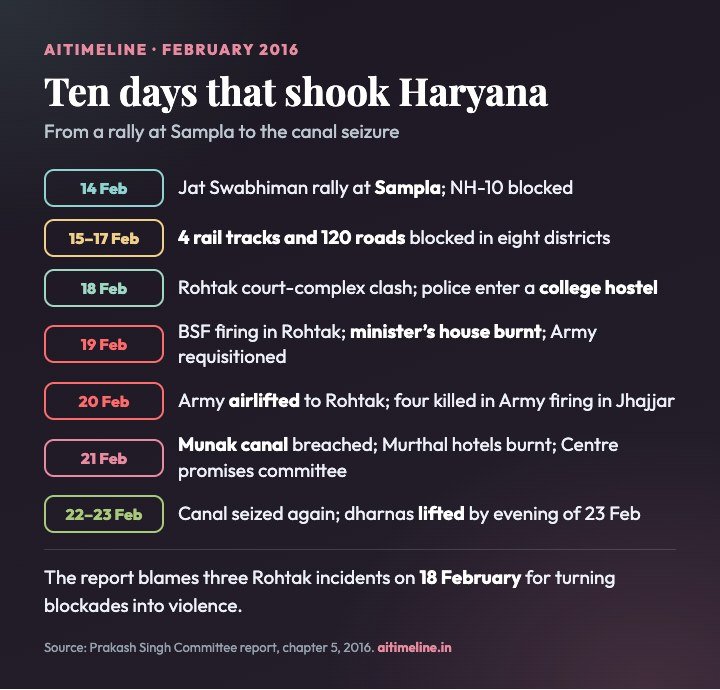
The Haryana government had agreed on 9 February to a Chief Secretary’s committee to find a route to reservation by 31 March. One faction went ahead anyway. A rally at Sampla on 14 February became a highway dharna, and within three days four railway tracks and 120 roads were blocked. The report identifies three incidents in Rohtak on 18 February — a clash between lawyers and traders, a rumour about a Sir Chhotu Ram statue, and a police raid on a college hostel — as the moment blockades turned into violence. Over the next five days, mobs burnt shops, schools, police posts and a minister’s house; security forces and the Army opened fire at several places; and Jat and non-Jat groups clashed in Jhajjar, Hisar, Gohana, Jind and Kaithal.
The seizure of the Munak canal on 21 and 22 February brought the crisis to Delhi, which draws a large share of its raw water through it. Talks with the Union Home Minister on 21 February produced the promise of a state law and a central committee, and blockades were lifted by the evening of 23 February.
The Human and Economic Toll
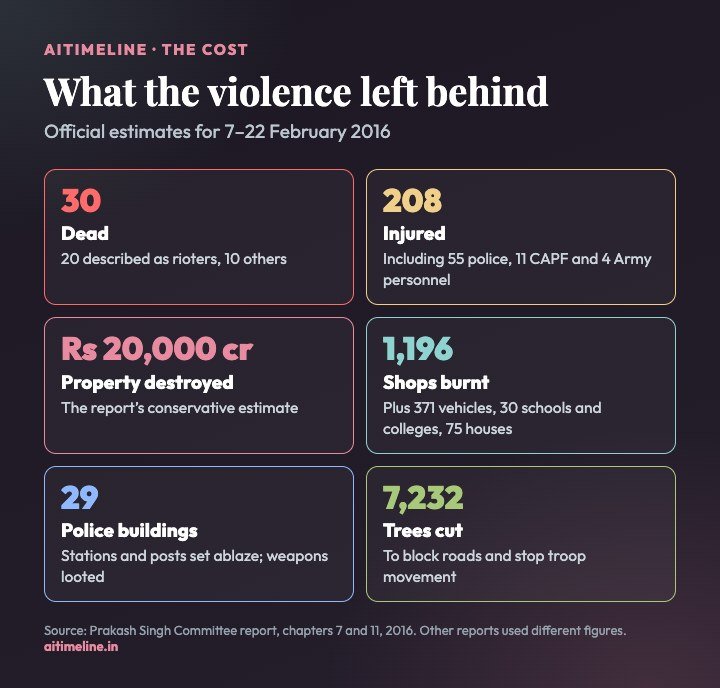
The brief we worked from put the injured at 324, including 67 security personnel. The Prakash Singh report’s own table for 7–22 February records 208 injured — 123 described as rioters, 15 others, 55 policemen, 11 central armed police and four Army personnel — and 30 dead. Other contemporary reports used different figures, often because they covered different dates or relied on hospital counts. Beyond the numbers, the violence left businesses in Rohtak and Jhajjar ruined, and relations between Jats and other communities badly strained.
What the Prakash Singh Report Found
An inquiry into officials, not into the demand.
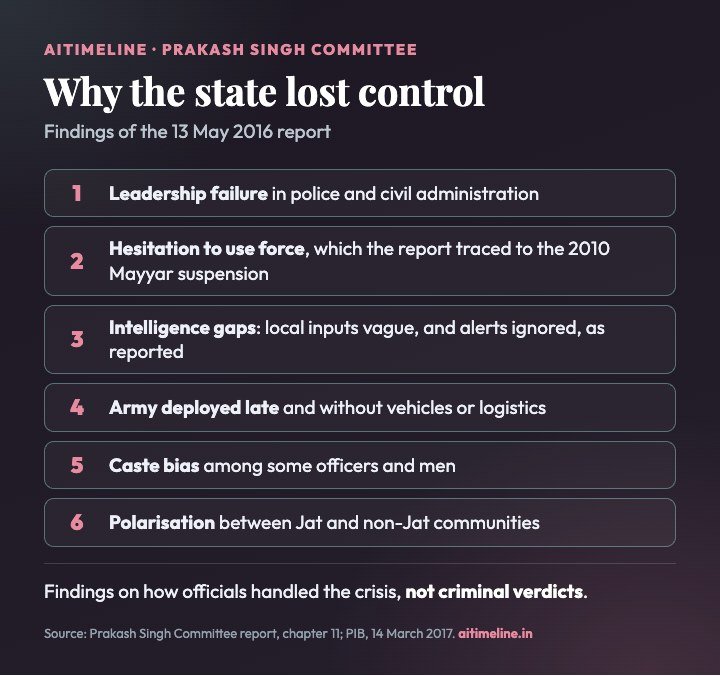
Appointed on 25 February 2016, the committee examined how police and civil officials in eight districts handled the crisis between 7 and 22 February. It was unsparing: officers stayed in their offices while markets burnt, prohibitory orders went unenforced, and some policemen deserted duty. It traced the reluctance to use force partly to 2010, when the government suspended and charged the police superintendent over the Mayyar shooting. The Indian Express reported that more than 90 officers and officials were criticised. In March 2017 the Union government told Parliament that Haryana had acted against the officers named.
The Criminal Cases
Ten years of withdrawals, closures and acquittals.
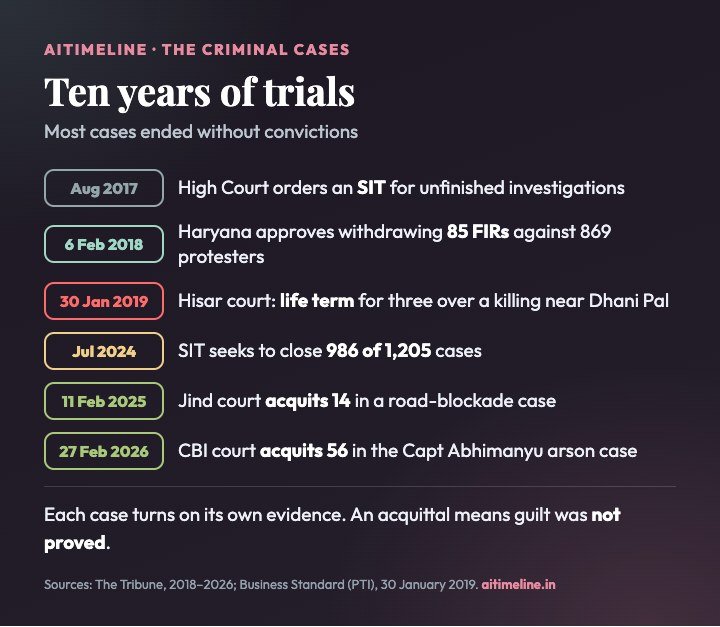
| Date | Court or body | Case | Outcome |
|---|---|---|---|
| 6 Feb 2018 | Haryana government | 85 FIRs, 869 protesters | Withdrawal approved |
| 30 Jan 2019 | Sessions court, Hisar | Killing of Mintu near Dhani Pal | Three sentenced to life |
| Apr 2022 | CJM, Hisar | 2015 highway blockade at Mayyar | Eight AIJASS leaders acquitted |
| Jul 2024 | Special Investigation Team | 1,205 unfinished cases | Sought to close 986 |
| 11 Feb 2025 | ACJM, Jind | Khokhri village road blockade | 14 acquitted |
| 27 Feb 2026 | Special CBI court, Panchkula | Arson at Capt Abhimanyu’s house | 56 acquitted |
Each case turns on its own evidence, so outcomes must be read one at a time. A pattern is still clear: few cases reached trial, witnesses frequently turned hostile, and the state itself withdrew dozens of cases as part of political settlements. The farm-law protests of 2020–21, covered in our farmers’ protest timeline, drew heavily on the same rural Haryana networks.
Why Did Jats Demand Reservation?
- Farm pressure: supporters pointed to uncertain farm incomes and landholdings shrinking with each generation.
- Jobs: secure government jobs were scarce, and young Jats competed with groups that already had quotas.
- Education: the ICSSR survey found Jats in Haryana lagged in school and higher education enrolment.
- The counter-argument: the NCBC found Jats were a landowning community whose share of top state jobs was close to their population share, and not socially backward.
- Other backward classes: existing OBC groups feared a large community would crowd them out of a fixed quota.
- The constitutional test: courts asked for current, quantifiable evidence of social backwardness and inadequate representation, not numerical strength or political pressure.
Where Things Stand
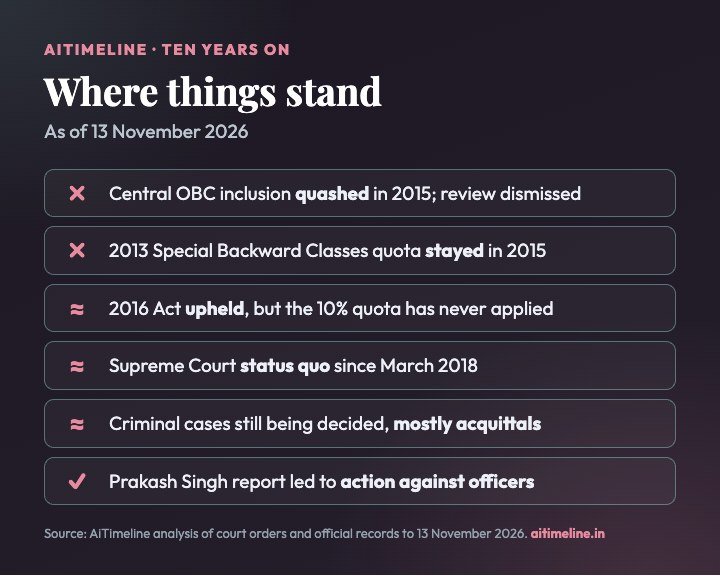
We found no final Supreme Court judgment on the 2016 Act and no report that the Block C quota has been applied. The state commission’s work on the size of the quota was overtaken by the 2018 status quo order. Before stating that any connected petition has been finally decided, check the latest Supreme Court cause list and orders.
Key People and Institutions
| Person or institution | Role |
|---|---|
| Yashpal Malik | Leader of the main AIJASS faction; led the 2012 and 2017 protests and announced the samiti’s dissolution in 2021 |
| Hawa Singh Sangwan | Leader of the rival AIJASS faction; organised the 2016 rallies at Mayyar and Sampla |
| Akhil Bharatiya Jat Mahasabha | Began organised mobilisation in 2007 |
| All India Jat Aarakshan Sangharsh Samiti (AIJASS) | Formed 2009; led the main agitations; split in 2011 |
| Manohar Lal Khattar | Haryana Chief Minister during the 2016 violence and the 2017 talks |
| Capt Abhimanyu | Haryana finance minister whose Rohtak home was burnt on 19 February 2016 |
| Prakash Singh | Retired police chief who headed the inquiry into official failures |
| Justice K.C. Gupta | Headed the Haryana Backward Classes Commission of 2011 |
| National Commission for Backward Classes | Advised against central inclusion in February 2014 |
| Supreme Court of India | Quashed the 2014 notification in Ram Singh v. Union of India (2015); ordered status quo on the 2016 Act (2018) |
| Punjab and Haryana High Court | Stayed the 2013 and 2016 quotas; upheld the 2016 Act in 2017 |
Facts at a Glance
| Question | Answer |
|---|---|
| Main demand | OBC reservation in government jobs and education |
| Organised mobilisation | From 2007; AIJASS formed 2009 |
| First deadly clash | Mayyar, Hisar, 13 September 2010 |
| State SBC quota | 24 January 2013; stayed 27 July 2015 |
| Central OBC notification | 4 March 2014 (Cabinet decision 2 March) |
| Supreme Court ruling | 17 March 2015 |
| Most violent phase | 18–23 February 2016 |
| Deaths recorded | 30 |
| Injured recorded | 208 |
| Haryana law | Backward Classes Act 2016; notified 12 May 2016 |
| Quota status | Never applied; Supreme Court status quo since 26 March 2018 |
Explore More Timelines
People Also Ask
Frequently Asked Questions
Based on official records and reporting to 13 November 2026.
⚠️ Editorial Note
This timeline separates the reservation demand, government decisions, court rulings, inquiry findings and individual criminal-case outcomes. The Prakash Singh report’s findings concern how officials handled law and order; they are not criminal convictions. Checking the record, we corrected several points in the brief we worked from: the Union Cabinet decided to include Jats on 2 March 2014, not 19 December 2013, when it only asked the NCBC to give its advice; the report records 208 injured, not 324; the 2011 blockade was at Narwana in Jind district; blockades were finally lifted on 23 February 2016; and AIJASS was dissolved at a meeting on 2 October 2021. We could not confirm a March 2008 Jind convention or an August 2023 Rohtak acquittal cited in the brief, and left them out. The 2015 ruling concerned the central notification; it is not a blanket bar on state-level measures.
Related Reading on AiTimeline
Sources & further reading
Every dated entry above was checked against these references. Last reviewed 13 November 2026.
- Report of the Committee headed by Shri Prakash Singh, IPS (Retd.) on the February 2016 Jat reservation agitation (13 May 2016)
- Ram Singh & Others v. Union of India, judgment of 17 March 2015
- Inclusion of Jat community in the Central List of OBCs: Cabinet decision of 19 December 2013
- Agitation for Reservation: Prakash Singh committee report submitted 13 May 2016 (Lok Sabha reply, 14 March 2017)
- HC stays Haryana's job quota for Jats, five other communities (26 May 2016)
- HC extends freeze on Haryana's quota for Jats, others (1 September 2017)
- SC orders status quo on Jat quota in Haryana (26 March 2018)
- Haryana placates Jats, to withdraw 85 cases (6 February 2018)
- Haryana: Three awarded life term for killing man during Jat quota stir (30 January 2019)
- Jat Samiti that led quota stir dissolved (3 October 2021)
- 7 yrs on, SIT wants to close 986 cases of violence during Jat stir in Haryana
- 14 accused acquitted in Jat agitation case (February 2025)
- CBI court acquits 56 in 2016 arson case at Capt Abhimanyu's house (27 February 2026)
- Jats call off quota agitation after govt truce (19 March 2017)