Sardar Sarovar Dam: History, Protests and Displacement
Sardar Sarovar Dam timeline from the 1961 foundation stone to 2026: Narmada Bachao Andolan, World Bank exit, Supreme Court rulings and displacement counts.
Latest Story
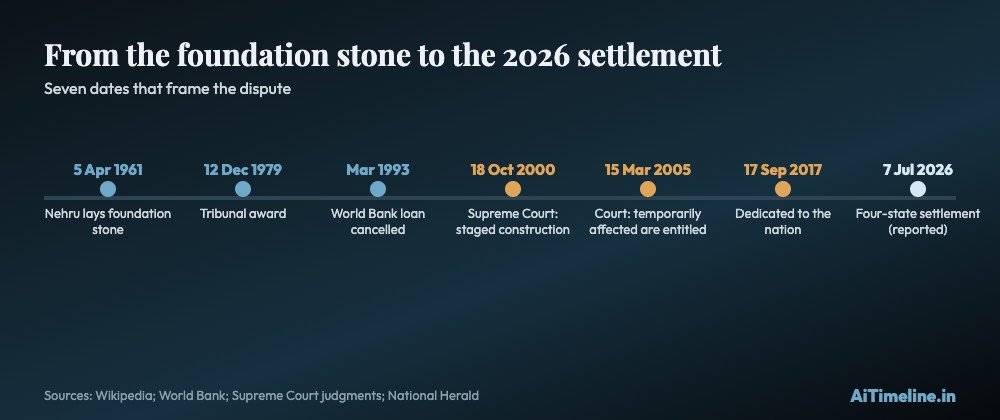
The Sardar Sarovar Dam timeline runs from Jawaharlal Nehru’s foundation stone on 5 April 1961 to a financial settlement between four states in July 2026. The dam on the Narmada river at Kevadia (now Ekta Nagar), Gujarat, reached its full reservoir level of 138.68 m and was dedicated on 17 September 2017. It is also one of India’s defining disputes over development and displacement: the Narmada Bachao Andolan, led publicly by Medha Patkar, challenged it for decades, the World Bank left in 1993, and the Supreme Court allowed construction only in stages tied to rehabilitation. Whether affected families were adequately rehabilitated is still contested. For related stories see AiTimeline’s timelines of the Singur and Nandigram land protests, the Green Revolution and Operation Flood.
💡 Short Answer
The Sardar Sarovar Dam is a 138.68 m concrete dam on the Narmada in Gujarat, built to supply irrigation, drinking water and electricity to Gujarat, Madhya Pradesh, Maharashtra and Rajasthan. The Supreme Court allowed it to rise in stages from 2000, the World Bank cancelled its loan in 1993, and the dam was dedicated in 2017. No single figure counts the people affected: the World Bank said more than 140,000 people were threatened, while state counts of eligible Madhya Pradesh families have fallen. Rehabilitation cases were still in court in 2026.
How Many People Were Affected? Who Counted What
Last updated: 26 October 2026. Each figure counts something different, so none should be read as the total.
| Source | What it counts | Figure | Year |
|---|---|---|---|
| World Bank evaluation | Reservoir: villages and families | 245 villages, about 41,000 families (80% Madhya Pradesh, 11% Gujarat, 9% Maharashtra); 38,000 ha submerged | 1995, design estimate |
| World Bank evaluation | Canals: families losing land | About 68,000 families on 74,000 ha; about 24,000 lose over a fourth of their land, about 2,000 over half | 1995, design estimate |
| World Bank evaluation | People whose livelihoods were threatened (reservoir plus canals) | More than 140,000 people | 1995 |
| Supreme Court judgment (respondents’ figures) | Villages and project-affected families | 245 villages (4 fully, 241 partly); 40,827 families; 17,725 tribal families | 2000 |
| Human Rights Watch and NRDC | People to be relocated by Sardar Sarovar alone | At least 90,000 (advocacy estimate) | 1992 |
| Madhya Pradesh NVDA report | Submergence-affected villages and families in the state | Villages 193 to 176; families 37,754 to 21,808 | 2016-17 |
| Narmada Bachao Andolan | Families removed from the submergence count | 15,946 families in 193 villages | Cited 2024 |
| Narmada Control Authority report | Affected families in Madhya Pradesh | 23,603 in 178 villages; 5,540 resettled in Gujarat, 18,063 in Madhya Pradesh | 2020-21 |
| Madhya Pradesh High Court record | Beneficiaries of plots allotted in 2002 | 25,602 beneficiaries; 2,095 registrations completed | Apr 2026 |
How to read the table. The World Bank figures are design-stage estimates from its 1995 evaluation. The judgment figures are the respondents’ numbers as recorded by the court. The Madhya Pradesh and NCA numbers are state counts of eligible families, which fell after backwater levels were reassessed; the NBA disputes that reduction. The Human Rights Watch figure is an advocacy estimate. A secondhand press report of 199,500 or 240,000 people in the Morse review was not checked against the report and is not used.
Sardar Sarovar Dam: Key Questions
The Sardar Sarovar Story in Ten Points
- Dam vs project: the dam is one part of a project with a reservoir, canals and power houses.
- Height: 138.68 m full reservoir level, fixed by the 1979 tribunal award.
- World Bank: approved credits in 1985, published the Morse review in June 1992, and cancelled its loan in March 1993.
- Courts: the 2000 judgment tied each height to rehabilitation; the 2005 judgment widened who is entitled.
- 2017: a Supreme Court order set up to Rs 60 lakh for eligible Madhya Pradesh families, and the dam was dedicated on 17 September.
- Counts differ: 140,000 people (World Bank, 1995) and 21,808 families (Madhya Pradesh, 2016-17) measure different things.
- Backwater levels: redrawing them cut the eligible count, which the NBA contests.
- 2026: the High Court heard that 2002 plots remain unregistered; four states signed a financial settlement.
- Outcomes vary: thousands were resettled and many were not; the record does not support “all” or “none”.
- Corrections: several claims in the source brief were fixed or left out; see the editorial note.
Sardar Sarovar Dam Timeline, Latest First
Each entry is tagged and ends with why it matters. Sources are linked in each entry.
2026
A “one-time settlement” between the four states States’ accounts
Reports say the chief ministers of the four states signed a financial settlement in New Delhi in the presence of Union Home Minister Amit Shah and Jal Shakti Minister C.R. Patil, closing one part of the money disputes over the project (National Herald). Madhya Pradesh had claimed Rs 7,669 crore from Gujarat in a revised claim of 10 February 2022; Gujarat said on 21 March 2024 it would recognise only the original Rs 281.46 crore (Counterview).
Under the reported terms Madhya Pradesh pays Gujarat about Rs 231 crore and Maharashtra about Rs 27 crore; Congress leaders cited Rs 550 crore instead. The official text had not been published when these reports appeared. The Narmada Bachao Andolan says it covers only inter-state accounts and leaves compensation and rehabilitation unresolved, including a Rs 2,900 crore demand by Madhya Pradesh for pending rehabilitation.
2026
Madhya Pradesh High Court: plots allotted in 2002 still not registered Rehabilitation
In a public interest petition filed in 2024, Medha Patkar told the High Court that allotment letters issued in 2002 to displaced people in Dhar, Badwani, Khargone and Alirajpur were never registered as title documents, so the plots could not be used for loans or sale. The court had ordered collectors on 14 October 2025 to form registration committees. Of 25,602 beneficiaries only 4,119 had applied, and 2,095 registrations were done, the state said. On 28 April 2026 the bench directed the Additional Chief Secretary to address Patkar’s concerns and file a fresh status report (SCC Online).
AiTimeline found no report of the 29 June 2026 hearing.
Flood in the Narmada valley and a fight over the reservoir level Protest
After heavy rain, the Omkareshwar dam gate was opened on 15 September 2023 and water rose in downstream villages on 16 September. Villagers and the Narmada Bachao Andolan alleged that Sardar Sarovar’s gates were opened only on 17 September, after Prime Minister Modi’s birthday events; that is their allegation, not an established finding (Mongabay India). The NBA has demanded that the reservoir be kept at about 122 m until rehabilitation is complete. The Gujarat and central authorities have not been quoted in the source accepting that demand.
Backwater levels redrawn, and the count of “affected” families falls Rehabilitation
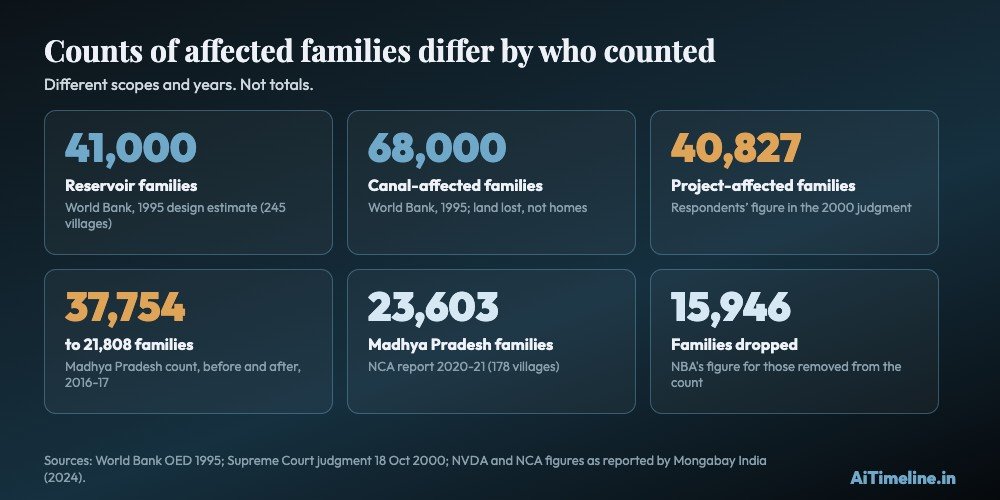
The Narmada Control Authority reassessed backwater levels in 2008, changing the level in 193 villages by 1.93 to 6.68 m, according to the NBA. The Madhya Pradesh Narmada Valley Development Authority’s 2016-17 report cut submergence-affected villages from 193 to 176 and affected families from 37,754 to 21,808. The NBA says 15,946 families were dropped from the submergence area and lose outstanding compensation. The NCA’s 2020-21 report gives 23,603 affected families in 178 villages. A committee set up by the Union environment ministry, led by Devendra Pandey, called the redetermined level unscientific (Mongabay India).
The numbers describe different scopes and dates, so they are not interchangeable. The chart below sets them side by side.
2019
The reservoir reaches 138.7 m Dam
The reservoir reached its highest level of 138.7 m on 15 September 2019, the first season it filled to the full reservoir level after the gates were closed in 2017 (Wikipedia). Flooding in the valley that year drew criticism that releases were badly timed; the NBA and independent analysts made that argument (Mongabay India).
2017
Prime Minister Modi dedicates the dam to the nation Dam
On his 67th birthday Prime Minister Narendra Modi dedicated the dam at Kevadia (now Ekta Nagar). IANS reported the height as 138.68 m, storage capacity as 4.73 million acre-feet and the hydro power output as 1,450 MW, and that, according to the Gujarat government, drinking water would reach 8,221 villages, 159 towns and eight cities in the state (IANS via Assam Tribune). The project took 56 years from foundation stone to dedication.
The PIB and PMO pages the brief cited returned an access error to AiTimeline, so the IANS report is used instead.
Patkar’s fast, arrests, and a ban on entering two districts Protest
Medha Patkar was on an indefinite fast at Chikalda in Badwani district when police removed her to a hospital in Indore on 7 August 2017, the twelfth day of the fast. She was arrested on 9 August on the way to Dhar, and the state barred her entry to two districts for a year from 10 August. The Madhya Pradesh High Court granted bail on 24 August on condition that she not obstruct officials removing people from the submergence area (The Quint; Front Line Defenders; Global Voices). The state’s position was that it was enforcing the Supreme Court’s order to vacate.
2017
Supreme Court: up to Rs 60 lakh per family, and vacate by 31 July Court
The Supreme Court directed that eligible Madhya Pradesh families who had rejected the Rs 5.58 lakh Special Rehabilitation Package offered in 2005, and those who took half and never received land, be paid up to Rs 60 lakh each, with Gujarat funding it. About 1,589 families who took the package but were cheated in a land-registry scam were to get Rs 15 lakh each. Those paid had to leave land likely to be submerged by 31 July 2017 (Sabrang India; Governance Now).
Reports disagree on the order date and on the number of families entitled; the 2005 package and its amounts are as the reports state them.
Narmada Control Authority clears closing the gates Dam
On 17 June 2017 the Narmada Control Authority decided that the 30 radial gates could be closed so the reservoir could rise to its full level of 138.68 m (Wikipedia). The same authority had cleared the final stage of raising in June 2014.
Final stage of raising approved Dam
In June 2014 the Narmada Control Authority gave final clearance to raise the dam to 138.68 m. In August 2013 heavy rain had already filled the reservoir to about 131.5 m, and roughly 7,000 villagers were relocated (Wikipedia).
Authority clears 121.92 m; Patkar fasts; Supreme Court asks the PM to help Dam
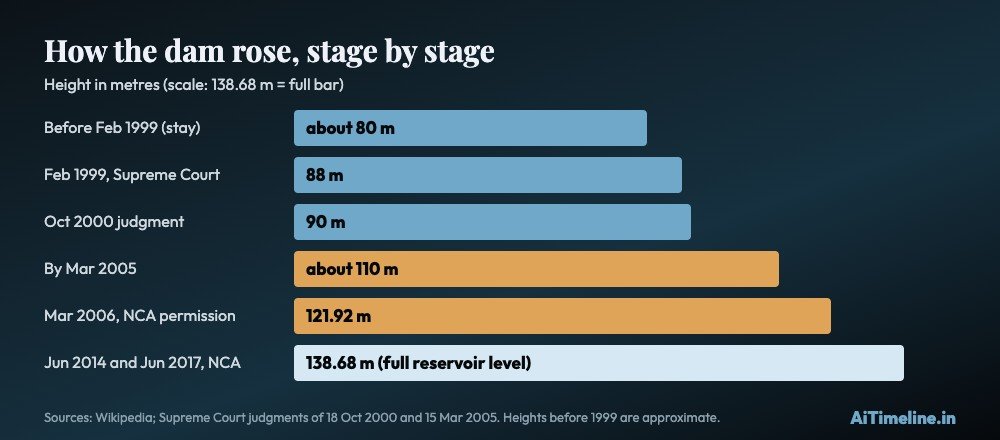
On 8 March 2006 the Narmada Control Authority permitted raising from about 110 m to 121.92 m. In April 2006 Medha Patkar fasted in protest, and reports say the Supreme Court declined to order construction stopped and asked the Prime Minister to help resolve the dispute (The Tribune). Petitioners argued that rehabilitation was not complete even at the earlier level; Madhya Pradesh said measures had been provided.
The brief put the 121.92 m milestone in December 2006; AiTimeline could not verify that month and gives the year.
2005
Supreme Court: temporarily affected families are entitled to the package too Court
The judgment, written by Justice S.B. Sinha, held that the award makes no distinction between permanently and temporarily affected families, so both are entitled to the rehabilitation package. It also held that adult sons are separate families and that oustees cannot demand land of their choice, though they may reject land that is unirrigable or uncultivable. It directed the Jalsindhi applicants to be allotted land already offered and sent other grievances to the Grievance Redressal Authority (Supreme Court judgment; Probe International).
The dam stood at about 110 m. This ruling was about who is entitled to what, not a general clearance to build higher, which is how the brief summarised it.
2000
Supreme Court allows construction to resume, in stages Court
The Supreme Court upheld the tribunal award. Construction up to 90 m could proceed at once because the rehabilitation sub-group had cleared it; going higher needed environment clearance and the Narmada Control Authority’s permission, and “further raising of the height will be only pari passu with the implementation of the relief and rehabilitation.” The authority had to draw up an action plan within four weeks, and unresolved differences could go to the Prime Minister (Supreme Court judgment). Wikipedia describes the verdict as a 2-1 majority (Wikipedia).
The judgment records the respondents’ figures of 245 villages (4 fully, 241 partly submerged) and 40,827 project-affected families.
Court allows the dam to rise from about 80 m to 88 m Court
In February 1999 the Supreme Court allowed the height to rise from about 80 m to 88 m, partly lifting the pause on construction (Wikipedia). The brief did not mention this step.
Court halts further construction Court
After a petition by the Narmada Bachao Andolan, the Supreme Court stopped further raising of the dam; the brief and Wikipedia date the stay to 1995, while another account says construction was stayed in 1994 (Wikipedia). The pause lasted until 1999 and made the dam a national test case for development, displacement and the courts.
The World Bank cancels the rest of its loan at India’s request World Bank
Responding to the independent review, the Bank set performance standards in September 1992 and made continued support conditional on resettlement and environmental performance. In March 1993 the Indian government asked it to cancel the remainder of the loan, and the Bank did so. “Project construction is proceeding with other funds,” the Bank’s own 1995 evaluation noted (World Bank, Learning from Narmada, May 1995).
Wikipedia’s dam page gives 1994 and another Wikipedia page gives 31 March 1993; the Bank’s documents say March 1993.
1992
The Morse review reports World Bank
The Bank’s independent review, chaired by Bradford Morse with Thomas Berger as deputy chair, was published on 18 June 1992. It concluded that the resettlement and environmental aspects were not being handled in line with Bank policy, and that both the Indian authorities and the Bank bore responsibility (World Bank timeline; Learning from Narmada).
The Bank’s later evaluation said the project threatened the livelihoods of more than 140,000 people in the flooded areas and along the canals.
The movement is recognised abroad; the Bank commissions a review Protest
The Narmada Bachao Andolan received the Right Livelihood Award in 1991, and the same year the Bank appointed the independent review team (Wikipedia: Narmada Bachao Andolan; World Bank timeline). Medha Patkar became its best-known public figure. Wikipedia dates the movement’s founding to 1985; other accounts place the formal alliance later.
Conditional environment clearance; construction begins Government
The Ministry of Environment and Forests released the project in April 1987 subject to conditions including field surveys, a completed rehabilitation plan and a seismicity study, after an earlier finding that environmental requirements had not been met (Human Rights Watch and NRDC, Defending the Earth, 1992). Construction of the main dam began in April 1987 (Wikipedia).
Critics argued the clearance breached the tribunal award and the government’s own laws; the conditions were still being argued over years later.
The World Bank approves the credit and loan World Bank
The Bank approved a dam and power project (credit 1552 and loan 2497) and a companion water delivery and drainage credit (1553) in 1985. The Bank’s 1995 evaluation said the aims were irrigation for almost 2 million hectares and drinking water for 30 million people, and estimated construction at $5.2 billion in 1992 dollars (Learning from Narmada). One press account puts the Bank’s commitment at $450 million.
1979
The tribunal gives its award Government
The tribunal released its decision in December 1979, after about ten years of hearings, fixing how Narmada water would be shared between Madhya Pradesh, Gujarat, Maharashtra and Rajasthan (Wikipedia; Learning from Narmada). The Supreme Court later recorded that the tribunal fixed the dam’s full reservoir level at 455 feet (138.68 m) (judgment).
1969
A tribunal is set up Government
The Narmada Water Disputes Tribunal was formed on 6 October 1969 after the states failed to agree on the dam’s height and the sharing of water and power (Wikipedia; Human Rights Watch).
1961
Nehru lays the foundation stone Government
Prime Minister Jawaharlal Nehru laid the foundation stone on 5 April 1961 (Wikipedia). Work on the main dam did not start for more than 25 years.
Court Rulings at a Glance
Supreme Court and High Court decisions on the dam and its oustees.
| Date | Court and case | What it decided |
|---|---|---|
| Feb 1999 | Supreme Court | Allowed the dam to rise from about 80 m to 88 m |
| 18 Oct 2000 | Supreme Court, Narmada Bachao Andolan v. Union of India | Allowed 90 m at once; higher only in step with rehabilitation and environment clearances; action plan in four weeks |
| 15 Mar 2005 | Supreme Court, WP (C) 328 of 2002 | Temporarily affected families are entitled to the rehabilitation package; adult sons are separate families; limits on rejecting land |
| Feb 2017 | Supreme Court | Up to Rs 60 lakh per eligible Madhya Pradesh family, paid by Gujarat; vacate by 31 Jul 2017 (reported) |
| 28 Apr 2026 | Madhya Pradesh High Court, Medha Patkar v. State of M.P. | State to register plots allotted in 2002 and report progress; next hearing 29 Jun 2026 |
Why Did the Dam Face Protests?
Four lines of objection, with the other side’s case.
Displacement. The reservoir threatened homes and farmland in Madhya Pradesh, Maharashtra and Gujarat, and canals took land from tens of thousands more families. For many, losing a house also meant losing fields, forest access, neighbours and cultural sites.
Rehabilitation. The central question was whether replacement land, housing and services would be provided before submergence. Critics said cash or distant plots could not replace a livelihood. The states pointed to packages, resettlement sites and court-supervised procedures, and the 2005 judgment itself says oustees may reject land only if it is unsuitable.
Environment. The Morse review found that environmental work was not handled in line with Bank policy, and the 1987 clearance came with conditions about surveys, rehabilitation planning and seismicity.
Adivasi communities. The Supreme Court record and Human Rights Watch both note large tribal populations among those affected (17,725 tribal families in the 2000 judgment). For them rehabilitation raised questions beyond housing, including forests and community continuity.
The Narmada Bachao Andolan pressed these points through marches, fasts, petitions and appeals to funders; it received the Right Livelihood Award in 1991. Supporters of the dam answered that irrigation, drinking water and power would benefit millions. The movement’s lasting effect was to make displacement and rehabilitation a standard question for large infrastructure in India.
The Dam vs the Sardar Sarovar Project
Keep the structure and the scheme apart: displacement came from the reservoir and canals, not the wall alone.
| Component | What it is | Figure (Wikipedia unless stated) |
|---|---|---|
| The dam | Concrete gravity dam on the Narmada at Kevadia (Ekta Nagar), Gujarat | Full reservoir level 138.68 m; length 1,210 m; about 163 m from deepest foundation |
| The reservoir | Storage behind the dam; its backwater reaches into Madhya Pradesh and Maharashtra | Gross capacity 9.46 km³; live 5.76 km³; surface 375.33 sq km |
| Power houses | River-bed and canal-head units | 6 × 200 MW plus 5 × 50 MW; 1,450 MW installed |
| Canal network | Distribution to farms, towns and Rajasthan | Network about 75,000 km; command 17,920 sq km in 12 Gujarat districts and 730 sq km in Rajasthan |
| Drinking water (Gujarat government, 2017) | Piped supply to villages and towns in Gujarat | 8,221 villages, 159 towns and 8 cities (IANS) |
| Flood protection | Moderating floods downstream | 30,000 ha, 210 villages and Bharuch city (about 400,000 people) |
The figures above are Wikipedia’s compilation and, where marked, a Gujarat government claim reported by IANS. AiTimeline did not audit them against official project reports.
Benefits Claimed vs What Is Disputed
Both sides have a case; this table keeps them apart.
| Claim | Who makes it | What the record shows |
|---|---|---|
| Irrigation for almost 2 million hectares and drinking water for 30 million people | Project design, as described by the World Bank in 1995 | Design aims. AiTimeline did not find an independent measure of actual irrigated area or people served |
| Drinking water for 8,221 Gujarat villages, 159 towns and eight cities | Gujarat government, reported by IANS in 2017 | Official claim; not independently audited here |
| Thousands of families have been resettled | State authorities | NCA 2020-21: 5,540 families resettled in Gujarat and 18,063 in Madhya Pradesh |
| Resettlement sites were unsuitable and many left | Residents and the NBA | Mongabay India reports residents saying Gujarat land was unsuitable for farming and some stayed in flood-prone homes |
| Compensation is largely done | State authorities | In 2026 the High Court was still hearing a case on unregistered 2002 plots, and states disagree on pending rehabilitation costs |
| Tens of thousands of families still lack rehabilitation | NBA and Medha Patkar | Counts vary by source; the state cut its eligible count from 37,754 to 21,808 families |
What Is Settled and What Is Open, as of 26 October 2026
Kept apart from the timeline because rulings, counts and political claims are different kinds of evidence.
| Question | Position of the sources | Status |
|---|---|---|
| Dam height and dedication | Full reservoir level 138.68 m; dedicated 17 Sep 2017; reached 138.7 m on 15 Sep 2019 | Settled |
| The Supreme Court allowed construction | Yes, in stages, from the 18 Oct 2000 judgment, tied to rehabilitation | Settled |
| World Bank loan | Remaining loan cancelled at India’s request in March 1993 | Settled |
| Total number of people displaced | No single figure; counts differ by scope and date | Contested |
| Whether affected families were adequately rehabilitated | State and NBA disagree; courts still hearing plot registration | Contested |
| Terms of the 7 July 2026 inter-state settlement | Reported figures differ (Rs 231 crore vs Rs 550 crore for Madhya Pradesh); text not published | Open |
| High Court hearing of 29 June 2026 | No report found | Unknown |
| Exact date the dam reached 121.92 m | NCA permission 8 Mar 2006; the brief’s December 2006 not verified | Year only |
| Morse review estimate of affected people | One German press account gives 199,500 or 240,000; not checked against the report | Not used |
The Story at a Glance
Oldest first.
| Date | Event | Type |
|---|---|---|
| 5 Apr 1961 | Nehru lays the foundation stone | Government |
| 6 Oct 1969 | A tribunal is set up | Government |
| 12 Dec 1979 | The tribunal gives its award | Government |
| 1985 | The World Bank approves the credit and loan | World Bank |
| 1987 | Conditional environment clearance; construction begins | Government |
| 1991 | The movement is recognised abroad; the Bank commissions a review | Protest |
| 18 Jun 1992 | The Morse review reports | World Bank |
| Mar 1993 | The World Bank cancels the rest of its loan at India’s request | World Bank |
| 1994–95 | Court halts further construction | Court |
| Feb 1999 | Court allows the dam to rise from about 80 m to 88 m | Court |
| 18 Oct 2000 | Supreme Court allows construction to resume, in stages | Court |
| 15 Mar 2005 | Supreme Court: temporarily affected families are entitled to the package too | Court |
| 2006 | Authority clears 121.92 m; Patkar fasts; Supreme Court asks the PM to help | Dam |
| Jun 2014 | Final stage of raising approved | Dam |
| Jun 2017 | Narmada Control Authority clears closing the gates | Dam |
| 8 Feb 2017 | Supreme Court: up to Rs 60 lakh per family, and vacate by 31 July | Court |
| Aug 2017 | Patkar’s fast, arrests, and a ban on entering two districts | Protest |
| 17 Sep 2017 | Prime Minister Modi dedicates the dam to the nation | Dam |
| 15 Sep 2019 | The reservoir reaches 138.7 m | Dam |
| 2008– 2023 | Backwater levels redrawn, and the count of “affected” families falls | Rehabilitation |
| Sep 2023 | Flood in the Narmada valley and a fight over the reservoir level | Protest |
| 28 Apr 2026 | Madhya Pradesh High Court: plots allotted in 2002 still not registered | Rehabilitation |
| 7 Jul 2026 | A “one-time settlement” between the four states | States’ accounts |
| Term | Meaning | Why it matters here |
|---|---|---|
| Full reservoir level (FRL) | Highest planned water level; 455 ft or 138.68 m | Fixed by the 1979 tribunal award |
| Backwater level | How far the reservoir backs up the river upstream | Decides which villages count as submerged |
| Project-affected family (PAF) | A family losing land or home to the project | Eligibility for the rehabilitation package |
| Pari passu | Latin for at the same pace | Court rule: raise the dam only as rehabilitation keeps pace |
| Narmada Control Authority (NCA) | Body that clears each stage of raising | Gives permission after sub-group clearances |
| Grievance Redressal Authority (GRA) | State bodies hearing oustee complaints | First stop for fact disputes, per the 2005 judgment |
| Special Rehabilitation Package | Cash alternative offered to Madhya Pradesh families in 2005 | Reported at Rs 5.58 lakh before the 2017 order |
Who Is Who
Narmada Bachao Andolan
Alliance of affected villagers and activists, associated with Medha Patkar, which challenged the project in courts, on the streets and before funders.
Medha Patkar
The movement’s best-known public figure; fasted in 2006 and 2017 and filed the 2024 High Court petition on plot registration.
Narmada Control Authority
Clears each stage of raising after rehabilitation and environment sub-group approvals.
Narmada Valley Development Authority (Madhya Pradesh)
Runs rehabilitation in Madhya Pradesh; its 2016-17 report cut the affected count.
World Bank
Approved credits in 1985, commissioned the Morse review, and cancelled the rest of its loan in March 1993.
Supreme Court and Madhya Pradesh High Court
Set the stage-by-stage rule in 2000 and still hear rehabilitation cases in 2026.
Common Claims vs the Record
| Common claim | What the record shows |
|---|---|
| The Supreme Court stopped the dam for good | It paused raising in 1994-95, then allowed construction in stages in 1999 and 2000 |
| The World Bank’s exit stopped the project | The Bank cancelled in March 1993; the Bank itself noted that construction continued with other funds |
| All displaced families were rehabilitated | Contested: thousands were resettled, but the state’s own eligible count fell and plot titles were still being registered in 2026 |
| No one received compensation | Not accurate either: packages and payments were made, and a 2017 order set up to Rs 60 lakh for eligible families |
| The 2005 judgment approved the dam’s height | It decided who is entitled to rehabilitation, including temporarily affected families |
| The dam is the whole project | The project also includes the reservoir, canals and power houses; displacement came from the reservoir and from canals |
Explore More Timelines
People Also Ask
Frequently Asked Questions
Development, Displacement and Accountability
The Sardar Sarovar Dam delivered a very large piece of water infrastructure and, along the way, a long argument about who carries the cost. Its history runs from a 1961 foundation stone through a tribunal, a funder’s exit, judgments that tied height to rehabilitation, and a dedication in 2017. The record supports neither a story of full rehabilitation nor one of none. What it shows is a project judged by its benefits and by how fairly its costs were met, with the second question still before the courts in 2026.
Related AiTimeline Stories
⚠️ Editorial Note
Last updated 26 October 2026. The source brief was corrected in several places. It described the 15 March 2005 judgment as allowing construction to proceed; the judgment decided that temporarily affected families are entitled to the rehabilitation package and did not itself approve a height. It gave December 2006 for the 121.92 m milestone, which AiTimeline could not verify (the authority’s permission was 8 March 2006). It dated the 1987 clearance without detail; the environment ministry released the project in April 1987 subject to conditions. It labelled the linked Human Rights Watch report “Before the Deluge”, but the PDF is the 1992 report “Defending the Earth”. It omitted the February 1999 step to 88 m, the February 2017 Rs 60 lakh order, the August 2017 arrests, the 2019 full level, the revised backwater counts, the 2026 High Court case and the July 2026 settlement. The brief’s 140,000 figure was confirmed in the World Bank’s May 1995 evaluation. The PIB, PMO and several other pages returned access errors, so a 2017 IANS report is used for the dedication figures. The stay is dated 1994 or 1995 depending on the source. Settlement terms are as reported; the official text was not published. No photographs of people or places are used.
Sources & further reading
Every dated entry above was checked against these references. Last reviewed 26 October 2026.
- Wikipedia: Sardar Sarovar Dam
- Wikipedia: Narmada Bachao Andolan
- World Bank OED: Learning from Narmada, May 1995
- World Bank timeline: Independent Review of Sardar Sarovar, 1992
- Supreme Court of India: Narmada Bachao Andolan v. Union of India, 18 October 2000
- Supreme Court of India: Narmada Bachao Andolan v. Union of India, 15 March 2005
- SCC Online: Medha Patkar v. State of M.P., Madhya Pradesh High Court, 2026
- Mongabay India: Sardar Sarovar water level and affected families, July 2024
- National Herald: Sardar Sarovar settlement and Madhya Pradesh's claim, July 2026
- Human Rights Watch and NRDC: Defending the Earth, 1992