Antrix-Devas Deal: A Timeline of India’s Satellite Scandal, Contract Cancellation and Global Legal Battle (2003–2026)
Antrix-Devas deal timeline: the 2005 ISRO satellite lease, its 2011 cancellation, India's court cases and the 2026 US rulings on arbitration awards.
Latest Story
The Antrix-Devas deal was a January 2005 agreement under which Antrix Corporation, the commercial arm of the Indian Space Research Organisation (ISRO), would lease satellite capacity in the S-band to Bengaluru-based Devas Multimedia for 12 years. India cancelled it in February 2011 for strategic needs. The cancellation set off three separate legal fights: a commercial arbitration, investor-treaty claims against India, and Indian criminal and company-law cases. As of 30 October 2026, courts in India, the United States and elsewhere are still deciding what the cancellation cost, and who, if anyone, is responsible. For ISRO’s wider story, see ISRO’s journey and milestones and the Thumba rocket launch.
The deal ended in 2011. The legal fights have not. Open points:
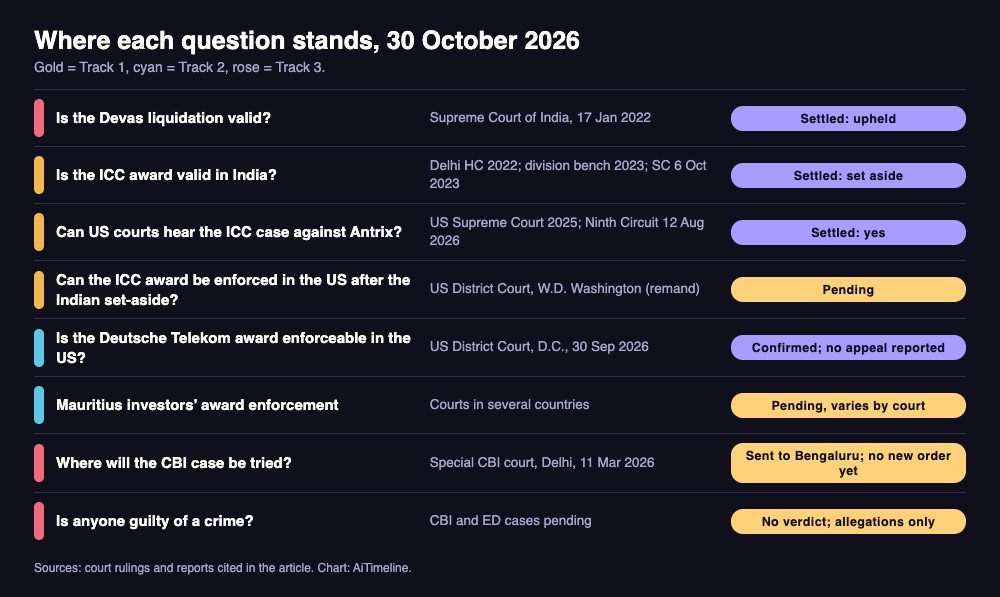
- Track 1: after the Ninth Circuit’s 12 August 2026 ruling, the US district court must decide how the Indian set-aside of the ICC award affects enforcement. Antrix may seek rehearing.
- Track 2: a US district court confirmed Deutsche Telekom’s $101 million award on 30 September 2026. No appeal had been reported.
- Track 3: the CBI must present its chargesheet before a Bengaluru court after the Delhi court’s 11 March 2026 order. No Bengaluru order has been reported.
- Next update: when a Bengaluru court takes up the CBI case, or a remaining overseas enforcement case produces a new order.
Allegations are not convictions
The CBI and ED cases in this story are allegations in pending cases. No court has convicted anyone in the Antrix-Devas criminal cases, and charges had not been framed when the Delhi court sent the chargesheet to Bengaluru in March 2026. A chargesheet is a statement of what an agency alleges. The accused, including former ISRO chairman G. Madhavan Nair, have denied wrongdoing. The fraud finding that led to Devas’ liquidation is a company-law ruling about the company, not a criminal verdict against any person.
💡 Short Answer
The Antrix-Devas deal was a 28 January 2005 lease of 90% of the S-band capacity on ISRO satellites GSAT-6 and GSAT-6A to Devas Multimedia for about Rs 167 crore. The government annulled it on 25 February 2011 for strategic use. Devas won a $562.5 million ICC award in 2015 that Indian courts later set aside; foreign investors won treaty awards of about $111 million and $101 million; and the CBI and ED cases remain allegations, with no conviction.
Antrix-Devas Deal: Key Questions
The Antrix-Devas Deal in Nine Points
- The deal: a 12-year lease of 90% of S-band capacity on GSAT-6 and GSAT-6A, signed 28 January 2005.
- Cancellation: CCS decision on 17 February 2011; Antrix terminated on 25 February 2011.
- Not spectrum allocation: the government says ISRO allocated no spectrum to Devas.
- Three tracks: commercial arbitration, investor-treaty claims, and Indian criminal and corporate cases.
- Track 1: $562.5 million ICC award; set aside in India, confirmed in the US, back before a US district court.
- Track 2: about $111 million and $101 million treaty awards; the German award confirmed in the US on 30 September 2026.
- Track 3: Devas liquidated (Supreme Court, 17 January 2022); CBI case sent to Bengaluru on 11 March 2026.
- No conviction: the criminal cases are allegations.
- Do not add the numbers: the awards come from different proceedings and overlap.
Three Legal Tracks, Not One Case
The dispute is often described as a single case. It is three separate sets of proceedings with different parties, courts and standards.
Commercial arbitration
Devas Multimedia v. Antrix
Contract dispute over the 2005 agreement. ICC award of $562.5 million (2015), confirmed in Washington (2020), set aside in India (2022-23), now at the Ninth Circuit and district court.
Investment-treaty arbitration
Foreign investors v. India
Claims by shareholders under the India-Mauritius and India-Germany treaties. Awards of about $111 million and $101 million (2020), with a US court confirming the German award in 2026.
Indian criminal and corporate cases
India v. Devas and individuals
CBI and ED cases (allegations, no convictions), the 2021-22 liquidation of Devas, and the 2026 order sending the CBI chargesheet to Bengaluru.
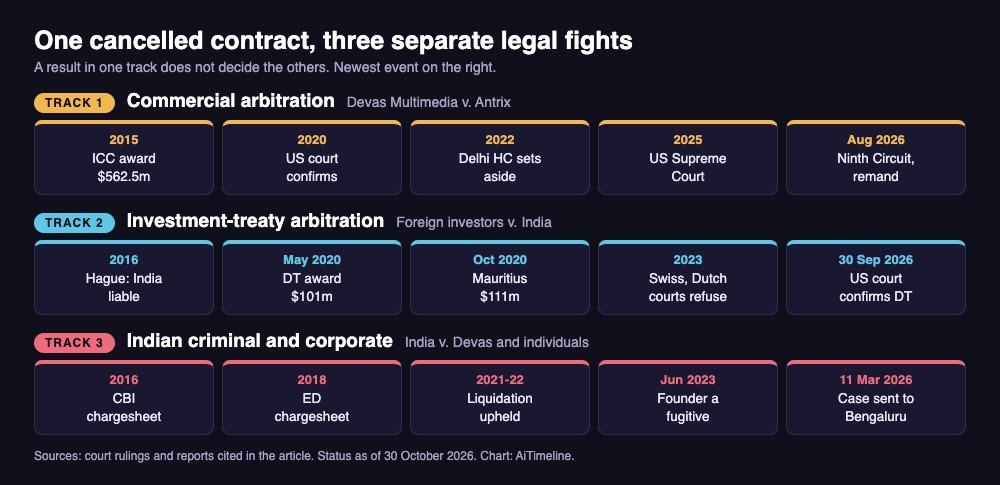
Antrix-Devas Deal Timeline, Latest First
From the September 2026 US ruling back to the 2003 proposal. Each entry is colour-coded and tagged by track.
2026
US court confirms Deutsche Telekom’s $101 million award against India Track 2 · Treaty
In Deutsche Telekom AG v. Republic of India, Judge Richard Leon denied India’s motion and confirmed the award that a Permanent Court of Arbitration tribunal in Geneva made in May 2020 under the India-Germany investment treaty. He wrote that courts in Switzerland, Germany and Singapore had “considered, and rejected, many of the same issues India advances here”, and that he joined them. The Indian Express reported the order in October.
India argued that Deutsche Telekom’s stake, held through a Singapore subsidiary, was not a protected investment, and that the Devas deal was unlawful because Indian courts had found it tainted by fraud. The court held that a covered equity interest in a company does not stop being an investment because the host state later withholds a licence, and that findings against Devas did not show that the German investor itself acted unlawfully or knew of any fraud.
This is a Track 2 ruling about a treaty award. It is separate from Devas Multimedia’s own award against Antrix. As of 30 October 2026 no appeal had been reported in the sources checked.
2026
Ninth Circuit keeps most of the US judgment on Devas’ ICC award Track 1 · Commercial
On remand from the US Supreme Court, the Ninth Circuit held that the arbitration exception to sovereign immunity gives US courts jurisdiction over Antrix, that the exercise of jurisdiction was consistent with the Fifth Amendment, and that forum non conveniens does not apply to a petition to confirm a foreign award under the New York Convention. It affirmed registration of the judgment in favour of Devas Multimedia America Inc. (Bar & Bench; opinion).
It reversed the part of the ruling that let three Mauritius shareholders of Devas register the judgment, finding they lacked standing. It also left open whether the award can be enforced after Indian courts set it aside; the district court must decide that. Devas’ lawyers say the award is now worth more than $2 billion with interest; Antrix may seek rehearing.
This is a Track 1 ruling about the ICC commercial award.
2026
CBI files supplementary chargesheet against two more former officials Track 3 · India cases
The CBI filed a supplementary chargesheet against S.K. Das and R.G. Nadathur after the special court, on 2 September 2025, directed it to probe their roles. The direction followed an application by former Department of Space additional secretary Veena Sriram Rao, who said they were party to the ISRO decisions that led to the 2005 agreement but had not been investigated (The Indian Express).
It is a chargesheet, which is an allegation. It is not a finding that either person committed an offence.
2026
Delhi CBI court says it cannot try the case and returns the chargesheet Track 3 · India cases
The court held that it lacked territorial jurisdiction and ordered the chargesheet returned to the CBI to be presented before a competent court in Bengaluru. Citing the Supreme Court’s Braj Bhushan Prasad (2001) ruling, it said that under the Prevention of Corruption Act the place where the main offence was committed decides the venue. It noted that Forge Advisors’ joint-venture proposal was submitted in Bengaluru, the Shankara Committee that vetted the deal was constituted and met there, and the 28 January 2005 agreement was signed there (The Indian Express).
The CBI had argued that the key Cabinet and Department of Space decisions, involving the Prime Minister’s Office, were taken in Delhi. This was a ruling on venue. It did not acquit anyone and did not decide whether the allegations are true. Charges had not been framed when the application was filed.
2025
Delhi court orders CBI to examine two more officials Track 3 · India cases
Rao, one of the accused, argued that other senior ISRO officials from the early 2000s were also party to the decisions behind the 2005 agreement but had not been investigated. The court directed the CBI to look into the roles of S.K. Das and R.G. Nadathur. The CBI filed its supplementary chargesheet against them on 7 March 2026. On 7 November 2025 Rao separately challenged the court’s territorial jurisdiction.
2025
D.C. Circuit leaves Deutsche Telekom’s case alive, sends defences back Track 2 · Treaty
The appeals court agreed that the district court was right to deny India’s motion to dismiss, but sent the case back so India’s substantive defences under the New York Convention could be considered. That produced the 30 September 2026 ruling (The Indian Express).
Earlier steps: Deutsche Telekom asked the US court to confirm the award on 19 April 2021; India won a stay in July 2022 by saying new evidence showed fraud in the formation of the agreement; the court lifted the stay in March 2023 after the Swiss Federal Supreme Court rejected India’s challenge; and it denied India’s motion to dismiss in March 2024.
2025
US Supreme Court: no extra “minimum contacts” test for foreign states Track 1 · Commercial
The Court held that the Foreign Sovereign Immunities Act has no separate statutory minimum-contacts requirement: if an exception to immunity applies and service is proper, personal jurisdiction exists. It reversed the Ninth Circuit’s earlier ruling for Antrix and sent the case back (opinion).
It did not decide whether the Constitution’s Due Process Clause requires minimum contacts, and it did not decide the merits of the 2005 agreement or whether the award can be enforced.
– 3 Mar 2025
US Supreme Court agrees to hear the case, then hears argument Track 1 · Commercial
The Court took up the question whether a plaintiff must show minimum contacts before a US court can exercise personal jurisdiction over a foreign state sued under the FSIA. The Ninth Circuit had said legislative history showed Congress intended such a requirement. Antrix argued that US courts lacked jurisdiction; Devas and its investors sought recognition of the award.
Devas’ US founder-president declared a fugitive economic offender Track 3 · India cases
A special court under the Prevention of Money Laundering Act declared Devas Multimedia’s US-based president, Ramachandran Vishwanathan, a fugitive economic offender in the ED’s case (Business Standard). The ED’s case is one of the Indian criminal tracks and is separate from the CBI case.
A fugitive-economic-offender order is a declaration about someone who is outside India and is not a conviction for the underlying allegations.
6 Oct 2023
Delhi High Court division bench and Supreme Court leave the set-aside intact Track 1 · Commercial
On 17 March 2023 a division bench dismissed Devas’ appeal against the August 2022 judgment, holding that nothing stopped the single judge from relying on the Supreme Court’s January 2022 findings, and that a court can on its own motion find grounds of public policy or fraud to set aside an award (SCC Online). On 6 October 2023 the Supreme Court dismissed Devas’ appeal, saying the order did not call for interference (Reed Smith; Bar & Bench). That was a dismissal, not a reasoned judgment on the fraud question.
Track 2, same year: the Swiss Federal Supreme Court rejected India’s appeals against the Deutsche Telekom award, and the top court of the Netherlands rejected India’s challenge to the Mauritius investors’ award ({L(DUTCH, ‘report’)}); a separate challenge to the quantum award was reported pending.
2022
Delhi High Court sets aside the $562.5 million ICC award Track 1 · Commercial
The High Court held that the award suffered from fraud and patent illegality and conflicted with the public policy of India, relying on the Supreme Court’s January 2022 judgment (Business Standard). The ICC tribunal had awarded Devas $562.5 million plus interest in September 2015.
This does not end the overseas cases. Devas and its investors ask foreign courts to enforce the award despite the Indian set-aside.
2022
Supreme Court upholds liquidation of Devas Multimedia Track 3 · India cases
The Court dismissed appeals by Devas, through its ex-director, and by shareholder Devas Employees Mauritius against the winding-up order (judgment). It rejected the argument that Antrix’s winding-up petition was meant to deprive Devas of the benefit of the arbitration awards (Business Standard).
This is a corporate-law finding about how Devas was set up. It is not a criminal conviction of any person.
2021
NCLT orders Devas wound up; NCLAT upholds it Track 3 · India cases
Antrix applied to the NCLT in January 2021, saying Devas had been incorporated with a fraudulent motive. The Tribunal ordered liquidation on 25 May 2021 (Business Standard), and the National Company Law Appellate Tribunal confirmed it on appeal, which sent Devas to the Supreme Court.
2020
US federal court in Washington confirms the ICC award Track 1 · Commercial
Judge Zilly granted the petition to confirm the ICC award of $562.5 million plus interest, with post-award interest set at 18% a year. The petition had been filed in September 2018. Reports put the total at about $1.2 billion with interest (Advanced Television); the exact figure depends on interest and later orders, so treat it as an estimate.
2020
Hague tribunal awards the Mauritius investors about $111 million Track 2 · Treaty
After finding India liable in July 2016, the tribunal fixed compensation at about $111 million plus interest for CC/Devas (Mauritius) Ltd. and Telcom Devas Mauritius Ltd. (award). The investors have since sought to enforce it in several countries, including the United States.
Geneva tribunal awards Deutsche Telekom about $101 million Track 2 · Treaty
Deutsche Telekom had invested about $99.2 million in Devas in 2008-09 through a Singapore subsidiary, for a 20.73% stake. The tribunal found that India breached the treaty and awarded about $101 million (The Indian Express). With interest, Deutsche Telekom asked the US court to confirm about $135 million.
ED files money-laundering chargesheet Track 3 · India cases
The ED chargesheeted former Antrix managing director K.R. Sridhara Murthi and Devas officials, alleging that part of the Rs 579 crore of foreign investment Devas received was moved out of India (Advanced Television). The Indian Express reports the ED’s figure as 85% of the funds sent to the US. Reports differ on how many people were named, from six to nine.
These are allegations in a pending case. No court has convicted anyone on them.
2016
CBI chargesheets former ISRO chairman G. Madhavan Nair and seven others Track 3 · India cases
The CBI named Nair, Devas Multimedia and others for criminal conspiracy, cheating and offences under the Prevention of Corruption Act, alleging a wrongful gain of about Rs 578 crore (Business Standard/PTI). The government gave sanction to prosecute in 2017 (Onmanorama). The Indian Express has described the chargesheet both as filed in 2016 and as “2018”; the contemporaneous reports point to August 2016.
A chargesheet is an allegation, not a conviction. Nair and the others have denied wrongdoing, and the case has not reached a verdict.
2016
Hague tribunal finds India breached the Mauritius investment treaty Track 2 · Treaty
The tribunal held that India violated its obligations under the India-Mauritius investment protection agreement in cancelling the deal, and left the amount of compensation for a later stage. According to the Business Standard, the tribunals pointed to delays and indecision in reallocating the spectrum as showing there was no immediate need or emergency. The finding was made in a treaty case against the Republic of India, not in the contract dispute between Devas and Antrix.
2015
ICC tribunal awards Devas $562.5 million Track 1 · Commercial
The tribunal held that Antrix had no legal justification for terminating the agreement and awarded about $562.5 million in damages, with interest. Including pre-award interest the sum reported at the time was about $672 million (The Quint). Devas had sought $1.6 billion, according to the government’s reply to Parliament (PIB).
2013
Government tells Parliament what the agreement was The deal
The Department of Space said Antrix had agreed on 28 January 2005 to lease 90% of the S-band transponder capacity on two satellites, to be funded, built and launched by ISRO. It stated that Antrix had no joint venture with Devas and that ISRO had not allocated any S-band spectrum to Devas. It listed the pending claims: the Mauritius investors’ notice of 3 July 2012, a statement of claim of 1 July 2013, and Deutsche Telekom’s own notice of arbitration of 2 September 2013 (PIB release).
2012
Mauritius shareholders give notice of treaty arbitration Track 2 · Treaty
Three Mauritius-based shareholders of Devas notified India that they were invoking the India-Mauritius investment protection agreement and UNCITRAL rules (PIB). This opened Track 2.
2012
Government bars Madhavan Nair and three others from official posts Track 3 · India cases
Following the Pratyush Sinha team’s findings, the government barred former ISRO chairman G. Madhavan Nair and three other former space officials from holding government posts (Governance Now). Nair challenged it before the Central Administrative Tribunal (Deccan Herald), which dismissed his plea in March 2013.
This was an administrative sanction. It is not a criminal finding, and the officials disputed it.
2011
Pratyush Sinha team reports “serious administrative and procedural lapses” Track 3 · India cases
The team reported lapses and “suggestion of collusive behaviour on the part of certain individuals”. An earlier two-member committee of B.K. Chaturvedi and Roddam Narasimha, which reported to the Prime Minister in March 2011, had concluded, according to press reports, that concerns about spectrum being sold cheaply to Devas had no basis. The two reviews pointed in different directions, and the Sinha findings were the ones the government acted on.
2011
Antrix terminates the agreement The deal
The Cabinet Committee on Security, chaired by the Prime Minister, decided on 17 February 2011 that Antrix should annul the contract (Assam Tribune). Antrix terminated it on 25 February. The government’s stated reason was a decision not to make S-band spectrum available for commercial use but to keep it for strategic needs (PIB).
The decision became public amid the 2G spectrum controversy, and was widely reported as an annulment of a “sweetheart deal”. The Business Standard timeline notes that the Department of Space had recommended annulment on 30 June 2010 and the Space Commission accepted it on 2 July 2010, but this was not communicated to Devas.
2010
Space Commission accepts recommendation to annul The deal
The Department of Space recommended annulment on 30 June 2010 and the Space Commission accepted it on 2 July (Business Standard). This came after complaints about implementation in November 2009 and a review by a committee chaired by B.N. Suresh, set up on 8 December 2009.
Deutsche Telekom invests about $99.2 million Track 2 · Treaty
The German company bought into Devas, joining Mauritius-based investors. Their stakes later became the basis of the two treaty claims (The Indian Express).
2005
Antrix and Devas sign the agreement The deal
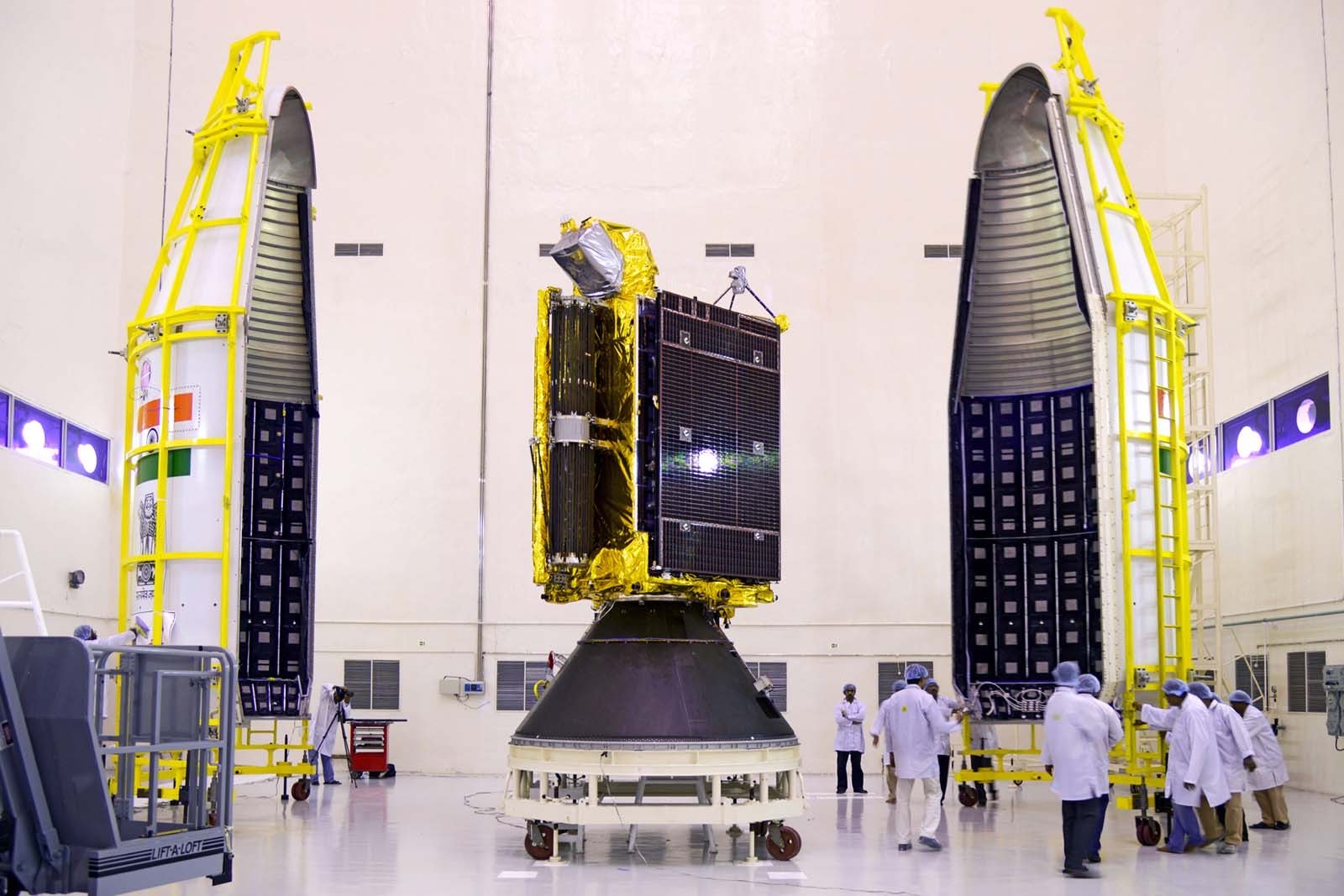
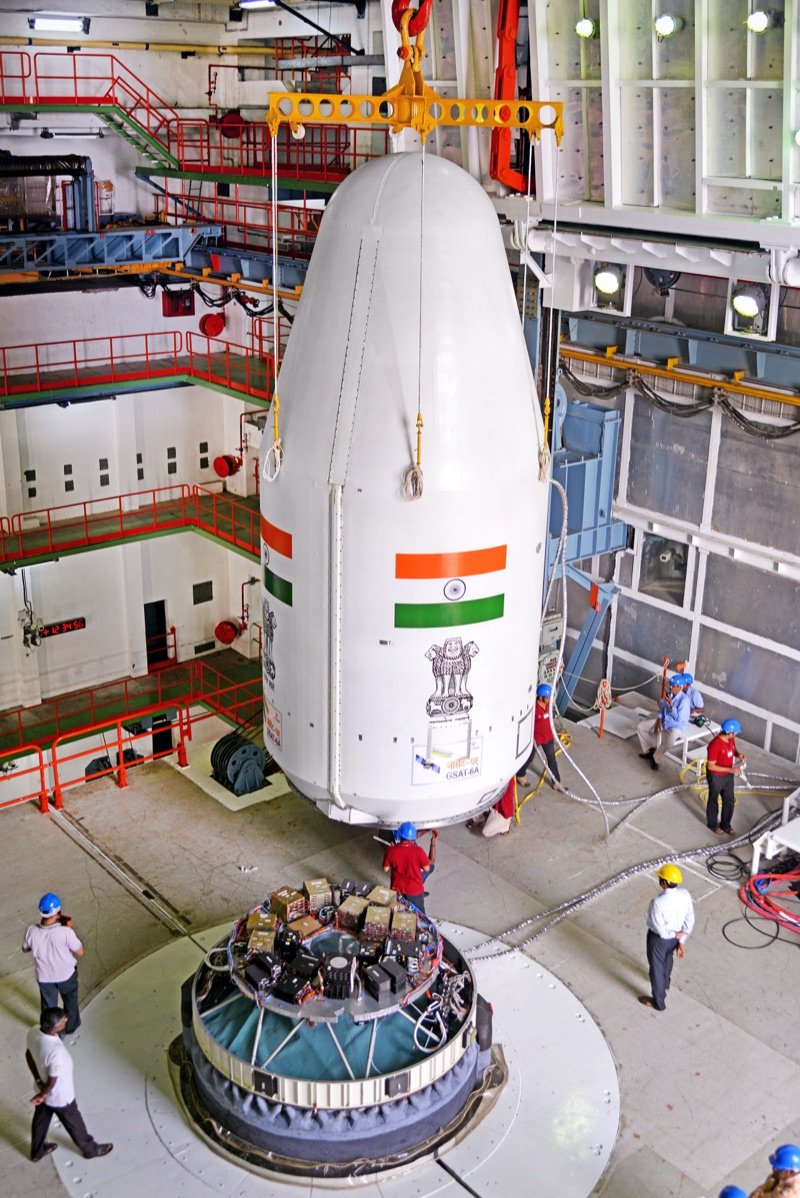
Antrix agreed to lease Devas 90% of the S-band transponder capacity on two ISRO satellites, GSAT-6 and GSAT-6A, to be funded, built and launched by ISRO, for 12 years. The price was Rs 167 crore, according to The Indian Express; the two satellites were built at a cost of Rs 766 crore. Devas planned multimedia services to mobile devices in India.
The government later stated that Antrix had entered no joint venture with Devas and that ISRO had not allocated spectrum to it (PIB).
Dec 2004
From Forge Advisors’ proposal to the founding of Devas The deal
A joint-venture proposal by the US firm Forge Advisors was submitted to Antrix in Bengaluru, and Devas Multimedia was founded in Bengaluru in 2004 by former ISRO officials and US-based space entrepreneurs. The CBI case concerns decisions in this period, and the Delhi court noted in 2026 that the Forge proposal and the Devas deal were handled in Bengaluru.
What is S-band, and what did Devas actually get?
S-band is a stretch of radio spectrum used by satellites, radar and some mobile services. Spectrum is a public resource, so who may use it, and for what, is a government decision. That is the heart of the controversy.
- What the contract covered: a lease of 90% of the S-band transponder capacity on two ISRO satellites, GSAT-6 and GSAT-6A, for 12 years. Transponders are the on-board units that receive and re-transmit signals.
- What the government says it did not do: in December 2013 the Department of Space told Parliament that ISRO had not allocated any S-band spectrum to Devas and that Antrix had no joint venture with it.
- What critics said: that capacity on those transponders was in effect the right to use valuable spectrum, and that it was committed to a private company for a small price without open competition. How much the capacity was worth was argued over in the media. Those estimates were not judicial findings.
- Why the government cancelled: it said S-band was needed for strategic uses, so it would not be available for commercial use (PIB).
For how India later sold spectrum through auctions, see Spectrum Auctions in India: From the 2G Row to 5G; for the licence-allocation case that dominated news in the same years, see The 2G Spectrum Scam.
Why Did the Antrix-Devas Deal Become Controversial?
Five separate questions, which are often run together.
1. Who should get scarce satellite capacity?
Critics asked whether a large share of S-band capacity should have gone to a private firm on negotiated terms. The government later said the capacity was needed for strategic and security uses.
2. Were the terms fair?
The contract price was about Rs 167 crore over 12 years, according to The Indian Express. The CBI alleges a wrongful gain of about Rs 578 crore. These two numbers measure different things and neither is a court finding of loss.
3. How was the deal made?
The CBI and ED looked at how Devas was founded, who the investors were and the roles of officials. Those are allegations in pending cases. The separate winding-up of Devas rests on a company-law finding of fraud in its incorporation, upheld by the Supreme Court in January 2022.
4. Was it a security decision or a cover?
India says the Cabinet Committee on Security cancelled the deal for strategic needs. Foreign tribunals, according to the Business Standard, pointed to delay and indecision in reallocating the spectrum as showing no immediate emergency. A 2010 recommendation to annul preceded the public announcement by seven months.
5. What do investors lose when a state cancels a contract?
Foreign shareholders argued that the cancellation breached treaty protections. Their claims led to treaty awards that courts in several countries are now asked to enforce. For another Indian case with scandal, a foreign arbitration and sharp disputes over evidence, see the AgustaWestland VVIP chopper scam. For how the 2G era shaped public debate, see the Radia tapes controversy.
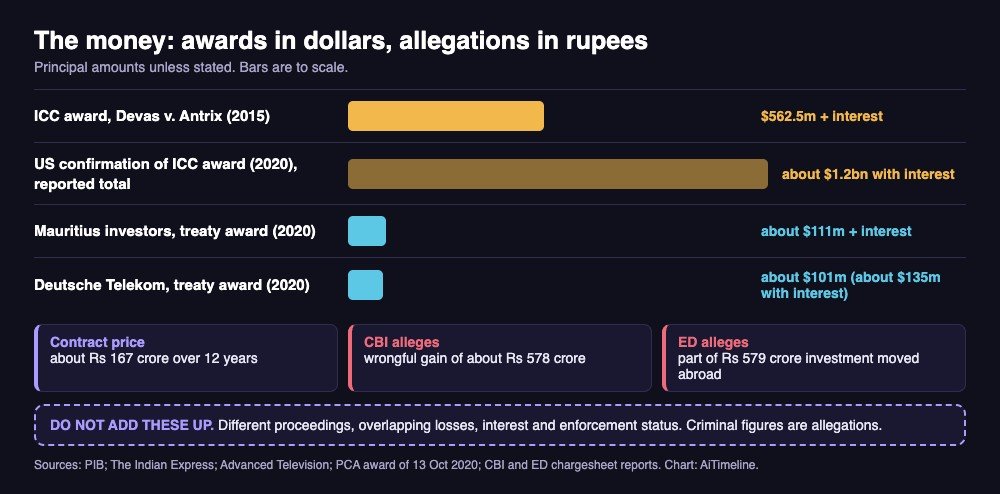
The Money: Awards, Interest and Allegations
Different proceedings, different currencies, different stages. Not additive.
| Proceeding | Amount | Who | Track |
|---|---|---|---|
| ICC commercial arbitration, Sep 2015 | $562.5 million + interest (about $672 million with pre-award interest, reported 2015) | Devas Multimedia | Track 1 |
| US confirmation of ICC award, Oct 2020 | About $1.2 billion with interest (reported; not a fixed figure) | Devas-related claimants | Track 1 |
| Hague treaty award, Oct 2020 | About $111 million + interest | Mauritius investors | Track 2 |
| Geneva treaty award, May 2020 | About $101 million; about $135 million sought with interest | Deutsche Telekom | Track 2 |
| US confirmation of treaty award, 30 Sep 2026 | $101 million award, plus interest | Deutsche Telekom | Track 2 |
| CBI chargesheet, Aug 2016 | Alleged wrongful gain of about Rs 578 crore | Allegation, no verdict | Track 3 |
| ED chargesheet, Aug 2018 | Part of Rs 579 crore of foreign investment allegedly moved abroad | Allegation, no verdict | Track 3 |
Where Each Question Stands
Settled or pending, as of 30 October 2026.
Explore More Timelines
People Also Ask
Antrix-Devas Deal: Frequently Asked Questions
A Satellite Lease That Became a 21-Year Legal Fight
The Antrix-Devas deal began as a plan to deliver mobile multimedia by satellite. Its cancellation in 2011 turned it into a long test of how government policy, commercial contracts, national security and international investment law fit together. India’s courts have upheld the liquidation of Devas and set aside the ICC award. Courts abroad have so far not accepted that as the last word, and the US rulings of August and September 2026 show the claims are still alive.
Three questions are still open: whether a US court will enforce the ICC award after the Indian set-aside, whether India appeals the Deutsche Telekom ruling, and what a Bengaluru court does with the CBI chargesheet. Other cases of this kind are collected in the India Political Cases hub.
What began as a satellite-capacity lease is still being decided, one court at a time.
Related AiTimeline Stories
⚠️ Editorial Note
Last updated 30 October 2026. The deal terms come from the Department of Space’s December 2013 reply to Parliament and the Supreme Court’s January 2022 judgment. The 2026 entries rely on press reports of the court orders and, where available, the opinions themselves; the Ninth Circuit and D.C. district court pages blocked automated access, so those two rulings are described from reports. Allegations in the CBI and ED cases are not findings. Dollar figures are principal amounts unless stated, and reports of totals with interest vary. We will update this page when a Bengaluru court, or a remaining overseas enforcement case, issues a new order.
Sources & further reading
Every dated entry above was checked against these references. Last reviewed 30 October 2026.
- PIB, Department of Space: Antrix-Devas Deal, Lok Sabha reply of 11 December 2013
- Supreme Court of India: Devas Multimedia Pvt. Ltd. v. Antrix Corporation Ltd., judgment of 17 January 2022 (Indian Kanoon)
- Business Standard: Antrix-Devas arbitration, a timeline of the 11-year-long legal battle (30 August 2022)
- The Indian Express: Delhi court rules Antrix-Devas main offences happened in Bengaluru, returns CBI chargesheet (March 2026)
- The Indian Express: US court upholds $101m Deutsche Telekom award over failed Devas-Antrix deal (October 2026)
- Bar & Bench: US court upholds confirmation of Devas' $562.5 million arbitral award against Antrix (14 August 2026)
- US Supreme Court: CC/Devas (Mauritius) Ltd. v. Antrix Corp., No. 23-1201, 5 June 2025 (Cornell LII)
- SCC Online: Delhi High Court upholds decision setting aside ICC award of $562.5 million (21 March 2023)
- Reed Smith: Once always, the Supreme Court of India upholds set-aside on fraud (October 2023)
- PCA: CC/Devas (Mauritius) Ltd. and Telcom Devas Mauritius Ltd. v. India, Award on Quantum, 13 October 2020 (italaw)
- Governance Now: Ex-ISRO chief, three other scientists barred from government jobs (January 2012)
- Business Standard/PTI: Antrix-Devas deal, CBI charges ex-ISRO chairman and top officials (11 August 2016)