Malegaon Blast 2008: Investigation, NIA Case, Acquittal and Justice Timeline
Malegaon blast 2008: ATS and NIA probes, the 17-year trial, the 31 July 2025 acquittal of seven accused and the victims' appeal, with sources.
Latest Story
On the night of 29 September 2008 a motorcycle bomb killed six people at Bhiku Chowk. The Malegaon blast 2008 case then passed from local police to the Maharashtra ATS and the NIA, and on 31 July 2025, after 17 years, a special court acquitted all seven accused. The court accepted that the blast happened. It held that the prosecution had not proved who was responsible. As of 3 November 2026, relatives of the victims are appealing in the Bombay High Court.
💡 Short Answer
The 2008 Malegaon blast killed six people and injured 95, the figure the court accepted. The ATS arrested Pragya Singh Thakur, Lt Col Purohit and others, and the NIA later changed the case. On 31 July 2025 a special NIA court acquitted all seven accused, holding the prosecution had not proved its case beyond reasonable doubt. Victims’ relatives have appealed to the Bombay High Court, which issued notices on 18 September 2025.
Malegaon Blast 2008: Key Questions
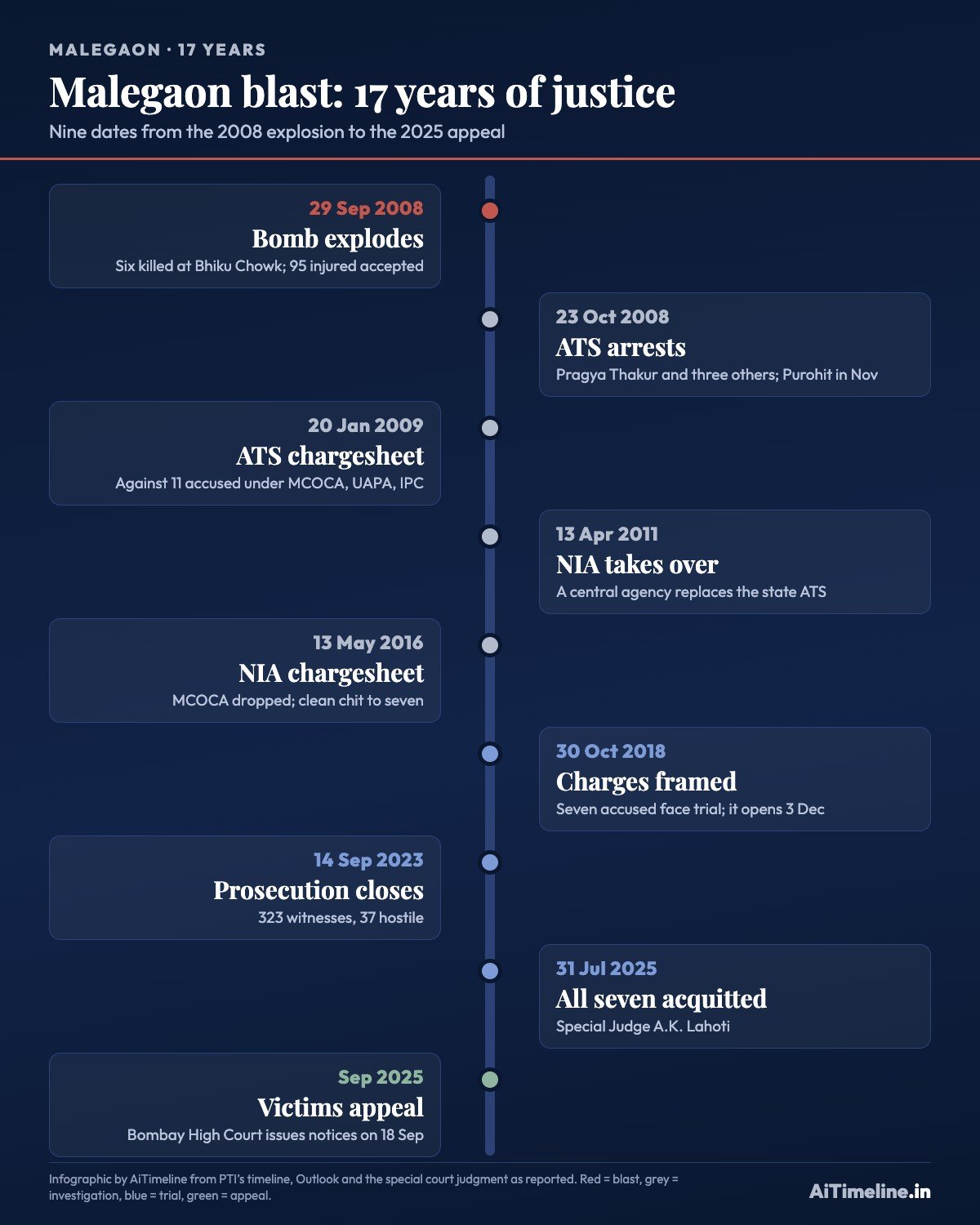
The Malegaon Blast Case in Nine Points
- 2008: a motorcycle bomb killed six people during Ramzan; the court accepted 95 injured.
- ATS: arrests began on 23 October 2008, and a chargesheet against 11 followed on 20 January 2009.
- MCOCA: dropped, restored, remitted and finally dropped again by the NIA.
- NIA: took over on 13 April 2011 and changed the case in its May 2016 chargesheet.
- Trial: charges framed on 30 October 2018 against seven; 323 witnesses, 37 hostile.
- Verdict: all seven acquitted on 31 July 2025.
- Reasons: reports cite the motorcycle, defective sanctions, forensic problems and hostile witnesses.
- Appeal: victims’ relatives went to the Bombay High Court; notices issued 18 September 2025.
- Distinction: a terror attack occurred, but guilt of these seven was not proved.
Where the Malegaon case stands
- Trial: over. On 31 July 2025 a special NIA court acquitted all seven accused, finding the prosecution had not proved its case beyond reasonable doubt.
- Appeal: relatives of six victims have appealed to the Bombay High Court. It issued notices on 18 September 2025 to the seven, the NIA and the Maharashtra government.
- NIA and the state: we found no report that either has filed its own appeal. The NIA said on 28 August 2025 that it was studying the verdict.
- Ruling on the appeal: none found as of 3 November 2026. Check the Bombay High Court case record for the latest listing.
- Not to be confused with: the separate 2006 Malegaon blast, in which the High Court discharged four accused on 22 April 2026, according to India TV.
The story in six pictures
Background: What Happened in Malegaon
The night of 29 September 2008.
What happened on 29 September 2008
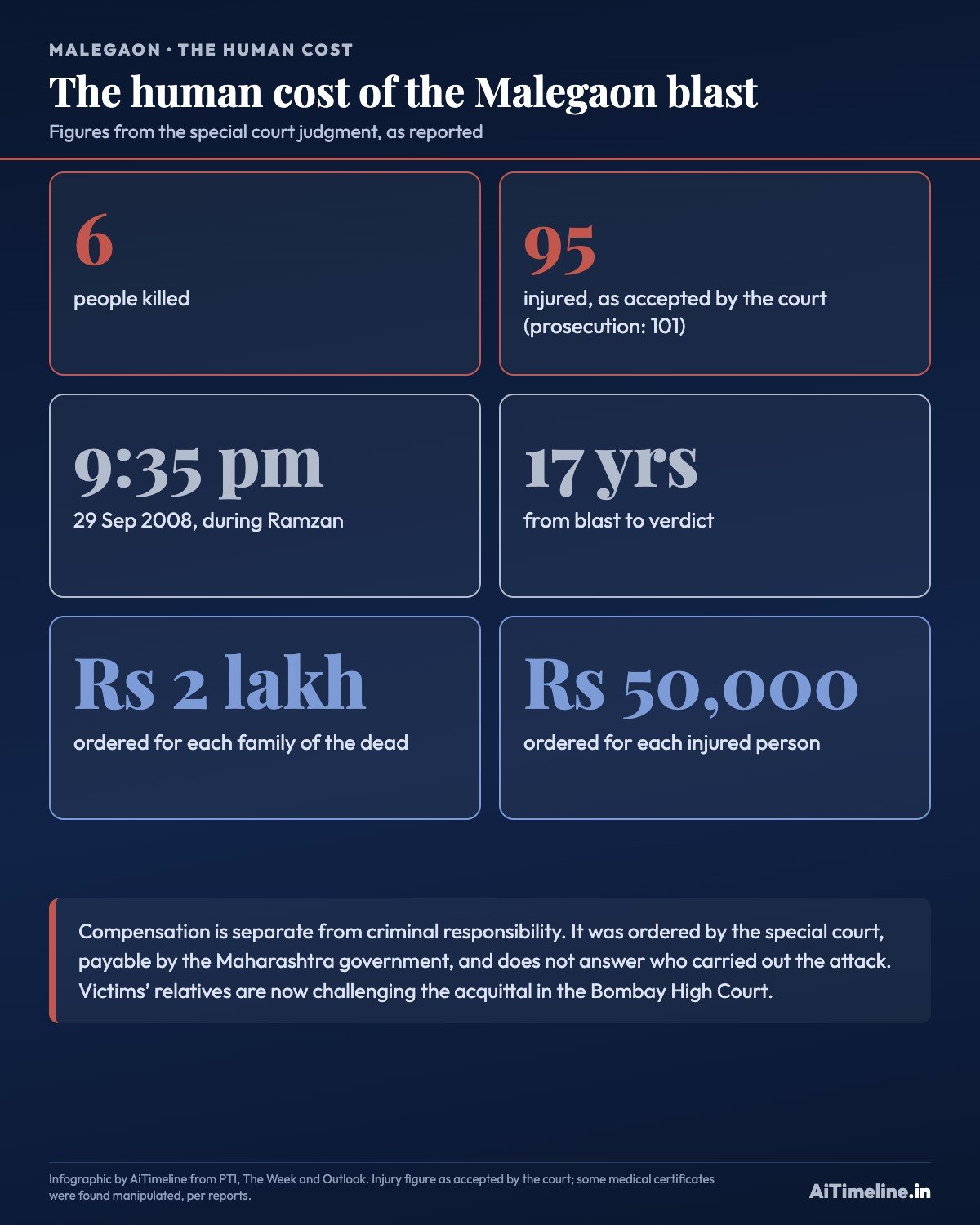
Malegaon, in Maharashtra’s Nashik district, is a textile and powerloom town with a large Muslim population. At about 9:35 pm on 29 September 2008, during Ramzan, a bomb attached to a motorcycle exploded near Bhiku Chowk, close to a mosque. Six people were killed. The prosecution put the injured at 101; the court accepted 95, finding some medical certificates had been manipulated, according to reports of the judgment.
Three agencies, one case
Local police registered the FIR. The Maharashtra Anti-Terrorism Squad (ATS) took over on 21 October 2008 and the National Investigation Agency (NIA) on 13 April 2011. The case then spent 17 years in the courts, with fights over which law applied, a change of the prosecution’s position and 323 witnesses. It became one of India’s most politically charged terrorism cases because the ATS case named people linked to Hindu organisations.
How to read this record
Entries are colour-coded into four tracks: the blast and victims, the ATS and NIA investigation, the courts, and political debate. Allegations are labelled as allegations. An acquittal means the prosecution did not prove guilt to the criminal standard. It does not say the blast did not happen, and it does not say every allegation was fabricated. For another long-running case where the courts and the investigators diverged, see our Bhima Koregaon timeline.
Malegaon Blast Timeline, 2008 to 2025, Latest First
Entries are colour-coded by track. Allegations are labelled as such.
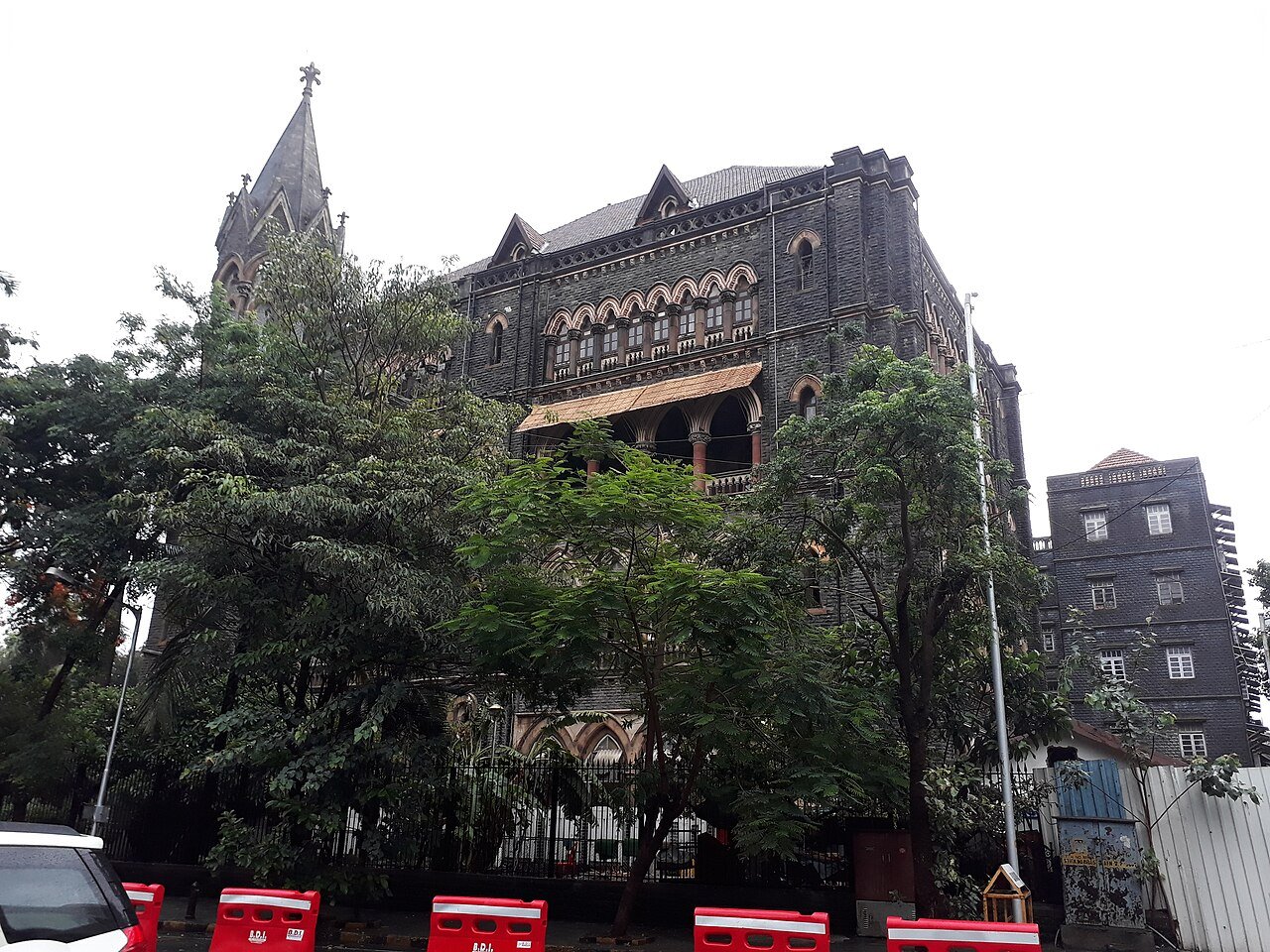
Victims’ families appeal; High Court issues notices Courts, bail and trial
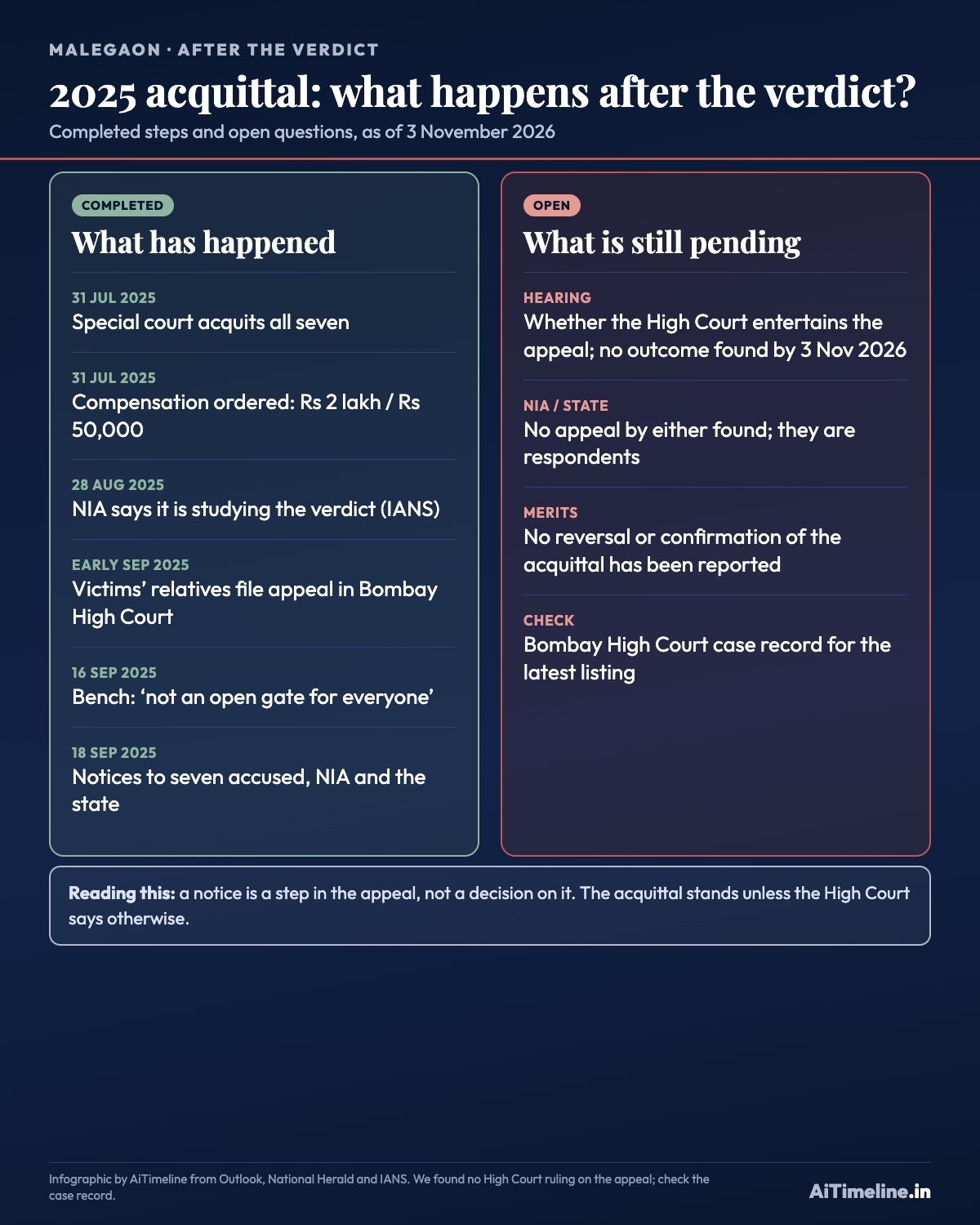
What happened: Relatives of the six people killed filed an appeal in the Bombay High Court against the acquittal. On 16 September the bench said the court was ‘not an open gate for everyone’ to appeal an acquittal and asked whether the family members had been examined as witnesses. On 18 September it issued notices to the seven acquitted accused, the NIA and the Maharashtra government, and posted the matter six weeks later.
Who is appealing: The appellants are victims’ relatives. The reports we read name the NIA and the state only as respondents. On 28 August, IANS reported the NIA was still studying the verdict and had not decided on an appeal; we found no report that it later filed one.
Since then: Siasat reported a later hearing was adjourned over incomplete details about the appellants (we read the headline, not the article). We found no High Court ruling on the appeal as of 3 November 2026.
Politicians react; the ‘saffron terror’ argument returns Political and public debate
What happened: BJP leaders said the verdict disproved the ‘saffron terror’ theory. The Maharashtra Chief Minister said terrorism was never saffron. Pragya Thakur, who had spent years in custody, said her life had been stained. AIMIM leader Imtiaz Jaleel demanded the state government challenge the acquittal in the High Court.
How to read it: These are political positions. The court acquitted seven people for want of proof. It did not rule on any party’s narrative, and it did not say who planted the bomb.
Special NIA court acquits all seven accused Courts, bail and trial
The verdict: The court found no ‘cogent and reliable’ evidence for conviction and held the prosecution had failed to prove its case beyond reasonable doubt. Pragya Singh Thakur, Prasad Purohit, Ramesh Upadhyay, Ajay Rahirkar, Sameer Kulkarni, Sudhakar Chaturvedi and Sudhakar Dwivedi were acquitted.
What it accepted: That a blast occurred at Bhiku Chowk and killed six people. Reports say the court held the prosecution had proved the explosion but not that the bomb was fitted on the motorcycle.
Why the case fell: As reported: the motorcycle had no clear chassis number and possession by Pragya Thakur was not proved; the UAPA sanction orders were defective; forensic samples were contaminated; phone interceptions were not authorised; and 37 of 323 prosecution witnesses turned hostile. The court also ordered Rs 2 lakh to each family of the dead and Rs 50,000 to each injured person.
Caveat: We could not open the judgment. Details come from PTI and news reports of it.
Trial closed for judgment Courts, bail and trial
What happened: After final arguments by the prosecution and the defence, the special court closed the trial and reserved its verdict. It was delivered on 31 July.
Defence evidence ends; accused give their statements Courts, bail and trial
What happened: On 23 July 2024 the examination of eight defence witnesses was completed. On 12 August the court recorded the accused’s statements under Section 313 of the Code of Criminal Procedure, which gives each accused the chance to answer the evidence against them.
Prosecution closes its evidence after 323 witnesses Courts, bail and trial
What happened: The prosecution decided to close its evidence after examining 323 witnesses, of whom 37 turned hostile, meaning they went back on what they had told investigators earlier.
Why it matters: Reports of the judgment say witnesses to the alleged conspiracy meetings were among those who did not support the prosecution.
Charges framed against seven; trial begins Courts, bail and trial
Charges: On 30 October 2018 charges were framed against Thakur, Purohit, Ramesh Upadhyay, Sameer Kulkarni, Ajay Rahirkar, Sudhakar Dwivedi and Sudhakar Chaturvedi: a terrorist act under the UAPA, and criminal conspiracy and murder under the IPC.
Trial: The first witness was examined on 3 December 2018. All the accused were on bail by then.
Three accused discharged; some UAPA charges dropped Courts, bail and trial
What happened: The court discharged Shivnarayan Kalsangra, Shyam Sahu and Praveen Mutalik (also spelled Takalki) from the case. It also dropped charges of belonging to a terrorist organisation and raising funds for terrorist acts under the UAPA.
Bail for Pragya Thakur and Purohit Courts, bail and trial
What happened: On 25 April 2017 the Bombay High Court granted bail to Pragya Thakur and refused it to Purohit. On 21 September the Supreme Court granted Purohit bail. By the end of the year, all arrested accused were out on bail.
Context: Bail lets an accused leave custody during trial. It is not an acquittal and not a finding on the allegations.
NIA files its chargesheet and drops MCOCA ATS and NIA investigation
What happened: The NIA filed a chargesheet, dropped the MCOCA charges and, in PTI’s words, ‘gives clean chit to seven accused’. In February 2016 it had told the court it had taken the Attorney General’s opinion on whether MCOCA applied.
Reading it: A change in a prosecution’s position is not proof of wrongdoing by anyone. It does show how far the NIA’s case differed from the ATS case. A different list of seven people was later charged, in October 2018.
Special prosecutor says she was pressed to go soft Political and public debate
What happened: Special public prosecutor Rohini Salian said publicly that she had been put under pressure by the NIA to go soft on the accused.
Response: The NIA denied the allegation, and the Centre later told the Supreme Court there was no truth in it.
Caveat: This is an allegation, not a finding. We found no judicial finding that the NIA interfered.
Supreme Court sends the MCOCA question back Courts, bail and trial
What happened: The Supreme Court sent the case back to the special court to reconsider whether MCOCA applied. The accused had challenged the 2010 High Court order restoring those charges.
MCOCA dropped, restored, and challenged Courts, bail and trial
What happened: In July 2009 the special court held MCOCA did not apply. The Maharashtra government appealed in August 2009. In July 2010 the High Court overturned that order and upheld the MCOCA charges. In August 2010 Purohit and Pragya Thakur went to the Supreme Court.
NIA takes over; arrests reach 14 ATS and NIA investigation
What happened: The National Investigation Agency took over on 13 April 2011. The ATS had arrested Pravin Mutalik on 1 February 2011, making 12 arrests. The NIA arrested Lokesh Sharma and Dhan Singh Chaudhary in February and December 2012, taking the total to 14.
ATS files its first chargesheet against 11 ATS and NIA investigation
What happened: The ATS filed its chargesheet against 11 arrested accused, including Pragya Thakur and Purohit, under MCOCA, the UAPA and the IPC. Ramji alias Ramchandra Kalsangra and Sandeep Dange were shown as wanted.
Allegation, not finding: The ATS said the blast was carried out by right-wing extremists. The special court did not find this proved.
ATS arrests Pragya Thakur and others, then Purohit ATS and NIA investigation
What happened: On 23 October 2008 the ATS made its first arrests: Pragya Singh Thakur and three others. In November it arrested Lt Col Prasad Purohit for his alleged part in the conspiracy.
Allegation, not finding: The prosecution case linked the motorcycle to Thakur and described meetings of Abhinav Bharat members. Both were alleged, and the 2025 court did not find them proved.
Maharashtra ATS takes over the investigation ATS and NIA investigation
What happened: Three weeks after the blast, the ATS took over the probe from the local police.
FIR registered at Azad Nagar police station ATS and NIA investigation
What happened: An FIR was lodged the day after the blast.
Motorcycle bomb explodes at Bhiku Chowk The blast and victims
What happened: A bomb attached to a motorcycle exploded near Bhiku Chowk, close to a mosque, during Ramzan. Six people were killed. The prosecution put the injured at 101; the court accepted 95, finding some medical certificates had been manipulated, according to reports.
What the court later held: The explosion and the six deaths were established. Who planted the bomb was not.
ATS vs NIA: How the Investigation Changed
Three stages: allegation, re-examination, judgment.
The case passed through three stages. Each is described below as it appears in the record, and the first two are the prosecution’s positions, not findings.
| Stage | Who | Position |
|---|---|---|
| 1. ATS case | Maharashtra ATS, 2008-2011 | A conspiracy by right-wing extremists; a motorcycle linked to Pragya Thakur; meetings of Abhinav Bharat members; chargesheet against 11 on 20 Jan 2009 under MCOCA, UAPA and IPC |
| 2. NIA case | National Investigation Agency, 2011 onward | Re-examined the evidence; dropped MCOCA on 13 May 2016; gave a clean chit to seven accused, per PTI; a different list of seven was later charged |
| 3. Court findings | Special NIA court, 31 Jul 2025 | The blast and six deaths were established; the accused’s involvement was not; no cogent and reliable evidence for conviction |
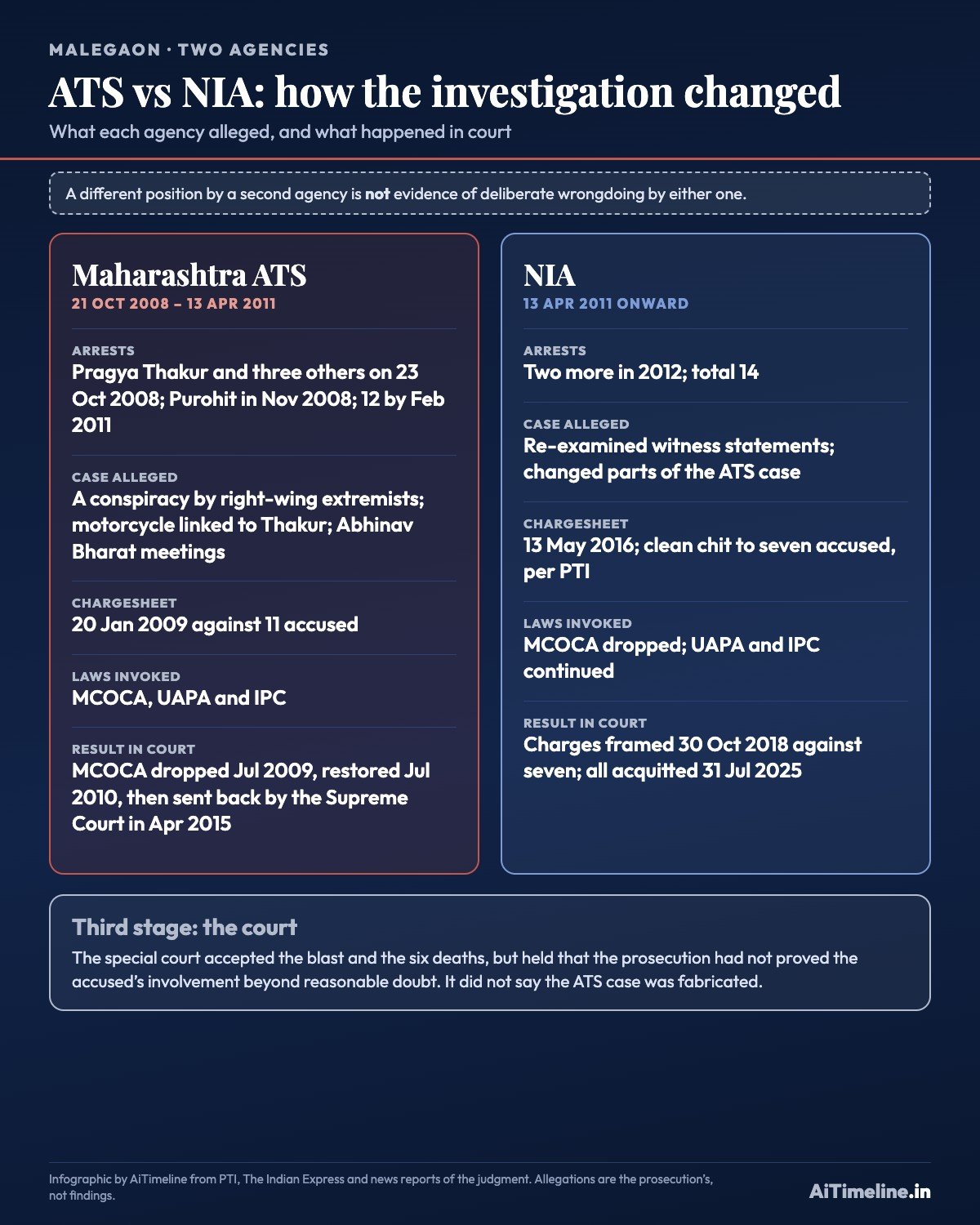
The NIA changing the ATS case is one of the most disputed parts of the story. Critics saw a softening, and defenders saw a correction after a fresh look. The court did not rule on either reading, and a change of position is not proof that anyone acted in bad faith.
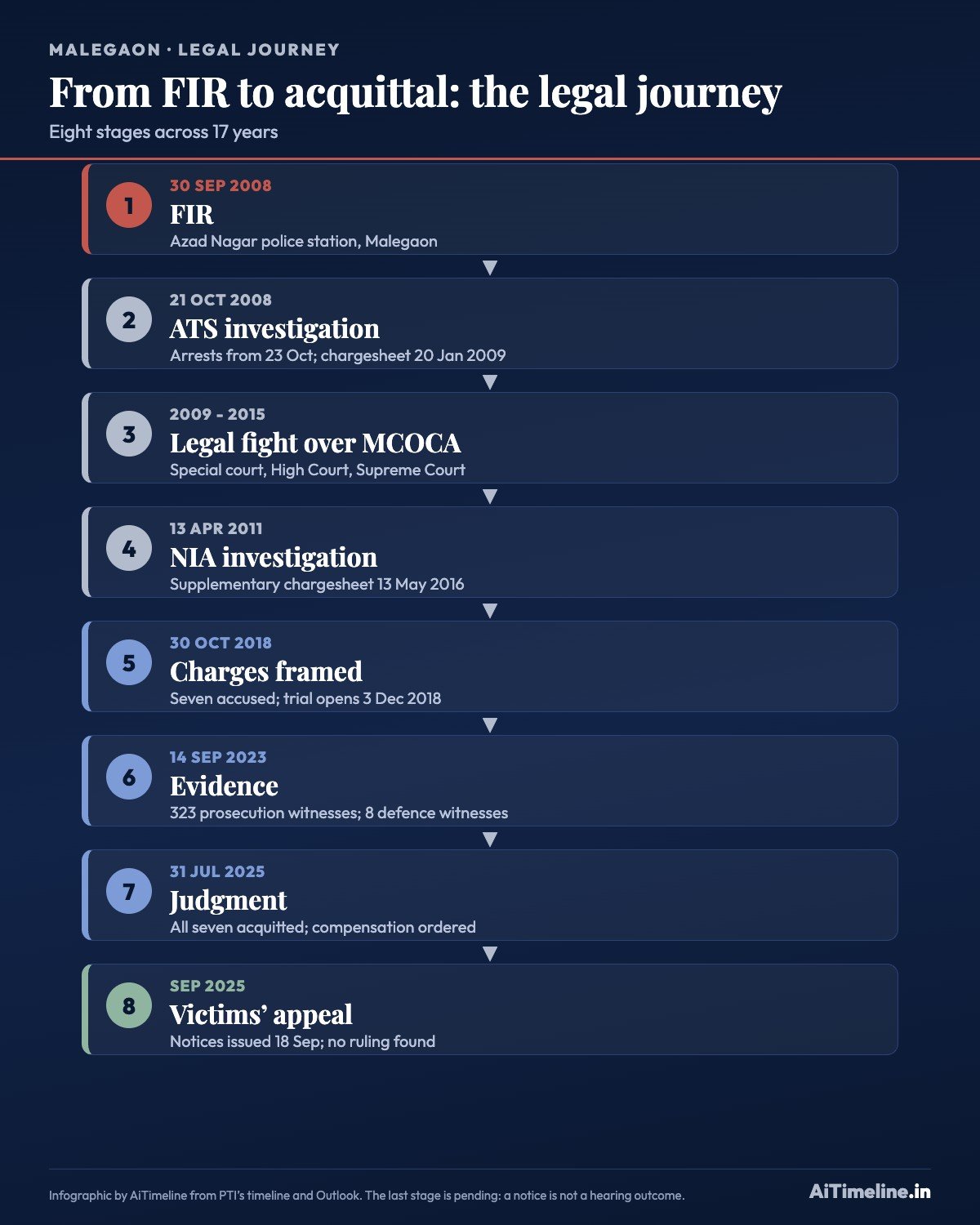
From FIR to Acquittal: The Legal Journey
The case’s path from FIR to appeal ran through eight stages. Years went on which law applied before the evidence was tested, and the trial itself began a decade after the blast.
Why the Prosecution Failed
What the court is reported to have found.
The special court is reported to have found the prosecution’s evidence wanting on several points. We could not open the full judgment, so the table follows PTI, BoomLive, Tribune and other reports of it.
| Issue | What the court is reported to have found |
|---|---|
| Conspiracy meetings | Not established; 37 of 323 prosecution witnesses turned hostile |
| Motorcycle | No clear chassis number; the prosecution could not prove Pragya Thakur possessed it before the blast |
| Bomb installation | The prosecution did not prove the bomb was fitted on the motorcycle or who planted it |
| RDX | No evidence that Purohit sourced RDX from Kashmir, stored it or assembled the bomb, as reported |
| Forensic evidence | Samples were contaminated, so the reports were not reliable |
| Phone interceptions | Some interceptions were not authorised |
| UAPA sanctions | Both sanction orders were defective |
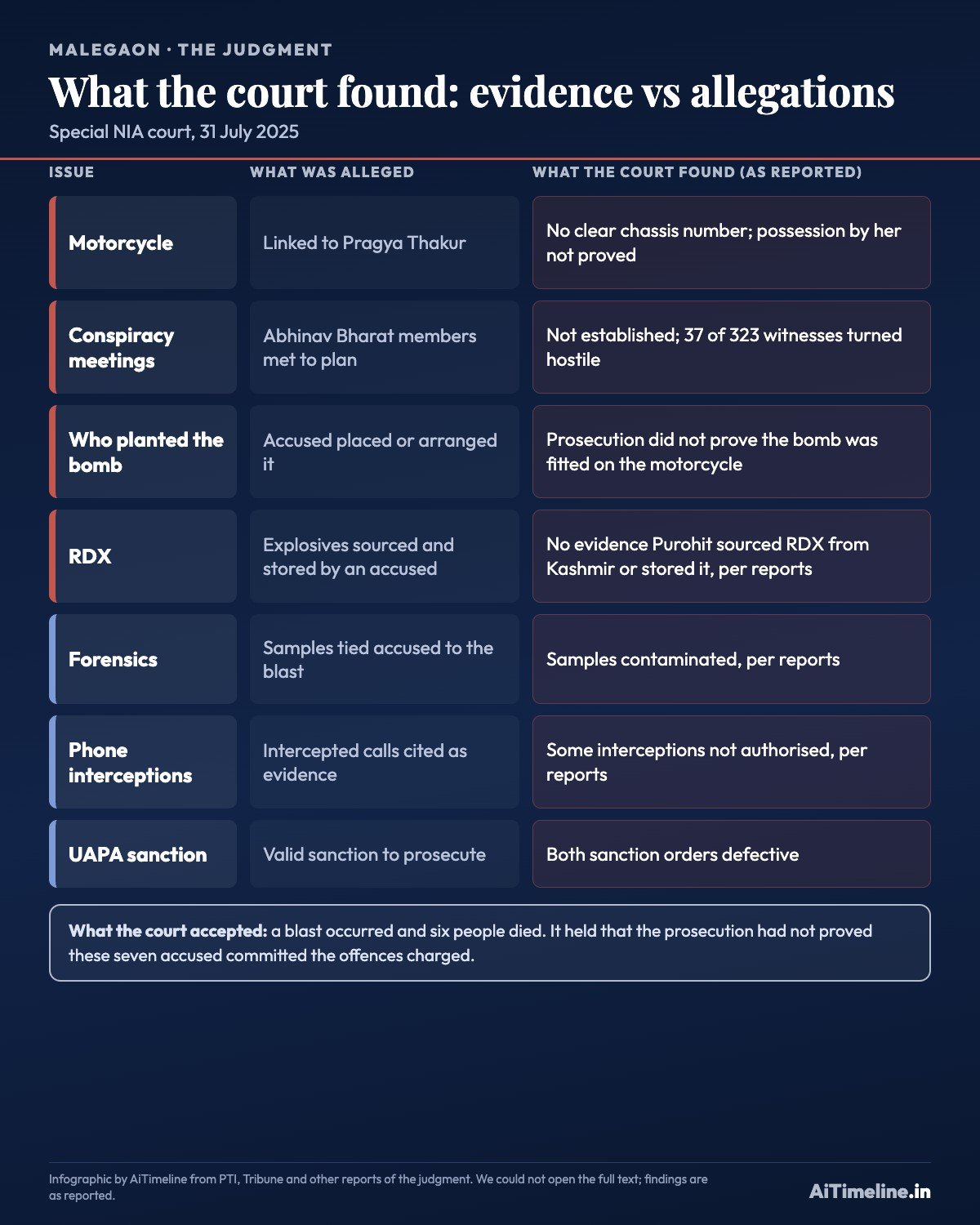
The court did not conclude that the bombing was imaginary or that no terrorist attack occurred. It concluded that the prosecution had not proved that these seven accused committed the offences charged.
The Seven Accused: What Happened in Court
Roles are the prosecution’s allegations. All seven were acquitted.
| Accused | Role in the prosecution case (allegation) | Outcome |
|---|---|---|
| Pragya Singh Thakur | Alleged motorcycle connection and conspiracy; bail 25 Apr 2017 | Acquitted 31 Jul 2025 |
| Lt Col Prasad Purohit | Alleged conspiracy and explosives procurement; Supreme Court bail 21 Sep 2017 | Acquitted 31 Jul 2025 |
| Ramesh Upadhyay | Alleged conspiracy | Acquitted 31 Jul 2025 |
| Ajay Rahirkar | Alleged organisational and financial links | Acquitted 31 Jul 2025 |
| Sameer Kulkarni | Alleged participation in the conspiracy | Acquitted 31 Jul 2025 |
| Sudhakar Chaturvedi | Alleged conspiracy links | Acquitted 31 Jul 2025 |
| Sudhakar Dwivedi | Alleged conspiracy links | Acquitted 31 Jul 2025 |
Acquittal means the prosecution did not prove guilt to the criminal standard. It should not be read as proof that every allegation made during the investigation was fabricated.
Political Impact: Why the Case Became Controversial
The Malegaon case became part of a wider debate about terrorism, religious identity and the independence of investigators. The positions below are political, not judicial findings.
- ‘Hindu terror’ and ‘saffron terror’. The ATS case named people linked to Hindu organisations, and the phrases entered political debate. Parties disagreed over whether they described real networks or were used for political ends.
- BJP and Congress. The two main parties have traded charges over the case since 2008, over the ATS investigation and over the NIA’s later change of course.
- The prosecutor’s claim. Rohini Salian’s June 2015 allegation of pressure from the NIA raised questions about prosecutorial independence. The NIA denied it, and it is an allegation, not a finding.
- After the verdict. BJP leaders said the verdict disproved the ‘saffron terror’ theory. The Maharashtra Chief Minister said terrorism was never saffron. AIMIM’s Imtiaz Jaleel asked the state to challenge the acquittal.
- Accountability of agencies. The case raised questions about forensic standards, witness protection, sanctions and evidence handling.
For a comparable case tracked on this site, see our Dantewada Maoist attack timeline, and for how a terror attack shapes policy, our Pulwama attack timeline.
The Victims and the Question of Justice
The legal outcome did not erase the suffering of those hurt. Six people died, and the court accepted that 95 were injured (the prosecution had said 101). Families waited 17 years for the criminal case to end. The special court directed Rs 2 lakh to the family of each person killed and Rs 50,000 to each injured person, payable by the Maharashtra government. Compensation is separate from criminal responsibility, and it does not identify who carried out the attack. Relatives of six victims are now challenging the acquittal in the Bombay High Court.
What Happens Next: The Appeal
Done, pending and unknown.
The acquittal is the operative outcome. The appeal is a separate legal step. What follows is a record of what has happened and what is only pending.
| Step | Position as of 3 Nov 2026 |
|---|---|
| Trial verdict | All seven acquitted, 31 Jul 2025 |
| NIA decision on appeal | Said on 28 Aug 2025 it was studying the verdict; no appeal by the NIA found |
| Victims’ appeal | Filed in the Bombay High Court in early Sep 2025 |
| High Court notices | Issued 18 Sep 2025 to the seven, the NIA and the state |
| Hearing on maintainability | The bench asked on 16 Sep 2025 whether relatives were examined as witnesses; a later hearing was reported adjourned |
| Ruling on the appeal | None found |
On the record
- The blast on 29 Sep 2008 and six deaths.
- Injuries: the court accepted 95; the prosecution had said 101.
- The trial ended with acquittal on 31 Jul 2025.
- The court ordered compensation.
Not proved in court
- That these seven committed the offences charged.
- Who planted the bomb.
- That the bomb was fitted on the motorcycle.
- The alleged conspiracy meetings.
Open on 3 Nov 2026
- Whether the High Court entertains the appeal.
- Whether the NIA or the state appeals.
- Whether anyone will be held responsible for the attack.
Explore More Timelines
People Also Ask
Malegaon Blast 2008: Frequently Asked Questions
Conclusion: Who Answers for Malegaon?
The Malegaon case is not simply a story of seven people acquitted after 17 years. It is a story of a deadly attack, competing investigative narratives, a prosecution that changed course, and the limits of a criminal trial when the evidence does not reach the required standard.
The 2025 verdict drew a legal distinction: that a terrorist attack occurred does not by itself prove the guilt of those accused of planning it. For the victims’ families the question of accountability now runs through the appeal. For investigators, the lesson is the importance of preserving evidence, valid sanctions and witnesses who hold. The central question remains how a country delivers justice to the victims of terrorism when years of investigation and trial do not establish who is responsible.
Related AiTimeline Stories
⚠️ Editorial Note
Last updated 3 November 2026. Dates follow PTI’s timeline and news reports. We could not open the special court’s judgment, so its findings are given as reported. Items flagged for review: the Bombay High Court record for any hearing or ruling on the victims’ appeal after 18 September 2025, whether the NIA or the state appeals, and the reasons on RDX and phone interceptions, which come from press reports. Allegations by the ATS, the NIA and the accused are labelled as allegations. Nothing here says who carried out the attack, and the accused are named because the court case named them. Casualty figures follow the trial court judgment as reported: six killed and 95 injured accepted, against the prosecution’s 101.
Sources & further reading
Every dated entry above was checked against these references. Last reviewed 3 November 2026.
- PTI via The Week: Timeline of events in 2008 Malegaon blasts case (31 July 2025)
- All India Radio News: NIA court acquits all accused in 2008 Malegaon blasts case (31 July 2025)
- The Wire: Malegaon terror blast, special NIA court acquits all seven accused
- BoomLive: Malegaon blast verdict, NIA evidence, acquittal and implications
- Outlook: Bombay HC admits appeal against acquittal in Malegaon blast case, issues notices (18 September 2025)
- National Herald: Malegaon blast, Bombay High Court bars open appeals against acquittal (16 September 2025)
- IANS: Malegaon blast acquittal, NIA studying verdict, no decision yet on filing appeal (28 August 2025)
- Scroll: 2008 Malegaon blast, victims move Bombay HC against acquittal
- Tribune: Malegaon verdict disproves saffron terror theory, says BJP
- ETV Bharat: Terrorism was never saffron and will never be, Fadnavis
- Free Press Journal: Highlights of NIA court verdict in 2008 Malegaon blast case, faulty medical certificates (31 July 2025)
- The Wire: NIA told prosecutor to go soft on accused, Rohini Salian (June 2015)
- LiveLaw: Never tried to influence Malegaon blast prosecutor, Centre tells Supreme Court
- India TV: Bombay High Court acquits four accused, quashes charges in 2006 Malegaon blast (22 April 2026)