Sardar Patel Jayanti: The Integration of India’s Princely States
Explore the Sardar Patel Jayanti timeline detailing how 562 princely states integrated into India and the three states that fiercely resisted.
Latest Story
Every year on October 31, India marks Sardar Patel Jayanti — the birth anniversary of Sardar Vallabhbhai Patel, the country’s first Deputy Prime Minister and Home Minister, observed nationally since 2014 as Rashtriya Ekta Diwas (National Unity Day). The day is not just a tribute to one leader. It commemorates one of the twentieth century’s largest peacetime political integrations: the absorption of more than 560 princely states into the newly independent Union of India between 1947 and 1950. This is the story of how that map was built — state by state, negotiation by negotiation, and in three difficult cases, by force.
🧠 AI Overview Summary
Sardar Patel Jayanti (October 31) honours Vallabhbhai Patel, India’s first Home Minister, who along with civil servant V.P. Menon negotiated the accession of more than 560 princely states into India after August 1947, using the Instrument of Accession, Standstill Agreements and privy purses. Junagadh, Hyderabad and Jammu & Kashmir resisted; Junagadh joined after a 1948 plebiscite, Hyderabad was integrated by military action (Operation Polo, September 1948), and Kashmir’s accession in October 1947 triggered a war whose territorial dispute continues today.
Sardar Patel Jayanti: Key Questions
What to know about the integration of India
- Not one agreement: India’s territorial unity was built through hundreds of separate negotiations, not a single treaty or declaration.
- Six-week sprint: The States Department was created on 5 July 1947; by Independence on 15 August, the large majority of rulers had already agreed to accede.
- Two-stage process: Accession (defence, external affairs, communications) came first; full administrative and constitutional integration took until 1950 and beyond.
- The Instrument of Accession let rulers join India without immediately surrendering internal administration — a deliberately narrow first ask.
- Junagadh, Hyderabad and Kashmir were the exceptions, each resolved through a different mechanism: plebiscite, military action, and war followed by a UN-mediated ceasefire.
- Operation Polo (September 1948) is the one case where India used force to integrate a princely state, after Standstill Agreement negotiations with the Nizam of Hyderabad broke down.
- Privy purses compensated former rulers financially for surrendering political power — a negotiated settlement later abolished by the 26th Constitutional Amendment in 1971.
- Mergers continued for years: Saurashtra, Rajasthan, Madhya Bharat and PEPSU were built by combining dozens of smaller states well after 1947.
- India’s state boundaries kept changing: the 1956 States Reorganisation Act and 1960’s Maharashtra-Gujarat split reshaped the map again, on linguistic lines.
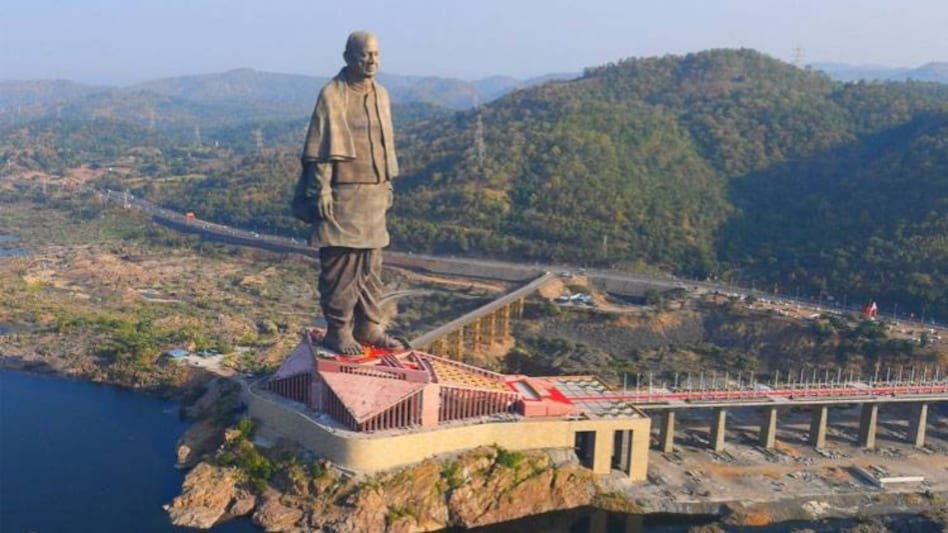
- October 31 became Rashtriya Ekta Diwas in 2014, and the Statue of Unity — the world’s tallest statue at 182 metres — opened on Patel’s birth anniversary in 2018.
What was a princely state?
British India’s other half
Before 1947, the Indian subcontinent was split into two overlapping political systems. British India covered provinces under direct colonial administration. Princely India covered territories ruled by hereditary maharajas, nawabs, nizams and rajas, who retained internal authority under British “paramountcy” — a relationship in which Britain controlled defence, foreign relations and other matters of imperial concern, while the ruler governed day-to-day affairs. Depending on how smaller estates and jagirs are classified, historians count somewhere between 552 and 565 princely states at independence, together covering roughly two-fifths of the subcontinent’s area and a substantial share of its population.
When Britain announced it would leave India, that in-between status became untenable. Paramountcy would lapse with the transfer of power — meaning every princely ruler, in theory, regained a free choice: join India, join Pakistan, or attempt independence. With scattered options, a fragmented “patchwork” India of hundreds of separate customs zones, currencies, armies and borders was a real and frightening possibility, not a hypothetical one.
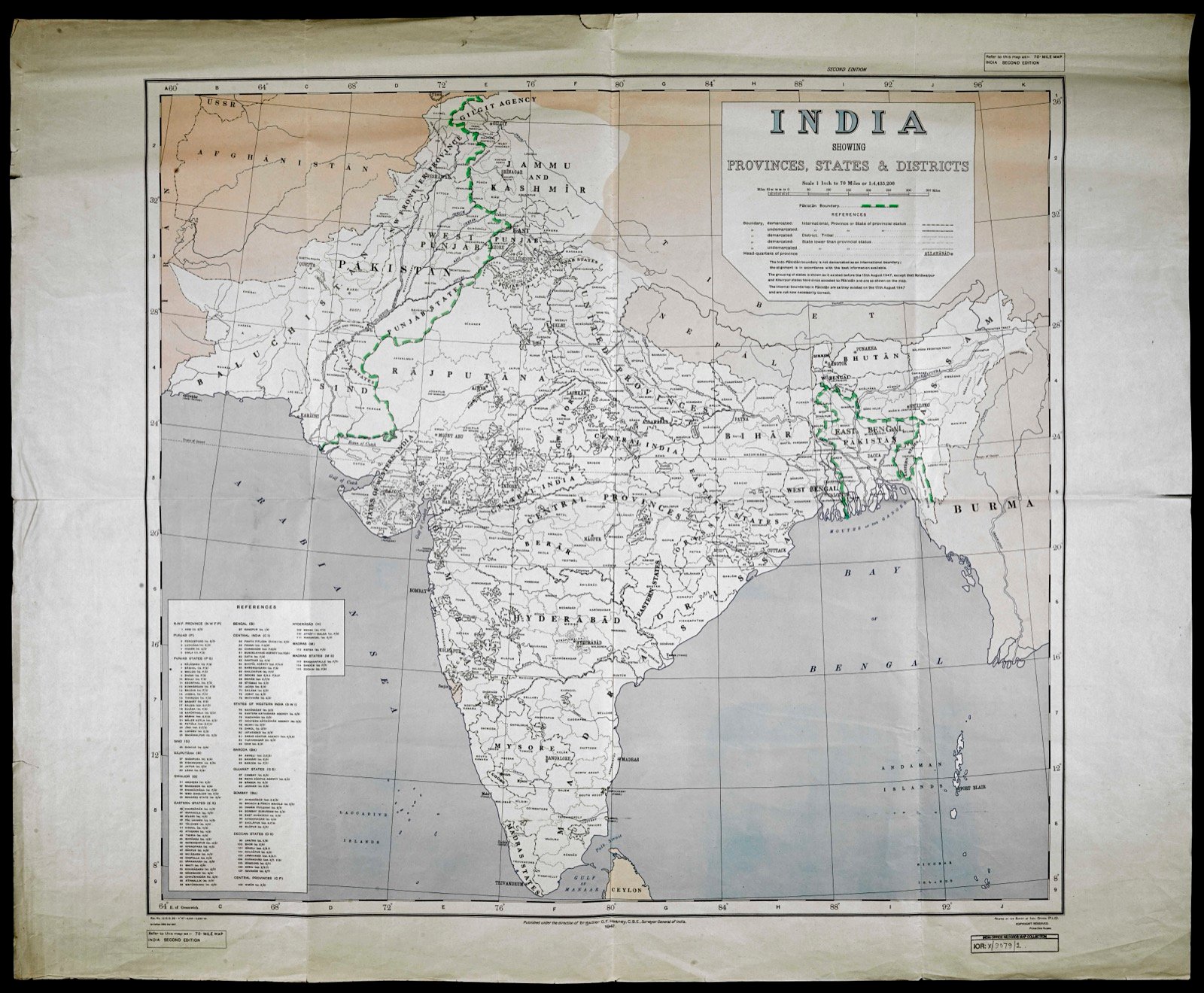
The 1947 Survey of India map that the States Department had to consolidate — provinces, princely states and agencies shown separately. Source: Survey of India, 1947 (public domain).
From Bardoli to the States Department
How Patel became India’s chief integrator
Vallabhbhai Jhaverbhai Patel was born on 31 October 1875 in Nadiad, Gujarat. He trained as a lawyer before becoming a political organiser under the wider freedom movement, building a reputation for discipline during the 1918 Kheda agitation and, a decade later, the 1928 Bardoli Satyagraha against a steep revenue-tax hike — the campaign that earned him the honorific “Sardar” (leader). Those campaigns taught him negotiation, mass organisation and administrative firmness, skills that scaled up dramatically after 1946.
As independence approached, a new States Department was created on 5 July 1947, six weeks before the transfer of power. Patel took charge as minister; the department’s secretary was civil servant V.P. Menon, who had already spent years inside the colonial administration and understood both its machinery and the princes’ concerns. Together they became the operational core of the integration effort: Patel supplying political authority and persuasion, Menon supplying the legal drafting, negotiation logistics and administrative follow-through. Lord Mountbatten, the last Viceroy, also used his personal standing with many rulers to encourage accession.
The Instrument of Accession and the Standstill Agreement
The two documents that made integration possible
Patel and Menon’s strategy rested on two deliberately narrow legal instruments rather than one sweeping demand.
The Instrument of Accession let a ruler join the Dominion of India on just three subjects: defence, external affairs and communications. It did not require surrendering internal administration, revenue collection or local law — a “solve the biggest problem first” approach that made accession far more palatable to rulers wary of losing everything at once. The Standstill Agreement solved a second, more mundane problem: continuity. It kept existing postal, rail, customs and administrative arrangements running during the transition, so accession didn’t mean bureaucratic collapse overnight.
The combination worked at remarkable speed. By the eve of Independence on 15 August 1947, the overwhelming majority of rulers had signed. Three states, however, did not: Junagadh, Hyderabad and Jammu & Kashmir — each for a different reason, and each resolved through a different route.
Now spans Telangana, parts of Maharashtra & Karnataka
Dispute continues; not a settled precedent
Overwhelming vote to join India
Timeline: from the States Department to the Republic
Reverse chronological — newest first
151st birth anniversary
Why it matters: India marks Patel’s 151st birth anniversary a year after the milestone 150th in 2025, with Rashtriya Ekta Diwas programming — Run for Unity events, pledge ceremonies and integration-themed commemorations — renewing public attention on the princely-state integration story.
Statue of Unity inaugurated
What happened: On Patel’s birth anniversary, India inaugurated the Statue of Unity near the Sardar Sarovar Dam on the Narmada river — at 182 metres, the world’s tallest statue.
Legacy: The monument turned Patel’s integration legacy into a physical landmark and a major tourism draw for Gujarat, reinforcing the “unity” framing of his birth anniversary.
Rashtriya Ekta Diwas declared
What happened: The Government of India designated October 31 as Rashtriya Ekta Diwas (National Unity Day), formally tying Patel’s birth anniversary to a national programme of unity-themed events, including the annual “Run for Unity.”
Why it matters: It elevated a low-key birth anniversary into an official day of civic commemoration, decades after Patel’s own role in preventing India’s territorial fragmentation.
Privy purses abolished
What happened: More than two decades after accession, Parliament passed the 26th Amendment abolishing the privy purses and official recognition of former rulers, after the Supreme Court had struck down an earlier 1970 presidential order to do the same.
Impact: It closed the financial-settlement chapter of integration; former ruling families lost constitutional recognition of their titles and privileges.
Bombay State splits into Maharashtra and Gujarat
What happened: Bombay State, itself built partly from former princely territory, was divided into Maharashtra and Gujarat — Patel’s home region — along linguistic lines.
Context: This came four years after the broader 1956 States Reorganisation Act, showing integration’s map continued evolving well past 1950.
States Reorganisation Act
What happened: India’s internal boundaries were substantially reshaped along linguistic lines. Many of the interim unions created during princely-state integration — PEPSU into Punjab, Madhya Bharat into a reorganised Madhya Pradesh, Travancore-Cochin into Kerala — were folded into larger states.
Why it matters: It shows accession and merger were not the end state; India’s map kept changing for a decade after 1947.
1950
India becomes a Republic
What happened: The Constitution of India, adopted by the Constituent Assembly on 26 November 1949, came into force. Former princely territories were now incorporated within a single constitutional Union rather than a patchwork of paramountcy and accession agreements.
Significance: This is the formal endpoint of the integration process that began with accession in 1947 — though, as the 1956 reorganisation shows, not the end of India’s internal map-making.
1948
Operation Polo: Hyderabad integrated by force
What happened: After the Nizam of Hyderabad, Mir Osman Ali Khan, sought independent status and negotiations under the November 1947 Standstill Agreement broke down amid rising violence linked to the Razakar paramilitary, Indian forces entered Hyderabad in what was officially called a “police action” — Operation Polo. Hyderabad’s forces surrendered within days; the Nizam agreed to cease resistance by 17-18 September 1948.
Human cost: Communal violence associated with the operation and its aftermath caused significant loss of life; historical estimates of the toll vary and remain debated by historians.
Junagadh plebiscite
What happened: Months after India assumed administration of Junagadh — whose Nawab had acceded to Pakistan despite a Hindu-majority population and a location surrounded largely by Indian territory — a referendum was held. The reported result overwhelmingly favoured joining India, formally resolving the state’s status.
Why it matters: Junagadh became the first of the three major crisis states to be settled, and the only one resolved by a plebiscite.
1947
Jammu & Kashmir’s Instrument of Accession
What happened: After tribal forces entered Jammu and Kashmir from the direction of Pakistan in October 1947, Maharaja Hari Singh — who had initially avoided aligning with either dominion — requested Indian military help. India required accession first; Hari Singh signed the Instrument of Accession to India on 26 October, and Indian troops were airlifted into Srinagar the next day.
Why it’s different: Unlike most accessions, Kashmir’s did not end the story — it triggered the first India-Pakistan war and a territorial dispute that continues, with parts of the former princely state under different administrations today.
Hyderabad Standstill Agreement
What happened: With the Nizam seeking independent status rather than accession, India and Hyderabad signed a Standstill Agreement to preserve existing arrangements while negotiations continued. Tensions rose over the following months as the Razakar paramilitary organisation gained influence and violence spread.
Outcome: Negotiations ultimately failed to produce a settlement, setting up the following year’s Operation Polo.
1947
India becomes independent
What happened: British rule ended at midnight. British paramountcy over the princely states lapsed with it. By this date, the large majority of princely rulers had already signed the Instrument of Accession to India, following six weeks of negotiation led by Patel and Menon.
What remained undone: Political independence had arrived, but territorial consolidation had not — Junagadh, Hyderabad and Kashmir remained unresolved, and deeper administrative integration of the acceding states had barely begun.
1947
States Department created
What happened: The interim government established a new States Department to handle the princely-state question. Sardar Patel took charge as minister; V.P. Menon was appointed secretary. The same day, Patel issued a public appeal to princely rulers urging accession on grounds of shared geography, economy, defence and culture.
Why it matters: This is the institutional starting point of the entire integration process — without it, the six-week sprint to Independence Day accession would have had no coordinating body.
Bardoli Satyagraha earns Patel the title “Sardar”
What happened: Patel led farmers in Bardoli in opposition to a steep land-revenue increase. The campaign secured concessions and cemented his reputation for disciplined organisation — the same reputation he drew on nineteen years later to negotiate with hundreds of princely rulers.
1875
Vallabhbhai Patel is born
What happened: Vallabhbhai Jhaverbhai Patel is born in Nadiad, in present-day Gujarat. He later trains as a lawyer before entering the freedom movement, eventually becoming India’s first Deputy Prime Minister and Home Minister.
The three crisis states, compared
Same year, three completely different outcomes
Junagadh
Muslim ruler, Hindu-majority population, geographically tied to India. Acceded to Pakistan in August 1947; administration taken over by India after unrest; a February 1948 plebiscite produced an overwhelming vote to join India.
Hyderabad
Muslim Nizam, Hindu-majority population, located entirely inside India. Sought independence; Standstill Agreement broke down; integrated via Operation Polo in September 1948 after negotiations failed.
Jammu & Kashmir
Hindu ruler, Muslim-majority population, bordering both new dominions. Delayed its decision; acceded to India in October 1947 amid a tribal invasion, triggering war and a territorial dispute that persists.
Travancore & Bhopal
Both initially floated independence — Travancore citing its resources and coastline, Bhopal’s Nawab hesitating under domestic pressure. Neither required force; both joined India through continued negotiation, later folding into Kerala and Madhya Pradesh respectively.
The integration toolkit
Different methods for different problems
| Tool | Purpose | Used on |
|---|---|---|
| Persuasion | Explain shared geography, economy and defence interests | Most of the 560+ states |
| Instrument of Accession | Legal route into India on defence, external affairs, communications | Nearly all acceding states, July–Aug 1947 |
| Standstill Agreement | Preserve postal, rail and administrative continuity during transition | Most states, including Hyderabad (Nov 1947) |
| Privy purse | Financial settlement in exchange for surrendered political power | All acceding rulers; abolished 1971 |
| Merger Agreement | Combine smaller states into administrative unions | Saurashtra, Rajasthan, Madhya Bharat, PEPSU |
| Political & economic pressure | Push hesitant rulers toward accession without force | Junagadh (1947), Bhopal, Travancore |
| Military action | Last resort where negotiation and pressure both failed | Hyderabad only — Operation Polo, Sept 1948 |
Building the new India: mergers and unions, 1947–1956
Accession was step one; administrative integration took years
Signing an Instrument of Accession did not instantly produce a modern administrative state. Hundreds of princely territories still had separate courts, revenue systems, currencies and bureaucracies. What followed accession was a second, less dramatic but equally important phase: merging small states into workable administrative units.
| Union formed | Built from | Formed | Later fate |
|---|---|---|---|
| Saurashtra | Numerous Kathiawar princely states | 1948 | Merged into Bombay State (1956), then Gujarat (1960) |
| Rajasthan | Mewar, Jaipur, Jodhpur, Bikaner, Jaisalmer, Kota, Bundi & others | Built in stages, 1948–1949 | Consolidated further in the 1956 reorganisation |
| Madhya Bharat | Gwalior, Indore & central Indian states | 1948 | Merged into reorganised Madhya Pradesh (1956) |
| PEPSU | Patiala, Nabha, Jind, Kapurthala & other Punjab states | 1948 | Merged into Punjab (1956) |
| Travancore-Cochin | Travancore and Cochin | 1949 | Became the core of Kerala (1956) |
562 vs 565: why the count varies
⚠️ A note on the numbers
Government sources themselves disagree on the exact count: a 2025 Press Information Bureau account cites 562 princely states, while an earlier Government of India exhibition and historical document cite 565. Some scholarly counts run as low as 552. This article uses “more than 560” in explanatory text and keeps “562” as the familiar headline figure, consistent with how most contemporary sources refer to the integration.
What if they had not united?
A counterfactual, not a prediction
Could a fragmented subcontinent have functioned as one country?
Imagine August 1947 with Hyderabad, Travancore, Bhopal and Kashmir all remaining outside the Union: railways crossing multiple customs jurisdictions, no unified defence command over central India, separate currencies in the middle of the map, and Hyderabad — larger than many European countries — sitting as an independent enclave. This is not a documented alternate history; it is the scale of the risk Patel and Menon were working against in 1947, and it is why their six-week sprint to accession mattered as much as any single battle of the era.
The people behind the integration
Not one leader alone
Sardar Vallabhbhai Patel
First Deputy Prime Minister and Home Minister; headed the States Department from July 1947. Combined persuasion with firmness — and, in Hyderabad’s case, force — earning him the title “Iron Man of India.”
V.P. Menon
Secretary of the States Department. Drafted the Instrument of Accession and Standstill Agreement, and personally negotiated with dozens of rulers — the administrative counterpart to Patel’s political authority.
Lord Mountbatten
Last Viceroy and first Governor-General of independent India. Used his personal relationships with several princely rulers to encourage early accession, ahead of the paramountcy lapse.
562+ princely rulers
Each faced an individual choice shaped by geography, religion, economics and internal politics — from Baroda and Mysore, who acceded readily, to Junagadh, Hyderabad and Kashmir, who did not.
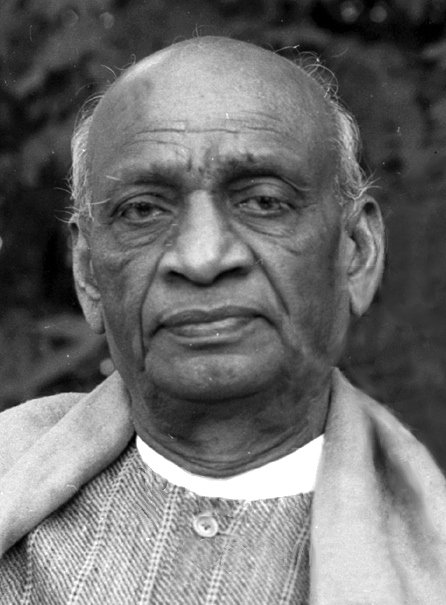
Sardar Vallabhbhai Patel, who led the States Department from July 1947. Image: public domain (Government of India).
Discover: facts most people miss
- The States Department existed for barely six weeks before Independence Day — most accessions happened in that window.
- Kashmir is the only major 1947 accession that opened a dispute rather than closing one; it should never be summarised as “resolved.”
- Privy purses continued for 24 years after accession before Parliament abolished them in 1971.
- Rajasthan wasn’t formed in one step — it was built through successive mergers between 1948 and 1949, then adjusted again in 1956.
- The Statue of Unity, at 182 metres, is taller than China’s Spring Temple Buddha and roughly double the height of the Statue of Liberty including its pedestal.
- India’s internal map changed twice more after 1950 — the 1956 States Reorganisation Act and the 1960 Maharashtra-Gujarat split — showing integration and boundary-drawing were separate, ongoing processes.
Explore More Timelines
People Also Ask
Frequently Asked Questions
⚠️ Editorial Note
This article compiles publicly available historical sources, including government archives and established secondary histories. Figures on the number of princely states vary by source (552-565) and are presented as a range rather than a single precise count. Casualty estimates around Hyderabad’s integration are contested among historians and are described here as disputed rather than given a single number. This is editorial history writing, not legal or official government record, and may contain inaccuracies; readers researching specific events should consult primary archival sources.
Sources & further reading
Every dated entry above was checked against these references. Last reviewed 19 September 2026.
- Press Information Bureau — Rashtriya Ekta Diwas, birth anniversary of Sardar Vallabhbhai Patel
- Ministry of Law and Justice — Constitution (Twenty-sixth Amendment) Act, 1971 (abolition of privy purses)
- Constitution of India — Article 291, Privy purse sums of Rulers
- Wikipedia: Integration of the princely states of India
- Wikipedia: Instrument of Accession
- Wikipedia: Operation Polo (Hyderabad, 1948)