Solid-State Battery Timeline: The Roadmap to 1,000 km EVs and the Death of Liquid Lithium (2025–2030)
Track the solid-state battery timeline: Toyota, QuantumScape, Mercedes-Benz, Samsung SDI and BYD race toward 2027-2030 commercialization targets.
Latest Story
“Death of liquid lithium” is a provocative framing, not a forecast — conventional lithium-ion batteries, including LFP and high-nickel chemistries, are still improving fast and will coexist with solid-state cells well past 2030. This solid-state battery timeline tracks the real, verifiable stages — from lab cell to automotive cell to pilot factory — that separate a laboratory breakthrough from a car you can actually buy. One technical correction worth making up front: most solid-state batteries are still lithium batteries. The real dividing line isn’t “solid-state vs lithium” — it’s solid electrolyte vs liquid/gel electrolyte.
🧠 AI Overview Summary
A solid-state battery replaces the liquid or gel electrolyte in a conventional lithium-ion cell with a solid one — it usually still contains lithium. As of August 2026, no mainstream production EV uses one; Toyota, Samsung SDI and BYD target roughly 2027–2028 for first commercial cells, with real mass-market scale not expected before 2030. Mercedes and Nissan have both demonstrated working prototypes on real roads, but a prototype road test is not a production car.
Solid-State EV Batteries: Key Questions
What Actually Changed in 2025–2026
- Toyota + Idemitsu formalized a partnership targeting commercialization around 2027–2028, with Idemitsu building large-scale sulfide-electrolyte manufacturing capacity.
- Mercedes-Benz + Factorial Energy drove a prototype EQS 1,205 km from Stuttgart to Malmö on one charge in August 2025 — a real road test, not a homologated production range.
- Nissan has run a pilot production line at its Yokohama plant since January 2025 and, in April 2026, stacked 23 cells into a pack prototype it says is sized for actual vehicle use.
- QuantumScape shipped B1-generation samples built on its faster “Cobra” separator process to PowerCo (Volkswagen) for testing, targeting in-vehicle field tests in 2026.
- Samsung SDI has been supplying pilot-line samples to automaker customers since 2023 and is targeting mass production around 2027, with BMW expected to evaluate cells in test platforms in late 2026.
- BYD confirmed a 2027 start for limited solid-state production in its premium Yangwang sub-brand, with mass-market scale targeted around 2030.
- CATL, the world’s largest battery maker, is deliberately hedging — expanding semi-solid “Condensed” cells and sodium-ion alongside solid-state R&D, not betting the company on any single chemistry.
- India’s solid-state capability remains lab/pilot-scale — Tata Chemicals has demonstrated kilogram-scale solid-electrolyte powders, but no Indian OEM has confirmed a solid-state production vehicle.
- None of this is mass-market yet. Every 2027 date above is a company target, not a guarantee, and every number quoted is either a prototype result or a stated goal.
What Is a Solid-State Battery?
A conventional lithium-ion cell sandwiches a liquid or gel electrolyte between a cathode and an anode, with a thin separator keeping the two electrodes from touching. A solid-state cell keeps the same basic cathode-and-anode arrangement but replaces that liquid electrolyte with a solid material that conducts lithium ions between them. That’s the entire structural change — which is also why “solid-state vs lithium battery” is a misleading way to frame this: most solid-state chemistries in development, including Toyota’s, Samsung SDI’s and BYD’s, are still lithium batteries. The correct axis of comparison is solid electrolyte vs liquid/gel electrolyte.
Developers are pursuing several different solid-electrolyte families, and there is no single “solid-state chemistry”:
Sulfide electrolytes — used by Toyota/Idemitsu and BYD — conduct ions well but are sensitive to moisture and require careful manufacturing. Oxide electrolytes are more chemically stable but historically harder to manufacture thin. Polymer and hybrid electrolytes trade some conductivity for easier processing. Many designs, including QuantumScape’s and Factorial’s cells used by Mercedes, also pair the solid electrolyte with a lithium-metal anode instead of the graphite or silicon-graphite anode used in today’s cells — some are effectively “anode-free,” growing the lithium-metal layer only during the first charge, which is one of the reasons they can pack more energy into the same volume.
Why Automakers Want Solid-State Batteries
Higher Energy Density
More usable energy for a given weight or volume — the main reason range and charging claims are so much higher than today’s packs, at least on paper.
Faster Charging
A solid electrolyte can, in principle, move lithium ions faster without the side reactions that limit today’s fast-charging speeds — several developers target roughly 10-minute top-ups.
Smaller, Lighter Packs
Automakers could use the extra density for a smaller, cheaper, lighter battery at similar range instead of chasing ever-bigger packs.
Thermal Stability
Removing a flammable liquid electrolyte could improve thermal behaviour, depending on the specific chemistry and pack design — not an automatic safety guarantee (more on this below).
Solid-State Battery Race — Status Dashboard, August 2026
🟢 Verified/achieved 🔵 Testing 🟠 Company target ⚪ Long-term roadmap
| Company | Electrolyte | Current stage | Vehicle testing | First commercial target | Mass production |
|---|---|---|---|---|---|
| Toyota + Idemitsu | Sulfide | 🟠 Pilot facility under construction | Not publicly confirmed | ~2027–2028 (target) | Scale-up after 2028 (target) |
| Mercedes-Benz + Factorial | Sulfide/lithium-metal | 🔵 Prototype road testing | 🔵 Modified EQS, 1,205 km run (Aug 2025) | Not publicly confirmed | Not publicly confirmed |
| QuantumScape | Ceramic separator, lithium-metal | 🟠 B1 samples to PowerCo; Cobra pilot line | 🟠 Field tests targeted for 2026 | Not publicly confirmed | Not publicly confirmed |
| Samsung SDI | Sulfide | 🔵 Pilot-line samples to customers since 2023 | 🟠 BMW i7 test platforms, late 2026 (expected) | ~2027 (target) | Not publicly confirmed |
| BYD | Sulfide | 🟠 Pre-production development | Not publicly confirmed | 2027, limited (Yangwang) (target) | ~2030 (target) |
| Nissan | Sulfide (in-house) | 🟢 Pilot line running since Jan 2025 | 🔵 23-cell pack prototype (Apr 2026) | FY2028 (target) | Not publicly confirmed |
| Honda | Sulfide (in-house) | 🟢 Demonstration line running since Jan 2025 | Not publicly confirmed | Second half of 2020s (target) | Not publicly confirmed |
| CATL | Multi-chemistry (sulfide R&D + semi-solid + sodium-ion) | ⚪ R&D, semi-solid already shipping | Not publicly confirmed | Not publicly confirmed for full solid-state | Not publicly confirmed |
Solid-State Battery Timeline: 2025–2026
Newest first — verified developments only
Nissan Stacks 23 Cells Into a Vehicle-Sized Pack Prototype Testing
What happened: Nissan announced it had stacked up to 23 all-solid-state cells into a single pack prototype the company says is sized for actual vehicle use, at its Yokohama pilot line running since January 2025.
Why it matters: A pack prototype is a step beyond a single test cell, but it is still not a vehicle on the road — Nissan’s own target for an in-house solid-state EV is fiscal year 2028.
Toyota and Idemitsu Formalize Sulfide-Electrolyte Partnership Company target
What happened: Idemitsu, drawing on sulfur byproducts from its petroleum refining business and two decades of sulfide-electrolyte research, committed to a large-scale facility targeting roughly 1,000 metric tons of lithium sulfide annually, aimed at mass production around 2027.
Why it matters: Solid-state batteries need specialty materials at industrial scale, not just a good lab formula — Idemitsu’s petroleum-refining byproducts give Toyota a domestic sulfur supply chain most rivals lack.
2025
QuantumScape Ships First B1 Samples on the Cobra Process Testing
What happened: QuantumScape began shipping Cobra-process B1 samples to PowerCo (Volkswagen’s battery unit) for testing; Cobra is roughly 25 times faster than the earlier Raptor separator process and is meant to enable gigawatt-hour-scale manufacturing.
Why it matters: Manufacturing speed, not lab performance, is the industry’s real bottleneck — PowerCo has committed up to $131 million in milestone payments toward the QSE-5 pilot line.
Mercedes’ Test EQS Covers 1,205 km on One Charge Verified
What happened: A modified EQS carrying a Factorial lithium-metal solid-state pack completed a 1,205 km drive from Stuttgart to Malmö without stopping to charge, arriving with 137 km of range still remaining. The pack’s usable capacity was raised about 25% over the standard EQS pack at a similar weight and size.
Why it matters: This is a real, independently observable test-drive result — not an EPA/WLTP-homologated production figure, and not yet a car anyone can buy.
Mercedes Puts a Solid-State EQS on Public Roads Verified
What happened: Following lab validation at the end of 2024, Mercedes began on-road testing of the Factorial-equipped EQS prototype in February 2025, targeting a range over 1,000 km.
Nissan and Honda Both Start Pilot/Demonstration Lines Verified
What happened: Nissan began operating its all-solid-state pilot line at the Yokohama plant, and Honda began production on its own all-solid-state demonstration line at Honda R&D in Sakura City, Tochigi — both aimed at proving manufacturing processes, not yet full-scale output.
Why it matters: A pilot or demonstration line answers “can we make this consistently,” which is a different and harder question than “does this work in a lab.”
The Companies Racing to Scale Solid-State
Toyota + Idemitsu: The 2027–2028 Target
Toyota’s solid-state push pairs its own cell and vehicle integration work with Idemitsu, a Japanese petroleum refiner that has studied sulfide solid electrolytes since 2001 and can draw on sulfur byproducts from its refining business. Toyota has publicly targeted commercialization around 2027–2028, with a first-generation solid-state battery aimed at exceeding 1,000 km of range and roughly 10-minute 10–80% DC fast charging; a longer-term second generation is aimed at exceeding 1,200 km. These are company targets, not confirmed launch dates.
It’s important to separate this from Toyota’s separate, already-more-mature liquid-electrolyte battery roadmap, first outlined at Toyota’s 2023 technical briefings, which also aims at around 1,000 km of range using conventional and bipolar lithium-ion chemistry — vehicle efficiency gains contribute meaningfully to that number, not battery chemistry alone.
| Toyota battery line | Technology | Range goal | Fast-charge goal | Status |
|---|---|---|---|---|
| “Performance” battery | Liquid lithium-ion | ~1,000 km (target) | ~20 min (target) | Next-gen roadmap |
| “Popularisation” battery | Liquid LFP | Lower cost, shorter range | ~30 min (target) | Next-gen roadmap |
| “High-performance” battery | Liquid, bipolar high-nickel | Above Performance tier (target) | ~20 min (target) | Next-gen roadmap |
| Solid-state (1st gen) | Solid sulfide electrolyte | >1,000 km (target) | ~10 min, 10–80% (target) | 2027–2028 commercialization target |
| Solid-state (2nd gen) | Solid sulfide electrolyte, advanced | >1,200 km (target) | Not publicly confirmed | Longer-term research |
All figures above are company-stated targets from Toyota’s own roadmap communications, not independently verified production specifications. Vehicle weight, aerodynamics and efficiency contribute to every range figure alongside battery chemistry.
QuantumScape: Can an Anode-Free Cell Actually Scale?
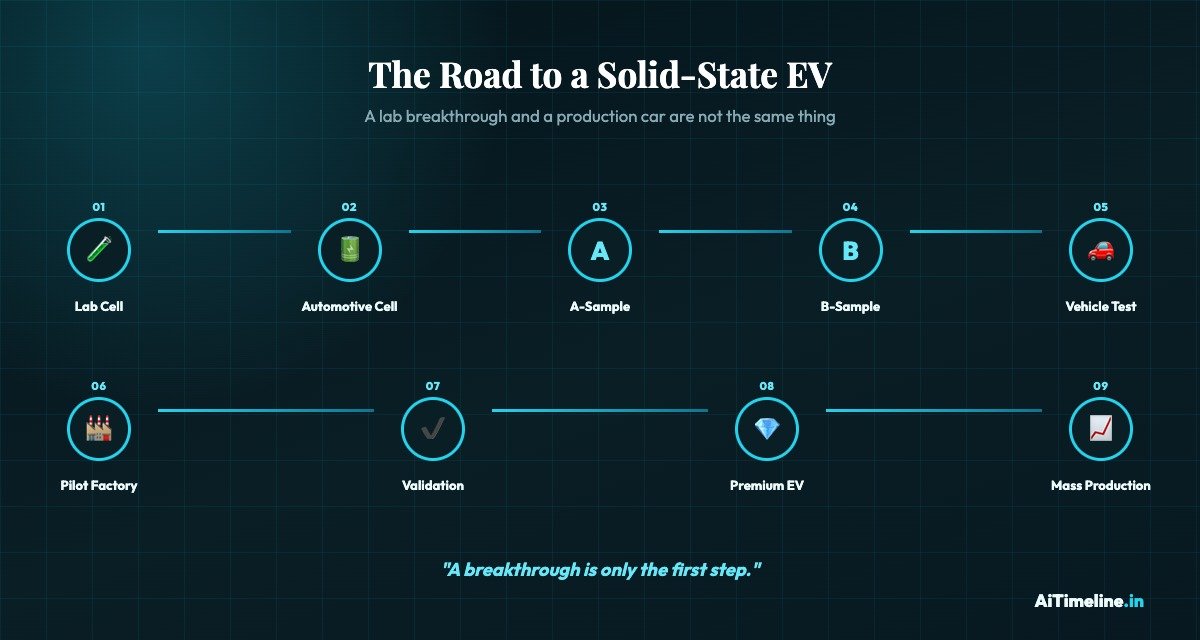
QuantumScape’s approach centers on a ceramic separator paired with a lithium-metal anode that is “anode-free” at manufacture — the lithium-metal layer forms during the cell’s first charge rather than being built in. The company has moved through A-sample and B-sample validation stages and, in Q3 2025, began shipping Cobra-process B1 samples to PowerCo, Volkswagen’s in-house battery arm, which has committed up to $131 million in milestone-based funding toward a QSE-5 pilot line in San Jose staffed by a 150-plus-person joint team. QuantumScape targets the start of in-vehicle field testing in 2026 — not a Volkswagen production car; no production vehicle currently ships with QuantumScape cells.
Mercedes-Benz + Factorial: Real Road Miles, Still a Prototype
Mercedes’ partnership with Factorial Energy has produced the most publicly visible road-test result in the industry — the 1,205 km Stuttgart-to-Malmö run in August 2025, engineered with Mercedes-AMG’s Formula 1 powertrain unit. It’s a genuine, independently observable result. It is not, however, a homologated WLTP or EPA range figure, and Mercedes has not announced a production timeline for the technology.
Samsung SDI: Pilot Samples Since 2023, 2027 Target
Samsung SDI opened a solid-state pilot line (“S-line”) at its Suwon R&D center in March 2022 and has been supplying prototype samples to automaker customers since 2023, targeting mass production around 2027. The company has discussed prototype-level figures — roughly 500 Wh/kg / 900 Wh/L energy density, a 9-minute 8–80% charge, and a company-estimated range near 600 miles (965 km) — but these are Samsung’s own prototype/cell-level figures, not independently verified or vehicle-homologated numbers. BMW is expected to evaluate Samsung SDI’s cells in i7 test platforms in late 2026.
BYD: 2027 in Yangwang, 2030 at Scale
BYD has publicly confirmed it will begin limited solid-state production in 2027, debuting first in its premium Yangwang sub-brand before any move to mass-market models, with company plans pointing to broader mass production around 2030. BYD’s sulfide-based cells are described by the company as reaching roughly 400 Wh/kg — about double current liquid cells — with cold-temperature and fast-charge claims that are, again, company-stated figures pending independent verification.
Nissan and Honda: Parallel Pilot Lines, Late-Decade Targets
Both Japanese automakers started pilot manufacturing in January 2025 — Nissan at its Yokohama plant, targeting an in-house solid-state EV by fiscal 2028 under its “Ambition 2030” plan, and Honda at a demonstration line in Sakura City, Tochigi, aiming to apply the technology to electrified models in the second half of the 2020s. Neither has announced a specific production vehicle.
CATL: Why the World’s Biggest Battery Maker Isn’t Betting on One Chemistry
CATL, the largest EV battery manufacturer globally, is deliberately not treating solid-state as a single winning bet. Alongside solid-state R&D, it has commercialized a semi-solid “Condensed” battery rated around 500 Wh/kg and is scaling sodium-ion (“Naxtra”) toward full mass production by the end of 2026 for applications including battery swapping and passenger vehicles. CATL frames LFP, high-nickel NMC and sodium-ion as a deliberately multi-chemistry strategy rather than a single roadmap to replace — direct evidence that the industry’s largest maker does not expect solid-state to make conventional lithium-ion obsolete anytime soon.
⚠️ Semi-Solid Is Not the Same as All-Solid-State
The industry uses a spectrum — liquid → gel/hybrid → semi-solid → all-solid-state — and marketing sometimes blurs it. CATL’s “Condensed” battery and similar semi-solid designs still contain some liquid or gel electrolyte; they are not true all-solid-state cells, even when described as “solid-state-like.” Only cells built entirely on a solid electrolyte, like the sulfide and ceramic-separator designs described above, qualify as all-solid-state.
Will Solid-State Batteries Really Deliver 1,000 km of Range?
Potentially — and prototypes have already come close or exceeded it, as Mercedes’ 1,205 km test drive shows. But 1,000 km is not a property of a battery chemistry on its own. Real-world range comes from battery energy plus vehicle weight, aerodynamics, motor efficiency, tyre rolling resistance, ambient temperature and driving speed together. A solid-state pack lets an automaker choose to add more range, or instead build a smaller, lighter, cheaper battery for similar range — that design choice matters as much as the chemistry.
WLTP vs EPA vs CLTC: Why Range Numbers Aren’t Comparable
Range claims from different markets use different official test cycles — Europe’s WLTP, the US EPA cycle, and China’s CLTC — and CLTC in particular tends to produce higher numbers than WLTP or EPA for a comparable car. A 1,000 km CLTC claim and a 1,000 km WLTP or EPA claim are not the same result, and comparing them directly, or in a single table without labelling the cycle, is a common source of inflated-sounding range claims.
Can an EV Really Charge in 10 Minutes?
Most “10-minute” solid-state charging targets, including Toyota’s, refer to a 10–80% state-of-charge window on a high-power DC fast charger — not a full 0–100% charge, and not a home Level 2 charge. That distinction matters: charging the same battery from 80% to 100% typically takes far longer than the fast, linear middle section, in any lithium chemistry.
Charging Speed Isn’t Just a Battery Problem
Even a cell capable of extreme charge rates needs the rest of the system to keep up: the pack’s thermal management, the vehicle’s 800V/1000V electrical architecture, the charger’s power output, the local grid connection, and the battery management system all have to be engineered together. A fast cell paired with an underpowered charger or a weak grid connection will not deliver its rated charging speed in practice.
Energy Density: The Number That Might Matter More Than Range
Energy density is usually measured in Wh/kg (by weight) or Wh/L (by volume), and it’s essential to distinguish cell-level figures from pack-level figures — a pack always carries lower effective density than its individual cells once casing, cooling and structure are added. Comparing one company’s cell-level number against another’s pack-level number, as sometimes happens in casual coverage, makes an apples-to-oranges comparison look like a real performance gap.
Higher density doesn’t have to mean a bigger battery for more range — automakers could instead use it to shrink the pack, cut vehicle weight, use fewer raw materials, and hold range roughly constant while improving efficiency. That’s a more sophisticated read on the technology than a simple “range war.”
Safety, Dendrites and the Interface Problem
Are Solid-State Batteries Safer?
Potentially — removing a flammable liquid electrolyte can improve thermal stability, depending on the specific chemistry and pack design. But “solid-state means no battery fires” is an oversimplification and should not be stated as fact; failure modes shift rather than disappear entirely, and lithium-metal anodes bring their own risks.
The Dendrite Problem
Under repeated charging, tiny lithium structures called dendrites can grow through or along the interfaces inside a cell. In a lithium-metal cell, dendrites that bridge the electrolyte can create a short circuit — this is one of the central technical challenges every lithium-metal solid-state developer is working to control through electrolyte composition, pressure and interface engineering.
Solids Don’t Naturally Behave Like Liquids
A liquid electrolyte naturally flows to fill microscopic gaps against an electrode’s surface. A solid electrolyte has to maintain intimate physical contact with the electrodes as they expand and contract during every charge cycle — any gap that opens up creates interface resistance, accelerates degradation, and adds real manufacturing complexity. This mechanical-contact problem, more than any single chemistry choice, is why moving from one great lab cell to millions of consistent automotive cells has taken the industry more than a decade.
Manufacturing and Cost: Why the First Solid-State EV Will Be Expensive
Making one excellent solid-state cell in a lab is a materials-science achievement. Making millions of them that perform consistently, survive years of cycling, work across extreme temperatures, and cost little enough for a mainstream car is a manufacturing achievement — a much harder and slower problem. Early solid-state production will run at low volumes, using specialized, moisture-sensitive materials and new equipment, with manufacturing yield still being worked out. That combination points to higher costs at launch, not lower ones.
Sports Cars and Luxury EVs First
That’s also why BYD is launching solid-state cells first in its premium Yangwang sub-brand rather than a mass-market model, and why the broader industry pattern — premium, then performance, then mass-market — is a plausible, economically sensible sequence rather than a guaranteed one. Premium vehicles can absorb higher battery costs and lower production volumes; a mainstream EV generally cannot until costs fall with scale.
Solid-State vs LFP: Different Jobs, Not Necessarily One Winner
Solid-state vs sodium-ion solves a different problem entirely: solid-state chemistries chase performance and energy density; sodium-ion, which CATL is scaling toward full mass production by the end of 2026, chases cost and raw-material availability for lower-end mobility and stationary storage. They aren’t really competing for the same use case.
Does Solid-State End the Lithium Supply Problem?
No. Most solid-state architectures in development, including Toyota’s, Samsung SDI’s, BYD’s and QuantumScape’s, still rely on lithium — the electrolyte changes, but the core ion carrying charge does not. Demand could shift for other materials — more sulfur derivatives and specialty ceramics for the electrolyte itself, potentially less graphite if lithium-metal anodes scale — but solid-state technology does not eliminate mining or lithium dependence.
What Solid-State Batteries Could Mean for India’s EV Market
India’s Advanced Chemistry Cell Production-Linked Incentive scheme (₹18,100 crore) targets 50 GWh of battery cell manufacturing, but execution has lagged: as of late 2025, only around 1.4 GWh — roughly 2.8% of that target, entirely from Ola Electric — had actually been commissioned under the PLI scheme itself. Beyond PLI beneficiaries, companies including Tata’s Agratas (a 20 GWh plant in Gujarat), Amara Raja, Exide and Mahindra have collectively committed more than 100 GWh of broader cell-manufacturing capacity.
Solid-state specifically remains at lab and pilot scale in India: fewer than five domestic facilities can currently produce kilogram-scale batches of certified solid electrolyte material. Tata Chemicals, Gujarat Fluorochemicals and Reliance New Energy are investing in solid-state materials R&D, and Tata Chemicals has demonstrated pilot-scale production of LLZO and lithium-sulfide powders — real progress, but no Indian automaker has confirmed a solid-state production-vehicle launch. India’s more realistic near-term opportunity may be upstream: cell materials, pack engineering, recycling and battery-management software, rather than racing to be first with a finished solid-state car.
Solid-State Battery Claims vs Reality
| Claim | Reality |
|---|---|
| “1,000 km EVs are here” | Prototype/test-drive results and next-generation liquid-battery targets, not a production solid-state car for sale |
| “Charges in 10 minutes” | Usually a targeted 10–80% state-of-charge window, not a full 0–100% charge |
| “No battery fires” | Incorrect — risk is reduced in some designs, not eliminated |
| “No lithium required” | Incorrect for most current designs, including Toyota’s, Samsung SDI’s and BYD’s |
| “Toyota launches in 2027” | A commercialization target Toyota has stated, not a guaranteed date |
| “Solid-state kills LFP” | Unlikely near-term — CATL and others are scaling LFP and sodium-ion in parallel |
| “Mass market by 2027” | Not supported by current evidence — 2027 targets are for limited/premium production |
| “2030 changes everything” | Possible for early scale-up, but manufacturing yield and cost remain unresolved |
Explore More Timelines
Would 1,000-km EVs Actually End Range Anxiety?
Maybe not as much as the headline number suggests. For many drivers, charging reliability may matter more than an extreme maximum range. A 500–600 km EV backed by fast, reliable, widely available charging could be more genuinely useful day-to-day than a 1,000 km EV carrying a much larger, heavier and more expensive battery pack. For drivers, the real breakthrough won’t be another laboratory energy-density record — it will be the point where someone can buy the car, fast-charge it repeatedly through both winter and summer, drive it for years, and eventually replace the battery at a reasonable cost. That’s the gap between battery science and an automotive product.
⚠️ Editorial Note
This article compiles publicly available company statements, road-test results, SEC filings and independent automotive/energy journalism from Toyota, Idemitsu, Mercedes-Benz Group, QuantumScape, Samsung SDI, Nissan, Honda, BYD and CATL. Company-stated performance figures (range, charging time, energy density, cost, launch dates) are identified as targets or prototype results throughout and should not be read as confirmed, independently verified production specifications. This is editorial and AI-assisted content, not investment, purchase or engineering advice; battery technology development timelines change frequently and figures here reflect the best publicly available information as of August 24, 2026.
Solid-State Batteries Are Getting Real — But the Lithium-Ion Era Isn’t Over
The solid-state battery story has genuinely moved from laboratory chemistry toward pilot factories and real test vehicles. Between 2027 and 2030, the industry should get its clearest answer yet on whether Toyota, QuantumScape, Mercedes/Factorial, Samsung SDI, BYD, Nissan or Honda can turn a promising cell into a reliable automotive product at meaningful scale. But the transition will not look like a switch being flipped. Liquid-electrolyte lithium-ion batteries — LFP, high-nickel NMC, and sodium-ion alongside them — will keep getting cheaper, charging faster and improving in energy density while solid-state manufacturers work through their own production challenges. The real race, in the end, is not simply solid-state versus lithium-ion; it’s which technology can deliver the best combination of range, charging speed, safety, lifetime, cost and manufacturing scale together. The first 1,000 km prototype will make headlines. The first affordable solid-state EV produced by the hundreds of thousands will matter far more.
Sources & further reading
Every dated entry above was checked against these references. Last reviewed 15 September 2026.
- Mercedes-Benz Group: EQS with solid-state battery covers 1,205 km
- Nissan Global Newsroom: All-solid-state battery pilot line
- Honda Global: All-solid-state battery demonstration production line
- Samsung SDI Newsroom: 900Wh/L All Solid Battery
- QuantumScape SEC Form 8-K, FY2025
- Electrek: BYD plans to bring all-solid-state batteries to EVs by 2027
- InsideEVs: Toyota and Idemitsu partner on solid-state batteries
- Business Standard: PLI ACC scheme global bids for 10 GWh