Roop Kanwar Case: The 1987 Incident That Changed India’s Anti-Sati Law
Explore the Roop Kanwar sati case timeline, the 1987 Deorala incident, anti-sati legislation, court acquittals and its lasting impact on women's rights.
Latest Story
On 4 September 1987, 18-year-old Roop Kanwar died on the funeral pyre of her husband in Deorala, a village in Rajasthan’s Sikar district. Her in-laws called it a voluntary sati; women’s groups said she had been forced. Within four months India had a new national law, and within a year the first of several prosecutions was under way. The Roop Kanwar sati case then ran for 37 years through two different kinds of trial, one for murder and others for glorifying sati, and ended without a single conviction. This page sets out every stage, date by date, to 17 November 2026.
There were two different kinds of case. The murder case was about Roop Kanwar’s death: 32 people were tried under the Indian Penal Code and acquitted in October 1996. The glorification cases were about what happened afterwards, under the anti-sati law: 11 accused were acquitted on 31 January 2004, 25 more later in 2004, and the last eight on 9 October 2024. Different charges, different accused, different courts. An acquittal means the prosecution failed to prove its case; it is not a finding that her death was voluntary, and not approval of sati.
💡 Short Answer
Roop Kanwar, 18, died on her husband’s pyre at Deorala, Rajasthan, on 4 September 1987. Her family called it voluntary; activists alleged coercion. Rajasthan issued an anti-sati ordinance and Parliament passed the Commission of Sati (Prevention) Act, assented on 3 January 1988. All 32 murder accused were acquitted in 1996. Every accused tried for glorifying sati was acquitted, the last eight on 9 October 2024. No one was convicted.
Roop Kanwar Sati Case: Key Questions
The Roop Kanwar Case in Ten Points
- The death: Roop Kanwar, 18, died on her husband’s pyre at Deorala on 4 September 1987, a day after Maal Singh, 24, died in hospital.
- The dispute: her in-laws said it was voluntary; women’s groups said it was forced. No court has decided.
- The ceremony: on 16 September 1987, more than 200,000 people attended a chunari ceremony at Deorala despite a High Court order to stop it.
- The ordinance: Rajasthan issued an anti-sati ordinance by 1 October 1987; 22 glorification cases followed.
- The Act: the Commission of Sati (Prevention) Act got assent on 3 January 1988 and was notified in force on 21 March 1988.
- The penalties: death or life for abetting sati; one to seven years and up to Rs 30,000 for glorifying it.
- The murder case: all 32 accused acquitted at Neem-ka-Thana on 11 October 1996.
- The first glorification verdict: 11 accused, including Rajendra Singh Rathore, acquitted on 31 January 2004.
- The last: eight accused in the 1988 truck-procession case acquitted on 9 October 2024.
- The legacy: a strong law on paper and no conviction in any of the principal cases.
The Roop Kanwar Case at a Glance
From a village cremation to a Jaipur verdict, 37 years later.
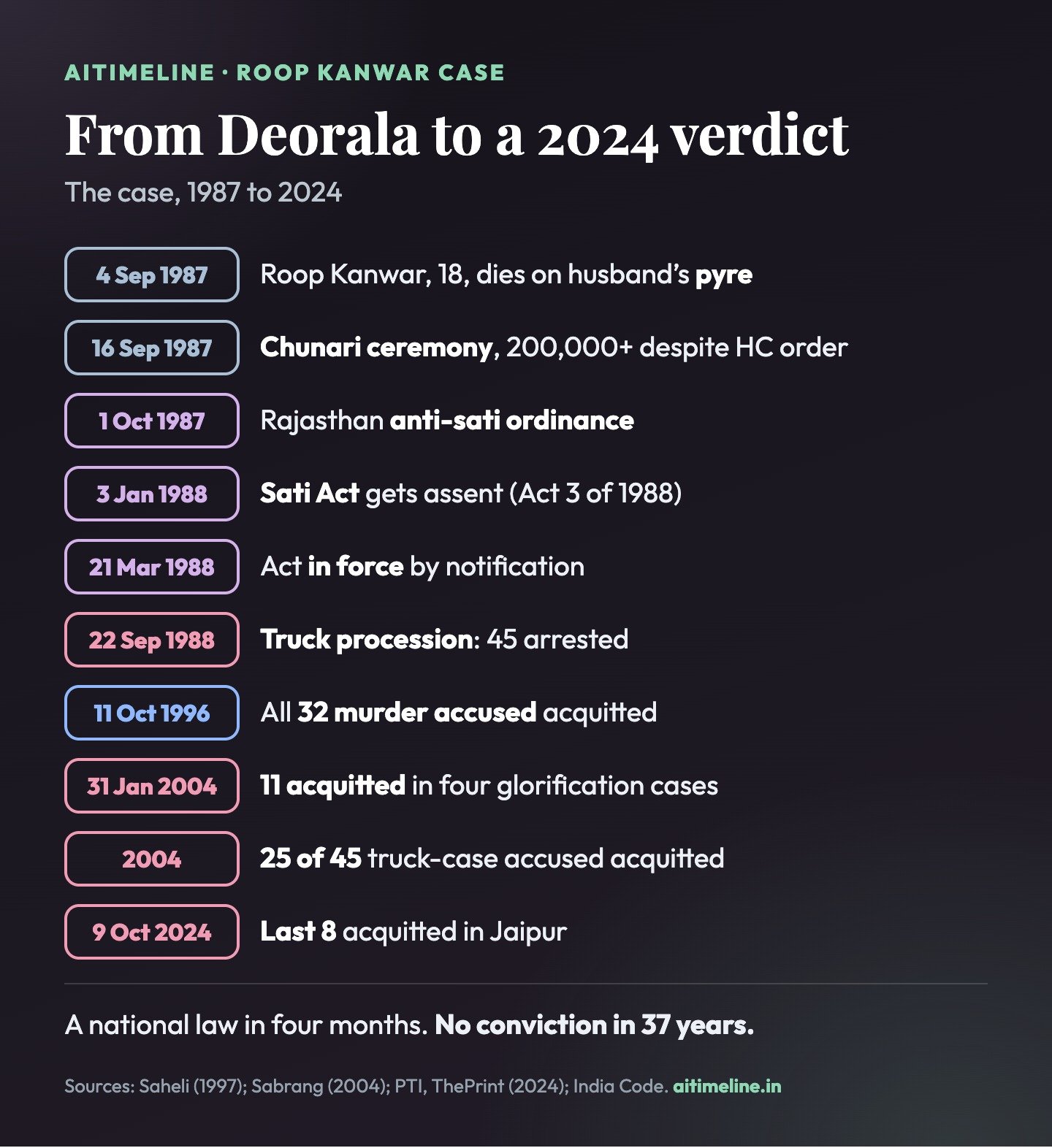
Roop Kanwar Sati Case Timeline: Newest First
Tagged by thread: the Deorala events, the law, the murder case, the glorification cases, and society and memory.
Where the Roop Kanwar cases stand Society & memory
No convictions: No court has convicted anyone in connection with Roop Kanwar’s death or its glorification. The 32 people tried for murder were acquitted in 1996. Every accused tried in the glorification cases was acquitted, in 2004 and in October 2024.
The appeals: Rajasthan appealed the 1996 murder acquittal; a March 1997 Saheli report said it had not yet been admitted, and a 2004 report said it had still not been heard. Women’s groups asked the state to appeal the 2024 verdict within 90 days. As of late October 2024, ThePrint reported that the state had not challenged it, and we found no later report of an appeal.
The law: The Commission of Sati (Prevention) Act, 1987, written in response to Deorala, remains in force. It punishes attempt, abetment and glorification of sati, and lets authorities ban ceremonies and seize funds raised for them.
ThePrint: “No pending file” on Roop Kanwar Society & memory
The court: Three weeks after the last acquittals, ThePrint reported that Jaipur’s Sati Nivaran court had no pending file on the case.
The village: At Deorala, a makeshift shrine stands at the spot of the pyre and draws visitors, and a shrine is kept at the family home. Some villagers told the reporter they wanted a temple built there.
The wider picture: The report described more than 100 sati temples across the Shekhawati “sati belt” and YouTube videos offering “digital darshan” of them, a practice activists say keeps the idea alive.
Women’s groups demand an appeal Society & memory
Who: PUCL, the All India Democratic Women’s Association, the National Federation of Indian Women and Vividha, among others, issued a joint statement.
What they asked: They urged the Rajasthan government to file an appeal within the 90-day limit, as the special court’s public prosecutor had recommended, and to pursue remedies in the 2004 cases.
The old petition: They said a writ petition filed in 2004 seeking an appeal against the earlier acquittals had been pending for about 20 years.
Last eight accused acquitted of glorification Glorification cases
The verdict: A special court in Jaipur acquitted the last eight people tried for glorifying sati after the Deorala death, giving them the benefit of the doubt. Police witnesses did not identify them in court.
Who: Mahendra Singh, Shravan Singh, Nihal Singh, Jitendra Singh, Uday Singh, Dashrath Singh, Laxman Singh and Bhanwar Singh. Spellings vary between reports.
The charge: Section 5 of the Commission of Sati (Prevention) Act, over the truck procession of 22 September 1988. Of the 45 people booked, 25 had been acquitted in 2004, eight had died and four were absconding.
Thirty-two years on, still on trial Glorification cases
The status: The New Indian Express reported that the glorification case was in its final stage. Reports at the time said 25 accused had been acquitted, six had died, five had been declared absconders and nine were still facing trial.
The village: The Times of India reported that at Deorala, Roop Kanwar was still revered as a goddess by many villagers.
Why it matters: The figures show how a case filed in 1988 had been worn down by death and absconding long before it reached a verdict.
Twenty-five of the 45 truck-procession accused acquitted Glorification cases
The verdict: In the case built on the 1988 truck procession, the special court acquitted 25 of the 45 accused in 2004. Reports differ on the month.
The remainder: The others were either absconding, dead or not yet before the court. Their trial would run for another two decades.
A separate case: This was a different set of accused from the 11 acquitted on 31 January 2004 in four other glorification cases.
Eleven acquitted in four glorification cases Glorification cases
The verdict: Judge Shiv Singh Chauhan acquitted all 11 accused in four of the 22 glorification cases filed in 1987. They included Rajendra Singh Rathore, then a former minister and later a senior BJP leader, Pratap Singh Khachariyawas, described as president of the Rajput Maha Sabha, Narendra Singh Rajawat, former IAS officer Onkar Singh and advocate Ram Singh Manohar.
The reasoning: As reported, the court held that glorification had to relate to a particular sati, and that since the Deorala death had not been proved to be sati, the accused could not be guilty of glorifying it.
The reaction: Women’s groups protested at the Rajasthan Assembly on 5 February 2004, about 700 women marched to the Secretariat on 3 March 2004, and a writ petition was filed seeking an appeal.
Glorification trials finally begin Glorification cases
The delay: The glorification cases were stalled for years by legal challenges. The Rajasthan High Court rejected challenges to the charge sheets in 1987, and the matter then went to the Supreme Court, where it remained until January 2003.
The restart: After the Supreme Court disposed of the matter, trial began in the special court in Jaipur by June 2003, almost 16 years after the events.
The law used: The 22 cases had been registered under the Rajasthan Sati (Prevention) Ordinance of 1987, and the special court tried them under the anti-sati law.
All 32 murder accused acquitted Murder case
The verdict: The court acquitted all 32 people charged with the murder of Roop Kanwar, including her father-in-law and brothers-in-law, citing lack of evidence.
The reasoning: Saheli reported the court’s view that not a single witness had deposed that Roop Kanwar’s death actually happened by being burnt alive. They were tried under the Indian Penal Code, as the anti-sati law came after the event.
The aftermath: The trial took nine years and saw the presiding judge change nine times. Three accused, including Pushpinder Singh, the youngest brother-in-law, believed to have lit the pyre, remained before a juvenile court. The state filed an appeal.
The truck procession and 45 arrests Glorification cases
What happened: A year after the death, by the Hindu calendar, people from Deorala set out in procession towards Ajitgarh with Roop Kanwar’s picture. After rain, about 45 people resumed on a truck around 8 pm and police arrested them.
The case: A case was registered at Thoi police station against 45 people for glorifying sati. A chargesheet followed on 26 September.
The long tail: This became the case that ran until 2024 and produced the final eight acquittals.
The central anti-sati law comes into force The law
In force: The Centre notified the Commission of Sati (Prevention) Act, which allowed different dates for different states. India Code gives its enforcement date as 21 March 1988.
What it covers: Attempting sati, abetting it, and glorifying it. Glorification includes ceremonies, processions, funds and temples meant to honour a woman who died by sati.
Special courts: All offences under the Act are tried by special courts, which is why the Deorala glorification cases went to the Sati Nivaran court in Jaipur.
Chief Minister Harideo Joshi replaced Glorification cases
The change: Harideo Joshi’s term as Chief Minister of Rajasthan ended on 20 January 1988. Shiv Charan Mathur succeeded him.
The context: Joshi’s government had been heavily criticised for failing to prevent the death and the public ceremonies that followed.
The caution: Contemporary reporting attributed his removal mainly to Congress factional politics. The Deorala controversy was part of the backdrop, not the stated reason.
The Commission of Sati (Prevention) Act is enacted The law
The Act: Parliament passed the bill in December 1987, and it received the President’s assent on 3 January 1988 as Act No. 3 of 1988.
The penalties: Abetting a sati: death or life imprisonment. Attempting sati: up to one year or fine. Glorifying sati: one to seven years and a fine of Rs 5,000 to Rs 30,000.
The powers: Collectors can ban ceremonies, seize funds and properties collected for glorification, and the government can order the removal of temples that perpetuate the memory of a sati.
Rallies and counter-rallies Society & memory
Defending the act: Rallies were held in which participants marched with drawn swords, presenting Roop Kanwar’s death as a matter of faith and Rajput tradition.
Opposing it: Women’s organisations, civil-liberties groups and journalists demanded prosecutions and a national law. The Women and Media Committee of the Bombay Union of Journalists published its report, Trial by Fire.
The divide: The clash framed the debate for decades: women’s lives and autonomy on one side, claims of religion and community honour on the other.
Rajasthan issues an anti-sati ordinance The law
The ordinance: Under pressure, the Rajasthan government issued the Rajasthan Sati (Prevention) Ordinance, 1987, targeting both sati and its glorification.
The cases: Police registered 22 glorification cases under the ordinance in the affected districts.
The model: The ordinance was the template for the central law that followed within three months.
Father-in-law and relatives arrested Deorala 1987
The arrests: Police arrested Roop Kanwar’s father-in-law Sumer Singh and three other relatives on charges of murder and abetting suicide, The New York Times reported.
The investigation: Many people from Deorala were later charged. The murder case eventually went to trial against 32 people.
Who lit the pyre: Reports named her youngest brother-in-law, Pushpinder Singh, then a minor, as the person believed to have lit the pyre.
The chunari ceremony goes ahead Deorala 1987
The court order: Acting on a petition by women activists, the Rajasthan High Court ordered the state to stop the ceremony. Sources date the order to 14 or 15 September.
The event: The ceremony went ahead anyway. More than 200,000 people gathered at Deorala, and pictures of Roop Kanwar were sold.
The money: ThePrint later reported that the event raised around Rs 70 lakh.
Roop Kanwar dies on her husband’s pyre Deorala 1987
What happened: Roop Kanwar, 18, died on the funeral pyre of her husband, Maal Singh Shekhawat, 24, a day after his death. Several thousand people were reported to have attended.
The contested account: Her in-laws and many villagers said she chose to die as a sati. Women’s groups and journalists who investigated said she had been coerced or forced. No court has decided which account is true.
The marriage: They had been married for about eight months and had no children.
Maal Singh dies Deorala 1987
The death: Maal Singh, a science graduate, died in hospital after an illness. ThePrint reported the cause as gastroenteritis.
The family: He was the son of Sumer Singh of Deorala. His body was brought home for cremation the next day.
Why it matters: His death set in motion the events of 4 September.
Bengal Regulation XVII bans sati The law
The ban: Bengal Regulation XVII of 1829 declared sati illegal and punishable in the Bengal Presidency, following a campaign by reformers including Ram Mohan Roy.
After that: Princely states followed over the next decades. Rare cases continued, mostly in Rajasthan.
The gap: Deorala showed in 1987 that a ban on the act did not cover the ceremonies, temples and money that kept its glorification alive.
Two Kinds of Case, Often Confused
The 1996 and 2024 acquittals were about different charges and different people.
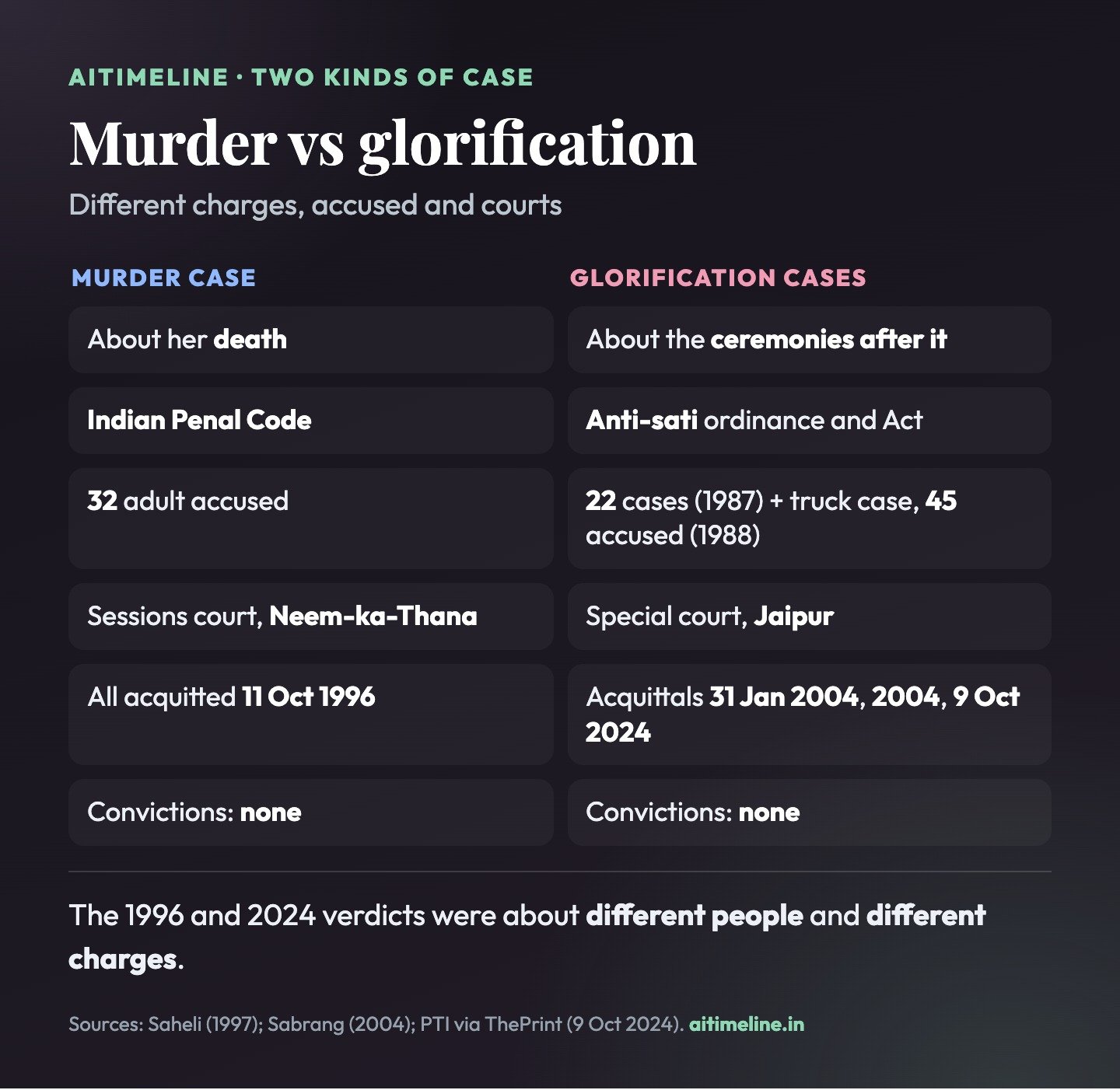
| Issue | Murder case | Glorification cases |
|---|---|---|
| Subject | Roop Kanwar’s death | Ceremonies, rallies and processions after it |
| Law | Indian Penal Code | Rajasthan ordinance and the 1987 anti-sati law |
| Accused | 32 adults (plus juveniles tried separately) | 22 cases from 1987; 45 people in the 1988 truck case |
| Court | Additional Sessions Court, Neem-ka-Thana | Special (Sati Nivaran) court, Jaipur |
| Verdicts | All acquitted, 11 Oct 1996 | 11 acquitted 31 Jan 2004; 25 in 2004; 8 on 9 Oct 2024 |
| Convictions | None | None |
What Is Sati, and Why Did Deorala Shock India?
The practice. Sati is the historical practice of a widow dying on, or in connection with, her husband’s funeral pyre. Bengal Regulation XVII of 4 December 1829, under Governor-General Lord William Bentinck, made it illegal in the Bengal Presidency after a long reform campaign. Other regions followed, but isolated cases continued, especially in Rajasthan’s Shekhawati region.
Why 1987 was different. Deorala was not a remote event discovered months later. It happened in a modern state, close to Jaipur, before a large crowd, and within two weeks drew more than 200,000 people to a ceremony that a High Court had ordered stopped. The scale of public celebration, not just the death, is what turned a local tragedy into a national crisis.
The gap in the law. Existing criminal law could punish murder or abetment of suicide. It had little to say about the processions, shrines, fund-raising and political rallies that turned a death into a cult. That gap is what the 1987 laws were written to close.
The Commission of Sati (Prevention) Act, 1987
Act No. 3 of 1988: assent 3 January 1988, in force by notification of 21 March 1988.
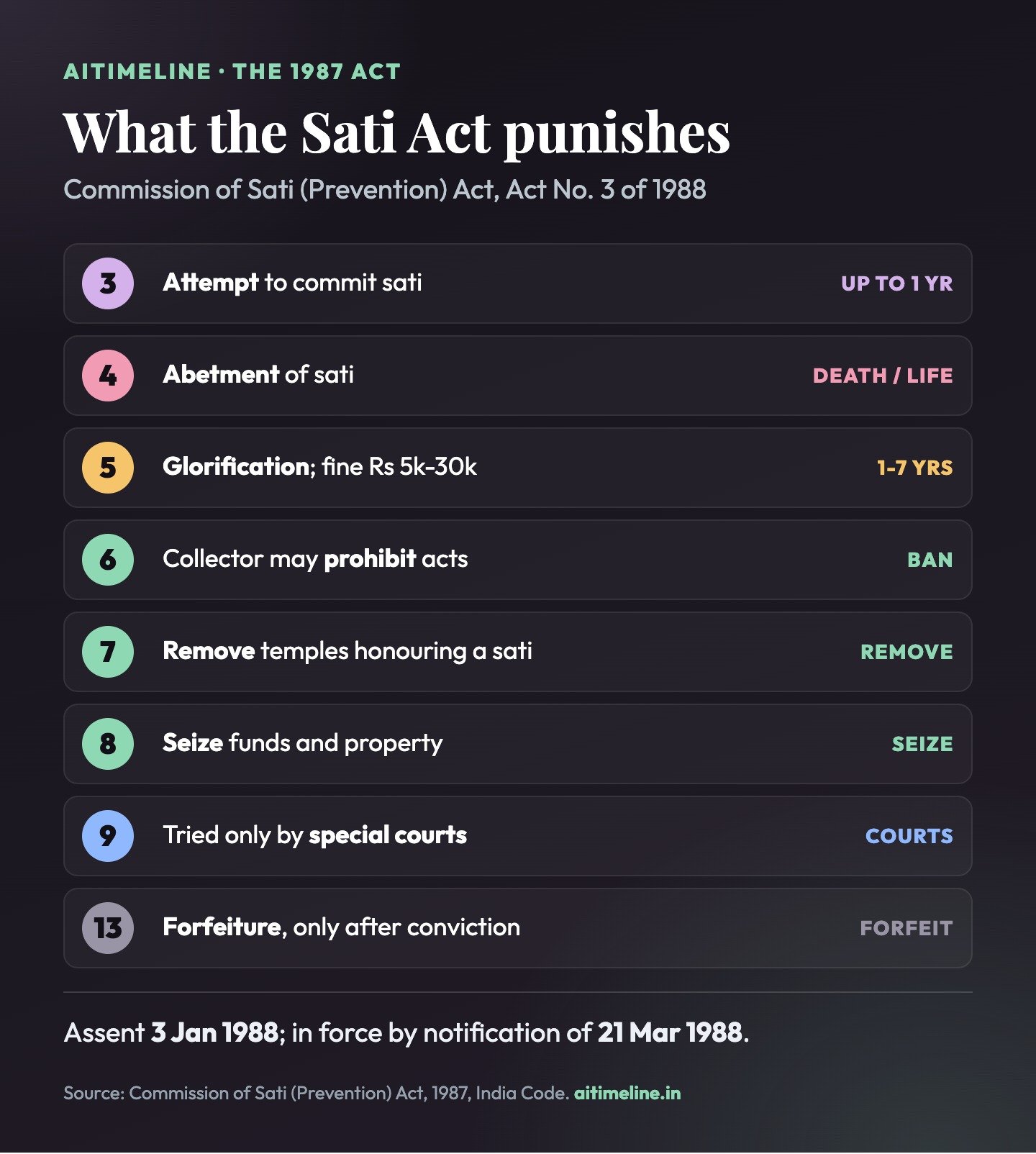
| Section | What it covers | Penalty or power |
|---|---|---|
| 2(1)(b) | Defines glorification | Ceremonies, processions, eulogies, trusts, funds, temples |
| 3 | Attempt to commit sati | Up to 1 year, or fine, or both; court must weigh her circumstances |
| 4 | Abetment of sati | Death or life imprisonment, plus fine; life for abetting an attempt |
| 5 | Glorification of sati | 1 to 7 years and Rs 5,000 to Rs 30,000 fine |
| 6 | Power to prohibit certain acts | Collector or District Magistrate may ban; breach 1 to 7 years |
| 7 | Removal of temples or structures | Government may order removal of structures honouring a sati |
| 8 | Seizure of property | Funds and property collected for glorification may be seized |
| 9 | Special courts | All offences tried only by special courts |
| 13 | Forfeiture | Seized funds may be forfeited after a conviction |
The design. The Act’s novelty was Section 5. By making glorification a crime, and by defining it to include ceremonies, processions and temples, it reached the social machinery around a sati, not just the people at the pyre.
The criticism. Section 3 punishes the woman who attempts sati, which some women’s groups argued treats a likely victim as an offender. The Act asks the court to consider her circumstances and state of mind before sentencing.
The limit. Section 13 forfeiture needs a conviction. Since no one was convicted in the Deorala cases, none of the money raised at the 1987 ceremony could be forfeited through this route.
The Murder Case: 32 Accused, Nine Years, No Conviction
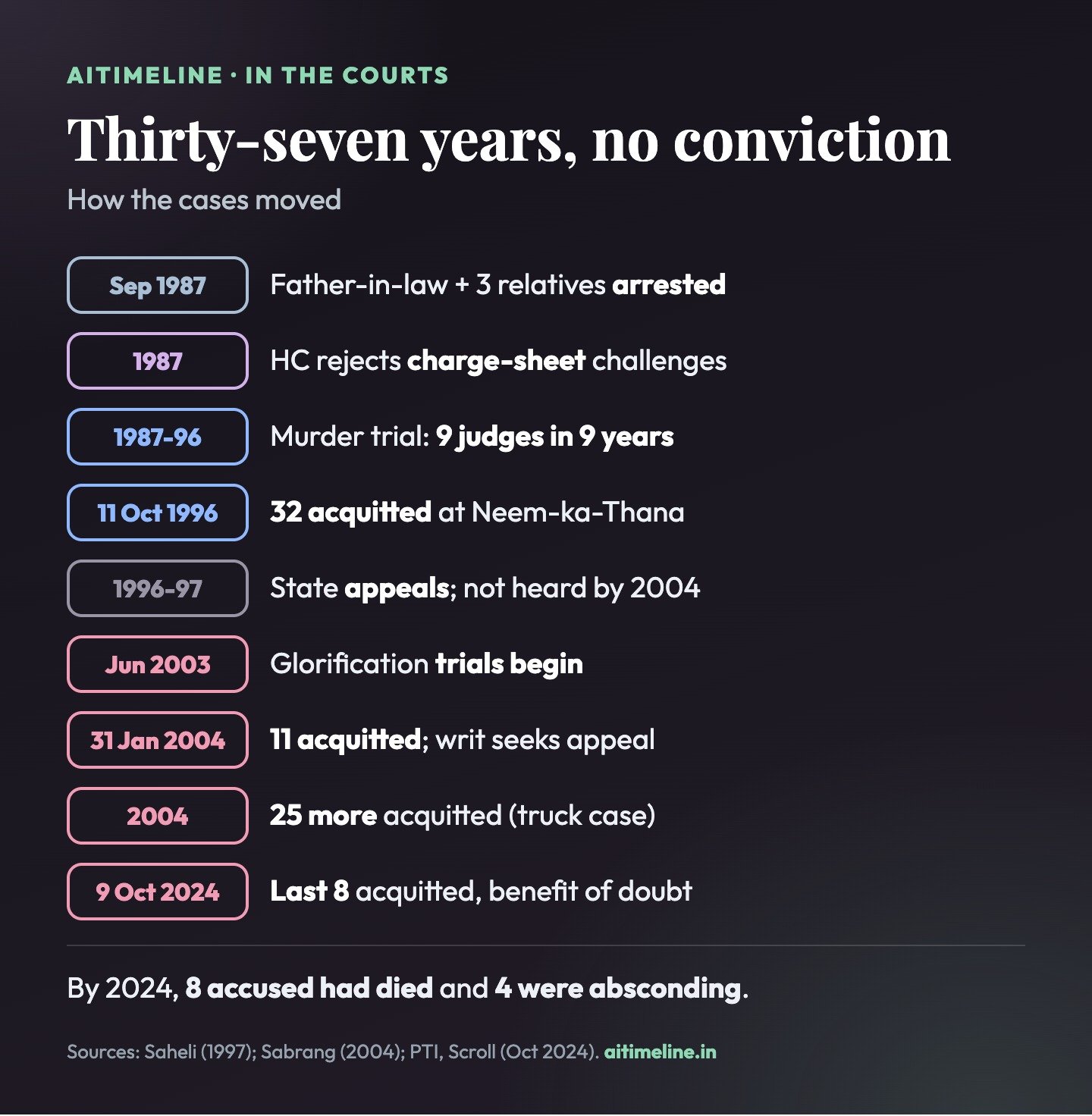
The charge. Police arrested Roop Kanwar’s father-in-law Sumer Singh and three relatives within about two weeks of her death. Eventually 32 adults, including her brothers-in-law, were tried for murder under the Indian Penal Code. The new anti-sati law could not be applied retrospectively.
The trial. It lasted nine years, and the presiding judge changed nine times. Witnesses who had been at the cremation did not support the prosecution in court.
The verdict. On 11 October 1996 the Additional Sessions Court at Neem-ka-Thana acquitted all 32. As reported by Saheli, the court said not a single witness had deposed that her death actually happened by being burnt alive. Three juveniles, including Pushpinder Singh, the brother-in-law believed to have lit the pyre, were dealt with separately.
The appeal. Rajasthan appealed. In March 1997 the appeal had not been admitted, and a 2004 report said it had still not been heard. We found no reported decision.
The Glorification Cases: 1987 to 2024
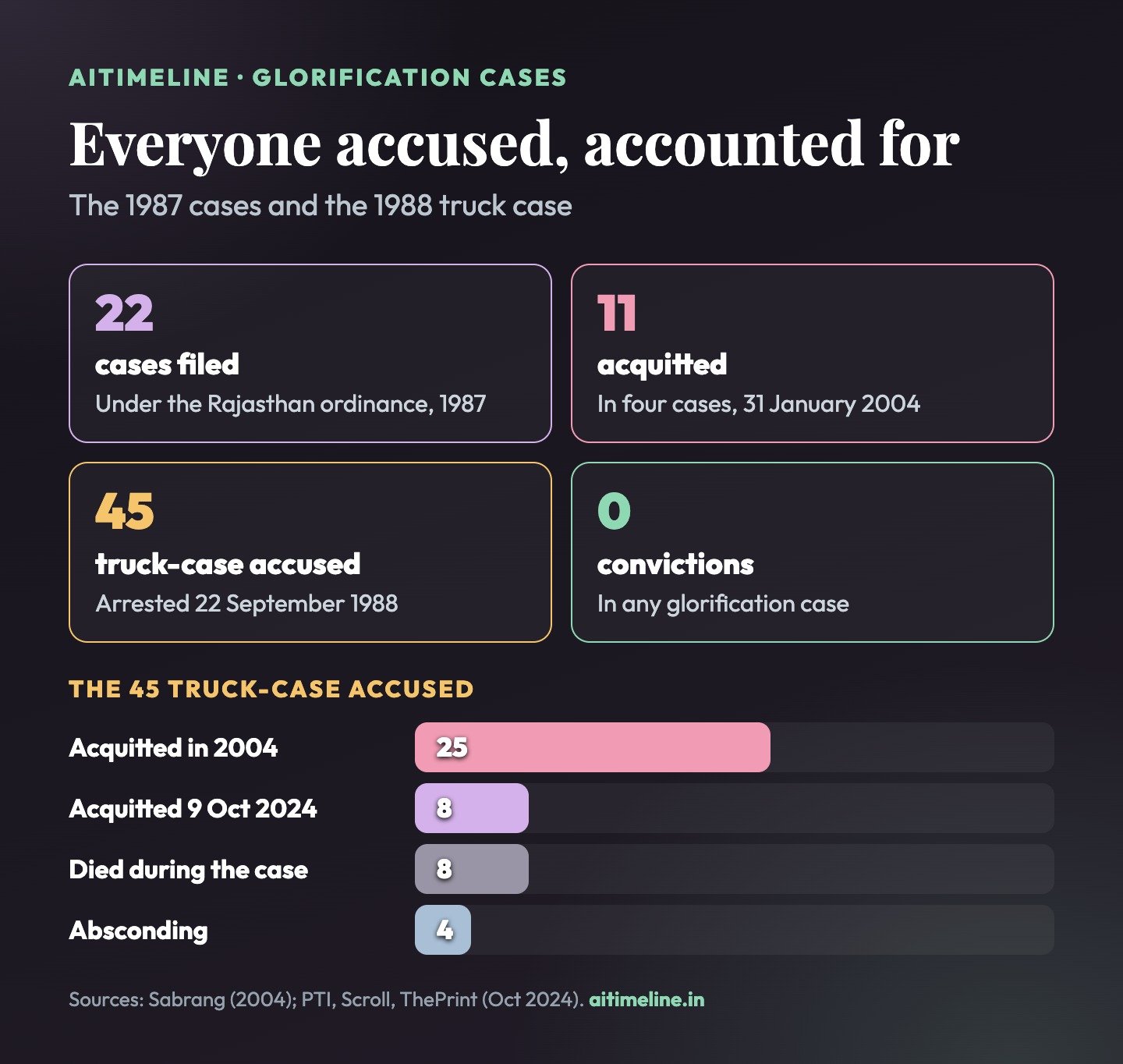
The 1987 cases. Police registered 22 glorification cases under the Rajasthan ordinance, over events including the chunari ceremony and pro-sati rallies. Legal challenges reached the Supreme Court and held up trials until 2003.
The January 2004 verdict. On 31 January 2004 Judge Shiv Singh Chauhan acquitted all 11 accused in four of those cases, including Rajendra Singh Rathore and Pratap Singh Khachariyawas. The court held, as reported, that because the Deorala death had not been proved to be a sati, glorifying it could not be proved either. Women’s groups called that reasoning circular, since the murder trial had already failed.
The truck case. On 22 September 1988, about 45 people were arrested on a truck heading from Deorala towards Ajitgarh with Roop Kanwar’s picture. Twenty-five were acquitted in 2004. The rest were dead, absconding or still on trial when the special court acquitted the last eight on 9 October 2024.
What Was Proved, and What Was Not
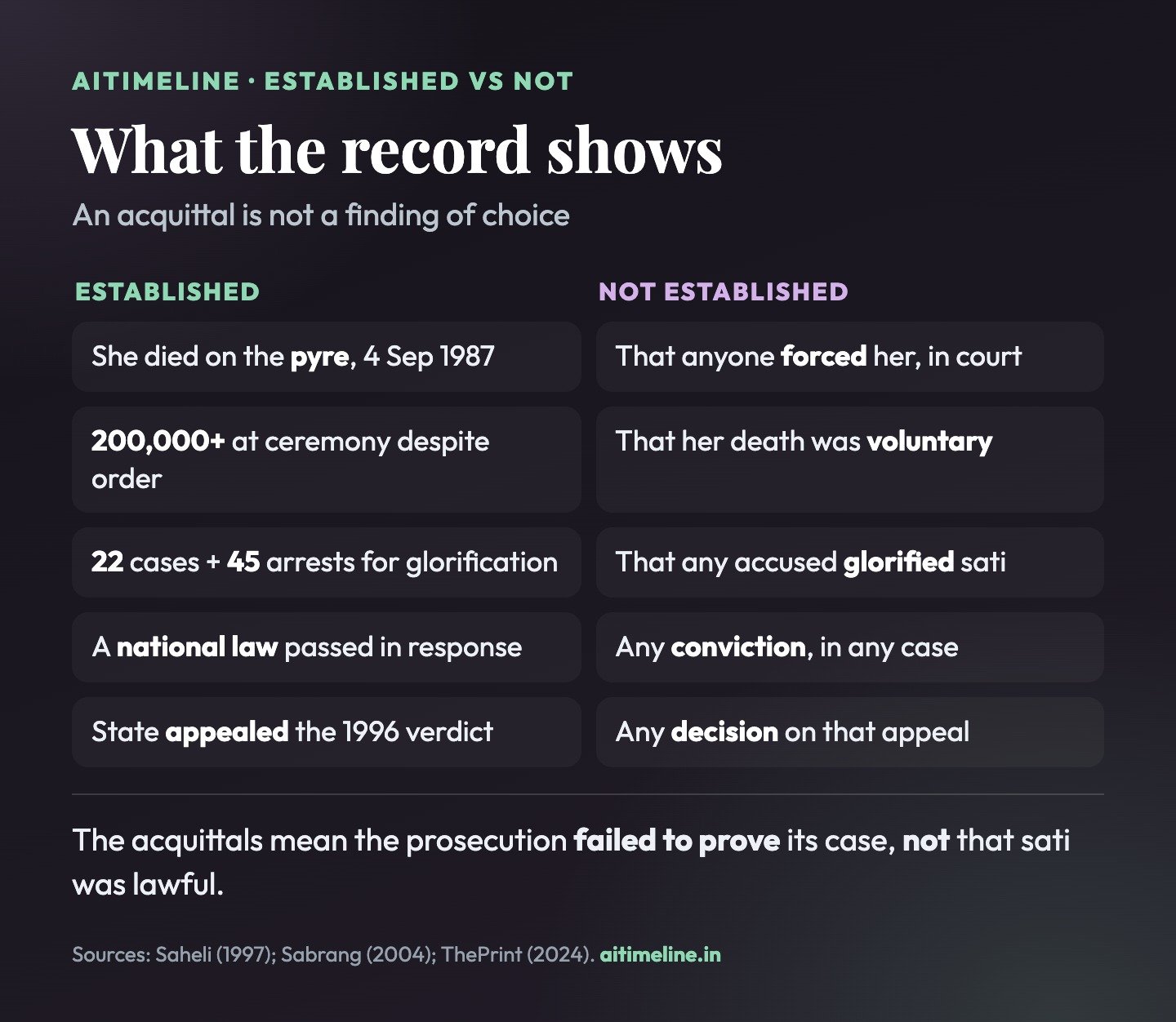
- She died on the pyre on 4 September 1987.
- A mass ceremony was held on 16 September, despite a court order.
- A national law was passed in response.
- That anyone forced her, in a court of law.
- That her death was voluntary: no court found this either.
- That any accused glorified sati.
- Any decision on the 1996 state appeal.
- The 2004 writ petition seeking an appeal.
- Use of Section 7 against Deorala’s shrine.
Deorala and the “Sati Belt” Today
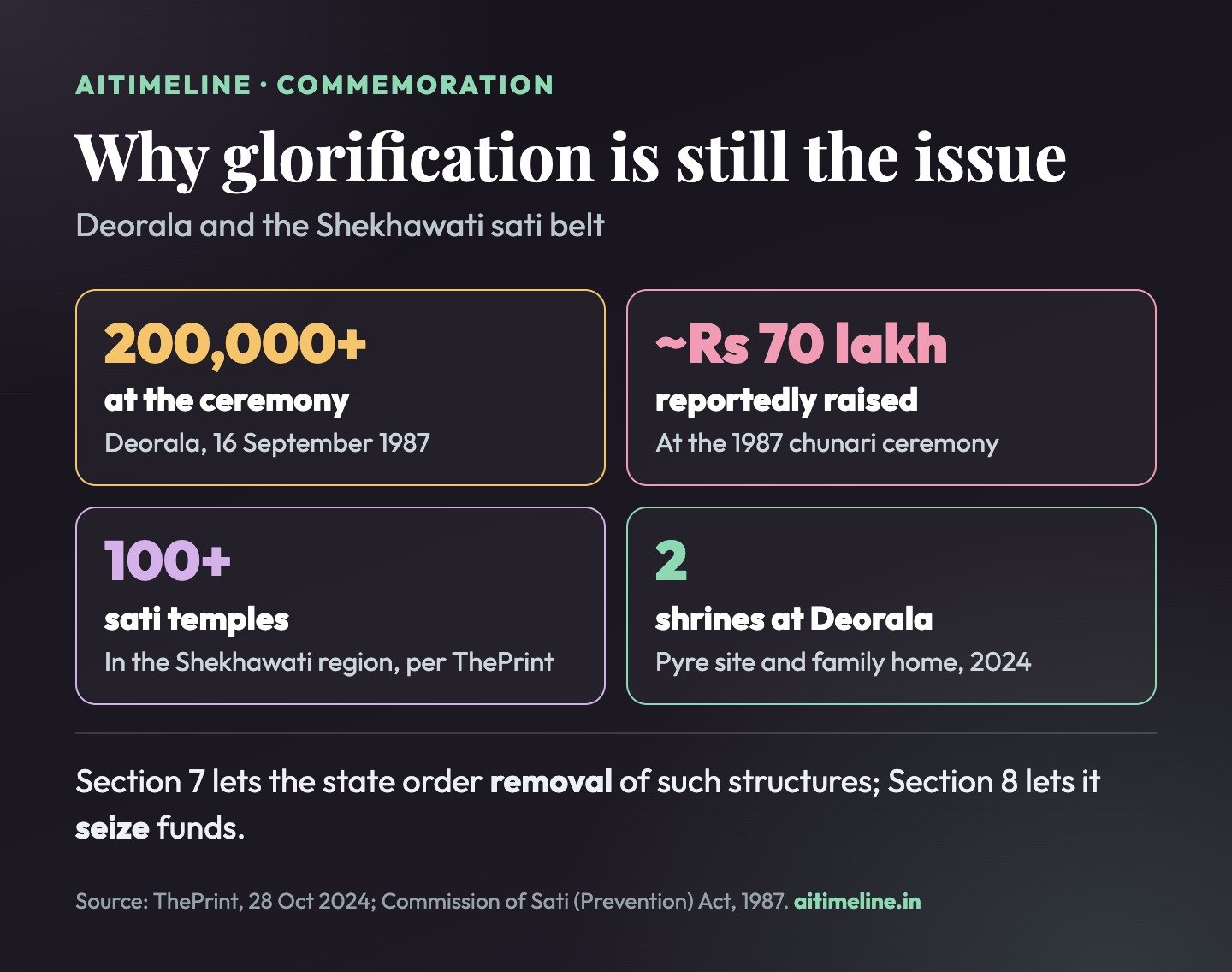
The shrine. ThePrint’s report of 28 October 2024 found a makeshift shrine at the spot of the pyre and another at the family home, with some villagers calling for a full temple.
The wider belt. The same report counted more than 100 sati temples in Shekhawati and described YouTube channels offering “digital darshan”. Activists argue this is exactly the commemoration the 1987 Act was written to stop.
The legal line. The Act targets acts meant to glorify sati: ceremonies, processions, fund-raising and temples. Private belief is not itself an offence, so enforcement depends on the specific conduct and on officials using the Section 6, 7 and 8 powers.
Key People and Institutions
Roop Kanwar
Aged 18; married about eight months to Maal Singh of Deorala.
Maal Singh Shekhawat
Aged 24, a science graduate; died in hospital on 3 September 1987.
Sumer Singh
Arrested in September 1987; among the 32 acquitted of murder in 1996.
Pushpinder Singh
A minor in 1987, believed to have lit the pyre; dealt with by a juvenile court.
Harideo Joshi
Rajasthan CM in 1987; replaced by Shiv Charan Mathur on 20 January 1988.
Shiv Singh Chauhan
Acquitted 11 accused in four glorification cases on 31 January 2004.
| Person or body | Role in the record |
|---|---|
| Rajendra Singh Rathore | Among 11 acquitted on 31 Jan 2004; later a senior BJP leader |
| Pratap Singh Khachariyawas | Among 11 acquitted on 31 Jan 2004; described then as Rajput Maha Sabha president |
| Rajasthan High Court | Ordered the state to stop the chunari ceremony, September 1987 |
| Sati Nivaran court, Jaipur | Special court that tried the glorification cases to 2024 |
| PUCL, AIDWA, NFIW, Vividha | Women’s and rights groups that demanded appeals in 2004 and 2024 |
| Women and Media Committee, BUJ | Published the 1987 fact-finding report Trial by Fire |
What the Case Exposed
Consent under pressure
Activists argued that a young widow’s “choice” before a crowd could not be treated as free consent.
Glorification as a crime
The 1987 Act reached beyond the pyre to the ceremonies, money and temples around it.
An order not enforced
A High Court order to stop the chunari ceremony was ignored in front of 200,000 people.
Silent witnesses
Every trial failed on testimony: villagers and even police witnesses did not support the prosecution.
Thirty-seven years
Accused died and absconded long before verdicts; one judge died mid-trial.
Commemoration continues
Shrines and sati temples remain, testing how the glorification law is enforced.
Did You Know?
- Thirteenth day: the chunari ceremony was held on the 13th day of mourning, 16 September 1987.
- Nine judges: the murder trial had nine presiding judges in nine years.
- Hindu calendar: the 1988 procession marked the first anniversary by the Hindu calendar, not 4 September.
- Not retrospective: the 32 murder accused were tried under the IPC, not the anti-sati Act.
- Act No. 3: the national law was the third central Act of 1988, though named for 1987.
- No forfeiture: Section 13 needs a conviction, so funds raised in 1987 could not be forfeited.
Explore More Timelines
People Also Ask
Frequently Asked Questions
Based on court reporting, the text of the 1987 Act and reporting to 17 November 2026.
⚠️ Editorial Note: What We Corrected and What We Could Not Confirm
The circumstances of Roop Kanwar’s death remain contested. Her family’s account of a voluntary sati and activists’ allegations of coercion are attributed, not presented as findings. The acquittals mean the prosecution did not prove its case; they are not judicial approval of sati or its glorification. The brief we started from had several errors. Harideo Joshi remained Chief Minister until 20 January 1988, not November 1987. Rajendra Singh Rathore and Pratap Singh Khachariyawas were acquitted on 31 January 2004 with nine others in four glorification cases, not among the 25 truck-case accused, and we could not confirm the brief’s date of 9 November 2004 for that later verdict. We could not confirm the brief’s marriage date of 17 January 1987, the arrest dates of 9 and 19 September 1987, a Lok Sabha debate on 12 November 1987, or an Indian Express report of 14 October 2024, and have not relied on them. We dropped anniversary entries that recorded no new event. Reports also differ on whether Maal Singh died in Sikar or Jaipur, and on the date of the High Court’s September 1987 order.
Related Reading on AiTimeline
Sources & further reading
Every dated entry above was checked against these references. Last reviewed 17 November 2026.
- India Code: The Commission of Sati (Prevention) Act, 1987 (Act No. 3 of 1988)
- Saheli: Sati and the Courts, Some Burning Questions (March 1997), on the 11 October 1996 Neem-ka-Thana acquittal
- Combat Law via Sabrang: Trial by fire, on the 31 January 2004 glorification acquittals (March 2004)
- PTI via ThePrint: 8 acquitted in 37-year-old sati glorification case in Jaipur (9 October 2024)
- Scroll: Eight persons accused in India's last known sati case acquitted by Jaipur court (October 2024)
- ETV Bharat: Roop Kanwar sati case, 8 accused acquitted (9 October 2024)
- ThePrint: Sati economy is still big in Rajasthan. No pending file on Roop Kanwar in Jaipur (28 October 2024)
- The Mooknayak: Women-led organisations express disappointment over acquittals in Rajasthan's sati glorification cases (October 2024)
- The Indian Express: 37 years ago, Roop Kanwar's death marked India's last sati case; 8 accused of glorifying the act acquitted (10 October 2024)
- BBC: Sati: Why India widow-burning case is back in news after 37 years (19 October 2024)
- The New York Times: India Seizes Four After Immolation (20 September 1987)
- The New Indian Express: Roop Kanwar forced sati case in final stage (September 2019)
- Hinduism Today: Glorification of Sati Outlawed in India (December 1988)
- Wikipedia: Hari Dev Joshi (Chief Minister of Rajasthan, terms of office)
- Wikipedia: Roop Kanwar