Tacos: The Complete History of Mexican Tradition and Indian-Inspired Fusion
The full history of tacos, 18 authentic Mexican recipes and 22 Indian-inspired fusion recipes, clearly separated, with nutrition, tips and 70 FAQs.
Latest Story
The taco stand in Mexico City’s Roma Norte neighbourhood had no sign, no menu on the wall, and a line that curled around the corner by 9pm. An Indian family visiting from Pune stood at the back of it, unsure at first whether to order in Spanish, English or by pointing. What arrived a few minutes later — two warm corn tortillas, barely bigger than the palm of a hand, filled with pork shaved straight off a spinning trompo, a scrape of pineapple, a spoon of green salsa, a scatter of raw onion and coriander — wasn’t what any of them had eaten under the name “taco” before. Back home, their idea of a taco had usually meant a crunchy yellow shell from a supermarket box. This was something else: thin, soft, smoky, built to be eaten in three bites while standing up. Weeks later, back in their own kitchen, they tried to recreate that memory — not by copying it exactly, because they didn’t have a trompo or the specific chile blend of a Mexico City al pastor stand, but by understanding what made it work, and then, on other nights, by using what their own kitchen already did well: garam masala, marinated paneer, leftover butter chicken. Two different things came out of that trip. One was a closer, more respectful attempt at an actual Mexican taco. The other was something new, built on Indian flavours, that never claimed to be the first thing. This guide is about both, kept carefully apart, because that distinction is the whole point.
🧠 AI Overview Summary
A taco is a Mexican dish built on a folded or rolled corn or wheat tortilla filled with meat, seafood, vegetables or beans and topped with salsa, onion, coriander or other garnishes. Corn tortillas, made from nixtamalized maize, are the older and more traditionally Mexican base; wheat flour tortillas became common later, particularly in Mexico’s northern states, and are the base most associated with Tex-Mex cooking. Historical and cultural sources trace the tortilla-as-edible-utensil concept to pre-Hispanic Mesoamerica, with today’s most recognisable regional styles — including tacos al pastor, which grew out of Lebanese immigrant shawarma techniques adapted with Mexican chiles in the mid-20th century — developing over subsequent centuries. Tacos spread internationally through the 20th century and are now also reinterpreted worldwide, including in Indian-inspired fusion versions built on ingredients like paneer, tandoori spices and butter chicken; this guide treats those fusion dishes as a distinct, clearly labelled category rather than as authentic Mexican cuisine.
Tacos, in six direct answers
What matters most about tacos, tradition and fusion
- Tacos have a real, traceable history in Mexico. The tortilla-as-edible-utensil concept predates European contact; specific regional styles like tacos al pastor are much more recent, emerging through 20th-century cultural exchange.
- Corn tortillas are the older, more traditionally Mexican base. Flour tortillas became common later, mainly in northern Mexico, and are the base most associated with Tex-Mex cooking outside Mexico.
- Regional Mexican taco styles differ significantly. Al pastor, cochinita pibil, carne asada and Baja fish tacos each reflect a different region’s ingredients, techniques and history — there is no single “authentic taco.”
- Indian-inspired tacos are fusion food, not Mexican cuisine. This guide’s 22 Indian-inspired recipes use the taco format to carry Indian flavours; none are presented as authentic or traditional Mexican dishes.
- Tacos can be a genuinely balanced meal. Combining vegetables, legumes or lean protein with fresh salsa and a modest amount of cheese keeps them nutritionally reasonable, in either culinary tradition.
- Homemade tortillas and store-bought ones both have a place. Fresh masa gives the best flavour and texture; good store-bought corn tortillas, warmed properly, are a realistic weeknight option.
- Street food culture shaped how tacos are eaten. Small, quickly assembled, stand-and-eat portions remain central to taco culture in Mexico, distinct from the larger, cutlery-eaten “taco plates” common elsewhere.
- Global popularity followed a documented path. International restaurant growth from the 1970s, a food-television boom in the 2000s, and social-media-driven food truck and fusion culture in the 2010s each expanded the taco’s reach in a different way.
- Vegetarian and vegan tacos are not a recent invention. Traditional Mexican vegetarian tacos — nopales, rajas con crema, papa — have long existed alongside meat-based styles, well before plant-based eating became a trend.
- This guide keeps facts, tradition and invention separate throughout. Historical background, authentic Mexican recipes, Indian-inspired fusion recipes and nutrition estimates are labelled distinctly in every section.
What Tacos Actually Are
Corn versus flour tortillas, street food culture, regional Mexican styles, Indian flavour adaptation, and how tacos fit into a balanced diet — the essentials before the history and the recipes.
At its simplest, a taco is a filled tortilla eaten by hand — but that simplicity is exactly why the format has travelled so far and been reinterpreted so many times. In Mexico, a taco is usually small: one or two soft corn tortillas, lightly filled, folded rather than overstuffed, designed to be eaten in a handful of bites while standing at a stall or sitting on a low stool. That is a meaningfully different eating experience from the larger, heavily loaded, often hard-shelled “taco” that became familiar in parts of the United States and, from there, much of the rest of the world.
The distinction between corn tortillas and flour tortillas is not cosmetic. Corn tortillas are made from masa — dried maize kernels cooked and steeped in an alkaline solution (a process called nixtamalization), then ground into dough. This technique, with roots going back millennia in Mesoamerica, produces a tortilla with a distinct earthy flavour and a slightly firmer, more textured bite. Flour tortillas, made from wheat, are softer, more elastic and more neutral in flavour; they became common later, particularly in Mexico’s northern states, where wheat cultivation was more established, and they are the tortilla most associated internationally with Tex-Mex cooking rather than central or southern Mexican tradition.
Street food culture is inseparable from how tacos developed. Taquerias, market stalls and mobile carts historically operated on tight margins and fast turnover, which shaped the format itself: small portions, quick assembly, minimal plating, and a reliance on the customer building the final bite themselves from a shared plate of onion, coriander, salsa and lime. Regional Mexican tacos reflect this same local, resourceful logic applied to very different ingredients — pork and pineapple in Mexico City, slow-roasted pork in banana leaf in the Yucatán, grilled beef in the north, battered fish in Baja California — each shaped by what was regionally available and by the specific communities, including immigrant communities, who settled there.
Indian flavour adaptations of the taco format are a much newer, separate development, built by home cooks and restaurants using the tortilla-and-filling structure as a vehicle for ingredients Indian cooks already know well — paneer, tandoori marinades, garam masala, butter chicken gravy, spiced legumes. These recipes are not attempts to replicate a Mexican dish; they are a distinct fusion category, and this guide treats them as such throughout, never describing them as regional Mexican cuisine.
On nutrition, tacos are genuinely flexible. A taco built around lean protein or legumes, plenty of fresh vegetables, a light hand with cheese and cream, and a fresh salsa rather than a heavy sauce can form part of a well balanced meal with meaningful fibre, protein and micronutrients. Fresh ingredients — ripe tomatoes, good chiles, fresh coriander, properly warmed tortillas — matter more to a good taco than any single “secret” technique, in both the traditional Mexican recipes and the Indian-inspired ones in this guide.
📜 History Insight
Tacos evolved over centuries through regional Mexican traditions before becoming a global favourite. The tortilla itself, and the practice of using it to wrap food rather than eating with separate utensils, is documented in pre-Hispanic Mesoamerican food culture. But many of the specific taco styles people think of as timeless — al pastor most famously — are 20th-century developments, shaped by immigration, trade and regional ingredient availability, not ancient fixed recipes.
The Complete Historical Timeline: Tacos From Pre-Hispanic Mesoamerica to 2026
Historical background, culinary significance, regional evolution and global impact are separated in every entry, newest first. Historical facts and modern adaptations are never blended into one unqualified claim.
Home cooking, healthy and plant-based tacos define the current culinary conversation
Current relevance: as of the most recent trend reporting referenced in this guide, home cooking of tacos continues to grow alongside restaurant culture, with plant-based fillings, portion-conscious “healthy taco” formats and Indian and other global fusion versions all covered as parallel, coexisting trends rather than one replacing another.
Regional evolution: traditional regional Mexican styles remain widely documented and cooked, even as fusion versions attract separate, growing coverage — food writers increasingly treat the two as distinct categories worth understanding on their own terms.
Fusion cuisine, including Indian-inspired tacos, grows as a distinct global trend
Regional evolution: through the early 2020s, fusion cooking built on the taco’s tortilla-and-filling format expanded well beyond earlier Tex-Mex and Korean-Mexican fusion, with Indian-inspired versions — built on paneer, tandoori spice and North Indian gravies — appearing on restaurant menus and in home cooking content across India and its diaspora communities.
Global impact: this period reinforced a broader pattern in global food culture: widely travelled, structurally simple dishes like the taco becoming a flexible format for other cuisines’ flavours, while food writers and cultural commentators increasingly emphasised the importance of not mislabelling fusion food as traditional.
Social media and the food truck movement reshape how tacos are discovered and shared
Global impact: the 2010s food truck boom, amplified heavily by image-driven social media platforms, gave independent taco vendors — both traditional Mexican specialists and fusion-focused operators — a much lower-cost path to visibility than a traditional restaurant required, accelerating experimentation and regional-style discovery alike.
Regional evolution: this period also saw increased mainstream food-media attention to authentic regional Mexican styles specifically, with critics and writers pushing back against homogenised “Tex-Mex as the default taco” framing that had dominated earlier decades of Western taco coverage.
The food television era brings regional Mexican cooking to a wider international audience
Global impact: the 2000s growth of dedicated food television programming, alongside an expanding culinary publishing market, gave regional Mexican cuisine — including specific taco styles and their history — significantly more detailed international coverage than the broader, less specific “Mexican food” framing common in earlier decades.
Regional evolution: this period helped popularise awareness, outside Mexico, that tacos al pastor, cochinita pibil, carne asada and Baja-style fish tacos were meaningfully different regional dishes rather than interchangeable variations on one recipe.
Global restaurant growth expands tacos beyond North America
Global impact: through the 1990s, Mexican and Tex-Mex restaurant formats continued expanding internationally beyond their strongest existing markets in North America, part of a broader global trend of increased cross-border restaurant chains and independent ethnic-cuisine restaurants opening in new regions.
Regional evolution: this expansion phase mostly carried simplified, Tex-Mex-influenced taco formats rather than deeply regional Mexican styles, a gap that later food-media coverage (2000s onward) would work to address.
International popularity accelerates through US restaurant chains
Historical background: the 1970s saw significant growth of Mexican-American and Tex-Mex restaurant chains in the United States, building on earlier 20th-century Mexican immigrant food culture in the American Southwest and California, and establishing the crunchy hard-shell taco as the dominant international image of “a taco” for much of the following two decades.
Culinary significance: this hard-shell, heavily topped format, while commercially significant, represents a distinct branch of taco history from the soft, corn-tortilla-based styles that remained (and remain) standard in most of Mexico.
Tacos al pastor emerge from Lebanese immigrant shawarma technique in central Mexico
Historical background: tacos al pastor developed through the mid-20th century as Lebanese immigrant communities in central Mexico adapted vertical spit-roasting techniques used for shawarma, replacing lamb with pork and incorporating Mexican chiles, achiote and pineapple, a dish widely documented by culinary historians as a genuine product of cultural exchange rather than a pre-Hispanic tradition.
Regional evolution: the style became strongly associated with Mexico City and central Mexico specifically, where trompo-roasted pork stands remain a defining feature of street food culture today.
Street-food expansion establishes the taquería as a defining institution
Historical background: through the early 20th century, urbanisation in Mexico supported the growth of dedicated taco stalls and taquerias as a distinct category of food business, formalising what had previously been more informal, home- and market-based taco preparation into a recognisable commercial street food culture.
Culinary significance: this period established much of the service format still recognisable today — small standing counters, a focus on speed and turnover, and a reliance on the customer’s own final assembly at the counter.
Regional taco styles diverge across Mexico’s distinct culinary regions
Regional evolution: through the 19th century, distinct regional culinary identities across Mexico — shaped by local agriculture, indigenous ingredients, and the degree and nature of Spanish colonial and other influences in each area — produced increasingly differentiated taco and tortilla-based food traditions in the north, centre, south and coastal regions.
Culinary significance: this divergence is the historical root of why “an authentic taco” cannot mean one single fixed recipe — a Yucatán-style filling, a northern grilled-beef style and a central Mexican style each reflect a genuinely different regional food culture.
Spanish colonisation introduces new livestock and ingredients into Mexican cooking
Historical background: Spanish colonisation, beginning in the early 16th century, introduced livestock including cattle, pigs and goats, along with wheat, dairy and other ingredients previously absent from Mesoamerican cooking, gradually expanding what could be used as a taco filling well beyond the indigenous ingredients available before contact.
Culinary significance: this period marks the beginning of the ingredient blending — indigenous techniques and staples combined with introduced livestock and wheat — that would eventually produce dishes like carne asada and, much later, flour-tortilla-based northern Mexican and Tex-Mex cooking.
Corn tortillas emerge as an edible utensil in Mesoamerican food culture
Historical background: historical and archaeological sources trace the corn tortilla, and the broader practice of using it to scoop, wrap and carry food rather than relying on separate utensils, to pre-Hispanic Mesoamerican food culture, with maize as a foundational staple crop across the region for millennia before European contact.
Culinary significance: this tortilla-as-utensil concept is the structural origin point of the taco itself — long before “taco” as a specific named dish existed, the underlying technique of wrapping food in a piece of cooked maize dough was already established practice.
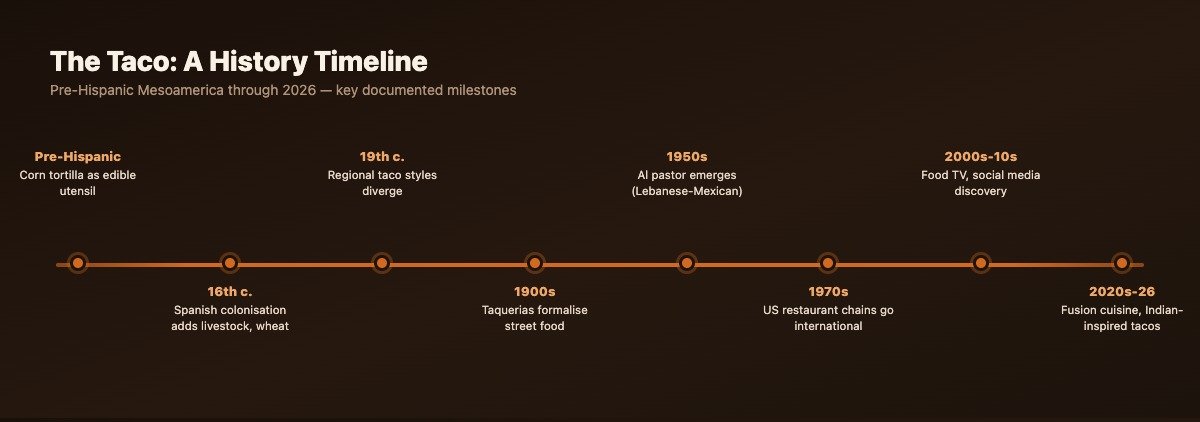
Taco history at a glance: pre-Hispanic origins through the 2026 fusion era.
Key Terms, Explained
The vocabulary this guide uses throughout — tortilla types, salsas, and the core Indian ingredients used in the fusion recipes.
Corn Tortilla
Made from nixtamalized maize (masa), the traditional and older base for most regional Mexican tacos, with a firmer texture and distinct earthy flavour.
Flour Tortilla
Made from wheat, softer and more elastic than corn, more associated with northern Mexico and Tex-Mex cooking than with central or southern Mexican tradition.
Salsa Varieties
Salsa roja (cooked red chile), salsa verde (tomatillo-based), pico de gallo (raw, chopped) and salsa macha (chile-oil based) each serve a different role and heat level.
Guacamole
Mashed ripe avocado, typically seasoned with lime, salt, onion and coriander; a side and topping, not itself a filling.
Pico de Gallo
A raw salsa of finely diced tomato, onion, chile and coriander, dressed with lime juice — fresh rather than cooked, and typically used sparingly as a topping.
Refried Beans
Cooked beans (commonly pinto), mashed and fried, traditionally used as a side or spread rather than a standalone taco filling on their own.
Mexican Cheese
Queso fresco (crumbly, mild) and cotija (firm, salty, aged) are the cheeses most associated with traditional Mexican tacos, distinct from the shredded cheddar common in Tex-Mex versions.
Al Pastor / Trompo
Pork marinated in chiles and achiote, stacked and roasted vertically on a spinning trompo spit, sliced thin as it cooks — the technique behind tacos al pastor.
Indian Spice Blends
Garam masala, tandoori masala and chaat masala are the blends used most often in this guide’s fusion recipes, layered onto the taco format rather than any Mexican spice tradition.
Fusion Cooking
Deliberately combining techniques or flavours from separate culinary traditions — here, Indian spicing and gravies with the Mexican taco format — while keeping both traditions clearly identified rather than blended into a false single origin.
Meal Preparation
Pre-cooking fillings, salsas and toppings ahead of time so tacos can be assembled quickly at the table — standard practice in both Mexican home cooking and the Indian-inspired recipes in this guide.
Nixtamalization
The process of cooking and steeping maize in an alkaline (lime/calcium hydroxide) solution before grinding it into masa — it improves flavour, workability and nutrient availability, and is what distinguishes true corn tortillas from plain cornmeal flatbread.
Evergreen Explainers
Four deeper dives referenced throughout this guide’s recipes and comparison tables.
History of Tacos
The taco’s story has two very different timescales layered on top of each other. The tortilla itself — and the basic idea of wrapping food in one rather than eating with separate utensils — is genuinely ancient, rooted in pre-Hispanic Mesoamerican food culture built around maize as a staple crop. But most of the specific, named taco styles eaten today are far more recent: al pastor is a mid-20th-century invention shaped by Lebanese immigrant cooking techniques; the crunchy hard-shell taco most familiar outside Mexico is a US restaurant-industry product of the mid-to-late 20th century; even Baja-style battered fish tacos are generally dated to the 20th century, tied to specific coastal fishing communities. Treating “the taco” as one dish with one origin story flattens a much more interesting, and better documented, reality of regional divergence and ongoing cultural exchange.
Corn vs Flour Tortillas
Beyond flavour and texture, the corn-versus-flour distinction carries real regional and historical weight. Corn tortillas, made through nixtamalization, are the base most tied to central and southern Mexican tradition and to the country’s deepest culinary roots. Flour tortillas rose to prominence later, in Mexico’s wheat-growing northern states, and became the tortilla most associated internationally with Tex-Mex cooking specifically. Neither is more “correct” than the other within Mexican cuisine as a whole — they simply carry different regional identities, and a recipe’s authenticity claim should generally match its tortilla choice to its region.
How to Make Fresh Salsa
Good salsa rests on balance, not heat alone. A basic pico de gallo needs ripe tomato, finely diced white onion (rinsed briefly in cold water to soften its bite), fresh chile to taste, chopped coriander, lime juice and salt, combined just before serving so the tomato doesn’t turn watery. A cooked salsa roja typically starts with dried or fresh red chiles, charred or lightly toasted, blended with garlic, a little onion and tomato, then simmered briefly to round out the flavour. Salsa verde follows a similar cooked method using tomatillos instead of tomatoes, giving a brighter, more acidic result. In every case, tasting and adjusting salt and acid at the end matters more than following exact quantities.
How Indian Flavours Complement Tacos
The taco format — a small, warm tortilla wrapped around a spiced filling and finished with a fresh, acidic topping — maps unusually well onto Indian cooking’s own structure, where a rich, spiced main (a curry, a marinade, a masala) is traditionally balanced by something cooling and fresh, like raita or a squeeze of lime. In this guide’s fusion recipes, that translation typically works best when the Indian element carries the main flavour — a tandoori marinade, a butter chicken gravy, a chana masala — while the taco’s own garnishes (onion, coriander, lime, a light crema) do the same balancing job they would in a Mexican dish. The result reads as genuinely fusion rather than either cuisine diluted.
🇯️ Culture Insight
Authentic tacos differ by region, ingredients and preparation methods. A taco from Tijuana, a taco from Mexico City and a taco from Mérida can use different tortillas, different meats, different salsas and different serving customs — all while being equally authentic to their own region. “Authentic” describes a genuine connection to a specific place and tradition, not a single fixed universal recipe.
Comparison Tables
Corn versus flour, traditional versus fusion, soft versus crispy, homemade versus store-bought, and a full timeline summary.
| Corn Tortillas | Flour Tortillas |
|---|---|
| Made from nixtamalized maize (masa) | Made from wheat flour, fat and water |
| Central/southern Mexican tradition | Northern Mexican and Tex-Mex tradition |
| Firmer, slightly grainy texture; distinct corn flavour | Soft, elastic, neutral flavour |
| Naturally gluten-free | Contains gluten |
| Best for most traditional taco recipes in this guide | Best for burritos, quesadillas and some northern-style tacos |
| Traditional Mexican Tacos | Indian-Inspired Fusion Tacos |
|---|---|
| Rooted in documented regional Mexican culinary history | Modern fusion creation, not a historical Mexican dish |
| Uses Mexican chiles, achiote, Mexican cheeses, epazote | Uses Indian spice blends, gravies, paneer, chutneys |
| Presented in this guide as authentic regional cuisine | Presented in this guide strictly as fusion cooking |
| Examples: al pastor, carnitas, barbacoa, cochinita pibil | Examples: butter chicken taco, paneer tikka taco, chole taco |
| Soft Tacos | Crispy Tacos |
|---|---|
| Warm, pliable tortilla, folded around the filling | Tortilla fried or baked until firm and crunchy |
| The standard style across most of Mexico | Includes tacos dorados and US-style hard-shell tacos |
| Lower in added oil | Higher in added oil from frying |
| Eaten immediately, doesn’t hold structure long | Holds its shape longer, easier for heavier fillings |
| Homemade Tortillas | Store-Bought Tortillas |
|---|---|
| Best flavour and texture when fresh masa is used | Convenient, consistent, widely available |
| Requires masa harina or fresh masa and a tortilla press | Quality varies significantly by brand |
| Best eaten within hours of making | Longer shelf life; always warm before serving |
| Recommended for special-occasion cooking | Realistic and reasonable for weeknight cooking |
| Vegetarian Fillings | Meat & Seafood Fillings |
|---|---|
| Generally lower in saturated fat | Higher in complete protein per portion |
| Beans, legumes, paneer and cheese as protein sources | Beef, pork, chicken, fish and shrimp as protein sources |
| Often faster to prepare (no marinating/browning meat) | Often needs marinating, browning or slow-cooking time |
| 18 of this guide’s 40 recipes are vegetarian or vegan | 22 of this guide’s 40 recipes include meat or seafood |
| Year / Era | Event | Culinary Significance |
|---|---|---|
| Pre-Hispanic | Corn tortilla established as edible utensil | Structural origin of the taco format itself |
| 16th century | Spanish colonisation introduces livestock, wheat | Expands possible fillings and tortilla types |
| 19th century | Regional taco styles diverge across Mexico | Root of Mexico’s regional culinary identity |
| 1900s | Taquerias formalise street food service | Establishes the modern taco-stand format |
| 1950s | Tacos al pastor emerge (Lebanese/Mexican fusion) | Landmark example of documented cross-cultural fusion |
| 1970s | US restaurant chains drive international popularity | Spreads a simplified, hard-shell taco image globally |
| 1990s | Global restaurant growth beyond North America | Widens international access, mostly Tex-Mex-style |
| 2000s | Food television era | Builds international awareness of regional authenticity |
| 2010s | Social media, food truck movement | Accelerates discovery of regional and fusion styles alike |
| 2020s | Fusion cuisine, incl. Indian-inspired tacos, grows | New, clearly distinct fusion category emerges |
| 2026 | Home cooking, healthy and plant-based tacos trend | Traditional and fusion styles covered as parallel trends |
💡 Did You Know?
Tacos have roots in pre-Hispanic Mesoamerica, and regional varieties such as tacos al pastor emerged much later through cultural exchange — al pastor specifically traces to Lebanese immigrant shawarma technique adapted in central Mexico in the mid-20th century, making it younger than many people assume.
🌿 Nutrition Insight
Combining vegetables, legumes and lean proteins can create balanced taco meals. Two or three modestly filled corn tortillas with a lean protein or bean filling, fresh salsa, shredded vegetables and a light amount of cheese generally deliver meaningful protein and fibre without excessive saturated fat — the nutrition table later in this guide breaks this down by recipe.
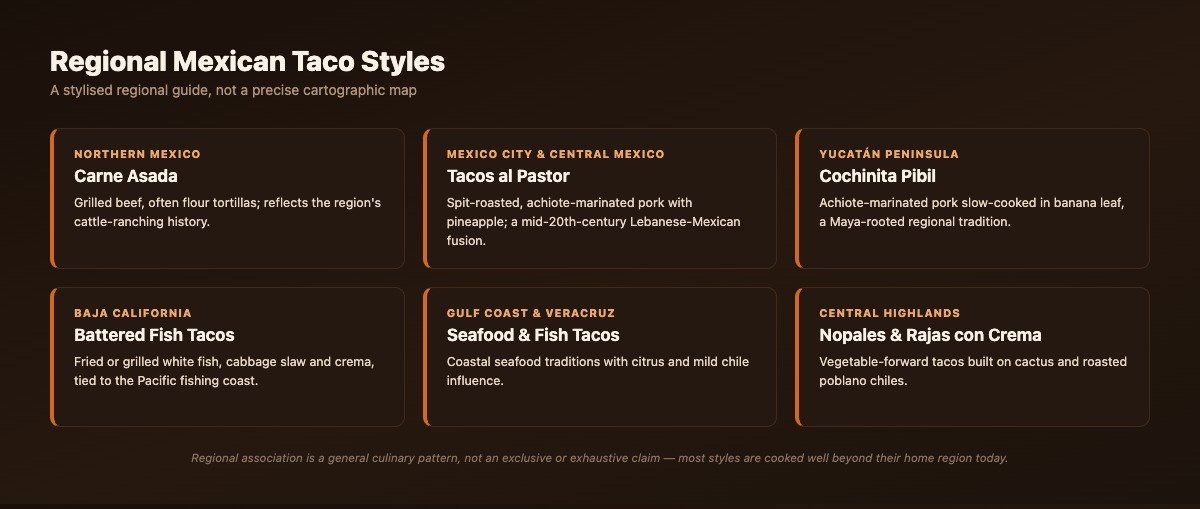
Regional Mexican taco styles: a rough geographic guide, not an exhaustive map.
🍏 Fusion Insight
Indian ingredients can inspire new taco recipes while remaining distinct from traditional Mexican cuisine. Garam masala in place of cumin-and-chile, a butter chicken gravy in place of salsa, paneer in place of queso fresco — each substitution creates something genuinely new, and this guide is careful never to describe the result as a regional Mexican dish.
✓ Historically Accurate
- Corn tortillas are the older, more traditionally Mexican base
- Al pastor is a mid-20th-century fusion dish, not pre-Hispanic
- Regional Mexican tacos genuinely differ by ingredients and method
- The hard-shell taco is primarily a US restaurant-industry format
⚠ Common Misconception
- That “hard-shell tacos” are the traditional Mexican default
- That one single recipe can be “the authentic taco”
- That al pastor is an ancient, unchanged Aztec-era dish
- That fusion tacos represent traditional Mexican cooking
Tacos in Context: Key Cuisines & Dishes
Mexican Cuisine
The originating culinary tradition for the taco, recognised by UNESCO as an element of intangible cultural heritage in 2010, encompassing deep regional variation across the country.
Indian Cuisine
The source tradition for this guide’s fusion recipes, contributing spice blends, gravies, paneer and legume-based dishes adapted into a taco format.
Tacos al Pastor
Spit-roasted, achiote-marinated pork with pineapple, native to central Mexico and shaped by mid-20th-century Lebanese-Mexican culinary exchange.
Pico de Gallo
A fresh, uncooked salsa of diced tomato, onion, chile, coriander and lime, used as a bright, acidic topping across most taco styles.
Guacamole
Mashed avocado seasoned simply with lime, salt and often onion or coriander, served as a side or topping rather than a filling.
Corn Tortilla
The traditional, nixtamalized-maize base most associated with central and southern Mexican tacos.
Flour Tortilla
The wheat-based tortilla most associated with northern Mexico and Tex-Mex cooking.
Queso Fresco & Cotija
The two Mexican cheeses used most often in this guide’s traditional recipes — queso fresco mild and crumbly, cotija firm and salty.
Garam Masala & Tandoori Masala
The two Indian spice blends used most often across this guide’s fusion recipes, applied to marinades and finishing spice alike.
Government of Mexico / Secretaría de Cultura
An official source for Mexican culinary heritage information, referenced for this guide’s historical claims about tortillas and regional food traditions.
Future Watch
- Officially recognised culinary festivals continuing to celebrate regional Mexican food traditions, including Mexico City street food events.
- Restaurant trend reporting pointing toward continued growth in both authenticity-focused regional Mexican dining and clearly labelled global fusion menus.
- Plant-based innovation expanding vegetarian and vegan taco fillings, including jackfruit- and mushroom-based options, across both traditions.
- Sustainable ingredient sourcing, including responsibly farmed seafood and regeneratively grown maize, becoming a more visible restaurant talking point.
Interesting Facts
- Nixtamalization — the alkaline treatment behind corn tortillas — also makes the maize’s niacin more nutritionally available, a documented benefit beyond flavour and texture.
- Cotija cheese is named after the town of Cotija in Michoacán, where it was traditionally produced.
- Baja California’s fish taco tradition is tied specifically to the region’s fishing communities and Pacific coastline.
- Mexico City’s al pastor stands typically slice pork directly off the trompo to order, a technique borrowed from shawarma preparation.
40 Complete Recipes: Traditional Mexican & Indian-Inspired Fusion Tacos
18 traditional Mexican recipes, clearly labelled, followed by 22 Indian-inspired fusion recipes, also clearly labelled. Use the filters below to jump to what you’re after.
| # | Recipe | Category | Dietary tags |
|---|---|---|---|
| 1 | Carne Asada Tacos | Traditional | Beef, Spicy, Street Food |
| 2 | Tacos al Pastor | Traditional | Pork, Spicy, Street Food |
| 3 | Baja Fish Tacos | Traditional | Seafood, Street Food |
| 4 | Chicken Tinga Tacos | Traditional | Chicken, Healthy |
| 5 | Carnitas Tacos | Traditional | Pork |
| 6 | Barbacoa Tacos | Traditional | Beef, Spicy |
| 7 | Tacos de Camarón | Traditional | Seafood, Healthy, Street Food |
| 8 | Tacos Gobernador | Traditional | Seafood |
| 9 | Tacos de Lengua | Traditional | Beef, Street Food |
| 10 | Tacos Dorados | Traditional | Chicken, Street Food |
| 11 | Tacos de Suadero | Traditional | Beef, Street Food |
| 12 | Tacos de Chorizo con Papa | Traditional | Pork, Spicy, Street Food |
| 13 | Tacos de Nopales | Traditional | Vegetarian, Vegan, Healthy |
| 14 | Tacos de Rajas con Crema | Traditional | Vegetarian |
| 15 | Tacos de Papa | Traditional | Vegan, Street Food |
| 16 | Tacos de Coliflor | Traditional | Vegan, Healthy |
| 17 | Tacos de Frijoles Refritos | Traditional | Vegetarian, Vegan, Healthy |
| 18 | Tacos de Pescado Zarandeado | Traditional | Seafood, Healthy |
| 19 | Paneer Tikka Tacos | Fusion | Paneer, Vegetarian, Spicy |
| 20 | Butter Chicken Tacos | Fusion | Chicken, Spicy |
| 21 | Rajma Tacos | Fusion | Vegetarian, Vegan, Healthy |
| 22 | Chole Tacos | Fusion | Vegetarian, Vegan, Healthy, Street Food |
| 23 | Tandoori Chicken Tacos | Fusion | Chicken, Spicy, Healthy |
| 24 | Masala Corn Tacos | Fusion | Vegetarian, Vegan, Street Food |
| 25 | Palak Paneer Tacos | Fusion | Paneer, Vegetarian |
| 26 | Keema Tacos | Fusion | Spicy |
| 27 | Prawn Masala Tacos | Fusion | Seafood, Spicy |
| 28 | Jackfruit Tacos | Fusion | Vegan, Healthy |
| 29 | Mushroom Masala Tacos | Fusion | Vegetarian, Vegan, Healthy |
| 30 | Egg Bhurji Tacos | Fusion | Vegetarian, Street Food |
| 31 | Amritsari Fish Tacos | Fusion | Seafood, Spicy |
| 32 | Malai Chicken Tacos | Fusion | Chicken |
| 33 | Aloo Tikki Tacos | Fusion | Vegan, Street Food |
| 34 | Chicken 65 Tacos | Fusion | Chicken, Spicy, Street Food |
| 35 | Seekh Kebab Tacos | Fusion | Spicy |
| 36 | Vindaloo Chicken Tacos | Fusion | Chicken, Spicy |
| 37 | Bhindi Masala Tacos | Fusion | Vegetarian, Vegan |
| 38 | Dal Makhani Tacos | Fusion | Vegetarian, Healthy |
| 39 | Achari Paneer Tacos | Fusion | Paneer, Vegetarian, Spicy |
| 40 | Chettinad Chicken Tacos | Fusion | Chicken, Spicy |
Traditional Mexican Recipes
1. Carne Asada Tacos
Traditional Mexican
Ingredients: 600g skirt or flank steak, 3 tbsp orange juice, 2 tbsp lime juice, 3 garlic cloves minced, 1 tsp cumin, 1 tsp ancho chile powder, 2 tbsp oil, salt, 8 corn tortillas, diced onion, coriander, lime wedges.
- Marinate steak in citrus, garlic, cumin, chile powder and oil for 1-4 hours.
- Grill or pan-sear over high heat, 3-4 min per side for medium.
- Rest 5 minutes, slice thinly against the grain, then dice.
- Warm tortillas on a dry comal; fill and top with onion, coriander and lime.
Nutrition (approx., per 2 tacos): 320 kcal, 24g protein, 12g fat, 28g carbs. Serving: with salsa roja. Storage: cooked meat keeps 3 days refrigerated. Variation: swap steak for skirt-cut chicken thigh.
2. Tacos al Pastor
Traditional Mexican
Ingredients: 700g pork shoulder, thinly sliced, 3 dried guajillo chiles, 2 dried ancho chiles, 2 tbsp achiote paste, 1/4 cup pineapple juice, 2 garlic cloves, 1 tsp cumin, 1 tsp oregano, salt, 10 corn tortillas, diced pineapple, onion, coriander.
- Soak and blend chiles with achiote, pineapple juice, garlic and spices into a smooth marinade.
- Coat pork slices and marinate at least 4 hours, ideally overnight.
- Sear pork in batches in a hot pan or on a grill until charred at the edges.
- Chop finely, warm tortillas, fill and top with pineapple, onion and coriander.
Nutrition (approx., per 2 tacos): 300 kcal, 21g protein, 14g fat, 24g carbs. Serving: with salsa verde. Storage: marinated pork keeps 2 days raw, 3 days cooked. Variation: a stovetop pan approximates a trompo without special equipment.
3. Baja Fish Tacos
Traditional Mexican
Ingredients: 500g firm white fish (cod or tilapia), 1 cup flour, 1 tsp baking powder, 1 cup cold beer or sparkling water, salt, pepper, oil for frying, 8 corn tortillas, shredded cabbage, crema, lime.
- Whisk flour, baking powder, salt and cold liquid into a light batter.
- Cut fish into strips, coat in batter, fry in 180°C oil until golden, 3-4 min.
- Drain on paper towel, warm tortillas.
- Fill with fish, shredded cabbage, crema and a squeeze of lime.
Nutrition (approx., per 2 tacos): 290 kcal, 18g protein, 13g fat, 26g carbs. Serving: with chipotle crema. Storage: best fresh; batter doesn’t hold well overnight. Variation: grill the fish instead of frying for a lighter version.
4. Chicken Tinga Tacos
Traditional Mexican
Ingredients: 500g chicken breast or thigh, 1 onion sliced, 3 garlic cloves, 2 chipotle chiles in adobo, 2 tomatoes, 1 tsp oregano, chicken stock, salt, 8 corn tortillas, avocado, crema.
- Poach chicken in stock until cooked through, then shred.
- Blend chipotles, tomato and garlic into a smooth sauce.
- Sauté onion until soft, add sauce, simmer 10 minutes, then add shredded chicken.
- Warm tortillas, fill and top with avocado and crema.
Nutrition (approx., per 2 tacos): 260 kcal, 26g protein, 8g fat, 22g carbs. Serving: with pickled onion. Storage: keeps 3 days refrigerated, freezes well. Variation: use rotisserie chicken to save time.
5. Carnitas Tacos
Traditional Mexican
Ingredients: 1.2kg pork shoulder, cubed, 1 orange (halved), 1 onion quartered, 4 garlic cloves, 1 bay leaf, 1 tsp cumin, salt, lard or oil, 12 corn tortillas, onion, coriander.
- Combine pork, orange, onion, garlic, bay leaf, cumin and salt with enough water to cover in a heavy pot.
- Simmer gently, uncovered, 2.5-3 hours until liquid evaporates and pork begins to fry in its own fat.
- Increase heat briefly to crisp the edges, then shred.
- Warm tortillas, fill and top with onion and coriander.
Nutrition (approx., per 2 tacos): 310 kcal, 22g protein, 16g fat, 24g carbs. Serving: with salsa verde and lime. Storage: keeps 4 days refrigerated, freezes well. Variation: a slow cooker on low for 8 hours works in place of stovetop simmering.
6. Barbacoa Tacos
Traditional Mexican
Ingredients: 1.3kg beef chuck or cheek, 3 dried guajillo chiles, 2 dried ancho chiles, 4 garlic cloves, 1 tbsp apple cider vinegar, 1 tsp cumin, 2 bay leaves, beef stock, salt, 12 corn tortillas.
- Toast and soak dried chiles, blend with garlic, vinegar and cumin into a paste.
- Rub beef with paste, place in a heavy pot with stock and bay leaves.
- Cover tightly and braise low and slow, 3.5-4 hours, until fork-tender.
- Shred, warm tortillas, fill and top with onion, coriander and lime.
Nutrition (approx., per 2 tacos): 330 kcal, 27g protein, 15g fat, 22g carbs. Serving: with the reserved braising broth for dipping. Storage: keeps 4 days refrigerated, freezes well. Variation: a pressure cooker cuts the braise to about 75 minutes.
7. Tacos de Camarón (Grilled Shrimp)
Traditional Mexican
Ingredients: 500g shrimp, peeled, 2 tbsp lime juice, 2 garlic cloves, 1 tsp paprika, 1/2 tsp cumin, oil, salt, 8 corn tortillas, cabbage slaw, chipotle crema.
- Toss shrimp with lime, garlic, paprika, cumin, oil and salt.
- Grill or pan-sear over high heat, 2 minutes per side, until just opaque.
- Warm tortillas.
- Fill with shrimp, slaw and a drizzle of chipotle crema.
Nutrition (approx., per 2 tacos): 220 kcal, 20g protein, 7g fat, 20g carbs. Serving: with extra lime wedges. Storage: best eaten fresh; shrimp toughens on reheating. Variation: add diced mango for a sweeter profile.
8. Tacos Gobernador
Traditional Mexican
Ingredients: 400g shrimp chopped, 1/2 onion diced, 1/2 bell pepper diced, 1 poblano chile diced, 1 cup shredded Oaxaca or mozzarella cheese, 8 flour tortillas, oil, salt.
- Sauté onion, bell pepper and poblano until soft.
- Add shrimp, cook until just pink, season with salt.
- Place filling and cheese inside a flour tortilla, fold, and griddle both sides until cheese melts and tortilla is golden.
- Slice and serve hot.
Nutrition (approx., per 2 tacos): 340 kcal, 22g protein, 18g fat, 24g carbs. Serving: with salsa roja. Storage: best fresh off the griddle. Variation: originally from Sinaloa; a mild green salsa is a common accompaniment.
9. Tacos de Lengua (Beef Tongue)
Traditional Mexican
Ingredients: 1 beef tongue (about 1.2kg), 1 onion halved, 4 garlic cloves, 2 bay leaves, salt, 12 corn tortillas, diced onion, coriander, salsa verde.
- Simmer tongue with onion, garlic, bay leaves and salt in water to cover, 2.5-3 hours until tender.
- Peel off the outer skin while still warm, then dice or slice the meat.
- Crisp lightly in a hot pan with a little oil.
- Warm tortillas, fill and top with onion, coriander and salsa verde.
Nutrition (approx., per 2 tacos): 300 kcal, 23g protein, 17g fat, 20g carbs. Serving: with a squeeze of lime. Storage: cooked tongue keeps 3 days refrigerated. Variation: a widely respected traditional taqueria staple, valued for its tenderness.
10. Tacos Dorados (Crispy Rolled)
Traditional Mexican
Ingredients: 2 cups shredded cooked chicken, 12 small corn tortillas, oil for frying, shredded lettuce, crema, queso fresco, salsa roja, toothpicks.
- Warm tortillas until pliable, fill lightly with chicken, roll tightly and secure with a toothpick.
- Fry in 180°C oil, seam-side down first, until golden and crisp, about 3-4 minutes total.
- Drain on paper towel, remove toothpicks.
- Top with lettuce, crema, queso fresco and salsa.
Nutrition (approx., per 2 tacos): 280 kcal, 16g protein, 15g fat, 22g carbs. Serving: immediately, while crisp. Storage: best fresh; loses crispness on reheating. Variation: also called flautas when made with larger, flour tortillas.
11. Tacos de Suadero
Traditional Mexican
Ingredients: 1kg beef brisket or flank cut thin, beef fat or oil, 1 onion quartered, 2 garlic cloves, salt, 12 corn tortillas, onion, coriander.
- Simmer beef gently in water with onion, garlic and salt until very tender, about 2 hours.
- Drain, then pan-fry in a little beef fat until crisped at the edges.
- Chop finely.
- Warm tortillas, fill and top with onion and coriander.
Nutrition (approx., per 2 tacos): 320 kcal, 24g protein, 18g fat, 20g carbs. Serving: a Mexico City street-stand classic, often doubled up on two tortillas. Storage: keeps 3 days refrigerated. Variation: traditionally cooked on a large flat griddle alongside other cuts.
12. Tacos de Chorizo con Papa
Traditional Mexican
Ingredients: 250g Mexican chorizo, 2 medium potatoes diced small, oil, 8 corn tortillas, onion, coriander, salsa verde.
- Boil or par-cook diced potato until just tender, drain.
- Cook chorizo in a pan, breaking it up, until fat renders.
- Add potato, fry together until crisp at the edges.
- Warm tortillas, fill and top with onion, coriander and salsa.
Nutrition (approx., per 2 tacos): 340 kcal, 15g protein, 20g fat, 26g carbs. Serving: a classic breakfast taco filling. Storage: keeps 3 days refrigerated. Variation: add scrambled egg for a heartier breakfast version.
13. Tacos de Nopales (Cactus)
Traditional Mexican
Ingredients: 3 cups cleaned, diced nopales (cactus paddles), 1/2 onion diced, 1 tomato diced, 1 serrano chile, oil, salt, 8 corn tortillas, queso fresco.
- Boil or grill nopales until the sliminess reduces, then rinse if boiled.
- Sauté onion, chile and tomato until soft.
- Add nopales, cook together 5 minutes, season with salt.
- Warm tortillas, fill and top with queso fresco.
Nutrition (approx., per 2 tacos): 170 kcal, 6g protein, 5g fat, 26g carbs. Serving: with a squeeze of lime. Storage: keeps 2 days refrigerated. Variation: omit queso fresco for a fully vegan version.
14. Tacos de Rajas con Crema
Traditional Mexican
Ingredients: 4 poblano chiles, roasted and sliced, 1 onion sliced, 1/2 cup crema or sour cream, 1/2 cup corn kernels, butter or oil, salt, 8 corn tortillas, queso fresco.
- Roast poblanos until blistered, steam in a covered bowl, then peel, deseed and slice.
- Sauté onion until soft, add corn and poblano strips.
- Stir in crema, simmer gently 3-4 minutes, season with salt.
- Warm tortillas, fill and top with queso fresco.
Nutrition (approx., per 2 tacos): 230 kcal, 6g protein, 12g fat, 26g carbs. Serving: a rich, comforting central Mexican classic. Storage: keeps 2 days refrigerated. Variation: add sliced mushrooms for extra body.
15. Tacos de Papa (Potato)
Traditional Mexican
Ingredients: 3 medium potatoes, boiled and mashed, 1/2 tsp cumin, 1/2 tsp smoked paprika, salt, oil, 8 corn tortillas, lettuce, salsa roja.
- Season mashed potato with cumin, paprika and salt.
- Fill tortillas with potato, fold and secure with a toothpick if needed.
- Pan-fry in a little oil until golden and crisp on both sides.
- Top with shredded lettuce and salsa roja.
Nutrition (approx., per 2 tacos): 240 kcal, 5g protein, 9g fat, 34g carbs. Serving: a common, budget-friendly street-stand option. Storage: filling keeps 3 days refrigerated. Variation: add a spoon of refried beans to the filling.
16. Tacos de Coliflor (Cauliflower)
Traditional Mexican
Ingredients: 1 head cauliflower, cut into small florets, 1 tbsp oil, 1 tsp cumin, 1 tsp smoked paprika, salt, 8 corn tortillas, pico de gallo, lime.
- Toss cauliflower with oil, cumin, paprika and salt.
- Roast at 220°C for 20-22 minutes until charred at the edges, or pan-sear until well browned.
- Warm tortillas.
- Fill with cauliflower and top with pico de gallo and lime.
Nutrition (approx., per 2 tacos): 160 kcal, 5g protein, 6g fat, 24g carbs. Serving: a lighter, vegetable-forward option. Storage: keeps 3 days refrigerated, reheats well in a hot pan. Variation: add a drizzle of chipotle crema.
17. Tacos de Frijoles Refritos
Traditional Mexican
Ingredients: 2 cups cooked pinto beans, 1/4 onion diced, 1 garlic clove, oil or lard, salt, 8 corn tortillas, queso fresco, pickled jalapeño.
- Sauté onion and garlic until soft.
- Add beans with a little of their cooking liquid, mash roughly as they heat through.
- Fry, stirring, until thick and slightly crisped at the edges.
- Warm tortillas, fill and top with queso fresco and pickled jalapeño.
Nutrition (approx., per 2 tacos): 210 kcal, 9g protein, 6g fat, 30g carbs. Serving: a simple, high-fibre everyday option. Storage: keeps 4 days refrigerated, freezes well. Variation: omit cheese for a fully vegan version.
18. Tacos de Pescado Zarandeado (Grilled Fish)
Traditional Mexican
Ingredients: 600g whole white fish fillets, 2 tbsp mayonnaise, 1 tbsp guajillo chile paste, 1 tbsp soy sauce, lime juice, 8 corn tortillas, cabbage slaw.
- Mix mayonnaise, chile paste, soy sauce and lime into a marinade.
- Coat fish and marinate 30-60 minutes.
- Grill over medium-high heat until just cooked through and lightly charred, about 4 minutes per side.
- Flake, warm tortillas, fill and top with slaw.
Nutrition (approx., per 2 tacos): 260 kcal, 22g protein, 10g fat, 22g carbs. Serving: a Nayarit coastal specialty. Storage: best fresh off the grill. Variation: a whole butterflied fish grilled over open coals is the traditional restaurant version.
Indian-Inspired Fusion Recipes
19. Paneer Tikka Tacos
Indian-Inspired Fusion
Ingredients: 300g paneer cubed, 1/2 cup yoghurt, 1 tbsp tandoori masala, 1 tsp ginger-garlic paste, 1 tsp lemon juice, 8 tortillas (corn or flour), sliced onion, mint chutney.
- Mix yoghurt, tandoori masala, ginger-garlic paste and lemon juice; coat paneer and marinate 30 minutes.
- Pan-sear or grill paneer until lightly charred on the edges, 4-5 minutes.
- Warm tortillas.
- Fill with paneer, onion and a drizzle of mint chutney.
Nutrition (approx., per 2 tacos): 300 kcal, 15g protein, 17g fat, 24g carbs. Serving: with a wedge of lime. Storage: marinated paneer keeps 2 days refrigerated. Variation: add bell pepper and onion to the pan for a fajita-style mix.
20. Butter Chicken Tacos
Indian-Inspired Fusion
Ingredients: 500g chicken thigh diced, 1 cup tomato puree, 2 tbsp butter, 2 tbsp cream, 1 tsp garam masala, 1 tsp kasuri methi, ginger-garlic paste, 8 flour tortillas, coriander.
- Cook chicken with ginger-garlic paste until browned.
- Add tomato puree, garam masala and butter, simmer 15 minutes until thickened.
- Stir in cream and kasuri methi, simmer 5 more minutes.
- Warm tortillas, fill with a spoon of the thickened gravy and chicken, top with coriander.
Nutrition (approx., per 2 tacos): 360 kcal, 22g protein, 20g fat, 24g carbs. Serving: best with a slightly thicker, less saucy version of the gravy so the tortilla holds. Storage: keeps 3 days refrigerated. Variation: use leftover butter chicken directly.
21. Rajma Tacos (Kidney Bean)
Indian-Inspired Fusion
Ingredients: 2 cups cooked kidney beans, 1 onion diced, 1 tomato diced, 1 tsp cumin, 1 tsp coriander powder, 1/2 tsp garam masala, ginger-garlic paste, oil, 8 corn tortillas.
- Sauté onion until golden, add ginger-garlic paste and spices.
- Add tomato, cook until soft and jammy.
- Add beans with a little liquid, simmer and lightly mash some for texture, 10 minutes.
- Warm tortillas, fill and top with coriander and a squeeze of lime.
Nutrition (approx., per 2 tacos): 220 kcal, 10g protein, 6g fat, 32g carbs. Serving: a high-fibre, plant-based option. Storage: keeps 4 days refrigerated, freezes well. Variation: finish with a spoon of yoghurt instead of cream for tang.
22. Chole Tacos (Chickpea)
Indian-Inspired Fusion
Ingredients: 2 cups cooked chickpeas, 1 onion diced, 1 tsp chole masala, 1/2 tsp cumin, 1 tomato diced, ginger-garlic paste, oil, 8 corn tortillas, onion, coriander.
- Sauté onion until golden brown, add ginger-garlic paste and chole masala.
- Add tomato, cook down until thick.
- Add chickpeas with a little liquid, simmer 10-12 minutes, mashing a few for body.
- Warm tortillas, fill and top with raw onion and coriander.
Nutrition (approx., per 2 tacos): 230 kcal, 10g protein, 6g fat, 34g carbs. Serving: reminiscent of a chole kulcha stall reworked as a taco. Storage: keeps 4 days refrigerated. Variation: top with sev for crunch.
23. Tandoori Chicken Tacos
Indian-Inspired Fusion
Ingredients: 500g chicken thigh, 1/2 cup yoghurt, 1 tbsp tandoori masala, 1 tsp lemon juice, ginger-garlic paste, 8 corn tortillas, sliced onion, mint chutney.
- Mix yoghurt, tandoori masala, lemon juice and ginger-garlic paste; coat chicken and marinate at least 2 hours.
- Grill or bake at 220°C until cooked through and lightly charred, about 18-20 minutes.
- Slice.
- Warm tortillas, fill and top with onion and mint chutney.
Nutrition (approx., per 2 tacos): 280 kcal, 24g protein, 12g fat, 20g carbs. Serving: a lean, high-protein option. Storage: marinated chicken keeps 2 days refrigerated. Variation: a stovetop grill pan works well without a tandoor or outdoor grill.
24. Masala Corn Tacos
Indian-Inspired Fusion
Ingredients: 2 cups corn kernels, 1 tbsp butter, 1/2 tsp chaat masala, 1/2 tsp red chile powder, lemon juice, 8 corn tortillas, chopped coriander, red onion.
- Melt butter in a pan, add corn, cook until lightly charred, 5-6 minutes.
- Off heat, toss with chaat masala, chile powder and lemon juice.
- Warm tortillas.
- Fill with masala corn and top with coriander and onion.
Nutrition (approx., per 2 tacos): 190 kcal, 5g protein, 7g fat, 30g carbs. Serving: inspired by Indian street-cart masala corn. Storage: best fresh, corn softens on reheating. Variation: add crumbled paneer for extra protein.
25. Palak Paneer Tacos
Indian-Inspired Fusion
Ingredients: 300g paneer cubed, 400g spinach, 1 onion, 2 garlic cloves, 1/2 tsp garam masala, 2 tbsp cream, oil, 8 corn tortillas.
- Blanch spinach briefly, blend into a smooth puree.
- Sauté onion and garlic, add spinach puree and garam masala, simmer 8-10 minutes.
- Stir in cream, add lightly pan-seared paneer cubes.
- Warm tortillas, fill with a thick spoon of the mixture.
Nutrition (approx., per 2 tacos): 270 kcal, 12g protein, 15g fat, 22g carbs. Serving: keep the filling thick so it doesn’t soak the tortilla. Storage: keeps 3 days refrigerated. Variation: swap paneer for extra-firm tofu.
26. Keema Tacos
Indian-Inspired Fusion
Ingredients: 500g minced lamb or chicken, 1 onion diced, 1 tomato diced, 1 tsp garam masala, 1/2 tsp turmeric, ginger-garlic paste, green peas (optional), 8 corn tortillas.
- Sauté onion until golden, add ginger-garlic paste.
- Add mince, cook until browned, breaking it up well.
- Add tomato and spices, simmer until the mixture is dry enough to fill a taco, about 10 minutes.
- Warm tortillas, fill and top with coriander.
Nutrition (approx., per 2 tacos): 310 kcal, 22g protein, 16g fat, 20g carbs. Serving: with a squeeze of lime. Storage: keeps 3 days refrigerated, freezes well. Variation: add finely diced potato for a keema-aloo version.
27. Prawn Masala Tacos
Indian-Inspired Fusion
Ingredients: 500g prawns peeled, 1 onion diced, 1 tomato diced, 1 tsp Kashmiri chile powder, 1/2 tsp turmeric, ginger-garlic paste, curry leaves (optional), oil, 8 corn tortillas.
- Sauté onion until soft, add ginger-garlic paste and spices.
- Add tomato, cook until it breaks down.
- Add prawns, cook just until pink and curled, 3-4 minutes — don’t overcook.
- Warm tortillas, fill and top with coriander.
Nutrition (approx., per 2 tacos): 230 kcal, 20g protein, 7g fat, 22g carbs. Serving: with lime and thinly sliced onion. Storage: best fresh; prawns toughen on reheating. Variation: add curry leaves and mustard seed tempering for a South Indian profile.
28. Jackfruit Tacos (Kathal)
Indian-Inspired Fusion
Ingredients: 400g young green jackfruit (tinned, drained), 1 onion diced, 1 tsp garam masala, 1 tsp red chile powder, ginger-garlic paste, oil, 8 corn tortillas, coriander.
- Sauté onion until golden, add ginger-garlic paste and spices.
- Add jackfruit, breaking the pieces apart with a spoon as they cook.
- Cook 15-18 minutes until the texture resembles pulled meat and edges crisp slightly.
- Warm tortillas, fill and top with coriander and lime.
Nutrition (approx., per 2 tacos): 190 kcal, 5g protein, 6g fat, 30g carbs. Serving: a popular plant-based, meat-texture alternative. Storage: keeps 3 days refrigerated. Variation: known as kathal in North Indian cooking, often prepared this way independent of tacos.
29. Mushroom Masala Tacos
Indian-Inspired Fusion
Ingredients: 400g mushrooms sliced, 1 onion diced, 1 tomato diced, 1 tsp garam masala, 1/2 tsp turmeric, ginger-garlic paste, oil, 8 corn tortillas.
- Sauté onion until soft, add ginger-garlic paste and spices.
- Add tomato, cook until jammy.
- Add mushrooms, cook uncovered until they release and reabsorb their liquid, about 8 minutes.
- Warm tortillas, fill and top with coriander.
Nutrition (approx., per 2 tacos): 160 kcal, 6g protein, 6g fat, 22g carbs. Serving: a savoury, umami-forward vegetarian option. Storage: keeps 3 days refrigerated. Variation: mix mushroom varieties for more textural contrast.
30. Egg Bhurji Tacos
Indian-Inspired Fusion
Ingredients: 6 eggs, 1 onion diced, 1 tomato diced, 1 green chile diced, 1/2 tsp turmeric, coriander, oil, 8 corn tortillas.
- Sauté onion, chile and tomato until softened.
- Add turmeric, then pour in beaten eggs.
- Scramble until just set, keeping it slightly loose.
- Warm tortillas, fill and top with coriander.
Nutrition (approx., per 2 tacos): 230 kcal, 13g protein, 12g fat, 18g carbs. Serving: a popular Indian street-food breakfast, reworked as a taco filling. Storage: best fresh; eggs don’t reheat well. Variation: add grated cheese while the eggs are still warm.
31. Amritsari Fish Tacos
Indian-Inspired Fusion
Ingredients: 500g firm white fish strips, 3 tbsp gram flour (besan), 1 tsp ajwain, 1 tsp Kashmiri chile powder, ginger-garlic paste, lemon juice, oil for frying, 8 corn tortillas.
- Mix gram flour, spices, ginger-garlic paste and lemon juice with a little water into a thick batter; coat fish and rest 20 minutes.
- Shallow-fry in 180°C oil until golden and cooked through, 3-4 minutes per side.
- Drain on paper towel.
- Warm tortillas, fill and top with mint chutney and onion.
Nutrition (approx., per 2 tacos): 280 kcal, 20g protein, 12g fat, 22g carbs. Serving: based on the Punjabi Amritsari fish preparation. Storage: best fresh. Variation: air-fry at 200°C for a lighter version.
32. Malai Chicken Tacos
Indian-Inspired Fusion
Ingredients: 500g chicken thigh, 1/3 cup cream, 2 tbsp grated cheese, 1 tsp green chile paste, ginger-garlic paste, lemon juice, 8 corn tortillas.
- Mix cream, cheese, green chile paste, ginger-garlic paste and lemon juice; coat chicken and marinate at least 1 hour.
- Grill or pan-sear until cooked through, about 12-14 minutes.
- Slice.
- Warm tortillas, fill and top with coriander.
Nutrition (approx., per 2 tacos): 300 kcal, 23g protein, 17g fat, 18g carbs. Serving: a milder, creamier alternative to spicier fusion options. Storage: marinated chicken keeps 2 days refrigerated. Variation: add a pinch of cardamom for a subtly aromatic version.
33. Aloo Tikki Tacos
Indian-Inspired Fusion
Ingredients: 3 potatoes boiled and mashed, 1/2 cup green peas, 1 tsp chaat masala, 1/2 tsp cumin, ginger chopped, oil, 8 corn tortillas, tamarind chutney.
- Mix mashed potato, peas, chaat masala, cumin and ginger; shape into small patties.
- Pan-fry in a little oil until golden and crisp, about 3-4 minutes per side.
- Break patties into pieces.
- Warm tortillas, fill and top with tamarind chutney.
Nutrition (approx., per 2 tacos): 240 kcal, 6g protein, 8g fat, 36g carbs. Serving: inspired by the classic Indian street snack. Storage: uncooked patties freeze well. Variation: add a drizzle of mint chutney alongside the tamarind.
34. Chicken 65 Tacos
Indian-Inspired Fusion
Ingredients: 500g boneless chicken diced small, 2 tbsp cornflour, 1 tbsp yoghurt, 1 tsp red chile powder, ginger-garlic paste, curry leaves, oil for frying, 8 corn tortillas.
- Marinate chicken in yoghurt, cornflour, chile powder and ginger-garlic paste for 30 minutes.
- Deep- or shallow-fry until golden and cooked through, 5-6 minutes.
- Quickly toss fried curry leaves through the hot chicken.
- Warm tortillas, fill and top with sliced onion.
Nutrition (approx., per 2 tacos): 320 kcal, 22g protein, 18g fat, 20g carbs. Serving: based on the South Indian restaurant starter. Storage: best fresh and crisp. Variation: air-fry at 200°C for a lighter version.
35. Seekh Kebab Tacos
Indian-Inspired Fusion
Ingredients: 500g minced lamb or chicken, 1 small onion grated and squeezed dry, 1 tsp garam masala, ginger-garlic paste, chopped mint, 8 corn tortillas.
- Mix mince with onion, spices, ginger-garlic paste and mint; rest 20 minutes.
- Shape into small logs around skewers, or as flat patties if skewers aren’t available.
- Grill or pan-sear until cooked through and charred, about 4-5 minutes per side.
- Warm tortillas, fill with pieces of kebab and top with mint chutney.
Nutrition (approx., per 2 tacos): 300 kcal, 21g protein, 17g fat, 18g carbs. Serving: with sliced onion and lime. Storage: keeps 3 days refrigerated, freezes well raw. Variation: a charcoal grill gives the most authentic smoky flavour.
36. Vindaloo Chicken Tacos
Indian-Inspired Fusion
Ingredients: 500g chicken thigh, 2 tbsp vinegar, 1 tbsp Kashmiri chile powder, 1 tsp cumin, garlic, ginger, onion diced, oil, 8 corn tortillas.
- Marinate chicken in vinegar, chile powder, cumin, garlic and ginger for at least 1 hour.
- Sauté onion until deep golden.
- Add chicken and marinade, simmer covered until tender, about 20 minutes, uncovering to thicken at the end.
- Warm tortillas, fill with the shredded, thickened chicken.
Nutrition (approx., per 2 tacos): 310 kcal, 23g protein, 16g fat, 20g carbs. Serving: genuinely spicy — adjust chile to taste. Storage: keeps 3 days refrigerated, flavour improves the next day. Variation: based on the Goan Portuguese-influenced original.
37. Bhindi Masala Tacos (Okra)
Indian-Inspired Fusion
Ingredients: 400g okra sliced, 1 onion sliced, 1 tsp coriander powder, 1/2 tsp turmeric, 1/2 tsp amchur (dry mango powder), oil, 8 corn tortillas.
- Pat okra thoroughly dry before cooking to avoid excess sliminess.
- Sauté onion until soft, add okra, cook uncovered over medium heat 10-12 minutes, stirring occasionally.
- Add spices in the last few minutes.
- Warm tortillas, fill with the masala okra.
Nutrition (approx., per 2 tacos): 170 kcal, 5g protein, 6g fat, 26g carbs. Serving: a dry-style filling that holds well in a tortilla. Storage: keeps 2 days refrigerated. Variation: add a pinch of ajwain for a more North Indian profile.
38. Dal Makhani Tacos
Indian-Inspired Fusion
Ingredients: 1.5 cups cooked black lentils and kidney beans, 2 tbsp butter, 2 tbsp cream, 1 tsp garam masala, ginger-garlic paste, tomato puree, 8 corn tortillas.
- Sauté ginger-garlic paste, add tomato puree and garam masala, cook until thick.
- Add cooked lentils and beans with a little liquid, simmer 20-25 minutes, mashing some for creaminess.
- Finish with butter and cream.
- Warm tortillas, fill with a thick spoon of dal, being careful not to overfill.
Nutrition (approx., per 2 tacos): 260 kcal, 11g protein, 12g fat, 28g carbs. Serving: best made with well-thickened, leftover-style dal makhani. Storage: keeps 4 days refrigerated, freezes well. Variation: a lighter dal tadka works as a quicker substitute.
39. Achari Paneer Tacos
Indian-Inspired Fusion
Ingredients: 300g paneer cubed, 2 tbsp yoghurt, 1 tsp achaari (pickle) masala, 1/2 tsp mustard seeds, oil, 8 corn tortillas, sliced onion.
- Mix yoghurt with achaari masala, coat paneer and marinate 20 minutes.
- Temper mustard seeds in hot oil, add marinated paneer.
- Pan-sear until lightly charred at the edges, about 5-6 minutes.
- Warm tortillas, fill and top with onion.
Nutrition (approx., per 2 tacos): 290 kcal, 14g protein, 17g fat, 20g carbs. Serving: tangy, pickle-spiced profile — pairs well with a plain yoghurt drizzle. Storage: marinated paneer keeps 2 days refrigerated. Variation: add sliced bell pepper to the pan.
40. Chettinad Chicken Tacos
Indian-Inspired Fusion
Ingredients: 500g chicken thigh diced, 1 onion diced, 1 tbsp Chettinad masala (or a blend of black pepper, fennel, coriander and dried chile), curry leaves, ginger-garlic paste, oil, 8 corn tortillas.
- Sauté onion and curry leaves until fragrant, add ginger-garlic paste and masala.
- Add chicken, cook until browned.
- Cover and simmer until tender, about 15 minutes, uncovering to thicken at the end.
- Warm tortillas, fill with the shredded, spiced chicken.
Nutrition (approx., per 2 tacos): 300 kcal, 22g protein, 16g fat, 18g carbs. Serving: a peppery, South Indian-inspired profile, distinctly different from the North Indian recipes above. Storage: keeps 3 days refrigerated. Variation: adjust black pepper and dried chile for heat.
Common Mistakes When Making Tacos at Home
- Skipping the tortilla warming step — a cold, un-warmed tortilla cracks and lacks flavour; 20-30 seconds per side on a dry pan or comal makes a real difference.
- Overfilling the tortilla, which makes it fold or tear; traditional Mexican tacos are deliberately small and lightly filled.
- Using a wet, sauce-heavy filling in a single tortilla without a firmer base ingredient, which leads to sogginess — keep gravies and dals thick, not soupy, for fusion recipes.
- Not patting proteins dry before searing, which steams rather than browns the meat, fish or paneer.
- Adding salsa or pico de gallo too far ahead of serving, which makes it watery and dulls its freshness.
- Assuming any yellow hard shell counts as “authentic” — it’s a legitimate, popular format, just not a traditional regional Mexican one.
Nutrition Guide: Approximate Values by Taco Type
Estimated values per two tacos, based on the recipes above. These are estimates for home-cooked portions, not laboratory-tested figures, and will vary with exact ingredients and portion size.
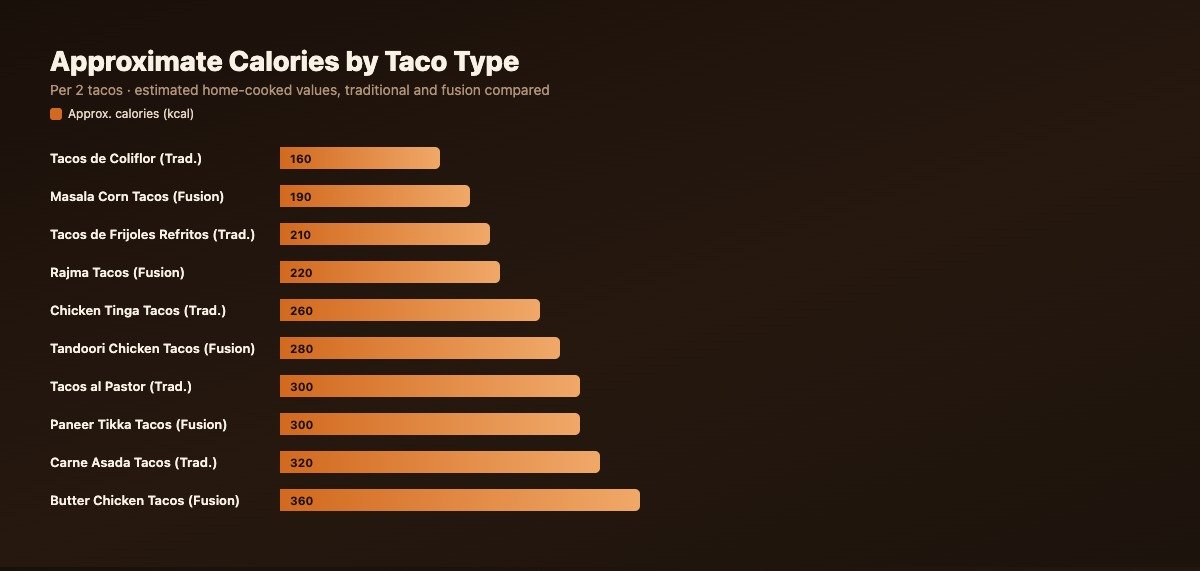
Approximate calories and protein by taco type, traditional and fusion compared.
| Recipe | Category | Approx. Calories | Approx. Protein |
|---|---|---|---|
| Tacos de Frijoles Refritos | Traditional, vegan-friendly | 210 kcal | 9g |
| Tacos de Coliflor | Traditional, vegan | 160 kcal | 5g |
| Chicken Tinga Tacos | Traditional | 260 kcal | 26g |
| Carne Asada Tacos | Traditional | 320 kcal | 24g |
| Tacos al Pastor | Traditional | 300 kcal | 21g |
| Rajma Tacos | Fusion, vegan-friendly | 220 kcal | 10g |
| Masala Corn Tacos | Fusion, vegan | 190 kcal | 5g |
| Tandoori Chicken Tacos | Fusion | 280 kcal | 24g |
| Paneer Tikka Tacos | Fusion | 300 kcal | 15g |
| Butter Chicken Tacos | Fusion | 360 kcal | 22g |
Cooking Tips
- Warm tortillas directly on a dry, hot comal or skillet, not in a microwave, for the best texture and flavour.
- Rest marinated meat at room temperature for 15-20 minutes before cooking so it cooks more evenly.
- Keep a small bowl of coarse salt nearby and season in stages, tasting as you go, rather than all at once.
- For fusion recipes, thicken gravies more than you would for a plate of rice — a taco needs a filling that holds together.
- Double up tortillas for wetter or heavier fillings, a common practical trick used at Mexican taco stands.
- Prep salsas, chutneys and slaws ahead of time; assemble tacos only right before eating.
Explore More Timelines
People Also Ask
70 Frequently Asked Questions About Tacos, Tradition and Fusion
Why Tacos Continue to Connect Cultures Around the World
Tacos endure, across continents and kitchens, because they combine two things that rarely coexist so easily in one dish: genuine simplicity and near-limitless creative range. A tortilla and a filling is not a complicated formula, and that simplicity is exactly what let it travel — from a specific pre-Hispanic technique for eating maize, through centuries of Mexican regional divergence, into Lebanese-Mexican fusion in 1950s Mexico City, through US restaurant chains in the 1970s, food television in the 2000s, social media in the 2010s, and now into Indian home kitchens experimenting with paneer and garam masala.
None of that erases or replaces the original tradition. Authentic Mexican tacos — al pastor, carnitas, barbacoa, cochinita pibil, and the many regional vegetarian styles that predate the current plant-based trend by generations — preserve centuries of documented culinary heritage, recognised formally through UNESCO’s 2010 inscription of traditional Mexican cuisine as intangible cultural heritage. Indian-inspired tacos, built honestly and labelled clearly as fusion cooking, celebrate a different kind of achievement: cross-cultural creativity that doesn’t need to borrow authenticity from the tradition it’s inspired by to be worth cooking and eating well.
The most useful way to approach both, as this guide has tried to throughout, is with curiosity and clarity held together — explore the real regional recipes for what they are, and enjoy the fusion adaptations for what they honestly claim to be, without letting the second category quietly stand in for the first.
Sources & further reading
Every dated entry above was checked against these references. Last reviewed 15 September 2026.