Europe’s Energy Crisis: A Timeline of Challenges and Resilience
Europe's energy crisis timeline: from the 1973 oil shock and the 2022 gas crisis to the 2026 Hormuz LNG shock, EU emergency measures and renewables.
Latest Story
Europe’s energy crisis did not begin with a single event. It grew from decades of dependence on imported oil and gas, geopolitical shocks, supply disruptions and the cost of moving to cleaner power. It was most acute in 2021–23: demand recovered after the pandemic, gas markets tightened, and Russia’s full-scale invasion of Ukraine in February 2022 pushed gas and electricity prices to extraordinary levels. The EU responded with REPowerEU, mandatory gas storage and a voluntary 15% cut in gas demand. By 2025 Russian gas had fallen from 45% of EU gas supply to 12%, and in January 2026 EU governments voted to ban it in stages. Then a new shock arrived: a war that broke out at the end of February 2026 closed the Strait of Hormuz and cut Qatar’s LNG, and by 20–23 October the gas price had reached its highest in nearly four years with storage below 75%. This page keeps official statistics, agency forecasts, market reports and second-hand remarks apart. For related reading, see AiTimeline’s timelines of Europe’s switch to LNG, the Russia–Ukraine war, OPEC and the oil crises and the Strait of Hormuz.
Tap a stage. The key point: Europe cut its Russian exposure, then met a different one.
Choose a stage above.
💡 Short Answer
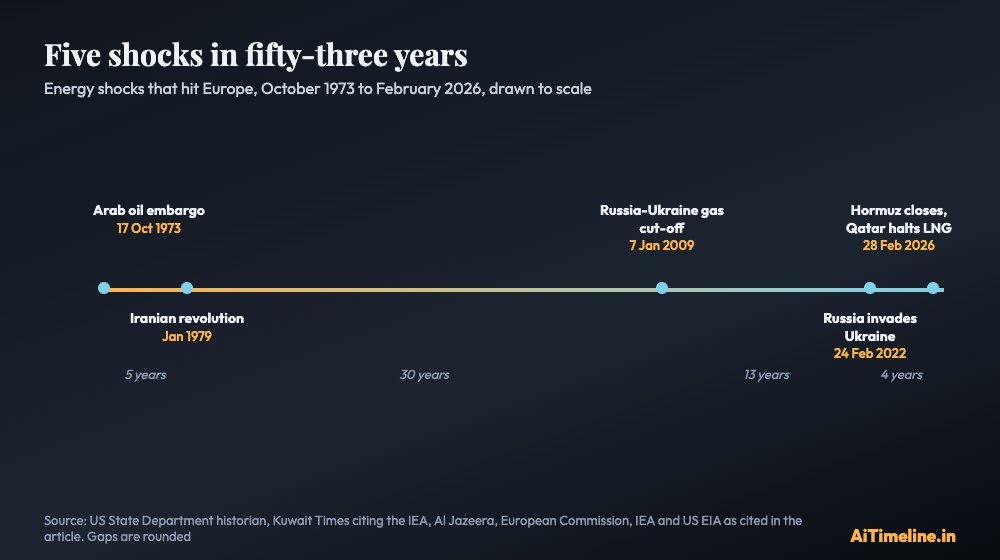
Europe’s energy crisis is a series of shocks, not one event: the 1973 oil embargo, the 1979 Iranian revolution, the January 2009 Russia–Ukraine gas cut-off, and the 2021–23 price crisis after Russia invaded Ukraine. The EU cut Russian gas from 45% of its supply in 2021 to 12% in 2025 and voted a legal ban on 26 January 2026. A new shock followed in late February 2026, when the Strait of Hormuz closed and Qatar halted LNG; by 20–23 October the gas price was near €90–92 per megawatt-hour and EU storage was about 74% full. As of 24 October 2026 the crisis has not ended.
Where Things Stand, as of 24 October 2026
Last updated: 24 October 2026. Kept separate from the timeline because each item has its own position. “Not verified” means AiTimeline could not confirm the latest position from published reports.
| Question | Authority or source | Latest position AiTimeline verified | Status |
|---|---|---|---|
| Russian gas phase-out, Regulation (EU) 2026/261 | Council of the EU; European Commission | Approved 26 Jan 2026; in force 3 Feb. Short-term LNG banned from 25 Apr and short-term pipeline gas from 17 Jun 2026; long-term LNG ends 1 Jan 2027; long-term pipeline gas ends 30 Sep 2027 (1 Nov 2027 at the latest) | In force, phasing in |
| Hungary’s challenge to the ban | Court of Justice of the EU | Hungary said it intends to challenge the ban; AiTimeline found no confirmed filing or ruling | Not verified |
| LNG through the Strait of Hormuz and Qatari output | IEA; ACER; market reports | Interim US–Iran deal in mid-June 2026; IEA said LNG transit was a fraction of pre-conflict levels. October market reports cite continued doubt. ACER: Qatar expected 3–5 years to repair Ras Laffan damage | Disrupted |
| EU gas storage | GIE AGSI+, as quoted by IndexBox | 74.26% full on 20 Oct 2026 against 82.84% a year earlier; Germany 61.2% | Below last year |
| TTF gas price | ICE, as quoted by market reports | About €90/MWh touched 20 Oct and about €92 on 23 Oct 2026; record front-month about €319 on 26 Aug 2022 (Argus) | Elevated, below the 2022 peak |
| Market Correction Mechanism (price safeguard) | Council of the EU | In force until January 2025; never triggered, per the Commission | Expired |
| Gas storage obligation, Regulation (EU) 2022/1032 | European Commission | 90% by 1 November each year, per the Commission | In force |
Europe’s Energy Crisis: Key Questions
Europe’s Energy Crisis in Ten Points
- Not one event: shocks in 1973, 1979, 2009, 2021–23 and 2026 each exposed dependence on imports.
- Before the war: prices were already rising in 2021, and the Commission published a price toolbox on 13 October 2021.
- 2022: Russia supplied about 45% of EU gas imports before the invasion; the price record was about €319/MWh on 26 August 2022.
- The response: REPowerEU, mandatory storage (90% by 1 November), a voluntary 15% gas cut and emergency power rules.
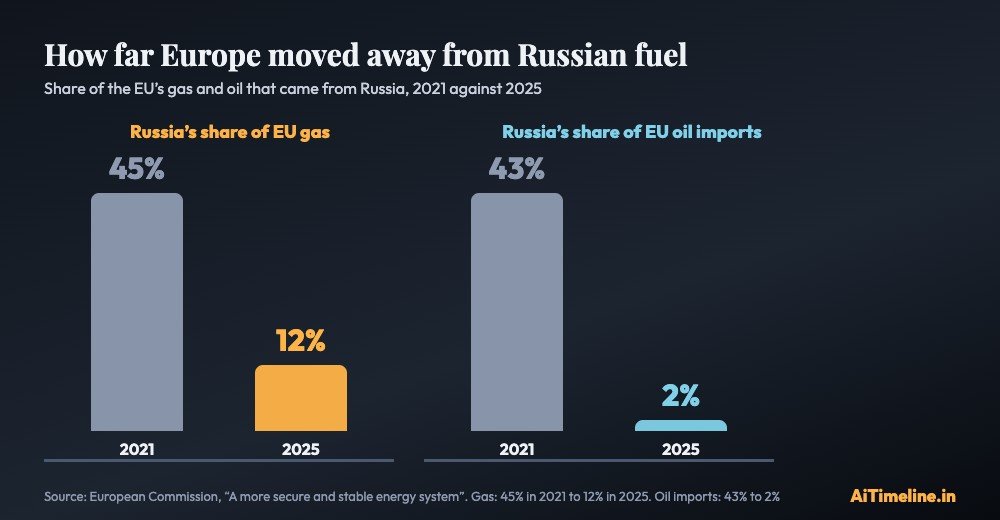
- Away from Russia: Russian gas fell to 12% of EU gas in 2025 and Ukraine transit ended on 1 January 2025.
- The ban: Regulation (EU) 2026/261 was approved on 26 January 2026 and ends Russian gas by autumn 2027.
- The 2026 shock: Hormuz closed from 28 February, Qatar halted LNG, and storage ended winter near 28%.
- The October position: about €90–92/MWh and EU storage 74.26% on 20 October, below last year.
- Not independent: the EU still imported 57% of its energy in 2024; diversification is not independence.
- The caution: official statistics, agency forecasts, market reports and second-hand remarks carry different weight.
Europe’s Energy Crisis Timeline, Latest First
Each entry is tagged by type and ends with why it matters. Second-hand reports and market commentary are labelled as such.
Show only the oil shocks, gas supply events, prices and storage, the EU response, or demand and clean power.
–
2026
Gas hits its highest price in nearly four years as storage sits below 75% Prices and storage
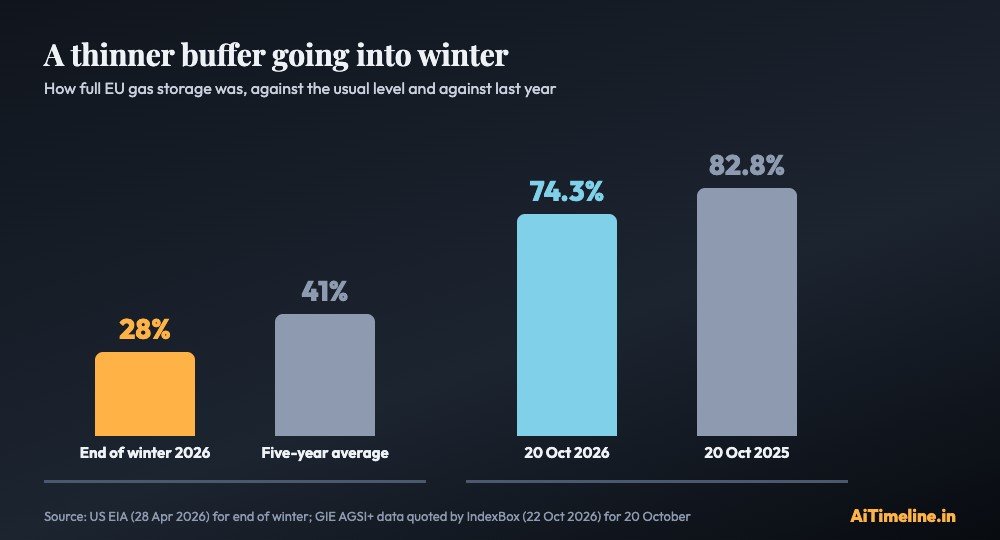
Market reports said front-month TTF touched €90 per megawatt-hour on 20 October for the first time in nearly four years, and traded near €92 on 23 October, the highest since December 2022 (IndexBox; TokenPost). EU storage was 74.26% full on 20 October against 82.84% a year earlier, with Germany at 61.2%, according to GIE AGSI+ data quoted by IndexBox. Reasons cited were doubt over whether shipping through the Strait of Hormuz will resume, the suspension of Qatari LNG, low inventories, Norwegian supply disruptions and colder weather.
Both reports are market commentary, not official statistics, so check the GIE AGSI+ and ICE data before quoting a figure. IndexBox, quoting Bloomberg, noted that prices were still well below the previous crisis peaks and that governments had not reinstated price caps or tax cuts.
2026
The IEA chief is reported warning of winter risk Prices and storage
Azernews reported on 25 August that IEA Executive Director Fatih Birol said Europe could face serious risks this winter because of Middle East supply disruption and the suspension of Russian LNG. The same report put European storage at 61.6% full against 74% a year earlier, and TTF at €68.36 per megawatt-hour (Azernews).
This is a paraphrase in a regional outlet. AiTimeline did not find a transcript or an IEA statement carrying those words, so treat it as reported, not as an IEA quotation. The IEA’s own written assessment is in its quarterly gas report (next entry).
The IEA’s gas report: demand down, LNG losses until 2030, storage short Prices and storage
The IEA said the Middle East war had dealt “a major supply shock” to gas markets and expected global gas demand to fall by about 0.5% in 2026, the third annual decline this decade. It put cumulative LNG supply losses for 2026–2030 at about 140 billion cubic metres, equal to 15% of the new LNG supply due over that period, with damage at Ras Laffan in Qatar the largest part (IEA, Gas Market Report Q3-2026).
For Europe it found EU storage at the end of June more than 15 bcm (23%) below the five-year average. Reaching an 80% fill by the start of winter would need about 7 bcm more injections than last year in July–October, and a 90% fill about 18 bcm more. LNG was Europe’s largest gas source at almost 39% in the first half of 2026, with the United States above 60% of LNG deliveries and Russia second at 14%.
2026
A US–Iran interim deal eases prices, but LNG flows stay low Gas supply and geopolitics
The IEA said the United States and Iran reached an interim agreement in mid-June intended to give a framework for fully reopening the Strait of Hormuz. LNG carrier transit rose after the announcement but stayed at only a fraction of pre-conflict levels. TTF month-ahead fell 6% between 15 and 26 June. The IEA’s forecast assumed the Strait would fully reopen in the third quarter and Qatari and UAE LNG would ramp up between July and October (IEA).
That assumption had not been met by late October, according to the market reports above, which cite continuing doubt over LNG shipping through Hormuz.
17 Jun 2026
The first Russian gas bans take effect EU policy response
Under the regulation, short-term Russian LNG contracts were banned from 25 April and short-term Russian pipeline contracts from 17 June 2026 (IEA; oenergetice.cz). The IEA expected the pipeline ban to cut Russian piped flows in the second half of the year. Russia was still Europe’s second-largest LNG supplier in the first half of 2026 with a 14% share, mostly delivered to Belgium, France and Spain.
Storage ends the winter near 28% Prices and storage
European storage finished winter 2025/26 about 28% full against a five-year average of 41% (US EIA). The EU regulator ACER said stocks fell below 30%, near nine-year lows, because of a lower starting point and high net withdrawals in a winter it described as colder than recent ones, especially in the first quarter (ACER). The IEA said the EU had already entered the 2025/26 winter with stocks about 13% lower than a year before.
2026
Strikes on gas fields and Ras Laffan deepen the LNG loss Gas supply and geopolitics
ACER recorded an Israeli strike on Iran’s South Pars facilities on 18 March, followed by an Iranian retaliatory attack on Ras Laffan Industrial City in Qatar that curtailed about 17% of Qatar’s LNG export capacity; it said Qatar expected three to five years to repair the damage (ACER). The IEA said spot prices in Asia and Europe reached their highest monthly averages since January 2023 in March (IEA).
2026
The war closes Hormuz and Qatar halts LNG Gas supply and geopolitics
The IEA said the war that broke out at the end of February led to the de facto closure of the Strait of Hormuz, through which almost 20% of global LNG supply had passed. The US EIA dated the closure to 28 February and said QatarEnergy declared force majeure on 4 March; no laden LNG vessel was known to have crossed between 1 March and 24 April (US EIA; IEA). ACER reported TTF rising about 70% week on week and said Qatar had supplied about 7% of EU LNG imports in winter 2025/26 (ACER).
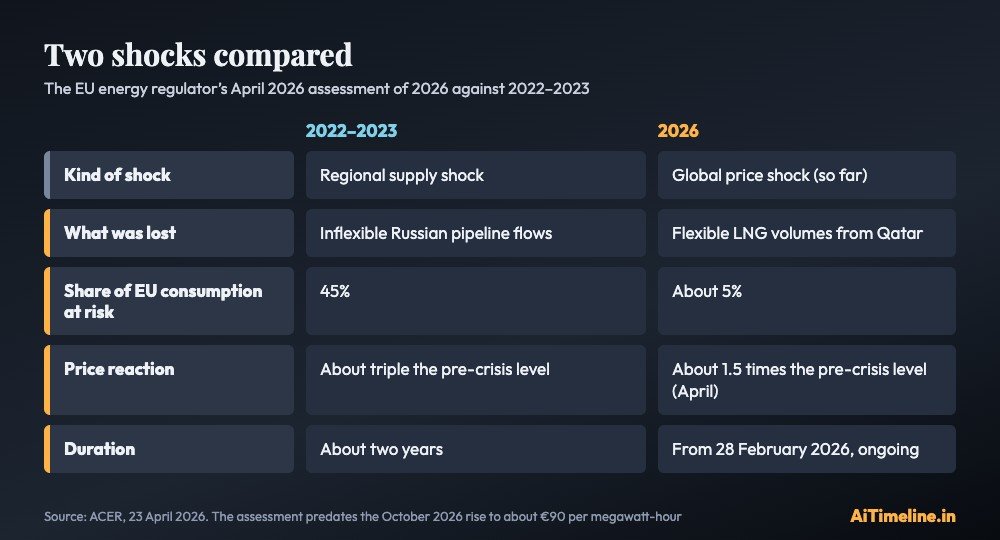
ACER’s April assessment judged the 2026 shock smaller than 2022–23 so far: a global price shock rather than a loss of pipeline gas, with about 5% of EU consumption at risk against 45% in 2022. That judgement was made in April, before prices climbed to nearly €90 in October.
2026
The EU adopts a legal ban on Russian gas EU policy response
EU governments gave final approval to the stepwise phase-out of Russian gas on 26 January; the regulation entered into force on 3 February (Jones Day). Short-term LNG contracts end from 25 April and short-term pipeline contracts from 17 June 2026; long-term LNG contracts end on 1 January 2027, and long-term pipeline contracts on 30 September 2027, or no later than 1 November 2027 if storage targets are hard to meet. Hungary and Slovakia voted against, and Hungary said it would challenge the ban at the EU’s Court of Justice (oenergetice.cz).
Russian gas falls to 12% of EU supply; solar and wind beat fossil fuels Demand and clean power
The Commission reported that Russian gas accounted for 12% of the EU’s gas in 2025, down from 45% in 2021, and that Russian oil fell to 2% of oil imports from 43%. It said that in 2025 the EU produced more electricity from solar and wind than from fossil fuels for the first time, and that gas consumption was 13% lower than in 2022. The same page says energy prices “need further stabilisation” and that sectors such as transport remain heavily dependent on fossil fuels (European Commission).
In February 2025 the Commission proposed an Affordable Energy Action Plan, noting that EU energy prices remain structurally high and hurt households and industrial competitiveness.
2025
Russian gas transit through Ukraine ends Gas supply and geopolitics
Ukraine’s gas transmission operator said its agreement with Gazprom expired at 7am Kyiv time on 1 January 2025 and that flows from the Sudzha entry point were halted. Gazprom blamed Ukraine’s refusal to extend it; Ukraine said it would not allow gas to cross its territory if it benefited Russia financially (S&P Global). Bruegel noted that Ukrainian transit had fallen from about 11% of EU gas imports in 2021 to about 5%, with Austria, Hungary and Slovakia most exposed (Bruegel).
Dependence is still 57% as storage and solar break records Prices and storage
Eurostat put the EU’s energy import dependency at 57% in 2024: net imports met nearly 60% of energy needs. Oil and petroleum products were 67% of energy imports and natural gas 24%. The United States supplied the largest share of imported oil (16%) and Norway the largest share of imported gas (30%); dependency ranged from 98% in Malta to 5% in Estonia (Eurostat).
The Commission said storage was 95% full at the start of winter 2024/25, with the 90% target passed in August. Ember found solar produced 11% of EU electricity in 2024, ahead of coal at 10% (Commission; Ember).
Prices retreat from the peak and the EU adds record solar Demand and clean power
Gas prices fell sharply from the 2022 peak; Argus described the front-month TTF as having “returned from the stratosphere” a year after its record (Argus). The EU installed a record 55.9 GW of solar in 2023, taking its fleet to 263 GW (SolarPower Europe). EU countries also agreed a Market Correction Mechanism in February 2023, a price-triggered safeguard that stayed in force until January 2025 and, the Commission says, was never triggered (Commission).
2022
Ministers agree a gas price safeguard EU policy response
EU energy ministers reached political agreement on a Market Correction Mechanism to protect citizens and the economy against excessively high gas prices (Council of the EU). It would activate automatically if month-ahead TTF exceeded €180/MWh for three working days and was also €35 above a global LNG reference price (Commission).
Emergency rules cut power use and cap windfall revenues EU policy response
Ministers reached political agreement on 30 September 2022 on common measures to lower energy prices (Council of the EU). The package cut electricity demand by 10% overall, with a binding 5% cut at peak hours; capped revenues of low-cost generators such as nuclear, lignite and renewables at €180/MWh and redistributed the surplus to consumers; and added a temporary solidarity contribution on excess profits in oil, gas, coal and refining (Commission). The measures expired in 2023.
2022
Nord Stream is damaged by explosions Gas supply and geopolitics
Leaks appeared in the Nord Stream 1 and 2 pipelines on 26 and 27 September, weeks after Gazprom stopped deliveries through Nord Stream 1 on 31 August citing equipment failure. Sweden’s security service confirmed in November that the damage was deliberate and found explosive remains. NATO called it sabotage; Russia blamed British navy personnel, which London denied (SBS). AiTimeline found no source that settles who was responsible.
2022
TTF reaches its record Prices and storage
Argus reports that front-month TTF hit an all-time high of about €319/MWh on 26 August 2022 and has not exceeded it since (Argus). Other series put contract highs between roughly €339 and €345, depending on the contract and the measure. ACER later summarised the 2022–23 shock as a price reaction of about triple pre-crisis levels (ACER).
2022
EU countries agree to cut gas use by 15% EU policy response
The Commission proposed “Save gas for a safe winter” on 20 July 2022, and the Council adopted the coordinated demand-reduction regulation on 5 August (European Commission). The 15% cut was voluntary for winter 2022/23, was later extended to winter 2023/24, and in March 2024 the Council recommended keeping voluntary measures until March 2025 (Commission).
2022
Mandatory gas storage rules are adopted EU policy response
The Gas Storage Regulation was adopted on 27 June 2022 (European Commission). Storage facilities must be filled to 90% by 1 November each year; the first-year target in 2022 was lower, at 80% (Commission).
2022
REPowerEU sets out how to end Russian fossil fuels EU policy response
The Commission published its REPowerEU communication on 8 March 2022 and the detailed REPowerEU plan on 18 May. It set out three levers: saving energy, diversifying supply and replacing fossil fuels with faster renewables roll-out (European Commission). It aimed for independence from Russian fossil fuels by 2027.
Russia cuts gas to several EU members Gas supply and geopolitics
Russia cut or reduced gas supplies to Bulgaria, Poland, Finland, the Netherlands and Denmark in April and May 2022, before halting Nord Stream 1 on 31 August (SBS).
2022
Russia invades Ukraine and the crisis becomes a security emergency Gas supply and geopolitics
Russia launched its full-scale invasion of Ukraine on 24 February 2022. Before the war it supplied about 45% of EU gas imports and 43% of oil imports (European Commission). ACER later described the 2022–23 shock as a regional supply shock that put about 45% of EU consumption at risk and lasted around two years (ACER). For the war itself, see AiTimeline’s Russia–Ukraine war timeline.
2021
The Commission publishes a toolbox for high energy prices EU policy response
The Commission’s communication “Tackling rising energy prices: a toolbox for action and support” set out what governments could do within existing EU rules to protect vulnerable consumers, after a spike in wholesale prices in 2021 (European Commission).
The price pressure had begun before the invasion, as demand recovered after the pandemic. The invasion intensified an existing vulnerability rather than creating it.
A Russia–Ukraine dispute cuts gas to Europe in mid-winter Gas supply and geopolitics
After Russia and Ukraine failed to agree a new contract, Gazprom cut supplies for Ukraine on 1 January and Europe stopped receiving Russian gas through Ukraine by 7 January. More than 15 countries were affected, Slovakia declared a state of emergency, and schools and factories shut in parts of eastern and central Europe (Yale Global). Flows resumed around 20 January after a deal (Al Jazeera).
The Iranian revolution triggers a second oil shock Oil shock
The revolution cut Iranian output by 4.8 million barrels a day, about 7% of global supply, by January 1979, and prices more than doubled between April 1979 and April 1980 (Kuwait Times, citing the IEA). The WEF notes the revolution caused global crude production to fall by about 7% (World Economic Forum).
1973
Arab oil producers announce an embargo and prices roughly quadruple Oil shock
After the October 1973 war, Arab oil-producing countries announced an embargo on states supporting Israel; the US State Department’s history office describes it as a response to the US decision to re-supply Israel (Office of the Historian). Oil rose from $2.90 to $11.65 a barrel between October 1973 and January 1974 (World Economic Forum). CVCE dates the end of the embargo to 18 March 1974 (CVCE). The shock helped inspire the creation of the International Energy Agency. For the wider story see AiTimeline’s OPEC timeline.
Five Common Claims, Checked
Each claim rests on something real. Each stops short of what it is often taken to show.
| Claim | What it rests on | What it does not show |
|---|---|---|
| Europe has ended its dependence on Russian gas | The Commission’s figure: Russian gas 12% of EU gas in 2025, down from 45% in 2021; a legal ban in force | Independence. Russia was still 14% of EU LNG imports in H1 2026, and the EU’s overall energy import dependency was 57% in 2024 |
| Gas prices are back to normal | Prices fell sharply from the 2022 record during 2023 | That they stayed low. TTF touched about €90 on 20 Oct 2026, the highest in nearly four years |
| 2026 is a repeat of 2022 | Prices and storage worries have returned | Equal scale. ACER’s April 2026 assessment put about 5% of EU consumption at risk, against 45% in 2022. It predates the October price rise |
| The IEA chief warned of winter risk | An Azernews report of 25 Aug 2026 paraphrasing Fatih Birol | An IEA statement. AiTimeline found no transcript. The IEA’s own Q3-2026 report is the primary source |
| Renewables have solved the crisis | Solar and wind produced more EU electricity than fossil fuels in 2025 (Commission) | That gas no longer matters. Gas still sets wholesale power prices in many markets and heats buildings, and storage is still short |
Why Did Europe’s Energy Crisis Become So Severe?
Five reasons, each tied to the record.
1. Dependence on imported energy. Eurostat put the EU’s import dependency at 57% in 2024, with oil and petroleum products 67% of energy imports and natural gas 24% (Eurostat). Importing energy exposes countries to global prices, supplier decisions and geopolitical disputes.
2. Concentrated gas supply. Before the war Russia supplied about 45% of EU gas imports, so replacing pipeline flows quickly was hard and expensive (European Commission). ACER called the 2022–23 event a regional supply shock that put about 45% of EU consumption at risk (ACER).
3. Competition for LNG. LNG can be shipped from many countries, but short-term supply is limited and Europe competes with Asia. In 2026 ACER found Asia paying an all-time-high premium over Europe, which made it harder for the EU to attract spot cargoes (ACER). The IEA found the spread flipped from a European premium of US$0.9/MBtu in January and February to an Asian premium averaging US$2.1 from March to June (IEA).
4. The link between gas and electricity. In markets where gas-fired plants set the wholesale price, expensive gas lifts the price of all power. That is why the EU capped the revenues of low-cost generators at €180/MWh in October 2022 (European Commission).
5. Low storage and uneven exposure. Countries differ in their mix of gas, nuclear, coal, hydro and renewables, and in storage and interconnections. In 2026 storage started from a low base: about 28% at the end of winter against a 41% average (US EIA). For the LNG side of this story, see AiTimeline’s LNG switch timeline.
How Did Europe Respond?
What the Commission and the Council actually adopted.
Diversifying suppliers. The Commission says it set up agreements with Egypt, Israel and Azerbaijan, increased LNG imports from North America, Australia, Qatar and East Africa, and that every EU country can now receive gas from at least two sources (European Commission). The US now supplies more than 60% of EU LNG, according to ACER (ACER).
Filling storage. The 2022 regulation requires 90% storage by 1 November each year; storage was 95% full at the start of winter 2024/25.
Cutting consumption. A voluntary 15% cut in gas demand was agreed for winter 2022/23 and extended; the Commission reports gas consumption 13% below 2022.
Accelerating renewables. The EU installed a record 55.9 GW of solar in 2023 (SolarPower Europe) and solar and wind produced more electricity than fossil fuels in 2025 (European Commission). Renewable sources supplied 54.1% of EU electricity in the second quarter of 2026 (Eurostat). For the nuclear side, see AiTimeline’s nuclear power comeback timeline.
Supporting households and businesses. The October 2022 emergency package cut electricity use, capped generator revenues and levied a solidarity contribution on excess fossil-fuel profits. Member states also used the Commission’s 2021 toolbox, and their support differed in size.
What Did It Do to Households and Industry?
The Commission says EU energy prices remain structurally high and hurt households and the competitiveness of industry, which is why it proposed an Affordable Energy Action Plan in February 2025 (European Commission). In 2026 the IEA found that high gas prices weighed on nitrogen-fertiliser production in Asia and Europe, since natural gas is a feedstock for ammonia and urea (IEA). Effects differed by country, contract and consumption pattern, and AiTimeline found no single Europe-wide figure for the cost to households.
Did Europe Become Energy Independent?
No. Eurostat put the EU’s import dependency at 57% in 2024, so net imports still met nearly 60% of its energy needs (Eurostat). Norway supplied 30% of imported gas, and the United States was the largest source of imported oil at 16%. Diversification is not the same as independence. Buying from several suppliers lowers the risk from one country, but not exposure to global LNG prices, which the 2026 shock showed. Resilience also depends on efficiency, grids, storage, flexible generation and domestic sources. For how the AI boom is changing power demand, see AiTimeline’s data-centre energy timeline.
What Remains Uncertain?
As of 24 October 2026, on the sources AiTimeline reviewed.
How long Hormuz and Qatari LNG stay disrupted. The IEA assumed the Strait would fully reopen in the third quarter and Qatari output would ramp up by October; market reports in October said that had not happened. ACER put Qatar’s repair time at three to five years for the damaged capacity (ACER). For the region’s earlier trade disputes, see the Qatar blockade timeline.
How the winter turns out. The IEA measured the extra injections needed to reach 80% or 90% storage by the start of winter; AiTimeline found no official figure for the final level, and the winter itself had not begun on 24 October 2026.
Whether prices climb to 2022 levels. October’s price was below a third of the 2022 record, and governments had not reinstated price caps or tax cuts, according to Bloomberg as quoted by IndexBox (IndexBox).
Hungary’s challenge. Hungary said it would challenge the Russian gas ban at the EU’s Court of Justice; AiTimeline did not find a ruling.
Dependence on US LNG. The IEA and ACER both report the US as the largest LNG supplier to Europe, above 60% of LNG deliveries. That is a different risk from Russian pipeline gas, not the absence of one.
Figure, Forecast or Report?
The same story, sorted by who said it and how strong it is.
| Figure or statement | Source | Type | Caution |
|---|---|---|---|
| EU energy import dependency 57% in 2024 | Eurostat, 18 Mar 2026 | Official statistic | Varies from 98% in Malta to 5% in Estonia |
| Russian gas 12% of EU gas in 2025, from 45% in 2021 | European Commission | Official figure | Other series give different shares by method; AFP cited 19% for 2024 |
| Front-month TTF record about €319/MWh on 26 Aug 2022 | Argus | Market data provider | Other contract measures put highs near €339–345 |
| TTF about €92.30 on 23 Oct 2026 | TokenPost | Market commentary | Check ICE for the settlement price |
| EU storage 74.26% on 20 Oct 2026 | GIE AGSI+ via IndexBox | Data quoted in commentary | Check the GIE AGSI+ database directly |
| Europe could face serious winter risks | Azernews paraphrasing Fatih Birol, 25 Aug 2026 | Reported remark | No transcript or IEA statement found |
| LNG losses of about 140 bcm over 2026–2030 | IEA Gas Market Report Q3-2026 | Agency estimate | Depends on the Strait reopening and on repair times; a forecast, not an outcome |
| About 5% of EU consumption at risk in 2026 | ACER, 23 Apr 2026 | Regulator’s estimate | Made in April, before the October price rise |
The Story at a Glance
Oldest first, with the type of each entry.
| Date | Event | Type |
|---|---|---|
| 17 Oct 1973 | Arab oil producers announce an embargo and prices roughly quadruple | Oil shock |
| 1979 | The Iranian revolution triggers a second oil shock | Oil shock |
| Jan 2009 | A Russia–Ukraine dispute cuts gas to Europe in mid-winter | Gas supply and geopolitics |
| 13 Oct 2021 | The Commission publishes a toolbox for high energy prices | EU policy response |
| 24 Feb 2022 | Russia invades Ukraine and the crisis becomes a security emergency | Gas supply and geopolitics |
| Apr–May 2022 | Russia cuts gas to several EU members | Gas supply and geopolitics |
| 18 May 2022 | REPowerEU sets out how to end Russian fossil fuels | EU policy response |
| 27 Jun 2022 | Mandatory gas storage rules are adopted | EU policy response |
| 5 Aug 2022 | EU countries agree to cut gas use by 15% | EU policy response |
| 26 Aug 2022 | TTF reaches its record | Prices and storage |
| 26 Sep 2022 | Nord Stream is damaged by explosions | Gas supply and geopolitics |
| Oct 2022 | Emergency rules cut power use and cap windfall revenues | EU policy response |
| 19 Dec 2022 | Ministers agree a gas price safeguard | EU policy response |
| 2023 | Prices retreat from the peak and the EU adds record solar | Demand and clean power |
| 2024 | Dependence is still 57% as storage and solar break records | Prices and storage |
| 1 Jan 2025 | Russian gas transit through Ukraine ends | Gas supply and geopolitics |
| 2025 | Russian gas falls to 12% of EU supply; solar and wind beat fossil fuels | Demand and clean power |
| 26 Jan 2026 | The EU adopts a legal ban on Russian gas | EU policy response |
| 28 Feb 2026 | The war closes Hormuz and Qatar halts LNG | Gas supply and geopolitics |
| 18 Mar 2026 | Strikes on gas fields and Ras Laffan deepen the LNG loss | Gas supply and geopolitics |
| Mar 2026 | Storage ends the winter near 28% | Prices and storage |
| 25 Apr & 17 Jun 2026 | The first Russian gas bans take effect | EU policy response |
| 15–26 Jun 2026 | A US–Iran interim deal eases prices, but LNG flows stay low | Gas supply and geopolitics |
| Jul 2026 | The IEA’s gas report: demand down, LNG losses until 2030, storage short | Prices and storage |
| 25 Aug 2026 | The IEA chief is reported warning of winter risk | Prices and storage |
| 20–23 Oct 2026 | Gas hits its highest price in nearly four years as storage sits below 75% | Prices and storage |
| Term | Meaning | Why it matters here |
|---|---|---|
| TTF | Title Transfer Facility, the Dutch virtual gas trading point | Europe’s benchmark gas price, quoted in euros per megawatt-hour |
| LNG | Liquefied natural gas, cooled and shipped by tanker | Lets Europe buy from many countries, but competes with Asia for cargoes |
| Strait of Hormuz | Narrow sea passage between the Gulf and the Indian Ocean | Almost 20% of global LNG passed through it before 2026 |
| Force majeure | A contract clause excusing a seller when events beyond its control stop delivery | QatarEnergy invoked it on 4 March 2026 |
| REPowerEU | The Commission’s plan to end dependence on Russian fossil fuels | Presented 8 March and 18 May 2022 |
| Market Correction Mechanism | A price-triggered EU safeguard against extreme gas prices | In force to January 2025; never triggered |
| Import dependency rate | Net energy imports divided by gross energy consumption | Stood at 57% for the EU in 2024 |
| bcm | Billion cubic metres of gas | The unit for storage and LNG supply gaps |
Who Is Who
International Energy Agency (IEA)
Set up in response to the 1970s oil crises; its quarterly Gas Market Report is the main primary source for the 2026 outlook.
ACER
The EU agency for energy regulators; its April 2026 report compared the 2026 shock with 2022–23.
European Commission
Proposed REPowerEU, the storage and demand rules, and publishes the Russian gas share figures.
Council of the EU
Adopted the 2022 emergency rules and the 2026 phase-out of Russian gas.
Eurostat
Source of import-dependency and renewable electricity figures.
QatarEnergy
Halted LNG production in March 2026 and declared force majeure; Ras Laffan is the world’s largest liquefaction site, per the IEA.
Gazprom
Russian gas exporter; stopped Nord Stream 1 on 31 Aug 2022 citing equipment failure; its Ukraine transit deal expired 1 Jan 2025.
Gas Infrastructure Europe
Publishes the AGSI+ storage database that market reports cite.
The Popular Story vs the Record
| Popular version | What the record shows |
|---|---|
| Europe’s energy crisis began with the Ukraine war | No. The price spike began in 2021, and Europe had earlier shocks in 1973, 1979 and 2009. The invasion intensified an existing vulnerability |
| Europe ran out of gas in 2022 | No. The EU avoided a continent-wide shortage; demand reduction, storage rules and new LNG supplies helped |
| Europe now buys no Russian gas | No. Russian gas was 12% of EU supply in 2025 and Russia was Europe’s second-largest LNG supplier in H1 2026; the ban phases in to 2027 |
| Qatar’s LNG loss is a direct hit on Europe | Only partly. Qatar supplied about 7% of EU LNG in winter 2025/26; the larger effect is competition with Asia for cargoes |
| The 2026 price is above the 2022 peak | No. About €92 in October 2026 against a record near €319 in August 2022 |
| Renewables make Europe energy independent | No. Solar and wind passed fossil fuels in 2025, but the EU still imported 57% of its energy in 2024 |
| The crisis is over | No. A new shock began in late February 2026 and storage was below last year’s level in October |
Explore More Timelines
People Also Ask
Frequently Asked Questions
Related AiTimeline Stories
⚠️ Editorial Note
Last updated 24 October 2026. This is a historical overview, not investment or energy-purchasing advice. It focuses on the European Union, with earlier events that affected Europe more broadly; energy mixes, national responses and consumer effects differ by country. Prices and storage levels for October 2026 come from market commentary quoting ICE and GIE AGSI+, so check those databases for current values. The remark attributed to the IEA chief is a second-hand report and is labelled as such. ACER’s comparison of the 2026 and 2022–23 shocks was made in April 2026. Forecasts in the IEA’s Q3-2026 report depend on assumptions about the Strait of Hormuz that may change.
Sources & further reading
Every dated entry above was checked against these references. Last reviewed 24 October 2026.
- International Energy Agency: Gas Market Report, Q3-2026
- ACER: Key developments in European gas wholesale markets, winter 2025-2026 (23 April 2026)
- European Commission: A more secure and stable energy system, how the EU faced the energy crisis
- Eurostat: Energy in Europe, imports dependency (18 March 2026)
- Eurostat: 54% of EU's electricity came from renewables in Q2 2026 (18 September 2026)
- US EIA: International LNG prices rise amid Strait of Hormuz closure (28 April 2026)
- European Commission (ManagEnergy): Actions and measures on energy prices, with dated EU measures 2021-2022
- Council of the EU Library: The 2022 Energy Crisis, Council meetings and conclusions
- Jones Day: EU moves to end Russian natural gas imports and prepare oil ban (February 2026)
- oenergetice.cz: EU states approve ban on Russian gas imports, Hungary and Slovakia oppose (26 January 2026)
- IndexBox: European gas prices hit four-year high as supply fears mount (22 October 2026)
- TokenPost: European gas reaches highest since 2022 at EUR 92.30 as EU storage sits at 74.62% (23 October 2026)
- Azernews: Europe could face serious winter risks, reports citing IEA chief (25 August 2026)
- SolarPower Europe: EU solar reaches record heights of 56 GW in 2023
- Ember: European Electricity Review 2025
- Argus: A year on, the TTF returns from the stratosphere
- Bruegel: The end of Russian gas transit via Ukraine and options for the EU
- S&P Global: Russian gas flows via Ukraine suspended as transit deal expires (1 January 2025)
- SBS: Sabotage or self-sabotage? Why Russia's Nord Stream gas pipeline has caused a stir
- Al Jazeera: Russian gas supplies reach Europe (20 January 2009)
- Yale Global: Ukraine says Russia shuts down all gas supplies to Europe (January 2009)
- US Department of State, Office of the Historian: Oil Embargo, 1973-1974
- CVCE: Oil crisis, Arab delegation at the OPEC conference in Vienna (16 March 1974)
- World Economic Forum: The 1973 energy crisis sparked the idea for establishing the IEA
- Kuwait Times: Biggest global oil supply disruptions in history, says IEA