Concorde Retirement: Why the Supersonic Jet Stopped Flying
Discover why Concorde retired in 2003. Follow its rise, the deadly 2000 crash, costly operations, sonic-boom restrictions and final flights.
Latest Story
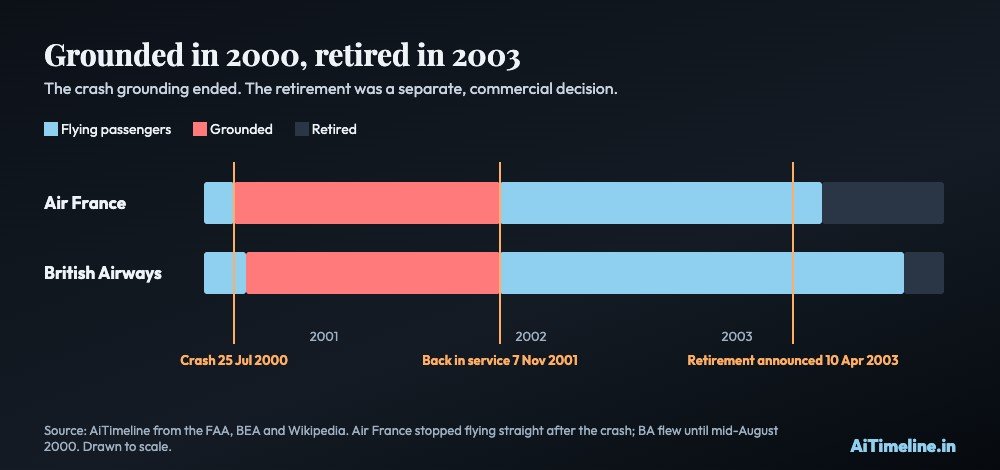
It crossed the Atlantic in about three and a half hours. So why did the world’s most famous supersonic airliner disappear? The Concorde retirement came in 2003, 23 years ago this week: British Airways flew its last passenger services on 24 October 2003, five months after Air France stopped. The aircraft had been grounded after the fatal crash of Air France Flight 4590 in July 2000, but it flew passengers again from November 2001. What finally ended it was a business calculation: falling revenue, rising maintenance costs and an ageing fleet of just 14 airliners, in a premium-travel market shaken by 9/11. For more aviation history, see AiTimeline’s Wright brothers first flight timeline and global aviation safety history.
💡 Short Answer
Concorde was retired in 2003 because it no longer made business sense. Air France and British Airways announced on 10 April 2003 that falling passenger revenue and rising maintenance costs, with Airbus unwilling to keep supporting the ageing fleet, made continued flying unjustifiable. The 2000 crash caused a 15-month grounding, not the retirement; the final flight was on 26 November 2003.
Concorde Retirement: Key Questions
The Concorde Retirement in Nine Points
- Two events, not one: grounded in 2000 for safety, retired in 2003 for business reasons.
- The crash: Air France Flight 4590, 25 July 2000, 113 killed.
- The trigger: a titanium strip dropped by a Continental DC-10 cut a tyre on take-off.
- The fix: Kevlar-lined fuel tanks and tougher tyres; passengers again from 7 November 2001.
- The bad timing: the return came two months after 9/11 hit premium travel.
- The decision: both airlines announced retirement on 10 April 2003.
- The money: falling revenue, rising maintenance costs, and Airbus support ending.
- The end: BA’s last passenger flights on 24 October 2003; last flight of all on 26 November 2003.
- The sequel: quieter supersonic research, not Concorde, is what regulators are now writing rules for.
Concorde Retirement Timeline, Latest First
Each entry is tagged by thread and ends with why it matters. Use the filter to isolate the retirement, the crash, the return to service or the supersonic revival.
Show only the retirement, the crash and the courts, the return to service, the service years, the origins or the supersonic revival.
–
The US proposes lifting its 1973 ban on supersonic flight over land Supersonic revival
The Federal Aviation Administration published a proposed rule, “Enabling Supersonic Overland Flight”, that would repeal the speed-based ban in 14 CFR 91.817 and replace it with a noise limit: sonic-boom overpressure at the ground of no more than 0.11 pounds per square foot (Holland & Knight summary). Comments closed on 17 August 2026. The FAA calls it the first step of a multi-step process; a second rule on take-off and landing noise is still to come.
Concorde could never have met that limit. Its boom was the reason it flew supersonic almost only over the sea. The proposal is aimed at a new generation of quieter designs, and it is not yet law.
NASA’s X-59 flies supersonic, built to make a thump instead of a boom Supersonic revival
NASA’s X-59 went supersonic for the first time on 5 June 2026, reaching about Mach 1.1 at 43,400 feet (NASA), and on 12 June reached its planned test condition of Mach 1.4 at 55,000 feet (NASA). Its long, shaped nose is designed to spread out the shock waves so that people on the ground hear a soft thump rather than a boom.
NASA plans to fly it over US communities and survey residents. That data is meant to underpin a permanent noise standard, the thing Concorde never had.
A White House order tells the FAA to end the overland ban Supersonic revival
President Trump signed an executive order directing the FAA to repeal the prohibition on supersonic flight over US land and to set an interim noise-based standard (Federal Register). The July 2026 proposal above is the FAA’s response.
A French appeals court clears Continental of criminal blame for the crash Crash and courts
The appeals court overturned the 2010 manslaughter convictions of Continental Airlines and mechanic John Taylor, finding that the mechanic could not have foreseen the disaster. It kept the civil ruling that Continental must compensate Air France (NBC News / AP; Wikipedia). The investigators’ account of how the crash began was not overturned.
A Paris court convicts Continental over the metal strip Crash and courts
A criminal court found Continental Airlines and one of its mechanics guilty of involuntary manslaughter, because the titanium strip that started the accident had fallen from a Continental DC-10. The airline was fined €200,000 and ordered to pay Air France €1 million (Wikipedia). Several French officials connected with Concorde’s development were acquitted.
2003
Concorde’s last ever flight lands at Filton Retirement
British Airways’ G-BOAF, the last Concorde built, flew from Heathrow to Filton near Bristol, where the British aircraft had been assembled and tested. It carried about 100 BA staff, and a crowd of more than 20,000 watched it land (Wikipedia: operational history). No Concorde has flown since.
2003
British Airways flies its final passenger services Retirement
British Airways ended scheduled Concorde service with a staged finale: G-BOAG arrived from New York, G-BOAE from Edinburgh and G-BOAF from a round trip over the Bay of Biscay with invited guests. The three aircraft circled London and landed one after another at Heathrow (Wikipedia: operational history). The Smithsonian dates the end of commercial flights to this day, after 27 years of operation (Smithsonian).
2003
Air France’s last Concorde flight Retirement
After its scheduled service ended, Air France flew F-BVFC to Toulouse, where Concorde had first flown, and retired it there (Wikipedia: operational history). The remaining French aircraft were delivered to museums in the following months.
Air France ends scheduled services Retirement
Air France’s final scheduled Concorde landed in New York on 30 May 2003 (Wikipedia: operational history), and the return flight on 31 May closed its scheduled operation. Reports from the time say Air France was filling barely a fifth of the seats on its Concordes before the retirement was announced (Heritage Concorde).
2003
Both airlines announce Concorde will retire Retirement
British Airways and Air France announced on the same day that Concorde would leave service in 2003. BA said passenger revenue had fallen steadily while maintenance costs rose, and that the further maintenance programme could not be justified during a global downturn in premium travel (Los Angeles Times; Heritage Concorde). Airbus, which held responsibility for the type’s airworthiness support, was not willing to support the aircraft beyond October 2003; Heritage Concorde reports Airbus told BA it would need to spend about £40 million over the next few years to keep flying.
The next day Richard Branson said Virgin Atlantic wanted the aircraft, first for £1 each and later for much more; BA declined ({L(WOP, ‘Wikipedia: operational history’)}).
Investigators publish their final report on the crash Crash and courts
France’s accident investigation bureau, the BEA, published its final report on Flight 4590 on 16 January 2002, after a preliminary report in September 2000 and interim reports in December 2000 and July 2001 (BEA).
2001
Concorde returns to commercial service Return to service
Both airlines resumed scheduled flights to New York on the same morning: Air France with F-BTSD from Paris and British Airways with G-BOAE from Heathrow (Wikipedia: operational history). The aircraft now had Kevlar-rubber liners in the fuel tanks, tougher Michelin tyres and changes to electrical wiring in the landing-gear bays (Wikipedia; Heritage Concorde).
It came back into a different market. The September 11 attacks two months earlier had cut transatlantic premium travel, the very business Concorde depended on.
Certificates restored, and a test flight lands as 9/11 unfolds Return to service
On 5 September 2001 the UK Civil Aviation Authority and France’s DGAC issued the directives that let modified aircraft fly passengers again. On 11 September, G-BOAF carried BA staff on a rehearsal flight and landed back at Heathrow at about 13:50 UK time, close to the moment the first hijacked aircraft hit the World Trade Center (Wikipedia: operational history).
The first modified Concorde flies Return to service
British Airways flew G-BOAF, the first aircraft fitted with the new fuel-tank liners, on a supersonic test flight out over the Atlantic towards Iceland and back to RAF Brize Norton, with Captain Mike Bannister in command (Wikipedia; Heritage Concorde).
2000
Airworthiness certificates suspended Crash and courts
The British and French authorities suspended Concorde’s certificates of airworthiness while the accident was investigated and fixes were developed (FAA). Air France had stopped its own Concorde flights straight after the crash; British Airways had continued flying for about three weeks (Wikipedia).
2000
Air France Flight 4590 crashes at Gonesse Crash and courts
Air France Flight 4590, a charter carrying mostly German passengers to New York to join a cruise, crashed into a hotel at Gonesse shortly after taking off from Paris Charles de Gaulle. All 100 passengers and nine crew died, along with four people on the ground: 113 in total (BEA).
Investigators found that a titanium strip that had fallen from a Continental Airlines DC-10 a few minutes earlier cut one of Concorde’s tyres. Tyre debris struck the wing, a pressure wave ruptured a fuel tank, the leaking fuel ignited, two engines lost thrust and the aircraft could not climb (Wikipedia; BEA). Concorde had a history of tyre and wheel incidents before 2000.
1977
New York service finally begins In service
New York’s airport authority had blocked Concorde over noise. After the US Supreme Court refused on 17 October 1977 to overturn a ruling against the ban, scheduled London and Paris services to JFK began on 22 November (Wikipedia: operational history). New York became Concorde’s defining route.
1976
Washington Dulles becomes the first US destination In service
With New York still closed, BA and Air France opened services to Washington Dulles (Wikipedia: operational history). Supersonic flight over US land had been banned in 1973, so all US routes depended on the ocean crossing.
1976
First scheduled supersonic passenger flights In service
British Airways and Air France launched scheduled Concorde services simultaneously (Wikipedia; Smithsonian). Neither opening route was the transatlantic run that later made Concorde famous.
Airline orders melt away and the US bans overland booms Origins
Airlines including Pan Am had taken options on more than 70 Concordes. Most were cancelled around 1973, amid rising fuel prices, doubts about economics and noise restrictions (Wikipedia). The same year the US banned civil supersonic flight over land, the rule the FAA is now proposing to repeal. In the end only Air France and British Airways, then state-owned, flew Concorde in regular service (Smithsonian).
1969
Concorde 001 makes its first flight Origins
The French prototype 001 took off from Toulouse, beginning the Anglo-French flight-test programme (Smithsonian). The British prototype 002 followed from Filton the next month, and 001 first went supersonic in October 1969 (Wikipedia).
Britain and France sign the Concorde treaty Origins
The two governments agreed to develop a supersonic airliner together. The treaty bound both countries to the project, which helped keep it alive through cost overruns (Wikipedia; Heritage Concorde).
Why Was Concorde Retired? The Seven Factors
Some factors decided the timing in 2003; others were built into the aircraft from the start.
| Factor | What the record shows | Role in 2003 |
|---|---|---|
| Maintenance and support costs | BA cited rising maintenance costs; Airbus would not support the type beyond October 2003 without major new spending | Decisive |
| Falling passenger revenue | BA said revenue had fallen steadily; Air France was reported to be filling barely a fifth of its seats | Decisive |
| Post-9/11 premium slump | Concorde returned on 7 Nov 2001 into a collapsed market for premium transatlantic travel | Major |
| The 2000 crash | 113 deaths, a 15-month grounding and a costly modification programme; public confidence was hit | Major, indirect |
| Fuel burn | About 6,771 US gallons on a regular flight (Smithsonian), shared among about 100 passengers | Structural |
| Sonic boom limits | Supersonic flight over land banned in the US from 1973; restricted elsewhere | Structural |
| Tiny fleet | 20 built, 14 in airline service, two operators: no economies of scale for spares and support | Structural |
Costs rose as the fleet aged. By 2003 the youngest Concordes were more than 20 years old, and the support arrangements were moving from Aérospatiale to Airbus. Heritage Concorde reports that Airbus told BA it would need to spend about £40 million over the following years to keep flying, and that Airbus was not willing to support the type beyond October 2003 (Heritage Concorde).
Revenue was falling. British Airways said passenger revenue had fallen steadily against a backdrop of rising maintenance costs (Los Angeles Times). Before the announcement BA was reportedly selling just under half its seats and Air France barely a fifth.
The structural limits never went away. Concorde used several times more fuel per passenger than the jumbo jets of its day, and its sonic boom kept it supersonic mostly over oceans (Smithsonian; Smithsonian). With 14 airliners and two customers, spares and engineering support were costly to sustain.
The crash and 9/11 squeezed what was left. The 2000 accident cost a 15-month grounding and an expensive modification programme, and the aircraft returned in November 2001 to a premium market hit by the September 11 attacks. AiTimeline’s Kingfisher Airlines story shows how quickly high costs and weak demand can sink an airline business.
Was Concorde Grounded or Retired?
The two words describe different decisions, made by different people, three years apart.
| Grounded (2000) | Retired (2003) | |
|---|---|---|
| When | 16 Aug 2000, after the 25 Jul crash | Announced 10 Apr 2003; last flights May to Nov 2003 |
| Who decided | Aviation regulators: UK CAA and France’s DGAC | The airlines, British Airways and Air France, with Airbus |
| Why | Safety: find the cause and fix the weak points | Business: revenue no longer covered rising costs |
| Did it end? | Yes. Certificates restored from 5 Sep 2001; passengers again from 7 Nov 2001 | Permanent. Last flight 26 Nov 2003 |
The grounding was a safety measure taken by regulators and it ended once the fixes were approved. The retirement was a commercial choice made by the airlines and it was final. Treating them as one event is the most common mistake in accounts of why Concorde stopped flying. For how crash investigations shape aircraft design, see the Boeing 737 MAX timeline.
Concorde by the Numbers
| Measure | Concorde | Note |
|---|---|---|
| Cruising speed | About Mach 2 (Mach 2.02) | Roughly 2,150 km/h |
| Cruising altitude | Up to about 60,000 ft | Far above subsonic airliners |
| Seats | About 100 as flown by BA and Air France | Four abreast |
| London or Paris to New York | About 3.5 hours | Against about 7 to 8 hours subsonic |
| Fuel on a regular flight | About 6,771 US gallons | Smithsonian figure |
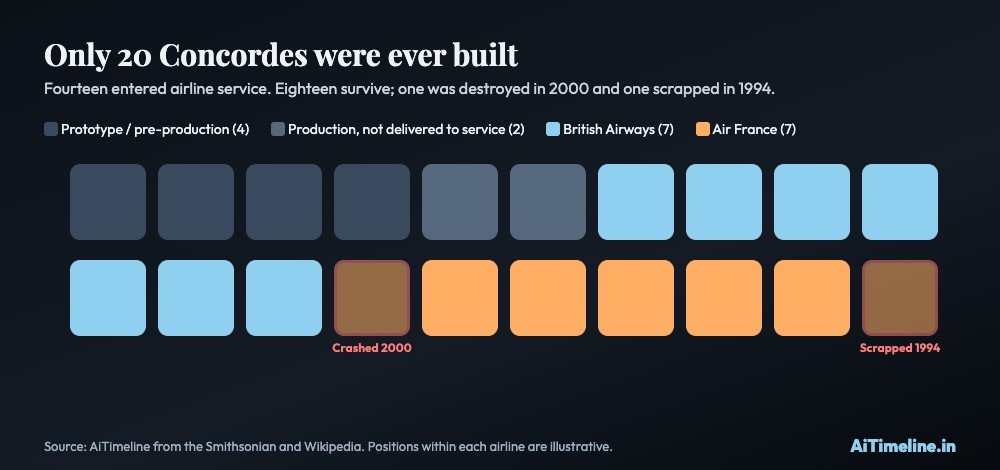
| Built | 20 | 14 entered airline service |
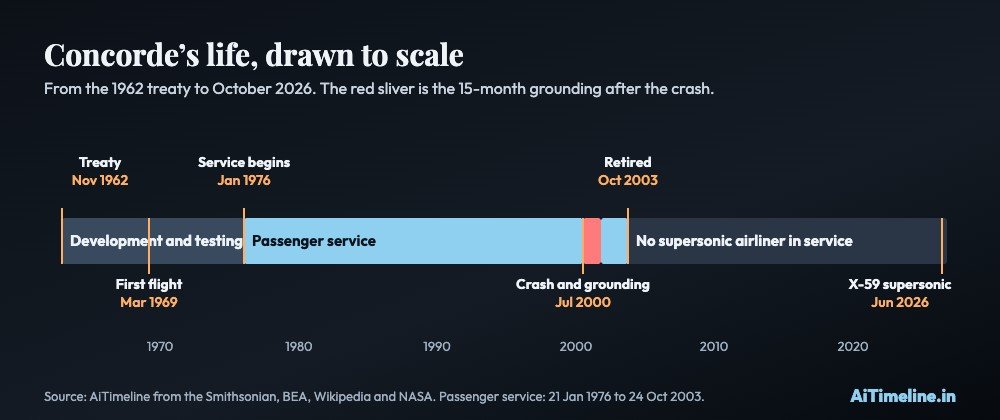
| Passenger service | 21 Jan 1976 to 24 Oct 2003 | 27 years and 9 months |
What Happened to Every Concorde?
Eighteen of the 20 aircraft survive. Locations as last reported by museums and Wikipedia; displays can move.
| Aircraft | Operator or role | Where it is now (as reported) |
|---|---|---|
| F-WTSS (001) | French prototype | Musée de l’Air et de l’Espace, Le Bourget |
| G-BSST (002) | British prototype | Fleet Air Arm Museum, Yeovilton |
| G-AXDN (101) | Pre-production | Imperial War Museum, Duxford |
| F-WTSA (102) | Pre-production | Paris-Orly area (Athis-Paray Aviation) |
| F-WTSB (201) | Test aircraft | Aeroscopia, Toulouse |
| G-BBDG (202) | Test aircraft | Brooklands Museum, Surrey |
| F-BVFA | Air France | Smithsonian Udvar-Hazy Center, Virginia |
| F-BVFB | Air France | Technik Museum Sinsheim, Germany |
| F-BVFC | Air France | Toulouse (Airbus heritage site) |
| F-BTSD | Air France | Le Bourget museum |
| F-BVFF | Air France | Paris Charles de Gaulle airport |
| F-BTSC | Air France | Destroyed in the July 2000 crash |
| F-BVFD | Air France | Scrapped in 1994 |
| G-BOAA | British Airways | National Museum of Flight, East Fortune, Scotland |
| G-BOAB | British Airways | Heathrow Airport |
| G-BOAC | British Airways | Runway Visitor Park, Manchester |
| G-BOAD | British Airways | Intrepid Museum, New York |
| G-BOAE | British Airways | Grantley Adams Airport, Barbados |
| G-BOAF | British Airways | Aerospace Bristol, Filton |
| G-BOAG | British Airways | Museum of Flight, Seattle |
Will Supersonic Passenger Travel Return?
The research has restarted. The business case is still unproven.
The noise problem is being attacked directly. NASA’s X-59 is shaped to turn a sonic boom into a quieter thump. It went supersonic on 5 June 2026 and reached Mach 1.4 at 55,000 feet on 12 June (NASA; NASA). Community overflight tests are still ahead.
The rules are being rewritten. After a June 2025 executive order, the FAA proposed on 2 July 2026 to replace the 1973 overland ban with a noise limit of 0.11 pounds per square foot at the ground (Federal Register; Holland & Knight). It is a proposal, not a final rule.
Concorde’s other problems remain. Fuel burn, emissions, airport noise at take-off and a narrow premium market all need answers before a new supersonic airliner can succeed where Concorde could not. For the climate side of high-altitude flight, see AiTimeline’s aircraft contrails timeline.
Who and What Is in the Story
British Airways
Flew seven Concordes; ended passenger service on 24 October 2003.
Air France
Flew seven Concordes; lost F-BTSC in July 2000; ended scheduled service in May 2003.
Airbus
Held responsibility for airworthiness support in 2003 and would not support the type beyond October.
BEA (France)
Investigated Flight 4590; final report published 16 January 2002.
UK CAA and French DGAC
Suspended certificates on 16 August 2000 and restored them for modified aircraft from 5 September 2001.
Mike Bannister
BA chief Concorde pilot; flew the first modified test flight and the last New York service.
André Turcat
Flew Concorde 001 on its first flight from Toulouse on 2 March 1969.
NASA X-59
Quiet supersonic demonstrator; first supersonic flight on 5 June 2026.
The Popular Story vs the Record
| Popular version | What the record shows |
|---|---|
| The crash grounded Concorde for good | The grounding lasted about 15 months. Concorde flew paying passengers again from 7 Nov 2001 to 24 Oct 2003 |
| Regulators banned Concorde in 2003 | No. The two airlines retired it for commercial reasons; its certificates had been restored in 2001 |
| Concorde was retired only because of the crash | The airlines cited falling revenue and rising maintenance costs; the crash and 9/11 had weakened an already narrow business |
| Concorde crashed because of a design flaw alone | Investigators traced the start to a metal strip dropped by another aircraft; Concorde’s tyres and fuel tanks were then made more robust |
| Concorde could fly supersonic anywhere | Its boom kept it supersonic mainly over the sea; the US banned overland supersonic flight in 1973 |
| Concorde lost money on every flight | BA is widely reported to have earned an operating profit for years; the development costs were never recovered and the 2003 economics no longer worked |
Explore More Timelines
People Also Ask
Frequently Asked Questions
Related AiTimeline Stories
⚠️ Editorial Note
Last updated 23 October 2026. This page separates the temporary grounding after the 2000 accident from the commercial retirement in 2003. The accident sequence follows France’s BEA and the FAA’s accident history; the retirement reasons follow the airlines’ April 2003 statements as reported at the time. Corrections to the draft brief: Air France’s last scheduled flight landed in New York on 30 May 2003 and returned on 31 May, and its final flight was F-BVFC to Toulouse on 27 June 2003; scheduled New York services began on 22 November 1977. The brief’s concordesst.com announcement links could not be opened by AiTimeline, so the announcements are cited from the Los Angeles Times and Heritage Concorde. Added: the 1962 treaty, the 1973 order cancellations and US overland ban, the 2001 test and rehearsal flights, the BEA final report, the 2010 and 2012 court rulings, and the 2025–2026 supersonic developments. Figures for seat loads and Airbus’s cost estimate are as reported by secondary sources; aircraft display locations can change.
Sources & further reading
Every dated entry above was checked against these references. Last reviewed 24 October 2026.
- BEA (France): Accident to the Concorde F-BTSC, 25 July 2000, Gonesse
- Federal Aviation Administration: Lessons learned, Concorde F-BTSC accident
- Smithsonian National Air and Space Museum: What happened to the Concordes?
- Smithsonian National Air and Space Museum: Concorde, Fox Alpha, Air France
- Smithsonian National Air and Space Museum: The evolution of the commercial airliner
- Los Angeles Times: Concorde to be retired (10 Apr 2003)
- Heritage Concorde: Concorde retirement 2003
- Heritage Concorde: G-BOAF return to service
- NBC News / AP: French court clears Continental in Concorde crash (Nov 2012)
- Federal Register: Executive Order 14304, Leading the World in Supersonic Flight (Jun 2025)
- Holland and Knight: Enabling supersonic flight over land, the FAA proposal (Jul 2026)
- NASA: X-59 flies supersonic for first time (Jun 2026)
- NASA: X-59 reaches speed and altitude for quiet supersonic flights (Jun 2026)
- Wikipedia: Concorde
- Wikipedia: Concorde operational history
- Wikipedia: Air France Flight 4590