FAA NextGen: How America Is Rebuilding Its Air Traffic Control System
Explore the FAA NextGen timeline, from satellite ADS-B and digital communications to the 2026 $50.1 billion air traffic control modernisation request.
Latest Story
The FAA’s Next Generation Air Transportation System, known as NextGen, is a multi-decade effort to move US air traffic control from radar and radio towards satellite surveillance, precise navigation, digital messaging and shared data. It began as a national plan in 2003. Aging equipment, outages and slow delivery kept modernization on the agenda, and in May 2025 the government launched a separate, faster programme, the Brand New Air Traffic Control System (BNATCS). On 17 November 2026 the administration asked Congress for $50.1 billion more.
NextGen and BNATCS are not the same programme. NextGen added new capabilities such as ADS-B, Data Comm and satellite routes from 2003 onwards. BNATCS, announced in 2025, replaces the aging telecoms, radios, radars and buildings underneath them. And the $50.1 billion is a request to Congress, not approved spending. Congress has approved $12.5 billion so far.
💡 Short Answer
FAA NextGen is the US programme, planned from 2003, that brought satellite-based ADS-B surveillance (nationwide by 2019), performance-based navigation, digital Data Comm clearances and the SWIM data network to air traffic control. The FAA says it delivered $10.9 billion in benefits from 2010 to 2023. BNATCS, a separate programme launched in May 2025 with $12.5 billion, is replacing aging infrastructure by December 2028. In November 2026 the administration requested a further $50.1 billion.
What Is FAA NextGen?
Six technologies meant to work as one connected system.
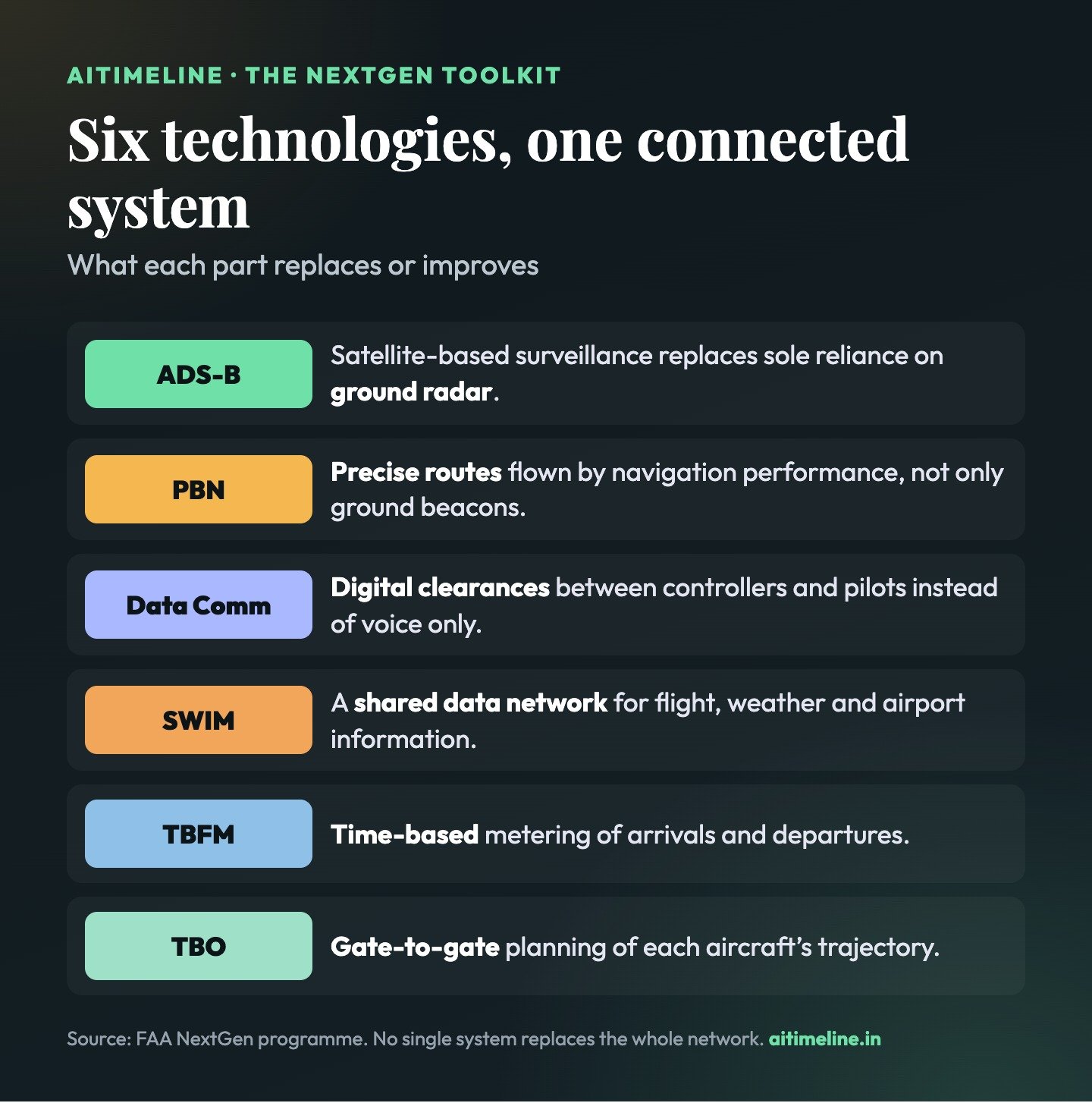
The US National Airspace System is one of the busiest in the world. The FAA coordinates aircraft through control towers at airports, approach control facilities (TRACONs) that handle traffic around busy airports, and 20 en route centres that manage high-altitude flights across the contiguous United States.
For most of the 20th century that system ran on ground radar, voice radio and separate computers that did not easily share information. NextGen’s goal is not to replace controllers. It is to give controllers and pilots more accurate information, better planning tools and a shared picture of the airspace.
| Traditional approach | NextGen capability | Intended improvement |
|---|---|---|
| Ground-based radar | ADS-B | Position updates about every second |
| Routes between ground beacons | Performance-based navigation | More precise, flexible flight paths |
| Voice-only clearances | Data Comm | Fewer misheard instructions, less radio congestion |
| Separate information systems | SWIM | One shared data network |
| Tactical sequencing | Time-based flow management | Better planned arrivals and departures |
| Sector-by-sector control | Trajectory-based operations | Gate-to-gate planning of each flight |
FAA NextGen: Key Questions
What to Know About US Air Traffic Control Modernization
- 2003: the Vision 100 Act created the NextGen planning office.
- 2009-2019: ADS-B went from first use over the Gulf to every FAA facility.
- 2015-2016: ERAM completed at 20 centres; Data Comm at 55 airports.
- 2022: the last of 11 Metroplex airspace redesigns was completed.
- Benefits: the FAA reports $10.9 billion in benefits for 2010-2023, an estimate rather than government savings.
- 2023-2025: the NOTAM outage and Newark failures exposed aging systems.
- May 2025: BNATCS launched as a separate programme; $12.5 billion followed in July.
- September 2026: GAO found no full cost estimate and 11,389 unintegrated schedules.
- November 2026: a nationwide ground stop, then a $50.1 billion request to Congress.
NextGen vs BNATCS: What Is the Difference?
Successive, overlapping efforts, not two names for one project.
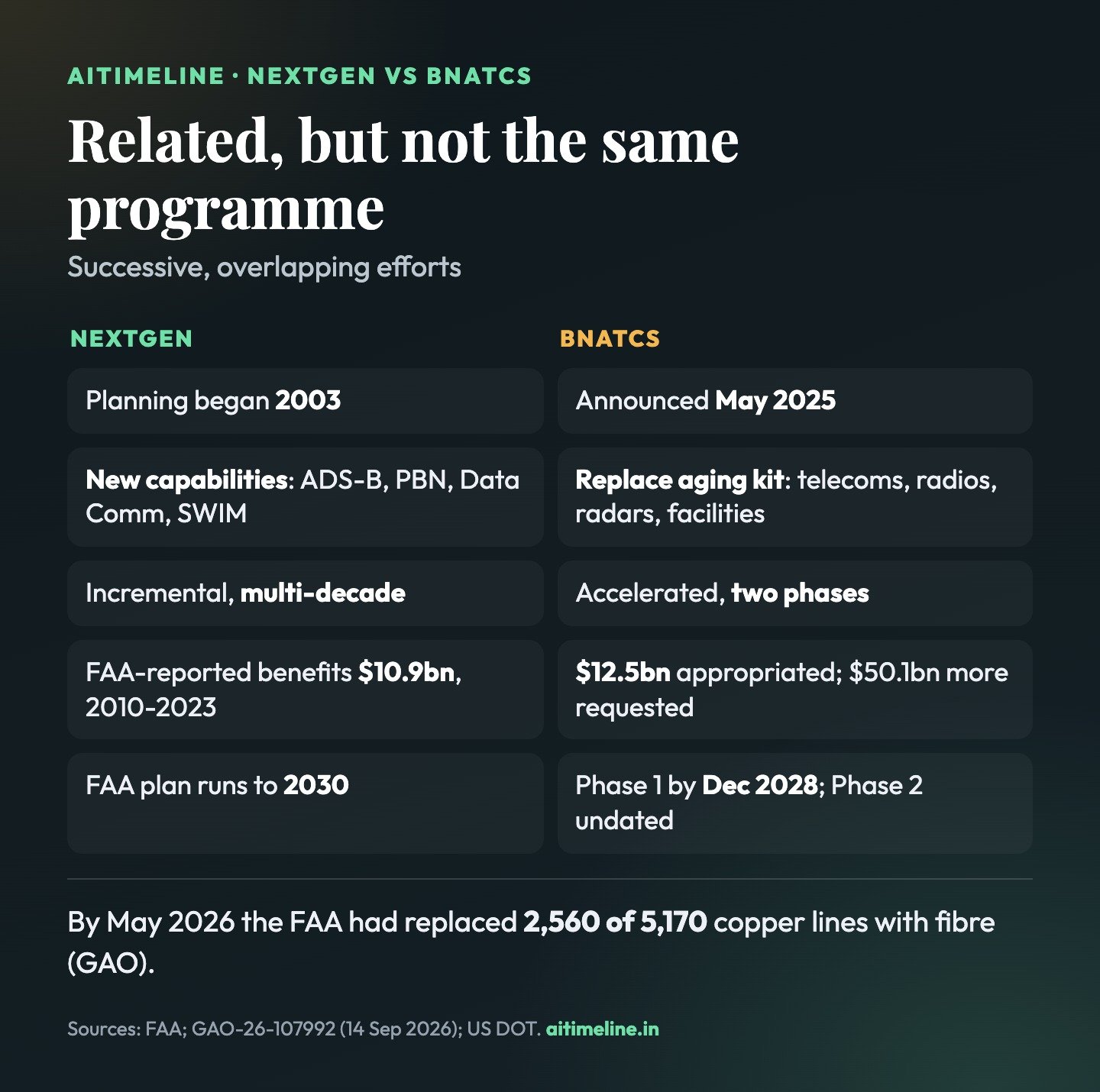
| Feature | NextGen | BNATCS |
|---|---|---|
| Origin | National planning from 2003 | Announced May 2025 |
| Main purpose | New navigation, surveillance, communications and data tools | Replace aging infrastructure; common automation platform |
| Approach | Incremental, multi-decade | Accelerated, two phases |
| Major technologies | ADS-B, PBN, Data Comm, SWIM, TBO | Fibre telecoms, radios, radars, voice switches, facilities, new automation |
| Funding | Annual FAA budgets plus industry equipage | $12.5bn appropriated July 2025; $50.1bn requested Nov 2026 |
| Schedule | FAA plan runs through 2030 | Phase 1 by Dec 2028; Phase 2 undated |
Timeline: From the NextGen Vision to the 2026 Funding Debate
Newest first. Labels mark policy, deployment, outages, oversight and funding.
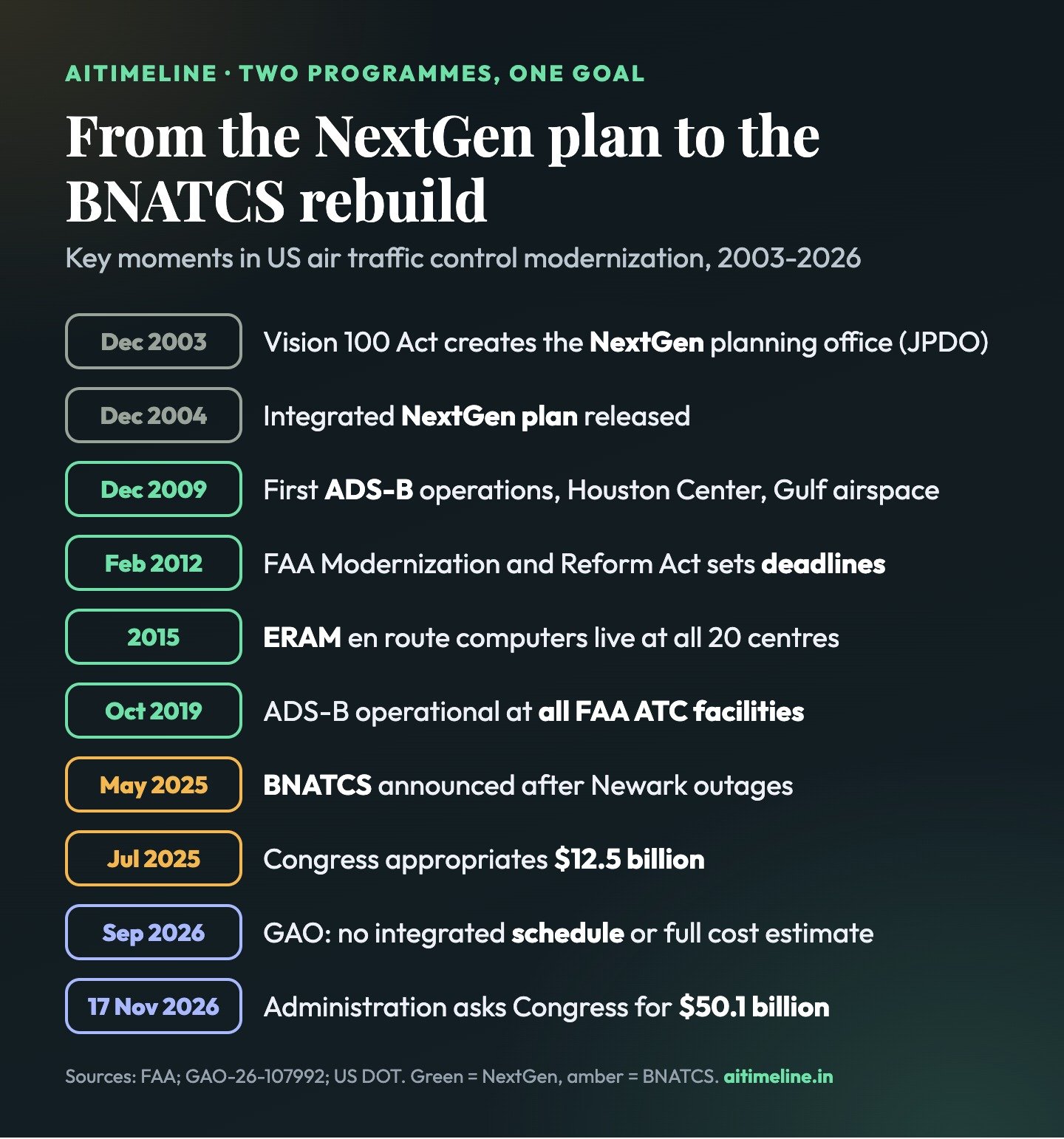
Administration asks Congress for $50.1 billion more Funding
What happened: Transportation Secretary Sean Duffy, FAA Administrator Bryan Bedford and budget director Russ Vought wrote to House and Senate appropriators asking for a further $50.1 billion for air traffic control and airport infrastructure.
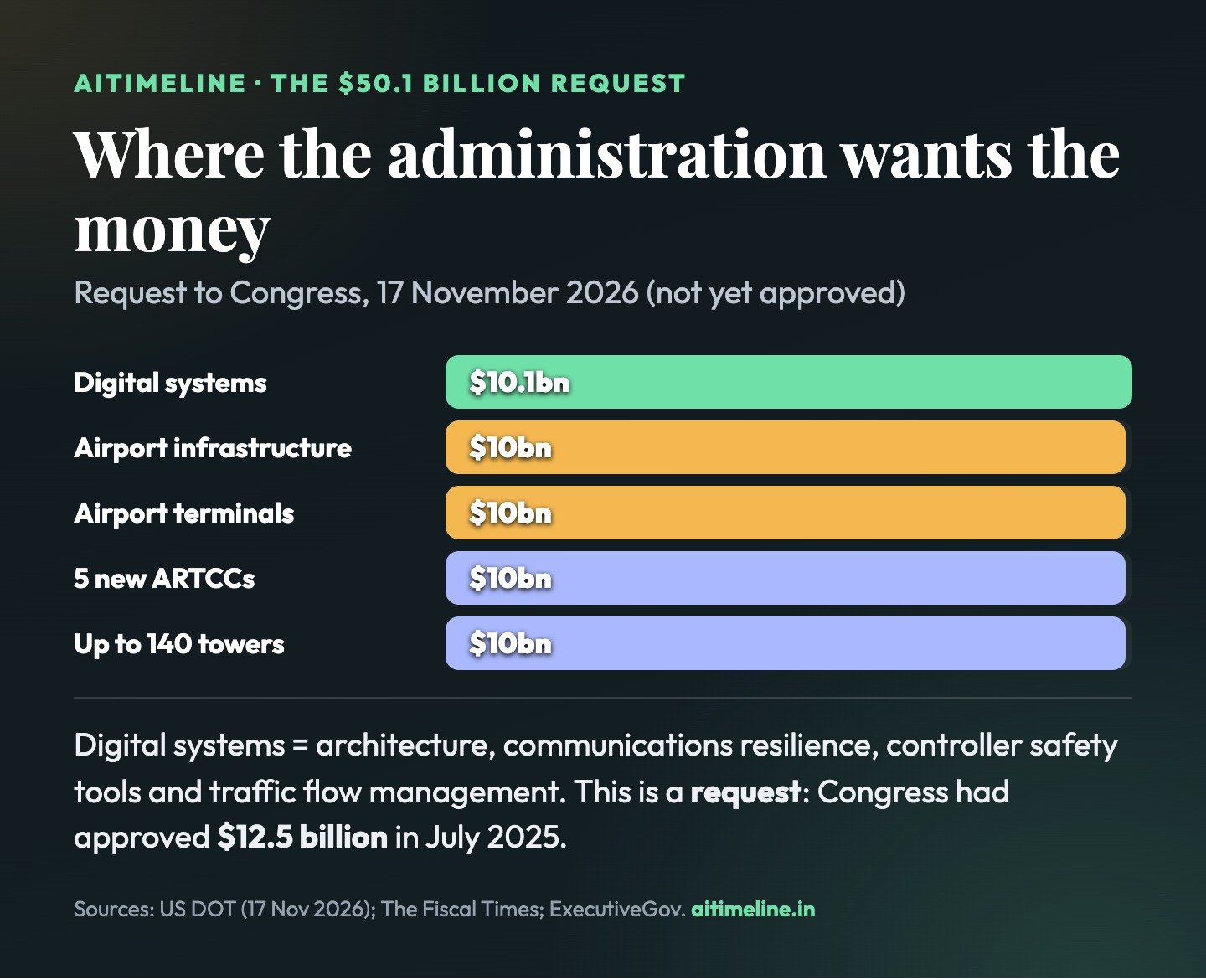
The breakdown: $10.1 billion for digital architecture, communications resilience, controller safety tools and air traffic flow management; $10 billion for airport infrastructure; $10 billion for terminals; $10 billion for five consolidated Air Route Traffic Control Centers; and $10 billion for building or improving up to 140 control towers.
Reaction: Several senators doubted the full amount would pass. Senate Commerce Committee chair Ted Cruz said he did not think the full $50 billion would be funded. The request arrived as Congress faced a 11 December government funding deadline.
Nationwide ground stop halts US departures for about four hours Outage
What happened: At about 4pm Eastern time the FAA stopped departures nationwide after a communications problem affecting several en route centres. The stop was lifted after roughly four hours, but disruption ran into the weekend: nearly 8,000 flights were cancelled and more than 10,000 delayed.
Cause: Secretary Duffy said air traffic control routers had become overloaded with data. Officials were also examining how older equipment interacted with newer technology being installed. The root cause was still under investigation in late November; officials said it did not appear to be a cyberattack.
Why it matters: The DOT cited the outage four days later as evidence that legacy systems had to be replaced faster.
GAO warns BNATCS lacks a full cost estimate and master schedule Oversight
Findings: The Government Accountability Office found the FAA had not developed a comprehensive, well-documented lifecycle cost estimate for BNATCS, and had no integrated master schedule for Phase 1. Instead it had 11,389 individual project schedules that were not integrated.
The risk: Without integration, separate projects were scheduled for installation at the same sites, generally without arranging them to reduce disruption to controllers. GAO said this heightened the risk of cost overruns and delays.
Phases: Phase 1 is to be completed by December 2028. The FAA said Phase 2, new automation systems, needs about $10.2 billion excluding facilities, and has no estimated start or end date.
Half of the old copper lines replaced with fibre Deployment
Progress: As of May 2026, the FAA reported replacing 2,560 of 5,170 old copper telecommunications lines with high-speed fibre-optic connections, according to GAO.
Scope: Phase 1 also covers radios, radars, voice switches, surface awareness at airports and controller training simulators, with most installations due between 2027 and the end of 2028.
Airspace Modernization Office created Oversight
What happened: The FAA set up an Airspace Modernization Office to manage installation and implementation work, according to GAO. In December 2025 it had picked Peraton as prime systems integrator to coordinate the programme.
Executive steering committee and fast-track buying rules Oversight
What happened: The FAA established an executive steering committee to oversee BNATCS and adopted accelerated acquisition procedures, waiving many of its normal Acquisition Management System steps to cut procurement time, GAO reported.
Congress appropriates $12.5 billion Funding
What happened: Congress provided $12.5 billion for air traffic control systems modernization and facilities in the reconciliation law signed in July 2025.
What it pays for: Mainly Phase 1: telecommunications, radios, radars, voice switches and related facilities work. Secretary Duffy had told lawmakers the full rebuild would cost about $31.5 billion, implying roughly $19 billion more would be needed.
Brand New Air Traffic Control System announced Policy
What happened: Secretary Duffy, at the President’s direction, announced the Brand New Air Traffic Control System (BNATCS), an accelerated plan to replace aging communications, surveillance and weather systems and build a common automation platform for controllers.
Distinction: BNATCS is not NextGen renamed. NextGen added new capabilities over two decades; BNATCS is a faster effort to replace the physical infrastructure underneath them.
Newark outages expose failing telecom lines Outage
What happened: Failures of aging telecommunications lines serving the Philadelphia approach control facility, which handles Newark traffic, caused controllers to lose radar and radio contact with aircraft for brief periods from 28 April.
Impact: Hundreds of flights were delayed or cancelled, the FAA cut Newark’s arrival rate, and some controllers took trauma leave.
FAA reports $10.9 billion in NextGen benefits Deployment
What it said: The FAA said NextGen had delivered $10.9 billion in benefits between 2010 and 2023 from more than 20 capabilities through more than 200 implementations, through fewer delays, lower fuel burn and better capacity.
Caveat: These are FAA-estimated benefits to airlines and passengers, not cash savings to government. A later FAA report put the total at $12.3 billion for 2010-2024, and the DOT Inspector General has questioned how reliable the agency’s benefit estimates are.
GAO: 51 of 138 systems unsustainable Oversight
Findings: GAO reported that 51 of the FAA’s 138 air traffic control systems were unsustainable and 54 potentially unsustainable, citing outdated technology, scarce spare parts and funding gaps.
Warning: Some of the most critical systems had no replacement planned for years, and GAO said the FAA was moving too slowly.
NOTAM outage grounds departures nationwide Outage
What happened: The FAA’s NOTAM system, which publishes safety notices for pilots, failed after a contractor accidentally deleted files. The FAA halted all departures nationwide on the morning of 11 January.
Impact: More than 1,300 flights were cancelled and about 10,000 delayed. Congress later required the FAA to modernise the NOTAM system.
Last of 11 Metroplex airspace redesigns completed Deployment
What happened: The FAA completed the South-Central Florida Metroplex, the last of 11 Metroplex projects that redesigned airspace and satellite-based procedures around busy metropolitan areas. The FAA says it was completed in June 2022, and the programme ended in September 2022.
Trade-off: Metroplex routes cut fuel burn but concentrated flight paths, prompting noise complaints in several cities.
ADS-B operational nationwide; equipage deadline arrives Deployment
What happened: On 7 October 2019 the FAA announced its final ADS-B implementation milestone: ADS-B was operational at air traffic control facilities across the country, from towers to en route centres, on schedule and within budget.
The rule: From 1 January 2020 aircraft flying in most controlled US airspace had to carry ADS-B Out, subject to exceptions.
Why it matters: ADS-B updates an aircraft’s position about once a second, compared with every five to 12 seconds for radar, and covers areas radar cannot reach, such as parts of Alaska and the Gulf of Mexico.
COVID-19 slows installations Outage
What happened: Restrictions on access to operational facilities delayed some NextGen deployments, while software development and research continued. The collapse in traffic also briefly removed the congestion pressure that had driven NextGen.
Data Comm reaches 55 airports Deployment
What happened: The FAA completed Data Comm tower services at 55 airports, ahead of schedule. Controllers could send departure clearances as text that pilots accept at the push of a button.
Since then: Data Comm departure clearances reached 65 airports, and en route services, for aircraft at cruising altitude, began rolling out at en route centres from around 2019.
ERAM live at all 20 en route centres Deployment
What happened: The FAA completed ERAM, replacing the decades-old Host computer system at the 20 centres in the contiguous United States that handle high-altitude traffic.
Why it matters: ERAM is the automation backbone that ADS-B, Data Comm and time-based flow management plug into. Terminal facilities moved to STARS, now at more than 200 approach control facilities.
FAA takes full charge; ADS-B ground network finished Policy
What happened: The Joint Planning and Development Office was wound down and the FAA took full responsibility for NextGen. The nationwide network of 634 ADS-B ground stations was completed the same year.
FAA Modernization and Reform Act sets deadlines Policy
What happened: The Act set deadlines for navigation and surveillance technology and required satellite-based performance-based navigation procedures at the 35 busiest airports by 2015. It also ordered a plan to integrate drones into the national airspace.
What followed: The FAA’s first drone integration roadmap followed in 2013.
Advisory committee and Mid-Term Concept of Operations Policy
What happened: The NextGen Advisory Committee was set up in 2010 to give airlines, airports, manufacturers, unions and others a formal say in priorities. In 2011 the FAA published a mid-term concept describing the move towards integrated gate-to-gate operations.
First ADS-B operations over the Gulf Deployment
What happened: ADS-B began operating at the Houston en route centre for airspace over the Gulf of Mexico, where radar coverage is limited, giving controllers satellite-derived positions for helicopters and aircraft serving offshore platforms.
Executive Order 13479 Policy
What happened: The order directed federal agencies to support the transformation of the national air transportation system and set up senior-level coordination for NextGen.
Integrated plan and concept of operations Policy
What happened: The Integrated Plan for the Next Generation Air Transportation System was delivered to Congress in December 2004. In June 2007 the JPDO published a detailed concept of operations setting out the research and policy work needed.
Vision 100 creates the NextGen planning office Policy
What happened: President Bush signed the Act, which created the Joint Planning and Development Office to plan the Next Generation Air Transportation System.
Background: A 2002 commission on the future of the US aerospace industry had called for a coordinated national plan after delays in the late 1990s, when roughly one flight in four ran late.
Why ADS-B Was NextGen’s Biggest Change
From radar sweeps to satellite position reports.
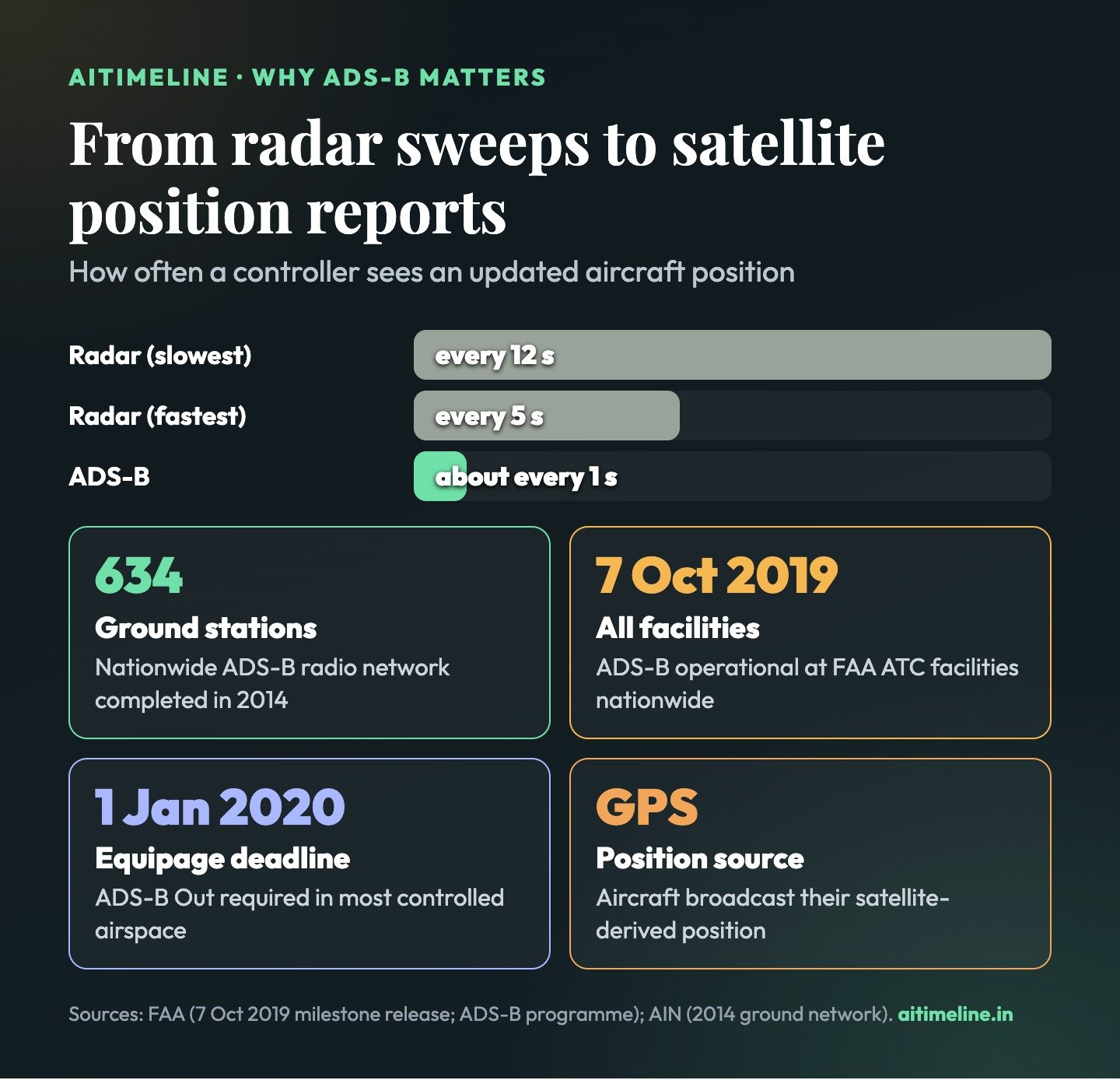
With radar, the ground works out where an aircraft is by bouncing signals off it. With ADS-B, the aircraft tells the ground where it is, using GPS, about once a second. The FAA says ADS-B is now the preferred source of surveillance at its facilities and also tracks aircraft and vehicles on runways and taxiways at equipped airports.
The cost was shared: the FAA built and paid for the ground network, while aircraft owners had to buy and install ADS-B Out avionics before the 1 January 2020 deadline.
The Outages That Forced the Issue
Three failures, three years apart.
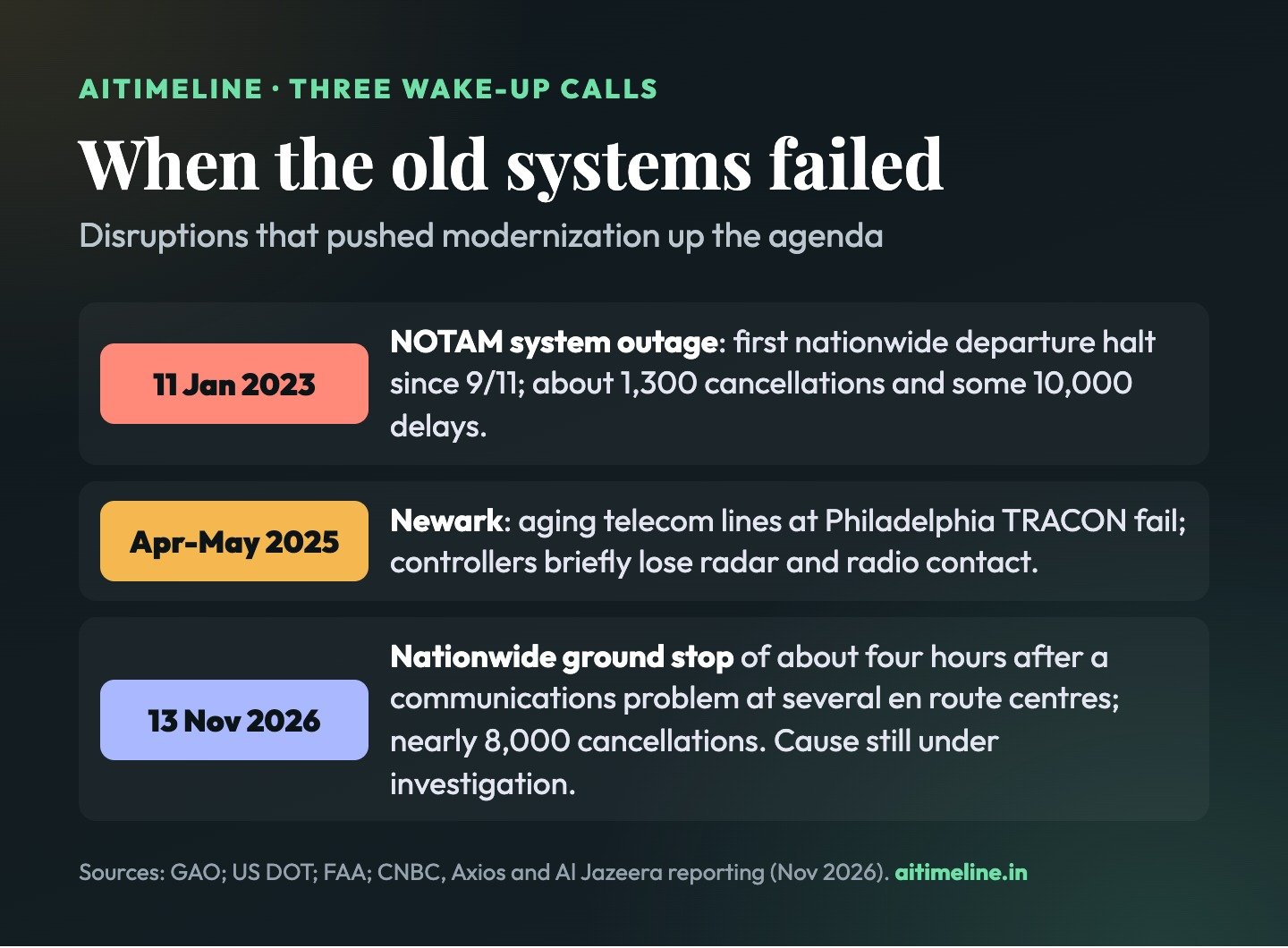
The failures had different causes. The 2023 outage was a database error in the NOTAM system; Newark was a telecommunications problem; the November 2026 cause had not been established when this page was updated, though officials pointed to overloaded routers and possible conflicts between old and newly installed equipment. What links them is a network built from many aging, tightly connected parts.
How Old Are FAA Systems?
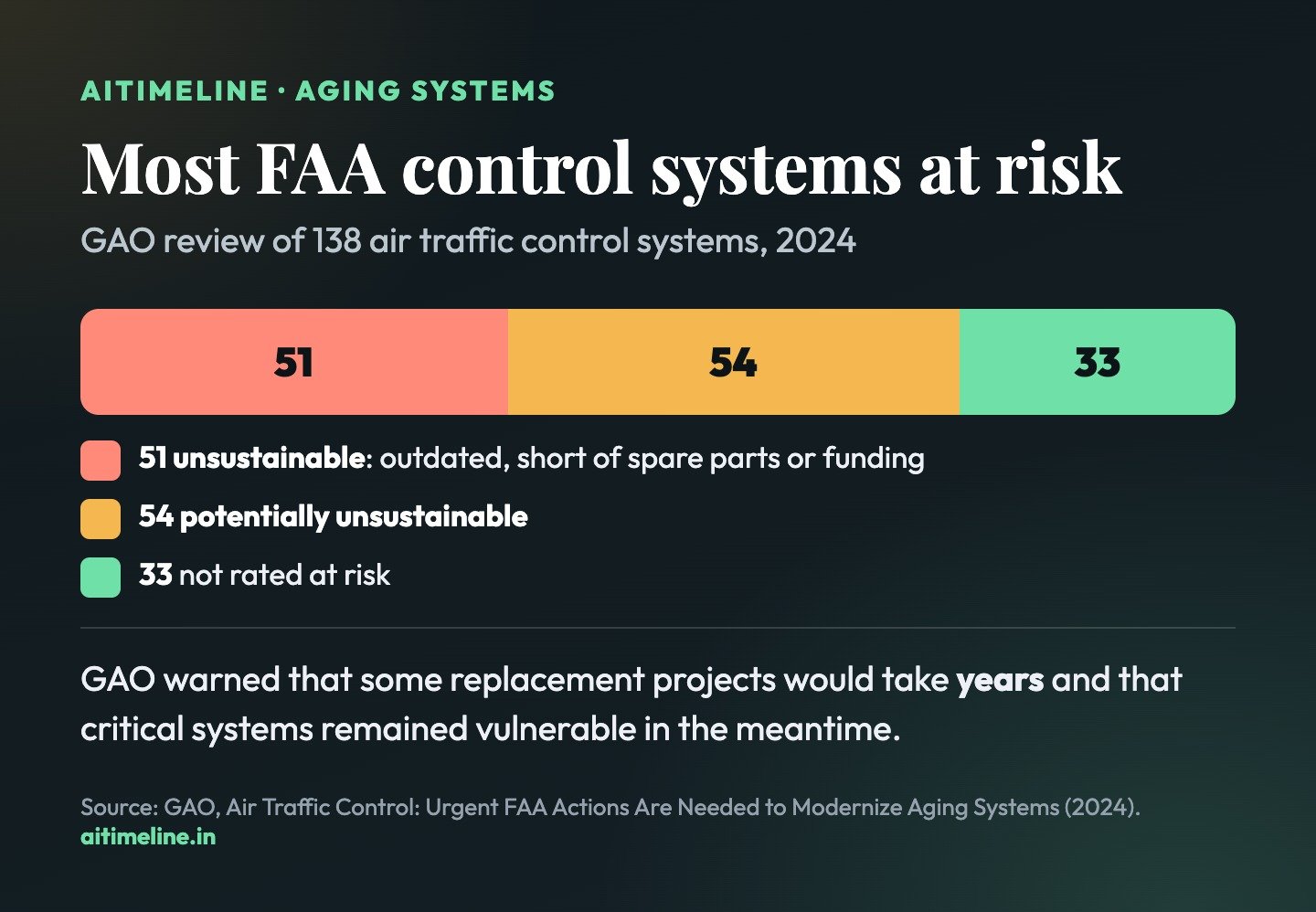
GAO’s point was not that every old system is unsafe, but that the FAA was running out of time to replace them before spare parts, expertise and vendor support ran out. That finding underpins BNATCS Phase 1.
How Much Has Modernization Cost?
The figures cover different programmes and periods. Do not add them together.
| Figure | Amount | What it represents |
|---|---|---|
| NextGen spending | Just over $14bn | FAA spending through fiscal 2022 (GAO) |
| NextGen benefits | $10.9bn | FAA estimate, 2010-2023 (later $12.3bn to 2024) |
| BNATCS appropriation | $12.5bn | Approved by Congress, July 2025 |
| BNATCS Phase 2 | About $10.2bn | FAA estimate, excluding facilities |
| Additional request | $50.1bn | Requested 17 November 2026; not approved |
The $10.9 billion is an FAA estimate of benefits to airlines and passengers, not cash returned to the Treasury, and the DOT Inspector General has questioned how reliable such estimates are. GAO has also warned that BNATCS’s lifecycle cost is not yet established.
What Are the Main Challenges?
- Aging equipment: spare parts and specialist expertise for older systems are increasingly hard to find.
- Changing the engine in flight: new systems must be installed and tested while thousands of flights keep using the airspace.
- Funding: the $12.5 billion does not cover Phase 2 or the wider infrastructure in the $50.1 billion request.
- Scheduling: GAO found 11,389 project schedules that were not integrated, risking clashes at the same sites.
- Training and transition: controllers, pilots and airports need new procedures; installation alone does not deliver benefits.
- Staffing: controller shortages limit how fast facilities can take systems offline for upgrades.
What Could It Mean for Passengers?
If delivered, the programmes could bring more predictable schedules, better handling of bad weather, shorter and more fuel-efficient routes, and fewer delays caused by equipment failures. These are intended benefits, not guarantees. Weather, airport capacity, airline operations and staffing will still decide whether a given flight leaves on time.
Key Facts at a Glance
| Question | Answer |
|---|---|
| What is NextGen? | The FAA’s Next Generation Air Transportation System |
| Planning established | 2003 |
| Integrated plan | 2004 |
| Core technologies | ADS-B, PBN, Data Comm, SWIM, TBO |
| ADS-B nationwide | 7 October 2019 |
| ADS-B Out deadline | 1 January 2020 |
| FAA-reported benefits | $10.9bn, 2010-2023 |
| New programme | BNATCS, announced May 2025 |
| Approved funding | $12.5bn (July 2025) |
| Phase 1 target | December 2028 |
| Additional request | $50.1bn (17 November 2026), not approved |
| Latest oversight | GAO-26-107992, 14 September 2026 |
The Next Phase
NextGen changed the technical direction of US air traffic management: satellite surveillance, precise navigation and digital messaging have moved much of the network beyond radar and radio. But adding capabilities is not the same as replacing a national system, and the infrastructure beneath NextGen aged faster than it was renewed.
BNATCS is the attempt to close that gap quickly. The November 2026 request shows its ambitions extend well beyond the first $12.5 billion. Whether Congress funds it, and whether the FAA can deliver on time, within a credible budget and without disrupting the airspace, is the question for 2027 and 2028.
Explore More Timelines
People Also Ask
Frequently Asked Questions
⚠️ Editorial Note
Dates and figures follow the FAA, the Government Accountability Office (including GAO-26-107992) and the US Department of Transportation. The $10.9 billion benefits figure is an FAA estimate. The $50.1 billion is a funding request that Congress had not approved as of 23 November 2026. The cause of the 13 November 2026 ground stop was still under investigation; details may change.
Related Stories
Sources & further reading
Every dated entry above was checked against these references. Last reviewed 23 November 2026.
- GAO-26-107992: Air Traffic Control Systems: Ambitious New Modernization Effort Needs to Improve Cost and Schedule Planning (14 September 2026)
- GAO-25-107917: Air Traffic Control: Urgent FAA Actions Are Needed to Modernize Aging Systems
- FAA Newsroom: NextGen (27 January 2025)
- FAA: History of NextGen
- FAA: FAA Successfully Completes Final ADS-B Milestone (7 October 2019)
- FAA: How many Metroplex projects did the FAA perform?
- US DOT: Trump Administration Calls on Congress to Fully Fund Air Traffic Control Modernization ($50.1 billion, 17 November 2026)
- CNBC: FAA lifts ground stop after more than four hours (13 November 2026)