Jones Act: History, Waivers and Impact on India’s Fuel Trade
Explore the Jones Act's history, US shipping restrictions, 2026 emergency waivers and the indirect impact on US crude oil exports and India's fuel trade.
Latest Story
The Jones Act is a 1920 American shipping law that reserves cargo moving between US ports for ships that are US-built, US-owned and US-crewed. It was written to protect America’s merchant fleet and shipyards for national defence, and critics have argued for decades that it raises domestic shipping costs. In March 2026, during the conflict involving Iran, Washington issued an emergency Jones Act waiver, and it has now been extended to February 2027. This guide traces the law’s history, explains how waivers work, and sets out what the rules do, and do not, mean for US crude oil exports to India.
The Jones Act covers cargo moving between two US points, such as Houston to New York. A tanker sailing from a US port to India is on an international voyage, so it can be foreign-built, foreign-owned and foreign-crewed. India’s direct crude imports from the United States have never needed a Jones Act ship, and the 2026 waiver did not change that.
💡 Short Answer
The Jones Act, Section 27 of the Merchant Marine Act of 1920 and now 46 USC 55102, requires cargo shipped between US ports to travel on US-built, US-owned, US-crewed vessels. The US waived it on 17 March 2026 amid the Iran conflict and has extended the waiver to 14 February 2027 on a case-by-case basis. It does not apply to direct US-to-India oil shipments, so its effect on India is indirect.
Domestic Shipping vs International Trade
The one distinction that explains the Jones Act’s link to India.
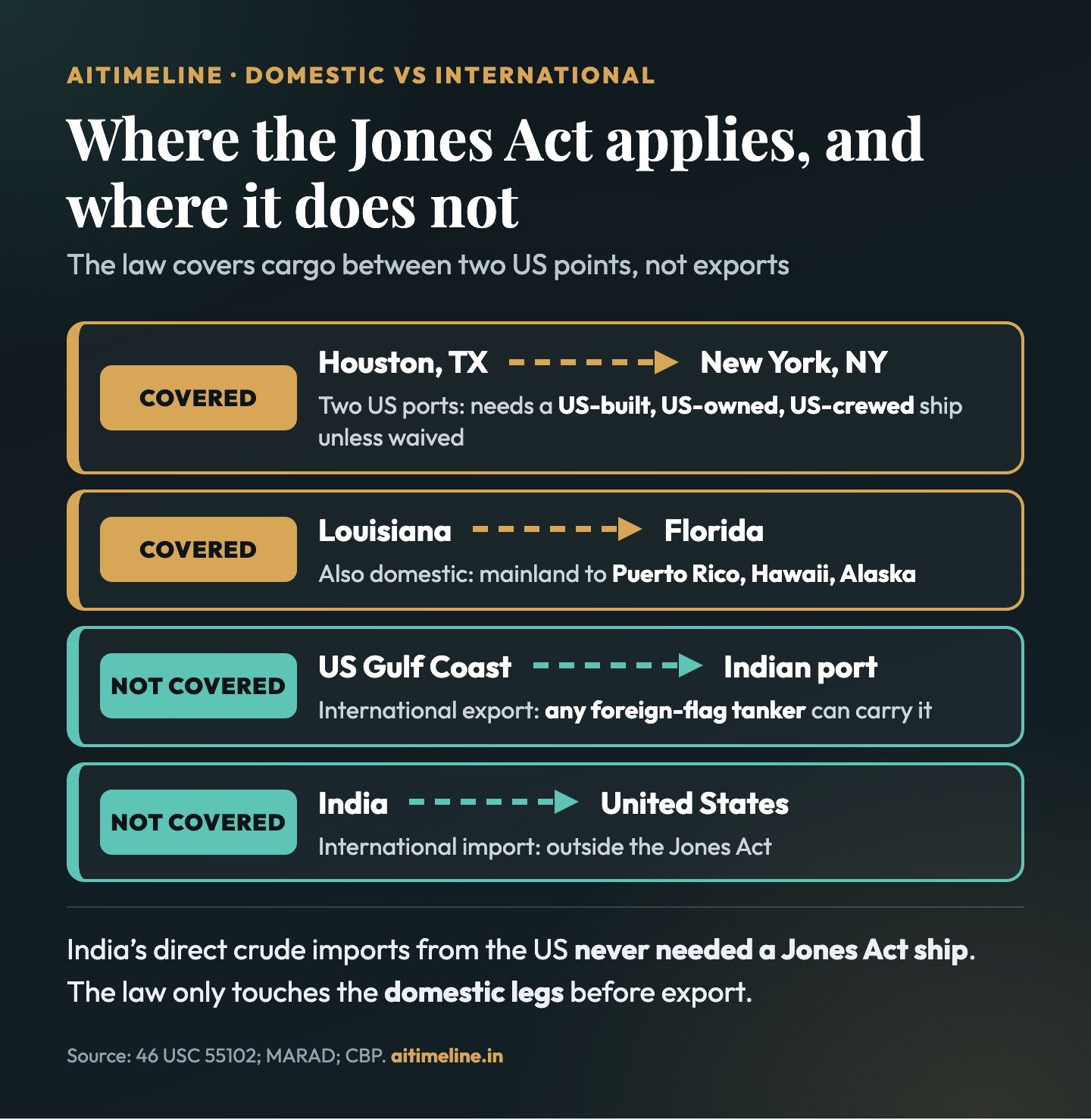
Texas refinery to New York
Gasoline or diesel moving by sea from the Gulf Coast to the East Coast travels between two US points. Without a waiver, it needs a Jones Act-qualified ship, and there are relatively few of them.
Also covered: Louisiana to Florida, the mainland to Puerto Rico, Hawaii or Alaska.
US Gulf Coast to an Indian port
Crude loaded at Corpus Christi or Houston for Jamnagar, Paradip or Vadinar is an export. Any tanker meeting normal international and port rules can carry it, whatever its flag, builder or crew.
Also not covered: India to the United States.
Jones Act: Key Questions
What to Know About the Jones Act
- Three tests: a qualifying ship must be US-built, US-owned and coastwise-endorsed with US crew requirements.
- Domestic only: it covers voyages between US points, not exports or imports.
- Old roots: US cabotage rules date to 1789 and 1817; the 1920 Act built on them after World War I.
- Waivers are rare: Katrina in 2005, Harvey and Irma in 2017, Maria in 2017 and Fiona in 2022 were short and targeted.
- 2026 is different: a national-defence waiver issued on 17 March 2026 has lasted more than eight months.
- Narrowed in August: since 17 August 2026, each foreign-flag voyage needs case-by-case approval.
- Current deadline: 11:59 pm Eastern Time on 14 February 2027.
- Volumes claimed: the White House says about 90 million barrels moved between US ports under the waivers.
- India trade: US crude exports to India were about 115.6 million barrels in 2025 but only about 31.5 million in January-August 2026, for reasons unrelated to the Jones Act.
What the Jones Act Requires
Section 27 of the 1920 Act, now 46 USC 55102.
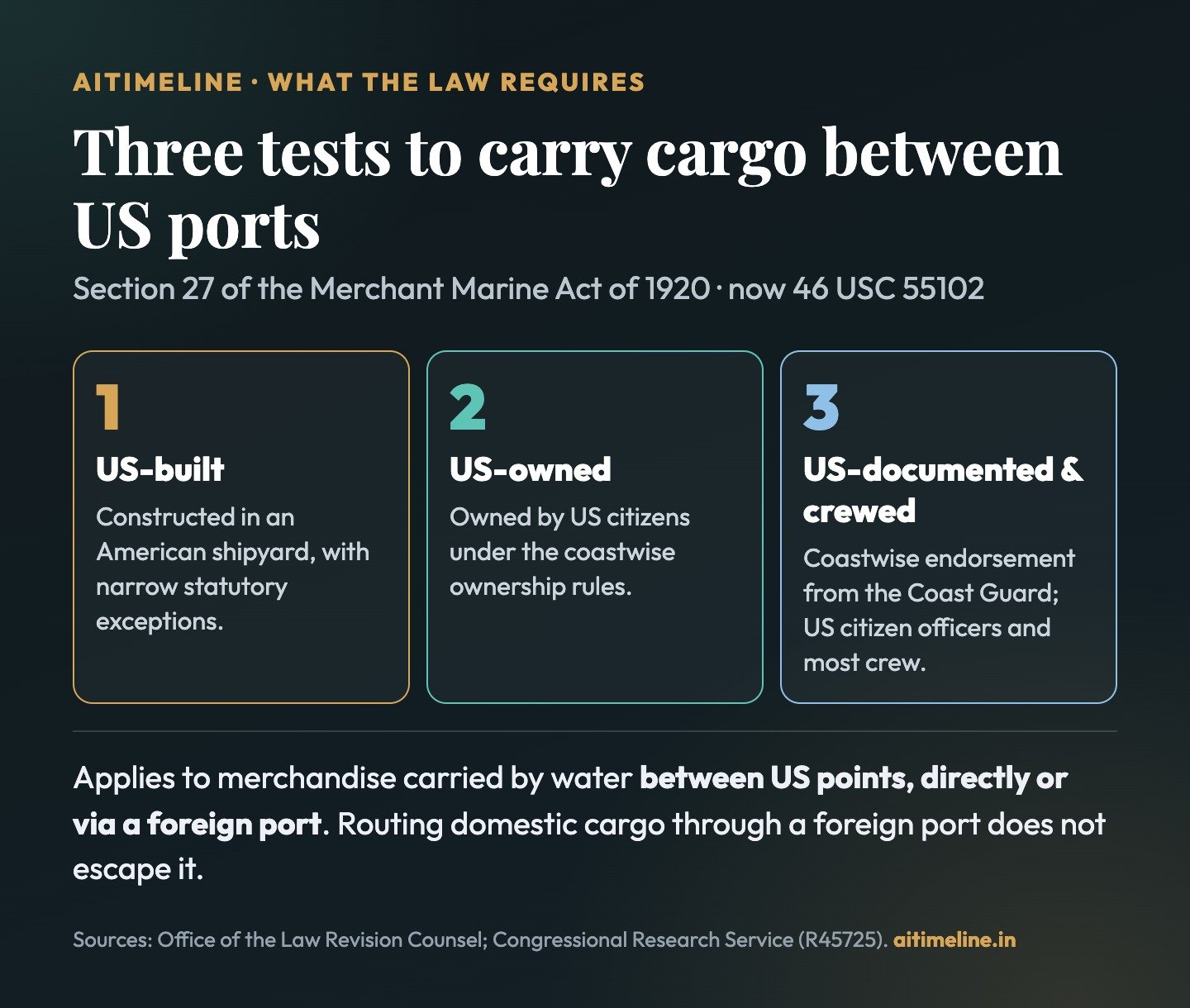
The law bars carrying merchandise by water between points in the United States, either directly or via a foreign port, unless the vessel is built in the United States, owned by US citizens under the coastwise ownership rules, and documented with a coastwise endorsement by the Coast Guard, which brings US citizenship requirements for officers and most of the crew. The ‘via a foreign port’ wording stops shippers getting around the rule by routing domestic cargo through, say, a Caribbean or Canadian port.
The rule is strict because the US-build requirement is expensive. A tanker built in an American yard costs several times more than a comparable ship built in Asia, so the Jones Act fleet is small compared with the global fleet. That is the main reason critics say the law raises the cost of moving fuel along the US coast, and the main reason supporters say it is the only thing keeping commercial shipbuilding alive in the United States.
A Century of Maritime Protection
From the first Congress to the 2026 waiver.
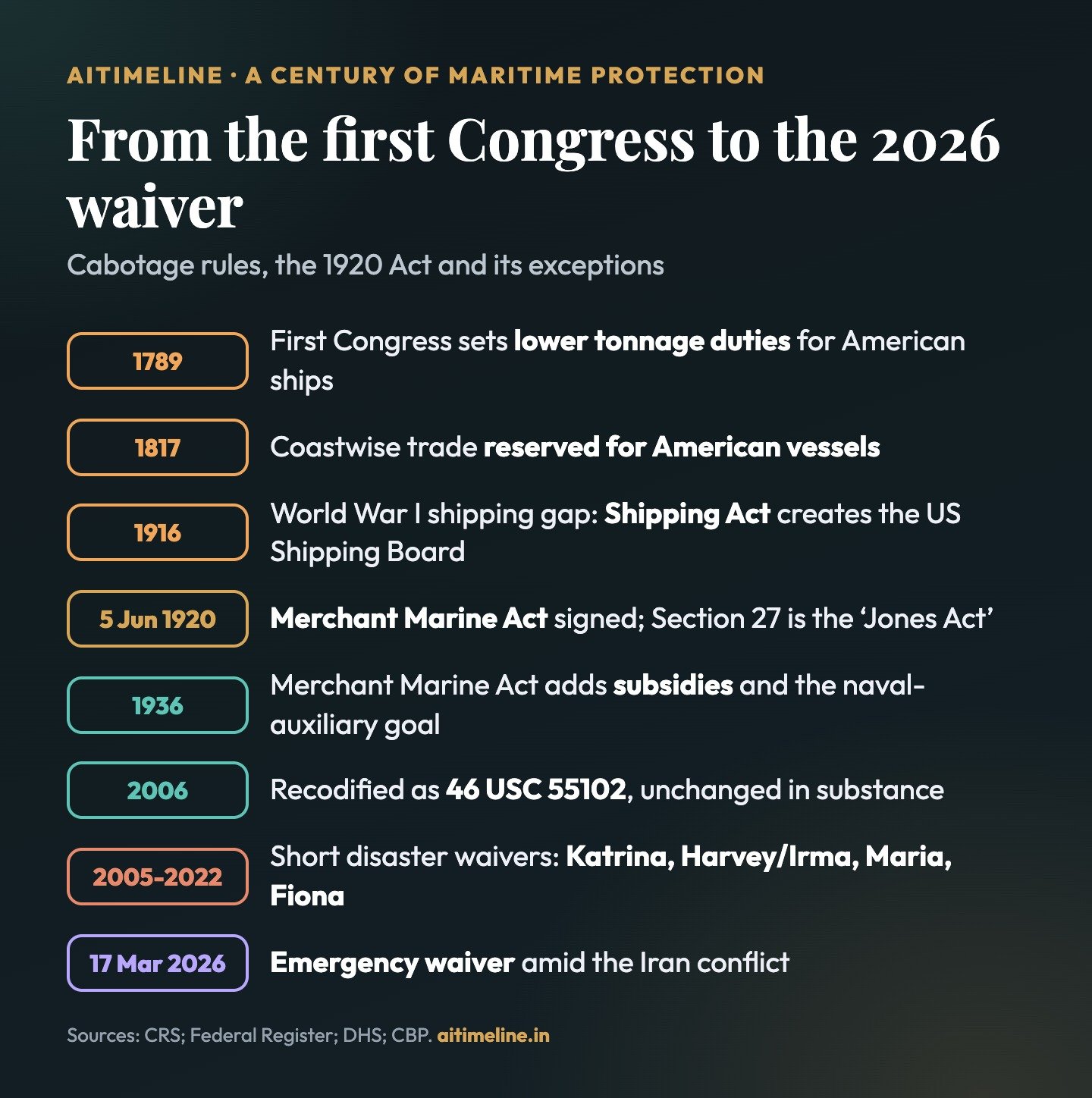
The United States protected its domestic shipping from the start. In 1789 the first Congress gave American ships lower tonnage duties, a 1793 law set up enrolment and licensing for coastal vessels, and in 1817 Congress barred foreign ships from carrying goods between US ports. These early laws are the roots of the US-build and US-ownership requirements.
World War I turned protection into national-security policy. When foreign ships that carried American trade were pulled into war service, the US scrambled to build its own fleet. The Merchant Marine Act of 1920, sponsored by Senator Wesley L. Jones of Washington and signed on 5 June 1920, aimed to keep that fleet in private American hands. The 1936 Act added subsidies and set out the goal of a merchant marine that could serve as a naval and military auxiliary. In 2006 the cargo rule was recodified, unchanged in substance, as 46 USC 55102.
How a Jones Act Waiver Works
Two legal routes, and the November 2026 process.
| Route | Who asks | Test |
|---|---|---|
| 46 USC 501(a) | Secretary of War (Defense) | Necessary for national defence to address an immediate adverse effect on military operations |
| 46 USC 501(b) | Other agencies or private requesters | MARAD finds no qualified US vessel available; waiver necessary in the interest of national defence |
| Reporting, 501(c) | Vessel owner or operator | Report each waived voyage to MARAD within 10 days |
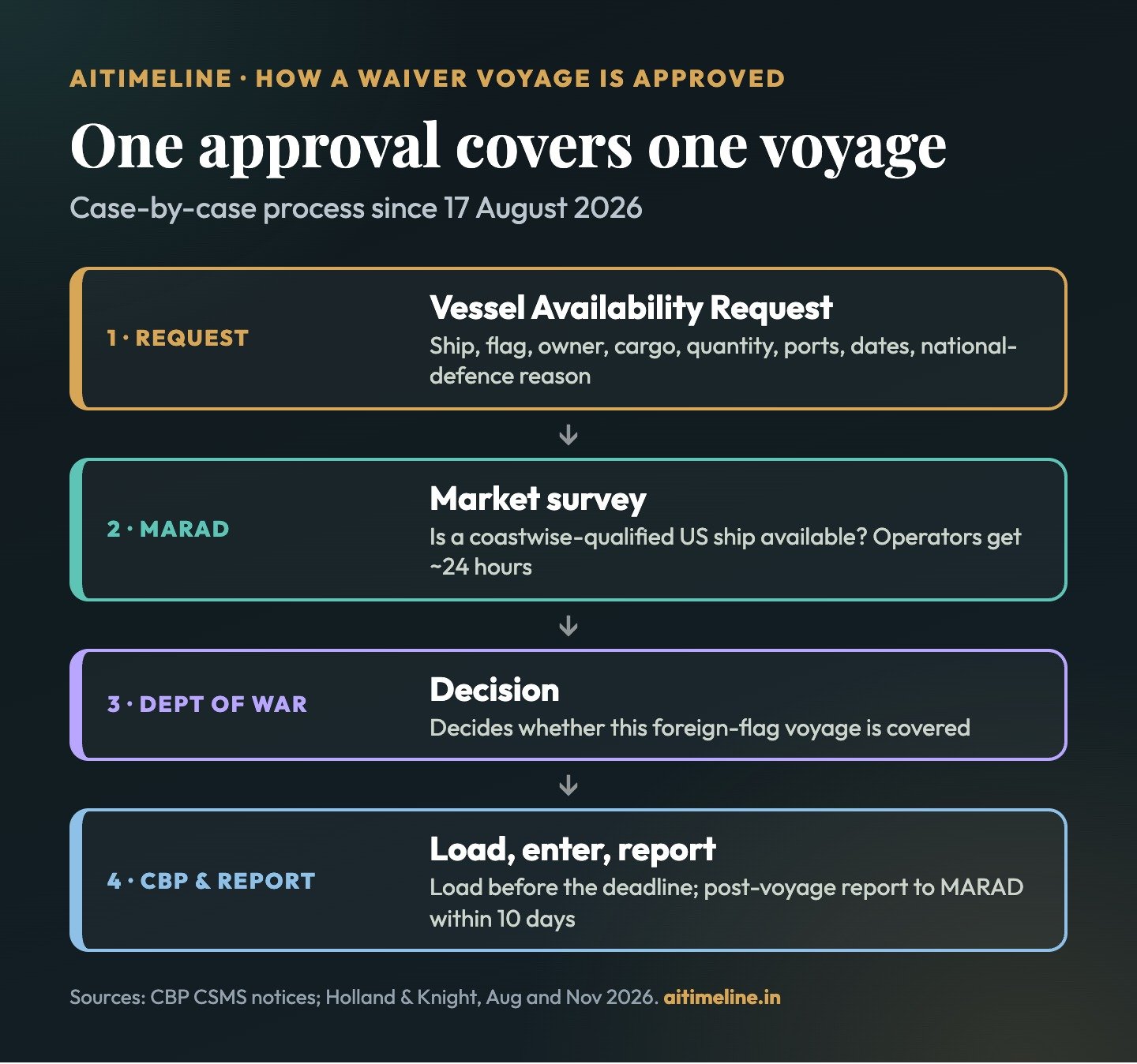
The 2026 waiver used Section 501(a). Since 17 August 2026, each voyage goes through four steps:
- Request. The shipper submits a Vessel Availability Request: vessel name, flag and owner, cargo and quantity, load and discharge ports, dates and a national-defence justification.
- MARAD survey. The Maritime Administration asks US operators whether a coastwise-qualified vessel can do the job; they normally have 24 hours to answer.
- Department of War decision. The department reviews the survey and decides whether that specific foreign-flag voyage is covered by the waiver.
- Customs and reporting. The voyage follows CBP entry rules, the cargo must be loaded before the deadline, and a post-voyage report goes to MARAD within 10 days.
The 2026 Waiver, Phase by Phase
A 60-day emergency measure that became an 11-month policy.
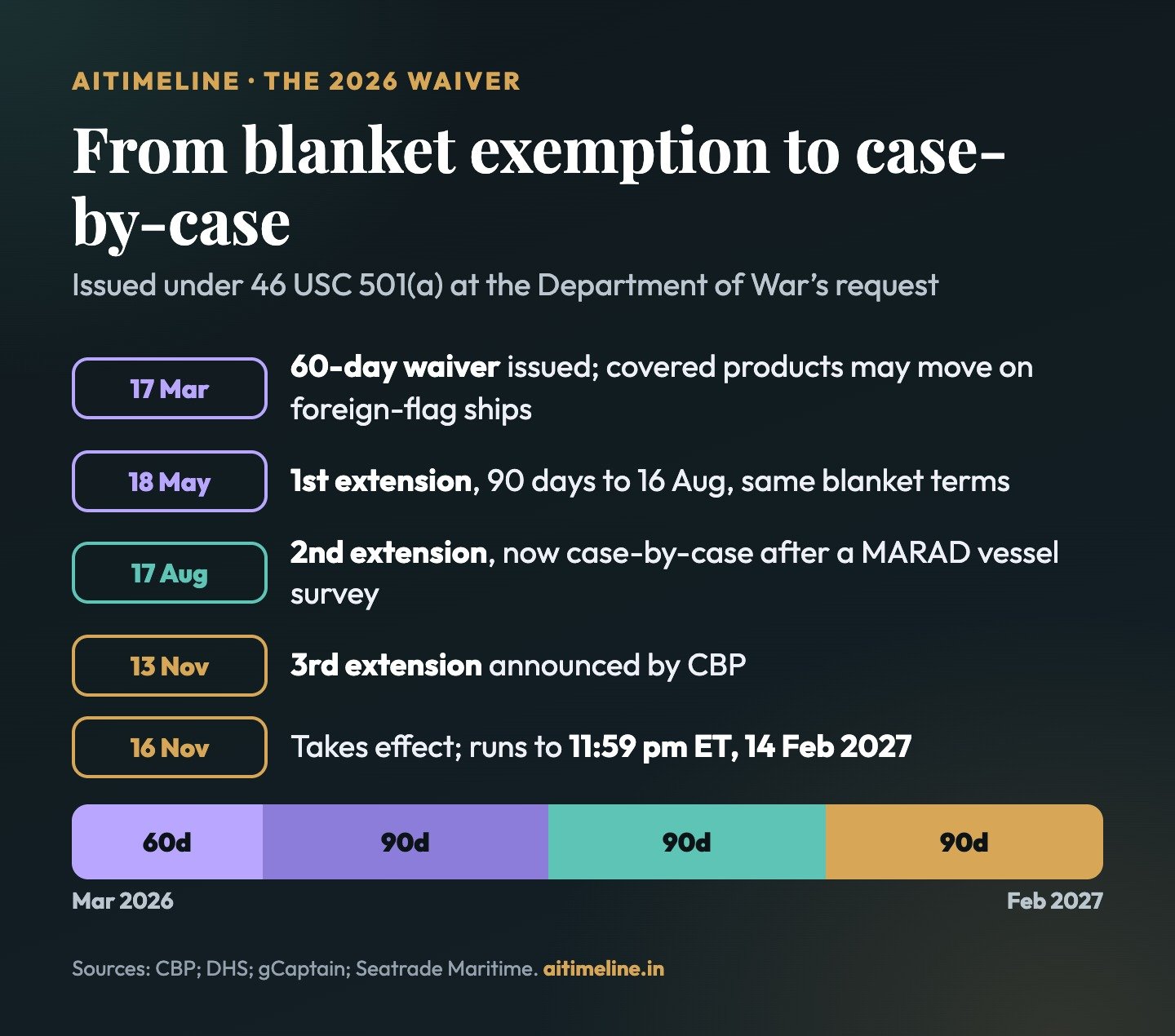
| Phase | Dates | Terms |
|---|---|---|
| Original waiver | 17 Mar – 17 May 2026 | 60 days; covered products on foreign-flag ships |
| 1st extension | 18 May – 16 Aug 2026 | 90 days; same blanket terms |
| 2nd extension | From 17 Aug 2026 | 90 days; case-by-case approval after MARAD survey |
| 3rd extension | 16 Nov 2026 – 14 Feb 2027 | 90 days; case-by-case process continues |
The administration says the waivers eased fuel and fertiliser logistics. According to figures the White House cited when announcing the November extension, about 90 million barrels of petroleum moved between US ports under the waivers since March.
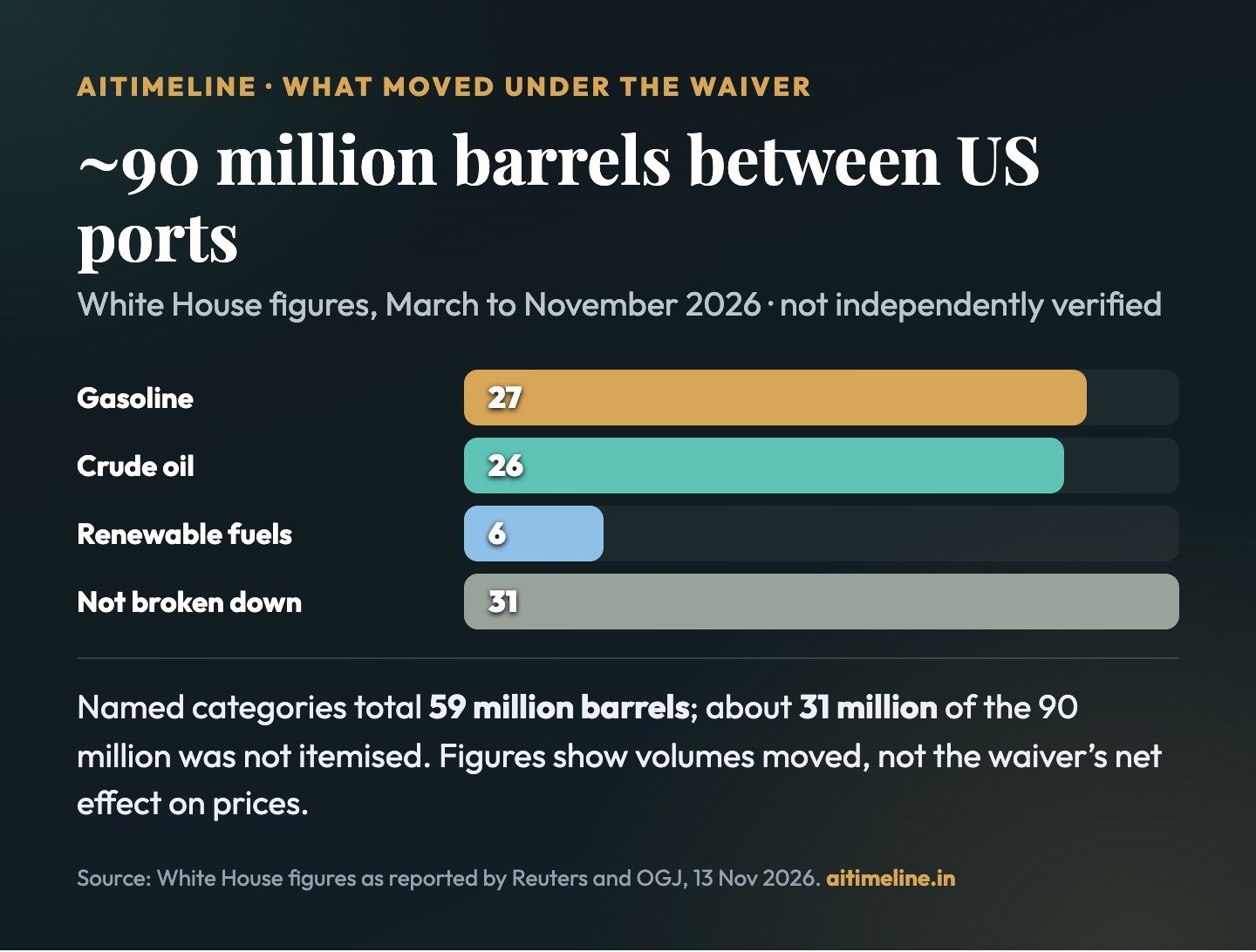
The three categories named add up to 59 million barrels; the rest of the total was not broken down. These are administration figures, not an independent estimate of how much extra oil moved because of the waiver, or what it did to prices. US domestic shipping groups dispute the benefit and want the waiver ended.
Timeline: The Jones Act and Its Waivers
Newest first. Labels mark history, law, disaster waivers, the 2026 waiver and India trade.
Third extension takes effect, running to 14 February 2027 2026 waiver
What happened: The Department of Homeland Security approved a third 90-day extension of the March waiver at the Department of War’s request. US Customs and Border Protection announced it on 13 November. It took effect on 16 November and covers cargo loaded before 11:59 pm Eastern Time on Sunday, 14 February 2027.
What did not change: The extension kept the case-by-case process introduced in August rather than restoring the broad March exemption. Each foreign-flag voyage still needs a vessel availability request, a MARAD market survey and a Department of War decision, and operators must file a post-voyage report with MARAD within 10 days.
The numbers cited: The White House said the waivers had moved about 90 million barrels of petroleum between US ports since March, including 27 million barrels of gasoline, 26 million of crude oil and 6 million of renewable fuels. These are administration figures, not an independent estimate.
Second extension narrows the waiver to case-by-case approvals 2026 waiver
What changed: The second 90-day extension replaced the blanket permission with a test. From 17 August, a company wanting to move covered cargo between US ports on a foreign-flag ship had to file a Vessel Availability Request with the Department of War and the Maritime Administration before the voyage.
How it works: MARAD surveys the market for a coastwise-qualified US vessel that can do the job; US operators normally have 24 hours to respond. The Department of War then decides whether that specific foreign-flag voyage is covered.
Why: US shipowners, shipbuilders and maritime unions had lobbied hard against the broad exemption, arguing that it handed domestic cargo to foreign ships while American vessels sat available.
First 90-day extension of the March waiver 2026 waiver
What happened: As the original 60-day waiver expired on 17 May, DHS approved a 90-day extension starting at midnight on 18 May, again at the Department of War’s request. Covered products could continue to move between US ports on foreign-flag vessels under the same conditions.
Why it matters: The extension turned a short emergency measure into a months-long policy, which sharpened the domestic shipping industry’s opposition.
Emergency Jones Act waiver issued amid the Iran conflict Disaster waiver
What happened: During the conflict involving Iran, which disrupted oil flows and pushed up fuel prices, DHS issued a limited waiver of the Jones Act under Section 501(a) of Title 46, the national-defence route. It allowed covered products to move between US ports on foreign-flag vessels for 60 days, expiring at 11:59 pm Eastern Daylight Time on 17 May 2026.
Scope: Law-firm analyses counted at least 659 potentially covered products on the list, including petroleum products and fertiliser inputs. CBP later issued further guidance on eligible products, vessel information and reporting. It was not permission for any foreign ship to carry any domestic cargo.
Why it matters: A Section 501(a) waiver requires a finding that it is necessary in the interest of national defence to address an immediate adverse effect on military operations, which is a higher and narrower bar than a typical hurricane waiver.
US crude exports to India slow sharply India trade
The figures: EIA data show the United States exported about 31.5 million barrels of crude oil to India from January to August 2026, roughly 3.9 million barrels a month. In 2025 the monthly average was about 9.6 million barrels.
What it is not: These are direct international shipments from US ports to India. The Jones Act does not apply to them, so the 2026 waiver neither allowed nor blocked them. Price spreads, freight rates, Indian refiners’ buying decisions and supply from other producers drive these volumes.
India buys more US crude: about 115.6 million barrels India trade
The figures: US crude exports to India rose from about 81.1 million barrels in 2024 to about 115.6 million barrels in 2025, according to EIA monthly data added together. September 2025 alone saw about 15.7 million barrels.
Why it matters: The rise showed the United States becoming a larger, if variable, part of India’s effort to diversify crude supply. All of this trade moves on ordinary international tankers, outside the Jones Act.
Hurricane Fiona: a one-ship waiver for Puerto Rico Disaster waiver
What happened: After Hurricane Fiona knocked out power in Puerto Rico, Homeland Security Secretary Alejandro Mayorkas granted a temporary, targeted waiver to let the Marshall Islands-flagged tanker GH Parks, carrying diesel loaded on the US Gulf Coast, discharge at the island so generators could keep running.
The dispute: The American Maritime Partnership said federal agencies had found the island already well supplied with diesel, and labour and industry groups called the waiver unnecessary. DHS later issued a separate waiver for liquefied natural gas shipments to Puerto Rico.
Hurricanes Harvey and Irma bring a fuel waiver Disaster waiver
What happened: With Gulf Coast refineries and pipelines disrupted by Harvey and Irma bearing down on Florida, DHS waived the Jones Act for the movement of fuel. A second waiver extended it to 22 September, and a separate waiver for Puerto Rico followed on 28 September 2017 after Hurricane Maria.
Why it matters: The 2017 waivers became the reference case for both sides: supporters of the law noted that they were short and targeted, critics that they were needed at all.
The Jones Act is recodified as 46 USC 55102 Law
What happened: Congress reorganised the shipping laws in Title 46 of the US Code. Section 27 of the 1920 Act became Section 55102, which bars transporting merchandise between US points by water, directly or via a foreign port, except on a vessel that is US-built, owned by US citizens and documented with a coastwise endorsement.
Why it matters: This is the section that waivers, CBP rulings and court cases cite today. The recodification did not change the policy itself.
Hurricane Katrina prompts an emergency waiver Disaster waiver
What happened: Katrina cut power to pipelines that normally move fuel from the Gulf Coast. DHS waived the Jones Act so foreign-flag tankers could carry petroleum and petroleum products between US ports in the region. The waiver was published in the Federal Register on 7 September 2005.
Why it matters: It showed how waivers are meant to work: short, tied to a specific shortage of US shipping or pipeline capacity, and lifted once normal supply returns.
Merchant Marine Act of 1936 Law
What happened: Congress declared that the US should have a merchant marine able to carry its domestic commerce and serve as a naval and military auxiliary in war or national emergency, built in the US and crewed by US citizens. It introduced direct subsidies for building and operating US ships.
Why it matters: It set out in law the national-security case that supporters of the Jones Act still make.
The Merchant Marine Act, the ‘Jones Act’, becomes law Law
What happened: President Woodrow Wilson signed the Merchant Marine Act of 1920. Section 27 restated and tightened the rule that cargo moving between US points by water must travel on US-built, US-owned vessels, and closed gaps that had allowed some routes through foreign ports.
Why it matters: The Act aimed to keep the large wartime fleet in private American hands and to preserve shipping capacity for national defence. The cargo rule in Section 27 is the part most people mean by ‘the Jones Act’.
World War I exposes America’s shipping gap History
What happened: When war began in 1914, foreign ships that carried much of America’s overseas trade were pulled into war service, and submarine warfare made shipping riskier. Congress created the US Shipping Board in 1916, and the government launched a huge emergency shipbuilding programme.
Why it matters: The experience convinced lawmakers that the country needed its own commercial fleet in peacetime, which is the logic behind the 1920 Act.
Coastwise trade reserved for American vessels History
What happened: Congress barred foreign vessels from carrying goods between US ports. Cabotage, meaning the carriage of goods or passengers between points within one country, became reserved for American ships.
Why it matters: The modern Jones Act builds on more than two centuries of US cabotage policy, not just the 1920 law.
The first Congress favours American ships History
What happened: In 1789 the first Congress set lower tonnage duties for American-built and American-owned ships than for foreign ones, giving US vessels an advantage in domestic trade. A 1793 law set up the enrolment and licensing system for vessels in the coastal trade.
Why it matters: The roots of the US-build requirement go back to these early registration and enrolment laws, long before 1920.
What the Jones Act Means for India’s Fuel Trade
A domestic US law with indirect effects on the barrels India buys.
Million barrels, from EIA monthly data added together. 2026 covers January to August only, so it is not a full-year total.
Monthly volumes swing widely: from about 15.7 million barrels in September 2025 to about 2.1 million in August 2026. Source: US Energy Information Administration, release of 30 October 2026.
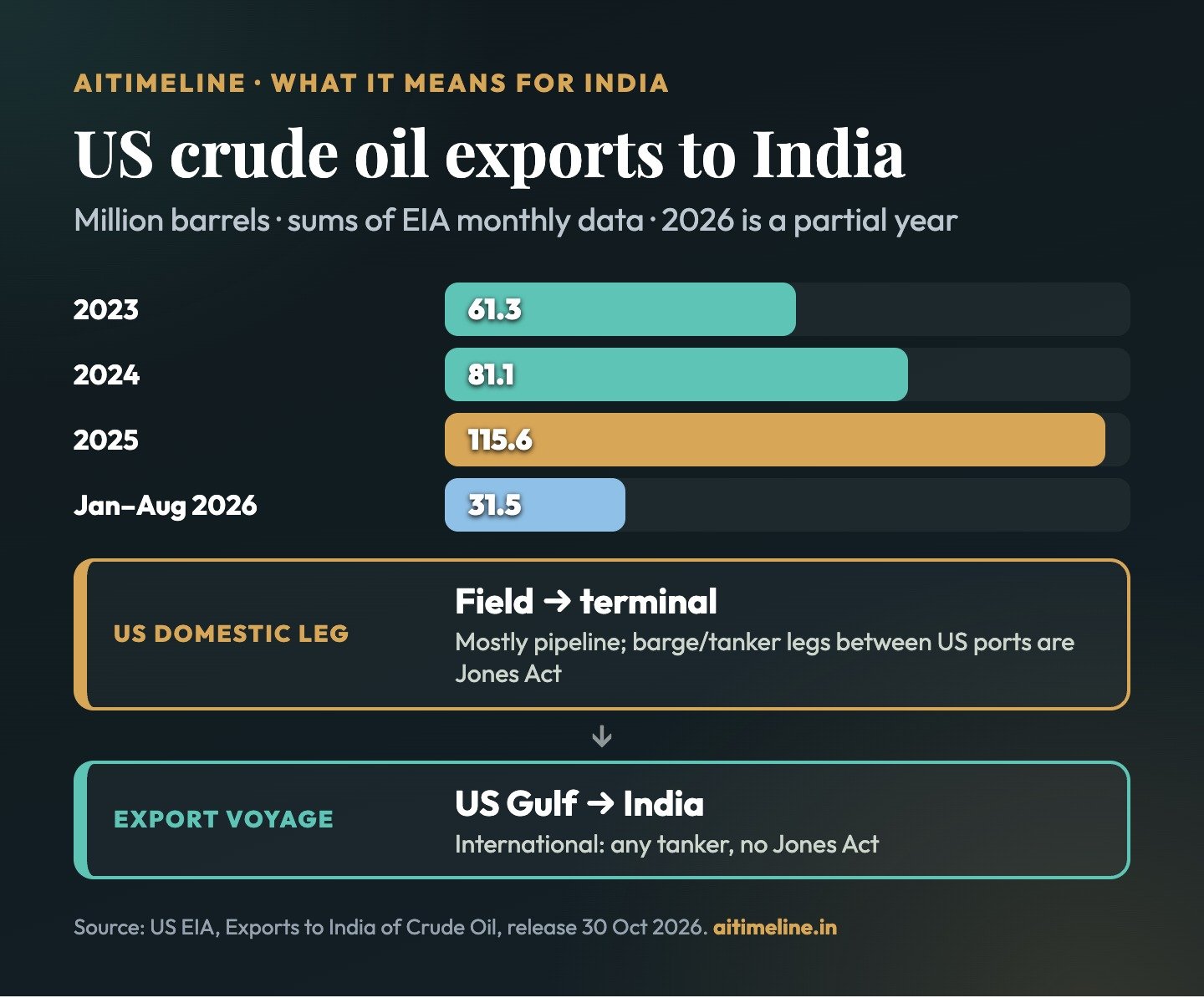
India is one of the world’s largest crude importers and has added US barrels to diversify its supply. EIA figures show US crude exports to India rising from about 81.1 million barrels in 2024 to about 115.6 million in 2025, then slowing to about 31.5 million in the first eight months of 2026. None of that trade involves a Jones Act ship. There are four indirect channels through which the law can matter:
1. Domestic distribution. Most US crude reaches Gulf Coast export terminals by pipeline, but some moves by barge or tanker between US ports. A waiver can add ships for those legs, which may help terminal supply. The effect depends on actual cargoes, refinery runs and export demand.
2. Shipping costs. Jones Act ships are scarce and expensive compared with the global fleet. Extra capacity for selected voyages can ease bottlenecks, but it does not set the price India pays. Benchmarks, freight to Asia, insurance and contract terms matter far more.
3. Access to export supply. Better domestic logistics may help move crude and products between refineries, storage and terminals. Indian refiners benefit only if that produces competitively priced cargoes. The waiver gives India no special access or entitlement.
4. Global prices. Domestic US shipping constraints can affect regional fuel prices, but global crude prices are driven by OPEC+ decisions, conflict risk, inventories, refinery demand, the dollar and freight. The waiver alone cannot be credited with lower petrol or diesel prices in India.
| Product | Why it matters for India |
|---|---|
| Crude oil | Refined in India into petrol, diesel and other fuels; the main US-India energy flow |
| LPG and other gases | Household cooking fuel and industrial use |
| Diesel | Transport, industry and agriculture |
| Gasoline | Imported occasionally as a finished fuel or blend component |
| Jet fuel | Aviation fuel supply |
The waiver lists specific covered commodities, and the list and process can change. Anyone planning a US domestic voyage under it should check current CBP guidance rather than assume every fuel or chemical cargo qualifies.
Arguments For and Against the Jones Act
Maritime security versus shipping costs.
| Supporters say | Critics say |
|---|---|
| Protects US shipbuilding capacity | Restricts competition from foreign ships |
| Supports American mariner jobs | Raises domestic shipping costs |
| Keeps a fleet available for defence and disasters | Shrinks the pool of available vessels |
| Keeps domestic waterways under US control | Makes fuel movement between US regions less flexible |
| Capacity lost now cannot be rebuilt quickly in a war | Costs fall on Puerto Rico, Hawaii, Alaska and consumers |
The 2026 waiver sharpened both sides. The administration presented it as a pragmatic response to an energy shock. The American Maritime Partnership and maritime unions argued that it gave domestic cargo to foreign ships while US vessels were available, and that its effect on pump prices was negligible. The free-market Cato Institute used the extension to renew its call for repeal.
Key Institutions
| Institution | Role |
|---|---|
| US Congress | Enacts and amends maritime law |
| Department of Homeland Security | Grants waivers under 46 USC 501 |
| Department of War | Requests national-defence waivers; decides individual voyages since August 2026 |
| Maritime Administration (MARAD) | Surveys US vessel availability; receives post-voyage reports |
| US Customs and Border Protection | Enforces coastwise rules, issues rulings and waiver guidance |
| US Coast Guard | Documents vessels and issues coastwise endorsements |
| Energy Information Administration | Publishes US petroleum trade data, including exports to India |
Facts at a Glance
| Detail | Information |
|---|---|
| Common name | Jones Act |
| Legislation | Merchant Marine Act of 1920, Section 27 |
| Signed | 5 June 1920, by President Woodrow Wilson |
| Named after | Senator Wesley L. Jones of Washington |
| Current provision | 46 USC 55102 (recodified 2006) |
| Vessel tests | US-built, US-owned, coastwise-endorsed |
| US-India oil exports | International trade; not covered |
| 2026 waiver issued | 17 March 2026 |
| Case-by-case approvals from | 17 August 2026 |
| Latest extension announced | 13 November 2026 |
| Current deadline | 14 February 2027, 11:59 pm ET |
| Petroleum moved under waivers | ~90 million barrels (White House figure) |
Explore More Timelines
People Also Ask
Frequently Asked Questions
⚠️ Editorial Note
Waiver dates and terms follow US Customs and Border Protection notices and law-firm analyses of them. Barrel volumes moved under the waiver are White House figures and have not been independently verified. US crude export figures are AiTimeline’s sums of EIA monthly data; the EIA revises its series, and 2026 is a partial year. This page explains a US law for general readers and is not legal or trade-compliance advice.
Related Stories
Sources & further reading
Every dated entry above was checked against these references. Last reviewed 22 November 2026.
- Office of the Law Revision Counsel: 46 USC 55102, Transportation of merchandise
- Congressional Research Service: Shipping Under the Jones Act, Legislative and Regulatory Background (R45725)
- US Customs and Border Protection, CSMS 70435180: third extension of the 17 March 2026 Jones Act waiver, 13 November 2026
- US Customs and Border Protection, CSMS 68370692: updated covered-products guidance, 16 April 2026
- Holland & Knight: DHS extends Jones Act waiver for a third time, 16 November 2026
- Holland & Knight: DHS extends Jones Act waiver again, case-by-case process, 13 August 2026
- Oil & Gas Journal: White House extends Jones Act waiver for another 90 days
- US Energy Information Administration: US exports to India of crude oil (monthly)
- Department of Homeland Security: September 2017 Jones Act waivers
- Federal Register, 7 September 2005: Jones Act waiver after Hurricane Katrina