Kerala’s EMS Namboodiripad Government Dismissal: A Timeline of the 1957-59 Political Crisis
Explore the 1957-60 timeline of EMS Namboodiripad's Kerala government, the Vimochana Samaram and its 1959 dismissal under Article 356 despite a majority.
Latest Story
On 5 April 1957, E.M.S. Namboodiripad became Chief Minister of a State that was barely five months old, at the head of the first Communist-led government ever elected in India. Twenty-eight months later, on 31 July 1959, the President dismissed his ministry under Article 356 and dissolved the Assembly, although the ministry had never lost a vote on the floor. This timeline of the EMS Namboodiripad government dismissal follows both reform threads that set off the crisis, the Education Bill and the land-reform Bill, through the Vimochana Samaram of 1959 to President’s Rule and the February 1960 election. It then traces what happened to the reforms after the government had gone. Dates are checked against the Supreme Court record and the Kerala Assembly’s own history.
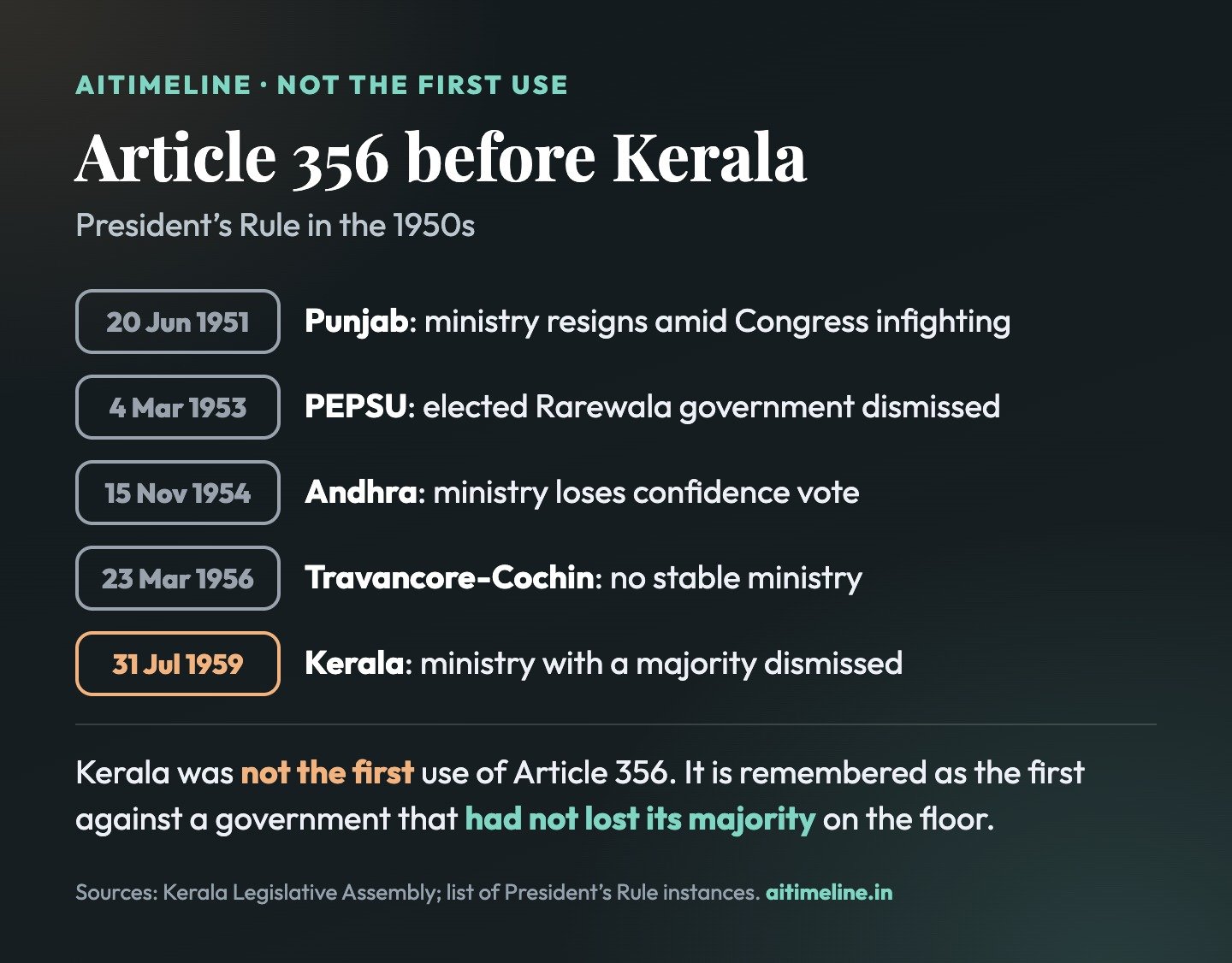
Kerala was not the first use of Article 356. President’s Rule had been imposed in Punjab in 1951 and in PEPSU in 1953, where an elected ministry was dismissed. What set Kerala apart is that the ministry still had its majority. The Education Bill was not simply “introduced” in 1957 and blocked: it was passed on 2 September 1957, sent to the Supreme Court, amended and given assent on 19 February 1959. The Supreme Court’s opinion on it is dated 22 May 1958, not 17 May as some summaries say. And the Congress won more votes than the CPI in 1957; the CPI won more seats.
💡 Short Answer
Kerala’s first elected government, a Communist Party of India ministry led by E.M.S. Namboodiripad, took office on 5 April 1957 and was dismissed on 31 July 1959 by a President’s Proclamation under Article 356. The trigger was the Vimochana Samaram, a 1959 agitation by the Congress, other opposition parties, the Catholic Church and the Nair Service Society against the government’s education and land reforms. The ministry had not lost a vote in the Assembly. President’s Rule ended on 22 February 1960, when Pattom A. Thanu Pillai took office.
EMS Government Dismissal: Key Questions
The Story in Ten Lines
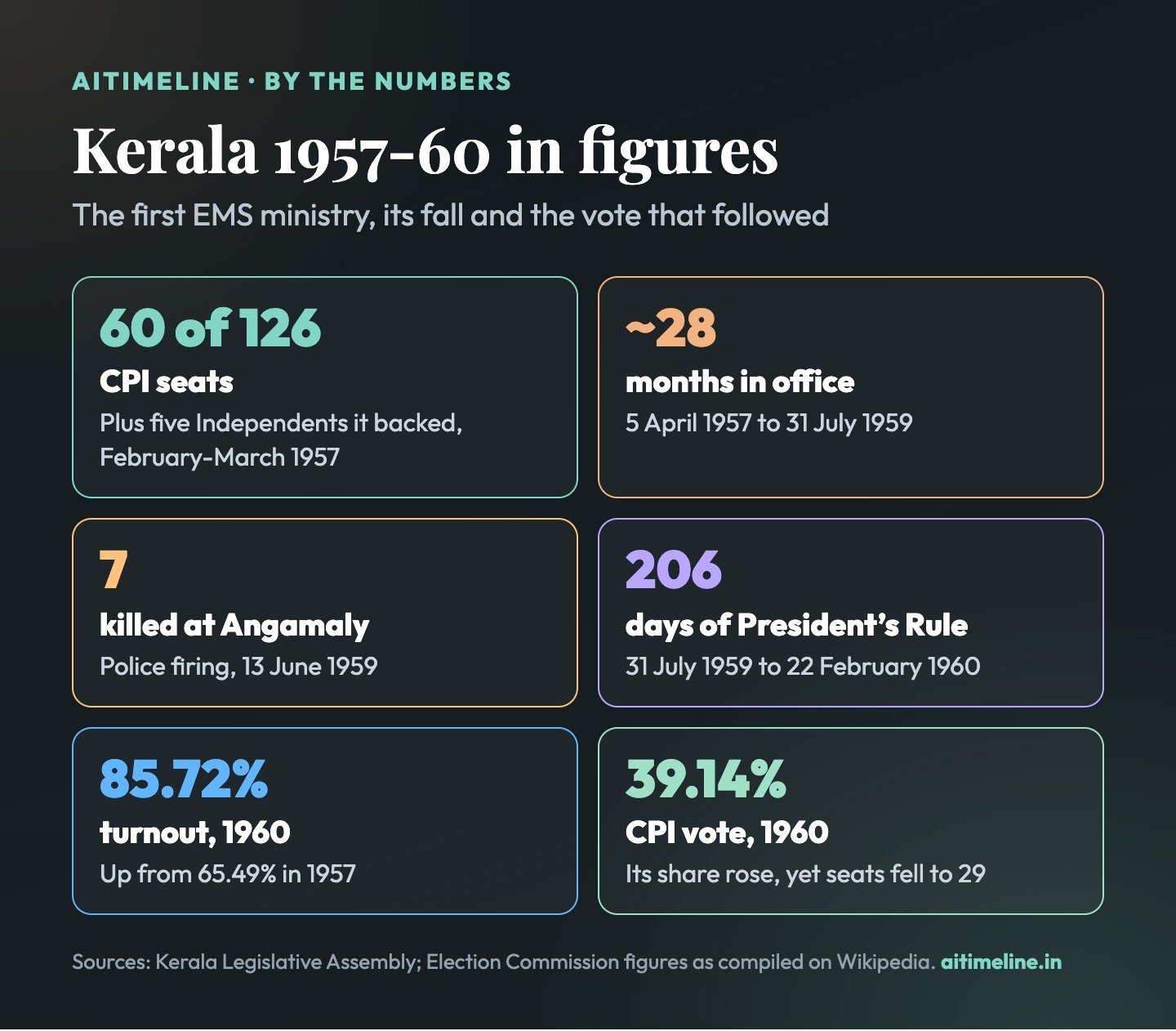
- The mandate: the CPI won 60 of 126 seats in 1957 and governed with five Independents.
- The first step: within days, an ordinance stayed the eviction of tenants.
- The schools: the Education Bill, passed on 2 September 1957, regulated aided schools and their teachers.
- The court: the Supreme Court’s 22 May 1958 opinion found some clauses offended minority rights; an amended Act got assent on 19 February 1959.
- The land: the Agrarian Relations Bill, introduced on 21 December 1957, was passed on 10 June 1959.
- The alliance: the Catholic Church and the Nair Service Society joined forces in late 1958.
- The turning point: police firing at Angamaly killed seven people on 13 June 1959.
- The dismissal: a Proclamation under Article 356 ended the ministry and dissolved the Assembly on 31 July 1959.
- The verdict: in February 1960 the CPI’s vote share rose to 39.14% but its seats fell to 29.
- The legacy: both reform laws outlived the ministry, and the use of Article 356 became a lasting federal controversy.
1957: A Mandate With a Thin Margin
How a five-month-old State elected a Communist ministry.
Kerala came into being on 1 November 1956, when the States Reorganisation Act joined most of Travancore-Cochin with the Malabar district of Madras State. It was born under President’s Rule, which had been imposed on Travancore-Cochin in March 1956 and continued until a new government took office.
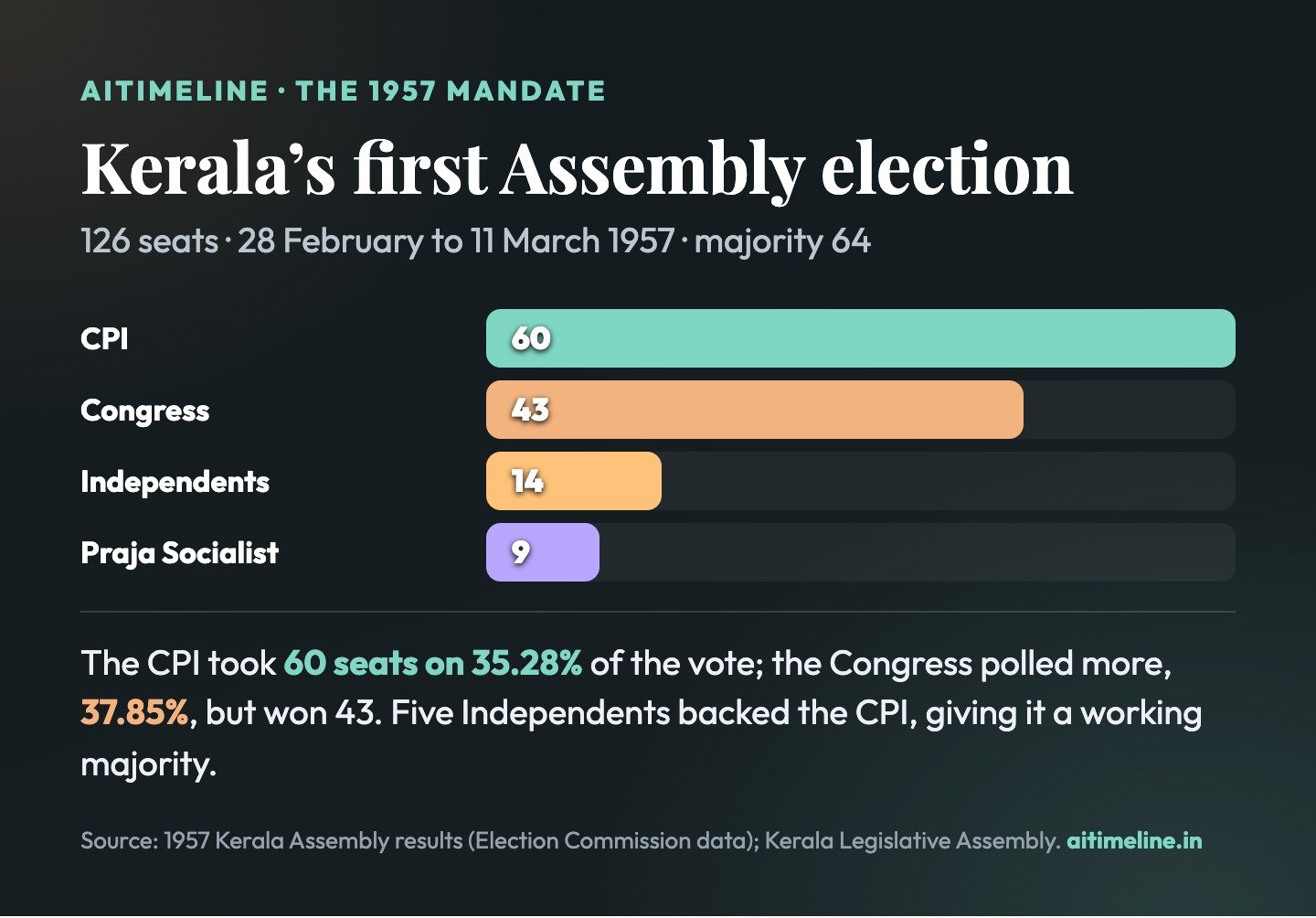
Polling for the first Assembly ran from 28 February to 11 March 1957. The CPI won 60 of the 126 elected seats. With five Independents it had backed, it could command a majority in a House of 127, including one nominated member. The Congress had in fact polled more votes, 37.85% against 35.28%, but the CPI’s vote was more efficiently spread. The newly merged Malabar region, where the CPI was strong, made a large difference.
On 5 April 1957, E.M.S. Namboodiripad took office with an 11-member ministry. The ministry’s programme reached quickly into the two areas that shaped the next two years: who controlled schools, and who controlled land.
Two Bills, Two Fronts
The education and land reforms moved on separate tracks.
| Issue | Government’s policy | Opponents’ concern | Main opponents |
|---|---|---|---|
| Education | Teacher qualifications, appointments from an approved list, salaries through the treasury, takeover powers | Management autonomy and the rights of minority institutions | Catholic Church, school managements |
| Land | Security of tenure, tenants’ right to buy land, a ceiling on holdings | Loss of landholdings and rent | Landholders, Nair Service Society |
| Political control | Carrying out the CPI’s election programme | A Communist party entrenching itself in power | Congress, PSP, Muslim League |
| Public order | Defended its handling of the police and administration | Alleged partisan policing and repression | The joint opposition front |
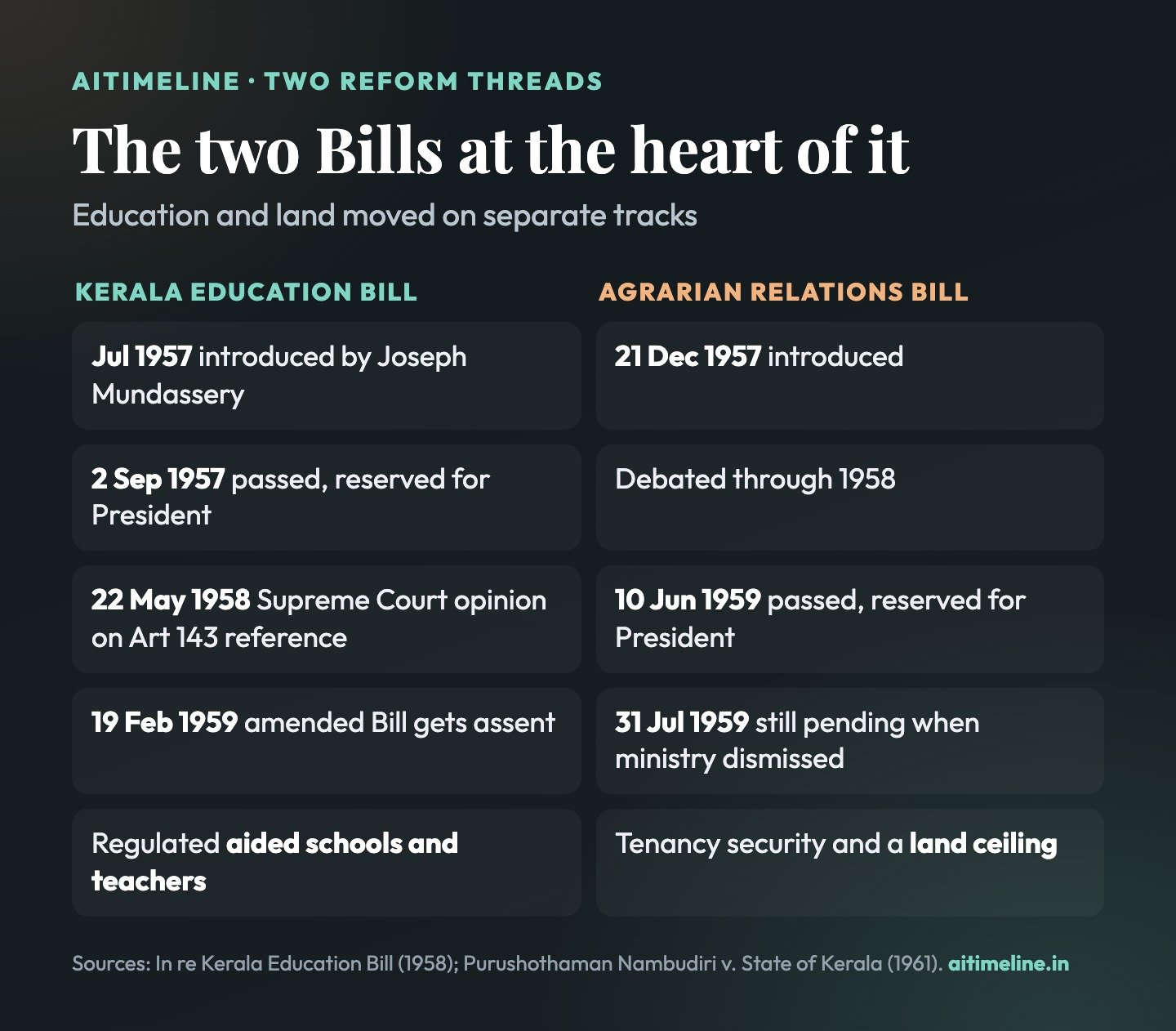
The Kerala Education Bill, introduced by Education Minister Joseph Mundassery, set out to regulate government-aided schools, many of them run by churches and community organisations. Teachers would be appointed from a government-approved list and paid directly from the treasury, managements would lose the power to dismiss them at will, and the State could take over schools that broke the rules. To teachers who had often been paid late, it was a protection. To the managements, led by the Catholic Church, it was an attack on their right to run their own institutions.
The Bill was passed on 2 September 1957 and reserved for the President, who referred it to the Supreme Court under Article 143. On 22 May 1958 the Court upheld most of it but found that some clauses would infringe the Article 30(1) rights of minority institutions. An amended Bill was passed and received assent on 19 February 1959.
The Agrarian Relations Bill was the second front. Introduced on 21 December 1957, it gave tenants security of tenure and the right to buy the land they tilled, and fixed a ceiling on how much land a family could hold. It drew opposition from landholders, including many members of the Nair community, and with it the Nair Service Society. The Assembly passed it on 10 June 1959, just as the agitation was beginning.
Neither Bill alone caused the dismissal. They were parallel grievances that brought very different groups into a common front whose only shared aim was to remove the ministry.
EMS Government Dismissal Timeline, 1956 to 1994
Newest first. Each entry is tagged by type.
S.R. Bommai puts limits on Article 356 Courts and laws
What happened: Thirty-five years after Kerala, a nine-judge bench of the Supreme Court held that a President’s Rule proclamation can be reviewed by the courts, that the floor of the House is the place to test a ministry’s majority, and that the Assembly should not be dissolved before Parliament approves the proclamation.
Why it matters here: Bommai did not reopen 1959. But the questions it answered are the ones critics had asked about Kerala: can the Centre remove a ministry that has not lost a vote in the House, and on what material?
The Supreme Court strikes down the Agrarian Relations Act for ryotwari lands Courts and laws
What happened: In Purushothaman Nambudiri, the Court held that a Bill awaiting the President’s assent does not lapse when the Assembly is dissolved, so the Act survived that challenge. But in Karimbil Kunhikoman, decided on the same day, it held that ryotwari lands in the areas that came to Kerala from Madras State were not ‘estates’ protected by Article 31A, and struck the whole Act down so far as it applied to those lands.
What followed: Kerala passed a fresh measure, the Kerala Land Reforms Act, in 1963. The land-reform thread that began with the EMS ministry’s 1957 Bill therefore ran for years after the ministry itself had gone.
The Agrarian Relations Bill finally becomes law Courts and laws
What happened: The President had returned the 1959 Bill on 27 July 1960 with suggested amendments. The new Assembly, elected in February 1960, passed the amended Bill on 15 October 1960, and it received the President’s assent on 21 January 1961.
Why it matters: The government that had been dismissed partly over its reform programme saw a version of its land Bill enacted by its successor. The dismissal did not decide the fate of the Bill.
The new government amends the Education Act Courts and laws
What happened: The Pattom Thanu Pillai government amended the Kerala Education Act, 1958. Accounts of the period say the changes restored much of the power of aided-school managements over appointing teachers.
Why it matters: The core of the Act, including salaries paid to teachers in aided schools through the State, remained. Many of its provisions are still part of how Kerala regulates aided schools.
President’s Rule ends; Pattom Thanu Pillai takes office State government
What happened: The President’s Rule that began on 31 July 1959 ended after 206 days. Pattom A. Thanu Pillai of the Praja Socialist Party became Chief Minister, with R. Sankar of the Congress as Deputy Chief Minister. The Second Assembly commenced the same day.
Why it matters: The Congress won more seats than the PSP but gave the chief ministership to its smaller partner, the shape of the alliance that had fought the Communists in the streets and at the polls.
Kerala votes again: fewer seats, more votes for the CPI Elections
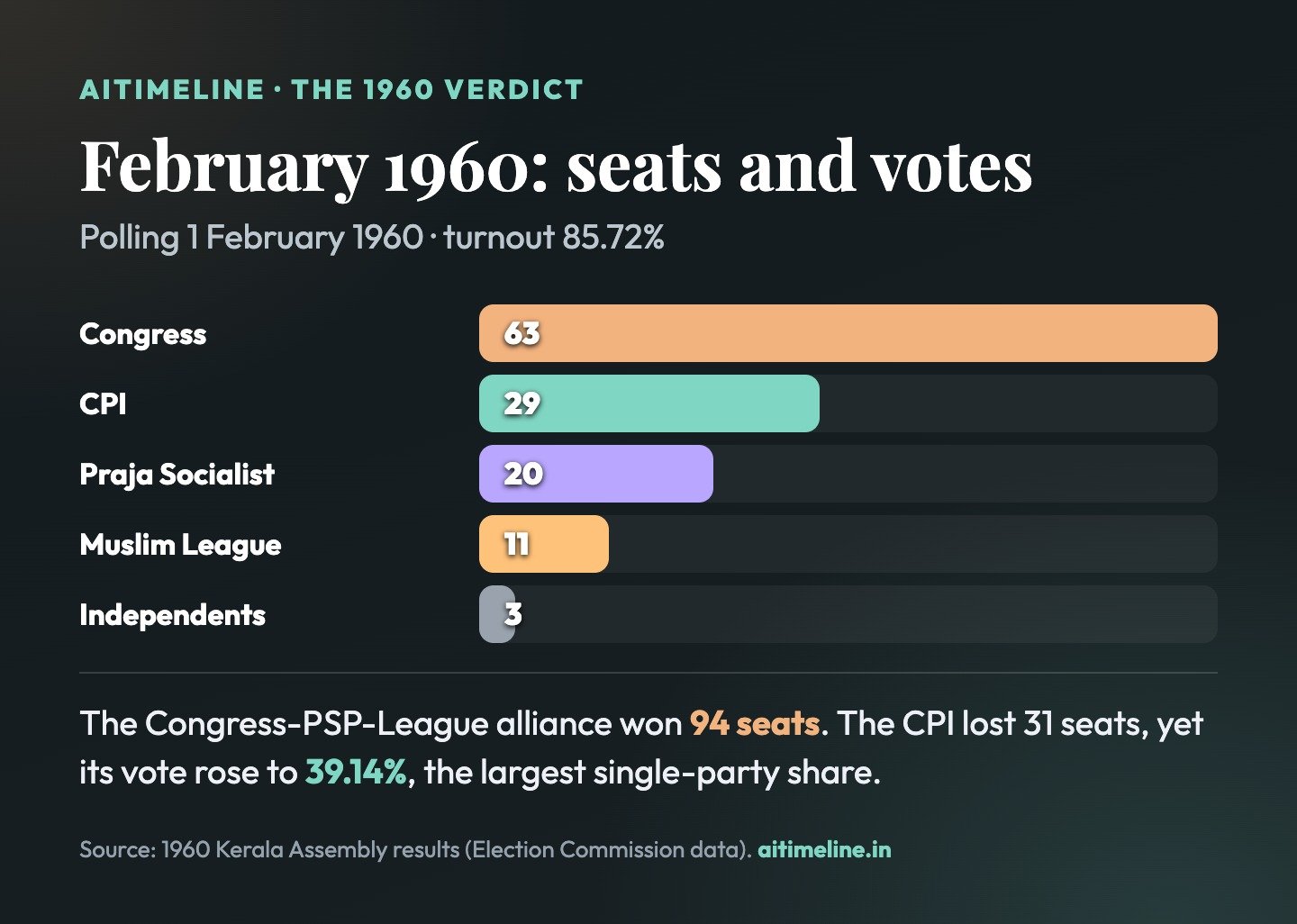
The result: The Congress won 63 seats, the Praja Socialist Party 20 and the Muslim League 11, giving the alliance 94 of 126. The CPI fell from 60 seats to 29.
The twist: The CPI’s share of the vote actually rose, from 35.28% in 1957 to 39.14%, the largest of any single party. A pre-poll alliance concentrated the anti-Communist vote seat by seat.
Turnout: Turnout jumped from 65.49% in 1957 to 85.72%, a sign of how far the crisis had polarised the State.
Parliament takes over law-making for Kerala Centre and Parliament
What happened: With the Assembly dissolved, Minister of State for Home Affairs B.N. Datar moved a Bill in the Lok Sabha on 27 November 1959 to let the President make laws for Kerala during President’s Rule. It became law in December 1959.
Why it matters: This was the standard device of the period: Parliament delegated the State’s legislative power to the President rather than legislate for Kerala itself, clause by clause.
Parliament debates and approves the Proclamation Centre and Parliament
What happened: Under Article 356(3), the Proclamation needed approval by both Houses. Home Ministry minister B.N. Datar moved the resolution, and Prime Minister Nehru spoke in the Rajya Sabha debate on 25 August 1959. Parliament approved the Proclamation in August.
Why it matters: The debates became the first big parliamentary argument over how Article 356 should be used, a debate that ran on for decades.
The EMS ministry is dismissed under Article 356 Centre and Parliament
What happened: The President issued a Proclamation under Article 356, dismissing the E.M.S. Namboodiripad ministry and dissolving the First Kerala Legislative Assembly on 31 July 1959. Kerala came under President’s Rule.
The key point: The ministry had not lost a confidence vote. It still had the support of the CPI’s 60 MLAs and the Independents who backed it. That is why the dismissal is still argued over.
Not the first use: Article 356 had been used before, in Punjab in 1951, PEPSU in 1953, Andhra in 1954 and Travancore-Cochin in 1956. Kerala is remembered as the first time it was used against a ministry that had not lost its majority.
The Centre’s decision reaches the Governor Centre and Parliament
What happened: The Union Cabinet accepted Governor B. Ramakrishna Rao’s recommendation for action under Article 356, and the decision was conveyed to the Governor on 30 July, a day before the Proclamation. Accounts of Nehru’s message describe the decision as taken reluctantly, to prevent further conflict.
Why it matters: The Governor’s report was the formal basis for the Centre’s action. Whether the situation it described justified removing an elected ministry is the core of the historical debate.
The agitation peaks Agitation
What happened: Through July, picketing, school closures, demonstrations and mass arrests spread across the State. Police firings during the agitation killed at least 15 people in all, by most accounts, including Flory, a pregnant fisherwoman whose death became a rallying point.
Two readings: The government and its supporters called the movement an attempt by entrenched interests to bring down an elected ministry. Its opponents said the government had lost control of law and order and was using the police against its critics.
The march: Mannath Padmanabhan led a jatha, a protest march, that began from the Angamaly church where the firing victims were buried.
Nehru comes to Kerala Centre and Parliament
What happened: Prime Minister Nehru visited Kerala and met E.M.S. Namboodiripad and other leaders, to see the situation for himself after weeks of unrest.
Why it matters: The visit signalled that the Centre was weighing intervention. It ended without an agreement between the government and the agitators.
Seven killed in the Angamaly firing Agitation
What happened: Police opened fire on protesters at Angamaly and seven people were killed. The government said police fired on a mob trying to attack a police station; protesters disputed that account.
Why it matters: The deaths turned a dispute over school laws into a mass movement. The victims were buried together at the St. George church in Angamaly the next day, and the church cemetery became a focal point of the agitation.
The opposition’s agitation opens Agitation
What happened: The organised campaign to remove the ministry began in mid-June with a statewide hartal called by the opposition. The Congress, the Praja Socialist Party and the Muslim League joined forces, with the Catholic Church and the Nair Service Society mobilising their members.
Who led it: A joint steering committee was headed by R. Sankar, then president of the Kerala Pradesh Congress Committee.
The Agrarian Relations Bill is passed State government
What happened: The Assembly passed the Kerala Agrarian Relations Bill. The Governor reserved it for the President’s consideration, where it was still pending when the ministry was dismissed seven weeks later.
What it did: The Bill gave cultivating tenants security of tenure and the right to buy the land they tilled, and fixed a ceiling on landholding, with surplus land to be taken over and redistributed.
Who opposed it: Landholders, including many in the Nair community, saw the ceiling and tenancy rules as a threat, which drew the Nair Service Society into the opposition.
The Congress high command backs a ‘charge-sheet’ campaign Agitation
What happened: According to a US Embassy telegram to Washington dated 28 May 1959, the Kerala Pradesh Congress Committee obtained a ‘green light’ from the All India Congress Committee at a meeting in Delhi from 10 to 13 May to go ahead with a ‘charge-sheet’ agitation against the ministry.
What it shows: The telegram describes an agitation over schools expected from 1 June, to be joined by an opposition campaign in the second week of June. It is a contemporary outside view, not a Congress record.
The Kerala Education Act gets assent Courts and laws
What happened: After the Supreme Court’s opinion, the Bill was reconsidered and passed again in amended form by the Assembly in late 1958. It received the President’s assent on 19 February 1959 and was published as Act 6 of 1959.
Why it mattered: The law was now on the books. The new school year in June 1959 became the trigger for an agitation over schools that grew into the wider campaign against the ministry.
The Church and the NSS join hands Agitation
What happened: The Nair Service Society, led by Mannath Padmanabhan, allied with the Catholic Church against the government. The two had been on opposite sides of Kerala politics before.
Why it matters: Padmanabhan said the aim was no longer to win concessions on particular laws but to remove the Communist government. That shift turned opposition to specific Bills into a campaign to unseat the ministry.
The Supreme Court gives its opinion on the Education Bill Courts and laws
What happened: President Rajendra Prasad referred the Bill to the Supreme Court for its opinion. A bench led by Chief Justice S.R. Das upheld most of it but said that some clauses, as applied to schools run by minorities, would offend their right under Article 30(1) to administer their own institutions.
A partial dissent: Justice Venkatarama Aiyar agreed on the other questions but disagreed that the free-education clause (clause 20) offended Article 30(1).
Why it matters: The opinion is still cited in cases on minority educational institutions. It sent the Bill back for changes rather than killing it.
The Agrarian Relations Bill is introduced State government
What happened: The Kerala Agrarian Relations Bill was introduced in the Assembly. It took 18 months to pass.
Why it matters: With the Education Bill, it became one of the two reform measures around which opposition to the ministry gathered.
The Kerala Education Bill is passed State government
What happened: The Assembly passed the Kerala Education Bill, introduced in July by Education Minister Joseph Mundassery. The Governor reserved it for the President under Article 200.
What it did: It regulated government-aided schools: minimum qualifications for teachers, appointments from a government-approved list, salaries paid through the treasury, limits on managements’ power to dismiss teachers, and power for the State to take over schools that did not comply.
Who opposed it: Many aided schools were run by churches and community bodies. Managements, led by the Catholic Church, saw the Bill as an attack on their right to run their own institutions.
A stay on evictions State government
What happened: Within days of taking office, the government issued an ordinance staying the eviction of tenants. It was the first step in its land-reform programme.
Why it matters: The ordinance protected tenants while the government drafted the fuller Agrarian Relations Bill.
E.M.S. Namboodiripad sworn in as Chief Minister State government
What happened: E.M.S. Namboodiripad of the CPI took office as Kerala’s first Chief Minister, heading an 11-member ministry. It was the first government in India led by a Communist party.
Why it mattered: A Communist party had come to power through an election, not a revolution. That drew attention from Delhi, Washington and Moscow alike.
Kerala’s first Assembly election Elections
The result: The CPI won 60 of 126 seats. The Congress won 43, the Praja Socialist Party 9 and Independents 14. Five Independents backed by the CPI gave it a working majority in a House of 127, including one nominated member.
The detail: The Congress actually won more votes, 37.85% against the CPI’s 35.28%. The CPI’s votes were more efficiently spread across seats.
Turnout: Turnout was 65.49%.
Kerala is formed State government
What happened: Kerala was created by joining most of Travancore-Cochin with the Malabar district of Madras State and the Kasaragod taluk. The new State was already under President’s Rule, which had been imposed in Travancore-Cochin on 23 March 1956.
Why it matters: Bringing Malabar into the State strengthened the CPI, whose base there was strong, and set up the 1957 result.
How the Liberation Struggle Built Up
From an agitation over schools to a demand to remove the ministry.
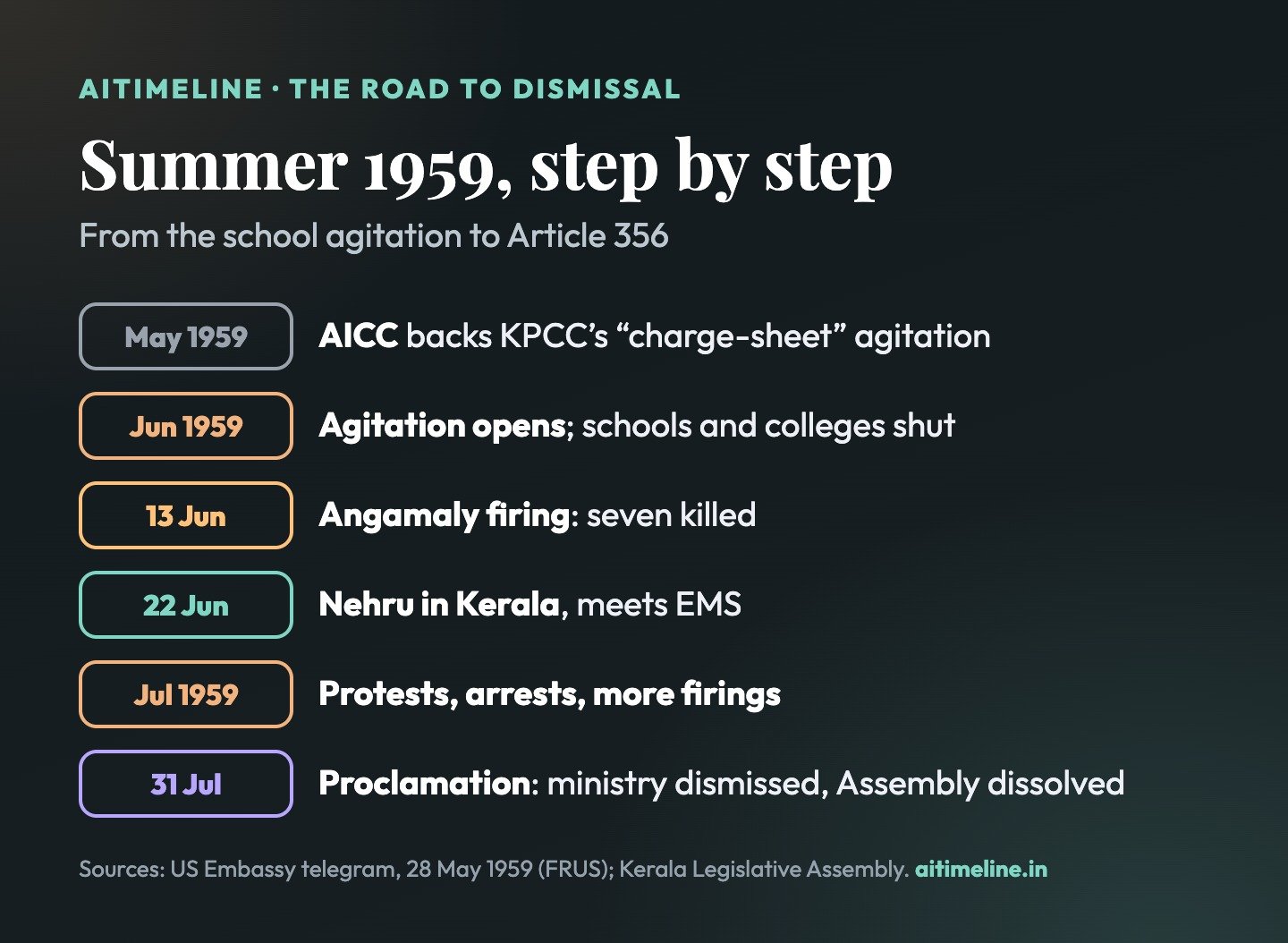
Opposition hardened through 1958. In December the Nair Service Society, led by Mannath Padmanabhan, allied with the Catholic Church. Padmanabhan made clear the goal was no longer a change in particular laws but the removal of the government.
In Delhi, the Congress leadership moved too. A US Embassy telegram of 28 May 1959 reported that the Kerala Pradesh Congress Committee had obtained a “green light” at an All India Congress Committee meeting from 10 to 13 May to launch a “charge-sheet” agitation, and that the Congress president, Indira Gandhi, had been openly critical of the Communist government.
The agitation opened in mid-June 1959. The Congress, the Praja Socialist Party and the Muslim League formed a joint steering committee under R. Sankar, the Kerala Congress president. On 13 June, police fired on protesters at Angamaly and killed seven people. The deaths transformed the movement. By most accounts at least 15 people were killed in police firings during the agitation, among them a pregnant fisherwoman, Flory.
Nehru visited Kerala on 22 June and met EMS. No settlement followed. Through July, picketing, school closures and mass arrests spread, and the government faced growing pressure from the Centre to restore order. The Communist Party alleged that the United States had helped fund the agitation; Daniel Patrick Moynihan, later US ambassador, wrote in 1978 that the US had given money to the Congress in Kerala. How much that mattered is still argued.
Why the Dismissal Is Still Argued Over
A constitutional power used against a ministry with a majority.
Article 356 lets the President take over a State’s administration if satisfied, on the Governor’s report or otherwise, that its government cannot be carried on in accordance with the Constitution. In July 1959 Governor B. Ramakrishna Rao reported on the situation, the Union Cabinet accepted his recommendation, and the decision reached the Governor on 30 July. The Proclamation followed on 31 July.
The case for the action, made by the Centre and the opposition, was that law and order had broken down, that the police were being used against opponents, and that only fresh elections could end the conflict. The case against it, made by the CPI and many constitutional critics since, was that the ministry had a majority and had never lost a vote, and that the agitation had been organised precisely to create the breakdown that was then cited to remove it.
The distinction matters. The ministry was dismissed through a constitutional Proclamation, not defeated by a no-confidence motion. Parliament approved the Proclamation in August 1959, with Nehru defending it in the Rajya Sabha on 25 August.
Thirty-five years later, in S.R. Bommai v. Union of India (1994), the Supreme Court held that Article 356 proclamations can be reviewed by the courts and that a ministry’s majority belongs on the floor of the House. Bommai did not revisit 1959, but it gave legal shape to the objections first raised over Kerala.
1960: The Vote That Followed
The CPI lost seats while gaining votes.
| Party | Seats 1957 | Seats 1960 | Vote % 1957 | Vote % 1960 |
|---|---|---|---|---|
| CPI | 60 | 29 | 35.28 | 39.14 |
| Congress | 43 | 63 | 37.85 | 34.42 |
| Praja Socialist Party | 9 | 20 | 10.76 | 14.14 |
| Muslim League | – | 11 | – | 4.96 |
| Independents | 14 | 3 | 12.88 | 5.93 |
| Turnout | – | 65.49 | 85.72 | |
Kerala voted again on 1 February 1960, with turnout leaping to 85.72%. The Congress, the PSP and the Muslim League fought as a pre-poll alliance and won 94 seats. The CPI fell from 60 seats to 29, yet its share of the vote rose to 39.14%, more than any other single party. The Muslim League does not appear as a separate party in the 1957 figures.
The alliance gave the chief ministership to the PSP’s Pattom A. Thanu Pillai, who took office on 22 February 1960, ending 206 days of President’s Rule. E.M.S. Namboodiripad returned as Chief Minister seven years later, on 6 March 1967.
What Happened to the Reforms
The dismissal did not settle either Bill.
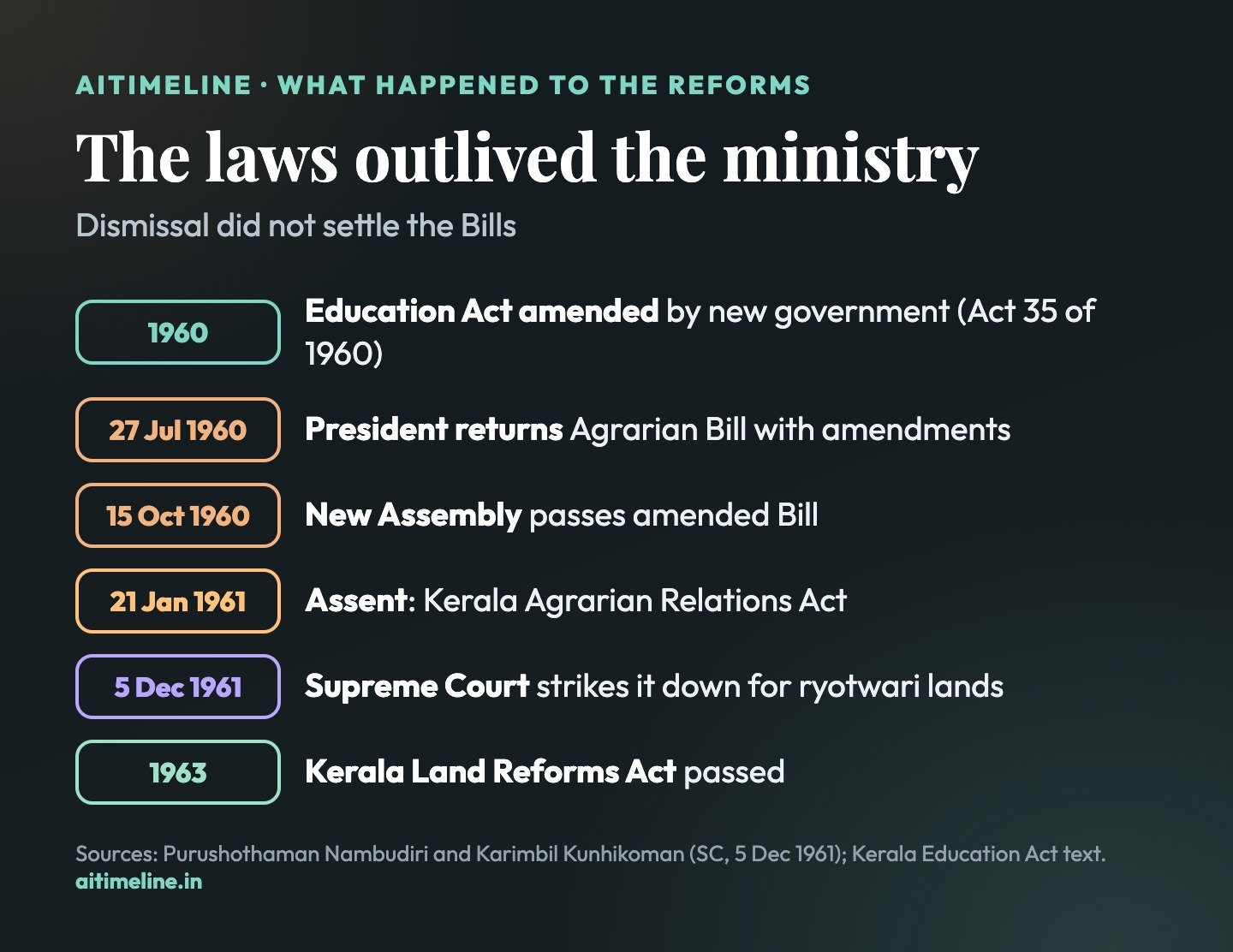
The Education Act was already law when the ministry fell. The new government amended it in 1960, and accounts of the period say the changes gave aided-school managements back much of their say over appointing teachers. The Act itself, including State payment of teachers’ salaries, stayed in force and remains the basic law for aided schools in Kerala.
The Agrarian Relations Bill was still waiting for the President when the Assembly was dissolved. On 27 July 1960 he returned it with suggested amendments; the new Assembly passed the amended Bill on 15 October 1960; it received assent on 21 January 1961. Challenged in the Supreme Court, it survived the argument that it had lapsed with the old Assembly, in Purushothaman Nambudiri. But in Karimbil Kunhikoman, decided the same day, 5 December 1961, the Court struck it down as applied to ryotwari lands in the former Madras areas. Kerala passed the Kerala Land Reforms Act in 1963.
The two measures had separate legal histories, and neither was finally decided by the dismissal. The politics that removed the ministry did not remove its reform agenda.
Who Was Who
E.M.S. Namboodiripad
CPI leader and Kerala’s first Chief Minister, 5 April 1957 to 31 July 1959; again from 6 March 1967 to 1 November 1969.
Jawaharlal Nehru
Visited Kerala on 22 June 1959; his Cabinet accepted the Governor’s recommendation; defended the action in Parliament.
B. Ramakrishna Rao
Governor of Kerala from 1956 to 1960, whose report was the formal basis for the Proclamation.
Joseph Mundassery
Introduced the Kerala Education Bill in 1957, the measure that first mobilised the school managements.
K.R. Gouri
Piloted the Agrarian Relations Bill, introduced on 21 December 1957 and passed on 10 June 1959.
Mannath Padmanabhan
Led the Nair Service Society into an alliance with the Church and called for the ministry’s removal.
R. Sankar
KPCC president who headed the joint steering committee; Deputy Chief Minister from 1960 and Chief Minister from 1962.
Pattom A. Thanu Pillai
PSP leader who became Chief Minister on 22 February 1960, ending President’s Rule.
Did You Know?
- Born under President’s Rule: Kerala was formed in November 1956 while Travancore-Cochin was already under it, and it ended on 5 April 1957, the day EMS took office.
- Fewer votes, more seats: the CPI won 60 seats in 1957 with a lower vote share than the Congress.
- More votes, fewer seats: in 1960 the CPI’s vote rose to 39.14% while its seats halved.
- 88 Bills: the First Assembly passed 88 Bills in 175 sittings before it was dissolved.
- An Act with two years: the Kerala Education Act is dated 1958 but is Act 6 of 1959.
- A Bill that did not lapse: the Supreme Court held in 1961 that a Bill pending assent survives the dissolution of the Assembly.
Explore More Timelines
People Also Ask
Frequently Asked Questions
Based on the Supreme Court record, the Kerala Assembly’s history and contemporary documents.
⚠️ Editorial Note: What We Checked
We checked the brief we started from against the Supreme Court’s 1958 opinion on the Kerala Education Bill, its 1961 judgments in Purushothaman Nambudiri and Karimbil Kunhikoman, the Kerala Legislative Assembly’s history pages and a 1959 US Embassy telegram. Kerala was not the first use of Article 356: Punjab (1951) and PEPSU (1953) came earlier, and PEPSU’s ministry was elected; Kerala is distinctive because the ministry still had its majority. The Education Bill was passed on 2 September 1957 and given assent in amended form on 19 February 1959. The Assembly’s history gives 1 March 1957 as the start of the First Assembly, a date before polling ended, so we have not used it. We could not open the Nehru Archive copy of the 30 July 1959 message or the Lok Sabha record of its vote, so we describe the message only in general terms and give the month of Parliament’s approval rather than a day. Allegations of foreign funding are presented as allegations. This article is a historical account and not legal advice.
Related Reading on AiTimeline
Sources & further reading
Every dated entry above was checked against these references. Last reviewed 20 November 2026.
- Supreme Court of India: In re The Kerala Education Bill, 1957, opinion of 22 May 1958 (Indian Kanoon)
- Supreme Court of India: Purushothaman Nambudiri v. State of Kerala, 5 December 1961 (Indian Kanoon)
- Supreme Court of India: Karimbil Kunhikoman v. State of Kerala, 5 December 1961 (Indian Kanoon)
- Kerala Legislative Assembly: Kerala Legislature, A Sketch of Evolution (the State Legislature since 1956)
- Kerala Legislative Assembly: President's Rule in Kerala at a Glance
- The Kerala Education Act, 1958 (Act 6 of 1959), text via PRS Legislative Research (PDF)
- US Department of State, FRUS 1958-60 vol. XV, doc. 231: Embassy in India telegram on Kerala, 28 May 1959