Wright Brothers First Flight: Timeline of Aviation History
Wright brothers first flight on 17 December 1903: the 12-second, 120-foot hop at Kitty Hawk, the experiments before it and the milestones after.
Latest Story
The Wright brothers first flight took place on 17 December 1903 at Kitty Hawk, North Carolina, when Orville Wright flew a wooden, fabric-covered biplane for about 12 seconds and 120 feet. It followed four years of research by two Dayton bicycle makers, and this timeline runs newest first so you can see the experiments, the failures and the later demonstrations that turned a short hop into a practical airplane.
💡 Short Answer
On 17 December 1903 at Kitty Hawk, Orville Wright made the first successful flight of a powered heavier-than-air machine with a pilot aboard, about 12 seconds and 120 feet. Wilbur flew the fourth and longest that day, 852 feet in 59 seconds. The brothers had spent four years on kites, gliders, a wind tunnel, an engine and propellers. They improved the design in 1904 and 1905, flew publicly in 1908, and sold an airplane to the US Army in 1909.
Wright Brothers First Flight: Key Questions
The First Flight in Ten Points
- Four flights: 12 s/120 ft first, 59 s/852 ft last, on 17 December 1903.
- Orville first: Wilbur had tried and failed on 14 December, not 17 December.
- Control first: wing warping and the 1902 glider solved control before an engine was added.
- Wind tunnel: built in fall 1901 after published data proved unreliable.
- Engine: 12 horsepower, built with mechanic Charles Taylor.
- Rival: Langley’s Aerodrome failed on 8 December 1903.
- 1905: Flyer III flew 39 minutes and 24.5 miles, the first practical airplane.
- 1908: a propeller failure at Fort Myer killed Lt. Selfridge, the first powered-airplane fatality.
- 1909: the US Army accepted the Wright Military Flyer on 2 August.
- Legacy: Flyer fabric has since flown to the Moon, on Mars and around the Moon again.
Wright Brothers First Flight Timeline, Latest First
Each entry is tagged by theme and ends with why it matters. Use the filter to isolate a theme.
Flights, experiments or legacy? Filter the Wright brothers timeline by theme.
–
A square of Flyer fabric flies around the Moon on Artemis II People & legacy
NASA said its Artemis II crew would carry a one-inch square of muslin from the original 1903 Wright Flyer, lent by the Smithsonian’s National Air and Space Museum. NASA’s announcement says a smaller piece of the same swatch flew on space shuttle Discovery on STS-51D in 1985, and that the fabric would be reunited with two other Flyer swatches at the museum afterwards. The museum has since published a video titled “A Piece of Aviation History (and the Museum) Flew Around the Moon on Artemis II”. This page did not locate a mission-date source, so none is given.
2021
Ingenuity carries Flyer muslin on the first powered flight on another planet People & legacy
NASA’s Ingenuity helicopter made the first powered, controlled flight on another planet on 19 April 2021, a hop of roughly 40 seconds to about 3 metres. Reports say a postage-stamp-sized piece of 1903 Flyer muslin, supplied by Carillon Historical Park in Dayton, was taped under its solar panel, and the take-off area was named Wright Brothers Field. Reports differ slightly on which wing the fabric came from, so this page does not name one.
A piece of the Flyer’s wood and fabric goes to the Moon on Apollo 11 People & legacy
The Smithsonian’s collection records note that Apollo 11 carried a piece of wood and fabric from the 1903 Flyer to the lunar surface to link the first airplane flight symbolically with the first human exploration of another world. The museum record does not give a day-by-day account of the item, so this page does not either.
1948
The Flyer is donated to the Smithsonian on the 45th anniversary of its flights People & legacy
After the 1903 Flyer’s damaging tumble it was crated, shipped to Dayton and stored in a shed behind the brothers’ bicycle shop. Dayton’s March 1913 flood left the crates under water and mud for eleven days. Orville reassembled it in 1916 for brief exhibitions, and in 1928 he lent it to the Science Museum in London, where it spent the Second World War in underground storage at Corsham, not in the London Underground as often claimed. The airplane returned to the United States in 1948 and was formally donated to the Smithsonian at a ceremony on 17 December, the 45th anniversary of the flights. Orville had died on 30 January 1948, so he did not see the ceremony. It has been on public display since.
1912
Wilbur Wright dies of typhoid fever at 45 People & legacy
Wilbur died on 30 May 1912, aged 45. By then the brothers had spent most of a decade giving demonstrations in the United States and abroad, securing patents and manufacturing contracts, while constantly trying to improve their airplanes. Orville lived until 1948.
Wilbur flies around the Statue of Liberty at the Hudson-Fulton Celebration Flights & demonstrations
Following his European tour, Wilbur was invited to fly at New York’s Hudson-Fulton Celebration, marking the centennial of Robert Fulton’s steamboat and the 300th anniversary of Henry Hudson’s entry into the harbour. In the Wrights’ first flight over American waters, he took off from Governor’s Island with a canoe strapped under the machine and flew around the Statue of Liberty while ships sounded their horns.
1909
US Army accepts the Wright Military Flyer Flights & demonstrations
After the 1908 crash the War Department postponed the trials for a year. In 1909 the brothers returned with a new machine and completed the demonstration; the Army Aviation Museum says Orville and Lt. Foulois flew the 10-mile test on 30 July at an average of about 42.6 mph. The Signal Corps had agreed to buy the airplane for $25,000 if it met set terms (two people, one hour aloft, 40 mph), and on 2 August 1909 it officially accepted it. The Smithsonian gives a total price of about $30,000, which sources explain as a speed bonus on top of the base price. The machine was used to train Army pilots.
1908
Fort Myer crash kills Lt. Thomas Selfridge, the first person to die in a powered airplane Flights & demonstrations
During the Army trials a propeller failure caused the Flyer to crash, severely injuring Orville and killing his passenger, Lt. Thomas Selfridge. Wilbur, who was in France, cancelled his flights for a week until he knew Orville was out of danger, the Library of Congress records. Orville recovered and completed the requirements in 1909.
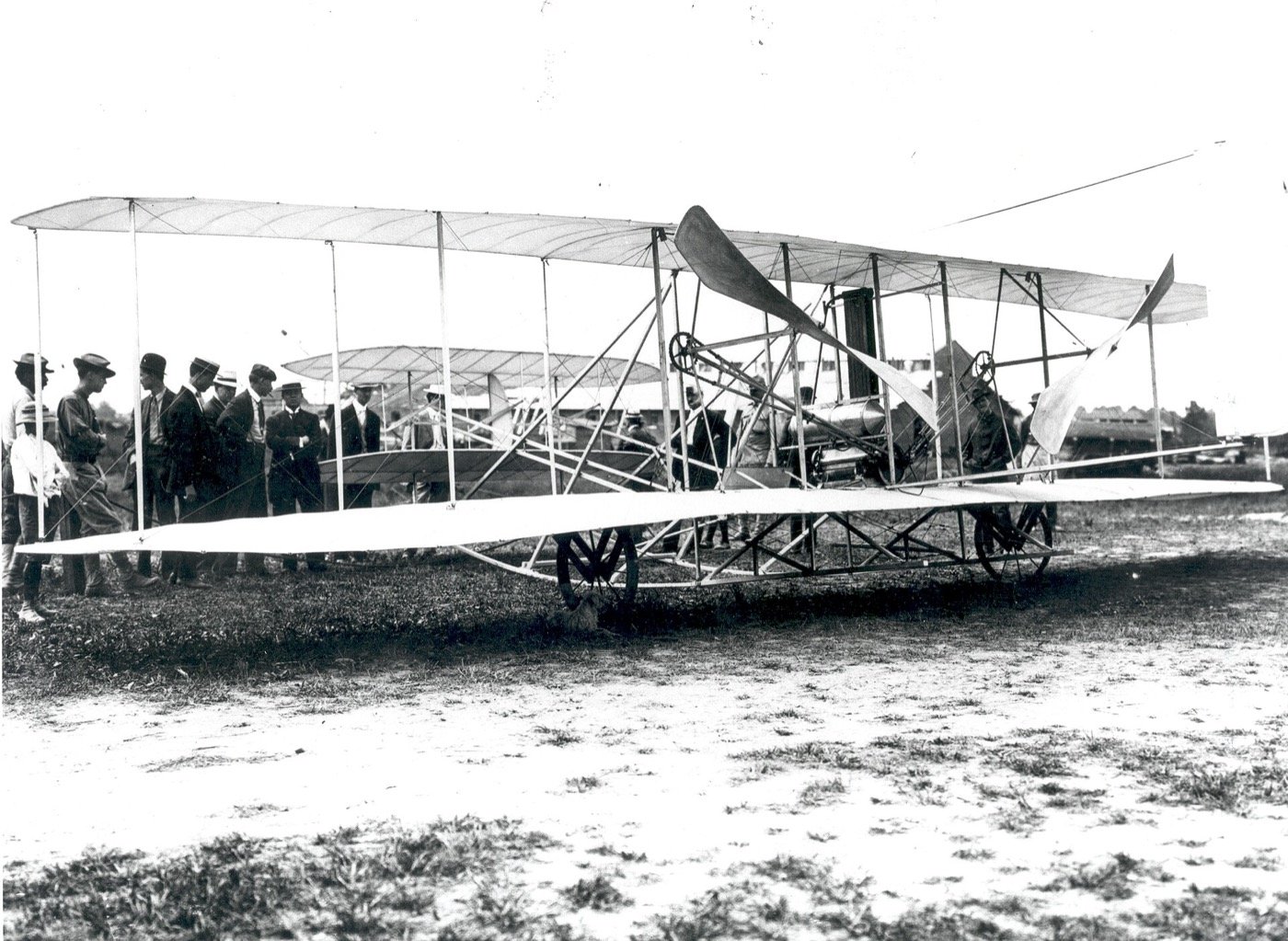
Wilbur’s flights in France make the Wrights international celebrities Flights & demonstrations
The Library of Congress says that when Wilbur arrived in France at the end of May 1908, he and Orville were considered simply talented acrobats because few had seen them fly. Wilbur completed some sixty-four flights in France, often with a passenger, and astounded those who watched. Admission tickets to see him fly at Le Mans were issued to control the crowds, and postcards increased his celebrity.
1906
The Wrights are granted a patent for their flying machine People & legacy
On the advice of attorney Henry Toulmin the brothers patented not the mechanisms of control but the idea of warping a wing itself, hoping a broad patent would defeat every challenge. The grant came on 22 May 1906, on an application filed before the first flight. The patent later became the centre of long legal disputes.
1905
Wilbur flies 39 minutes and 24.5 miles in the Flyer III Flights & demonstrations
With the brothers’ third powered airplane, Wilbur made a 39-minute flight covering 39.2 km (24.5 miles) over a closed course at Huffman Prairie. The Library of Congress says the 1905 machine had separate pitch, roll and yaw controls, which made it the first fully controllable aircraft, and that it could bank, turn and make figure eights. It could be called the world’s first practical airplane.
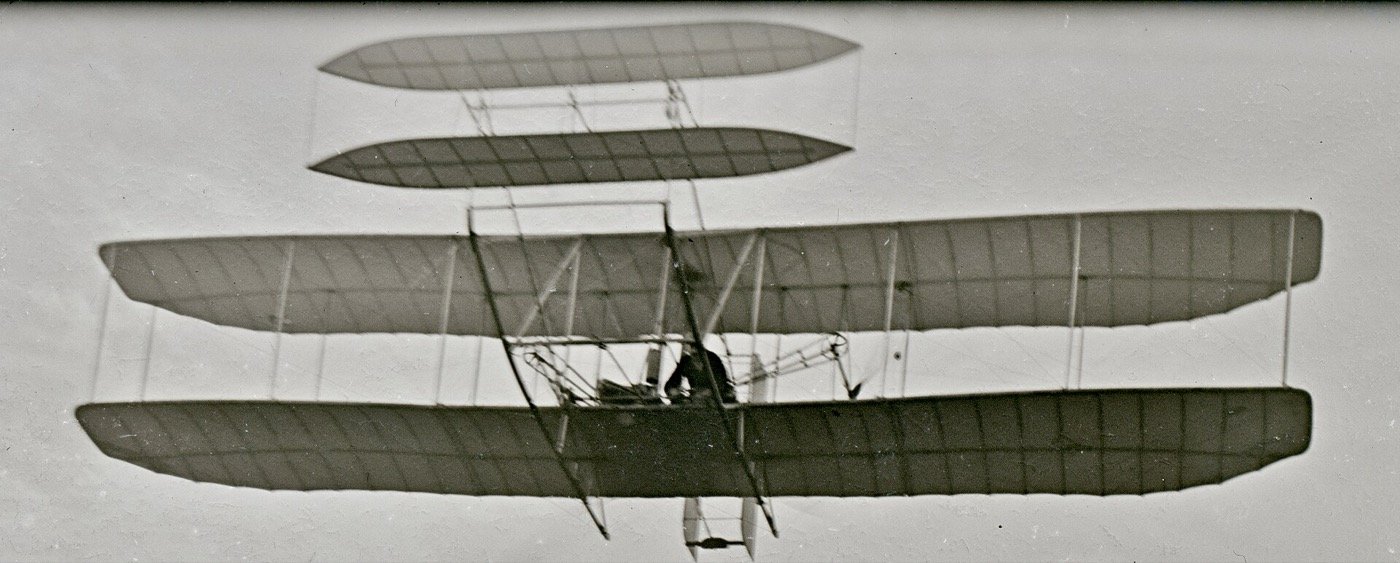
The Flyer II refines flying skills at Huffman Prairie Research & design
The Wrights spent 1904 and 1905 flying and experimenting at Huffman Prairie near Dayton, a field they could reach from the bicycle shop. The Smithsonian says they built refined versions of the Flyer in 1904 and 1905 to bring the design to practicality. Orville’s diary went up with him on each of the Huffman Prairie flights noted in it, the Library of Congress says.
1903
Four flights at Kitty Hawk: 12 seconds and 120 feet, then 59 seconds and 852 feet Flights & demonstrations
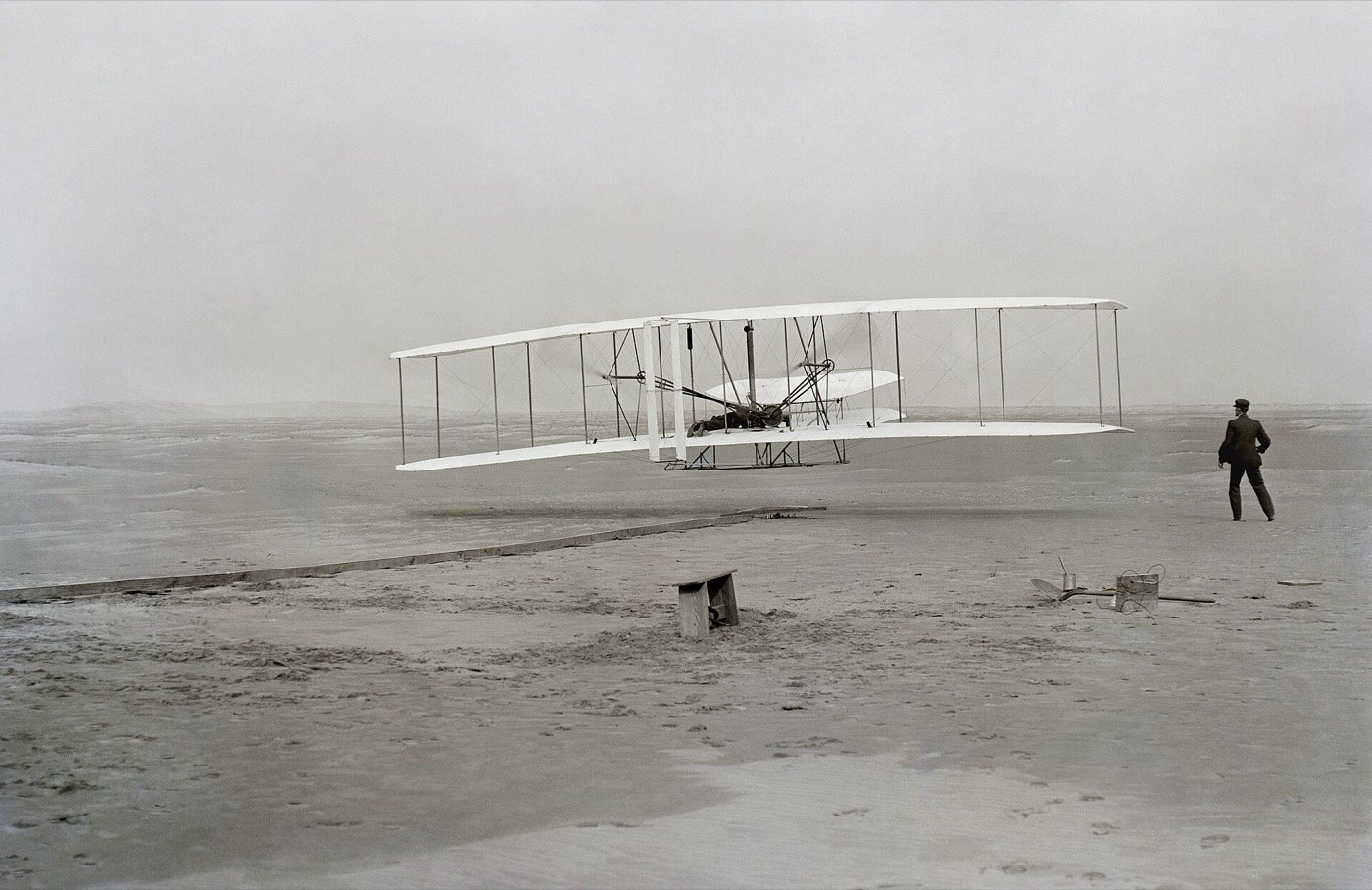
Orville released the restraining wire at 10:35 a.m. into a 27 mph headwind, and the Flyer flew about 120 feet in 12 seconds, a ground speed of 6.8 mph, according to the National Park Service. John Daniels of the nearby lifesaving station snapped a preset camera as the machine left the rail. The brothers alternated three more flights; the second and third were around 200 feet. Wilbur’s fourth and last flight covered 852 feet in 59 seconds. After it a gust overturned the Flyer and damaged it so badly that it never flew again. Their telegram to their father, as widely reproduced, gave the longest flight as 57 seconds, a figure later records correct to 59.
1903
Wilbur’s first attempt stalls and the Flyer is damaged Flights & demonstrations
The brothers tossed a coin to decide who would try first and Wilbur won. After leaving the launching rail he oversteered with the elevator; the Flyer climbed too steeply, stalled and dived into the sand, damaging it slightly, the Smithsonian says. Repairs took three days.
1903
Langley’s Aerodrome fails again nine days before Kitty Hawk Research & design
Samuel Langley, whose experiments for the Smithsonian were followed in the press and funded by the War Department, saw his piloted Aerodrome fail twice, on 7 October and 8 December 1903; it fell into the Potomac both times and the pilot, Charles Manly, was pulled out unhurt. The National Park Service notes Langley had relied on power to keep a stable machine aloft, whereas the Wrights believed a human must fly the machine.
summer 1903
The brothers build their own engine and propellers Research & design
The Flyer was essentially a larger, sturdier version of the 1902 glider; the only fundamentally new part was propulsion. With the help of shop mechanic Charles Taylor the Wrights built a small twelve-horsepower gasoline engine, and designed propellers as rotary wings, an idea the Smithsonian calls one of the most original aspects of their work. Two propellers were driven by a chain and sprocket transmission, one crossed so they turned in opposite directions.
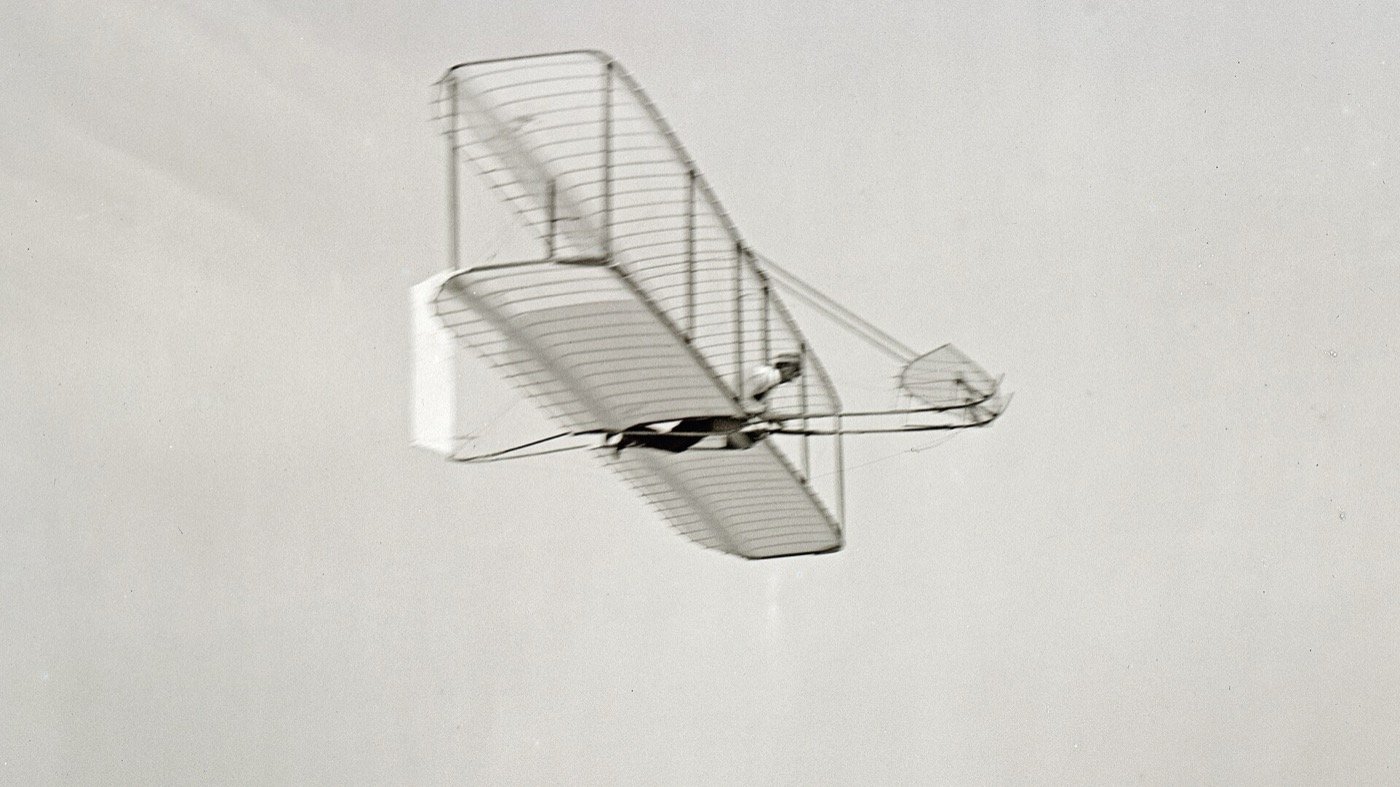
The third glider makes 700 to 1,000 controlled glides Research & design
Built from the wind-tunnel data, the 1902 glider solved the lift problem, and a movable vertical tail linked to the wing-warping system, controlled by a hip cradle, solved control. The Smithsonian says the brothers made between seven hundred and one thousand flights that year, the best being 622.5 feet in twenty-six seconds. The Library of Congress says they ended the year knowing the problem of control had been solved.
1901
A home-built wind tunnel shows the published aerodynamic data were wrong Research & design
The 1900 and 1901 gliders produced far less lift than the brothers’ calculations predicted, so they questioned the aerodynamic data they had used. They built a small wind tunnel in the fall of 1901 and tested model wing shapes with instruments of their own design that measured lift and drag. The Smithsonian says the use of a wind tunnel and flight testing as design tools was among their pioneering contributions.
First trip to Kitty Hawk with a full-size glider Research & design
Dayton did not offer suitable conditions, so the brothers asked the US Weather Bureau, which pointed to Kitty Hawk’s sandy, open spaces and strong, steady winds. They made their first trip in September 1900 and built two piloted gliders in 1900 and 1901. The control system worked and the structure was sound, but the lift was well below predictions.
1899
Wilbur writes to the Smithsonian and the brothers build a wing-warping kite Research & design
After absorbing the books available locally, Wilbur wrote to the Smithsonian on 30 May 1899 asking for any publications on aeronautics. In the summer the brothers built a five-foot-wingspan biplane kite to test their control idea: twisting the wing tips in opposite directions so one side lifts more than the other and the aircraft banks. The Library of Congress says Wilbur’s insight came while he idly twisted a bicycle inner-tube box.
Otto Lilienthal’s death prompts serious study of flight Research & design
The Smithsonian says the widely publicised fatal crash of Otto Lilienthal in 1896 prompted the brothers to begin serious study of flight. The Library of Congress notes Wilbur said in 1901 that his interest in aeronautics dated back to it, and that Lilienthal was the first to show air could support a man in flight.
The brothers start a bicycle business in Dayton People & legacy
The Library of Congress says the Wrights started a bicycle business in 1892. Their talent for mechanical innovation led them to design and build their own models, giving them hands-on experience with precision crafting and lightweight structures and an acute appreciation of the need for control of an unstable machine.
A toy rubber-band helicopter sparks early curiosity People & legacy
In 1878 their father gave the boys a toy flying helicopter model powered by twisted rubber. The Smithsonian says they played and experimented with it extensively and even built several larger copies, and had some experience with kites. It describes this as a passing interest in flight in their youth, not yet a research programme.
The Four Flights of 17 December
How Long It Took
The Story at a Glance
Dates and figures from museum and government records.
| Date | Event | Detail |
|---|---|---|
| 1878 | Toy helicopter | Rubber-band model from their father |
| 1892 | Bicycle business | Dayton, Ohio |
| 1896 | Lilienthal dies | Prompts serious study of flight |
| 30 May 1899 | Letter to Smithsonian | Request for aeronautics publications; kite in summer |
| Sep 1900 | First Kitty Hawk trip | Full-size glider after Weather Bureau advice |
| Fall 1901 | Wind tunnel | Lift and drag measured on model wings |
| 1902 | Third glider | 700 to 1,000 glides; best 622.5 ft in 26 s |
| 8 Dec 1903 | Langley fails | Aerodrome falls into the Potomac |
| 14 Dec 1903 | First attempt | Wilbur stalls; Flyer slightly damaged |
| 17 Dec 1903 | Four flights | 12 s/120 ft to 59 s/852 ft |
| 5 Oct 1905 | Flyer III | 39 minutes, 24.5 miles |
| 22 May 1906 | Patent | US 821,393, wing-warping control |
| May-Aug 1908 | France | About 64 flights by Wilbur |
| 17 Sep 1908 | Fort Myer crash | Selfridge killed; Orville injured |
| 2 Aug 1909 | Army acceptance | Signal Corps buys the Military Flyer |
| 30 May 1912 | Wilbur dies | Typhoid fever, aged 45 |
| 17 Dec 1948 | Smithsonian | Flyer donated on the 45th anniversary |
| 2021 and 2026 | Space tributes | Ingenuity on Mars; Artemis II around the Moon |
How the 1903 Wright Flyer Worked
Wings. A canard biplane of wood covered in unbleached muslin, with a wingspan of 40 feet 4 inches, according to the Smithsonian.
Engine. A twelve-horsepower, four-cylinder gasoline engine on the lower wing, built with Charles Taylor, driving two pusher propellers through a chain-and-sprocket system, one chain crossed so the propellers turned in opposite directions.
Propellers. Designed as rotary wings from the brothers’ wind-tunnel data; the National Park Service calls it the first efficient airplane propeller.
Controls. The pilot lay on the lower wing; a hip cradle warped the wings and swung the rear rudder together, a stick moved the front elevator for climb and descent, and a lever controlled the engine.
Integration. The achievement was the combination of power, lift and control, tested through glider flying first, not a single invention.
| Term | Meaning | Why it matters here |
|---|---|---|
| Wing warping | Twisting wing tips in opposite directions to bank the aircraft | The roll-control idea tested on the 1899 kite and patented in 1906 |
| Elevator | Horizontal surface that controls climb and descent | Mounted in front of the 1903 Flyer; oversteering it caused the 14 Dec stall |
| Rudder | Vertical surface that steers left and right | A movable tail linked to wing warping was the key 1902 fix |
| Pusher propeller | Propeller behind the wings that pushes the airplane | The Flyer had two, chain-driven and turning in opposite directions |
| Lift and drag | Upward force from wings and the air resistance against them | The wind tunnel measured both on small models in 1901 |
| Glide | A flight without an engine | The brothers made 700 to 1,000 glides in 1902 alone |
| Huffman Prairie | Field near Dayton used for 1904-05 flights | Where the Flyer III became a practical airplane |
| Signal Corps | The Army branch that bought the first military airplane | Accepted the Wright Military Flyer on 2 Aug 1909 |
Who Is Who in the Story
Orville Wright
Flew the first successful flight on 17 Dec 1903 and was injured at Fort Myer in 1908; died 30 Jan 1948.
Wilbur Wright
Flew the longest flight of 17 Dec 1903 and about 64 flights in France; died 30 May 1912.
Charles Taylor
Bicycle-shop mechanic who helped build the 12-horsepower engine.
John T. Daniels
Lifesaving-station man who snapped the preset camera as Orville left the ground.
Samuel Langley
Smithsonian experimenter whose Aerodrome failed on 7 Oct and 8 Dec 1903.
Otto Lilienthal
German glider pioneer whose 1896 death prompted the Wrights to study flight.
Lt. Thomas Selfridge
Killed in the 17 Sep 1908 Fort Myer crash, the first death in a powered airplane.
Lt. Benjamin Foulois
Flew the 10-mile Army test with Orville on 30 Jul 1909.
Why It Mattered
A repeatable method. The wind tunnel, glider tests and flight diaries made invention a measurement process; the Smithsonian says they pioneered techniques of modern aeronautical engineering.
From hop to aircraft. The 1905 Flyer III could bank, turn and fly for tens of minutes; the 1909 Army airplane carried two people for an hour.
Not alone. Lilienthal’s gliding inspired them and the Smithsonian supplied literature; other engineers improved aircraft afterwards.
A symbol. Pieces of Flyer fabric travelled on Apollo 11, shuttle Discovery, Ingenuity and Artemis II.
The Popular Story vs the Record
| Popular version | What the record shows |
|---|---|
| The first successful flight was also the day of the failed attempt | The failed attempt was on 14 December; the successful flights were three days later, on 17 December 1903 |
| Wilbur flew first | Wilbur won the coin toss and tried on 14 December, but Orville flew the first successful flight |
| The brothers made every part alone | They built the engine with shop mechanic Charles Taylor, according to the Smithsonian |
| Nobody had ever left the ground under power before | The National Park Service says the Flyer went beyond the powered hops and glides others had achieved |
| The Flyer survived intact | A gust overturned it after the fourth flight and it never flew again |
| The Flyer sat out the war in the London Underground | The Smithsonian says it was in underground storage at Corsham, not in the London Underground |
| The longest flight lasted 57 seconds | The widely reproduced telegram says 57; museum records say 59 seconds and 852 feet |
The First Flight in Numbers
| Measure | Figure | Source and caveat |
|---|---|---|
| First flight | 12 seconds, 120 feet | Smithsonian; NPS |
| Longest flight, 17 Dec 1903 | 59 seconds, 852 feet | Smithsonian; NPS |
| Headwind on the day | About 27 mph | National Park Service |
| Ground speed, first flight | 6.8 mph | National Park Service |
| Engine | 12 horsepower, four cylinders | Smithsonian |
| Weight, empty and gross | 605 lb and 750 lb | Smithsonian |
| Wingspan and length | 40 ft 4 in and 21 ft 1 in | Smithsonian |
| 1902 glides | 700 to 1,000 | Smithsonian |
| Best 1902 glide | 622.5 ft in 26 s | Smithsonian |
| Flyer III record flight | 39 minutes, 24.5 miles | Smithsonian; 5 Oct 1905 |
| Wilbur flights in France | About 64 | Library of Congress |
| Army price | $25,000 base; about $30,000 total | Army Aviation Museum; Smithsonian |
Explore More Timelines
People Also Ask
Frequently Asked Questions
Related AiTimeline Stories
⚠️ Editorial Note
Dates, distances and durations are drawn from the Smithsonian National Air and Space Museum, the National Park Service, the Library of Congress, the Army Aviation Museum and NASA, and checked on 21 October 2026. The achievement is described as the first successful powered, controlled flight of a heavier-than-air machine with a pilot aboard, not as the first attempt to fly. The failed Wilbur attempt was on 14 December 1903, not 17 December. The Artemis II flight date was not located in the pages read.
Sources & further reading
Every dated entry above was checked against these references. Last reviewed 21 October 2026.