Rohingya Genocide Ruling: A Timeline of Justice and Displacement
Rohingya genocide ruling explained: the 2017 Myanmar military operations, refugee displacement and the landmark 2026 ICJ judgment, step by step.
Latest Story
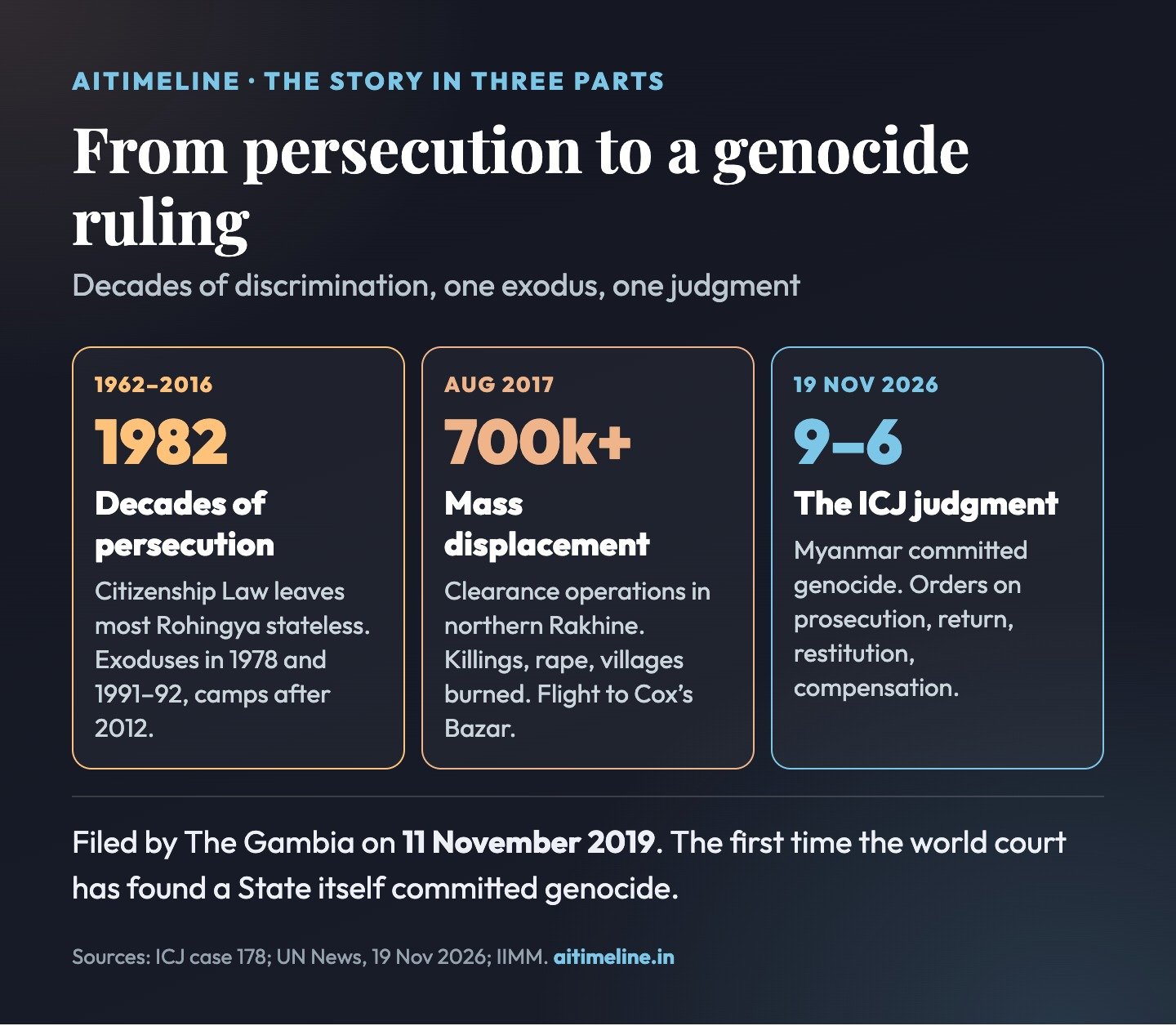
The Rohingya genocide ruling came on 19 November 2026, when the International Court of Justice found, by nine votes to six, that Myanmar committed genocide against the Rohingya in northern Rakhine State during the 2017 military clearance operations. It was the first time the world court had found a State itself responsible for committing genocide. The case was brought by The Gambia in 2019. The ruling arrived nine years after more than 700,000 Rohingya fled to Bangladesh, and after decades of statelessness and repeated expulsions. This timeline traces that history, explains exactly what the Court decided and ordered, and sets out what it means for the 1.2 million Rohingya refugees still in Bangladesh.
The ICJ judged Myanmar as a State, not any individual. Its finding is that Myanmar breached the 1948 Genocide Convention. No general or politician was convicted. Individual criminal responsibility is a separate question for criminal courts, mainly the International Criminal Court (ICC), where the Prosecutor’s application for an arrest warrant against Senior General Min Aung Hlaing was still pending in November 2026. Refugee figures on this page are dated, because they change every month.
💡 Short Answer
On 19 November 2026 the International Court of Justice ruled 9-6 in The Gambia v. Myanmar that Myanmar committed genocide against the Rohingya in northern Rakhine State in 2017, and failed to prevent and punish it. The Court ordered Myanmar to investigate and prosecute suspects, allow safe and dignified return, restore property and compensate victims, and to report within two years. The judgment is final and binding, but it is not a criminal conviction of any individual.
Rohingya Genocide Ruling: Key Questions
What to Know About the Rohingya Genocide Ruling
- Historic first: the ICJ had never before found a State responsible for committing genocide.
- Close vote: 9-6 on the main finding, with a six-judge joint dissent on how intent was proved.
- 2017 at the core: the finding concerns the clearance operations in northern Rakhine, not every past wave.
- Three acts: killing, serious bodily or mental harm, and measures to prevent births (Article II a, b, d).
- Incitement claim failed: incitement by private persons was not established, 14-1; the genocide finding stands separately.
- Reparations ordered: return, property restitution, rehabilitation and compensation, with the amount set later.
- Two-year clock: Myanmar must report on restitution and compensation by November 2028.
- Not a conviction: the ICC process against individuals is separate and still pending.
- Displacement continues: 1,208,018 Rohingya were in Bangladesh on 31 October 2026.
What Exactly Did the ICJ Decide?
The operative findings were voted on one by one, and they were not all unanimous.
Each bar shows how many of the 15 judges voted for the finding. Blue: the claim was upheld. Apricot: the Court rejected the claim, so the bar shows the single judge who would have upheld it.
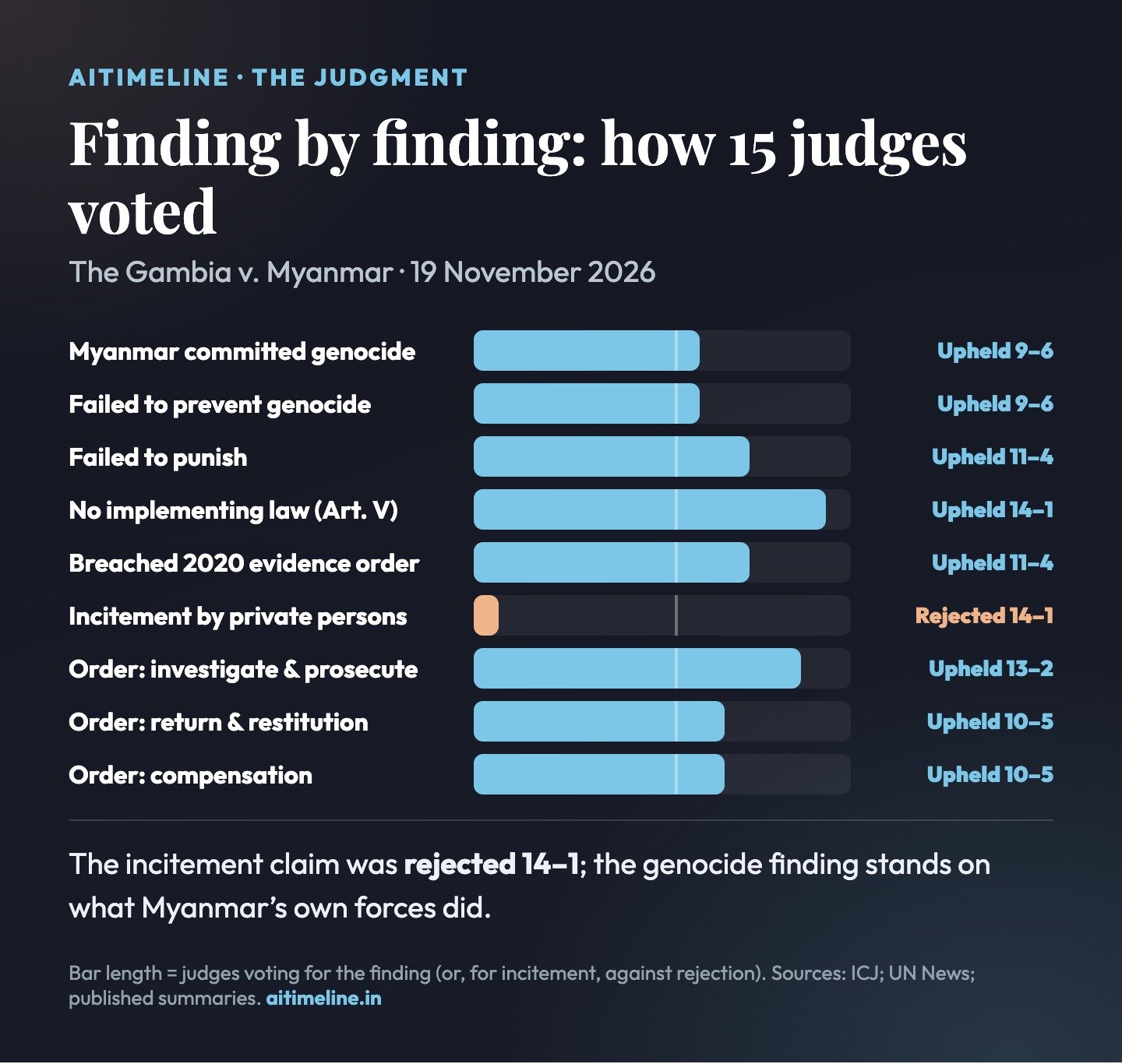
The rejected incitement claim is easy to misread. The Gambia argued that Myanmar was also responsible for direct and public incitement to genocide by private persons, a reference to hate speech that spread before 2017. The Court found that part not established. It did not undo the main finding, which rests on what Myanmar’s own forces and organs did.
The dissent was not about whether atrocities happened. Vice-President Julia Sebutinde and Judges Tomka, Abraham, Xue and Nolte, with Judge ad hoc Kress, accepted the gravity of the violence but argued that the evidence did not make genocidal intent the ‘only reasonable inference’, the test the Court itself set in its Bosnian and Croatian genocide cases. In their view the facts fitted ethnic cleansing and crimes against humanity of deportation and persecution. The majority disagreed, pointing among other things to the killing of infants as evidence of intent to prevent births.
What Does the Judgment Require Myanmar to Do?
Remedies voted separately; compensation figures come later.
| Area | What the Court ordered | Vote |
|---|---|---|
| Legislation | Enact laws giving full effect to the Genocide Convention | 14-1 |
| Investigation | Investigate everyone reasonably suspected of prohibited acts in 2017; prosecute and punish where warranted | 13-2 |
| Non-repetition | Give assurances and guarantees that the violations will not recur | 9-6 |
| Safe return | Allow safe, voluntary and dignified return, from Bangladesh, elsewhere abroad or within Myanmar | 10-5 |
| Property | Return or replace in kind individual and collective Rohingya property lost or damaged | 10-5 |
| The missing and dead | Help search for the disappeared; recover, identify and rebury bodies with Rohingya traditions | 10-5 |
| Rehabilitation | Provide for those who suffered physical or psychological injury | 10-5 |
| Protection | Protect the Rohingya against discrimination and persecution; facilitate family reunification | 10-5 |
| Compensation | Compensate the group and its members for harm restitution cannot repair | 10-5 |
| Report | Report to the Court within two years on restitution and on the amount and modalities of compensation | 10-5 |
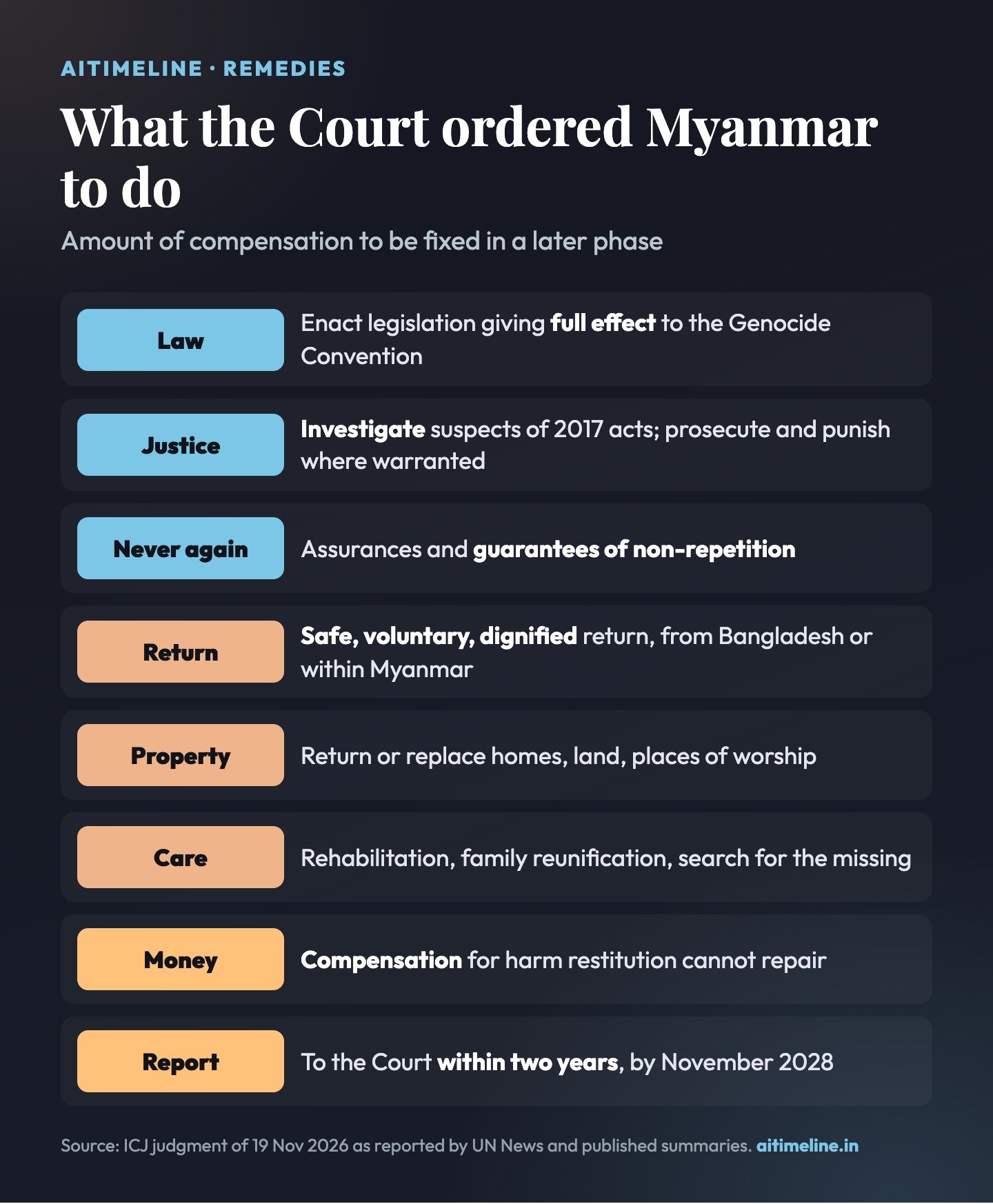
Some summaries of the judgment, including in early coverage, list citizenship and the right to self-identify as Rohingya among the orders. The operative findings published by the UN and summarised in independent reporting are framed around return, restitution, protection and compensation. Citizenship is widely regarded as the precondition for any of those to work, which is why it dominates the debate on what comes next. Check the full judgment for the Court’s exact language.
ICJ vs ICC: What Is the Difference?
Two courts in The Hague, two different questions.
International Court of Justice
- UN’s principal judicial organ
- Hears disputes between States
- Case: The Gambia v. Myanmar
- Found Myanmar responsible for genocide, 19 Nov 2026
- Can order State reparations
- Cannot convict or jail anyone
International Criminal Court
- Separate treaty court (Rome Statute)
- Prosecutes individuals
- Situation: Bangladesh/Myanmar
- Investigation authorised 14 Nov 2019
- Warrant sought for Min Aung Hlaing, 27 Nov 2024; pending
- Charges: deportation and persecution, not genocide
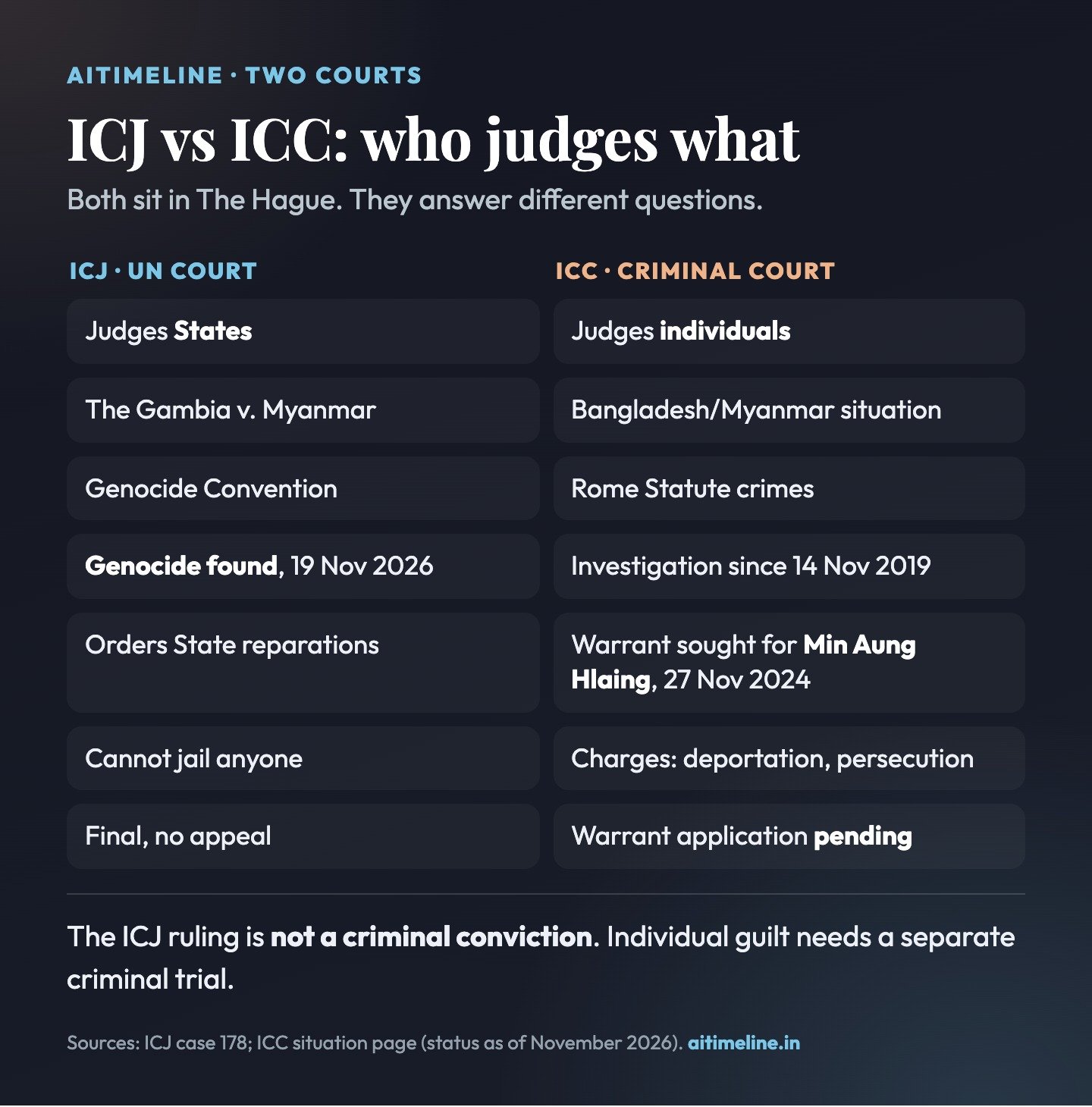
The ICC’s jurisdiction comes through Bangladesh. Myanmar has never joined the Rome Statute, but deportation is a crime that ends across a border, and Bangladesh is a member. That is why the ICC case concerns deportation and persecution, crimes completed partly on Bangladeshi soil, rather than genocide. There have also been national cases: in February 2025 a court in Argentina, acting under universal jurisdiction, issued arrest warrants for Min Aung Hlaing and other officials.
Timeline: From Discrimination to the 2026 Genocide Judgment
Newest first. Colour shows the kind of event.
The judgment is in; the camps are still full Now
Where things stand: A day after the ruling, Bangladesh hosted 1,208,018 Rohingya refugees in 251,889 households, according to joint Government of Bangladesh and UNHCR data dated 31 October 2026: 1,174,975 in the 33 camps of Cox’s Bazar district and 33,043 on the island of Bhasan Char.
Why it matters: The Court ordered Myanmar to allow safe, voluntary and dignified return. It did not, and could not, make that happen overnight. Northern Rakhine is still an active conflict zone, and humanitarian agencies say conditions there do not yet allow sustainable return.
ICJ finds Myanmar committed genocide, 9 votes to 6 Court
The finding: The International Court of Justice held that Myanmar committed genocide against the Rohingya group in northern Rakhine State, in breach of the 1948 Genocide Convention. President Yuji Iwasawa read the judgment in The Hague. It is the first time the Court has found that a State itself committed genocide.
What the Court relied on: It found that Myanmar’s security forces and other State organs committed acts under Article II(a) killing, II(b) serious bodily or mental harm and II(d) measures intended to prevent births, during the 2017 clearance operations. It cited an estimated 10,000 Rohingya killed and nearly 400 of about 1,000 villages in three northern townships partially or totally destroyed, and held that genocidal intent was the only reasonable inference from the pattern of conduct.
The split: Six judges dissented on the main finding, including Vice-President Julia Sebutinde and Judges Tomka, Abraham, Xue and Nolte, with Judge ad hoc Kress, in a joint dissent arguing the evidence did not meet the ‘only reasonable inference’ test.
Orders on accountability, return and compensation Court
What Myanmar must do: Enact legislation giving full effect to the Convention (14-1); investigate everyone reasonably suspected of prohibited acts and, where warranted, prosecute and punish them (13-2); give guarantees of non-repetition (9-6); allow the safe, voluntary and dignified return of displaced Rohingya and return or replace lost property (10-5); and compensate for harm restitution cannot repair (10-5).
What comes next: The amount and form of compensation will be decided in a later phase. Myanmar must report to the Court within two years on the restitution measures it has taken and on the amount and modalities of compensation (10-5).
Merits hearings close Court
What happened: After three weeks of public hearings, including witness testimony from the villages of Min Gyi, Chut Pyin and Maung Nu and a witness called by Myanmar about an ARSA attack, the Court retired to deliberate.
The arguments: The Gambia argued that killings, rape, village burning and decades of discriminatory policy showed intent to destroy the Rohingya. Myanmar called the case ‘flawed’ and ‘unfounded’ and said its operations were counter-terrorism responses to ARSA attacks.
Merits hearings open at the ICJ Court
What happened: Public hearings on the substance of The Gambia’s claims began, more than six years after the case was filed.
Why it matters: This was the stage at which the Court would decide not whether it could hear the case, but whether genocide had actually occurred.
UN mechanism documents razed Rohingya villages UN investigation
What it found: The Independent Investigative Mechanism for Myanmar published a summary of its investigation into emblematic cases where Rohingya villages destroyed in the 2017 clearance operations were demolished and replaced with Border Guard Police battalion bases, including in the U Daung, Myo Thu Gyi and Inn Din village tracts.
Why it matters: The report traces the loss of homes, farmland, mosques and community ties to ancestral land, and is intended to support future prosecutions and reparations.
Four more States admitted as interveners Court
What happened: The Court found the declarations of intervention filed by Slovenia, the Democratic Republic of the Congo, Belgium and Ireland admissible, bringing the number of intervening States to eleven.
Why it matters: Interveners under Article 63 can address only how the Genocide Convention should be interpreted, not the facts of the case.
ICC Prosecutor seeks warrant for Min Aung Hlaing Court
What happened: ICC Prosecutor Karim A.A. Khan applied for an arrest warrant against Senior General Min Aung Hlaing, commander-in-chief of Myanmar’s armed forces, for the crimes against humanity of deportation and persecution of the Rohingya, committed in Myanmar and in part in Bangladesh.
Status: As of November 2026 no public warrant had been issued. The ICC has said warrants can be issued under seal, so the public record shows the application as pending.
First seven interventions admitted Court
What happened: The Court unanimously held admissible the declaration of the Maldives and the joint declaration of Canada, Denmark, France, Germany, the Netherlands and the United Kingdom, filed on 15 November 2023.
Why it matters: The joint declaration addressed how genocidal intent may be inferred and how acts such as sexual violence and harm to children fit the Convention.
ICJ rejects Myanmar’s preliminary objections Court
What happened: The Court rejected all four of Myanmar’s preliminary objections and held that it had jurisdiction under Article IX of the Genocide Convention and that The Gambia’s application was admissible.
Why it matters: It confirmed that any State party to the Convention can bring a case to enforce obligations owed to all parties, even if it is not directly injured. The case moved to the merits.
ICJ orders provisional measures, unanimously Court
What the Court ordered: Myanmar must take all measures within its power to prevent acts under Article II of the Convention against the Rohingya, ensure its military and irregular units do not commit them, preserve evidence, and report to the Court, first within four months and then every six months.
Why it matters: The order was binding, but it was not a finding that genocide had occurred. In 2026 the Court found Myanmar had breached the evidence-preservation part of it.
ICC authorises an investigation Court
What happened: ICC judges authorised the Prosecutor to investigate crimes within the Court’s jurisdiction committed at least in part on the territory of Bangladesh, a State party to the Rome Statute. The situation covers the 2016 and 2017 waves of violence in Rakhine State.
Why it matters: Myanmar is not an ICC member. The cross-border element of deportation into Bangladesh is what gives the ICC jurisdiction.
The Gambia files its genocide case Court
What happened: The Gambia filed an application at the ICJ accusing Myanmar of breaching the Genocide Convention in its treatment of the Rohingya, and asked for provisional measures.
What it asked for: A declaration that Myanmar was responsible, an end to ongoing violations, prosecution of perpetrators, and reparations for victims, including safe return.
UN creates the Investigative Mechanism UN investigation
What happened: The Human Rights Council set up the Independent Investigative Mechanism for Myanmar to collect, preserve and analyse evidence of the most serious international crimes and prepare files for criminal proceedings.
Why it matters: The IIMM has shared evidence with both the ICJ case and the ICC investigation.
Fact-Finding Mission reports genocidal intent UN investigation
What it found: The Independent International Fact-Finding Mission on Myanmar concluded there was sufficient information to warrant the investigation and prosecution of senior military officials, including Min Aung Hlaing, for genocide, crimes against humanity and war crimes.
What it was not: An investigative finding and recommendation, not a court judgment. It became a core part of the evidence the ICJ later weighed.
UN rights chief: ‘a textbook example of ethnic cleansing’ UN investigation
What happened: Two weeks into the operations, the UN High Commissioner for Human Rights described them as a textbook example of ethnic cleansing.
Why it matters: Ethnic cleansing is a description, not a separate crime in international law. Whether the same acts amounted to genocide was the question the ICJ decided nine years later.
ARSA attacks, then the clearance operations Displacement
What happened: The Arakan Rohingya Salvation Army attacked about 30 police posts and an army base. The military responded with ‘clearance operations’ marked by mass killings, rape and the burning of villages.
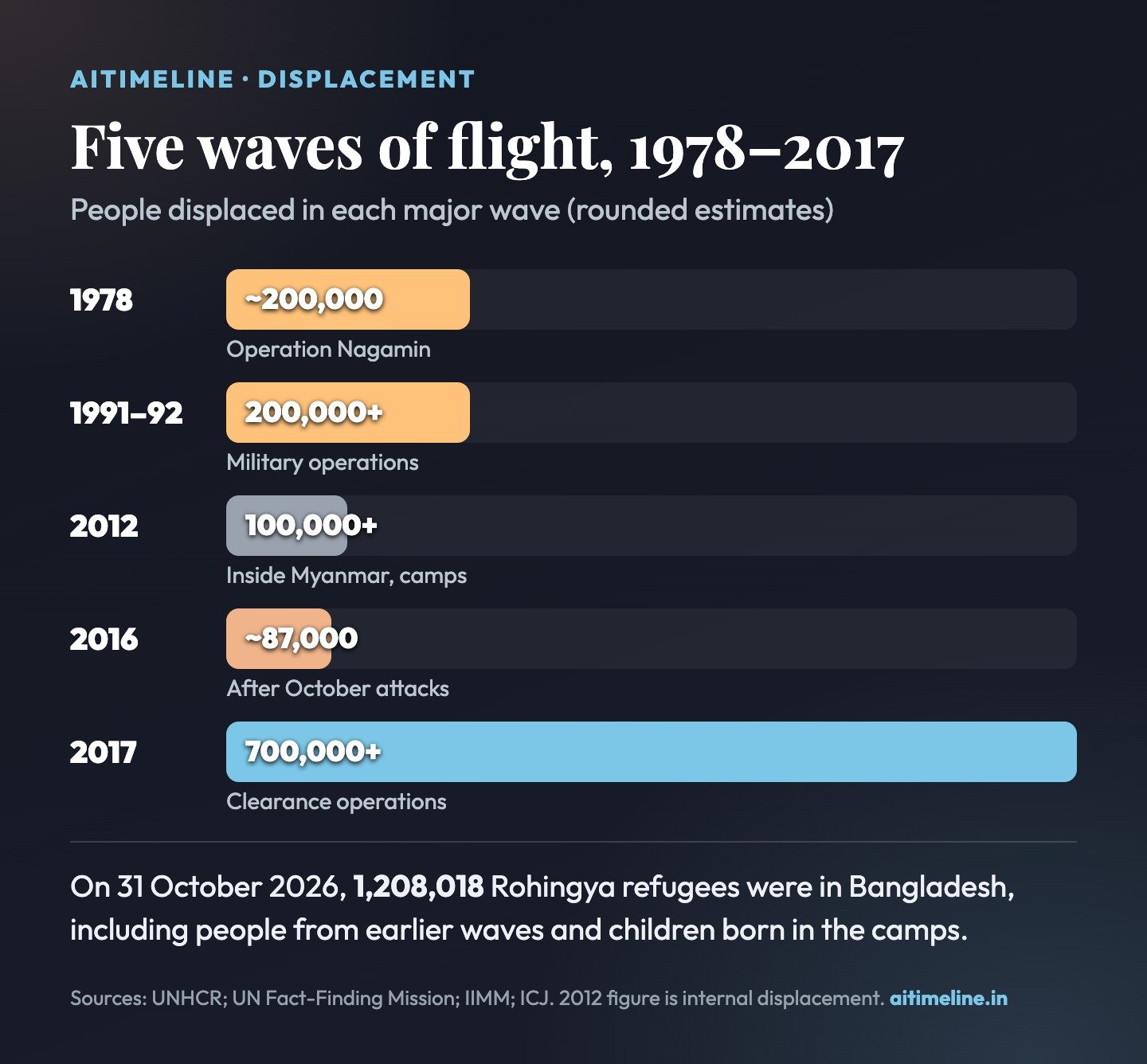
The exodus: More than 700,000 Rohingya crossed into Bangladesh within months, most into Cox’s Bazar district, through forests, across the Naf River and by sea.
Later finding: These operations are the core of the ICJ’s 2026 genocide finding.
First wave: attacks on border posts Displacement
What happened: Armed men attacked three border police posts in Maungdaw and Rathedaung, killing nine officers. Security forces launched clearance operations, with reports of killings, sexual violence, arrests and burned villages.
Displacement: About 87,000 Rohingya fled to Bangladesh by mid-2017.
Violence in Rakhine and the camps Displacement
What happened: Communal violence in June and October 2012 killed scores of people and destroyed homes. More than 100,000 Rohingya were displaced and confined to camps around Sittwe and elsewhere.
Why it matters: Many of these internal camps still existed in 2017, and movement restrictions on their residents continued for years.
Another exodus to Bangladesh Displacement
What happened: Following a military build-up in northern Rakhine, with reports of forced labour, rape and confiscation of land, more than 200,000 Rohingya fled to Bangladesh.
Aftermath: Most were repatriated over the following years under a Bangladesh-Myanmar arrangement monitored by UNHCR, back into the same restrictions.
Citizenship Law leaves most Rohingya stateless Persecution
What it did: The law tied full citizenship to membership of the ‘national races’ deemed settled before 1823. The Rohingya were not among the recognised groups.
Why it matters: Most Rohingya were left without recognised citizenship, which underpinned later limits on movement, marriage, education and health care.
Operation Nagamin Displacement
What happened: A nationwide census and immigration check was accompanied by reports of arrests, violence and intimidation in Rakhine. About 200,000 Rohingya fled to Bangladesh.
Aftermath: Most were repatriated under an agreement between the two governments.
Independence, then military rule Persecution
What happened: Burma became independent from Britain on 4 January 1948. In 1962 General Ne Win seized power, beginning decades of military rule.
Why it matters: Under military rule, the status of the Rohingya was progressively narrowed, culminating in the 1982 law.
Rohingya Displacement: The Humanitarian Picture
UNHCR and Government of Bangladesh data · 31 October 2026
Cox’s Bazar holds 97% of the total. Source: Government of Bangladesh and UNHCR, data updated 31 October 2026.
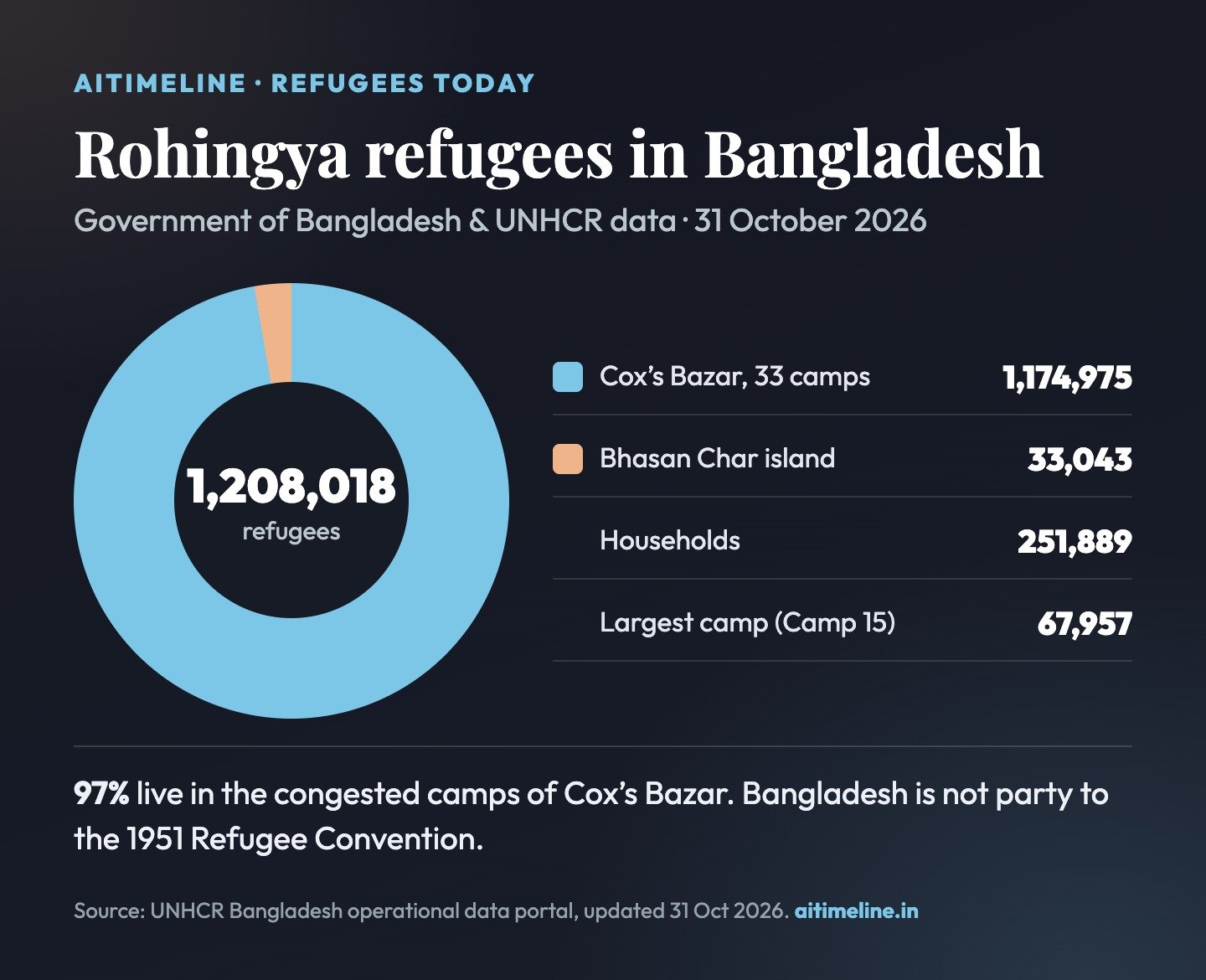
Bangladesh is not a party to the 1951 Refugee Convention, and the camps are run under government directives. UNHCR describes the 33 camps in Cox’s Bazar district as highly congested. The largest, Camp 15, housed 67,957 people on 31 October 2026. Since December 2020 the government has moved refugees to Bhasan Char, a silt island in the Bay of Bengal, to ease crowding; rights groups have questioned how voluntary those moves were and how exposed the island is to cyclones.
Life in the camps depends on aid. Formal schooling and paid work are restricted, protection risks for women and children are high, and funding has repeatedly fallen short. In May 2026 the UN and partners appealed for about US$710 million for the year’s Rohingya response. Food rations have been cut more than once when money ran short.
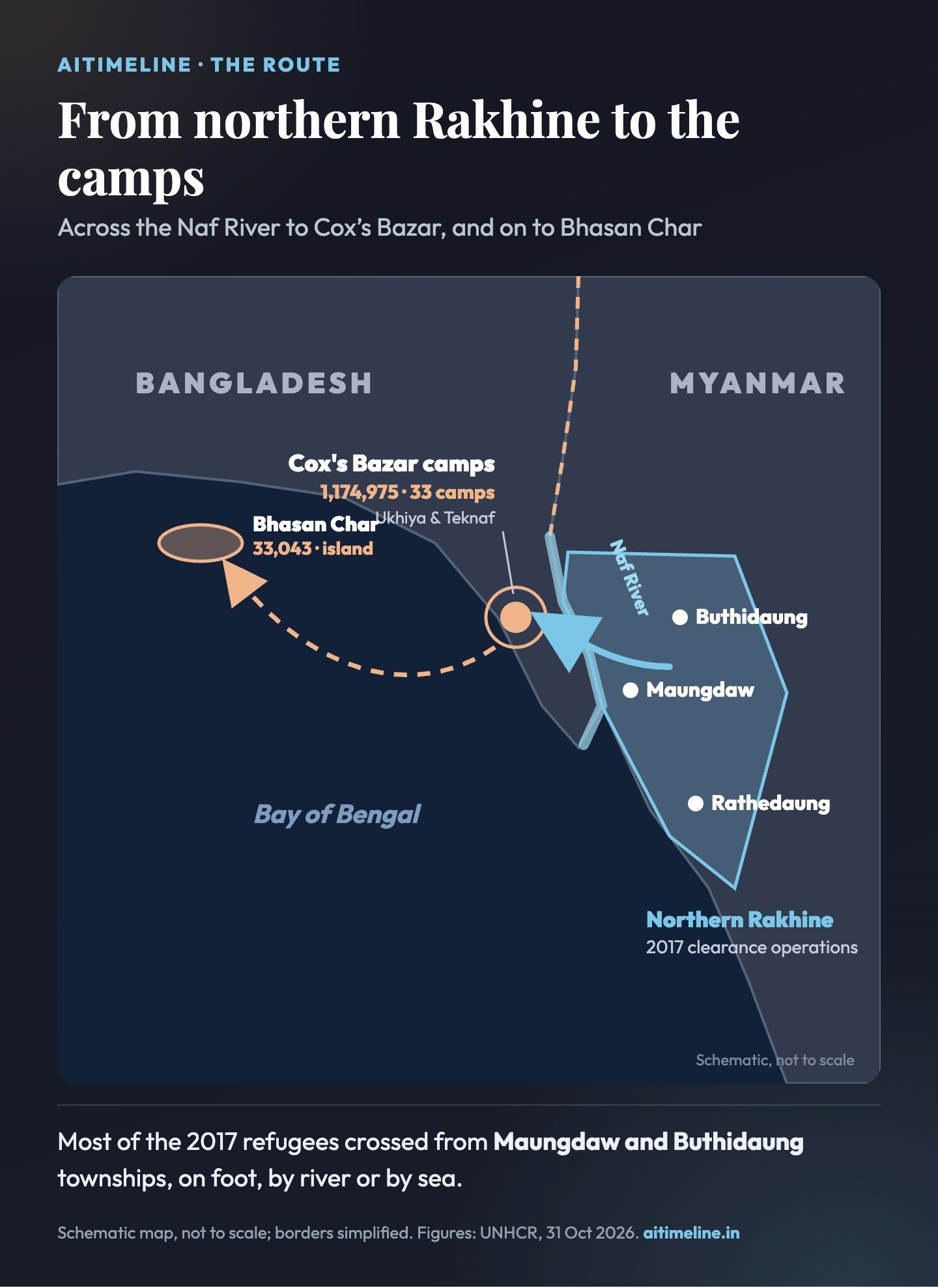
Why Safe Return Remains Difficult
The judgment sets obligations; conditions on the ground decide what happens.
Key People and Institutions
The Gambia
Filed the case on 11 November 2019 with backing from the Organisation of Islamic Cooperation, under Article IX of the Genocide Convention.
Myanmar
Found responsible for genocide, failure to prevent and punish, and breach of the 2020 order. Its military government rejected the ruling.
Min Aung Hlaing
Commander-in-chief during the 2017 operations; the ICC Prosecutor’s November 2024 arrest-warrant application against him was pending in November 2026.
ARSA
Arakan Rohingya Salvation Army, whose attacks in October 2016 and August 2017 preceded the two military crackdowns.
International Court of Justice
The UN’s principal judicial organ. President Yuji Iwasawa read the 19 November 2026 judgment.
International Criminal Court
Investigates individuals in the Bangladesh/Myanmar situation, covering the 2016 and 2017 waves.
Fact-Finding Mission
Created March 2017; its 2018 reports called for senior officers to be investigated for genocide.
IIMM
Independent Investigative Mechanism for Myanmar, set up in September 2018 to preserve evidence for criminal cases.
A Landmark Judgment, but Displacement Continues
The 19 November 2026 ruling gives the Rohingya something they have sought for decades: an authoritative legal finding, by the world’s highest court, that what was done to them in 2017 was genocide. It sets obligations to investigate and punish, to restore what was taken, to compensate and to protect against repetition.
A judgment does not rebuild a village or issue a citizenship card. More than 1.2 million Rohingya remain in Bangladesh, and conditions in Rakhine still stand in the way of safe return. The test now is whether Myanmar, and the States that have their own duties under the Genocide Convention, turn the Court’s findings into accountability, restitution and lasting protection. The first marker is Myanmar’s report to the Court, due by November 2028.
Explore More Timelines
People Also Ask
Frequently Asked Questions
Based on the ICJ’s case record, UN News, UNHCR data, the ICC and the IIMM.
⚠️ Editorial Note: What We Checked
The judgment date, the 9-6 genocide vote, the acts found, the remedies and the two-year reporting deadline are from the ICJ’s case page and UN News coverage of 19 November 2026; the vote counts on other findings are as summarised in independent reporting on the judgment. Intervention dates are from the ICJ case record: the Maldives and the six-State joint declaration were admitted on 3 July 2024, and Slovenia, the DRC, Belgium and Ireland on 25 July 2025. ICC dates are from the ICC’s situation page. Refugee figures are UNHCR and Government of Bangladesh data dated 31 October 2026. Historical displacement figures are rounded estimates. This page describes a finding of State responsibility; it does not attribute criminal guilt to any individual.
Related Reading on AiTimeline
Sources & further reading
Every dated entry above was checked against these references. Last reviewed 20 November 2026.
- International Court of Justice: Application of the Genocide Convention (The Gambia v. Myanmar: 11 States intervening), case 178, judgment of 19 November 2026 and case record
- UN News: World's top court finds Myanmar guilty of genocide against Rohingya, 19 November 2026
- UNHCR Bangladesh operational data portal: Rohingya refugee population, data of 31 October 2026
- International Criminal Court: Situation in Bangladesh/Myanmar, procedural history and arrest-warrant application
- UN Independent Investigative Mechanism for Myanmar: The destruction and dispossession of Rohingya land and property during the 2017 clearance operations, public summary, 29 September 2025
- ICJ press release: The Court decides that the declarations of intervention filed by seven States are admissible, 3 July 2024
- EJIL:Talk! (Marko Milanovic): Gambia v. Myanmar, The Bottom Line, 19 November 2026