Thames Water Debt Crisis: Timeline of Rescue Plans
Follow Thames Water's debt crisis, emergency loans, creditor rescue plans, government objections and the possibility of special administration.
Latest Story
The Thames Water debt crisis is one of Britain’s most serious public-utility crises. The company serves about 16 million customers and carries roughly £20 billion of debt. Emergency creditor loans have kept it running, a High Court-approved restructuring bought time in 2025, and a creditor consortium now wants to take control. As of 24 November 2026 no full recapitalisation has been approved, and the government has kept special administration in reserve.
The emergency facility is borrowing, not a government grant. It is money from creditors that ranks ahead of existing lenders. The creditor rescue is a proposal, not a decision. Thames Water’s board, Ofwat and other regulators have not accepted it, so write-offs and new equity below are not final.
💡 Short Answer
Thames Water has about £20 billion of debt, a £3 billion emergency facility sanctioned in February 2025 and a request to lift it to £5.4 billion. Creditors proposed a £9.4 billion write-off in June 2026, which the government questioned. A further interim restructuring to push debt maturities into March 2028 is under way. No full rescue has been approved.
How the Debt Grew
Reported debt by year. The figures cover different dates, measures and entities, so they are not like-for-like.
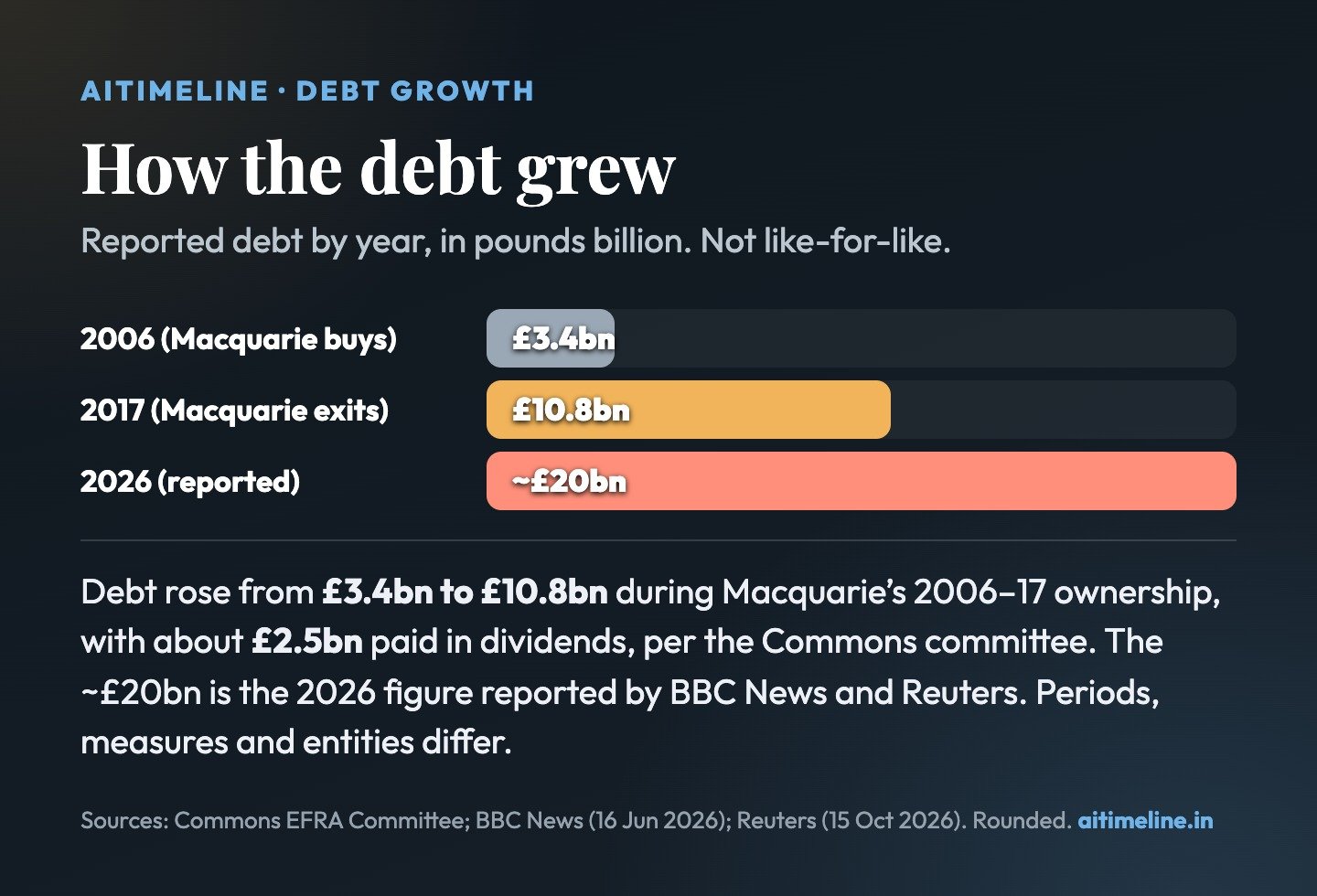
The Commons Environment, Food and Rural Affairs Committee reported that debt rose from £3.4 billion to £10.8 billion during Macquarie’s ownership between 2006 and 2017, with roughly £2.5 billion paid in dividends. Macquarie argues it oversaw an investment programme averaging more than £1 billion a year and growth in the regulated asset base. The dispute is about how that investment was financed.
Thames Water Debt Crisis: Key Questions
From Privatisation to the Brink
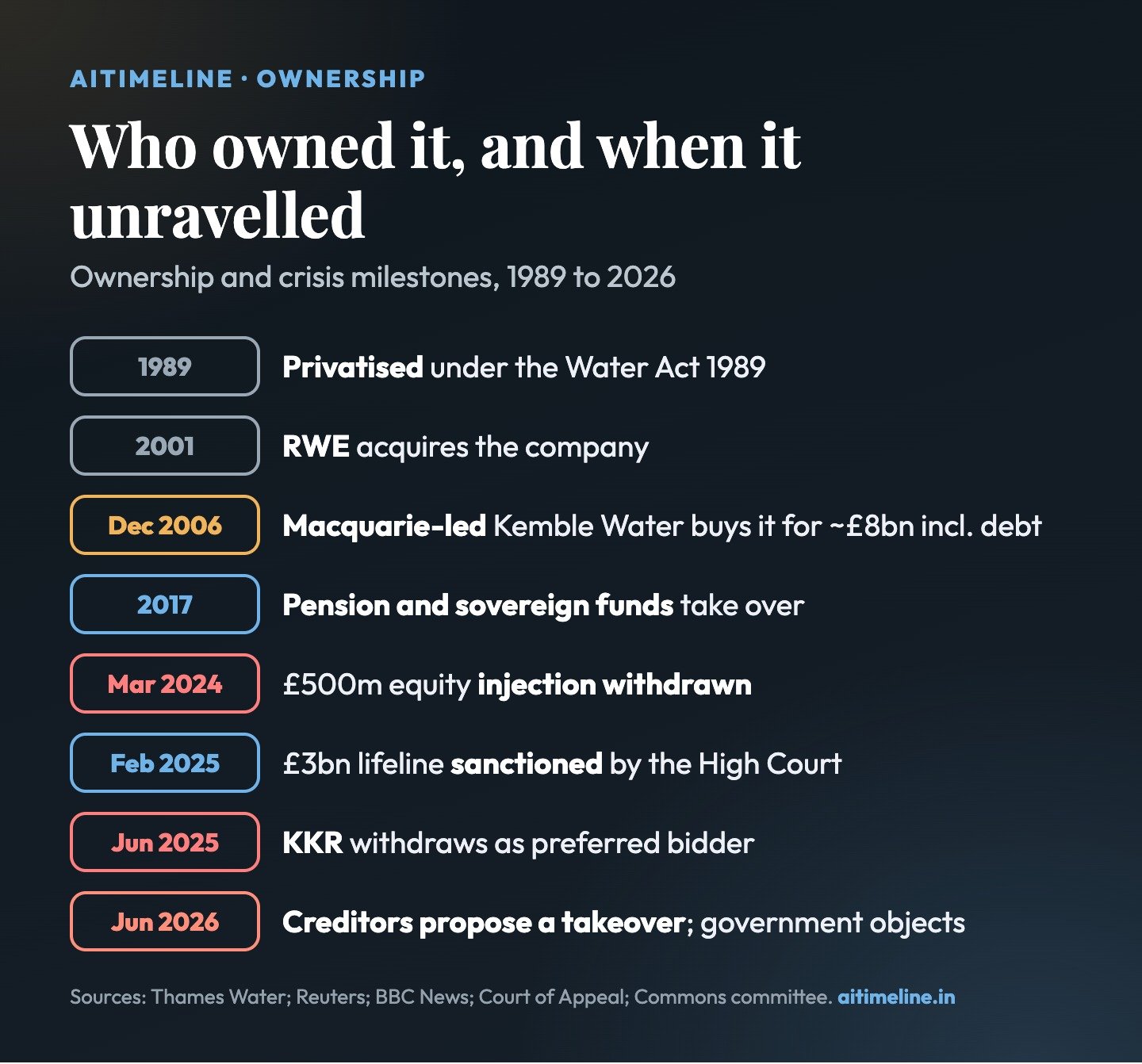
- 1989: Thames Water was privatised under the Water Act 1989.
- 2006-2017: Under Macquarie, debt rose from about £3.4bn to £10.8bn.
- March 2024: Shareholders withdrew a promised £500m injection.
- February 2025: The High Court sanctioned a £3bn emergency plan.
- May 2025: Ofwat fined the company £122.7m, its biggest penalty.
- June 2026: Creditors proposed a £9.4bn write-off; the government objected.
- October 2026: The company sought £2.4bn more, with £2.65bn already drawn.
- November 2026: Another interim deal would extend debt to March 2028.
Timeline: How Thames Water Reached the Brink
Newest first. Labels mark origins, ownership, financing, regulation and current status.
No full rescue has been approved Status
Where it stands: Thames Water has not agreed a full recapitalisation. It is pursuing a further interim restructuring to push senior debt maturities from 2027 into March 2028 while talks with the London & Valley Water (L&VW) creditor consortium, Ofwat and other regulators continue.
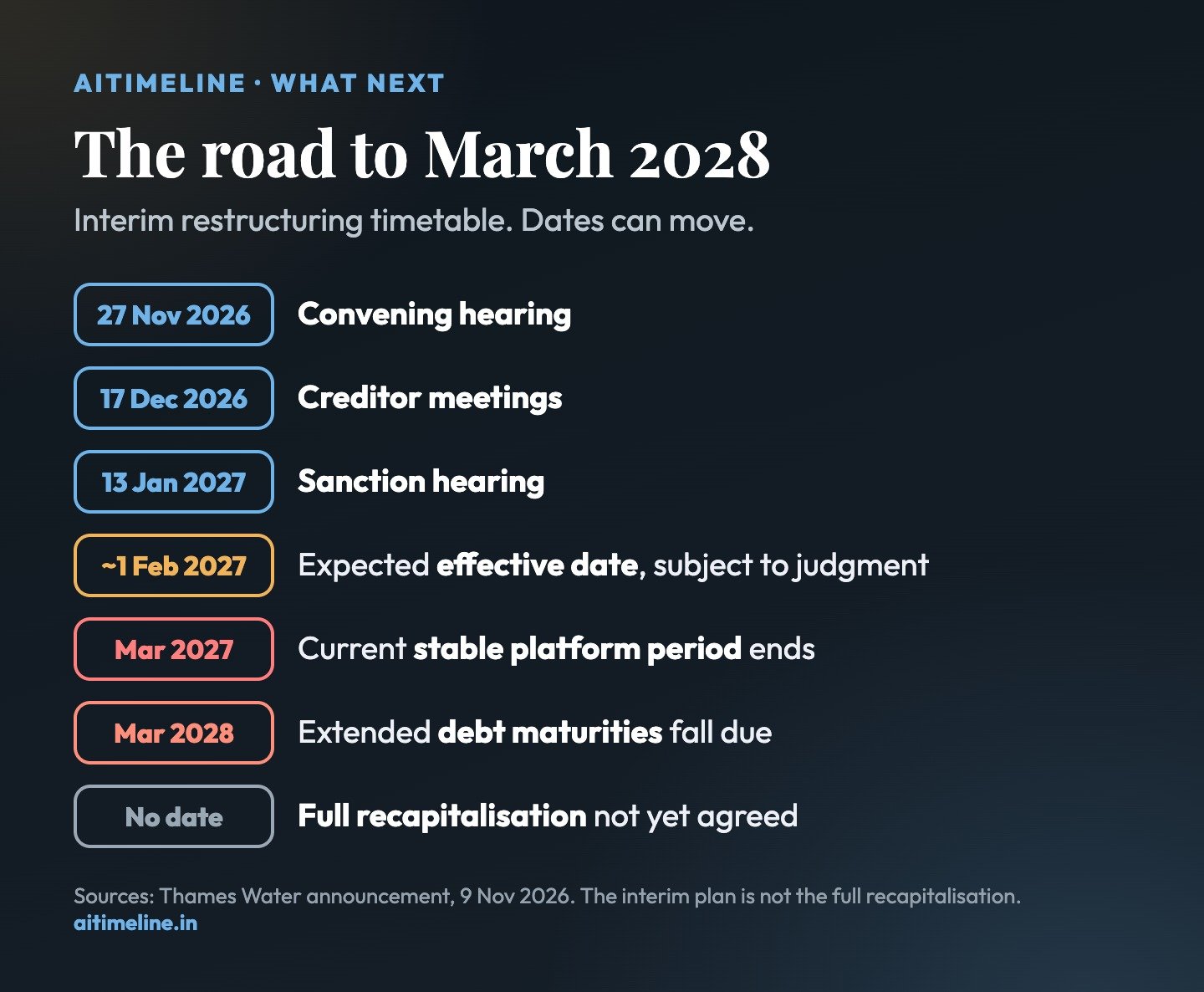
Next steps: A convening hearing is due on 27 November, creditor meetings on 17 December and a sanction hearing on 13 January 2027. None of these completes the creditor takeover.
Special administration: The government has said it stands ready for all eventualities, including temporary public control. It remains a contingency, not a decision.
Another interim restructuring is launched Financing
What changes: Thames Water said creditors certifying more than 12 billion pounds of secured debt had signed a transaction support agreement. Super senior, Class A and Class B debt falling due in 2027 would be extended to March 2028, and the stable platform period would run to the same month.
Interest: Interest payments on the senior debt would continue to be paid, not deferred.
Timetable: Convening hearing 27 November 2026, creditor meetings 17 December, sanction hearing 13 January 2027, and an expected effective date in or around the week of 1 February 2027, subject to the court’s judgment.
Why it matters: The company said it lacked sufficient certainty that a full recapitalisation could be implemented before certain senior debt matures and the stable platform period expires in March 2027.
Class B creditors agree terms Financing
What was agreed: A Class B agreement was signed on 16 October by the company, consenting Class A creditors and Class B creditors holding more than 60% of the Class B debt. It sets out how Class B creditors would be treated in a future recapitalisation.
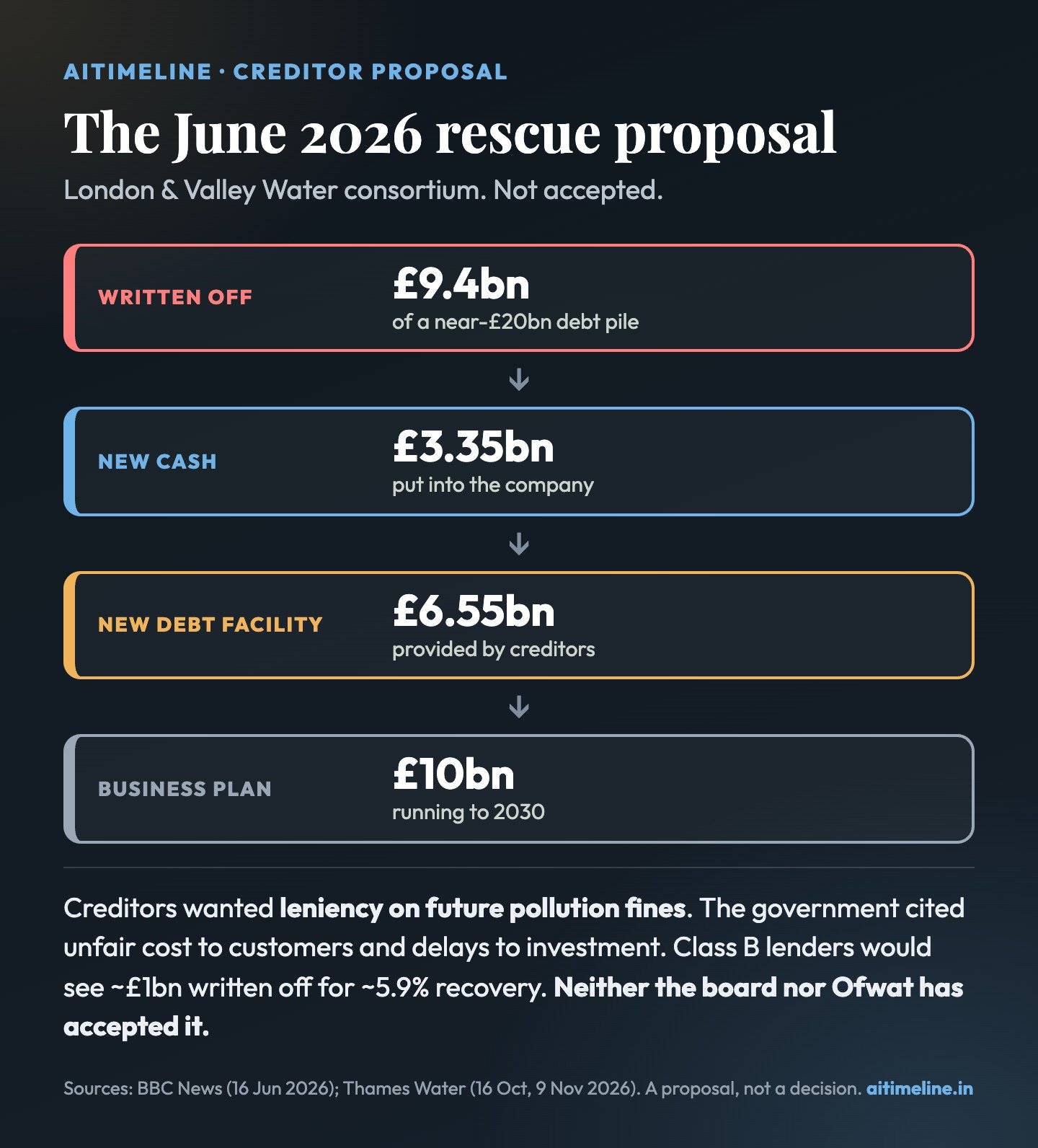
The terms: The current terms contemplate writing off the full roughly 1 billion pounds of Class B debt. In return Class B creditors would receive restructured equity giving a recovery of about 5.9%, the right to take part in 150 million pounds of new equity, and participation rights in some new debt or preferred equity.
The caveat: The company stressed there is no certainty the recapitalisation will be agreed, so the Class B terms may never take effect.
Thames Water seeks 2.4 billion pounds more Financing
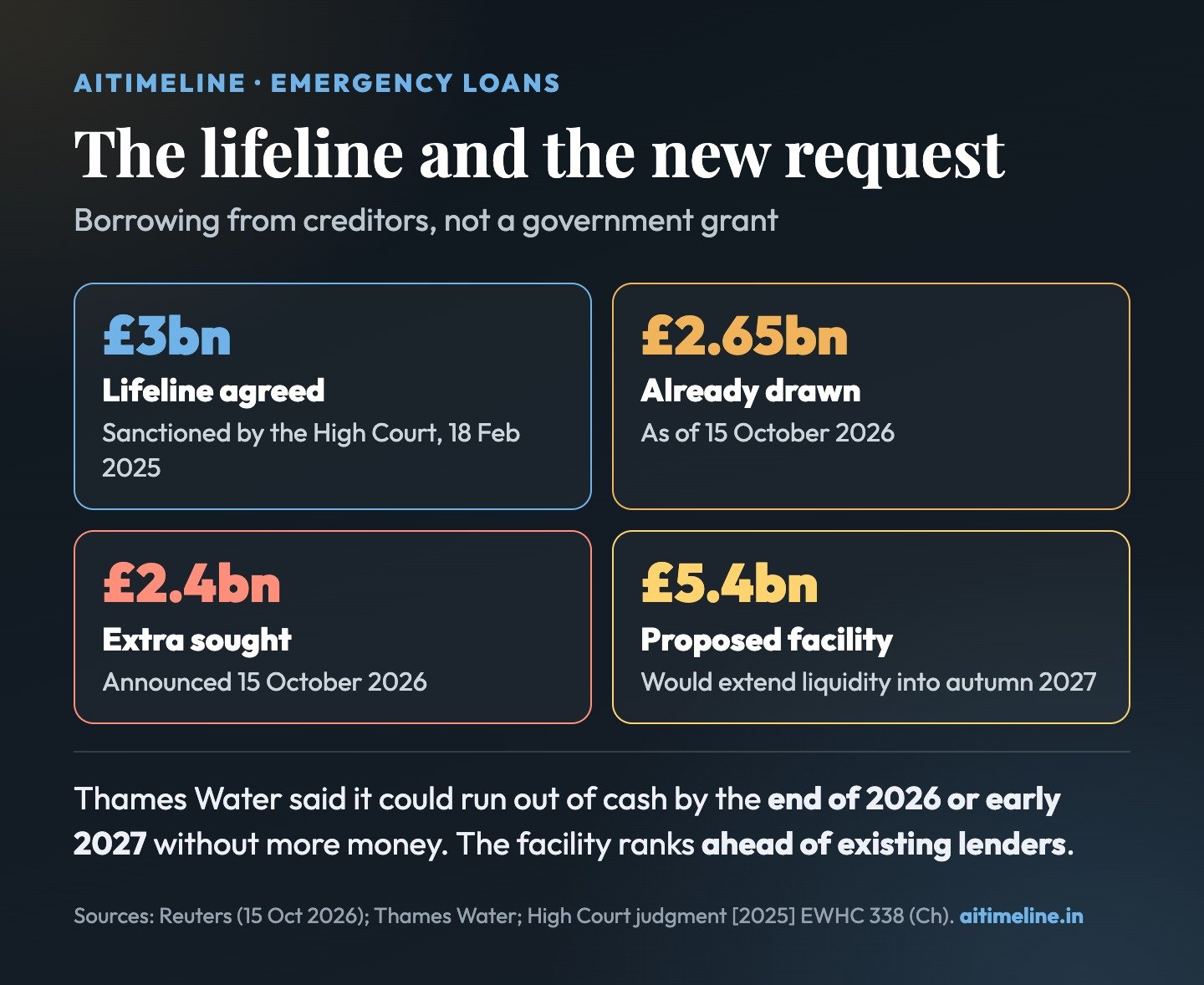
The request: Thames Water said it needed to raise its emergency facility by 2.4 billion pounds, from 3 billion to 5.4 billion, to keep operating into autumn 2027.
The cash position: It had already drawn 2.65 billion pounds of the existing 3 billion pound lifeline. On its latest forecasts it could run out of money by the end of 2026 or early 2027, before a planned recapitalisation was completed.
The consortium: Reuters reported that L&VW named proposed directors in August to oversee a decade-long overhaul if its rescue plan is approved.
MPs call for urgent action on special administration Regulation
The report: The Commons committee examined whether the government should prepare for special administration. It criticised weaknesses in the regulatory regime and warned that a rescue could reward failure if fines or performance commitments are relaxed.
Debt history: The committee recorded that debt rose from 3.4 billion pounds to 10.8 billion pounds during Macquarie’s ownership from 2006 to 2017, with roughly 2.5 billion pounds paid in dividends. Macquarie disputes the framing and points to heavy investment.
Caveat: The report’s page returns an access block to automated checks, so these details follow press coverage and the committee’s own summary.
Government objects to the creditor rescue Regulation
The proposal: L&VW offered to write off 9.4 billion pounds of Thames Water’s near 20 billion pound debt, inject 3.35 billion pounds of cash and provide a new 6.55 billion pound debt facility, as part of a 10 billion pound business plan to 2030. Creditors wanted leniency from future pollution fines in return.
The objections: Ms Reynolds told the Commons she had three concerns: an unfair cost to customers, delays to vital infrastructure investment and delays to environmental improvements. She said the government stood ready for all eventualities, including temporary nationalisation.
The reply: L&VW said its plan was the fastest route to better outcomes, with no government funding and no bill rises beyond those set by Ofwat. Ofwat said its board had made no decision.
Creditors move to take control Ownership
The idea: A group of senior creditors, branded London & Valley Water, began advancing a plan to restructure the debt, inject new equity and take ownership, avoiding special administration.
The catch: Any deal needs Ofwat and other regulators to agree, and agreement between creditor classes. That has proved slow.
Independent Water Commission reports Regulation
What it said: The commission proposed major changes to the water sector, including a more integrated regulator, stronger oversight and a more strategic approach to infrastructure and regional planning.
Why it matters: Its findings reflected concern that the existing regulatory structure had not prevented financial instability or poor performance.
KKR walks away Ownership
What happened: US private-equity firm KKR, the preferred bidder for new investment, withdrew from the process.
Effect: Its exit left creditors as the main source of a rescue and raised doubts about whether any outside buyer would accept the company’s financial and operational risks.
Ofwat imposes a 122.7 million pound penalty Regulation
The breach: Ofwat fined Thames Water 122.7 million pounds for breaching rules on sewage spills and shareholder payouts.
Effect: The penalty added to scrutiny of governance and complicated efforts to attract new investment.
Court of Appeal gives its reasons Status
The result: The appeal by opposing creditors was dismissed. The outcome was announced on 17 March 2025 and the reasons were handed down on 15 April.
The reasoning: The court held that the first judge took too narrow an approach to the question of restructuring surplus, yet the appeal still failed.
High Court sanctions the lifeline plan Status
What it allowed: The High Court sanctioned a restructuring plan under Part 26A of the Companies Act 2006. It let Thames Water access up to 3 billion pounds of super senior funding in stages, with the first 1.5 billion pounds extending liquidity into 2025.
Debt terms: Certain Class A and Class B maturities were extended by about two years.
Opposition: A group of lower-ranking Class B creditors opposed the plan and appealed.
Ofwat sets the 2025 to 2030 price controls Regulation
What it set: Ofwat’s final determination framed customer bills, investment and performance commitments for the five-year period.
Thames Water’s view: The company questioned whether the settlement would support the investment it said was needed.
A 3 billion pound emergency plan is announced Financing
The plan: Thames Water announced up to 3 billion pounds of super senior financing: an initial 1.5 billion pound tranche with a further 1.5 billion available on conditions.
Purpose: It was meant to provide short-term stability while a longer-term recapitalisation was sought.
Ofwat places the company under enhanced oversight Regulation
What it means: The regime brings closer scrutiny of financial and operational performance, business plans and customer protections.
What it does not do: It does not change ownership or reduce the debt.
Shareholders withdraw a 500 million pound injection Ownership
What happened: A promised 500 million pound equity injection was withdrawn. Credit ratings were cut and a cash lock-up restricted the movement of money through the corporate structure.
Why it matters: The question changed from long-term investment to whether the company could finance itself.
Financial instability becomes a public issue Regulation
What happened: Thames Water’s chief executive resigned and the company faced rising scrutiny over sewage pollution, infrastructure performance and its ability to secure fresh equity.
Regulation: Ofwat strengthened its powers to restrict dividends where a water company’s financial resilience is in doubt.
Pension and sovereign wealth funds take over Ownership
New owners: A group of institutional investors, including pension funds and sovereign wealth funds, acquired the remaining Macquarie-era holdings.
The inheritance: They took on a company with heavy debt and a large infrastructure bill.
Macquarie-led consortium buys Thames Water Ownership
The deal: RWE sold Thames Water to Kemble Water Holdings, a consortium led by Macquarie, for about 8 billion pounds including debt. The sale was agreed in October 2006 and completed in December.
The debate: Macquarie says it oversaw an investment programme above 1 billion pounds a year and growth in the regulated asset base. Critics focus on borrowing and dividends.
German utility RWE buys the company Ownership
What happened: Thames Water plc was acquired by German utility RWE in 2001.
Thames Water is privatised Origins
What happened: The Thames Water Authority was privatised as Thames Water Utilities Limited under the Water Act 1989 and floated on the stock market.
Why it matters: It created a regulated private monopoly responsible for water supply and wastewater, with Ofwat later setting its price controls.
The Emergency Loans
Borrowing from creditors, not a government grant.
| Indicator | Figure | Note |
|---|---|---|
| Customers served | About 16 million | BBC News |
| Debt in 2006 | About £3.4bn | Commons committee |
| Debt in 2017 | About £10.8bn | Commons committee |
| Debt in 2026 | About £20bn | BBC News, Reuters |
| Lifeline agreed | Up to £3bn | Sanctioned 18 Feb 2025 |
| Already drawn | £2.65bn | As of 15 Oct 2026 |
| Extra sought | £2.4bn | Would lift facility to £5.4bn |
| Proposed write-off | £9.4bn | June 2026 L&VW plan |
Debt figures refer to different reporting periods and corporate structures.
The Main Rescue Options
Who controls the company, who absorbs the loss and how investment is funded.
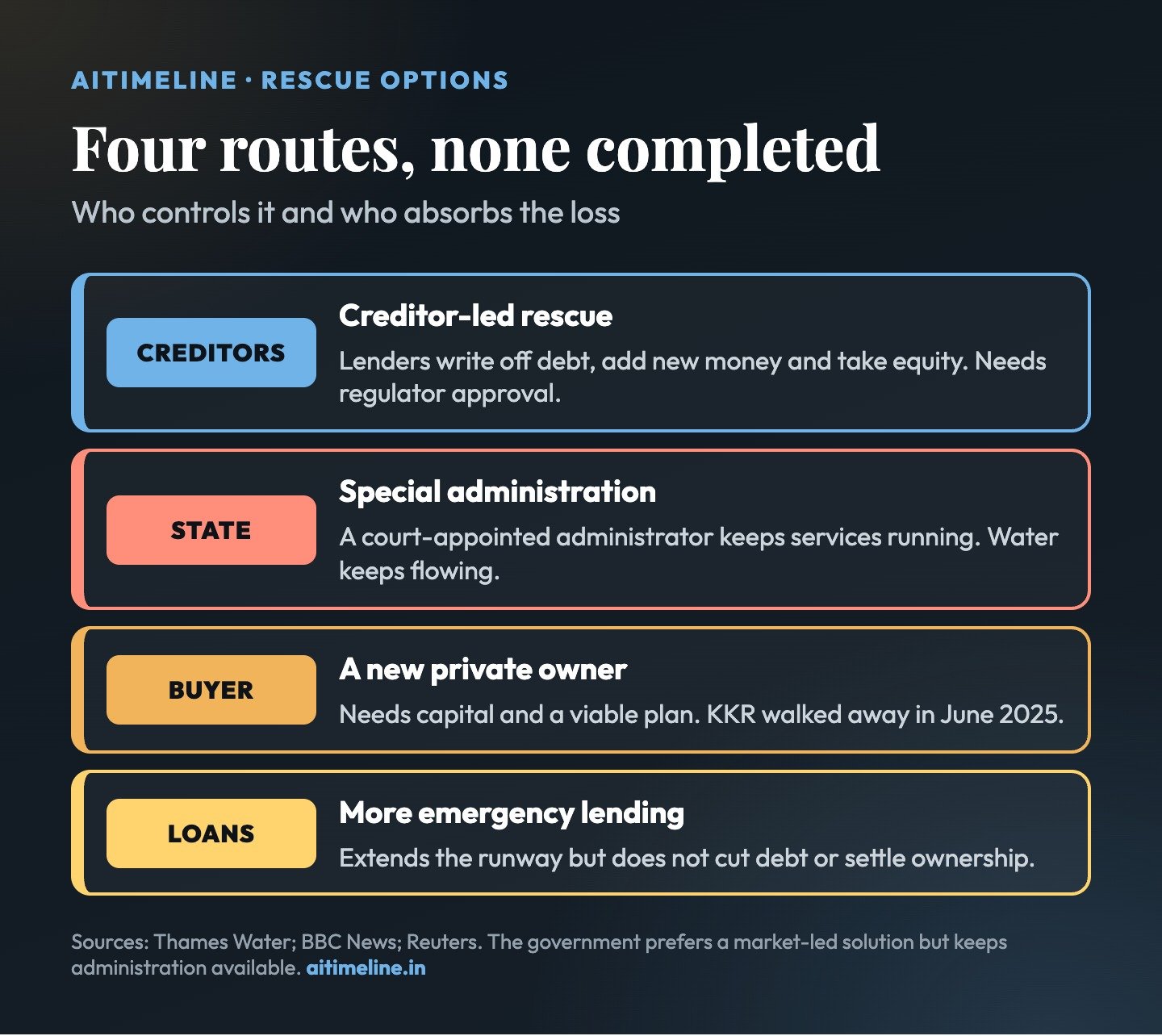
| Route | How it works | Potential benefit | Main concern |
|---|---|---|---|
| Creditor-led rescue | Lenders write off debt, add new money and take equity | Avoids administration; keeps private ownership | Costs to customers; weaker protections |
| Special administration | Court-appointed administrator keeps services running | Services continue; resets the structure | Public financing; decisions on creditors and ownership |
| New private owner | An investor buys after restructuring | Fresh capital | KKR’s 2025 exit shows how hard it is |
| More emergency lending | Larger facility extends the runway | Avoids a cash crunch | Does not cut debt or settle ownership |
What It Means for Customers
The central public question is who ends up paying.
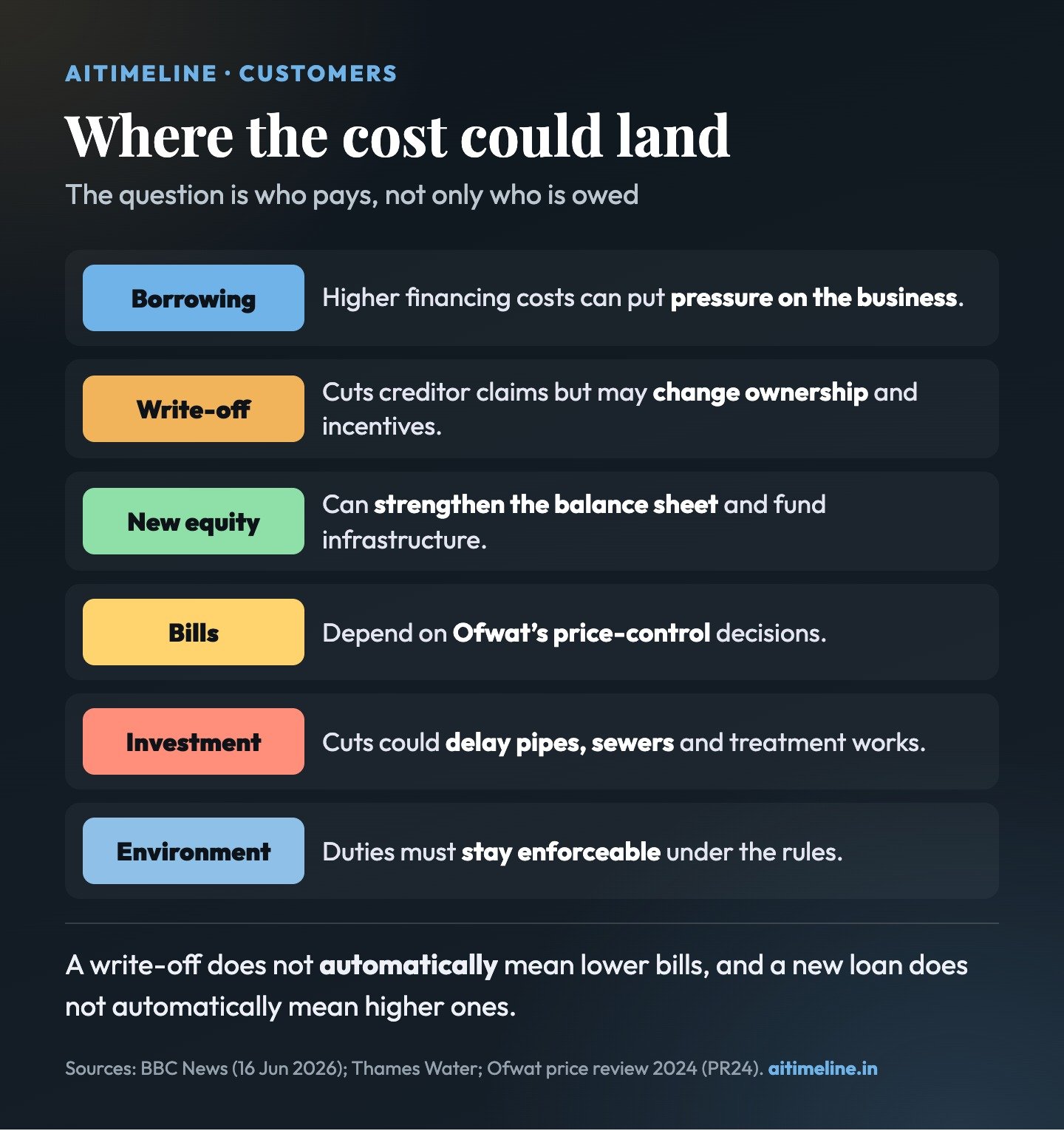
A debt write-off does not automatically mean customers pay less. Equally, a new creditor loan does not automatically mean its full cost lands on household bills. Ofwat’s decisions and the final terms of any rescue will decide how the cost is shared. Environment Secretary Emma Reynolds said she did not want customers to “pick up the bill for the company’s failures”, while L&VW said its plan did not anticipate bill rises beyond those set by Ofwat.
Sewage pollution is part of the same debate. Thames Water has faced sustained criticism over discharges and leakage, and creditors asked for leniency from future pollution fines. A rescue that cut debt but weakened environmental commitments would leave a major part of the crisis unresolved.
What Special Administration Would Mean
Special administration is a legal regime designed to keep essential water and wastewater services running if a company becomes insolvent. Households would not lose drinking water, as BBC News noted. An administrator would work towards a rescue, transfer or sale rather than permanent nationalisation, but it would raise hard questions for government about financing investment and what happens to existing debt and ownership.
As of 24 November 2026 it remained a contingency, not an implemented decision.
Conclusion: A Rescue Is Not a Turnaround
Thames Water’s crisis has grown from a debt problem into a test of Britain’s privatised water model. Emergency lending has repeatedly prevented an immediate collapse, but it has not settled the company’s debt, ownership or infrastructure needs.
The November 2026 interim restructuring is another attempt to buy time. The larger question remains open: how to build a financially sustainable company without weakening what it owes customers and the environment, and whether the cost of failure falls on investors, creditors, taxpayers or households.
Explore More Timelines
People Also Ask
Frequently Asked Questions
⚠️ Editorial Note
Debt figures use different periods and entities. Statements on 2026 events follow Thames Water’s own announcements, Reuters and BBC News. The Commons committee report is cited from its published summary and press coverage because the page blocks automated checks. The creditor proposals, emergency funding increases and interim restructuring steps are not completed transactions, and the November 2026 plan remains subject to creditor and court processes.
Related Stories
Sources & further reading
Every dated entry above was checked against these references. Last reviewed 24 November 2026.
- Thames Water: Recapitalisation Update, Proposed Transaction to Extend Debt Maturities (9 Nov 2026)
- Thames Water: Agreement Reached with Class B Creditors (16 Oct 2026)
- Reuters via Euronext: Thames Water seeks 2.4 billion pounds more emergency funding (15 Oct 2026)
- BBC News: Thames Water moves step closer to nationalisation after government objects to rescue deal (16 Jun 2026)
- Thames Water: Restructuring plan sanctioned (18 Feb 2025)
- High Court: Re Thames Water Utilities Holdings, sanction judgment [2025] EWHC 338 (Ch)
- Court of Appeal: Kington SARL v Thames Water [2025] EWCA Civ 475 (15 Apr 2025)
- House of Commons EFRA Committee: The Future of Thames Water and Special Administration (18 Sep 2026)
- Thames Water: Five-year plan 2025 to 2030