← AiTimeline Home

Cricket History · Kolkata · March 2001

2001 Eden Gardens Test: Why It Remains Cricket’s Greatest Comeback

📅 Updated 24 November 2026🏏 India v Australia, 2nd Test, 11-15 March 2001✎ By Nazish Fatima

View as Web Story

In short

Relive India's historic 2001 Eden Gardens Test comeback against Australia: Laxman's 281, Dravid's 180, Harbhajan's hat-trick and a 171-run victory.

Latest Story

The 2001 Eden Gardens Test is the match in which India, 274 runs behind and forced to follow on against a team that had won 16 Tests in a row, scored 657/7 and won by 171 runs. VVS Laxman made 281, Rahul Dravid 180 and Harbhajan Singh took 13 wickets, including India’s first Test hat-trick. Only twice before in Test history had a team won after following on.
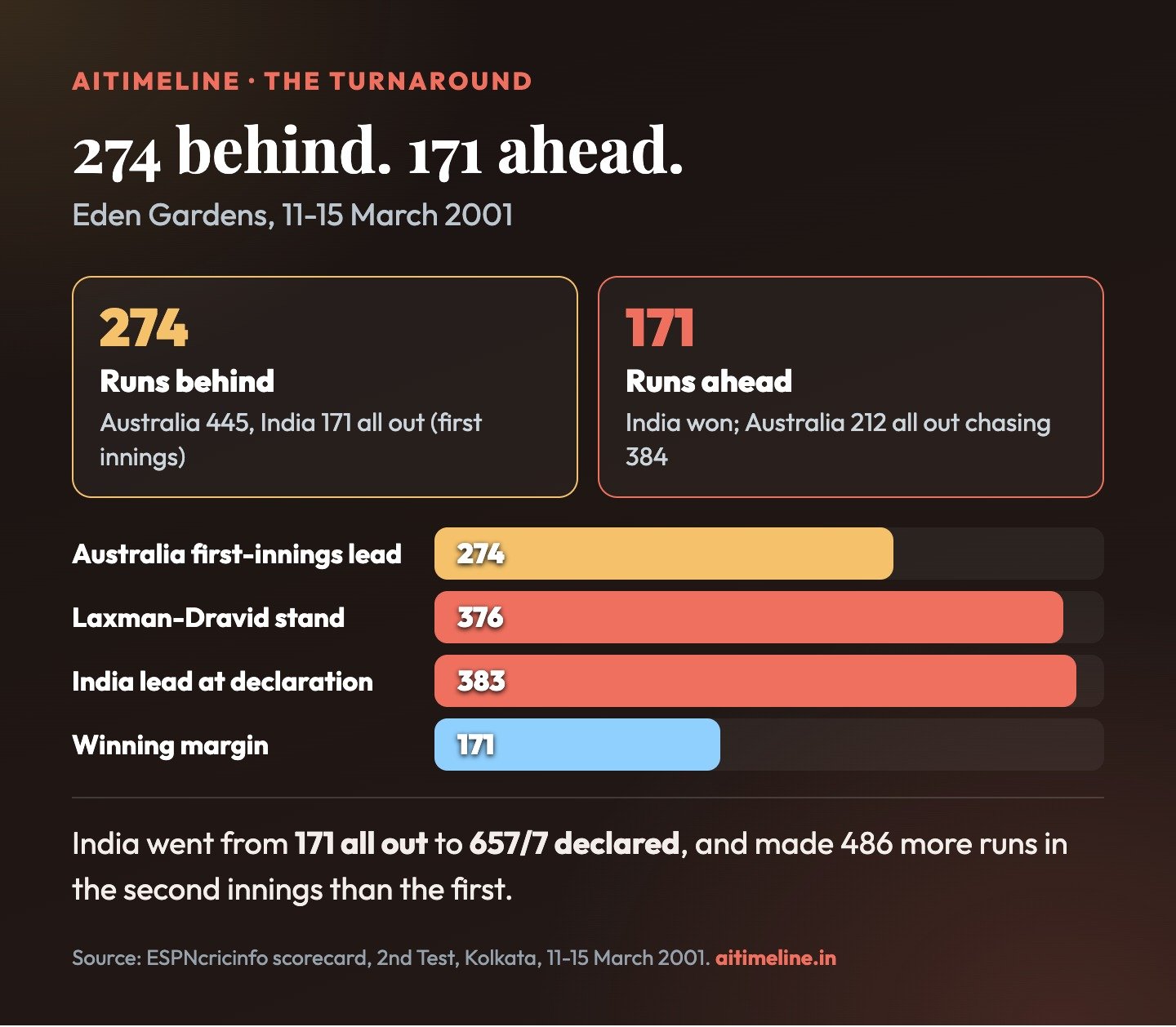
Eden Gardens 2001: India trailed by 274 runs after the first innings (Australia 445, India 171) and won by 171 runs. The Laxman-Dravid stand was 376, India led by 383 at the declaration, and Australia were bowled out for 212 chasing 384.
274 behind, then 171 ahead
Two details often misreported

Dravid joined Laxman on the evening of day 3, not on day 4: the stand began at 232/4 and India closed day 3 on 254/4. Laxman did not resume on the last morning needing a double century: he had passed 200 on day 4 and was 275 not out overnight, falling for 281 on day 5.

💡 Short Answer

At Eden Gardens, Kolkata, on 11-15 March 2001, India beat Australia by 171 runs after following on 274 behind. Australia made 445 and India 171; India then scored 657/7 declared, built on a 376-run fifth-wicket stand between VVS Laxman (281) and Rahul Dravid (180). Harbhajan Singh took 13/196 with a hat-trick. The win ended Australia’s run of 16 consecutive Test victories and levelled the series 1-1; India won it 2-1 at Chennai.

⚡ Eden Gardens 2001 at a Glance
Dates11-15 March 2001
ResultIndia won by 171 runs
First-innings deficit274 runs
Fifth-wicket stand376 (Laxman, Dravid)
Harbhajan13/196, hat-trick
Australia’s streak ended16 Test wins
⚡ Quick Answers — AI Overview Ready

2001 Eden Gardens Test: Key Questions

What happened in the 2001 Eden Gardens Test?
India, bowled out for 171 and made to follow on 274 behind, scored 657/7 declared and bowled Australia out for 212 to win by 171 runs. Laxman made 281, Dravid 180 and Harbhajan Singh took 13 wickets.
How big was the Laxman-Dravid partnership?
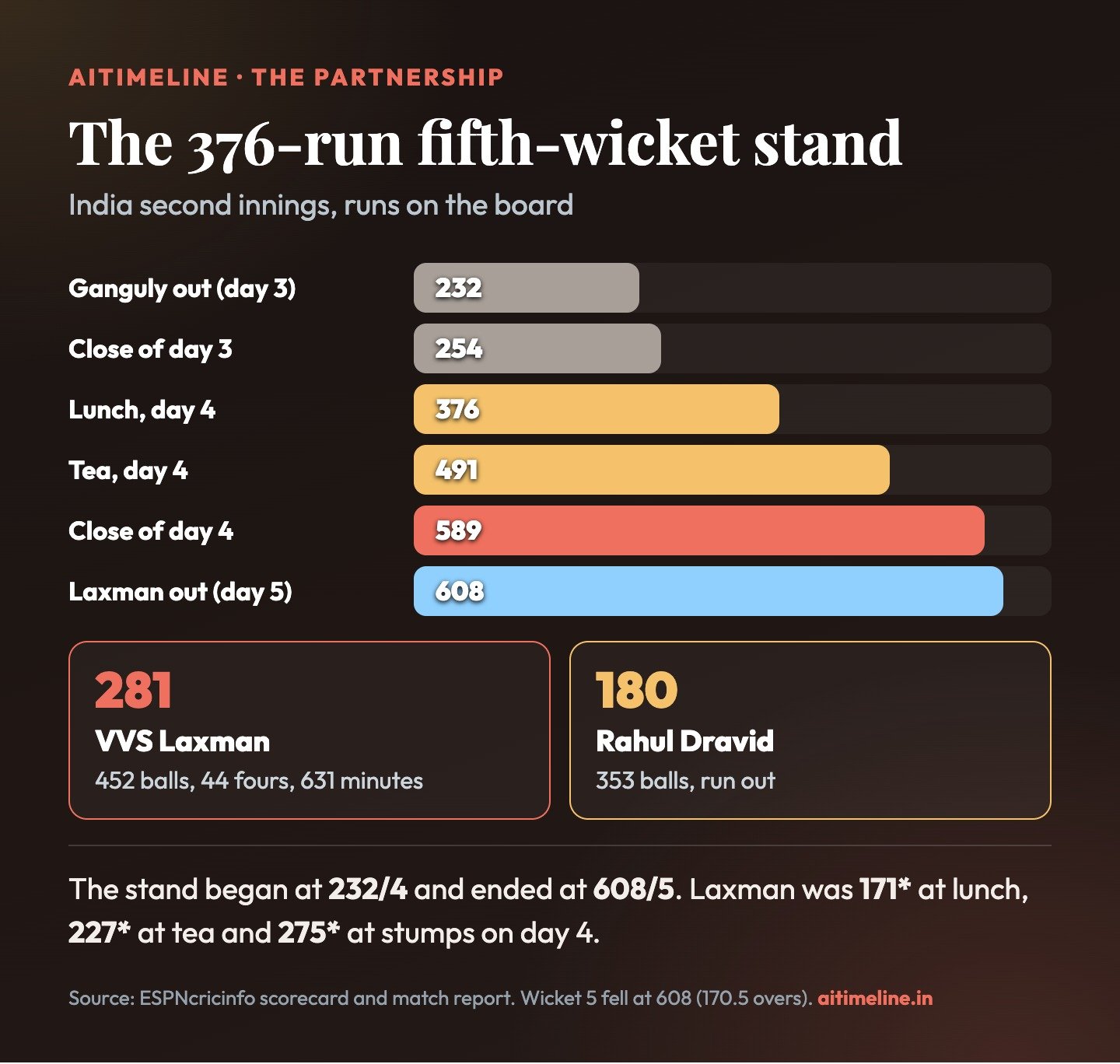
376 runs for the fifth wicket, from 232/4 to 608/5. India added 335 on day 4 without losing a wicket, and the stand ended when Laxman was caught at gully off McGrath on the final morning.
Who took the hat-trick?
Harbhajan Singh, on day 1, dismissing Ricky Ponting, Adam Gilchrist and Shane Warne with successive balls. It was the first Test hat-trick by an Indian bowler.
Has any other team won after following on?
Yes. England did it twice against Australia (1894-95 and 1981), and New Zealand beat England at Wellington in 2023. India’s was the third such win, and the largest by margin.
📚 Key Takeaways

What Happened at Eden Gardens

  • Day 1: Australia reached 291/8; Harbhajan took a hat-trick at 252/4.
  • Day 2: Steve Waugh made 110 and Australia 445; India closed on 128/8.
  • Day 3: India were out for 171, followed on, and closed at 254/4 with Laxman on 109.
  • Day 4: Laxman and Dravid batted all day; India finished on 589/4.
  • Day 5: India declared at 657/7 and Australia collapsed to 212.
  • Laxman moved up to No. 3 for the second innings and made 281, then the highest Test score by an Indian.
  • Tendulkar took 3/31 with leg-spin, including Gilchrist first ball.
  • The series: Mumbai went to Australia by 10 wickets; India won Kolkata and then Chennai by 2 wickets.

Day by Day: The Eden Gardens Test

Newest first. Labels mark build-up, setbacks, turning points, results and context.
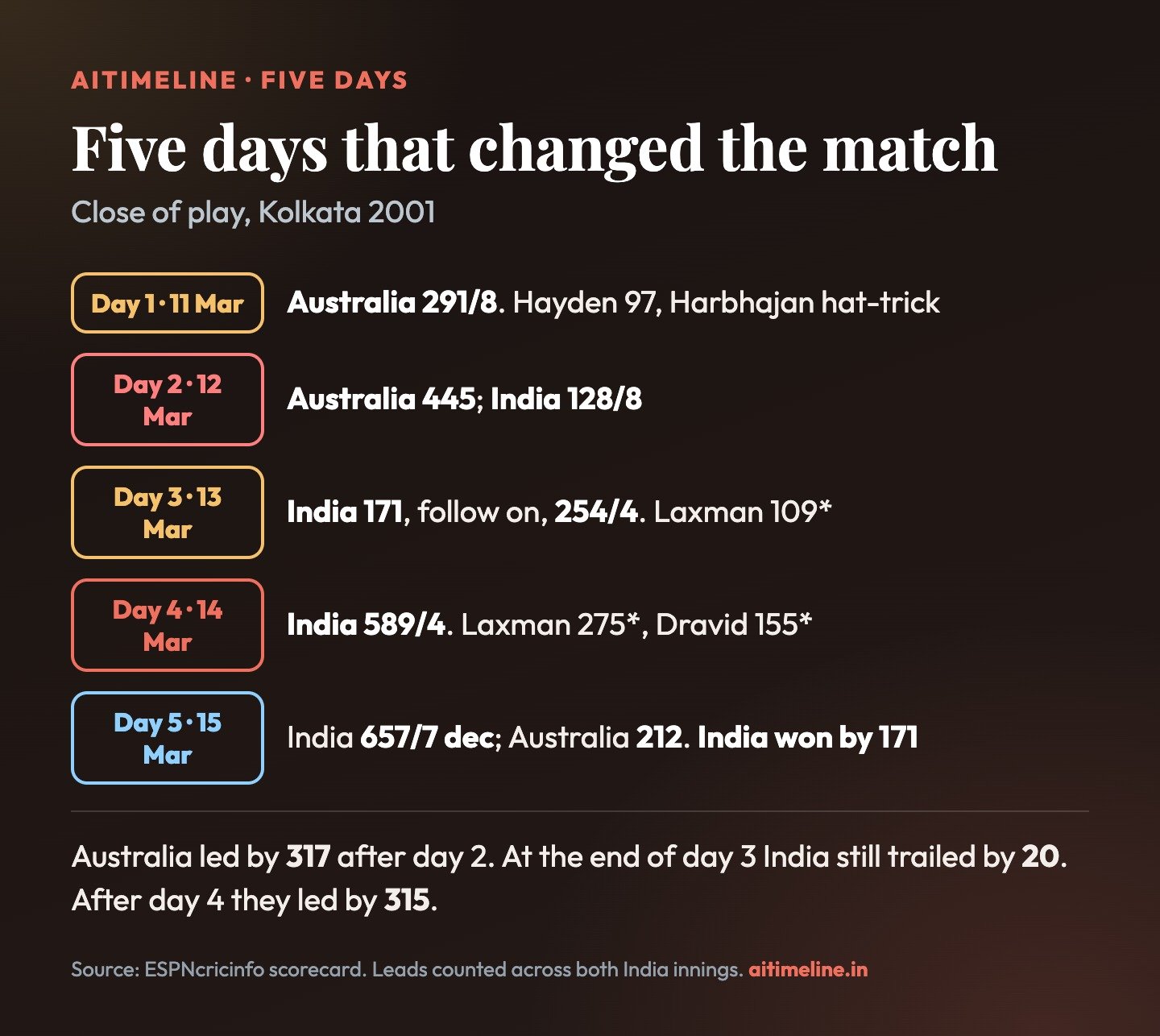
Close of play at Eden Gardens 2001: day 1 Australia 291/8; day 2 Australia 445, India 128/8; day 3 India 171 and 254/4 with Laxman 109 not out; day 4 India 589/4 with Laxman 275 not out and Dravid 155 not out; day 5 India 657/7 declared, Australia 212, India won by 171 runs.
Close of play, day by day
Since

The follow-on myth is only half true Context

Cricket Australia analysis, 15 March 2021Follow-on rate, 1971-2021

What the data shows: Cricket Australia’s analysis found the follow-on was enforced in 10.44% of Tests in the 30 years before Kolkata (89 times in 852 Tests) and in 11.18% of the 20 years after (98 times in 876). Australia’s own rate was 6.94% before and 6.36% after.

What did change: Steve Waugh enforced the follow-on in all seven later Tests where it was possible. His successors Ricky Ponting and Adam Gilchrist chose to do so in only four of 14 chances.

Waugh enforced it again five months later, against England at The Oval in 2001.
Context

Only the third follow-on win in Test history at the time Context

ESPNcricinfo match report, 15 March 2001Fourth instance: Wellington, 2023

The list: England beat Australia by 10 runs at Sydney in 1894-95 and by 18 runs at Headingley in 1981. India’s 171-run win in 2001 was the third, and Australia lost all three. New Zealand later beat England by 1 run at Wellington in February 2023.

Why Kolkata stands apart: It remains the only one of the four won by a large margin: 171 runs, against 10, 18 and 1.

In 1894-95 and 1981 England won by narrow margins; India’s winning margin is the largest of the four.
22 Mar 2001

Chennai: India clinch the series 2-1 Result

3rd Test, MA Chidambaram Stadium18-22 March 2001

Result: India won the deciding Test by 2 wickets on the fifth day and took the Border-Gavaskar Trophy 2-1. The first Test in Mumbai had gone to Australia by 10 wickets.

Awards: Harbhajan Singh was Man of the Series. He shared Man of the Match at Chennai with Matthew Hayden.

Kolkata levelled the series 1-1; Chennai won it.
15 Mar 2001, afternoon

Australia collapse from 166/3 to 212 all out Result

Target: 384 in 75 oversAustralia 212 all out in 68.3 overs

The chase: Hayden (67) and Michael Slater (43) put on 74 for the first wicket. At tea Australia were 161/3 (Hayden 59, Steve Waugh 23). Waugh, dropped just before tea, was caught by substitute Hemang Badani at backward short leg for 24.

Five for eight: From 166/3 Australia lost five wickets for 8 runs. Ponting was caught at short leg by Shiv Sunder Das, Gilchrist was lbw to Tendulkar first ball for a king pair, Hayden was lbw to Tendulkar and Warne was lbw to Tendulkar.

The finish: Harbhajan Singh took 6/73; Tendulkar’s part-time leg-spin gave him 3/31. Glenn McGrath, lbw to Harbhajan, was the last wicket and India won by 171 runs.

Gilchrist, who had won all 15 of his previous Tests, was out first ball in both innings.
15 Mar 2001, morning

Laxman falls for 281; India declare at 657/7 Turning point

Laxman c Ponting b McGrathDravid run out for 180

Laxman’s innings: Laxman added six more runs on the final morning, slashing at a short wide ball from McGrath and being caught by Ponting at gully. He had batted 631 minutes and faced 452 balls with 44 fours. It was then the highest Test score by an Indian, passing Sunil Gavaskar’s 236 not out.

Dravid and the declaration: Dravid was run out for 180 off 353 balls, with Zaheer Khan (23 not out) and Harbhajan Singh (8 not out) finishing the innings. Sourav Ganguly declared at 657/7 after 178 overs, leaving Australia 384 to win in 75 overs.

Virender Sehwag’s 309 at Multan in 2004 later passed Laxman’s 281 as India’s highest Test score.
14 Mar 2001

Day 4: Laxman and Dravid bat all day Turning point

India 254/4 to 589/4No wicket fell all day

The three sessions: India added 335 runs in about 90 overs without losing a wicket. They were 376/4 at lunch (Laxman 171, Dravid 50), 491/4 at tea (227, 106) and 589/4 at stumps (275, 155).

Milestones: Laxman reached 200 off 304 balls and passed Gavaskar’s 236 not out on 237. Dravid reached 100 off 205 balls and 150 off 303. Australia’s attack of McGrath, Gillespie, Kasprowicz and Warne could not break through.

By the close of day 4, India led by 315 runs having started the day 20 behind.
13 Mar 2001, evening

Following on, India lose Ganguly at 232/4 Turning point

India 254/4 at stumpsLaxman 109 not out, Dravid 7 not out

The start: Shiv Sunder Das and Sadagoppan Ramesh (30) added 52 for the first wicket. Laxman, promoted to No. 3 for the second innings, came in at 52/1 and added 45 with Das (39). He reached 50 off 93 balls and a hundred off 166 balls with 17 fours.

The fifth wicket: Sachin Tendulkar fell for 10 and Ganguly for 48, leaving India 232/4. Dravid, who had come in at No. 6, joined Laxman there. At stumps India were 254/4, still 20 runs behind.

Dravid joined Laxman on the third evening, not day 4: the partnership began at 232/4 on day 3.
13 Mar 2001, morning

India 171 all out; Waugh enforces the follow-on Setback

Australia lead by 274McGrath 4/18

The collapse: India resumed at 128/8 and were bowled out for 171 in 58.1 overs. McGrath took 4/18 and Laxman, caught by Hayden off Warne, top-scored with 59.

The decision: Waugh asked India to bat again. In his autobiography he said the intention was to keep India pinned down after their Mumbai defeat, and that the decision was taken after a brief discussion with the team and coach John Buchanan.

India had been 0/1 after 1.3 overs, and 88/5 at one stage.
12 Mar 2001

Day 2: Steve Waugh’s 110 and Australia’s 445 Build-up

Australia 445 all out in 131.5 oversHarbhajan Singh 7/123

The lower order: Waugh scored 110 off 203 balls, his first Test hundred in India. He added 133 for the ninth wicket with Jason Gillespie (46).

India’s reply: Harbhajan finished with 7/123. India then slipped to 128/8 at the close, with Laxman 26 not out. Warne bowled Dravid for 25.

At the end of day 2 Australia led by 317 runs.
11 Mar 2001, afternoon

Harbhajan takes the first Indian Test hat-trick Turning point

Over 72, Australia 252/4 to 252/7Ponting, Gilchrist, Warne

The three balls: Harbhajan Singh had Ricky Ponting lbw for 6, Adam Gilchrist lbw first ball for 0, and Shane Warne caught at short leg by Sadagoppan Ramesh for 0.

The effect: Australia went from 252/4 to 252/7. Steve Waugh then held the innings together, and Australia ended day 1 at 291/8.

It was the first hat-trick in Test cricket by an Indian bowler.
11 Mar 2001, morning

Day 1: Hayden and Langer give Australia control Build-up

Australia won the tossAustralia 193/1 at tea

The start: Michael Slater (42) and Matthew Hayden added 103 for the first wicket. Hayden made 97 and Justin Langer 58 as Australia reached 193/1 at tea.

The captains: Steve Waugh led Australia and Sourav Ganguly led India. Australia were 88/0 at lunch, with Slater and Hayden both on 41.

Hayden was dismissed for 97, caught by substitute Hemang Badani off Harbhajan Singh.

Mumbai: a 10-wicket defeat sets the stage Build-up

1st Test, Wankhede StadiumAustralia won by 10 wickets

The match: India made 176 in their first innings. Australia were 99/5 in reply before Gilchrist and Hayden added 197 for the sixth wicket in 32 overs, and Gilchrist scored a century off 84 balls.

The streak: Steve Waugh’s Australia arrived at Eden Gardens with 16 consecutive Test wins. Ricky Ponting’s team later equalled that record, about seven years later.

Waugh chose to bowl first in Mumbai, citing a run of 30 straight innings in which his side had bowled the opposition out.

The 376-Run Partnership

The Laxman-Dravid stand in runs on the board: Ganguly out at 232 on day 3, close of day 3 254, lunch day 4 376, tea day 4 491, close of day 4 589, Laxman out at 608 on day 5. Laxman scored 281 off 452 balls with 44 fours; Dravid 180 off 353 balls, run out.
From 232/4 to 608/5

The partnership took India from a position in which defeat in two days looked likely to a lead of 315 by the end of day 4. Laxman scored quickly and Dravid, who had lost his No. 3 place, absorbed pressure. The two scored at nearly four runs an over against an attack of McGrath, Gillespie, Kasprowicz and Warne, and none of them took a wicket on day 4.

Harbhajan Singh’s Hat-trick
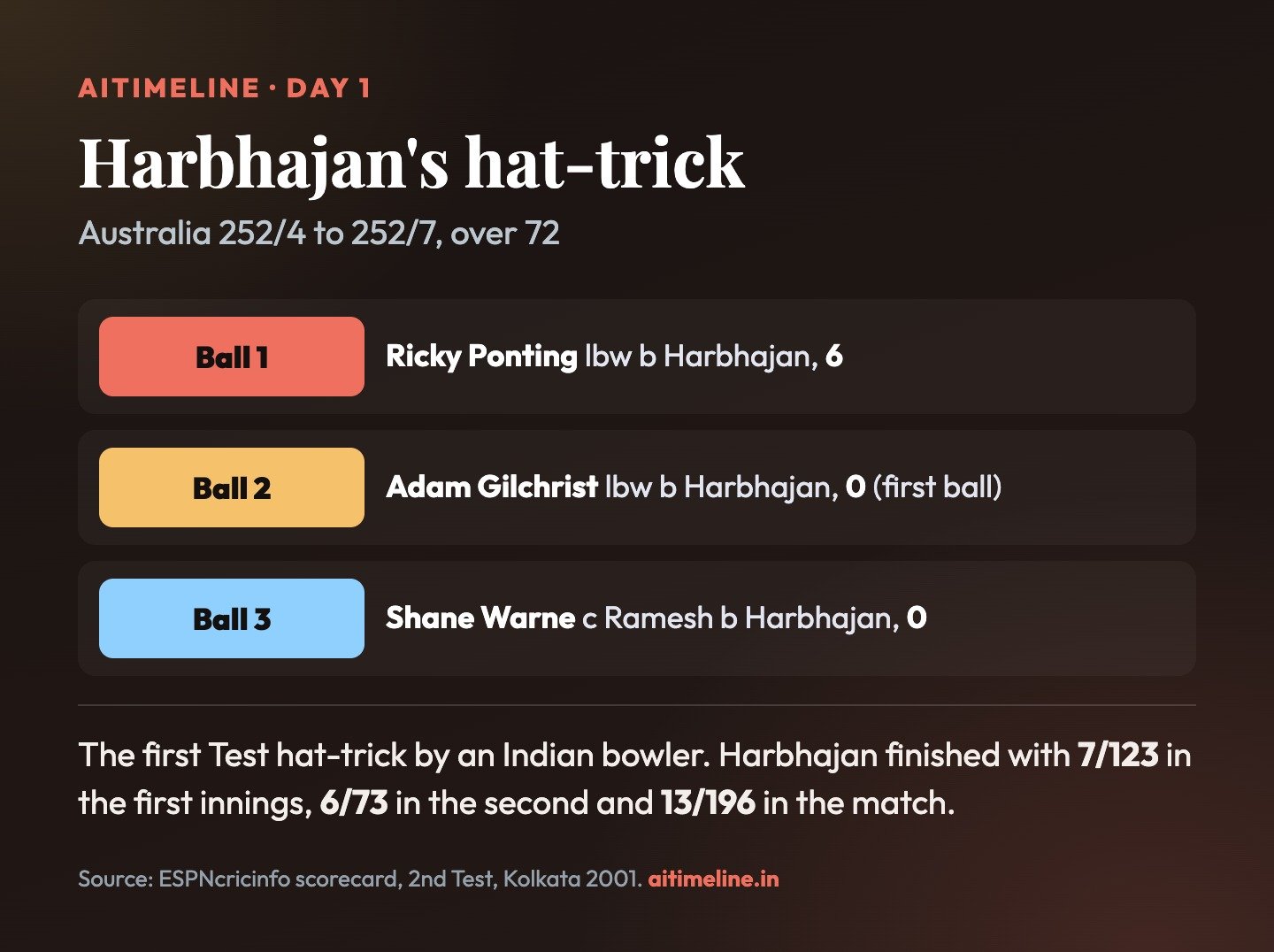
Harbhajan Singh took a hat-trick on day 1: Ricky Ponting lbw for 6, Adam Gilchrist lbw for 0 and Shane Warne caught by Ramesh at short leg for 0, taking Australia from 252/4 to 252/7. It was the first Test hat-trick by an Indian. He finished with 7/123 and 6/73, 13/196 in the match.
Australia 252/4 to 252/7

The hat-trick briefly took India back into the match, but Steve Waugh’s 110 and a 133-run ninth-wicket stand with Gillespie rebuilt Australia’s innings. Harbhajan then took 6/73 on the final day, as the pitch wore and Australia chased 384.

Where Kolkata Sits Among Follow-on Wins
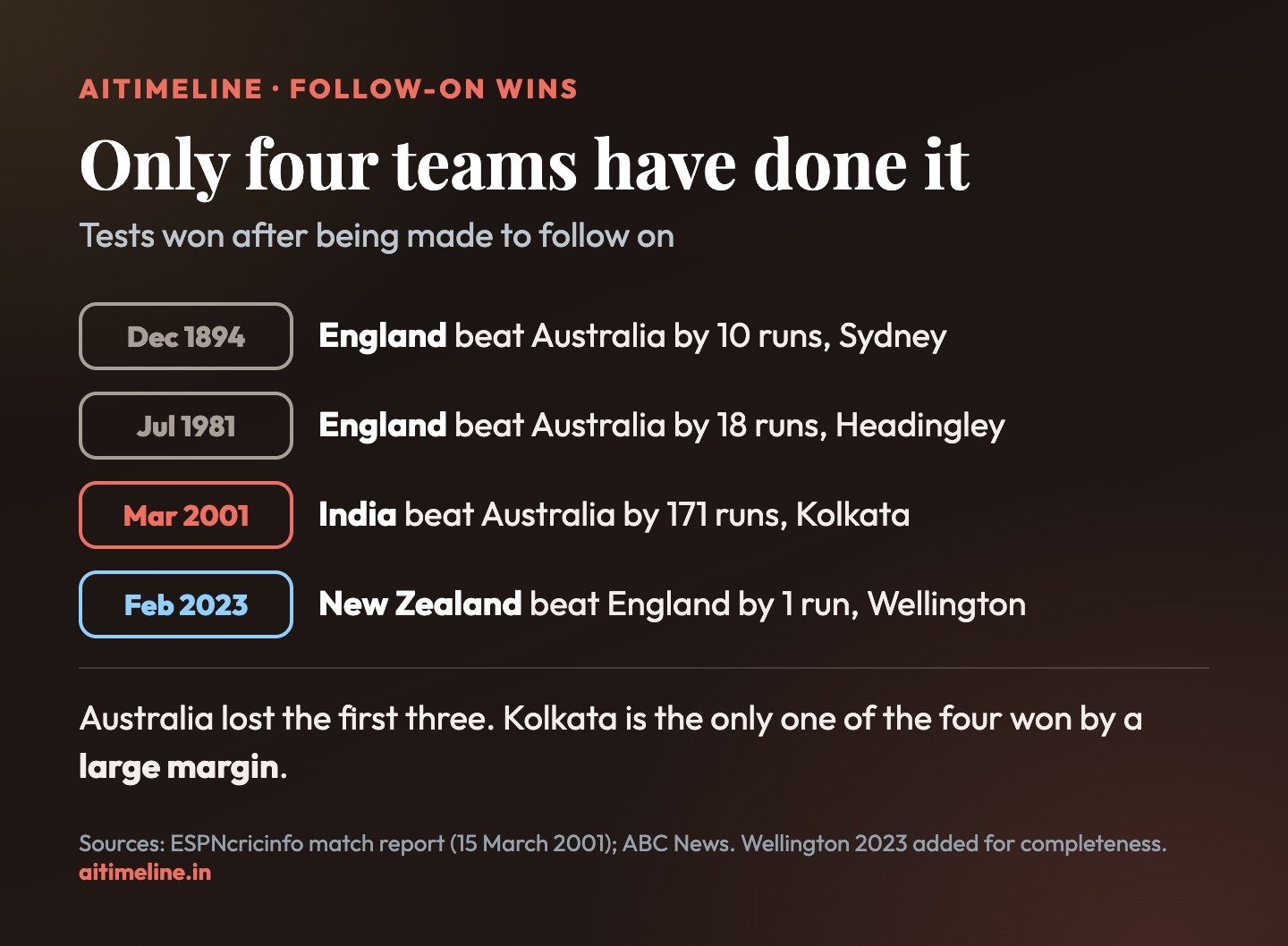
Tests won after following on: England beat Australia by 10 runs at Sydney in December 1894; England beat Australia by 18 runs at Headingley in July 1981; India beat Australia by 171 runs at Kolkata in March 2001; New Zealand beat England by 1 run at Wellington in February 2023. Kolkata is the largest margin of the four.
Four follow-on wins in Test history
MatchWinnerMargin
Sydney, 1894-95England10 runs
Headingley, 1981England18 runs
Kolkata, 2001India171 runs
Wellington, 2023New Zealand1 run

From a Mumbai Defeat to a 2-1 Series Win
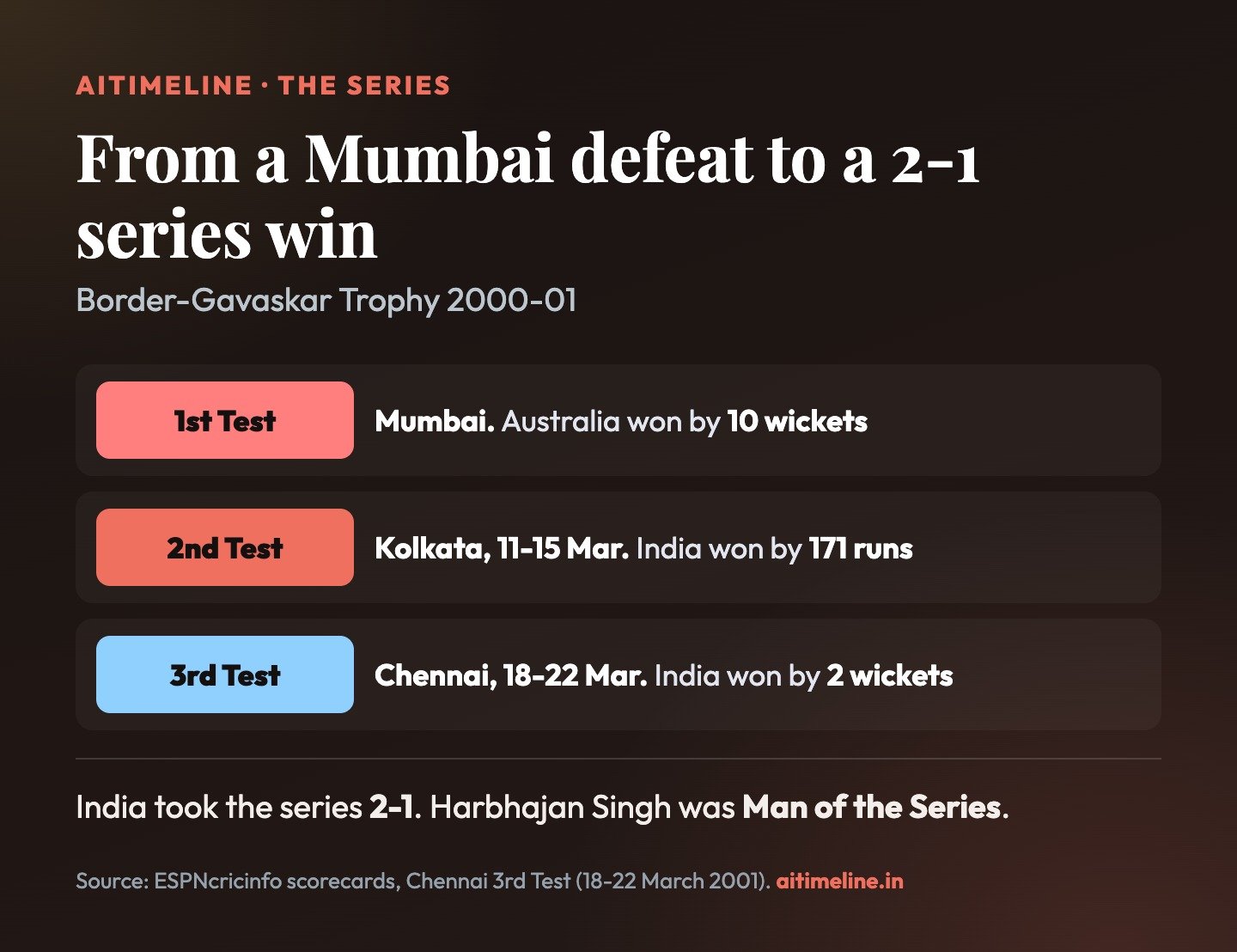
The 2001 Border-Gavaskar Trophy: first Test at Mumbai, Australia won by 10 wickets; second Test at Kolkata, 11-15 March, India won by 171 runs; third Test at Chennai, 18-22 March, India won by 2 wickets. India won the series 2-1 and Harbhajan Singh was Man of the Series.
Border-Gavaskar Trophy 2000-01

India lost the first Test in Mumbai by 10 wickets, with Australia recovering from 99/5. Kolkata levelled the series; Chennai, decided by 2 wickets on 22 March, won it. The comeback is remembered largely for the second Test, but the series needed both wins.

Four Match Winners
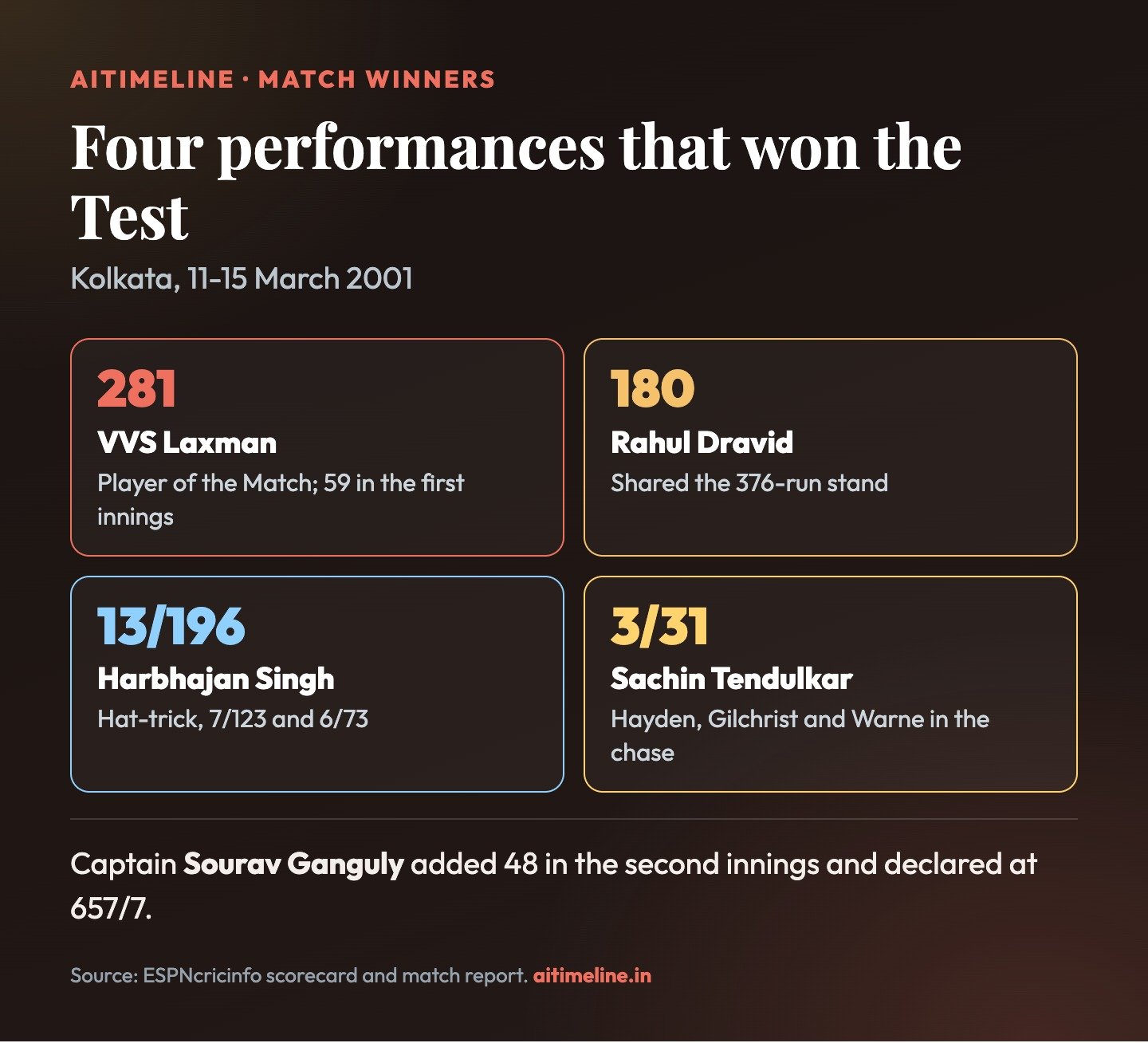
Four performances at Eden Gardens 2001: VVS Laxman 281 and Player of the Match; Rahul Dravid 180; Harbhajan Singh 13/196 with a hat-trick; Sachin Tendulkar 3/31, dismissing Hayden, Gilchrist and Warne. Sourav Ganguly added 48 and declared at 657/7.
Laxman, Dravid, Harbhajan and Tendulkar

Scorecard Summary

InningsScoreTop performers
Australia 1st445 (131.5 ov)S Waugh 110, Hayden 97, Langer 58; Harbhajan 7/123
India 1st171 (58.1 ov)Laxman 59, Dravid 25; McGrath 4/18
India 2nd (f/o)657/7 dec (178 ov)Laxman 281, Dravid 180, Ganguly 48, Das 39
Australia 2nd212 (68.3 ov)Hayden 67, Slater 43; Harbhajan 6/73, Tendulkar 3/31
ResultIndia won by 171 runs. Player of the Match: VVS Laxman

Source: ESPNcricinfo scorecard, Test no. 1535.

Conclusion: What the Result Changed

The match is remembered for what it showed rather than for a single moment. A team that had won 16 straight Tests and held a 274-run lead could still lose, and the player who turned it, Laxman, had been moved up the order only for the second innings. India went on to win the series at Chennai.

It did not end Australia’s era. Ponting’s team later equalled the 16-win streak, and Cricket Australia’s own data suggests the follow-on was enforced about as often afterwards as before. What Kolkata gave Indian cricket was a template: a long second innings, built on patience, against the best side in the world.

Explore More Timelines

People Also Ask

Why is the 2001 Eden Gardens Test so famous?
India won by 171 runs after following on 274 runs behind, ending Australia's run of 16 consecutive Test wins. VVS Laxman scored 281, Rahul Dravid 180 and Harbhajan Singh took 13 wickets, including India's first Test hat-trick. It was only the third Test win after a follow-on.
How many Test wins have come after following on?
Four. England beat Australia at Sydney in 1894-95 (by 10 runs) and at Headingley in 1981 (by 18 runs), India beat Australia at Kolkata in 2001 (by 171 runs), and New Zealand beat England at Wellington in 2023 (by 1 run). Kolkata is the largest margin.
How big was the Laxman-Dravid partnership?
376 runs for the fifth wicket, from 232/4 to 608/5. It began on the evening of day 3, lasted all of day 4 without a wicket falling, and ended on day 5 when Laxman was caught by Ponting off McGrath for 281.
Who took the hat-trick in the 2001 Kolkata Test?
Harbhajan Singh, on day 1. He dismissed Ricky Ponting lbw, Adam Gilchrist lbw first ball and Shane Warne caught at short leg by Sadagoppan Ramesh, taking Australia from 252/4 to 252/7. It was the first hat-trick by an Indian bowler in Tests.
Why did Steve Waugh enforce the follow-on?
Australia led by 274 after bowling India out for 171. Waugh wrote that he wanted to keep India pinned down after their Mumbai defeat, and the decision was taken after a brief discussion with the team and coach John Buchanan. The result showed the risk, though not that it was an obviously wrong call.

Frequently Asked Questions

What was the final scorecard of the Kolkata Test?
Australia 445 and 212; India 171 and 657/7 declared. India won by 171 runs on 15 March 2001. Australia needed 384 in 75 overs on the final day and were bowled out in 68.3 overs.
When and where was the match played?
At Eden Gardens, Kolkata, from 11 to 15 March 2001. It was the second Test of the three-match Border-Gavaskar Trophy series between India and Australia.
Who was Player of the Match and Player of the Series?
VVS Laxman was Player of the Match in Kolkata. Harbhajan Singh was Man of the Series for the three-Test series, and shared Man of the Match at Chennai with Matthew Hayden.
How many runs did VVS Laxman score and how long did he bat?
He scored 281 off 452 balls with 44 fours in the second innings, batting for 631 minutes. He had scored 59 in the first innings, and was Player of the Match.
Was Laxman's 281 India's highest Test score?
At the time, yes: it passed Sunil Gavaskar's 236 not out. Virender Sehwag's 309 at Multan in 2004 later became India's highest. Laxman's 281 remains one of the best-known innings in Indian Test history.
How did Rahul Dravid get out for 180?
He was run out, after batting 353 balls, while India tried to speed up the scoring before declaring. The dismissal came at 629/7 on day 5, after Laxman had fallen at 608/5.
Where did Laxman bat in the second innings?
At No. 3, ahead of Tendulkar and Ganguly. He had batted No. 6 in the first innings. Dravid came in at No. 6 in the second innings and joined Laxman after Ganguly fell at 232/4.
What was the score at the end of each day?
Day 1: Australia 291/8. Day 2: Australia 445, India 128/8. Day 3: India 171 and 254/4. Day 4: India 589/4. Day 5: India won by 171 runs.
How many Tests had Australia won in a row?
Sixteen, a record at the time. The run ended at Eden Gardens. Ricky Ponting's team equalled the 16-win record about seven years later, according to Cricket Australia.
What happened in the Mumbai Test?
Australia won the first Test at Wankhede Stadium by 10 wickets. India made 176 in their first innings, and Gilchrist (a century off 84 balls) and Hayden added 197 for the sixth wicket after Australia were 99/5.
What happened in the Chennai Test?
India won the third Test at Chepauk by 2 wickets on 22 March 2001, winning the series 2-1. Harbhajan Singh was Man of the Series and shared Man of the Match with Matthew Hayden.
How many wickets did Harbhajan Singh take?
13 in the match for 196 runs: 7/123 in the first innings and 6/73 in the second. It included the hat-trick on day 1, when Australia went from 252/4 to 252/7.
What did Sachin Tendulkar do in the match?
He scored 10 in each innings and then took 3/31 in Australia's second innings with leg-spin. He dismissed Matthew Hayden (lbw), Adam Gilchrist (lbw, first ball) and Shane Warne (lbw).
What was Australia's target and how did they collapse?
The target was 384 off 75 overs. Hayden (67) and Slater (43) made a start, but Australia lost five wickets for eight runs from 166/3 and were all out for 212 in 68.3 overs.
Who captained the two teams?
Sourav Ganguly captained India and Steve Waugh captained Australia. Ganguly scored 23 and 48 and declared India's second innings at 657/7.
What was India's lead at the declaration?
383 runs: India's 171 plus 657 minus Australia's 445. Ganguly declared after 178 overs, leaving Australia 384 to win in 75 overs.
How many runs did India add on day 4?
335, from 254/4 to 589/4 in about 90 overs, without losing a wicket. Laxman went from 109 to 275 and Dravid from 7 to 155.
Did Steve Waugh score a hundred in the match?
Yes. He scored 110 off 203 balls in the first innings, his first Test century in India according to ESPNcricinfo, and added 133 for the ninth wicket with Jason Gillespie.
Did Australia stop enforcing the follow-on after 2001?
Not on the numbers. Cricket Australia found the follow-on rate across Tests rose from 10.44% in the 30 years before Kolkata to 11.18% in the 20 years after. Waugh enforced it in all seven later chances.
Was it the first follow-on win by India?
Yes. India had never before won a Test after being made to follow on. Australia were the losing side in all three of the first follow-on wins in Test history, in 1894-95, 1981 and 2001.
What was the margin of the first innings lead?
274 runs: Australia 445 against India's 171 all out. India were still 20 runs behind at the close of day 3, at 254/4 in their second innings.
Who batted with Laxman before Dravid?
Shiv Sunder Das and Sadagoppan Ramesh opened and added 52 (Ramesh 30). Laxman came in at 52/1 as the new No. 3 and added 45 with Das (39), then 18 with Tendulkar and 117 with Ganguly (48) before Dravid joined at 232/4.
What did Steve Waugh say about Laxman's innings?
He described it as some of the best batting he had ever seen, according to ESPNcricinfo's match report of 15 March 2001.
Why does the match still matter in Indian cricket?
It showed India could beat the strongest side in the world at home from a hopeless position. India then won the Chennai Test to take the series, and the match is still cited as a turning point in Indian Test cricket.

⚠️ Editorial Note

Scores, overs and times follow the ESPNcricinfo scorecard and match report for the Kolkata Test, and the Cricket Australia and ABC News analyses of the follow-on. Dates for the Mumbai Test are not given because they were not verified for this article. Quotes are attributed to the source named.

Related Stories

IMF Bailouts: A Timeline of Major Global Rescues Since 1976 BBC Charter Review: History, Licence Fee and What Comes Next
New article
→
Next Article