IMF Bailouts: A Timeline of Major Global Rescues Since 1976
Explore the history of major IMF bailouts since 1976, from Britain's sterling crisis and India's 1991 crisis to Asia, Greece, Argentina and Sri Lanka.
Latest Story
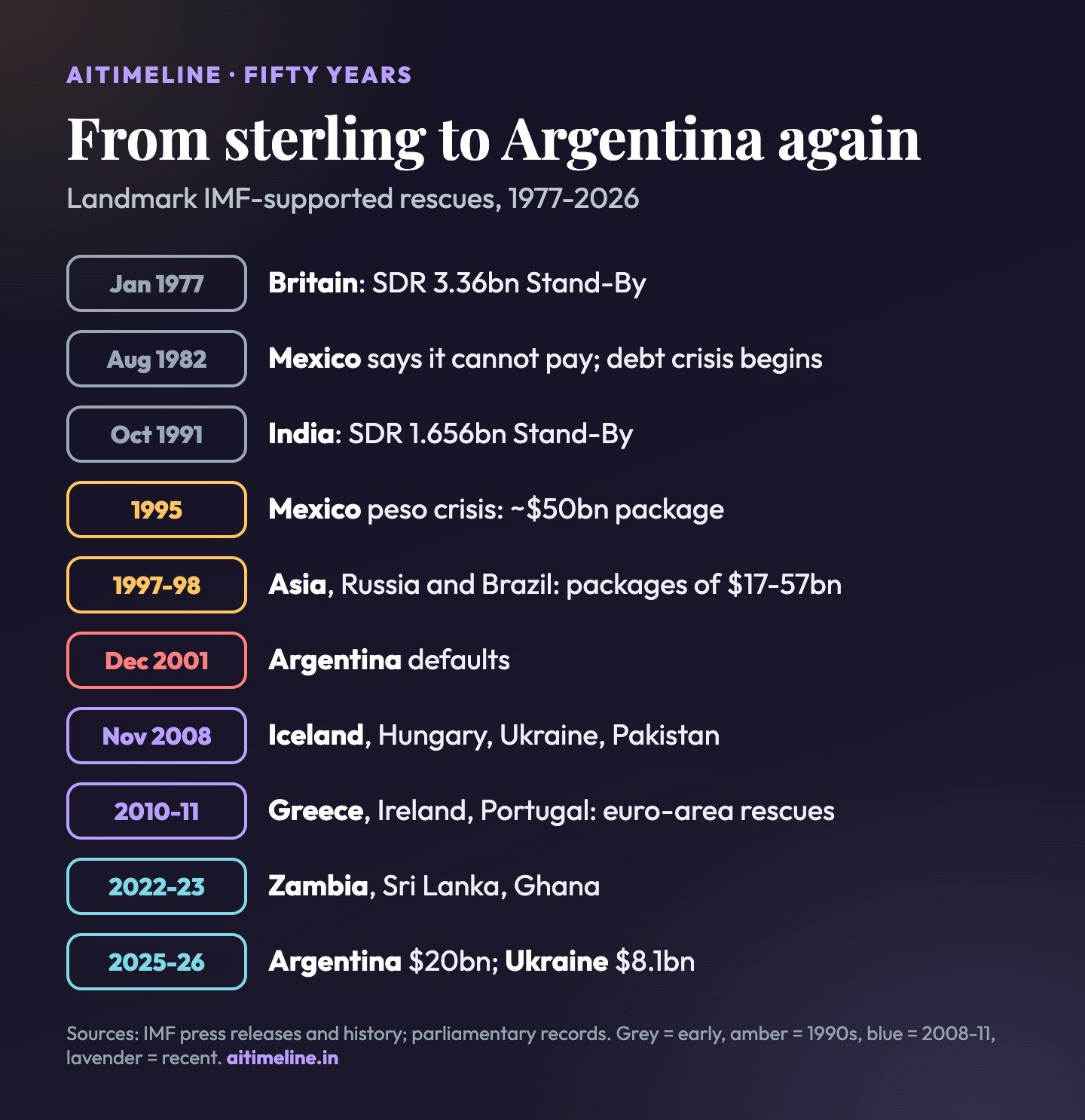
IMF bailouts are the rescues the International Monetary Fund organises when a country runs short of foreign currency, cannot repay external debt or loses market access. Since Britain’s stand-by in January 1977, IMF-supported programmes have met currency collapses, banking failures and sovereign defaults, from Mexico in 1982 and Asia in 1997 to Greece, Sri Lanka and Argentina’s US$20 billion programme in 2025. Some restored market access. Others became symbols of austerity and repeat borrowing.
A “bailout” has three different numbers. The approved amount is the most an arrangement allows, the disbursed amount is what the country has actually received, and the total package can include the World Bank, other governments and central banks. Headline sizes in this timeline are therefore not like for like; each entry says whose money is counted.
💡 Short Answer
An IMF bailout is IMF financing, usually paired with policy conditions, for a country in balance-of-payments trouble. Major cases since 1976 include Britain (SDR 3.36 billion, 1977), Mexico (1982 and 1995), South Korea (about US$57 billion, 1997), Greece (EUR 110 billion, 2010), Argentina (about US$57 billion in 2018 and US$20 billion in 2025), Sri Lanka (US$3 billion, 2023) and Ukraine (US$8.1 billion, February 2026). Headline totals often include money from other lenders.
What Is an IMF Bailout?
Three numbers that are often confused.
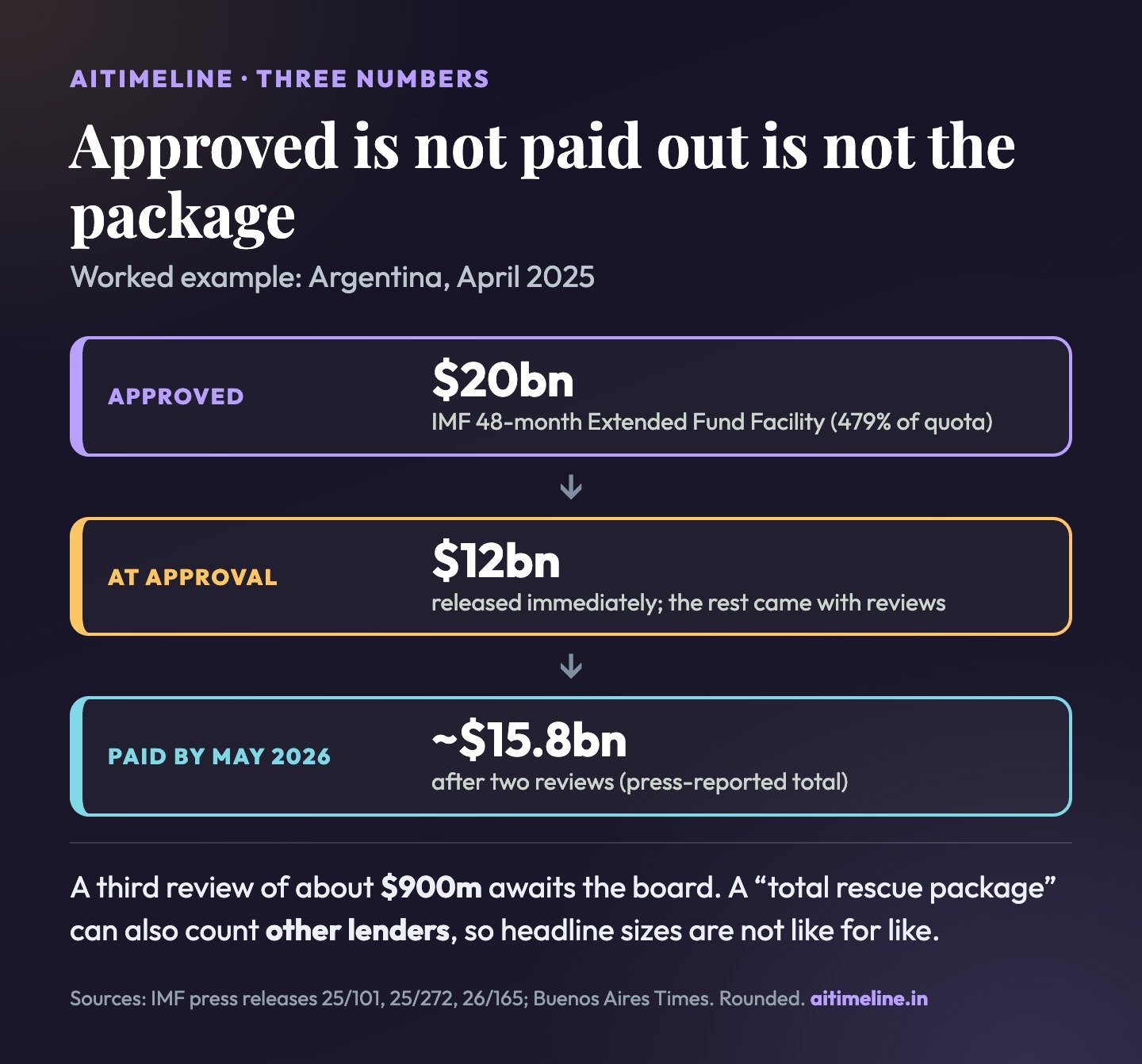
The IMF lends to member countries through arrangements such as the Stand-By Arrangement, the Extended Fund Facility and the Extended Credit Facility, and through emergency instruments. In return the government agrees to economic policies and periodic reviews, and each review can decide whether the next instalment is released.
The IMF is rarely the only lender. Governments, central banks, the World Bank and regional development banks often add their own money, so a “US$57 billion rescue” can contain far less IMF cash. Where a headline in this article is a total package, we say so.
IMF Bailouts: Key Questions
What Fifty Years of IMF Rescues Show
- 1977: Britain borrowed SDR 3.36 billion under a two-year stand-by approved on 3 January.
- 1982: Mexico’s inability to pay began a Latin American debt crisis that lasted most of a decade.
- 1991: India’s response was IMF drawings and an SDR 1,656 million stand-by plus reforms, not one cash transfer.
- 1997-98: Thailand, Indonesia and South Korea needed packages of about US$17, 23 and 57 billion; Russia and Brazil followed.
- 2001: Argentina’s fixed exchange rate collapsed into default.
- 2008-11: Iceland, Hungary, Ukraine and Pakistan, then Greece (EUR 110 billion), Ireland (EUR 85 billion) and Portugal (EUR 78 billion).
- 2020-22: COVID-19 emergency lending reached about US$170.6 billion for 90 countries.
- 2022-23: Zambia, Sri Lanka and Ghana took programmes of about US$1.3, 3 and 3 billion after defaults.
- 2025-26: Argentina signed a US$20 billion programme and Ukraine a US$8.1 billion one.
Timeline: Major IMF-Supported Rescues Since 1976
Newest first. Labels mark origins, crisis rescues, euro-area programmes, modern programmes and data.
Five programme reviews wait for IMF board decisions Data
What is queued: Argentina reached a staff-level agreement on its third review in late October, worth about US$900 million; the IMF said the board could consider it in early December. Sri Lanka’s next review is reported for 2 December (about US$345 million). Pakistan has a staff agreement on its fourth Extended Fund Facility review, with a December board date expected.
Also reported: On 18 November the IMF said it had reached agreement with Egypt to unlock about US$2.3 billion, subject to board approval. Ghana’s staff reached a deal on a new no-loan Policy Coordination Instrument, which also needs board approval.
Caution: These are instalments of programmes approved earlier, not new bailouts. Board dates come from press reports and can change.
Ukraine gets a new US$8.1 billion programme Modern
What was approved: The board approved an Extended Fund Facility of SDR 5.9353 billion (about US$8.1 billion, 295% of quota) and released about US$1.5 billion at once. Reuters reported that it replaced a US$15.5 billion programme approved in 2023.
Context: Staff had agreed the deal on 26 November 2025. The IMF put Ukraine’s 2026 financing gap at about US$52 billion, to be met by the IMF, EU arrangements, G7 funds and bilateral support within a wider package of US$136.5 billion.
Argentina signs its 23rd programme: US$20 billion Modern
Terms: A 48-month Extended Fund Facility of about US$20 billion (SDR 15.267 billion, 479% of quota). US$12 billion was available immediately; the rest was tied to reviews.
Why: Reuters counted it as Argentina’s 23rd IMF programme. The money was meant to help lift capital controls and rebuild reserves. It followed a US$44 billion arrangement approved in March 2022.
Since: The first review (31 July 2025) released about US$2 billion and the second (May 2026) about US$1 billion. A third review, about US$900 million, awaits the board.
Pakistan moves from a stand-by to a US$7 billion programme Modern
The bridge: In July 2023 the IMF approved a nine-month Stand-By Arrangement of SDR 2.25 billion (about US$3 billion) as reserves and external financing came under strain.
The longer programme: In September 2024 it approved a 37-month Extended Fund Facility of SDR 5.32 billion (about US$7 billion), centred on fiscal consolidation, energy-sector reform and rebuilding reserves. A Resilience and Sustainability Facility runs alongside it.
Ghana: a US$3 billion credit facility Modern
Terms: The board approved SDR 2.242 billion (about US$3 billion) after a crisis of high inflation, currency depreciation, rising public debt and difficulty servicing external obligations.
Link to restructuring: The programme sat inside a wider international effort to restructure Ghana’s debt, with IMF support conditional on credible financing assurances from creditors.
Sri Lanka: US$3 billion after its first sovereign default Modern
The default: In April 2022 Sri Lanka announced a suspension of external debt payments, its first sovereign default, amid shortages of fuel, food and medicines and a sharp fall in reserves.
The programme: The board approved SDR 2.286 billion (about US$3 billion) with about US$333 million released at once. It aimed to rebuild reserves, strengthen public finances and support debt restructuring while protecting vulnerable households.
Zambia: US$1.3 billion after Africa’s pandemic-era default Modern
Background: Zambia missed a Eurobond payment in November 2020 and became the first African country to default in the COVID-19 era. A long restructuring with bilateral and private creditors followed.
The programme: The board approved SDR 978.2 million (about US$1.3 billion) to restore macroeconomic stability, improve debt sustainability and create room for social spending.
COVID-19: an emergency lending wave, not one package Data
Scale: The tracker recorded about US$170.6 billion of financial assistance for 90 countries between March 2020 and March 2022, much of it through the Rapid Financing Instrument and the Rapid Credit Facility.
What it was: A series of country-specific emergency loans after tourism, trade and tax revenues collapsed and health spending rose. It was never a single bailout.
Ecuador: a US$4.2 billion programme meets street protests Modern
The deal: Ecuador agreed a US$4.2 billion Extended Fund Facility to address fiscal imbalances and support reforms.
The backlash: A decree ending fuel subsidies set off protests in October 2019. The government withdrew the measure and the programme was later revised.
Argentina: a record US$50 billion stand-by, later about US$57 billion Crisis
Terms: The IMF approved a US$50 billion Stand-By Arrangement in June 2018, later raised to about US$57 billion, after capital outflows and doubts about Argentina’s fiscal and external position weakened the peso.
Outcome: The peso kept falling and inflation stayed high. The programme became politically controversial, and only part of the headline amount was ever drawn.
Egypt: US$12 billion and a floated pound Modern
The programme: In November 2016 the board approved a three-year Extended Fund Facility of about US$12 billion, supporting a move to a more flexible exchange rate, lower energy subsidies and stronger public finances.
The cost: The currency adjustment and associated inflation squeezed household purchasing power. In March 2024 the IMF expanded an existing arrangement from about US$3 billion to US$8 billion.
Ukraine: a stand-by, then a US$17.5 billion extended facility Crisis
Programmes: After political upheaval, Russia’s annexation of Crimea and the conflict in the east, the IMF approved a Stand-By Arrangement (about US$17 billion) in April 2014. A larger Extended Fund Facility, about US$17.5 billion, replaced it in March 2015.
Aims: Stabilise public finances, reform the energy sector, strengthen banks and rebuild reserves. Continuing conflict made delivery difficult.
Greece: a second programme, a bond restructuring and a third in 2015 Europe
Why a second: The first programme did not restore debt sustainability or market confidence. A second was agreed in March 2012, combining European lending with an IMF facility.
The restructuring: The same month, private holders exchanged roughly EUR 200 billion of Greek government bonds in one of the largest sovereign restructurings on record, taking large losses.
2015: The third programme was financed through the European Stability Mechanism. The IMF did not provide new money under it.
Portugal: EUR 78 billion and an exit without a safety net Europe
The rescue: Portugal lost affordable market funding amid high debt, weak growth and fiscal worries. In May 2011 it agreed a EUR 78 billion package; the IMF committed about EUR 26 billion and European mechanisms the rest.
The deal: Fiscal consolidation and structural reforms were meant to restore market access. Portugal completed the programme in May 2014 without a precautionary credit line.
Ireland: banks first, then the sovereign Europe
The crisis: Ireland’s government had guaranteed its banks and, as the cost of rescuing them grew, it could no longer fund itself. It asked the IMF and EU for help in November 2010.
The money: The package was EUR 85 billion: EUR 67.5 billion from external lenders (the IMF contributing about EUR 22.5 billion) and EUR 17.5 billion from Ireland’s own resources.
Greece: EUR 110 billion, the first euro-area rescue Europe
The programme: On 9 May 2010 the board approved a three-year Stand-By Arrangement of EUR 30 billion as part of a EUR 110 billion package; euro-area countries supplied EUR 80 billion in bilateral loans.
The terms: Major fiscal adjustment, tax changes and structural reforms were required. Their social and economic consequences became one of the most debated results of any IMF programme.
Iceland: US$2.1 billion after its banks collapsed Crisis
The collapse: Iceland’s banking system failed when its largest banks could not refinance large foreign liabilities.
The programme: The board approved a two-year Stand-By Arrangement of SDR 1.4 billion (about US$2.1 billion) to stabilise the currency, restore confidence and restructure the banks. It equalled about 1,190% of Iceland’s quota, exceptional relative to its membership share.
Hungary, Ukraine and Pakistan follow within weeks Crisis
Hungary: An international package of about EUR 20 billion, with the IMF, the EU and the World Bank.
Ukraine and Pakistan: Ukraine received IMF support to stabilise its economy and banks. Pakistan secured a US$7.6 billion Stand-By Arrangement in November 2008 to address a balance-of-payments emergency.
Argentina: default and the corralito Crisis
Pressure: Argentina’s peso was fixed to the US dollar. Years of recession, rising public debt and falling investor confidence put the system under severe strain.
The collapse: Bank withdrawals were restricted (the corralito), protests and political instability followed, and in December 2001 Argentina defaulted on a large part of its sovereign debt. The IMF programme was suspended as the crisis deepened.
Brazil: US$41.5 billion to defend the real Crisis
The package: After Russia’s crisis made investors wary of emerging markets, an international package of about US$41.5 billion was announced in November 1998 to defend the currency and stabilise public finances.
The outcome: Brazil gave up its currency peg in mid-January 1999 and let the real float. It continued to work with the IMF under later arrangements.
Russia: a US$22.6 billion package, then default Crisis
The package: In July 1998 the IMF and other lenders announced about US$22.6 billion. Russia faced weak public finances, falling confidence, pressure on the ruble and difficulty servicing government debt.
What happened: On 17 August the government devalued, defaulted on domestic debt and imposed a moratorium on some payments. Only part of the announced money, a first instalment, had been released.
South Korea: a US$57 billion package Crisis
The shortage: Korean banks and large firms had borrowed heavily in short-term foreign currency. When lenders refused to roll the loans over, the country ran out of foreign exchange.
The deal: The IMF approved an exceptionally large arrangement on 3 December 1997 within a package of about US$57 billion. Corporate restructuring and banking reform followed.
Thailand and Indonesia: the crisis begins Crisis
Thailand: Thailand floated the baht on 2 July 1997. The currency fell sharply and capital fled across Asia. The IMF announced a programme of about US$17 billion in August.
Indonesia: Indonesia’s currency weakened, companies struggled with foreign-currency debt and confidence in the banks collapsed. An international package of about US$23 billion was announced on 31 October. Implementation became controversial amid political upheaval and President Suharto’s fall in May 1998.
HIPC: debt relief rather than new loans Data
The initiative: The IMF and World Bank launched the Heavily Indebted Poor Countries Initiative in 1996 to cut debt burdens judged unsustainable in eligible low-income countries.
The scale: By 2017, according to the IMF’s own timeline, debt relief for 36 countries under the initiative had reached almost US$77 billion.
Mexico’s tequila crisis: about US$50 billion Crisis
The crisis: Mexico devalued the peso in December 1994 after pressure on its currency and reserves. Investors withdrew capital quickly and the shock threatened other emerging markets.
The response: The United States and international institutions assembled a package of about US$50 billion in early 1995, with the IMF the largest single contributor.
India: a balance-of-payments crisis and a Stand-By Arrangement Origins
The crisis: In 1991 India’s foreign-exchange reserves fell to critically low levels, leaving it struggling to pay for imports and meet external obligations. The government pledged gold, devalued the rupee in July and began deregulating industry and trade.
The IMF money: In January 1991 India drew about SDR 552 million under a first-credit-tranche arrangement and SDR 717 million from the compensatory and contingency facility. On 31 October 1991 the board approved a Stand-By Arrangement of SDR 1,656 million.
Mexico cannot pay: the debt crisis begins Origins
The announcement: On 12 August 1982 Mexico told its creditors it could no longer meet its external debt payments on schedule. Years of heavy borrowing, rising world interest rates and falling confidence had drained reserves.
The response: The IMF approved an extended arrangement in December, linked to debt rescheduling and new lending from commercial banks and official creditors. The crisis spread to Brazil, Argentina, Chile and other economies and led to a decade of adjustment.
Britain: SDR 3.36 billion after the sterling crisis Origins
The programme: After inflation, weak growth, a falling pound and pressure on reserves, Britain submitted a stabilisation programme in December 1976. The IMF approved a two-year Stand-By Arrangement of SDR 3.36 billion on 3 January 1977.
The extras: The IMF’s General Arrangements to Borrow helped fund it, and a separate US$3 billion standby came from the Bank for International Settlements and participating central banks.
The IMF creates a concessional Trust Fund Origins
What it was: The Trust Fund provided concessional financing to eligible developing countries, paid for by selling part of the IMF’s gold.
Why it matters: It was not a bailout of any one country but an institutional change that shaped the IMF’s later concessional lending.
The Biggest Packages, Side by Side
Headline sizes at announcement. Do not read them as like for like.
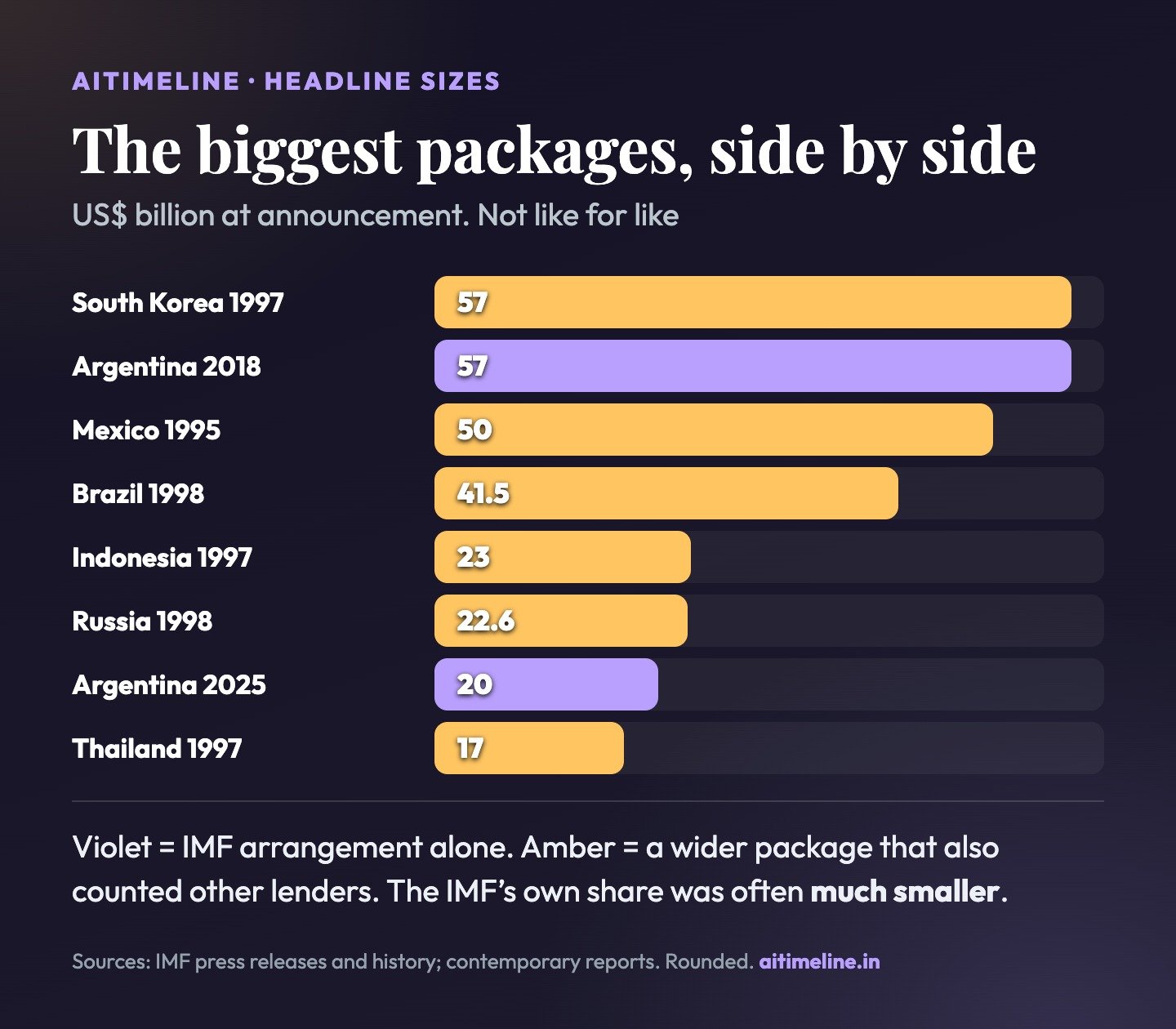
| Year | Country | Headline amount | What the number counts |
|---|---|---|---|
| 1977 | United Kingdom | SDR 3.36bn | IMF stand-by; separate US$3bn BIS facility |
| 1982 | Mexico | About US$3.8bn | IMF extended arrangement, December 1982 |
| 1991 | India | SDR 1,656m | Stand-By approved 31 Oct 1991, plus earlier drawings |
| 1995 | Mexico | About US$50bn | IMF (about US$17.8bn), US Treasury and others |
| 1997 | Thailand, Indonesia, South Korea | About US$17bn, 23bn, 57bn | IMF-led packages with other lenders |
| 1998 | Russia | About US$22.6bn | Announced; only a first instalment was paid |
| 1998 | Brazil | About US$41.5bn | IMF (about US$18bn) and other official lenders |
| 2008 | Iceland | About US$2.1bn | IMF stand-by, SDR 1.4bn |
| 2010 | Greece | EUR 110bn | IMF EUR 30bn plus EUR 80bn from euro-area states |
| 2010 | Ireland | EUR 85bn | EUR 67.5bn external (IMF about EUR 22.5bn) plus EUR 17.5bn Irish funds |
| 2011 | Portugal | EUR 78bn | IMF about EUR 26bn plus European mechanisms |
| 2018 | Argentina | About US$57bn | IMF stand-by, raised from US$50bn |
| 2022 | Zambia | About US$1.3bn | IMF Extended Credit Facility |
| 2023 | Sri Lanka, Ghana | About US$3bn each | IMF Extended Fund Facility; Extended Credit Facility |
| 2024 | Pakistan | About US$7bn | IMF Extended Fund Facility, SDR 5.32bn |
| 2025 | Argentina | About US$20bn | IMF Extended Fund Facility |
| 2026 | Ukraine | About US$8.1bn | IMF Extended Fund Facility, SDR 5.9353bn |
Amounts are rounded. Sources: IMF press releases and history; parliamentary records for India; contemporary reports for 1995-98.
Asia 1997: Three Rescues in Five Months
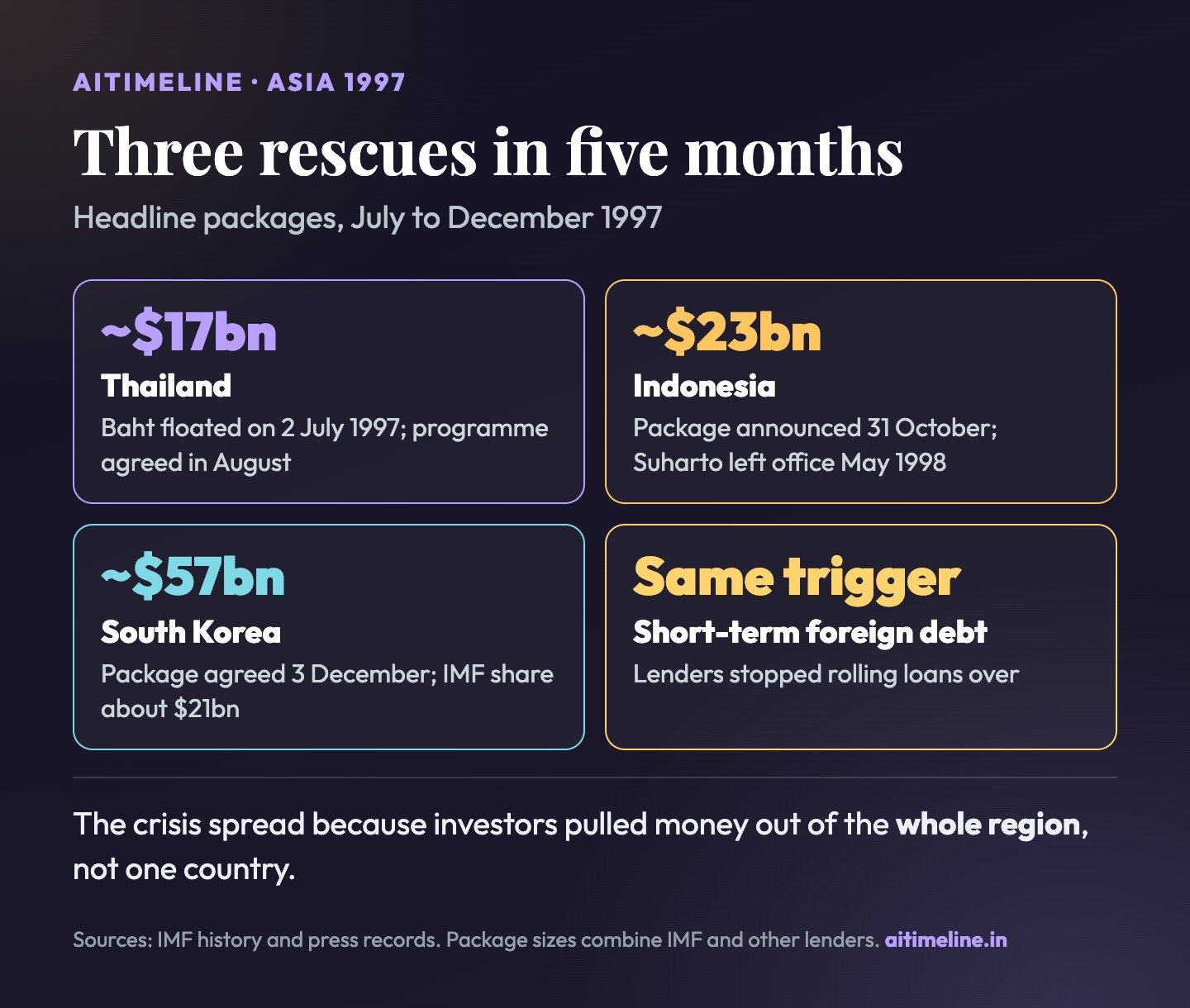
The Asian crisis shows how quickly a rescue can grow. Thailand’s programme looked large in August 1997; by December South Korea needed more than three times as much. Each country had borrowed heavily in foreign currency, so a sudden stop in lending hit banks and firms together. The responses brought banking restructuring in Indonesia and corporate reform in South Korea, and in Indonesia the programme became entangled with political upheaval.
The Euro-Area Rescues: Who Paid
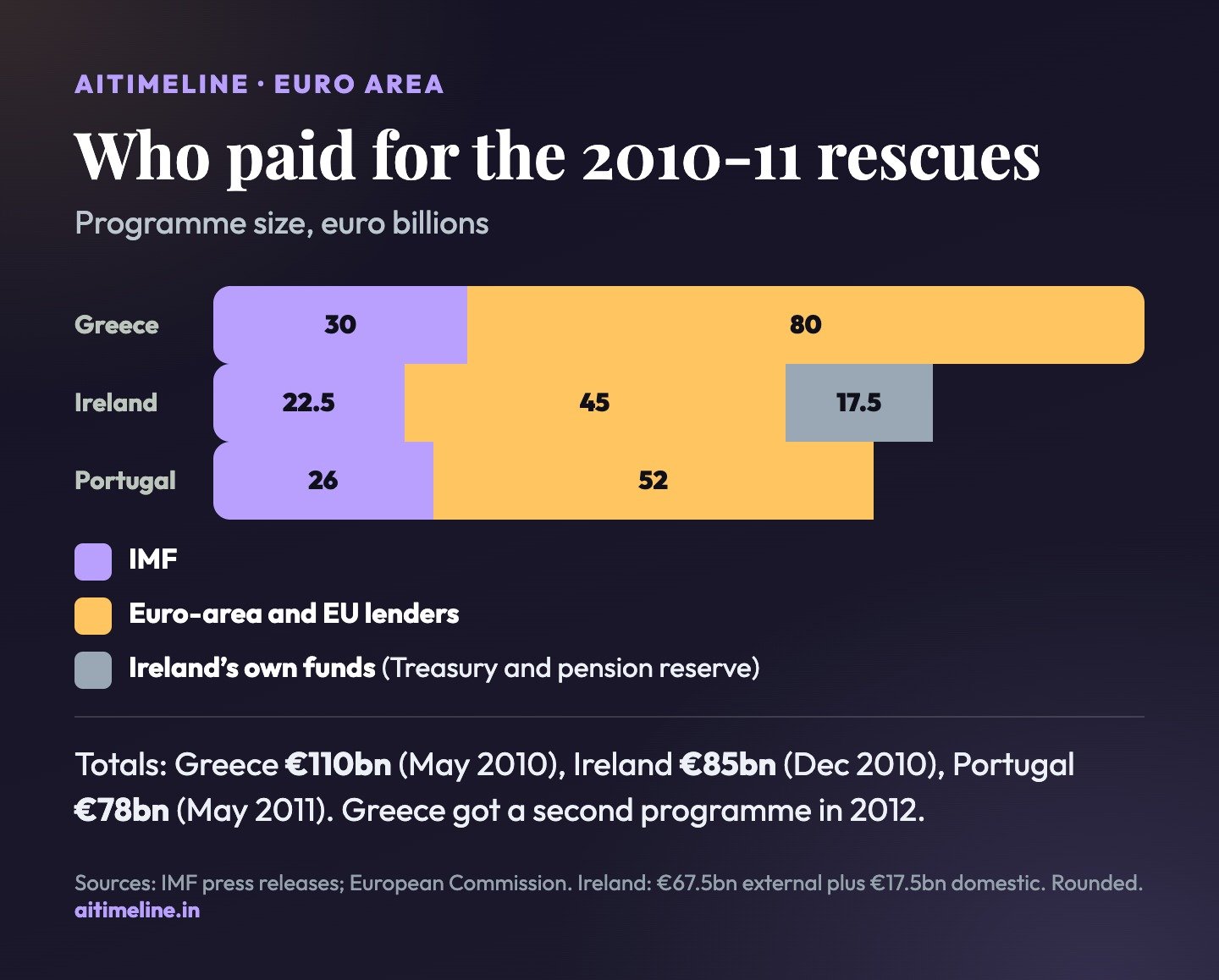
The euro-area programmes were joint efforts: the IMF with the European Commission and the European Central Bank. In each the IMF put in roughly a quarter to a third of the money. Greece needed a second programme in 2012 and a third in 2015; Ireland and Portugal completed theirs, in December 2013 and May 2014.
Recent Cases: 2022 to 2026
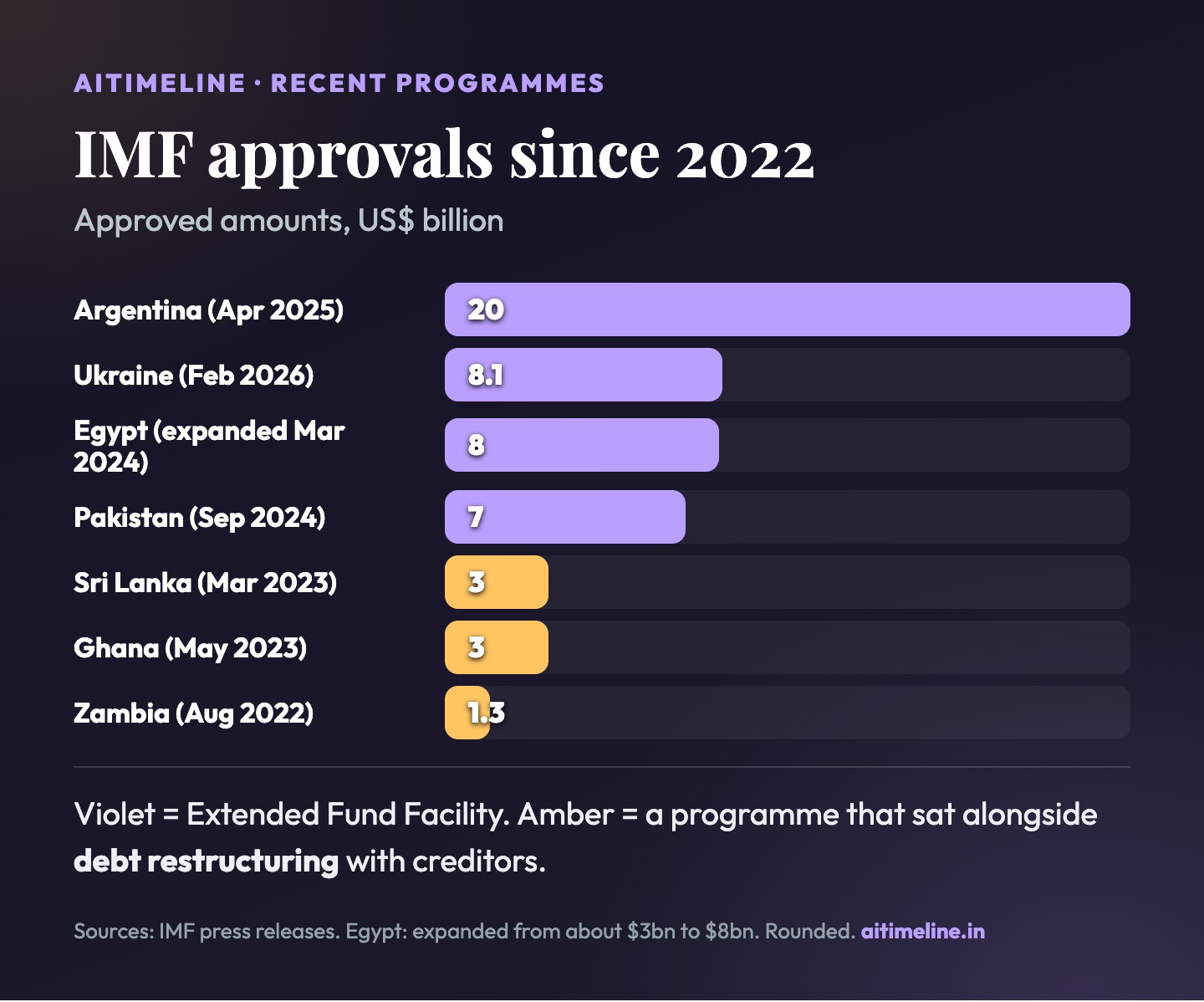
Recent programmes often run alongside a restructuring with creditors. Zambia, Sri Lanka and Ghana each defaulted, then used IMF programmes to anchor negotiations with bilateral and private lenders. Argentina, Pakistan and Egypt are repeat borrowers. Several of the 2026 reviews fall in December: check the IMF’s press releases for the final board decisions.
How an IMF Programme Works
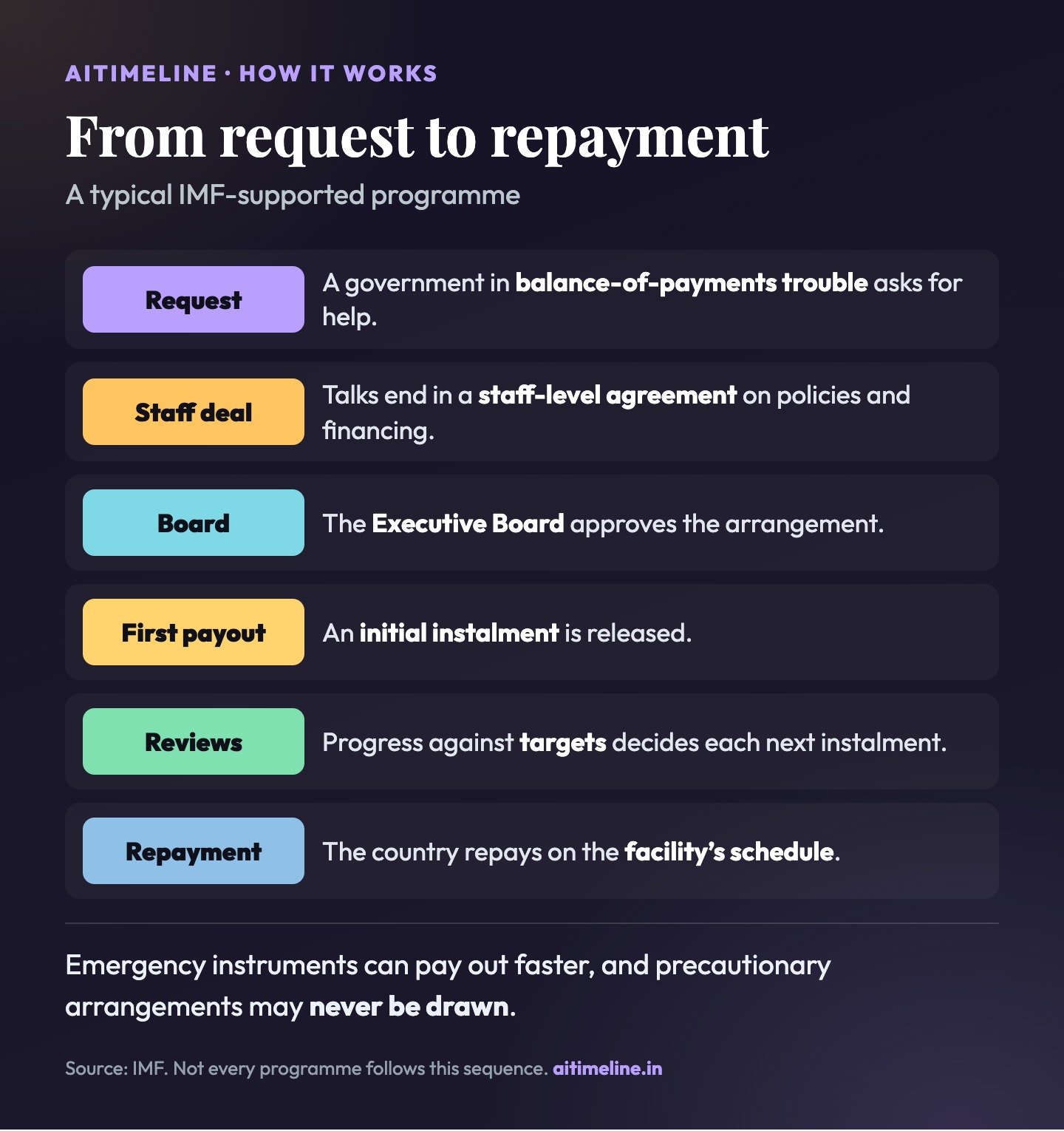
Not every IMF loan follows this exact sequence. Emergency instruments can provide money faster, and precautionary arrangements may be approved without ever being fully drawn. The review mechanism is the lever: each instalment depends on whether targets were met, or on a waiver if they were not.
Why IMF Bailouts Remain Controversial
| Issue | Why it matters |
|---|---|
| Fiscal consolidation | Deficit cuts through spending reductions, tax rises or subsidy reform |
| Currency adjustment | A more flexible exchange rate raises the local cost of imports |
| Public-sector reform | State-firm restructuring, pension and spending changes |
| Social cost | Higher energy prices and reduced subsidies press on lower-income households |
| Debt sustainability | IMF money alone does not fix debt; restructuring may be needed |
| Repeat borrowing | Argentina’s 23 programmes show a cycle, not a cure |
The outcomes differ by country. Programme design, domestic political support, external conditions, debt levels and implementation all shape the result. Ecuador withdrew a fuel-subsidy decree after protests in 2019; Korea repaid early; Argentina has returned again and again.
Conclusion: Time and Stability, Not a Guarantee
Since 1976 the IMF has moved from supporting countries facing currency and external-payment pressures to coordinating large international rescues during regional and global crises. The Latin American debt crisis, the Asian crisis, 2008, the euro-area emergency and the recent cases of Sri Lanka, Ghana, Zambia, Pakistan and Argentina show how often countries turn to the Fund.
An IMF bailout is not a guarantee of recovery. It provides financing and a framework for adjustment; the long-term result depends on whether a country can restore sustainable public finances, rebuild confidence, protect vulnerable groups and return to stable growth. The question behind every rescue is the same: can emergency financing buy enough time for the country to repair the problems that caused the crisis?
Explore More Timelines
People Also Ask
Frequently Asked Questions
⚠️ Editorial Note
Programme amounts follow IMF press releases, IMF history and parliamentary records, and are rounded. Dollar figures for SDR-denominated arrangements are approximate. Headline totals for 1995-98 and the euro-area programmes combine IMF and other lenders; we say so in each entry. Board dates and amounts for November and December 2026 reviews come from press reports and may change. This is not financial advice.
Related Stories
Sources & further reading
Every dated entry above was checked against these references. Last reviewed 24 November 2026.
- IMF: Argentina, Executive Board approves 48-month US$20 billion Extended Arrangement (press release 25/101, April 2025)
- IMF: Argentina completes second review of the Extended Arrangement (press release 26/165, May 2026)
- IMF: Executive Board approves US$8.1 billion under an Extended Fund Facility arrangement for Ukraine (26 February 2026)
- IMF: COVID-19 Financing and Debt Service Relief Tracker (last updated 9 March 2022)
- IMF: Greece's EUR 30 billion Stand-By Arrangement, May 2010 (press release 10/187)
- IMF: Iceland's US$2.1 billion Stand-By Arrangement, November 2008 (press release 08/296)
- IMF: Russia financing announcement, 13 July 1998 (transcript)
- Rajya Sabha: IMF Stand-By Arrangement of SDR 1,656 million, approved 31 October 1991 (question 165, 24 November 1992)