Dot-Com Crash Anniversary: History of the 2000 Tech Bubble
Explore the dot-com bubble timeline, the Nasdaq's 78% collapse, failed internet companies, market causes and lessons for today's technology investors.
Latest Story
The dot-com crash was the collapse of internet-stock prices that began after the Nasdaq Composite closed at a record 5,048.62 on 10 March 2000. By 9 October 2002 the index had closed at 1,114.11, about 77.9% lower. The internet revolution was real. What investors got wrong was how quickly, and how profitably, it would change business. This timeline follows the boom, the bust and the long recovery, from Netscape’s 1995 IPO to the Nasdaq’s return above its old high in April 2015.
All Nasdaq figures are closing levels unless stated; intraday highs and lows give different percentages. The crash had no single cause and no single day: rates, valuations, funding, telecom overcapacity and later accounting scandals all played a part, and the 2001 recession and 11 September came on top.
💡 Short Answer
The dot-com bubble was a late-1990s surge in internet-stock prices, driven by genuine technology change and by investors paying for growth rather than profit. The Nasdaq Composite peaked at 5,048.62 on 10 March 2000, then fell about 77.9% to 1,114.11 on 9 October 2002. It did not close above that peak again until 23 April 2015, at 5,056.06. Pets.com, Webvan and eToys failed; Amazon, eBay and Cisco survived.
What Was the Dot-Com Bubble?
Extreme speculation in internet companies, built on a real technology.
Personal computers, commercial internet access and the World Wide Web created genuine business opportunities. Venture capital funded start-ups, companies rushed to launch online services, and stock markets rewarded rapid user growth. The problem was that investors often valued companies on expectations rather than demonstrated results.
Some businesses had no consistent profits, very little revenue, high customer-acquisition costs, expensive expansion plans, unproven business models and heavy dependence on fresh investment. A company could win a high valuation by claiming it would dominate an emerging online market. The technology revolution was real. The assumption that nearly every internet company would become a profitable winner was not.

Dot-Com Crash: Key Questions
What the Record Shows
- Real technology, wrong price: the internet changed the world, but that did not justify every valuation.
- 9 August 1995: Netscape priced at US$28 and closed its first day at US$58.25.
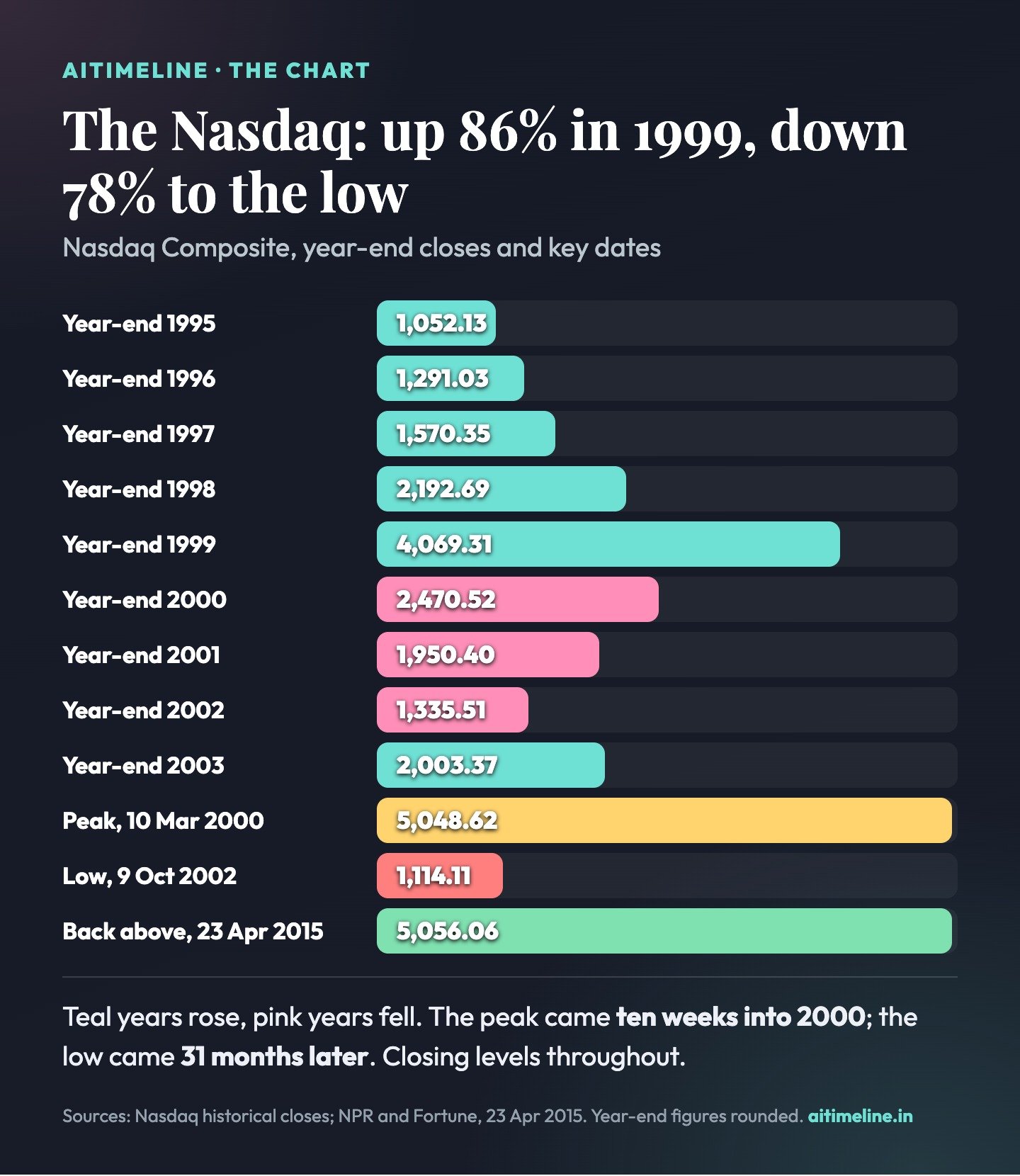
- 1999: the Nasdaq rose about 86% in a single year.
- 10 March 2000: record close of 5,048.62.
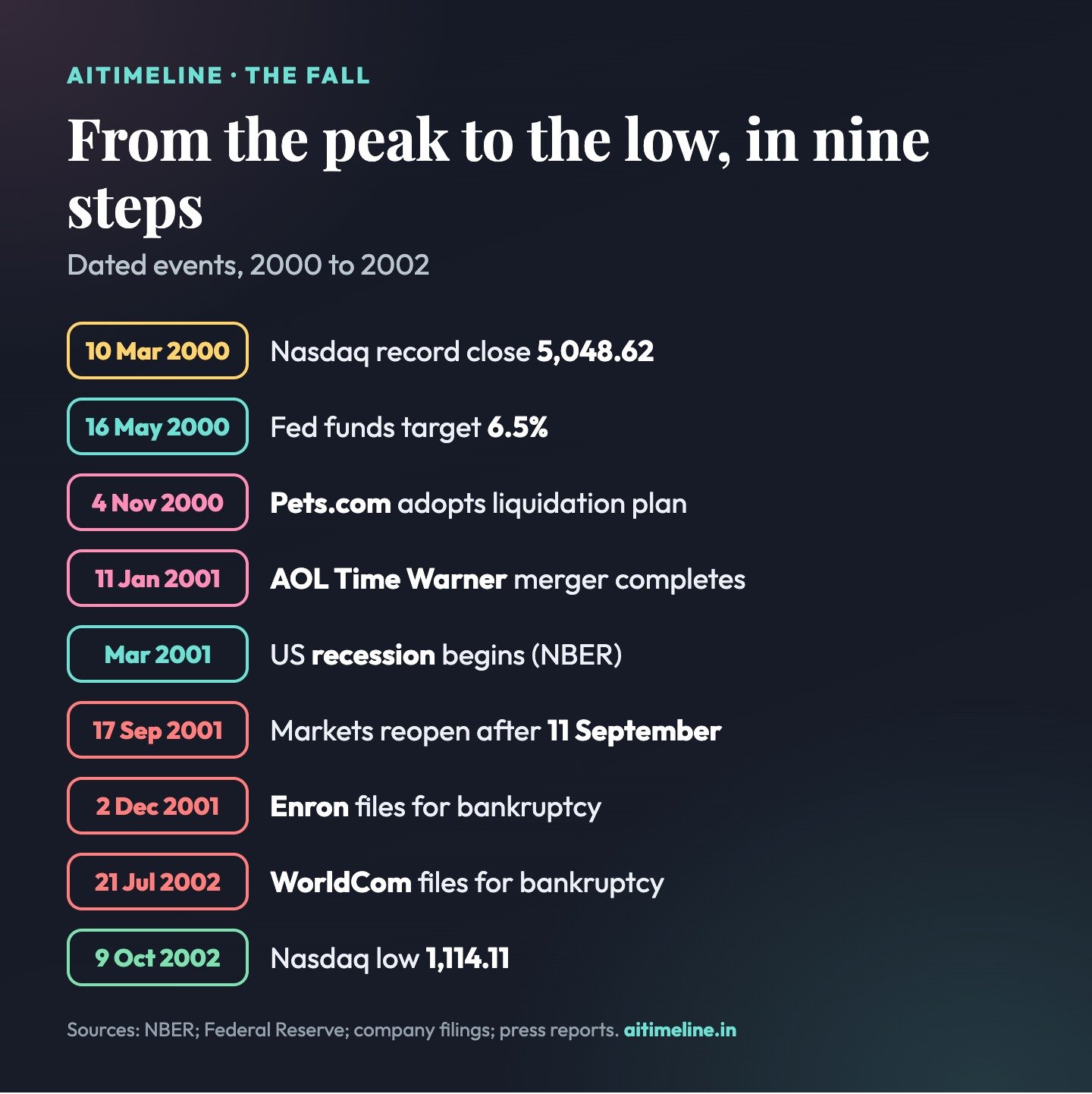
- Rates: the Fed reached 6.5% on 16 May 2000, a pressure rather than the only cause.
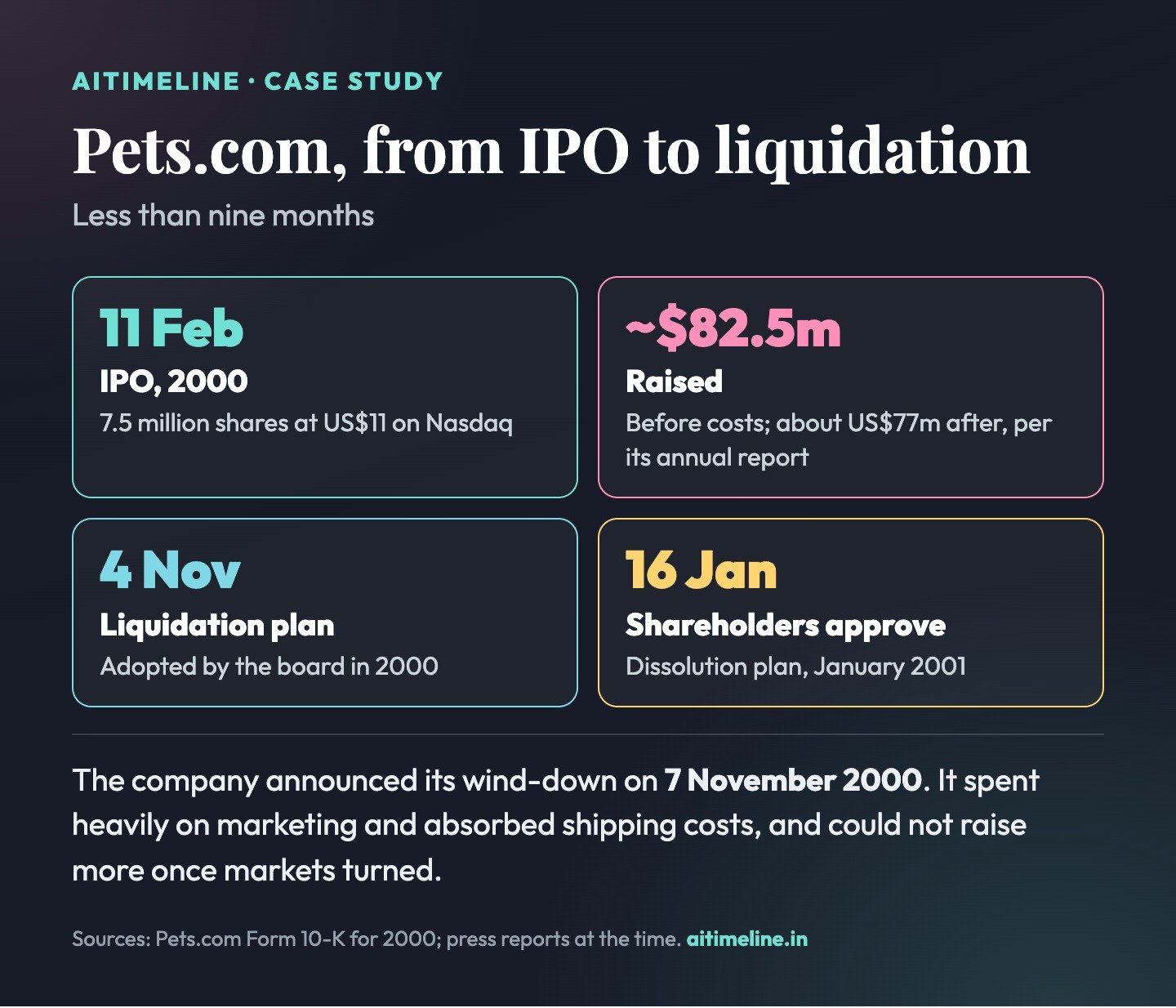
- 4 November 2000: Pets.com adopted a liquidation plan, nine months after its IPO.
- 2001-02: a recession, 11 September, Enron and WorldCom compounded the damage.
- 9 October 2002: closing low of 1,114.11, about 77.9% down.
- 23 April 2015: the index closes above its 2000 peak; many companies never did.
The Numbers Behind the Crash
Nasdaq Composite closing levels.
| Indicator | Figure |
|---|---|
| Nasdaq peak (close) | 5,048.62 |
| Peak date | 10 March 2000 |
| Nasdaq trough (close) | 1,114.11 |
| Trough date | 9 October 2002 |
| Peak-to-trough decline | About 77.9% |
| Time from peak to trough | About 31 months |
| First close above the peak | 23 April 2015 (5,056.06) |
The 77.9% decline is calculated from the March 2000 closing peak to the October 2002 closing low. Year-end figures in the chart are rounded closes.
Timeline: The Rise and Fall of the Dot-Com Bubble
Newest first. Labels mark the boom, policy, the crash, scandals and data.
23 April 2015: the Nasdaq finally closes above its 2000 peak Data
What happened: The Nasdaq Composite closed at 5,056.06, above the 5,048.62 record set on 10 March 2000. Reuters, NPR and others reported it as a new all-time closing high.
What it did not mean: An index recovering is not every company recovering. The Nasdaq of 2015 was a different mix of companies from the Nasdaq of 2000, and many bubble-era names had vanished.
NBER dates the end of the recession to November 2001 Policy
The date: The NBER’s Business Cycle Dating Committee announced that the US recession had reached its trough in November 2001, making it an eight-month downturn from the March 2001 peak.
The lag: Employment and technology investment took far longer to recover than the official dates suggest. The Nasdaq’s own low did not come until October 2002.
Nasdaq closes at 1,114.11, the bear-market low Crash
The bottom: The Nasdaq Composite closed at 1,114.11, about 77.9% below its 5,048.62 peak. That is roughly 31 months from the top.
What was left: Many internet companies had closed or been sold. The survivors were forced to focus on cash flow, costs and revenue that customers actually paid for.
Sarbanes-Oxley Act signed into law Policy
The law: President George W. Bush signed the Sarbanes-Oxley Act on 30 July 2002. It tightened rules on corporate financial reporting, auditor independence and executive certification of accounts.
Why it belongs here: It was a reaction to the Enron and WorldCom failures rather than to the dot-com bubble itself, but it shaped how every listed technology company reported its numbers afterwards.
WorldCom files for bankruptcy protection Scandal
The filing: WorldCom and substantially all of its subsidiaries filed for Chapter 11 protection on Sunday 21 July 2002, nearly a month after disclosing an accounting problem.
The size: It was the largest US bankruptcy filing to that date. Later investigations put the total misstatement far above the first disclosure.
WorldCom discloses about $3.8 billion of improperly booked expenses Scandal
The disclosure: WorldCom said it would restate 2001 and the first quarter of 2002 after finding about US$3.8 billion of expenses had been booked as capital investment, which made profits look larger.
Caution: Figures grew as investigators kept digging. Treat 3.8 billion as the first number, not the final one.
Enron files for bankruptcy Scandal
What happened: Enron filed for bankruptcy after revelations about its accounting and finances. It was an energy company rather than an internet one.
Link to the bust: Its collapse hit confidence in corporate reporting just as investors were already burned by technology stocks.
US stock exchanges reopen after the 11 September attacks Crash
Shock: US exchanges stayed shut for several days after the attacks. When trading resumed on 17 September, sellers dominated.
Not the cause: The attacks did not burst the bubble, which had peaked 18 months earlier. They deepened an economy and a market already in trouble.
NBER says the US recession began in March 2001 Policy
The ruling: The NBER said the US economy had reached a business-cycle peak in March 2001, marking the start of a recession.
The link: Technology firms that had raised cheap money in the boom now faced weaker demand, falling investment and shut capital markets.
AOL completes its merger with Time Warner Boom
The deal: AOL and Time Warner completed the merger announced a year earlier, pairing an internet distribution giant with a traditional media company.
Aftermath: The deal came to symbolise bubble-era optimism. The combined company later reported enormous write-downs and difficulties.
Pets.com’s board adopts a plan to liquidate Crash
The end: Pets.com’s board unanimously adopted a plan of complete liquidation and dissolution on 4 November 2000, less than nine months after its IPO. The wind-down was announced publicly on 7 November.
Why it became the symbol: It spent heavily on marketing and shipping heavy goods at a loss, and could not raise more money once markets turned.
Fed lifts rates to 6.5% Policy
Tightening: The Federal Reserve kept raising its policy rate through the boom’s last months, reaching 6% on 21 March and 6.5% on 16 May 2000.
One cause among several: Higher rates raise borrowing costs and make distant profits worth less today. They were a pressure, not the sole trigger. Valuations and business models were already the weak point.
Pets.com goes public Crash
The IPO: Pets.com sold 7.5 million shares at US$11, raising about US$82.5 million before costs and roughly US$77 million after, according to its own annual report.
The model: The company sold pet supplies online, spent heavily on advertising and absorbed shipping costs. Its sock-puppet mascot was far better known than its profits.
Nasdaq closes at 5,048.62, its record Data
The peak: The Nasdaq Composite closed at 5,048.62, the high point of the boom. The index had roughly doubled in the previous year.
The decline: The fall that followed exposed how much of the sector’s value rested on expectations of future growth rather than present profits.
The dot-com frenzy reaches its height Boom
Mania: IPOs became a standard way to fund start-ups. Online businesses spent heavily on advertising, infrastructure and customer acquisition, often putting users first and profits later.
Y2K: Corporate spending to fix the Year 2000 date bug ran alongside the boom. It was a separate story, but it added to attention on technology.
Rate cuts after the LTCM crisis feed the boom Policy
Easier money: After the near-collapse of the hedge fund Long-Term Capital Management, the Federal Reserve cut its policy rate in September, October and November 1998.
Effect: Cheaper money supported risk-taking just as internet valuations were accelerating.
Amazon goes public as venture money pours in Boom
Funding: Venture capital funded portals, marketplaces, search services and online retailers. Investors increasingly valued market share and user growth over near-term profits.
Amazon: Amazon’s IPO on 15 May 1997 was one of the best-known of the era. It would survive the crash, though its shares fell very sharply along the way.
Greenspan asks whether ‘irrational exuberance’ is at work Policy
The warning: Fed Chairman Alan Greenspan asked how policymakers should judge when asset prices were being driven by ‘irrational exuberance’ rather than fundamentals.
What followed: Stocks dipped briefly, then kept rising for more than three years.
Netscape’s IPO sets the tone Boom
The debut: Netscape Communications priced at US$28 and opened at US$71 before closing at US$58.25 on its first day of trading.
The signal: It showed how strongly investors would bet on an internet company that had barely begun to earn money.
The web and the first online businesses Boom
Foundations: Tim Berners-Lee proposed the World Wide Web at CERN in 1989, and CERN made the technology free to use in April 1993. Browsers such as Mosaic made it usable by non-specialists.
First businesses: Companies began building online shopping, advertising and information services. Amazon was founded in 1994.
Why Did the Dot-Com Bubble Burst?
There was no single event. Several weaknesses converged.
1. Valuations became disconnected from profits
Investors paid enormous sums for companies with limited revenue and no established path to profit. Traditional measures were often dismissed in favour of website traffic, user numbers and market-share projections.
2. Companies spent faster than they earned
Many internet businesses invested heavily in advertising, warehouses, technology and expansion. Operating costs grew faster than sustainable revenue.
3. Funding became harder to obtain
Many start-ups depended on repeated fundraising rather than customer cash. When confidence weakened, firms with little in reserve had to close or sell.
4. Interest rates rose
The Fed raised its target to 6.5% in May 2000. Higher rates reduce the present value of far-off profits, so growth companies with distant earnings are the most exposed.
5. Technology spending slowed
Telecom companies and others had invested heavily in networks. When demand did not grow as fast as forecast, the industry was left with excess capacity and debt.
6. Scandals damaged trust
Enron and WorldCom were not the original cause, but they deepened the loss of confidence in company accounts during the downturn.
Famous Dot-Com Companies: Failures and Survivors

| Company | What happened |
|---|---|
| Pets.com | IPO February 2000; liquidation plan adopted 4 November 2000 |
| Webvan | Expanded rapidly; bankrupt in 2001 |
| Boo.com | Online fashion retailer; collapsed in 2000 |
| eToys | Online toy retailer; bankrupt in 2001 |
| WorldCom | Telecom group; accounting scandal, bankrupt 21 July 2002 |
| Enron | Energy trader; bankrupt 2 December 2001 (not a dot-com) |
| Amazon | Survived; share price fell very sharply, later a global retailer and cloud provider |
| eBay | Survived and grew into a major online marketplace |
| Priceline | Survived; its owner is now Booking Holdings |
| Cisco | Survived; shares fell about 87% from March 2000 to October 2002 |
Survival did not mean immunity: several firms that lasted still lost most of their market value.
The Economic Impact of the Crash
Investors lost wealth
The Nasdaq’s decline of about 78% destroyed a large amount of market value. Those who bought technology shares near the peak faced years of losses.
Start-ups and workers were hit
Many internet companies closed and survivors cut spending and jobs. The era of easy financing ended for most start-ups.
Telecom overcapacity
Fibre-optic networks built in expectation of rapid demand sat underused, leaving carriers with debt they could not service.
Corporate governance under scrutiny
Enron and WorldCom intensified demands for reliable reporting. The Sarbanes-Oxley Act of 30 July 2002 was Congress’s response.
What Happened to the Internet After the Crash?
The crash did not show that the internet was a failed technology. It showed that many businesses had been valued far beyond what they could earn. Afterwards the industry shifted towards sustainable products, stronger revenue models and disciplined spending.
Online retail grew beyond early adopters, search and digital advertising became major businesses, cloud computing removed the need for companies to build their own infrastructure, social networks created new platforms, and smartphones and apps changed how people used digital services. Amazon and eBay are examples of survivors that benefited from the long-term growth of online commerce.
Dot-Com Crash vs the 2008 Financial Crisis
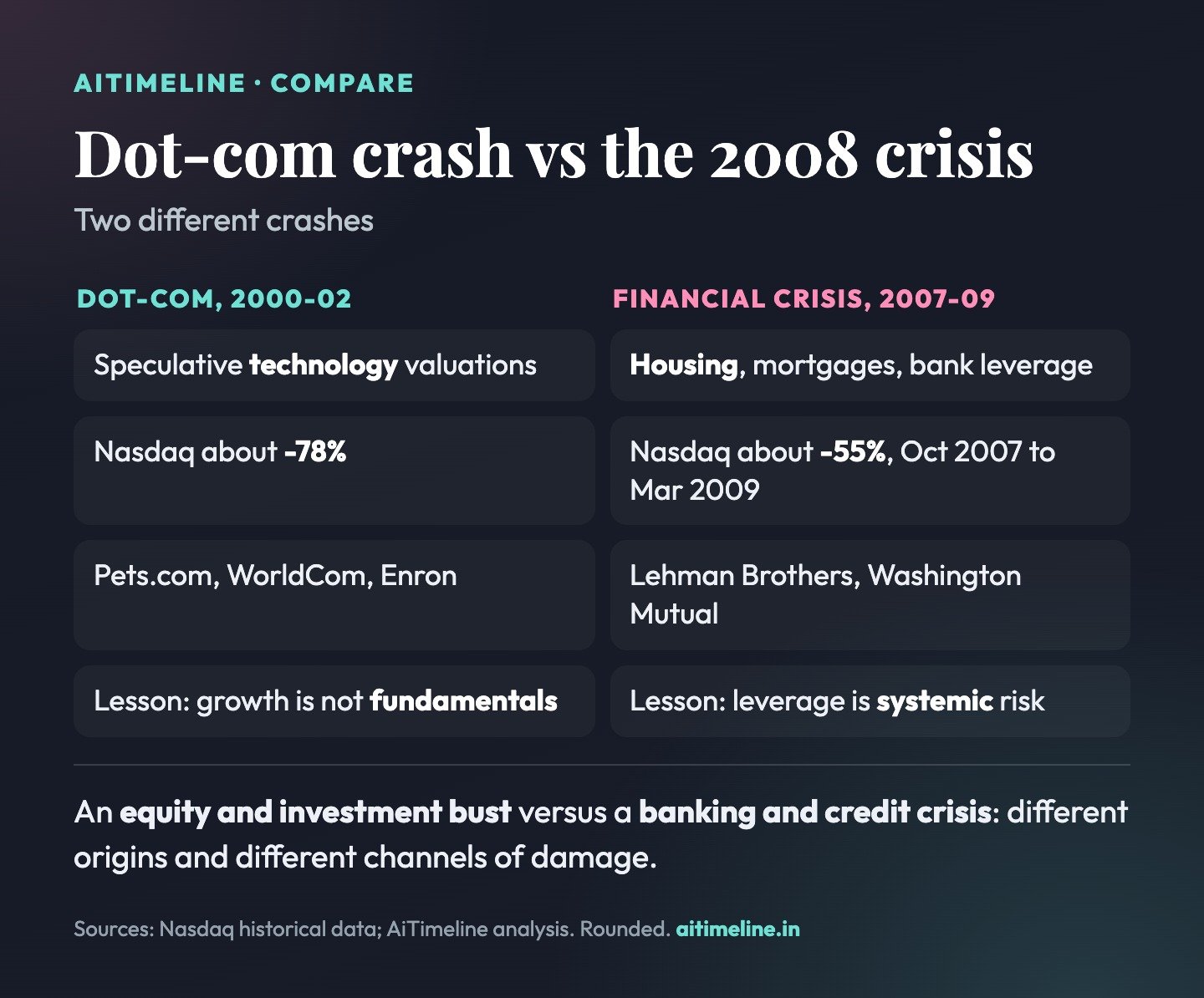
| Factor | Dot-com crash | 2008 crisis |
|---|---|---|
| Main problem | Speculative technology valuations | Housing, mortgage and bank-system risk |
| Period | 2000-2002 | 2007-2009 |
| Where losses sat | Technology and internet shares | Banks, housing, credit markets |
| Nasdaq decline | About 78% | About 55%, Oct 2007 to Mar 2009 |
| Typical failures | Pets.com, WorldCom, Enron | Lehman Brothers, Washington Mutual |
The dot-com collapse was mainly an equity-market and technology-investment bust. The 2008 crisis was rooted in housing finance, leverage and bank vulnerabilities.
Lessons From the Dot-Com Bubble

The lasting lesson is not that investors should avoid new technology. It is that technological progress and investment returns are two different things. This article does not claim today’s market is repeating 2000; the evidence it offers is historical.
Conclusion: The Bubble Burst, but the Internet Won
The dot-com crash was one of the most consequential collapses in modern market history. It exposed the dangers of speculation, unrealistic valuations and growth without sustainable economics. The Nasdaq’s fall from 5,048.62 in March 2000 to 1,114.11 in October 2002 remains a reminder of what happens when expectations run far ahead of business reality.
Yet the technology behind the boom kept developing, and the internet became central to commerce, communication, banking, entertainment and work.
Explore More Timelines
People Also Ask
Frequently Asked Questions
⚠️ Editorial Note
Nasdaq figures are closing index levels unless stated. The 77.9% decline runs from the March 2000 closing peak to the October 2002 closing low; intraday measures give different percentages. Year-end closes are rounded. Company-level share-price falls are approximate and depend on the dates used. This is history, not investment advice.
Related Stories
Sources & further reading
Every dated entry above was checked against these references. Last reviewed 24 November 2026.
- Goldman Sachs: The late 1990s dot-com bubble implodes in 2000
- NPR: 15 years after the dot-com bust, a Nasdaq record (23 April 2015)
- Fortune: Nasdaq surpasses Internet-bubble peak to set new record (23 April 2015)
- Federal Reserve: Open market operations archive
- NBER: Business Cycle Dating Committee announcement, 26 November 2001 (March 2001 peak)
- NBER: Business Cycle Dating Committee announcement, 17 July 2003 (November 2001 trough)
- Pets.com Form 10-K for 2000 (IPO proceeds and liquidation plan), SEC EDGAR
- Brookings Papers on Economic Activity: Financial collapses of Enron, WorldCom and Global Crossing
- Economic Report of the President 2002, chapter 1, US Government Publishing Office
- Sarbanes-Oxley Act of 2002 (Public Law 107-204), US Government Publishing Office