BBC Charter Review: History, Licence Fee and What Comes Next
Explore the BBC Charter's history, licence fee changes, 2026 review, funding alternatives and what the next Royal Charter could mean from 2028.
Latest Story
The BBC Charter review will decide how Britain’s public broadcaster is funded, governed and held to account from 2028. The current Royal Charter expires on 31 December 2027. The annual TV licence fee has risen to £180, while the number of licences in force has fallen. Ministers are weighing a reformed licence fee, a household levy, advertising and subscriptions. The next Charter is scheduled to begin on 1 January 2028.
Every alternative to the licence fee is a proposal, not a decision. The government has not published its White Paper, so nothing below has been adopted. Fee figures are nominal pounds, not adjusted for inflation, so a 1946 fee and a 2026 fee cannot be compared directly.
💡 Short Answer
The BBC’s current Royal Charter began on 1 January 2017 and ends on 31 December 2027. The government launched a Charter review on 16 December 2025, and the television licence fee is £180 a year from April 2026. MPs reported on 1 October 2026, and a White Paper is still awaited. Options include reforming the fee, a household levy, limited advertising and paid subscriptions. None has been adopted.
What Is the BBC Royal Charter?
The constitutional document behind the BBC.
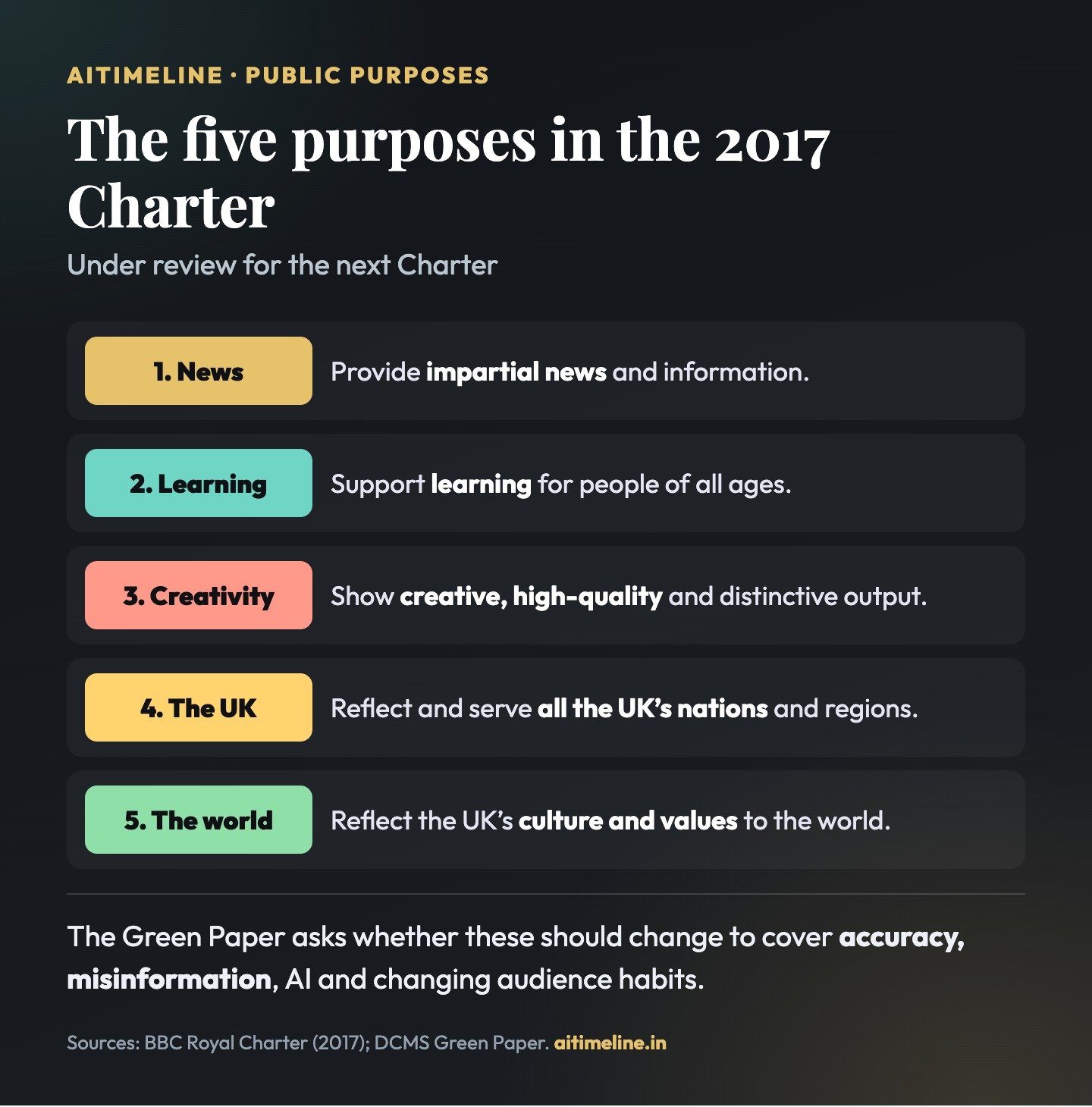
The Royal Charter makes the BBC a public corporation. It sets the BBC’s mission, public purposes, governance structure and independence. A Framework Agreement between the BBC and the government adds detailed rules on funding, regulation, accountability and public-service obligations.
The current Charter began on 1 January 2017, expires on 31 December 2027 and protects the BBC’s editorial and creative independence. Ofcom, the UK communications regulator, regulates the BBC externally. The government is running a full review ahead of the next Charter, which is expected to start on 1 January 2028.
BBC Charter Review: Key Questions
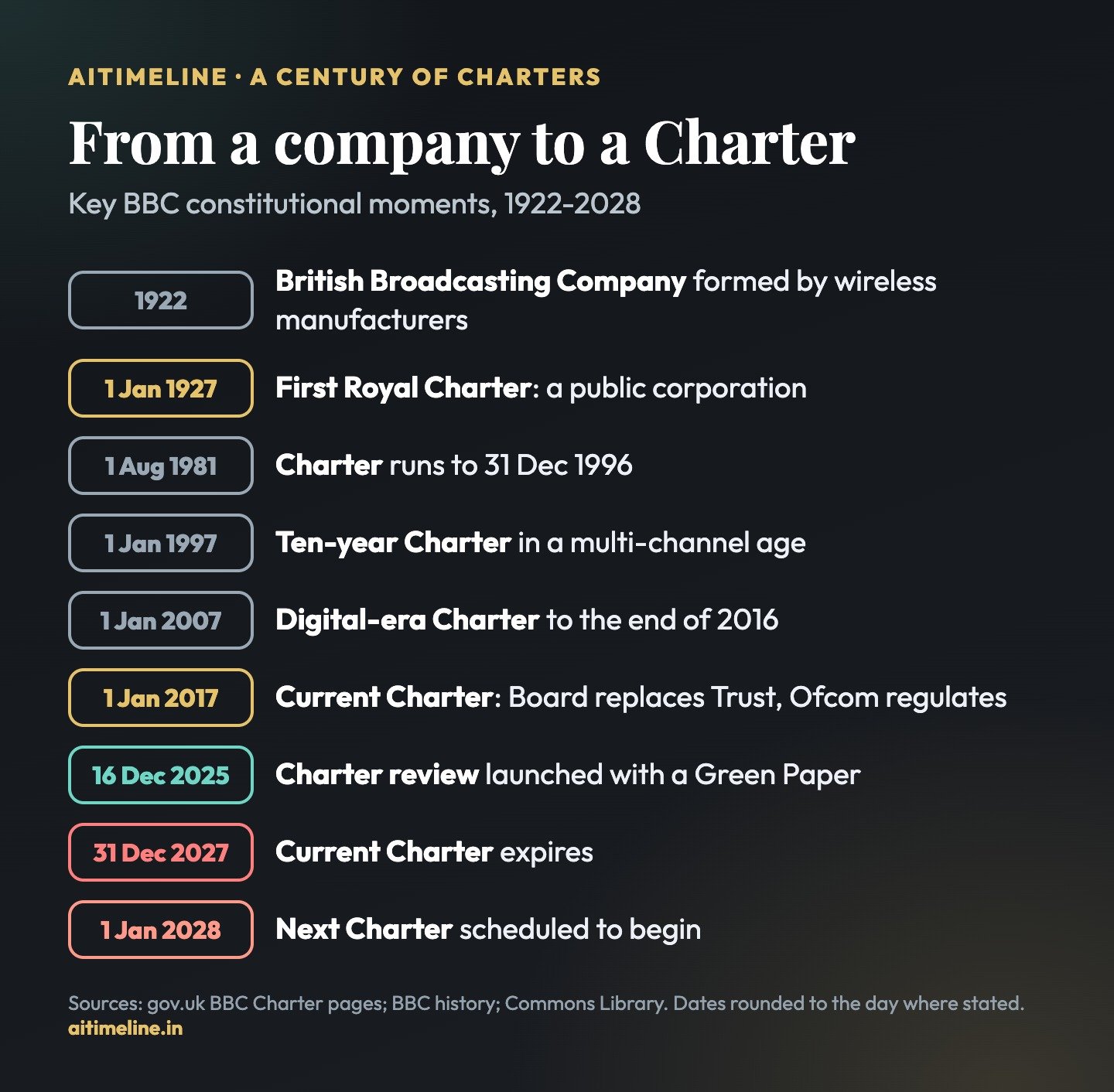
What a Century of BBC Charters Shows
- 1923: The first radio licence cost 10 shillings, equal to 50 pence today.
- 1927: The BBC became a public corporation under its first Royal Charter on 1 January.
- 1946 and 1968: Radio and TV licences were combined, then colour got its own licence at £10.
- 2017: The current Charter replaced the BBC Trust with a Board and made Ofcom the regulator.
- 2022-26: After a freeze at £159, the fee rose to £169.50, £174.50 and £180.
- 2026: Licences in force fell from about 23.8 million to 23.3 million over the year to March.
- 1 Oct 2026: MPs backed widening the licence fee, ending political Board appointments and a permanent Charter.
- Now: The White Paper is awaited; the new Charter is scheduled for 1 January 2028.
Timeline: A Century of BBC Charters and Licence Fees
Newest first. Labels mark origins, Charters, fee changes, reviews and current status.
The White Paper has not been published Status
Where it stands: The government has not yet published its White Paper, the document that will set out its policy for the next Charter. A minister told the House of Lords on 19 October that it would arrive by the end of the year, and Ampere Analysis expects it in December. Ministers say no final decisions have been made.
The politics: Culture Secretary Lisa Nandy has said the government is committed to keeping the licence fee but reforming it. A draft Charter is then due to be debated in Parliament during 2027.
Latest estimate: On 23 November Ampere Analysis modelled extending the licence to on-demand streaming services. It estimated about GBP 1.6 billion a year in extra revenue with perfect enforcement. That is a commercial estimate, not government policy.
Commons Library examines the future of the licence fee Review
What it covers: The Commons Library briefing sets out why the traditional licence fee is under strain, as viewing moves from scheduled television to on-demand and streaming services, and reviews the funding options now under discussion.
Why it matters: It gives MPs and the public a neutral summary of the choices: reform the fee, replace it with a household levy, add advertising or subscriptions, or lean more on commercial income.
MPs publish their Charter recommendations Review
Licence fee: The committee called the fee outdated and recommended widening it beyond television, on condition that the individual cost comes down. It said strong arguments exist for a household levy but that none of the alternatives was sufficiently attractive to recommend replacing the licence fee.
Governance: It recommended ending political and geographical appointments to the BBC Board and backed a permanent Charter with regular accountability reviews instead of a fixed end date. It also proposed a new duty to counter misinformation, if the BBC is resourced for it.
The warning: The committee warned that if non-payment keeps rising and the government does not act, there will not be a BBC as we know it by the end of the next Charter period.
Status: These are recommendations. The government has not adopted them.
BBC director-general: the fee is “no longer fit for purpose” Status
What was said: Giving evidence to the Culture, Media and Sport Committee, director-general Matt Brittin said the BBC is held back by the television licence fee, which he called no longer fit for purpose. He said payment had fallen to about 80% of households.
Why it matters: It put the BBC’s own leadership on record that the current model needs to change, ahead of the committee’s report in October.
The licence fee rises to GBP 180 Fee
The change: The annual colour television licence rose by GBP 5.50 to GBP 180. The black-and-white licence rose to GBP 60.50. The increase follows the inflation-linked formula set in the 2022 settlement.
What comes next: The government has confirmed one more inflation-linked rise in April 2027, the last year of the current Charter.
The shrinking base: Licence Fee Trust Statements show licences in force falling from about 23.8 million to 23.3 million over the year to March 2026.
The Green Paper consultation closes Status
What closed: The public consultation on the Green Paper ran from 16 December 2025 until 10 March 2026. It asked about the BBC’s mission, funding, governance, accountability and role.
The BBC’s answer: The BBC published its own response, titled A BBC for All, on 5 March 2026.
Responses: The government is analysing the responses. This article does not give a response total because the official figure has not been confirmed.
Government launches the Charter review Review
What launched: The government published a Green Paper, terms of reference and a public consultation. It set three ambitions: sustainable funding for decades, a BBC that commands trust and represents all communities, and one that drives growth and jobs across the nations and regions.
The options: The Green Paper raised the BBC’s purposes, editorial accuracy and misinformation, governance, commercial activity and funding. Funding ideas included a reformed licence fee, advertising, a subscription top-up and more commercial income.
Next step: Ministers said responses would inform a White Paper in 2026, followed by a draft Charter for debate.
The fee reaches GBP 174.50 Fee
The change: The annual colour licence rose from GBP 169.50 to GBP 174.50. The rise was set by the formula agreed in the 2022 settlement.
The backdrop: The government began preparing the Charter review, which would ask whether the licence fee could stay sustainable as more households shift to streaming.
The fee rises to GBP 169.50 Fee
The change: The colour licence rose by GBP 10.50, from GBP 159 to GBP 169.50, ending the two-year freeze announced in 2022.
Why: From April 2024 the fee was set to rise with inflation each year until the end of the current Charter.
A licence-fee settlement: freeze, then inflation Fee
The deal: The government set the colour licence at GBP 159 for two years, then linked it to inflation for the rest of the Charter period.
The pressure: The settlement gave some funding certainty but squeezed the BBC as production and operating costs climbed.
Free licences limited to over-75s on Pension Credit Fee
The change: From August 2020 free licences generally went only to households where someone aged 75 or over receives Pension Credit. The BBC had taken over responsibility for the concession under the 2015 funding deal.
The reaction: Campaigners and some politicians said older people outside Pension Credit could face extra pressure. The episode showed how decisions made by government could land directly on the BBC’s budget.
The current Charter begins Charter
Governance: The BBC Board replaced the BBC Trust, and Ofcom became the BBC’s external regulator. The Charter defined five public purposes and strengthened accountability and transparency.
Independence: Editorial and creative independence stayed central to the BBC’s mission.
A freeze at GBP 145.50, and the World Service Fee
The deal: The licence fee was frozen at GBP 145.50 until 2016. The BBC also took on new responsibilities, including funding the BBC World Service from the licence fee from 2014 rather than through a government grant.
Later debates: These arrangements fed into the 2015-16 Charter negotiations and are still argued over today.
A Charter for the digital era Charter
The shift: The 2007 Charter put more weight on digital broadcasting and the move to new television technology.
The market: The BBC now competed with satellite television, broadband and online media.
Free licences for people aged 75 and over Fee
The change: The government introduced free television licences for households with someone aged 75 or over.
The legacy: The concession became a central argument about who should pay for the BBC and how the cost of public broadcasting should be shared.
A ten-year Charter in a multi-channel age Charter
The setting: The BBC’s public-service model carried on as commercial broadcasting expanded and new channels launched.
A new 15-year Royal Charter Charter
The change: A longer framework for a period of fast technological change, including the arrival of satellite television.
The radio-only licence is abolished Fee
The change: The separate radio-only licence was abolished in February 1971. The television licence became the main household broadcasting licence and, over time, the central funding mechanism for the BBC.
Colour television gets its own licence Fee
The change: A colour television licence was introduced at GBP 10, against GBP 5 for monochrome. It reflected the extra cost of colour broadcasting.
The combined licence reaches GBP 3 Fee
The change: The combined licence rose from GBP 2 to GBP 3 as television ownership grew and the broadcasting system expanded.
Radio and television licences are combined Fee
The change: The combined radio and television licence cost GBP 2 a year, compared with GBP 1 for radio alone. Television was a growing part of British household life.
Successive Charters widen the BBC’s role Charter
The shift: Through renewed Charters, the BBC’s duties grew from entertainment to information, education and national public service. The growth of television required changes to its broadcasting and funding arrangements.
The BBC becomes a public corporation Charter
The change: On 1 January 1927 the BBC began operating as a public corporation under its first Royal Charter. The change followed the Crawford Committee, which examined the future of British broadcasting.
Why it matters: It set the BBC’s public-service character and put its governance under a Royal Charter rather than a commercial-company structure.
The first radio licence: 10 shillings Origins
The change: An annual wireless receiving licence was introduced in November 1923 at 10 shillings, equivalent to 50 pence in decimal money. The Post Office administered it.
The foundation: It became the funding model that would finance the BBC for generations.
The British Broadcasting Company is formed Origins
The start: The British Broadcasting Company began broadcasting in 1922 as a commercial company owned by a group of wireless manufacturers. Its early purpose was to organise radio broadcasting and build a national service.
The Licence Fee Through History
Nominal pounds, not adjusted for inflation.
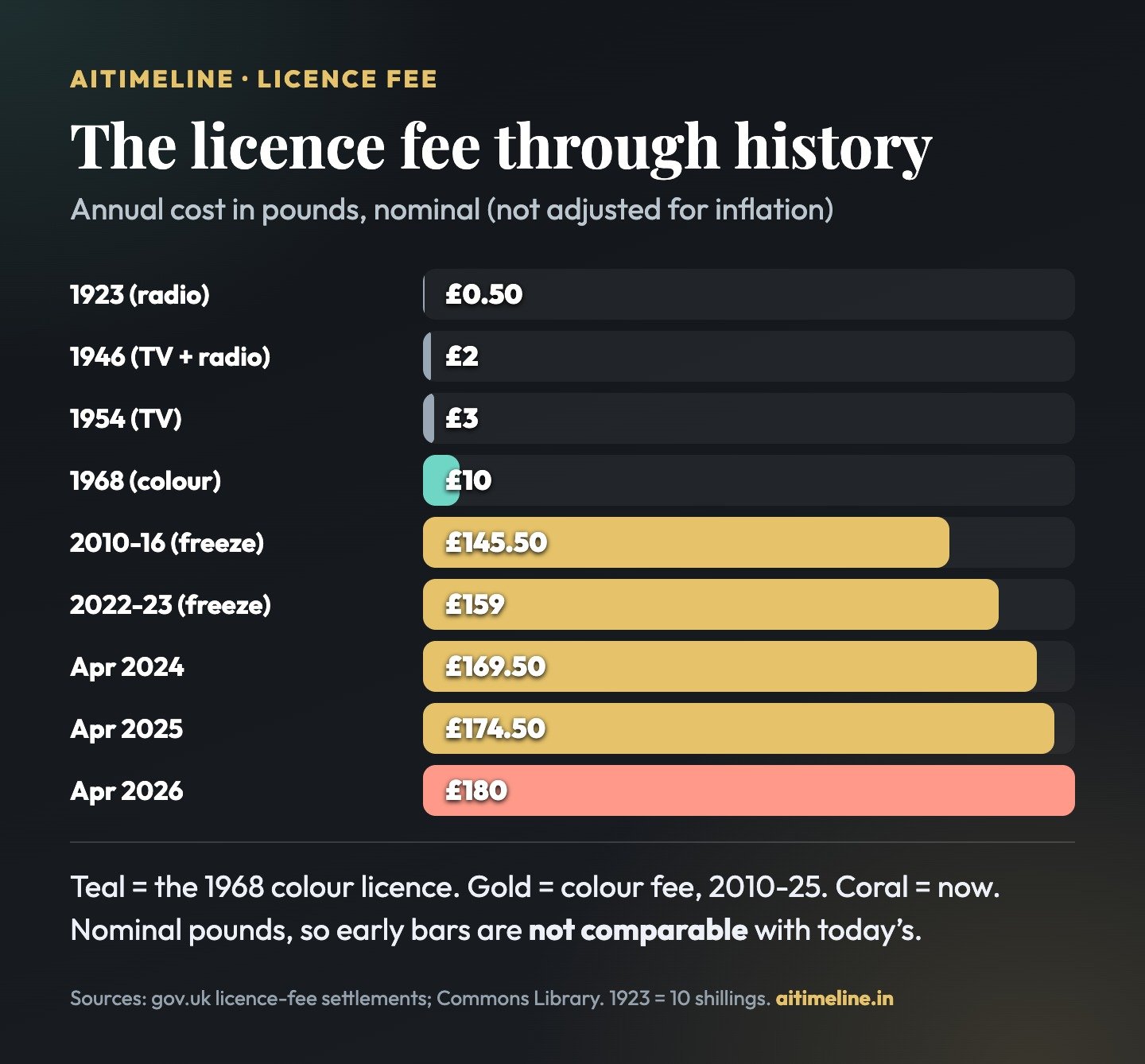
| Date | Licence | Annual cost | What changed |
|---|---|---|---|
| Nov 1923 | Radio | 10 shillings (50p) | First wireless licence |
| Jun 1946 | Radio and TV | £2 (radio-only £1) | Combined licence |
| Jun 1954 | Radio and TV | £3 | TV ownership grows |
| Jan 1968 | Colour TV | £10 (mono £5) | Supplementary colour licence |
| 2010-16 | Colour TV | £145.50 | Freeze under the 2010 settlement |
| 2022-23 | Colour TV | £159 | Two-year freeze |
| Apr 2024 | Colour TV | £169.50 | Inflation-linked rise |
| Apr 2025 | Colour TV | £174.50 | Inflation-linked rise |
| Apr 2026 | Colour TV | £180 (B&W £60.50) | Up £5.50 |
Sources: gov.uk licence-fee announcements and settlements; Commons Library.
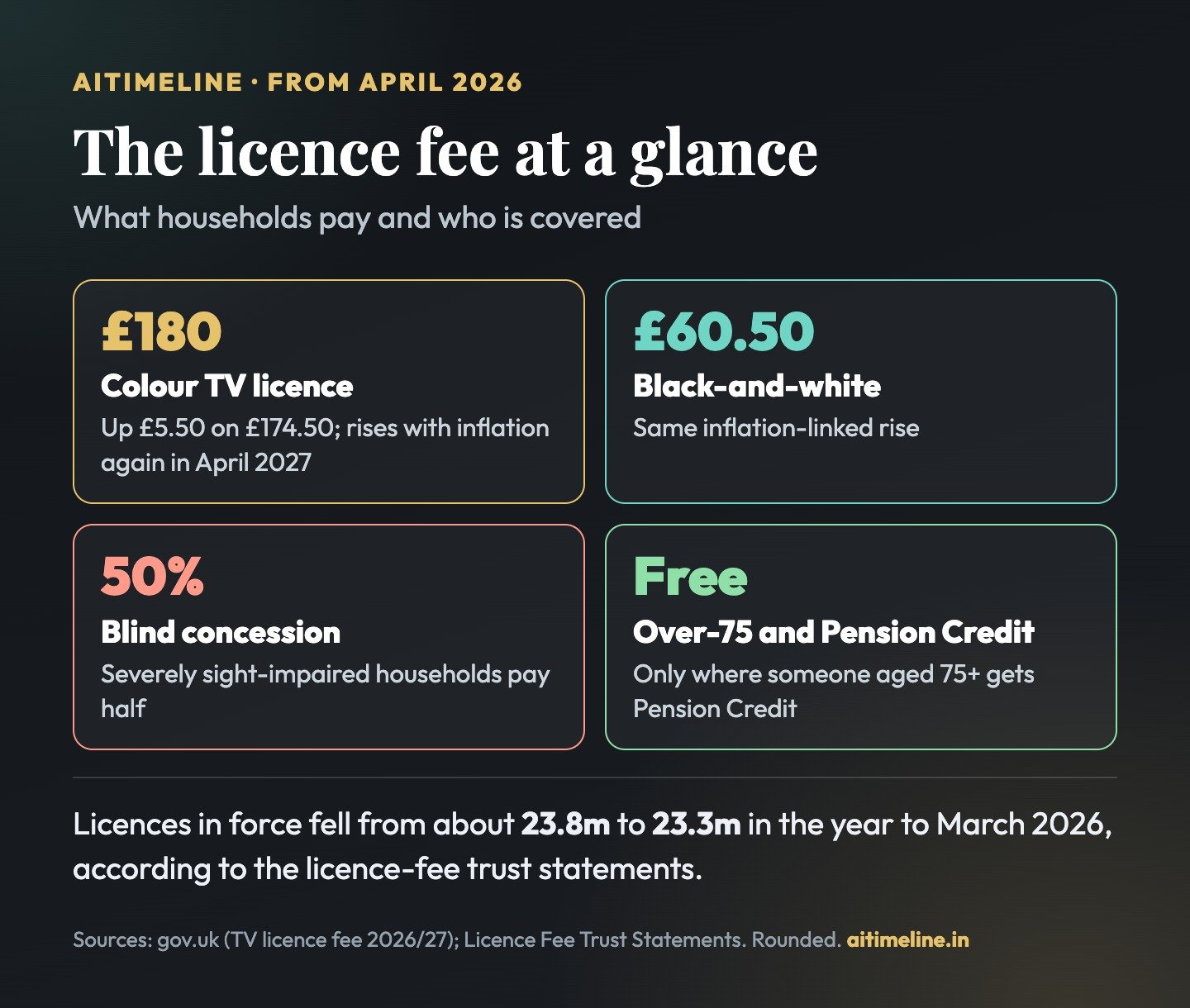
A licence is legally required to watch or record live television on any channel, or to use BBC iPlayer, subject to concessions. The fee funds mainly BBC television, radio, online and public-service work. Its base is shrinking as viewing shifts to on-demand services.
What Could Replace the Licence Fee?
The Green Paper did not announce a replacement. Every option below is a proposal.
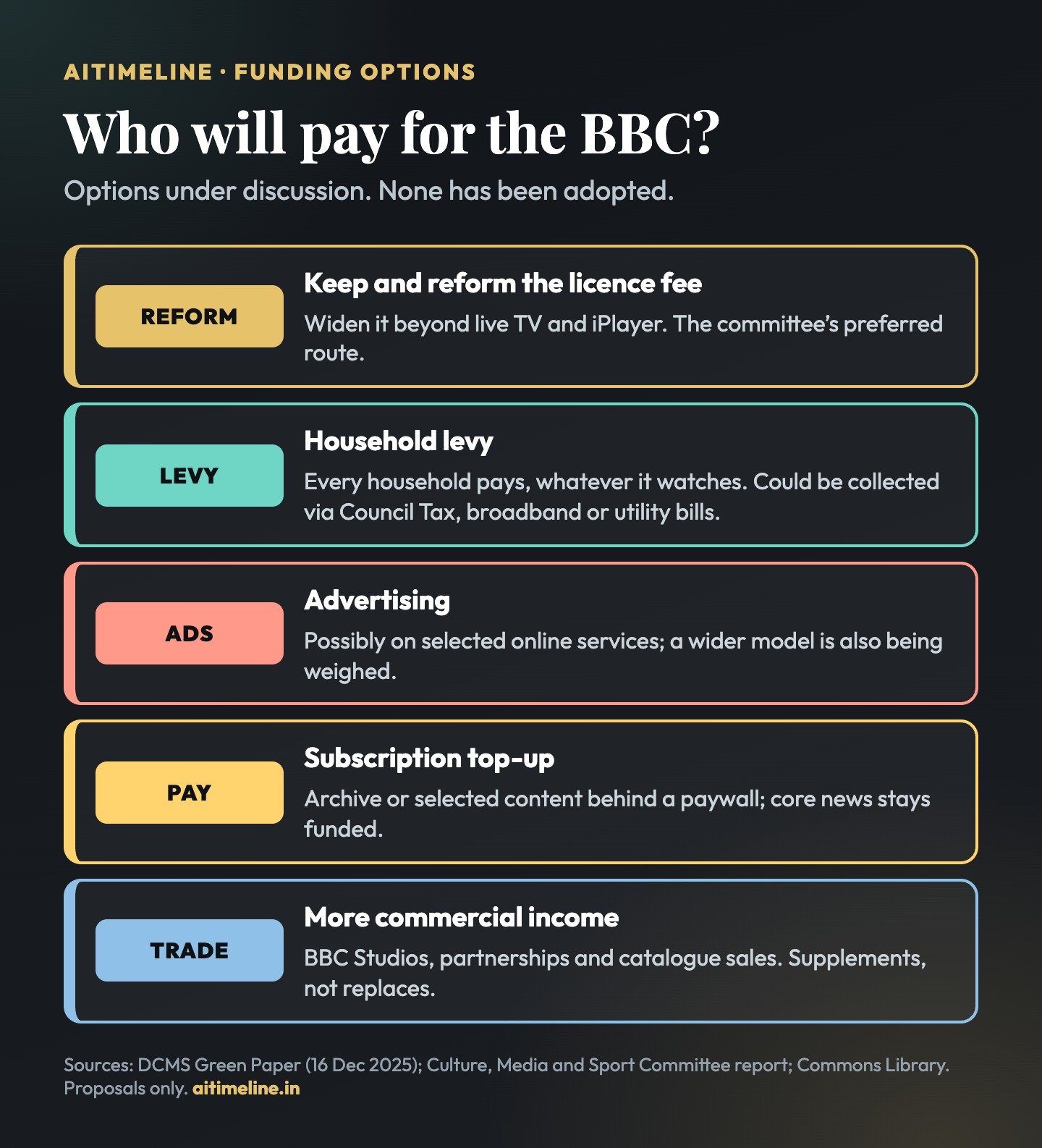
| Option | How it would work | Potential benefit | Main challenge |
|---|---|---|---|
| Reform the fee | Keep a licence but widen it beyond live TV and iPlayer | Keeps a direct, universal funding link | Defining who pays, fairly |
| Household levy | Every household contributes, whatever it watches | Cuts the effect of falling licence uptake | Exemptions for households in hardship; collection route |
| Advertising | On selected online services, or more widely | New revenue | Competes with commercial broadcasters for ad budgets |
| Subscription | Archive or selected content behind a paywall | Extra commercial revenue | Could reduce universal access |
| Commercial income | BBC Studios, partnerships, catalogue sales | Supplements public funding | Does not replace the fee on its own |
The Green Paper explores whether limited advertising could appear on selected online services, or whether a wider model could be considered. The government acknowledges that wider advertising could raise money but might affect commercial broadcasters competing for the same budgets. A more extensive subscription model could place selected entertainment behind a paywall while keeping news, current affairs and children’s programming publicly funded.
On a household levy, the Commons committee said there are strong arguments for it but did not recommend replacing the licence fee. How a levy would be collected is unsettled. Ideas raised in the debate include Council Tax and broadband or utility bills.
Ampere Analysis estimated on 23 November 2026 that extending the licence to streaming could raise about £1.6 billion a year with perfect enforcement. That is a commercial estimate, not government policy.
What MPs Recommended
Culture, Media and Sport Committee report, 1 October 2026.
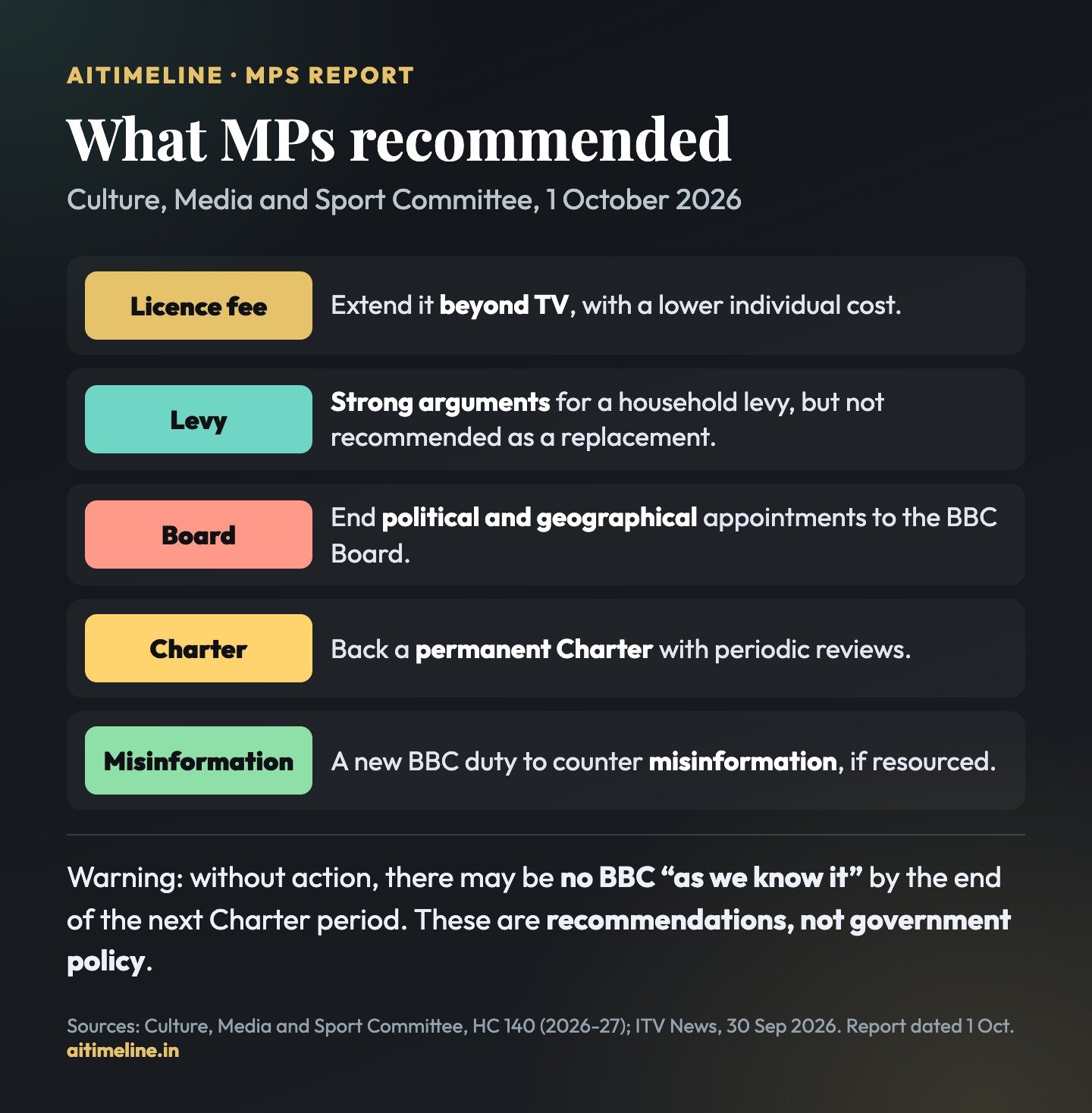
The committee called the licence fee outdated and warned that without action there will not be a BBC as we know it by the end of the next Charter period. The government has not adopted its recommendations. The government’s own position, according to Culture Secretary Lisa Nandy, is to keep the licence fee but reform it.
The Biggest Issues in the Review
| Issue | What is being weighed |
|---|---|
| Independence | Government-appointed Board members; the committee wants political and geographical appointments ended |
| Accuracy and trust | Whether accuracy gets more emphasis, and a duty to counter misinformation, without weakening independence |
| World Service | Mixed funding today, with licence-fee money and government support for parts of it |
| Streaming competition | Keeping younger audiences while staying universal, against Netflix, Prime Video, Disney+ and YouTube |
| Local and regional | Local news, regional programming, independent production and jobs outside London |
| Fairness | Who pays, and how to protect households facing hardship |
Each trade-off pulls in two directions. A levy would stabilise income but widen who pays. Advertising or subscriptions would raise money but could weaken universal access or compete with commercial rivals. The final answer will come through the White Paper and the draft Charter.
What Happens Next: The Roadmap
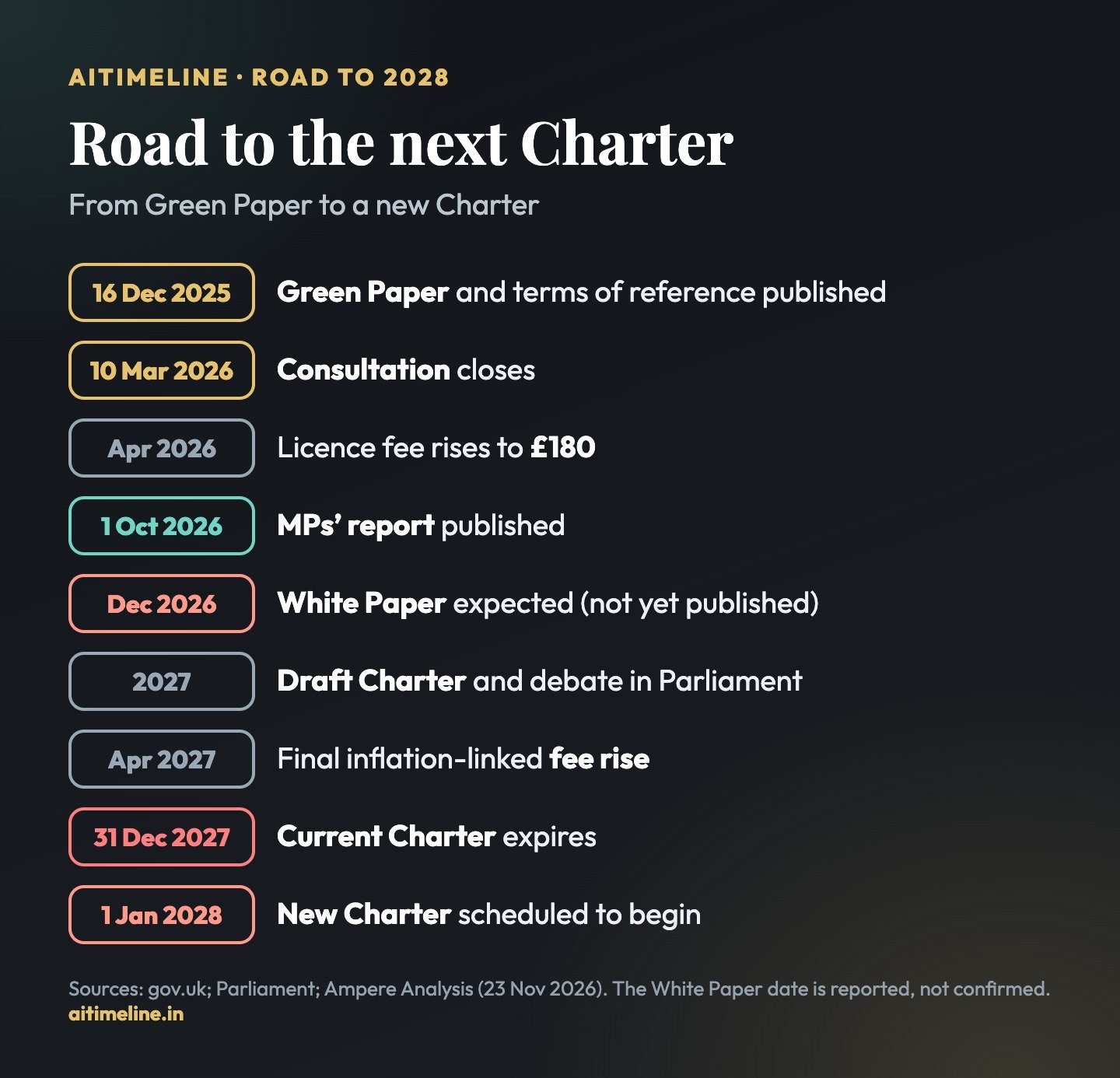
The government will publish its policy in a White Paper, then a draft Charter, which both Houses of Parliament will have the chance to debate. The new Charter is scheduled for 1 January 2028. The dates are reported targets and can move.
Conclusion: A Turning Point for Public Broadcasting
The BBC Charter review is a debate about the future of public-service media, not a routine renewal. The licence fee was built when radio and television dominated. Audiences now have streaming, social platforms and global entertainment companies, and the BBC has to compete in that market.
The next Charter will have to settle three connected questions: how the BBC is funded, how its independence is protected and what public-service broadcasting means in a digital age. As of 24 November 2026 the government has not settled them. The question is no longer only how much the public should pay for the BBC, but what kind of public broadcaster Britain wants to fund.
Explore More Timelines
People Also Ask
Frequently Asked Questions
⚠️ Editorial Note
Fee figures follow gov.uk announcements and are nominal. Licences-in-force figures come from Licence Fee Trust Statements and are rounded. The committee’s recommendations, ministerial comments and the Ampere estimate are reported as stated; none is government policy. White Paper timing comes from ministerial statements and press reports and may change. Reports of the July 2026 hearing differ slightly on wording.
Related Stories
Sources & further reading
Every dated entry above was checked against these references. Last reviewed 24 November 2026.
- UK Government: BBC Royal Charter Review 2025 to 2027 (collection)
- UK Government: Britain's Story: The Next Chapter, Green Paper and public consultation
- UK Government: BBC Royal Charter (2017)
- UK Government: BBC Framework Agreement
- BBC History: Royal Charter archive
- UK Government: Cost of TV licence fee set for 2026/27
- House of Commons Library: The future of the BBC licence fee (CBP-10050, 13 October 2026)
- UK Parliament: BBC Royal Charter Review, Culture, Media and Sport Committee report (HC 140)
- ITV News: MPs recommend BBC Charter renewal is scrapped and licence fee extended beyond TV (30 September 2026)
- Advanced Television: Extending TV licence fee to streaming could raise GBP 1.6bn for BBC (Ampere analysis, 23 November 2026)