EU Free Movement Debate: Rayner, Burnham and the Brexit Timeline
Angela Rayner backs Andy Burnham's call for an evidence-based EU free movement debate. See the timeline from the 2016 Brexit vote to the 2026 summit.
Latest Story
The EU free movement debate reopened on 24–25 October 2026, when Prime Minister Andy Burnham told The Sunday Times that Britain should have an “honest discussion” about a possible return to free movement, and Angela Rayner defended the approach. Free movement has not been restored or proposed. The government says there will be no return to the customs union, single market or freedom of movement in this parliament, and the next scheduled step is a UK-EU summit in Brussels on 20 November. This page follows the story from the 2016 vote, marks what is verified and what is not, and will be updated as it develops. For related background, see AiTimeline’s timelines of the India-UK trade agreement, the euro’s launch and crisis and Black Wednesday.
💡 Short Answer
Burnham called for a factual, evidence-based discussion about EU free movement on 24 October 2026 and Rayner backed an honest conversation on 25 October. No policy has changed: Labour’s 2024 manifesto ruled out free movement, the single market and the customs union, and the government repeats that line. Any fundamental change would need a new mandate. The next date is the Brussels summit on 20 November 2026.
Who Has Said What on Free Movement?
Last updated: 25 October 2026. Statements and reactions, with sources.
| Who | What was said or done | Date | Source |
|---|---|---|---|
| Andy Burnham (PM) | Calls for an “honest discussion” and an “evidence-based debate” on free movement; does not propose it; could not imagine recommending Schengen or the euro | 24 Oct 2026 | UK Fact Check |
| Angela Rayner | Says the PM is seeking an “honest conversation”; government committed to its promise for this parliament; a future manifesto could differ | 25 Oct 2026 | Bloomberg |
| Government spokesperson | “No return to the customs union, the single market, or freedom of movement” | Oct 2026 | City AM |
| Nigel Farage (Reform UK) | “A total betrayal of Brexit Britain” | 25 Oct 2026 | UK Fact Check |
| Chris Philp (shadow home secretary) | Criticised the remarks | 25 Oct 2026 | UK Fact Check |
| Kemi Badenoch (Conservatives) | Earlier in October: Burnham is “unpicking” the withdrawal agreement | Oct 2026 | UK Fact Check |
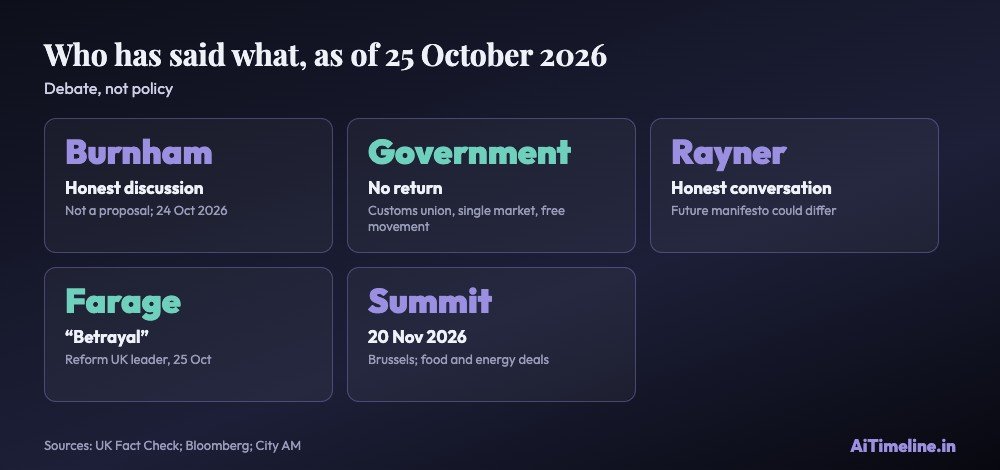
How to read the table. Burnham’s quotes come from UK Fact Check’s account of the Sunday Times interview. Rayner’s comments are from a Bloomberg report as summarised in a search result; AiTimeline could not open the full ITV or Bloomberg text, so her words are paraphrased rather than quoted beyond “honest conversation.”
EU Free Movement Debate: Key Questions
The Free Movement Debate in Ten Points
- Debate, not policy: no proposal to restore free movement has been made.
- Burnham: an “honest discussion” and “evidence-based debate,” released 24 October 2026.
- Rayner: defended an “honest conversation” and said a future manifesto could differ.
- Red lines: Labour’s 2024 manifesto ruled out free movement, the single market and the customs union.
- Limits: Burnham could not imagine recommending Schengen or the euro.
- Options: on 30 September he named staying as we are, a customs union, closer single-market ties and going further.
- Reaction: Farage called it a betrayal; the shadow home secretary criticised it.
- Summit: 20 November 2026, Brussels, originally planned for 22 July.
- History: free movement ended on 31 December 2020, not at exit on 31 January 2020.
- Unverified: some claims in circulation, such as party reactions and a January 2026 petition reply, could not be confirmed and are left out.
EU Free Movement Debate Timeline, Latest First
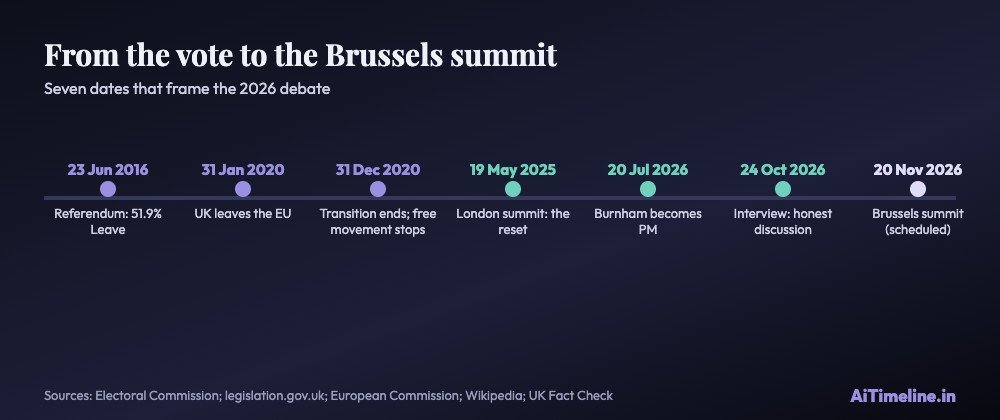
Each entry is tagged and ends with why it matters. The summit entry is scheduled, not past.
2026
Next: the UK-EU summit in Brussels UK-EU
Burnham told MPs on Monday 12 October that a summit with EU leaders would take place on 20 November 2026, where he wants to sign off food-standards and energy-market agreements proposed under his predecessor (City AM). He is expected to meet European Commission President Ursula von der Leyen and European Council President António Costa (UK Fact Check). The summit had originally been planned for 22 July, before the leadership change.
It has not happened yet. Nothing published by 25 October says the agenda includes restoring free movement, and the government’s stated position is that it will not return to the customs union, single market or freedom of movement in this parliament.
2026
Rayner defends the idea of an “honest conversation” Government
Angela Rayner, described by Bloomberg as Housing Secretary, denied that Burnham is reopening the Brexit debate and said the prime minister is seeking an “honest conversation” about Britain’s relationship with the EU. She said the government remains committed to its promise for the current parliament but suggested a future Labour manifesto could take a different approach (Bloomberg, via a search summary). ITV’s headline the same day was that nothing is off the table in Burnham’s talks with the EU (ITV News); AiTimeline could not open the full ITV text.
Rayner resigned as deputy prime minister and housing secretary in September 2025 over a property-tax error, and Wikipedia lists her as Housing Secretary again from 20 July 2026.
2026
Burnham tells The Sunday Times: “an honest discussion” on free movement Debate
In an interview released on the night of 24 October 2026, Burnham said Britain should have an “honest discussion” about a possible return to free movement. “Revolving door migration where people would come and then go back is different,” he said, and added: “The balance of migration has changed, hasn’t it, since then?” He called for “a very factual, quite evidence-based debate” (UK Fact Check; Reuters).
He has not proposed restoring it. He said he could not imagine recommending Schengen membership or replacing the pound with the euro. UK Fact Check notes no serving prime minister had publicly entertained the idea since 2016.
2026
Reactions: Farage calls it “betrayal”; shadow home secretary criticises Reaction
Nigel Farage wrote that it was “a total betrayal of Brexit Britain and his Makerfield pitch,” and called Burnham “deluded” to claim immigration was different when Britain was in the EU. Shadow home secretary Chris Philp also criticised the remarks (UK Fact Check). Earlier in October, Conservative leader Kemi Badenoch had said Burnham was “unpicking” the withdrawal agreement and would not secure a better deal.
AiTimeline found no verified reaction from the Liberal Democrats to the interview itself. The Lib Dems’ conference position on the single market was cited by Burnham on 30 September.
2026
Burnham to MPs: the status quo “is not good enough” Government
In a Commons statement on 12 October, Burnham said “sticking with the current status quo is not good enough for Britain” and confirmed the 20 November summit (UK Fact Check; City AM). A government spokesperson reaffirmed: “We are not rejoining the European Union, and there will be no return to the customs union, the single market, or freedom of movement.”
2026
Burnham on Today: “we could stay as we are” or “go all the way” Debate
Burnham told the BBC’s Today programme that “we could stay as we are. That’s definitely an option, if people think this is the right place to stay.” He pointed to a customs union (an idea from George Osborne), closer single-market ties (the Liberal Democrats’ conference position) and, in his words, to “go all the way” (City AM; UK Fact Check). Those were framed as options for discussion, not a programme, and the government said it would hold to the manifesto until the next general election.
2026
Burnham becomes prime minister Government
Burnham won the Makerfield by-election on 18 June 2026. Keir Starmer announced on 22 June he would resign, Burnham was the only eligible candidate and was acclaimed Labour leader on 17 July, and King Charles asked him to form a government on 20 July 2026 (Wikipedia: 2026 Labour leadership election). The EU paused reset talks when Starmer announced his departure, and the regular summit, planned for 22 July, was pushed back (Open University EU blog).
2025
UK agrees to rejoin Erasmus+ from 2027 UK-EU
Britain and the EU agreed on 17 December 2025 that the UK would rejoin the Erasmus+ exchange programme for the 2027/28 academic year, at a contribution of about £570 million with a 30% discount on default terms. Participation beyond 2027/28 would be agreed separately (University of Leeds; Brussels Times).
It shows cooperation resuming scheme by scheme without general free movement.
2025
London summit: a “reset” with three documents UK-EU
The first UK-EU summit since Brexit, on 19 May 2025, approved a Joint Statement, a Common Understanding and a Security and Defence Partnership. The Common Understanding covers closer cooperation including reciprocal fishing access to 30 June 2038, a proposed link between the UK and EU emissions trading schemes and a youth mobility scheme (European Commission: EU-UK relations; Open University EU blog).
Youth mobility has been the sticking point since: caps on numbers, student fees and permitted activities have been disputed through 2026.
Rayner resigns after a property-tax breach Government
Rayner left government after the prime minister’s ethics adviser found she had breached the ministerial code over tax paid on a Hove property. She returned to the cabinet under Burnham in July 2026, and Wikipedia reports HMRC cleared her in May 2026 (Wikipedia). Included because her role is part of why her backing is read as significant.
2024
Labour wins with three red lines on Europe Government
Labour won the 2024 general election on a manifesto promising closer cooperation with Europe while ruling out rejoining the EU, the single market, the customs union or freedom of movement. The current government line, repeated in October 2026, is that this holds until the next general election (City AM).
2020
The transition period ends and EU free movement stops applying Legal
The transition ended on 31 December 2020. From then EU free movement no longer applied to the UK, and new immigration rules took effect on 1 January 2021 alongside the EU-UK Trade and Cooperation Agreement (legislation.gov.uk).
2020
The United Kingdom leaves the European Union Legal
The UK formally left on 31 January 2020. A transition period then ran to the end of 2020, during which EU rules largely continued to apply while the future relationship was negotiated.
2016
The referendum puts immigration at the centre Background
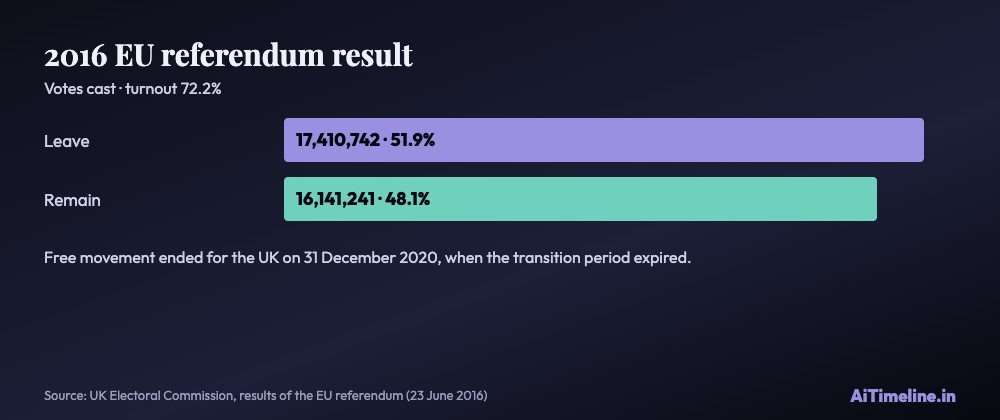
On 23 June 2016 voters chose to leave by 17,410,742 votes to 16,141,241, which is 51.9% to 48.1% (Electoral Commission). Control over immigration was a prominent theme on both sides of the campaign.
What Does Free Movement Mean, and How Does It Differ From Other Options?
Free movement, single market, customs union and membership are separate arrangements.
Freedom of movement is one of the EU’s core principles: citizens of a member state can generally live, work or study in another, subject to conditions. Before Brexit it applied between the UK and the EU. After the transition ended, UK and EU citizens became subject to separate immigration requirements.
Restoring free movement would not automatically mean rejoining the EU, but participation in the single market is linked to accepting it. The table sets out the options Burnham and others have mentioned. It is a plain-language explainer by AiTimeline, not an official classification.
| Arrangement | What it covers | Includes free movement of people? | Status for the UK |
|---|---|---|---|
| Status quo (Trade and Cooperation Agreement plus the 2025 reset) | Goods trade without tariffs, plus targeted deals | No | In force; “we could stay as we are” (Burnham, 30 Sep) |
| Targeted schemes (Erasmus+, youth mobility) | Time-limited exchange for students and young people | Limited and time-bound | Erasmus+ agreed for 2027/28; youth mobility disputed |
| Customs union | Common external tariff and tariff-free goods trade | No, not by itself | Named by Burnham as an idea; ruled out by the 2024 manifesto |
| Single-market membership | Free movement of goods, services, capital and people | Yes, as a core principle | Ruled out by the 2024 manifesto; raised as an option on 30 Sep |
| Full EU membership | All of the above, plus institutions and budget | Yes | “We are not rejoining” (government spokesperson) |
Possible effects, not predictions. Supporters of closer ties argue easier movement could help employers recruit and cut trade friction. Critics argue it could undermine control over immigration and reopen the divisions of 2016. Either outcome would depend on a negotiated deal, its design and wider economic conditions, and no text exists.
What Happens Next?
Dates to watch.
The next date is the UK-EU summit in Brussels on 20 November 2026, where Burnham is expected to meet Ursula von der Leyen and António Costa. The stated aim is to sign off food-standards and energy-market agreements, with youth mobility still disputed. The longer-term question is whether a future Labour manifesto would propose a different relationship and whether voters would be asked to approve it at a general election. This page will be rechecked after the summit.
What Is Settled and What Is Open, as of 25 October 2026
Kept apart from the timeline because statements, schedules and intentions are different kinds of evidence.
| Question | Position of the sources | Status |
|---|---|---|
| Has free movement been restored or proposed? | No. Burnham has not proposed it; the government line is no return in this parliament | Settled: no |
| Date Burnham’s interview was released | Night of Saturday 24 Oct (UK Fact Check); reported by Reuters on 25 Oct | Settled |
| Rayner’s exact words | Bloomberg and a search summary give “honest conversation”; ITV full text not opened | Paraphrase only |
| Rayner’s current role | Described as Housing Secretary by Bloomberg; Wikipedia lists her as Housing Secretary from 20 Jul 2026 | Single-source detail |
| Summit on 20 November | Burnham told MPs on 12 Oct; originally planned for 22 Jul | Scheduled, not yet held |
| Liberal Democrat and Conservative leader reactions to the interview | No verified statement found for Daisy Cooper or Kemi Badenoch on this specific interview | Not given here |
| January 2026 government response to the rejoin-EU petition | AiTimeline could not open the Commons Library briefing or find the response | Unverified, omitted |
| What a deal would contain | No text exists; the EU has not offered terms | Open |
The Story at a Glance
Oldest first.
| Date | Event | Type |
|---|---|---|
| 23 Jun 2016 | The referendum puts immigration at the centre | Background |
| 31 Jan 2020 | The United Kingdom leaves the European Union | Legal |
| 31 Dec 2020 | The transition period ends and EU free movement stops applying | Legal |
| 4 Jul 2024 | Labour wins with three red lines on Europe | Government |
| Sep 2025 | Rayner resigns after a property-tax breach | Government |
| 19 May 2025 | London summit: a “reset” with three documents | UK-EU |
| 17 Dec 2025 | UK agrees to rejoin Erasmus+ from 2027 | UK-EU |
| 20 Jul 2026 | Burnham becomes prime minister | Government |
| 30 Sep 2026 | Burnham on Today: “we could stay as we are” or “go all the way” | Debate |
| 12 Oct 2026 | Burnham to MPs: the status quo “is not good enough” | Government |
| 24–25 Oct 2026 | Reactions: Farage calls it “betrayal”; shadow home secretary criticises | Reaction |
| 24–25 Oct 2026 | Burnham tells The Sunday Times: “an honest discussion” on free movement | Debate |
| 25 Oct 2026 | Rayner defends the idea of an “honest conversation” | Government |
| 20 Nov 2026 | Next: the UK-EU summit in Brussels | UK-EU |
| Term | Meaning | Why it matters here |
|---|---|---|
| Freedom of movement | EU citizens’ right to live, work or study in another member state, subject to conditions | The thing Burnham asked to discuss |
| Single market | Free movement of goods, services, capital and people | Membership is linked to accepting free movement |
| Customs union | Common external tariff; no tariffs between members | Does not by itself include free movement of people |
| Schengen | The EU’s passport-free travel area | Britain was never in it; Burnham ruled it out |
| Common Understanding | Document approved at the 19 May 2025 summit | Basis of the current reset |
| Youth mobility scheme | Time-limited work and study access for young people | The most disputed part of the reset |
| Red lines | Labour’s 2024 manifesto limits on EU policy | Hold until the next general election |
Who Is Who
Andy Burnham
Became prime minister on 20 July 2026; said on 24 October that Britain should have an honest discussion about free movement.
Angela Rayner
Defended the call for an honest conversation on 25 October; resigned as deputy prime minister in September 2025 and returned to the cabinet in July 2026.
Nigel Farage
Called the remarks a total betrayal of Brexit Britain.
Chris Philp
Criticised the remarks.
Kemi Badenoch
Said earlier in October that Burnham was unpicking the withdrawal agreement.
Ursula von der Leyen and António Costa
Expected to meet Burnham in Brussels on 20 November.
The Headlines vs the Record
| Common claim | What the record shows |
|---|---|
| Britain is bringing back free movement | No decision exists. The prime minister called for a discussion; the government repeats its manifesto line |
| Rayner announced a policy | She defended the idea of an honest conversation and said a future manifesto could differ |
| Free movement ended when Britain left in January 2020 | It ended on 31 December 2020, when the transition period expired |
| Burnham wants to join the euro or Schengen | He said he could not imagine recommending either |
| The summit will restore free movement | The stated aim is to sign off food-standards and energy-market agreements; nothing says free movement is on the agenda |
| A customs union means free movement | A customs union is about tariffs on goods; free movement is tied to single-market membership |
Explore More Timelines
People Also Ask
Frequently Asked Questions
A Debate About Britain’s Long-Term Relationship With Europe
The comments reopened a sensitive question, but the line between debate and policy matters. The manifesto commitments stand, no restoration of free movement has been announced, and the November summit is about specific agreements. The larger question is how policymakers would weigh economic opportunity, immigration control, trade and democratic consent, and that would be settled by a future manifesto and a general election, not by an interview.
Related AiTimeline Stories
⚠️ Editorial Note
Last updated 25 October 2026. This is a fast-moving story and will be rechecked after the 20 November summit. The source brief was corrected: it said Badenoch and Liberal Democrat deputy leader Daisy Cooper reacted to the interview, but AiTimeline found only Farage and Chris Philp on record (Badenoch’s verified remark was earlier in October); it described a January 2026 reply to a rejoin-EU petition, a December 2025 list of agreements, a Burnham link between free movement and migration data-sharing, and a Rayner point about business friction, none of which could be verified, so they are omitted; it dated Burnham’s September remarks to the month, whereas the Today interview was on 30 September; and the gov.uk summit link in the brief returns 404. The ITV, Reuters, Bloomberg, Commons Library and Electoral Commission pages could not be opened in full by AiTimeline, so quotes rely on UK Fact Check and search summaries. Rayner’s role as Housing Secretary comes from Bloomberg and Wikipedia. No photographs of the politicians are used.
Sources & further reading
Every dated entry above was checked against these references. Last reviewed 25 October 2026.
- UK Fact Check: Burnham calls for honest discussion on EU free movement
- Bloomberg: Rayner defends Burnham move to revisit EU free movement
- Reuters: Burnham open to discussing EU free movement
- ITV News: Rayner says nothing off table in Burnham's talks with the EU
- City AM: Burnham on Brexit, customs union, single market or all the way
- Wikipedia: 2026 Labour Party leadership election
- Open University EU blog: Not even a new reset, the minimalist Burnham agenda
- European Commission: EU-UK relations
- University of Leeds: UK to rejoin Erasmus+
- UK Electoral Commission: Results and turnout at the EU referendum