← AiTimeline Home

Indian Science · National Science Day · 1888 to 2026

National Science Day: Raman Effect Discovery Timeline in India

📅 Updated 27 November 2026🔬 Spectra obtained 28 February 1928✎ By Nazish Fatima
In short

Discover how C.V. Raman and K.S. Krishnan found the Raman Effect in 1928, won the 1930 Nobel Prize and inspired India's National Science Day.

Latest Story

National Science Day falls on 28 February because of a question about the colour of the sea. In 1921 C.V. Raman looked at the Mediterranean from the deck of the SS Narkunda and doubted the textbook answer. Seven years later, in Calcutta, he and K.S. Krishnan showed that a small part of scattered light changes colour. That is the Raman Effect. Raman won the 1930 Nobel Prize in Physics, and India now marks the discovery each year. We follow the story from his birth in 1888 to National Science Day 2026, and mark where sources differ.

The point most summaries blur

The discovery was a process, and Krishnan was central to it. The Nobel Prize went to Raman alone, but Wikipedia says Krishnan first noted the new scattering on 7 January 1928 and co-authored the main 1928 papers. The 28 February date marks the day the two obtained spectra of the modified light.

💡 Short Answer

National Science Day is celebrated on 28 February to mark the discovery of the Raman Effect, which PIB dates to 28 February 1928. C.V. Raman and K.S. Krishnan found that a small share of light scattered by molecules changes colour. Nature printed their letter on 31 March 1928, Raman won the 1930 Nobel Prize in Physics, and India held its first National Science Day on 28 February 1987.

The Lead Picture: From a Blue Sea to a Nobel Prize

Ten dates, 1888 to 1987.

Road from the blue sea to a Nobel Prize: Raman born 7 November 1888, Palit Professor 1917, SS Narkunda voyage September 1921, Krishnan sees the glow 7 January 1928, spectra 28 February 1928, Bangalore lecture 16 March 1928, Nature letter 31 March 1928, Nobel Prize 1930, Raman Research Institute 1948, first National Science Day 28 February 1987.
The road from a blue sea to a Nobel Prize
⚡ Raman Effect and National Science Day at a Glance
Discovery28 Feb 1928
WhereIACS, Calcutta
Nature letter31 Mar 1928
Nobel PrizePhysics, 1930
First NSD28 Feb 1987
NSD 2026 themeWomen in Science
⚡ Quick Answers — AI Overview Ready

Raman Effect: Key Questions

Why is National Science Day on 28 February?
It commemorates the discovery of the Raman Effect, dated by PIB to 28 February 1928. The National Council for Science and Technology Communication asked for the designation in 1986, and the first observance was on 28 February 1987.
What is the Raman Effect?
A small fraction of light scattered by molecules comes out with a different energy and colour because it has exchanged energy with the molecules. The ACS says only about one in a million scattered photons shows the change.
Who gets the credit?
C.V. Raman won the 1930 Nobel Prize in Physics alone. K.S. Krishnan co-authored the 1928 Nature letter and, per Wikipedia, first noted the new scattering. Landsberg and Mandelstam in Moscow saw it independently in crystals.
What was the 2026 theme?
‘Women in Science: Catalysing Viksit Bharat’, according to the ISRO U R Rao Satellite Centre. A PIB release describes the 28 February 2026 events under the same theme.
📚 Key Takeaways

What the Record Shows

  • The sea started it: the 1921 voyage on the SS Narkunda turned Raman to light scattering, seven years before the effect.
  • A process, not a moment: hints appear from 1923, Krishnan saw a glow on 7 January 1928, and spectra followed on 28 February.
  • Very weak: about one in a million scattered photons shows the shift, so stronger light sources mattered.
  • Simple equipment: a seven-inch telescope, sunlight, then mercury arc lamps and a quartz spectrograph.
  • Published fast: the Bangalore lecture came on 16 March and the Nature letter on 31 March 1928.
  • Nobel to one: the 1930 prize went to Raman alone; Krishnan was not nominated.
  • Not alone in 1928: Landsberg and Mandelstam saw it in crystals, but the Nobel Committee proposed only Raman.
  • Day versus discovery: the day was designated in 1986 and first observed in 1987.
  • Source differences: the knighthood year, the Academy’s founding year and exact IISc dates differ by source, so we give both or the years only.

Timeline: The Raman Effect and National Science Day, 1888 to 2026

Newest first. Labels mark life events, science, honours, institutions and the national day.

28 Feb 2026

National Science Day 2026: ‘Women in Science: Catalysing Viksit Bharat’ National Day

Annual observanceDepartment of Science and Technology and institutions across India

The theme: India observed National Science Day on 28 February 2026 under the theme ‘Women in Science: Catalysing Viksit Bharat’. The ISRO U R Rao Satellite Centre says the day is celebrated to mark Raman’s discovery of 1928.

What happened: A PIB release says the day was marked with lectures, exhibitions, demonstrations and public outreach, including a programme in Delhi by CSIR-IGIB. The next observance falls on 28 February 2027.

PIB spells the theme ‘Catalyzing’ and URSC spells it ‘Catalysing’. We use the second spelling.
15 Dec 1998

The Raman Effect becomes an International Historic Chemical Landmark Honour

American Chemical SocietyIACS, Jadavpur, Calcutta

The designation: The American Chemical Society and the Indian Association for the Cultivation of Science dedicated the Raman Effect as an International Historic Chemical Landmark on 15 December 1998, at the IACS campus in Jadavpur.

The plaque: The plaque says Raman discovered at the institute in 1928 that a fraction of light scattered by a liquid is of a different colour from the beam entering it.

The ACS describes the effect as one that chemists adopted: ‘The Raman Effect became the adopted child of chemistry’, in the words it quotes from James Hibben.
28 Feb 1987

The first National Science Day National Day

First observanceAcross India

The day: India celebrated the first National Science Day on 28 February 1987, a year after the Government of India accepted the proposal to designate the date.

The idea: PIB says theme-based science communication activities are carried out across the country on the day.

PIB says the day commemorates the discovery of the Raman Effect, which it dates to 28 February 1928.

NCSTC asks for a National Science Day National Day

National Council for Science and Technology CommunicationGovernment of India

The request: In 1986 the National Council for Science and Technology Communication asked the Government of India to designate 28 February as National Science Day. The government accepted the request.

Source: This is stated in the PIB explainer on National Science Day. The year is the year of designation, and the first observance followed in 1987.

The designation (1986) and the first observance (1987) are different years, and the two are often swapped.
21 Nov 1970

Raman dies in Bangalore at 82 Life

Died aged 82Bangalore

The end: C.V. Raman died on 21 November 1970 in Bangalore, according to Wikipedia. He had been working at the Raman Research Institute, which he founded in 1948.

Where it stands: The discovery that bears his name outlived him in laboratories across the world. We could not confirm further details of his death from the sources we read.

He had turned 82 two weeks earlier, on 7 November 1970.

Bharat Ratna Honour

India’s highest civilian honourAwarded 1954

The award: Raman received the Bharat Ratna in 1954, alongside C. Rajagopalachari and Sarvepalli Radhakrishnan, according to Wikipedia.

Other honours: He had already won the Matteucci Medal (1928), the Nobel Prize (1930) and the Royal Society’s Hughes Medal (1930). Wikipedia also lists the Franklin Medal in 1941.

Wikipedia notes that Raman was openly critical of Nehru’s science policy, and also reports an episode in which he smashed his Bharat Ratna medallion. We treat that as reported, not confirmed.

Raman Research Institute Institution

BangaloreFounded 1948

The institute: After leaving IISc, Raman founded the Raman Research Institute in Bangalore in 1948. It began as a private institution owned by Raman and became autonomous in 1972, with funding from the Department of Science and Technology.

Why it matters: It gave him a base for independent work on optics, crystals and colour perception for the rest of his life, as the Nobel Foundation’s biography and the institute’s own history describe.

The institute is still in Bangalore, and its funding comes from the Department of Science and Technology.

The Indian Academy of Sciences Institution

BangaloreFounded 1934

The founding: Raman founded the Indian Academy of Sciences in Bangalore in 1934 and served as its president from the start, according to the Nobel Foundation. It also publishes the Proceedings that carried much of his work.

A date conflict: Wikipedia’s article on Raman says he founded the Academy in 1933. The Academy’s own article gives 1934, which we use.

Raman also founded the Indian Journal of Physics in 1926, where the Raman Effect was first reported in detail.

The first Indian director of the Indian Institute of Science Institution

IISc, BangaloreDirector 1933 to 1937

The move: Raman moved to Bangalore in 1933 as the first Indian director of the Indian Institute of Science. Wikipedia’s list of directors gives 1933 to 1937, and the Nobel Foundation says he stayed as professor until 1948.

What we could not check: The brief gives exact dates in March 1933 and July 1937. We could not read the IISc source for those, so we give the years only.

Wikipedia’s list shows Sir Martin Forster as director from 1922 to 1933, just before Raman.

The Nobel Prize in Physics goes to Raman alone Honour

Royal Swedish Academy of SciencesPhysics, 1930

The citation: Raman received the 1930 Nobel Prize in Physics ‘for his work on the scattering of light and for the discovery of the effect named after him’. He was the first Asian to receive a Nobel Prize in the sciences, Wikipedia says.

Who else was considered: Wikipedia reports that Landsberg and Mandelstam in Moscow were nominated too, but the Nobel Committee proposed only Raman. Krishnan was not nominated, although he co-authored the main 1928 papers.

Wikipedia reports that Raman booked steamship tickets to Stockholm in July 1930, months before the announcement.

Knighted as Sir C.V. Raman Honour

Knight Bachelor1929 or 1930, by source

The honour: The Nobel Foundation’s biography says Raman was knighted in 1929. Wikipedia says approval for the 1929 Birthday Honours was delayed, and that the Viceroy, Lord Irwin, conferred the knighthood at a special ceremony in New Delhi.

Date conflict: Wikipedia dates the knighthood to 1930 in one place. We give both years and treat 1929 as the honours year.

The Royal Society elected him a Fellow in 1924, five years before the knighthood.
31 Mar 1928

Nature publishes ‘A New Type of Secondary Radiation’ Science

Nature, volume 121, pages 501-502Raman and Krishnan

The letter: Nature carries the letter, by C.V. Raman and K.S. Krishnan, with a publication date of 31 March 1928. It argues that light scattered by dust-free liquids and gases carries a modified radiation of degraded frequency.

The Indian record: The ACS says Raman’s quantitative results were also published in the Indian Journal of Physics. The ACS adds that the study covered roughly 60 liquids, all showing the same effect.

Nature’s page for the letter lists more than 2,000 citations.
16 Mar 1928

Raman announces the ‘new radiation’ in Bangalore Science

South Indian Science AssociationBangalore

The lecture: Raman described the discovery to the South Indian Science Association on 16 March 1928. The ACS quotes his opening words: ‘I propose this evening to speak to you on a new kind of radiation or light emission from atoms and molecules.’

The apparatus: The ACS says the precise measurements shown in that lecture came from a quartz spectrograph, courtesy of the IACS.

Wikipedia reports a thousand reprints were posted to scientists in other countries within days.
28 Feb 1928

The spectra: the day India now celebrates Science

IACS, CalcuttaRaman and K.S. Krishnan

What happened: According to Wikipedia, on 28 February 1928 Raman and Krishnan obtained spectra of the modified scattering, separate from the incident light, with a spectrograph Raman had devised. The same day Raman announced the result to the press.

Why it was different: Raman and Krishnan showed that a small part of scattered light changed colour. Most of the scattered light keeps the colour of the incident beam, which is Rayleigh scattering. The altered part carries information about the molecules.

The Associated Press of India reported it on 29 February 1928, and The Statesman carried it on 1 March, per Wikipedia.
7 Jan 1928

Krishnan sees it first Science

IACS, CalcuttaK.S. Krishnan

The first sighting: Wikipedia, citing a 2018 history paper by Rajinder Singh, says Krishnan began the experiment in early January 1928. On 7 January he noticed that every pure liquid he used gave a polarised glow in visible light.

What followed: Raman was astonished that he had never seen it. That night the two named it ‘modified scattering’, in contrast with the unmodified scattering Compton had seen in X-rays.

Wikipedia says Krishnan ‘alone first noted the new scattering’, which is why the 28 February date is a milestone and not a single moment.

Compton’s Nobel Prize points the way Science

Compton effectCalcutta

The prompt: Wikipedia says the news of Arthur Compton’s Nobel Prize in December 1927 excited Raman. He told Krishnan that if the effect held for X-rays it should hold for light, and that an optical analogue of the Compton effect had to exist.

The background: Compton had shown in 1923 that electromagnetic waves can behave as particles. Raman had sided against him in a 1924 debate, according to Wikipedia.

Raman is reported to have said that if he had found the effect earlier he would have had to share the Nobel Prize with Compton.

A seven-inch telescope concentrates the light Science

IACS, CalcuttaEquipment

The instrument: The ACS says the IACS acquired a seven-inch (18 cm) refracting telescope in 1927. It let Raman condense sunlight into a stronger source.

What came next: By early 1928 mercury arc lamps were commercially available, and Raman switched to them. He also replaced visual observation with a pocket spectroscope and then a quartz spectrograph.

The effect is very weak. The ACS says only about one in a million scattered photons shows the change.
1923 to 1925

Faint hints of a second colour Science

Raman, Ramanathan, KrishnanCalcutta

What they saw: Wikipedia says Raman’s experiments in 1923 hinted at extra rays when sunlight passed through violet glass into some liquids and solids. K.R. Ramanathan believed it was a trace of fluorescence.

Krishnan’s note: In 1925 K.S. Krishnan, a new research associate, wrote about the possible extra scattering and called it ‘feeble fluorescence’. Attempts to explain it failed for the next two years.

The brief placed Krishnan’s note in 1924. Wikipedia’s reference is a 1925 paper, so we use 1925.

The sea voyage that started the question Science

SS NarkundaReturn trip from London to Bombay

The observation: On the return voyage in 1921, Raman became fascinated by the deep blue colour of the Mediterranean. He doubted Lord Rayleigh’s explanation that the sea merely reflected the sky, according to the ACS.

The follow-up: When the ship docked at Bombay he finished a short article, ‘The colour of the sea’, which Nature published in November 1921. In 1922 he argued the blue came from molecular scattering by the water itself.

The voyage did not produce the Raman Effect. It pushed Raman into light scattering, and the effect followed seven years later.

Raman becomes Palit Professor Life

University of CalcuttaRajabazar Science College

The chair: In 1917 Raman became the first Palit Professor of Physics at the University of Calcutta, appointed by Ashutosh Mukherjee, according to Wikipedia. He left the finance service to take it.

The lab: He kept working at the IACS, which let him carry out his research on acoustics and optics.

Raman became honorary secretary of the IACS in 1919, the Nobel Foundation says.

A civil servant who did physics after office hours Life

Indian Finance DepartmentCalcutta

The job: After his master’s degree, Raman joined the Indian Finance Department in 1907 as an Assistant Accountant General in Calcutta. The Nobel Foundation says the duties of the office took most of his time.

The lab: He found time for experiments at the IACS, which Mahendralal Sircar founded in 1876 as India’s first research institute, according to Wikipedia.

His first research paper, on the diffraction of light, was published in 1906 while he was still a student, per Wikipedia.

A gold medal in physics at Presidency College Life

Presidency College, MadrasBA 1904, MA 1907

The record: The Nobel Foundation says Raman entered Presidency College in 1902, passed his BA in 1904 in first place with the gold medal in physics, and took his MA in 1907 with the highest distinctions.

The interests: His earliest research was in optics and acoustics. The ACS says he studied the vibrations of the violin, the veena and the tabla.

His first paper, on diffraction, was published before he had finished his degree.
7 Nov 1888

Born in Tiruchirappalli Life

Tiruchirappalli, Madras PresidencyBorn 7 November 1888

The family: Chandrasekhara Venkata Raman was born on 7 November 1888 in Tiruchirappalli. His father, R. Chandrasekhara Iyer, was a lecturer in mathematics and physics, so Raman grew up in an academic home.

Later years: Wikipedia says the family moved to Visakhapatnam when his father took a college post there.

Wikipedia records Raman recalling that at his birth his father earned ten rupees a month.

How the Raman Effect Works

What happens to a photon that hits a molecule.
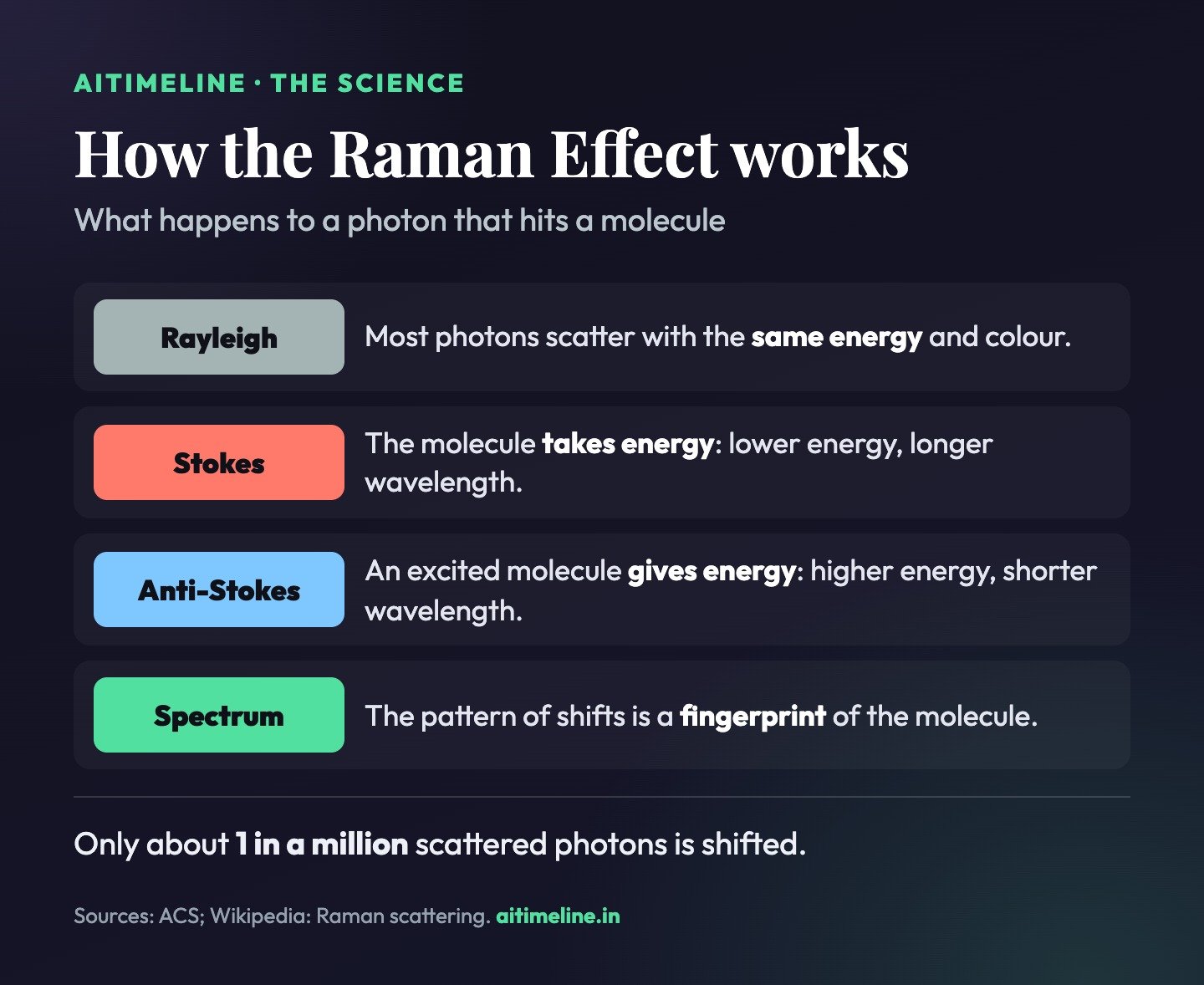
How the Raman Effect works: Rayleigh scattering keeps the same energy and colour; Stokes scattering takes energy from the photon, giving lower energy and longer wavelength; anti-Stokes scattering gives energy from an excited molecule, giving higher energy and shorter wavelength; the pattern of shifts is a fingerprint of the molecule.
How the Raman Effect works

Most scattered light keeps the colour of the incident beam. That is Rayleigh scattering, the same process Lord Rayleigh used to explain the blue of the sky. In the early experiments, the ACS says, the incident violet light was isolated with a violet filter and the changed light was picked out with a green filter. A small part of the light had traded energy with the molecules, and that part carried the molecule’s signature.

Who Made the Discovery

Calcutta and Moscow, 1928.
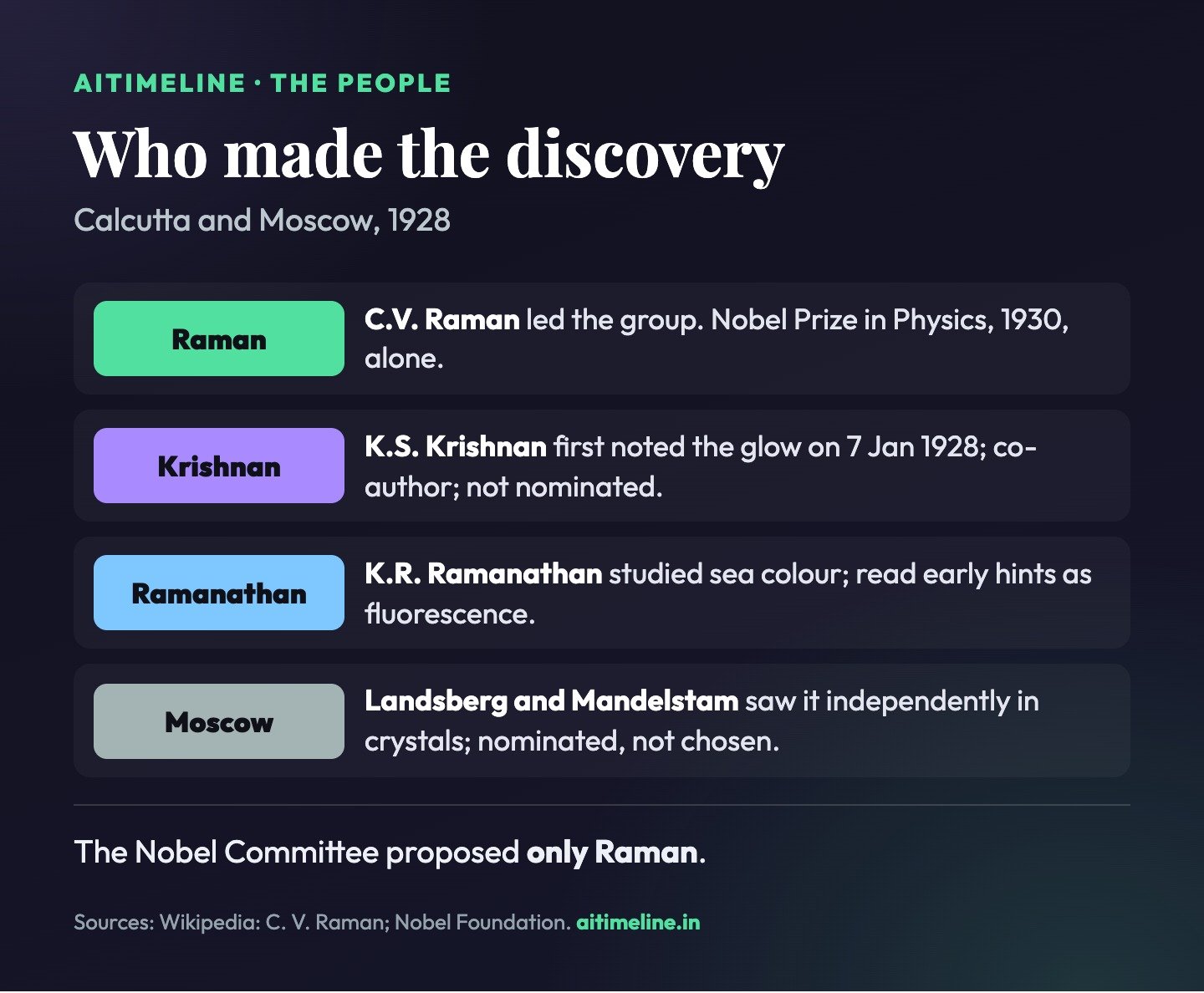
Who made the discovery: C.V. Raman led the group and won the 1930 Nobel Prize alone; K.S. Krishnan first noted the glow on 7 January 1928, co-authored the paper and was not nominated; K.R. Ramanathan studied sea colour and read early hints as fluorescence; Landsberg and Mandelstam saw the effect independently in crystals in Moscow.
Who made the discovery

The Nobel Committee, according to Wikipedia, preferred Raman because he and Krishnan had shown the effect in solids, liquids and gases, while the Russians had observed it in crystals and cited Raman’s article. Wikipedia also says Raman later admitted Krishnan was a co-discoverer, and that their relationship soured. We have not checked the primary sources behind that account.

The Discovery in Numbers

A very weak effect, found with simple equipment.
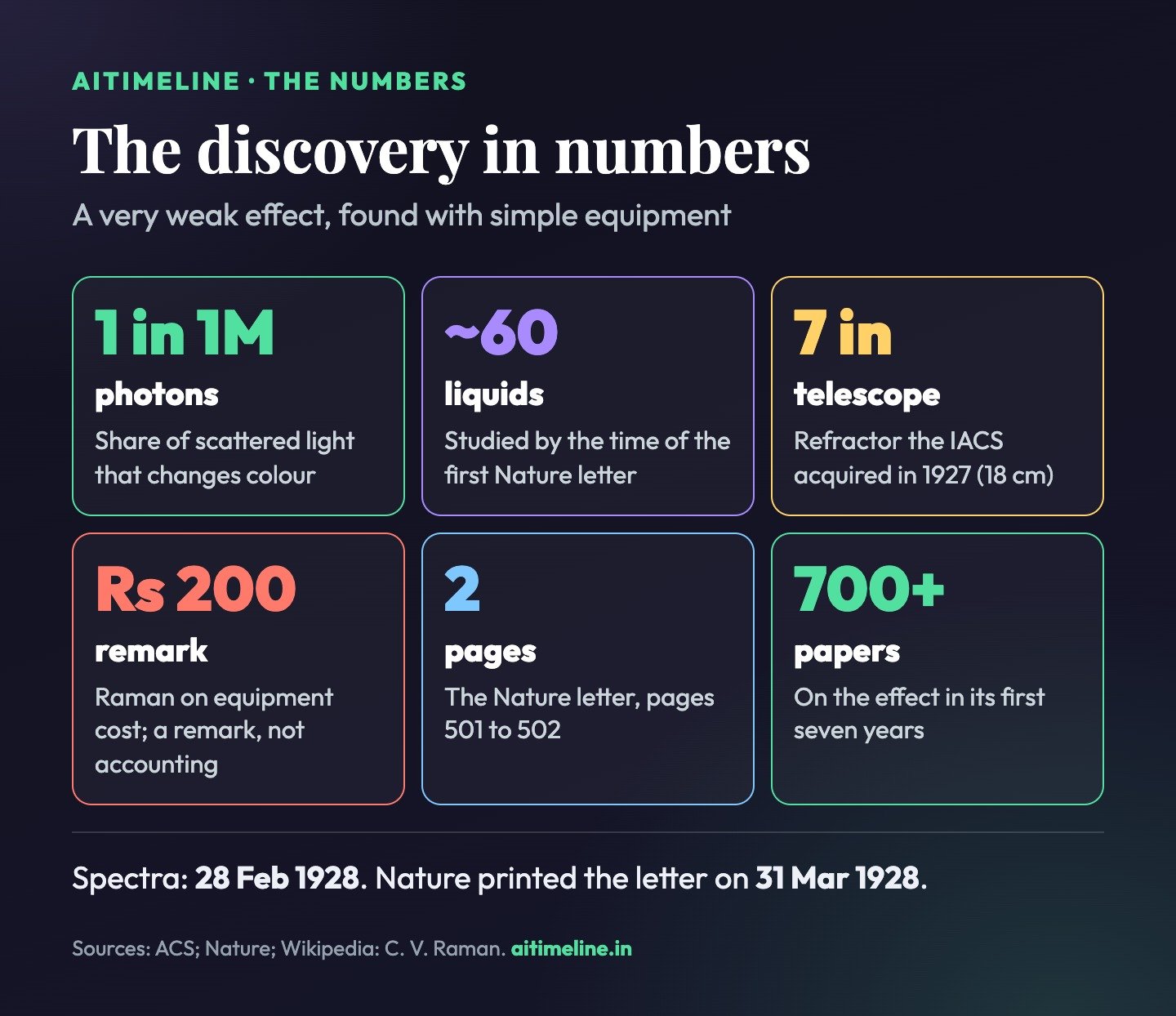
The discovery in numbers: 1 in 1 million scattered photons shifted, about 60 liquids studied, a 7-inch telescope acquired in 1927, a remark of Rs 200 on equipment, a 2-page Nature letter and more than 700 papers in seven years.
The discovery in numbers

Where Raman Spectroscopy Is Used

From chemistry labs to cultural heritage.

Where Raman spectroscopy is used: chemistry, pharmaceutical process monitoring, forensics, materials, cultural heritage and medical research, with suitability depending on sample, equipment and question.
Where Raman spectroscopy is used

The ACS says that by the late 1930s the Raman Effect was the main method of nondestructive chemical analysis, that infrared spectroscopy overtook it after the Second World War, and that the laser revived it from the 1960s. Medical uses are mostly at the research stage. Raman spectroscopy is not a replacement for other methods, and its suitability depends on the sample, the equipment and the question asked.

Raman and Indian Science

A journal, an academy and an institute.
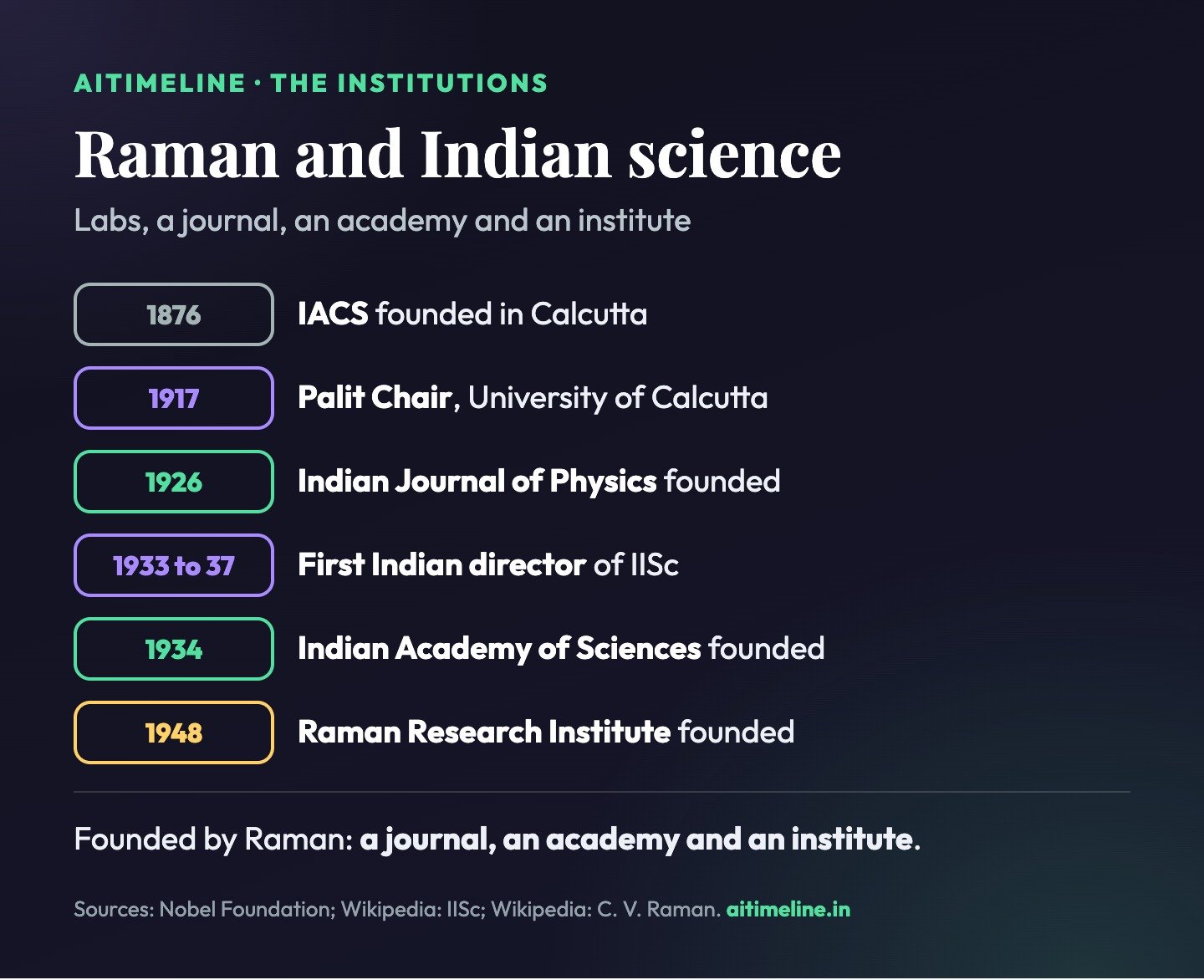
Raman and Indian science: IACS founded 1876, Palit Chair 1917, Indian Journal of Physics 1926, first Indian director of IISc 1933 to 1937, Indian Academy of Sciences 1934, Raman Research Institute 1948.
Raman and Indian science

National Science Day, 1928 to 2026

From a discovery to a national observance.

National Science Day: spectra obtained 28 February 1928, NCSTC asks and government accepts in 1986, first National Science Day 28 February 1987, themes of 2020, 2024, 2025 and 2026, next observance 28 February 2027.
National Science Day, 1928 to 2026

Source Gaps and Corrections

Claim in earlier summariesWhat we foundStatus
Discovered on a single day, 28 Feb 1928Krishnan first saw the glow on 7 Jan 1928; spectra followed on 28 FebBoth given
Krishnan’s note in 1924Wikipedia’s reference is a 1925 paperRestated
Ramanathan saw it in 1923Raman’s 1923 experiments hinted at it; Ramanathan read it as fluorescenceRestated
Knighted in 1929Nobel Foundation says 1929; Wikipedia also gives 1930 for the ceremonyBoth given
IISc director from 31 Mar 1933 to 19 Jul 1937Wikipedia lists 1933 to 1937; exact days not confirmedYears only
Academy founded in 1934Academy article says 1934; Raman article says 19331934 used
Among the first Bharat Ratna recipientsWikipedia says 1954, with Rajagopalachari and RadhakrishnanReworded
Raman alone discovered the effectKrishnan co-authored the papers; Landsberg and Mandelstam saw it independentlyQualified
2026 theme spelled ‘Catalysing’URSC spells it so; PIB says ‘Catalyzing’Both noted

Conclusion: One Question About the Sea

The story of the Raman Effect is a reminder that large discoveries can begin with a small doubt. A question about the colour of the sea led to years of measurements at the IACS, and then to a faint shifted line that chemists still use.

What we could not settle from our sources is the exact days of Raman’s IISc directorship, the full text of the 1928 Nature letter beyond its opening and the primary record behind the Raman and Krishnan dispute. We have marked each. Readers who need exact wording should consult the Nobel Foundation biography, the ACS landmark page and the Nature letter itself.

Explore More Timelines

People Also Ask

Did K.S. Krishnan share the Nobel Prize for the Raman Effect?
No. The 1930 Nobel Prize in Physics went to C.V. Raman alone. Krishnan was a co-author of the 1928 Nature letter and, according to Wikipedia, the first to note the new scattering in January 1928, but he was not nominated. Wikipedia adds that Raman later admitted Krishnan was a co-discoverer.
Was the Raman Effect discovered on a single day?
Not really. 28 February 1928 is the date India commemorates, when Raman and Krishnan obtained spectra of the modified scattering. Wikipedia, citing a 2018 history paper, says Krishnan first saw a polarised glow in pure liquids on 7 January 1928. Earlier hints go back to 1923.
Did Raman discover the Raman Effect on the Mediterranean voyage?
No. The 1921 voyage on the SS Narkunda made Raman curious about the blue of the sea and about light scattering. The effect itself was found seven years later in Calcutta, in February 1928. The voyage was the start of the question, not the date of the discovery.
Did anyone else observe the effect in 1928?
Yes. Wikipedia reports that Grigory Landsberg and Leonid Mandelstam in Moscow independently observed it in 1928, in crystals. They were nominated for the 1930 Nobel Prize, but the Nobel Committee proposed only Raman, because he and Krishnan had shown the effect in solids, liquids and gases.
Is Raman spectroscopy used in routine medical diagnosis?
Not routinely, as far as we found. Wikipedia describes European work on monitoring cancer through body fluids, and other biomedical uses are research-stage. The ACS describes established use in chemistry and pharmaceutical manufacturing. We treat clinical diagnosis as experimental.

Frequently Asked Questions

Why is National Science Day celebrated on 28 February?
It commemorates the discovery of the Raman Effect by Sir C.V. Raman, which PIB dates to 28 February 1928. The National Council for Science and Technology Communication asked the government in 1986 to designate the date, and the government accepted. The first observance was held on 28 February 1987.
Who discovered the Raman Effect?
C.V. Raman, working with his research associate K.S. Krishnan at the Indian Association for the Cultivation of Science in Calcutta. The effect is named after Raman, and the Nobel Prize went to him alone. Krishnan co-authored the 1928 Nature letter and first noticed the new scattering, according to Wikipedia.
What is the Raman Effect in simple words?
When light passes through a transparent material, most of it scatters with the same colour. A tiny share, about one in a million photons according to the ACS, comes out with a different energy because it has exchanged energy with the molecules. That shifted light is the Raman Effect.
What was National Science Day 2026's theme?
'Women in Science: Catalysing Viksit Bharat'. The ISRO U R Rao Satellite Centre gives this as the theme for NSD-2026, and a PIB release describes the 28 February 2026 celebrations under the same theme, with the spelling 'Catalyzing'. The next observance is on 28 February 2027.
When did C.V. Raman win the Nobel Prize?
In 1930. The Royal Swedish Academy of Sciences gave him the Nobel Prize in Physics for his work on the scattering of light and for the discovery of the effect named after him. Wikipedia says he was the first Asian to receive a Nobel Prize in the sciences.
Who was K.S. Krishnan?
Kariamanickam Srinivasa Krishnan was an Indian physicist who worked with Raman at the IACS. He co-authored the main 1928 papers, and Wikipedia says he first noted the new scattering. He later moved to Dacca University in 1928 and became known for work on crystal magnetism.
Where was the Raman Effect discovered?
At the Indian Association for the Cultivation of Science in Calcutta, now Kolkata. The IACS had been founded in 1876, and the American Chemical Society and the IACS dedicated the Raman Effect as an International Historic Chemical Landmark there on 15 December 1998.
What inspired Raman to study light scattering?
A voyage in 1921. Returning from London to Bombay aboard the SS Narkunda, Raman became fascinated by the deep blue of the Mediterranean and doubted Lord Rayleigh's explanation that the sea reflected the sky. He sent a letter to Nature when the ship docked, and studied molecular scattering in water.
What did Raman and Krishnan publish in 1928?
A Nature letter titled 'A New Type of Secondary Radiation', published on 31 March 1928 in volume 121, pages 501 to 502. It argued that light scattered by dust-free liquids and gases carries a modified radiation of degraded frequency alongside the ordinary scattered light.
What is Stokes scattering?
In Stokes scattering the molecule takes some energy from the photon. The scattered photon therefore has lower energy, lower frequency and a longer wavelength than the incident light. It is the stronger of the two Raman lines at room temperature, because most molecules start in the lowest vibrational state.
What is anti-Stokes scattering?
Here the photon gains energy from a molecule that is already in an excited vibrational or rotational state. The scattered photon has higher energy, higher frequency and a shorter wavelength. It is usually weaker than the Stokes line because fewer molecules start in an excited state.
What is Rayleigh scattering?
It is the elastic scattering of light, in which the scattered photon keeps the same energy and colour as the incident one. It is far stronger than Raman scattering. Rayleigh's explanation of the sky's blue was the one Raman used to show that the sea's blue also came from scattering by molecules.
How weak is the Raman Effect?
Very weak. The ACS says only about one in a million of the scattered photons shows the change in wavelength, which is part of why it was not discovered earlier. Stronger light sources, first a telescope and mercury arc lamps and later lasers, made it far easier to observe.
What equipment did Raman use?
Early work relied on sunlight and visual observation of colour. The IACS acquired a seven-inch refracting telescope in 1927 to concentrate sunlight, and by early 1928 Raman used mercury arc lamps. He measured wavelengths with a pocket spectroscope, then a quartz spectrograph, according to the ACS.
How much did the equipment cost?
Raman is reported to have said that when he got his Nobel Prize he had spent hardly 200 rupees on his equipment. Wikipedia adds that it was obvious his total expenditure on the experiment was much more. We treat the figure as a remark, not an accounting.
When did Raman give his first public account?
On 16 March 1928, in a lecture titled 'A new radiation' to the South Indian Science Association in Bangalore. The ACS quotes his opening line about a new kind of radiation or light emission from atoms and molecules. Wikipedia reports that reprints were sent to scientists abroad.
How was the discovery received abroad?
Quickly. The ACS quotes Professor R.W. Wood of Johns Hopkins, who cabled Nature that he had verified the discovery in every particular. It adds that more than 700 papers on the effect appeared in the first seven years. Wikipedia says some French and German physicists were at first sceptical.
Was Raman knighted?
Yes. The Nobel Foundation's biography says he was knighted in 1929. Wikipedia says approval for the 1929 Birthday Honours was delayed and that the Viceroy conferred the Knight Bachelor at a special ceremony in New Delhi, and elsewhere dates it to 1930. Both years appear in sources.
What are Raman's other institutions?
He founded the Indian Journal of Physics in 1926, the Indian Academy of Sciences in 1934 and the Raman Research Institute in Bangalore in 1948. He was also the first Indian director of the Indian Institute of Science, serving 1933 to 1937 according to Wikipedia's list of directors.
What is the Raman Research Institute?
An institute in Bangalore that Raman founded in 1948 after leaving the Indian Institute of Science. It began as a private institute and became autonomous in 1972, with funding from the Department of Science and Technology. Raman worked there on optics, crystals and colour perception until his death.
When did Raman receive the Bharat Ratna?
In 1954. Wikipedia says he received it alongside C. Rajagopalachari and Sarvepalli Radhakrishnan. He had earlier received the Matteucci Medal in 1928, the Nobel Prize and the Royal Society's Hughes Medal in 1930, and, per Wikipedia, the Franklin Medal in 1941.
When did Raman die?
On 21 November 1970 in Bangalore, aged 82, according to Wikipedia. He had been born on 7 November 1888 in Tiruchirappalli. By then the institute he founded, the Raman Research Institute, had been running for more than twenty years.
Where is Raman spectroscopy used today?
The ACS says it is used to monitor manufacturing in the petrochemical and pharmaceutical industries and to analyse seized drugs without breaking the evidence seal. Wikipedia adds uses in art and cultural heritage, forensic trace evidence, materials and cells. Suitability depends on the sample and equipment.
Why did Raman spectroscopy decline and then return?
The ACS says that after the Second World War infrared spectroscopy became routine with better detectors, while Raman work still needed skilled operators and darkrooms. The laser revived Raman spectroscopy from the 1960s, and commercial Fourier-transform Raman instruments appeared in the late 1980s.
Is the ACS landmark national or international?
International. The ACS page says the Raman Effect was dedicated an International Historic Chemical Landmark on 15 December 1998 at the IACS in Jadavpur. A Wikipedia article on Raman scattering calls it a National Historic Chemical Landmark, which is the ACS's general programme name.
Was the 1921 voyage on the way to or from Europe?
On the way back. The ACS says it was the return trip from London to Bombay aboard the SS Narkunda, a fifteen-day voyage. Wikipedia places it in September 1921 and says Raman's article 'The colour of the sea' appeared in Nature in November 1921.
What were earlier National Science Day themes?
Wikipedia lists 'Women in Science' for 2020, 'Global Science for Global Wellbeing' for 2023, 'Indigenous Technologies for Viksit Bharat' for 2024 and a youth-focused Viksit Bharat theme for 2025. We rely on Wikipedia for those, and on PIB and URSC for 2026.
Did Raman and Krishnan stay on good terms?
Not according to Wikipedia, which says Raman remained openly antagonistic towards Krishnan in later years, and that Krishnan called it the greatest tragedy of his life. We report this as Wikipedia's account and did not check the primary sources it cites.
What is the best short summary of the story?
A question about the sea's colour in 1921 led Raman to study light scattering. In 1928 he and Krishnan showed that scattered light carries a faint, shifted colour. Raman won the 1930 Nobel Prize, and India marks the date of the discovery as National Science Day.

⚠️ Editorial Note

This page draws on the Nobel Foundation’s biography of Raman, the American Chemical Society’s landmark page, the Nature letter of 31 March 1928, PIB and URSC pages on National Science Day, and Wikipedia’s articles on Raman, Raman scattering, Raman spectroscopy and the Indian Institute of Science. Sources differ on the knighthood year and the Academy’s founding year, and we give both. We could not read the Nature letter beyond its opening or the IISc source for the directorship dates. Wikipedia’s account of Raman and Krishnan’s relationship is reported, not independently confirmed. This is editorial history, not scientific or professional advice.

Related Stories

Ramadan Economics: How the Holy Month Reshapes Gulf Markets Tariff Walls and Trade Bridges: The Hidden Forces Reshaping Global Trade
New article
→
Next Article