From Chandrayaan-3 to Gaganyaan: India’s Historic Space Odyssey Timeline
Explore India's space journey from Aryabhata and Chandrayaan to Aditya-L1, Gaganyaan and the Bharatiya Antariksh Station, with the current ISRO roadmap.
Latest Story
India’s space programme did not begin with a Moon landing, and it will not end with one either. It began in 1963 with a borrowed rocket fired from a fishing village in Kerala, and it has moved, deliberately and unevenly, from building satellites, to launching them independently, to watching the Earth from orbit, to reaching the Moon and Mars, to studying the Sun, and now toward carrying its own astronauts into space. Chandrayaan-3’s landing near the Moon’s south polar region on August 23, 2023 is the event India now marks every year as National Space Day, but it is one milestone in a much longer chain of capability-building that stretches from Aryabhata in 1975 through Gaganyaan, India’s human spaceflight programme, and on to a planned Indian space station in the next decade.
🌐 India’s Space Journey in 60 Seconds — AI Overview
India’s space programme moved from launching sounding rockets in 1963 to building its first satellite, Aryabhata, in 1975, to reaching orbit on its own rocket in 1980, to landing near the Moon’s south pole with Chandrayaan-3 on August 23, 2023 — the date India now observes as National Space Day. The next major goal is Gaganyaan, India’s human spaceflight programme: an uncrewed orbital test flight is targeted for late 2026, ahead of a crewed mission ISRO has indicated for 2027 but not yet formally confirmed. Beyond that, ISRO is developing Chandrayaan-4 (lunar sample return), a Venus orbiter, and the Bharatiya Antariksh Station, India’s planned space station.
National Space Day 2026: Why August 23 Matters
India observes National Space Day on August 23 because that is the date, in 2023, that the Vikram lander from the Chandrayaan-3 mission touched down on the lunar surface in the Moon’s south polar region — the first landing by any country in that specific part of the Moon. Three days later, addressing the Chandrayaan-3 team, Prime Minister Narendra Modi announced that August 23 would be marked every year as National Space Day, and that the exact landing spot would be named Shiv Shakti Point. The point where Chandrayaan-2’s orbiter had earlier photographed its own lander’s crash site was retroactively named Tiranga Point in the same announcement.
What made the landing significant was not a single fact but a combination of them: it was a soft landing — a controlled, powered descent rather than an impact — executed autonomously by the lander’s own guidance computer in the final phase; it took place in the Moon’s south polar region, an area of scientific interest because of permanently shadowed craters believed to hold water ice, but also one of the most difficult regions to land in because of its rough terrain and long shadows; and it followed directly from the partial failure of Chandrayaan-2 four years earlier, meaning it demonstrated that ISRO’s engineers had specifically fixed the failure mode that ended that mission. The lander (Vikram) and rover (Pragyan) together spent roughly ten Earth days operating on the surface, running instruments that measured the Moon’s thermal, seismic and chemical properties before both went into a planned sleep as the two-week lunar night began.
One wording point worth being precise about: Chandrayaan-3 is usually and accurately described as landing in the Moon’s south polar region — it did not land exactly at the geographic south pole, and earlier ISRO/NASA missions had already photographed and partially measured that broader region from orbit. The more defensible claim, and the one ISRO itself has used, is that India became the first country to achieve a soft landing this far south on the Moon, not the first to visit the region in any form.
India’s Space Programme: Key Questions
Key Takeaways
- India’s space programme is a 60-year accumulation of capability, not a sudden 2023 achievement — sounding rockets (1963), a first satellite (1975) and an independent launch vehicle (1980) all came decades before any planetary mission.
- Chandrayaan-3 changed India’s space story by proving the specific capability — autonomous hazard-avoidance and a controlled soft landing — that Chandrayaan-2 had failed to demonstrate in 2019, turning a documented failure into a corrected, repeatable one.
- National Space Day, observed August 23, exists because of that landing; 2026 is its third year, hosted in Ahmedabad by the Space Applications Centre with the theme “Towards Viksit Bharat: Innovating, Collaborating and Aspiring to Global Space Leadership.”
- Gaganyaan has not yet flown a crewed or uncrewed orbital mission as of August 2026; ISRO is targeting an uncrewed orbital test (G1) in the second half of 2026, after the originally planned early-2026 window slipped.
- A robotic lunar landing and a crewed orbital flight are different engineering problems: Gaganyaan additionally requires life support, a crew escape system, and safe recovery of living astronauts — it cannot simply reuse Chandrayaan-3’s playbook.
- India’s own PSLV rocket failed a mission as recently as January 2026 (PSLV-C62), a useful reminder that even a 30-year-old, historically reliable launch vehicle family can still fail — and a reason ISRO has cited for moving cautiously on Gaganyaan’s schedule.
- Chandrayaan-4 (lunar sample return) and the Venus Orbiter Mission are both past Cabinet approval and in hardware development, but ISRO’s own public statements have given different target years for each — this page reports both rather than picking one.
- NISAR, a joint ISRO-NASA Earth-observation satellite, has been operational since its July 30, 2025 launch — a working example of India’s space programme collaborating with, not just competing against, established space agencies.
- The Bharatiya Antariksh Station is India’s answer to “what comes after the ISS partnership ends” for India — a five-module national space station with a first-module target of 2028 and a full-assembly target of 2035.
- Private Indian space companies (Skyroot, Agnikul and others) are now flying their own rockets from their own pads, a genuinely new development since 2022 that sits alongside, not in place of, ISRO’s own missions.
India’s Space Capability Ladder
The order in which India actually built up the ability to do harder things in space — not a list of famous missions, but the skills each one unlocked.
This is a description of the capabilities India has actually built up, in the order it built them — not a promise that every future step happens on the schedule ISRO has stated today.
India’s Space Exploration Timeline
From the first sounding rocket to the current Gaganyaan programme, in the order events actually happened.
–63
India’s Space Programme Begins at Thumba
What happened: Physicist Vikram Sarabhai persuaded the Indian government to form the Indian National Committee for Space Research (INCOSPAR) in 1962. The Thumba Equatorial Rocket Launching Station (TERLS) was set up near a fishing village close to the magnetic equator — a location scientifically useful for upper-atmosphere research — and on November 21, 1963, India launched its first sounding rocket, a U.S.-supplied Nike-Apache, to study the ionosphere.
Why it mattered: This was not a satellite or an orbital launch — it was India’s first hands-on experience running a rocket-launch operation at all, built around scientific research rather than prestige.
Capability gained: Basic sounding-rocket operations and a permanent institutional home for space research, which became ISRO six years later.
–72
ISRO Is Formed, Then Given Its Own Department
What happened: The Indian Space Research Organisation (ISRO) was established in 1969 under the Department of Atomic Energy. In 1972, the Government of India created a dedicated Department of Space and Space Commission, with ISRO reporting directly to the Prime Minister’s Office rather than through another ministry.
Why it mattered: Sarabhai’s founding vision, stated explicitly, was that India would use space technology for practical development needs — communications, weather forecasting and remote sensing — not for a prestige race with other spacefaring nations. That development-first framing shaped ISRO’s priorities for the next two decades.
Capability gained: A dedicated, PM-linked institutional structure that could plan multi-decade programmes independent of shifting ministry priorities.
Aryabhata: India’s First Satellite
What happened: Aryabhata, India’s first satellite, launched on a Soviet Kosmos-3M rocket from Kapustin Yar under an ISRO-USSR cooperation agreement — India built the satellite, but did not yet have a rocket capable of launching it. Named after the 5th-century Indian mathematician-astronomer, it carried instruments for X-ray astronomy, aeronomy and solar physics. A power-system failure ended most experiments after about four days in orbit, though the satellite itself remained in orbit for years.
Why it mattered: This is the clear dividing line the brief for this article insists on: Aryabhata proved India could design and build a satellite. It did not prove India could launch one independently — that capability was still five years away.
Capability gained: Spacecraft design, integration and testing, entirely separate from launch-vehicle capability.
India Reaches Orbit on Its Own Rocket
What happened: The Satellite Launch Vehicle-3 (SLV-3), led by project director A.P.J. Abdul Kalam, successfully placed the 35 kg Rohini RS-1 satellite into orbit — after an earlier SLV-3 attempt in August 1979 had failed. The launch made India the sixth country to reach orbit using a rocket it had built itself, after the Soviet Union, the United States, France, Japan and China.
Why it mattered: This closes the loop the Aryabhata entry opens: building satellites and launching them independently are two separate skills, and SLV-3 is the moment India acquired the second one. Every subsequent Indian launch vehicle — ASLV, PSLV, GSLV, LVM3 — descends from this programme.
Capability gained: Independent, sovereign access to orbit.
–01
India’s Communication Satellite Era: INSAT and GSAT
What happened: INSAT-1A launched in 1982 as India’s first multipurpose communications satellite (procured and launched abroad); the indigenously-built INSAT-2 series followed in the early 1990s. The GSAT series, launched from 2001 onward primarily on ISRO’s own GSLV rockets, extended this into telecommunications, television broadcasting, weather monitoring and disaster warning.
Why it mattered: This is the part of India’s space history that gets skipped when the story jumps straight from Aryabhata to the Moon — but INSAT and GSAT satellites, not planetary probes, are what most Indians have actually depended on for television, telephony, cyclone warnings and weather forecasts for four decades.
Capability gained: Sustained geostationary satellite operations at national infrastructure scale.
–99
PSLV Becomes India’s Workhorse Rocket
What happened: The Polar Satellite Launch Vehicle’s first flight (PSLV-D1) in 1993 partially failed; its second flight in October 1994 succeeded, and PSLV went on to become ISRO’s most reliable and most-flown rocket family, carrying Earth-observation (IRS series) satellites into polar orbit and, later, dozens of commercial and international payloads on a single mission — a record single flight in February 2017 launched 104 satellites at once.
Why it mattered: PSLV is the rocket that gave India routine, repeatable, commercially useful access to orbit, decades before any Moon or Mars mission. Nearly every major ISRO planetary mission — Chandrayaan-1, Chandrayaan-2, Mangalyaan — launched on a PSLV.
Capability gained: Reliable, repeatable, commercially competitive orbital launch.
Chandrayaan-1: India Begins Its Lunar Exploration Era
What happened: India’s first mission beyond Earth orbit launched on a PSLV-C11 and entered lunar orbit in November 2008. Its instruments, including NASA’s Moon Mineralogy Mapper flown as a guest payload, contributed to the international scientific case for water and hydroxyl molecules on the lunar surface. A power and communication issue cut the mission short at 312 days of its planned two years, though ISRO stated it had already met most of its objectives.
Why it mattered: Chandrayaan-1 was India’s entry into planetary science and international lunar collaboration, not a solo discovery — the water/hydroxyl evidence came from combining Chandrayaan-1’s data with instruments and analysis from NASA and other international teams, and this article does not claim India discovered lunar water alone.
Capability gained: Deep-space navigation, lunar orbit insertion and operation, and international science-payload collaboration.
–14
Mangalyaan Reaches Mars — On the First Attempt
What happened: The Mars Orbiter Mission (Mangalyaan) launched on November 5, 2013, and entered Mars orbit on September 24, 2014, making India the fourth space agency to reach Mars and the first anywhere to succeed on its very first attempt. Its five instruments studied the Martian surface, atmosphere and mineralogy. The mission’s approved cost was widely reported around ₹450 crore, a genuinely modest figure for an interplanetary mission — though comparisons to any single film’s budget are a media framing device, not an ISRO claim, and are avoided here.
Why it mattered: Mangalyaan demonstrated interplanetary trajectory design and Mars orbit insertion — a much harder navigational problem than a lunar mission, given Mars’s greater distance and the tighter margins of a single insertion attempt. The orbiter operated for roughly eight years, far beyond its planned six-month mission, before contact was lost in 2022.
Capability gained: Interplanetary navigation and autonomous operations at Mars distance.
Chandrayaan-2: A Failure Becomes a Lesson
What happened: Chandrayaan-2 launched July 22, 2019, carrying an orbiter, the Vikram lander and the Pragyan rover. The orbiter reached lunar orbit successfully and remains operational, still returning science data years later. The Vikram lander, however, lost communication during its final powered descent on September 6, 2019, at an altitude of roughly 2.1 km, and was later found to have crash-landed rather than touched down softly.
Why it mattered: It is inaccurate to describe Chandrayaan-2 as simply “a failure” — the orbiter component succeeded and is still working; only the landing objective failed. ISRO’s post-mission analysis identified specific issues in the lander’s guidance software and sensor performance during the final descent phase, and those specific fixes — wider landing-site ellipse, stronger legs, more fuel margin, additional sensors — were carried directly into Chandrayaan-3’s design.
Capability gained: A precise, documented understanding of what goes wrong in a lunar descent, without which Chandrayaan-3’s 2023 success is difficult to explain.
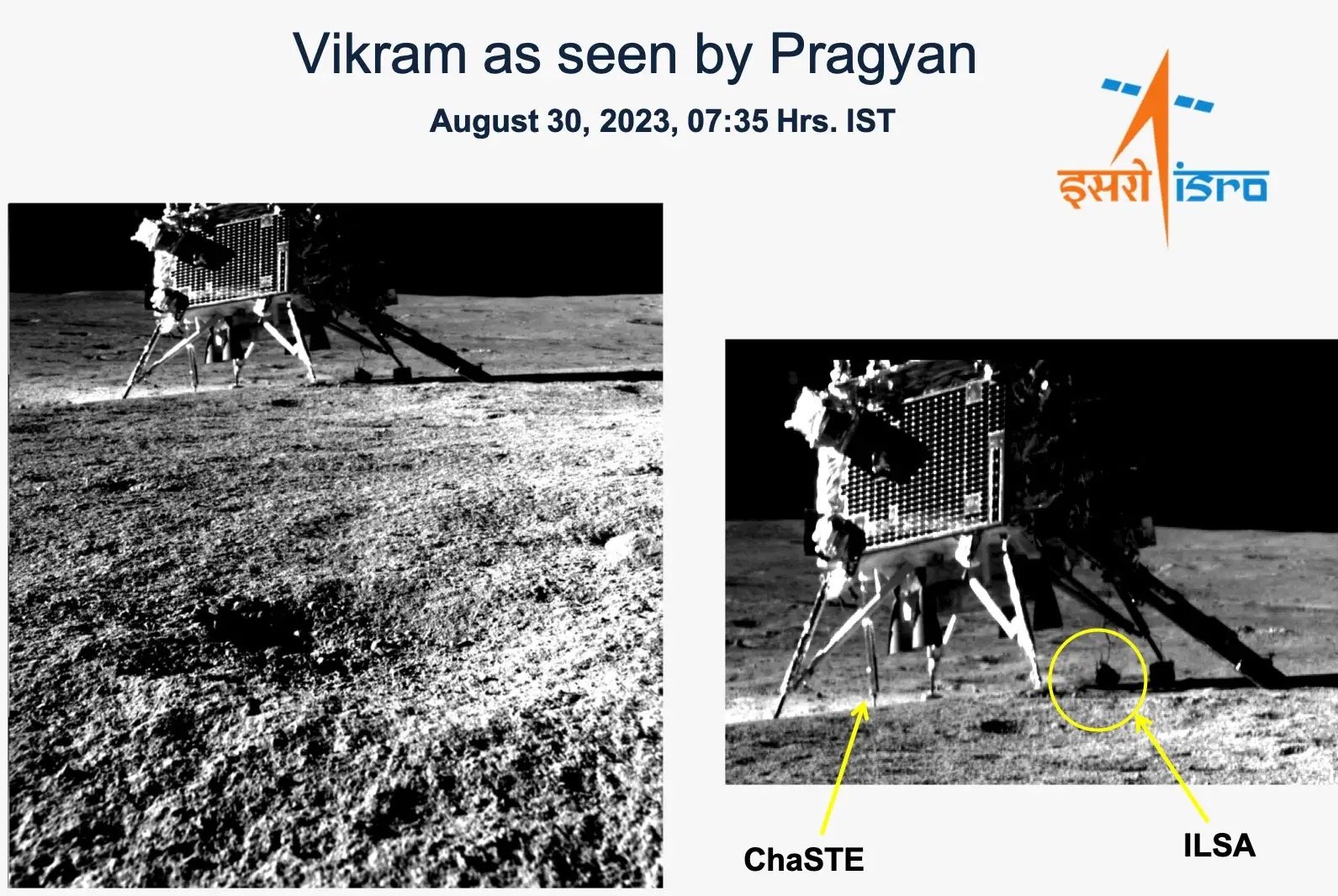
Vikram lander on the lunar surface, imaged by the Pragyan rover’s navigation camera at 07:35 IST on August 30, 2023. Credit: ISRO, Government Open Data Licence – India.
2023 — Chandrayaan-3 Makes History
Chandrayaan-3 launched on July 14, 2023, on an LVM3-M4 rocket, and on August 23, 2023, at around 6:04 pm IST, its Vikram lander executed a fully autonomous powered descent and soft landing near the Moon’s south polar region, at a site later named Shiv Shakti Point (roughly 69°S). The mission carried three modules: a propulsion module that stayed in lunar orbit conducting a separate experiment (SHAPE, studying Earth’s spectral and polarimetric signature as a proxy for exoplanet habitability studies), the Vikram lander, and the Pragyan rover, which rolled down a ramp from the lander shortly after touchdown.
Over roughly ten days — one lunar daytime period — Pragyan travelled a little over 100 metres across the surface, using a laser-induced breakdown spectroscopy (LIBS) instrument to detect sulfur and other elements in the lunar soil, while Vikram’s instruments recorded a surface temperature profile showing the topsoil was significantly hotter than models had predicted, and its seismic instrument (ILSA) detected what appeared to be natural lunar seismic activity. Both lander and rover were put into sleep mode on September 2, 2023, as the two-week lunar night began; ISRO attempted, but did not achieve, a wake-up in the following lunar day, and the mission’s active phase is considered complete — a planned outcome, not a failure, since the mission was designed for a single lunar day of surface operations.
Why the mission mattered beyond the headline: the theme running through this article’s account of Chandrayaan-2 and Chandrayaan-3 is that they are the same engineering problem, attempted twice. Chandrayaan-2 exposed a specific weakness in autonomous hazard detection and guidance during final descent; Chandrayaan-3 demonstrated the fix, with a redesigned lander carrying more propellant margin, stronger landing legs, additional laser and camera-based hazard-avoidance sensors, and a wider acceptable landing ellipse. That is a recovery story, not just a landing story — and it is the reason ISRO’s own leadership has repeatedly described Chandrayaan-3 as validating a landing capability that can now be reused for Chandrayaan-4 and LUPEX, rather than as a one-off achievement.
Chandrayaan-3 Changed India’s Space Story
What changed, specifically
- Demonstrated a working, autonomous lunar soft-landing capability that India had previously attempted and not achieved.
- Gave ISRO’s planning for Chandrayaan-4 and LUPEX a proven landing system to build on, rather than a second unproven design.
- Strengthened India’s standing in international space cooperation, including the LUPEX partnership with Japan’s JAXA and continuing NASA collaboration on NISAR.
- Created the institutional and public momentum behind National Space Day, now in its third year.
- Measurably increased public and student interest in ISRO’s work, visible in the scale of the National Space Day outreach programme each August.
This list does not include a specific economic-return figure for Chandrayaan-3, because no independently verifiable one exists for a single scientific mission of this kind — claims of a precise rupee-value “boost” from a lunar landing should be treated as unsupported.
2023-2024 — Aditya-L1 Begins India’s Solar Mission
Aditya-L1, India’s first dedicated solar observatory, launched on September 2, 2023, on a PSLV, and after a series of Earth-bound orbit-raising manoeuvres and a trans-Lagrangian-point transfer, entered a large halo orbit around the Sun-Earth L1 point on January 6, 2024. L1 is not a location “at the centre between Earth and the Sun” in any physical sense — it is a gravitationally balanced point roughly 1.5 million km from Earth, about 1% of the Earth-Sun distance, where a spacecraft can maintain a stable orbit with a continuous, unobstructed view of the Sun without the need for frequent course corrections. Aditya-L1 carries seven instruments studying the solar corona, chromosphere, solar wind and magnetic fields, aimed at understanding space weather that can affect satellites and power grids on Earth. The mission remains operational as of 2026, continuing to return science data; readers wanting the latest specific findings should check ISRO’s own Aditya-L1 mission page directly, since specific 2026 results were not independently verified for this article.
2024 — XPoSat Expands India’s Space Science Programme
The X-ray Polarimeter Satellite (XPoSat) launched on January 1, 2024, becoming only the second dedicated X-ray polarimetry mission in the world, after NASA’s IXPE. Its two instruments, POLIX and XSPECT, study the polarisation of X-rays from neutron stars, black holes and other high-energy astronomical sources — measurements that reveal the geometry and physics around these objects in ways ordinary X-ray brightness measurements cannot. XPoSat began science operations in March 2024 and continues observing as of 2026, broadening India’s space science portfolio well beyond the Moon-and-Mars missions that dominate public attention.
Gaganyaan: India’s Road to Human Spaceflight
Gaganyaan is ISRO’s programme to independently launch Indian astronauts into low Earth orbit and return them safely — a capability, as of 2026, held only by Russia, the United States and China. Announced by Prime Minister Modi in his 2018 Independence Day address with an original sanctioned outlay of roughly ₹10,000 crore, the programme centres on a human-rated version of the LVM3 rocket (referred to as HLVM3), an Orbital Module made up of a crew module (the pressurised cabin astronauts occupy) and a service module (providing propulsion, power and life-support systems), and a crew escape system designed to pull the crew module clear of the rocket in the event of a launch failure.
Four Indian Air Force test pilots — Group Captains Prasanth Balakrishnan Nair and Ajit Krishnan, and Wing Commanders Angad Pratap and Shubhanshu Shukla — were named as astronaut-designates and completed generic spaceflight training at Russia’s Gagarin Cosmonaut Training Centre in Star City, followed by mission-specific training at ISRO’s own Astronaut Training Facility in Bengaluru. Separately from Gaganyaan, Shubhanshu Shukla has already flown to orbit, serving as pilot on the privately organised Axiom Mission 4 to the International Space Station — a real spaceflight, but a different mission, vehicle and programme from Gaganyaan, and this article does not conflate the two.
As of August 2026, no Gaganyaan mission — crewed or uncrewed orbital — has flown. The programme has completed ground and abort-system tests (below), and ISRO’s public statements describe an uncrewed orbital test flight as the next major milestone, ahead of any crewed launch.
Why Human Spaceflight Is Different From a Robotic Mission
🤖 A robotic mission must survive
- Launch loads and vibration
- The vacuum and radiation of space
- An autonomous, one-shot landing sequence
- Communication delay, with no ability to intervene in real time
👤 A crewed mission must additionally guarantee
- Breathable air and temperature control for the full duration
- A working crew escape system at every phase of flight
- Redundancy on every life-critical system, not just mission-critical ones
- Safe, survivable parachute descent and recovery for living passengers
- Pre-flight medical clearance and in-flight medical contingency planning
- Extensive astronaut training, not just ground-control operation
This is the practical reason Gaganyaan cannot simply reuse Chandrayaan-3’s playbook, even though both are ISRO missions built on related technology: a lunar lander that fails partially can still return partial science, as Chandrayaan-2 did; a crewed capsule has no equivalent “partial success” if its life-support or escape systems fail.
Gaganyaan Test Flight Timeline
Only officially confirmed tests are listed. No TV-D2 date is stated as fact where ISRO itself has not fixed one.
TV-D1: First Abort Test
Objective: Test the crew escape system’s ability to pull the crew module away from a failing rocket during the most stressful phase of ascent, using a specially built single-stage test vehicle rather than the full HLVM3.
Result: Successful. The crew escape system fired as planned, separated the crew module, and it descended under parachutes to a safe splashdown in the Bay of Bengal, where it was recovered.
Next step: Further abort and recovery tests, and progress toward the first uncrewed orbital flight, G1.
–26
Crew Module Recovery and Ground Testing
Objective: Validate parachute deployment, splashdown structural integrity, and Indian Navy recovery procedures for the crew module, alongside integrated ground testing of the crew escape system’s motors.
Result: ISRO has reported crew escape system motor development and testing as complete, and recovery-drill exercises with the Navy as ongoing; a further uncrewed abort test (referred to as TV-D2, reusing a refurbished crew module) has been reported in industry tracking sources as targeted around the end of 2026, though this is not yet confirmed with the same certainty as TV-D1’s own completed test.
Next step: Completion of remaining abort/recovery validation ahead of G1.
G1: First Uncrewed Orbital Test Flight
Objective: Fly a full, uncrewed Orbital Module to low Earth orbit and back on the human-rated HLVM3, carrying Vyommitra, a half-humanoid robot instrumented to record conditions a human occupant would experience, without yet risking a human crew.
Result: Not yet flown as of this writing. ISRO Chairman Dr V Narayanan stated in June 2026 that G1 is targeted for the second half of 2026; an earlier target window around February 2026 slipped, a delay that followed both a ground-station support issue and, on the same day, the unrelated PSLV-C62 launch failure in January 2026.
Next step: If G1 succeeds, ISRO has indicated a crewed Gaganyaan flight would follow, with 2027 referenced informally but not locked as a firm, penalty-bearing date.
Gaganyaan in 2026: Where Does the Programme Stand?
Testing status: The crew escape system has completed its first flight-test milestone (TV-D1) and further ground and abort testing; a further abort test is reported, not confirmed, to be scheduled around late 2026, likely after G1.
Hardware and launch vehicle readiness: The human-rated HLVM3 and Orbital Module hardware for G1 are in final integration; ISRO has not published a specific, fixed calendar date for G1 as of this writing, describing the target only as the second half of 2026.
Astronaut preparation: All four astronaut-designates have completed their Star City and Bengaluru training phases and remain in ongoing readiness training; none has yet flown a Gaganyaan mission.
Crew module status: Flight-qualified hardware has been demonstrated in the TV-D1 abort test; the specific crew module intended for the first crewed flight is still in production and integration.
Uncrewed flight status: G1 has not launched. ISRO currently plans to fly it before any crewed mission, consistent with the programme’s original design of validating the full system uncrewed first.
Expected next milestone: The G1 uncrewed orbital flight. This article deliberately avoids stating a crewed-flight date as fact; where ISRO has said “ISRO currently plans a crewed flight around 2027,” that phrasing — not a bare “2027 launch” — is the accurate one to use.
The Moon-to-Human-Flight Progression
India’s evolving capability chain, not a fixed mission schedule — some of these steps run in parallel, not strictly one after another.
What Comes After Chandrayaan-3?
Chandrayaan-4 — status: Approved, in development. The Union Cabinet approved Chandrayaan-4 with a sanctioned cost of ₹2,104.06 crore. The mission is designed as a two-launch profile, using two LVM3 rockets, to achieve India’s first lunar sample-return: collecting lunar soil and rock and bringing it back to Earth, a significantly harder objective than a landing alone. ISRO’s own public statements have given differing target years for launch — some reporting has cited 2027, while ISRO’s chairman has separately referenced 2028 — and this article reports that inconsistency rather than picking one figure to state as settled.
LUPEX / Chandrayaan-5 — status: In development, joint India-Japan mission. The Lunar Polar Exploration Mission is a joint project between ISRO and Japan’s JAXA: India is expected to provide the lander, at roughly 6,000 kg, while Japan provides a smaller rover, around 350 kg, launched together on Japan’s H3 rocket. The mission targets the Moon’s polar region specifically to search for water ice. ISRO and JAXA held a joint review meeting in Bengaluru in July 2026 on power, communications and interface systems between the two countries’ hardware; reported target launch windows range across 2027-2028, again not settled to a single confirmed date.
NISAR — India and NASA Build a New Earth-Observation Capability
NISAR (NASA-ISRO Synthetic Aperture Radar) launched on July 30, 2025, on a GSLV-F16 from Satish Dhawan Space Centre, and has been operational since. It is a joint ISRO-NASA mission carrying dual-frequency (L-band from NASA, S-band from ISRO) radar instruments that can image the Earth’s surface in fine detail regardless of cloud cover or daylight, tracking changes as small as centimetres. Its intended applications span disaster response (tracking landslides, floods and earthquake deformation), agriculture (monitoring crop health and soil moisture), forestry and ice-sheet dynamics relevant to climate science. NISAR stands as one of the largest and most technically ambitious Earth-science collaborations either agency has undertaken with a foreign partner.
India’s Next Planetary Targets
Venus Orbiter Mission (Shukrayaan) — status: Approved, in development. Cabinet-approved, with its Preliminary Design Review reported complete per ISRO’s 2026 Annual Report. The mission is planned to carry 19 scientific payloads, including instruments developed in collaboration with Russia’s Roscosmos and Sweden’s Institute of Space Physics, to study Venus’s atmosphere, surface and plasma environment. ISRO has stated a launch “no earlier than March 2028,” with an expected Venus arrival around July 2028 — both explicitly forward-looking targets, not locked commitments.
Beyond Venus: ISRO’s longer-term roadmap statements reference further Mars exploration and additional solar-science missions building on Aditya-L1, but as of 2026 neither has the Cabinet-approval and funding status that Chandrayaan-4, LUPEX and the Venus Orbiter Mission already have. This article does not convert those roadmap mentions into scheduled missions.
Bharatiya Antariksh Station: India’s Planned Space Station
The Bharatiya Antariksh Station (BAS) is India’s planned national space station, intended to give ISRO an orbital platform for long-duration human spaceflight and microgravity research independent of the International Space Station. Its five-module design was reported finalised around December 2025. ISRO’s stated roadmap targets the launch of the first module, BAS-1, in 2028 on an LVM3, with the full, multi-module station operational by around 2035. Four dedicated precursor missions are planned between 2026 and 2028 to validate docking systems, life-support technology and robotic assembly — capabilities the station will depend on and that Gaganyaan’s crewed missions are expected to help prove out. BAS’s connection to Gaganyaan is direct: a functioning human-rated launch and crew-return system is a prerequisite for regularly crewing a space station, not an optional extra.
India’s Long-Term Space Roadmap: 2035-2040
ISRO’s own longer-range public statements describe a vision, not a funded schedule, extending past BAS’s 2035 target: continued crewed missions to the space station, further lunar exploration building on Chandrayaan-4 and LUPEX, eventual lunar sample-return capability maturing into a lunar research presence, and continued solar and planetary science. Indian officials have also spoken publicly about a longer-term ambition of an Indian crewed lunar landing sometime after 2035-2040 — but that reference remains a stated vision, not an approved, funded mission with Cabinet sanction, in the way Chandrayaan-4, LUPEX, the Venus Orbiter Mission and BAS-1 already are. This article treats it accordingly: as a direction ISRO has pointed toward, not a scheduled event.
India’s Launch Vehicle Evolution
“Human-rated” is a specific, formal certification, not a marketing description — this article does not apply it to LVM3 until ISRO itself confirms that certification is complete.
India’s Space Revolution Is No Longer Only About ISRO
Since 2020, India has opened space activity to private companies through IN-SPACe (the Indian National Space Promotion and Authorisation Centre), which authorises and regulates non-government space activity, and NSIL (NewSpace India Limited), ISRO’s commercial arm, which markets ISRO-developed technology and manages commercial launch contracts. This has not replaced ISRO’s own mission programme — Chandrayaan, Gaganyaan and every mission described above remains an ISRO/Department of Space mission — but it has added a genuinely new layer of Indian space activity operating alongside it.
IN-SPACe
Authorises and regulates private-sector space activity in India, including launch-site access; reported in August 2026 coverage to have overseen the allocation of India’s second spaceport to a private operator.
NSIL (NewSpace India Limited)
ISRO’s commercial arm, responsible for transferring ISRO technology to industry and managing commercial launch and satellite contracts.
Skyroot Aerospace
Flew Vikram-S, India’s first privately developed rocket to reach space, in a 2022 suborbital test flight; continues developing the orbital-class Vikram series.
Agnikul Cosmos
Launched its Agnibaan rocket in May 2024 from its own privately built launch pad at Sriharikota — a first for an Indian private company.
India’s Commercial Space Opportunity
Beyond launch vehicles, India’s commercial space activity spans satellite manufacturing, Earth-observation data services, satellite communications and downstream applications built on ISRO and NASA data products such as NISAR. IN-SPACe’s role in authorising private access to launch infrastructure — including the 2026 reporting on a private operator taking on India’s second spaceport — is a specific, concrete example of that shift from a purely ISRO-run ecosystem toward one that also includes regulated private players, rather than a general claim about market size that this article does not have verified figures for.
Why India’s Space Programme Matters Beyond Science
Practical applications of India’s space assets
- Weather forecasting and cyclone tracking, via INSAT/GSAT meteorological instruments.
- Agricultural monitoring and crop health assessment, using Earth-observation satellites including NISAR.
- Disaster management — flood, landslide and earthquake-deformation tracking.
- Navigation, through India’s own NavIC regional satellite navigation system.
- Telecommunications and broadcasting infrastructure across the INSAT/GSAT fleet.
- Climate and ice-sheet monitoring, a core NISAR application.
- Commercial satellite launch services, marketed internationally through NSIL.
This article does not attach a specific rupee-value estimate to India’s “space economy” as a whole, since credible, independently verified figures for that were not confirmed in this research.
India’s Space Mission Dashboard — August 2026
| Mission / Programme | Destination | Status | Main objective | Next milestone |
|---|---|---|---|---|
| Chandrayaan-3 | Moon (south polar region) | Completed | Soft landing + surface science | Follow-up missions (Chandrayaan-4, LUPEX) |
| Aditya-L1 | Sun-Earth L1 point | Operational | Solar and space-weather science | Continued observation; check isro.gov.in for latest data releases |
| XPoSat | Low Earth orbit | Operational | X-ray polarimetry astronomy | Continued science operations |
| NISAR | Earth orbit | Operational (since Jul 30, 2025) | Dual-frequency Earth-observation radar | Ongoing science data releases |
| Gaganyaan (G1) | Low Earth orbit | In development / testing — not yet flown | Uncrewed orbital validation of human-rated system | Launch targeted 2nd half 2026 |
| Gaganyaan (crewed) | Low Earth orbit | Planned, no locked date | India’s first crewed orbital spaceflight | Dependent on G1 success; ISRO has referenced 2027 informally |
| Chandrayaan-4 | Moon | Approved, in development | Lunar sample return | Target reported as 2027 or 2028 (sources differ) |
| LUPEX / Chandrayaan-5 | Moon (polar region) | In development (India-Japan) | Polar water-ice exploration | Target reported 2027-2028; joint reviews ongoing (Jul 2026) |
| Venus Orbiter Mission | Venus | Approved, in development | Venus atmosphere/surface/plasma science | Launch no earlier than March 2028 |
| Bharatiya Antariksh Station | Low Earth orbit | Planned (design finalised ~Dec 2025) | National space station | BAS-1 first module targeted 2028 |
Upcoming ISRO Missions to Watch
Near term (actively progressing, 2026)
- Gaganyaan G1 — uncrewed orbital test flight, targeted 2nd half 2026.
- Further Gaganyaan crew-escape and recovery testing, reported around late 2026.
- Continued NISAR, Aditya-L1 and XPoSat science operations.
Medium term (approved, in development)
- Chandrayaan-4 lunar sample-return mission — target reported as 2027 or 2028.
- LUPEX / Chandrayaan-5 with JAXA — target reported 2027-2028.
- Venus Orbiter Mission — launch no earlier than March 2028.
- Gaganyaan’s first crewed flight, following a successful G1.
- Bharatiya Antariksh Station precursor missions (docking, life support, robotics validation), 2026-2028.
Long term (roadmap vision, not yet funded on a fixed schedule)
- Full Bharatiya Antariksh Station assembly, targeted around 2035.
- Further Mars and solar-science missions beyond Mangalyaan and Aditya-L1.
- A stated long-term ambition of Indian human lunar exploration after 2035-2040 — a vision, not an approved mission.
Explore More Timelines
People Also Ask
Frequently Asked Questions
Related Coverage
⚠️ Editorial Note
This page separates missions ISRO has completed from ones it has approved-but-not-yet-flown, and from ones that remain a stated long-term vision without Cabinet funding or a fixed schedule. Where ISRO’s own public statements have given conflicting dates — Chandrayaan-4’s target year, and LUPEX’s launch window, in particular — both figures are reported rather than one being silently chosen. This is a living page: the “Latest India Space Update” section is intended to be refreshed each National Space Day and whenever a major milestone (a Gaganyaan test flight, a new mission launch) actually occurs, without rewriting the historical sections above it. Verify current mission status directly at isro.gov.in before citing a figure from this page elsewhere.
Sources & further reading
Every dated entry above was checked against these references. Last reviewed 15 September 2026.
- ISRO — Chandrayaan-3 Mission
- ISRO — Gaganyaan Mission
- ISRO — Aditya-L1 Mission
- ISRO — NISAR Mission (GSLV-F16)
- Free Press Journal — 3rd National Space Day 2026 Theme, Ahmedabad
- The Week — Bharatiya Antariksh Station Design Finalised
- Deccan Herald — ISRO Chairman on Chandrayaan-4 Launch Target
- Civilsdaily — Chandrayaan-4 and Venus Orbiter Cabinet Approval