Thumba Rocket Launch: How India’s Space Journey Went from a Church to the Moon
India's first rocket rose from Thumba on 21 Nov 1963, assembled in a church. How that Nike-Apache led to SLV-3, Mangalyaan and Chandrayaan-3.
Latest Story
The Thumba rocket launch of 21 November 1963 began India’s space programme in a fishing village near Thiruvananthapuram. The rocket, a two-stage Nike-Apache, came from NASA; its payload came from France; it had been put together inside the St Mary Magdalene Church, which served as the station’s office and laboratory. Almost sixty years later, on 23 August 2023, an Indian lander named after the man behind that launch, Vikram Sarabhai, touched down near the Moon’s south pole.
This is the story of how a borrowed rocket became a national launch industry: why Thumba was chosen, what the church and the bicycle photos really show, the failures that came before each success, and where the programme stands in 2026, after two PSLV failures and with its first uncrewed human-spaceflight test still ahead.
💡 Short Answer
India’s first rocket, a US-made Nike-Apache, was launched from Thumba, Kerala, at about 6:25 pm on 21 November 1963, carrying a French sodium-vapour experiment. Thumba was chosen because it lies almost on the magnetic equator. Its parts were assembled in St Mary Magdalene Church, now the VSSC Space Museum. From there India built its own rockets (1967), satellite (1975), orbital launcher (1980) and reached the Moon (2008), Mars (2014) and a lunar landing (2023).
Thumba Rocket Launch: Key Questions
From Thumba to the Moon in Ten Points
- The launch: a NASA Nike-Apache with a French sodium payload, 21 November 1963, about 6:25 pm.
- The place: Thumba, chosen because the magnetic equator runs almost overhead.
- The church: St Mary Magdalene became office and laboratory; rocket systems were assembled inside; it is a museum since 1985.
- The idea: Vikram Sarabhai wanted space technology to serve communication, weather, mapping and education.
- Import, then build: US, French and Soviet rockets first; India’s own RH-75 in 1967.
- Institutions: INCOSPAR 1962, ISRO 1969, Department of Space 1972.
- Satellite and rocket: Aryabhata on a Soviet rocket in 1975; SLV-3 put Rohini in orbit in 1980 after failing in 1979.
- The workhorse: PSLV failed in 1993, succeeded in 1994, and later carried India to the Moon and Mars.
- The far firsts: Chandrayaan-1 (2008), Mangalyaan in Mars orbit at the first try (2014), Chandrayaan-3 landing (2023).
- 2025–26: an Indian on the space station, but two PSLV failures and a Gaganyaan test still pending.
Why Thumba? The Location Was the Experiment
A launch site chosen by geophysics, not convenience.
In the early 1960s the most interesting unanswered questions in Indian geophysics were overhead. About 100 kilometres above the magnetic equator flows the equatorial electrojet, a concentrated electric current in the ionosphere that affects radio communication and the Earth’s magnetic field. Balloons cannot climb that high and satellites fly far above it. Sounding rockets, which go up and come straight back down, can carry instruments right through it.
So the launch site had to sit under the magnetic equator, and in India the magnetic equator crossed the coast near Thiruvananthapuram. Thumba, a fishing village on that coast, offered open sea to the west for spent rocket stages to fall into. In 1962 the new Indian National Committee for Space Research (INCOSPAR), set up under the Department of Atomic Energy with Vikram Sarabhai in charge and Homi Bhabha as its patron, chose it.
The station that resulted, TERLS, was also deliberately international. It flew American, French and Soviet rockets, and in 1968 it was dedicated to the United Nations. For a newly independent country with little money, sharing a scientifically valuable site was a way into space research that did not require building a rocket first.
The Church, the Bishop and the Bicycle
What the famous stories get right, and where they blur.
The land the scientists wanted held the St Mary Magdalene Church and the homes of its fishing community. Bishop Peter Bernard Pereira of Trivandrum took the request to his congregation, and the parish agreed to move to a new church built nearby. VSSC’s own history says the church “served as the office and the laboratories”, while the Bishop’s House became the office of the TERLS director. The VSSC Space Museum goes further: it was in the church that “the first rocket systems were assembled and integrated”.
Facilities were so thin that, by many accounts, rocket parts and payloads were moved around the site on bicycles and bullock carts, and a well-known 1960s photo shows a rocket nose cone carried on a bicycle. Be careful with the other famous image: the photograph of a satellite on a bullock cart is not from Thumba in 1963. It shows the APPLE communication satellite in 1981, moved by cart for an antenna test because a non-metal vehicle avoided radio interference.
The church building outlived its emergency role. As the station grew, with a control centre and laboratories on the Veli hills, the old church faded into the background, until in 1985 it reopened as the VSSC Space Museum, now showing a full-scale PSLV model, an ASLV motor and early rocket hardware.
The Thumba church: 1962 vs today
Sarabhai’s Idea: Space as a Tool for Development
Sarabhai’s justification for a space programme in a poor country is still quoted on ISRO’s pages: India did not need to compete with economically advanced nations in exploring the Moon or planets, but it must be “second to none in the application of advanced technologies to the real problems of man and society”. The early programme followed that brief. Sounding rockets studied the atmosphere and the monsoon; the 1975–76 SITE experiment, agreed with NASA in 1969, beamed educational television to 2,400 villages; the INSAT and IRS satellite series later carried television, weather forecasting, crop and water mapping and disaster warnings.
The irony is that, by following the development brief for four decades, ISRO built exactly the rockets and spacecraft skills that let it go to the Moon and Mars anyway. Chandrayaan-1 flew on PSLV, a rocket designed to launch remote-sensing satellites.
Pick a milestone and compare it with the 1963 Nike-Apache.
Figures are ISRO’s published numbers, rounded. “How far” is the distance from Earth that the mission worked at, not the total path it flew.
Choose a milestone above
Thumba Rocket Launch to Chandrayaan-3: The Full Timeline
Newest first, from the Gaganyaan target of 2026 back to the church at Thumba.
2026
Gaganyaan’s first uncrewed flight, G1 Target
ISRO chairman V. Narayanan said in June 2026 that the agency is aiming for the first uncrewed Gaganyaan test flight, G1, by the end of 2026. It will carry the half-humanoid robot Vyommitra on a human-rated LVM3 and end with a splashdown in the Bay of Bengal. A drop test of the crew module from a Chinook helicopter and crew-module systems checks were completed in April–July 2026. A crewed flight follows only after more uncrewed tests.
2026
GSLV-F17 puts EOS-05 in orbit Official
GSLV-F17 launches the earth-observation satellite EOS-05 (GISAT-1A) from Sriharikota, ISRO’s first launch in almost eight months and a return to flight after the PSLV loss in January.
2026
PSLV fails for the second time in a row Official
PSLV-C62 is lost when a deviation in the third stage’s roll control appears just before stage separation. It follows the PSLV-C61 failure of 18 May 2025, also in the third stage. For a rocket that had flown about 60 times and carried India to the Moon and Mars, two consecutive losses are a serious setback.
Why it matters: the Thumba lesson, that failure is data, applies at every age. SLV-3 failed in 1979 and PSLV in 1993 before both succeeded.
2025
Shubhanshu Shukla reaches the space station Official
Indian Air Force test pilot Shubhanshu Shukla, one of the four astronauts selected for Gaganyaan, flies on the commercial Axiom-4 mission and becomes the first Indian aboard the International Space Station, and the second Indian in space after Rakesh Sharma in 1984. The same year India docks two satellites in orbit (SpaDeX, January 2025), Sriharikota hosts its 100th launch (29 January 2025), and the NASA–ISRO radar satellite NISAR launches on a GSLV (30 July 2025).
2023
Thumba’s 60th anniversary Official
Six decades after the Nike-Apache, the anniversary arrives with India on the Moon. The church where the first rocket was put together is the VSSC Space Museum, and the Thumba campus around it designs the rockets that launched Chandrayaan-3.
2023
Chandrayaan-3 lands near the lunar south pole Official
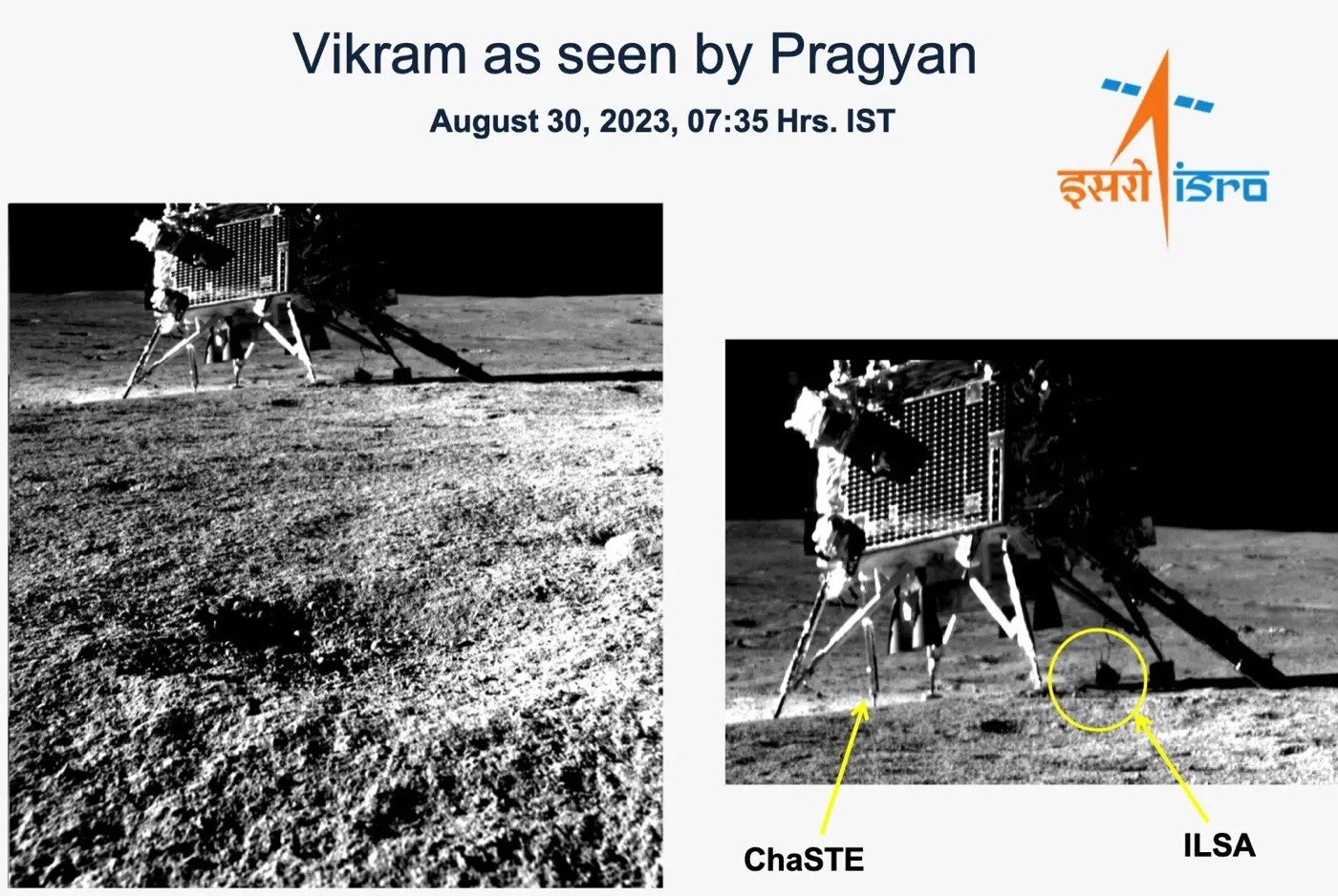
Launched by LVM3-M4 on 14 July 2023 and in lunar orbit from 5 August, Chandrayaan-3’s Vikram lander touches down at 6:04 pm IST, about 69 degrees south. India becomes the fourth country to soft-land on the Moon after the Soviet Union, the United States and China, and the first to land so close to the south pole. The 26 kg Pragyan rover drives about 100 metres and confirms sulphur in the soil.
Why it matters: 59 years and nine months after a borrowed rocket left Thumba, an Indian lander is on another world.
2019
Chandrayaan-2’s lander is lost Official
Chandrayaan-2, launched on 22 July 2019 by GSLV Mk III, puts an orbiter around the Moon that is still working. But its Vikram lander loses contact in the final phase of its descent and crashes. ISRO redesigns the lander with stronger legs, more fuel, wider landing zones and more sensors for Chandrayaan-3.
2014
Mangalyaan enters Mars orbit, first time Official
The Mars Orbiter Mission, launched on 5 November 2013 on a PSLV, enters Mars orbit after a 323-day journey. ISRO becomes the fourth space agency to reach Mars orbit and the first to do so on its first attempt, for about ₹450 crore. Designed for six months, the spacecraft operates for about eight years until contact is lost in 2022.
2008
Chandrayaan-1 goes to the Moon Official
India’s first lunar mission launches from Sriharikota and orbits the Moon at about 100 km with 11 instruments from India, the United States, Europe and Bulgaria. On 14 November 2008 its Moon Impact Probe strikes the surface near the south pole. NASA’s Moon Mineralogy Mapper on board detects water and hydroxyl molecules, announced in September 2009.
1994
PSLV works, at the second attempt Official
The Polar Satellite Launch Vehicle puts IRS-P2 in orbit, a year after its first flight failed. PSLV becomes ISRO’s workhorse, launching remote-sensing satellites, Chandrayaan-1, Mangalyaan and, in 2017, a record 104 satellites on one flight.
Rakesh Sharma flies in space Official
Squadron Leader Rakesh Sharma spends about eight days on the Soviet Salyut 7 station, the first Indian in space. Asked by Prime Minister Indira Gandhi how India looks from space, he answers “Saare Jahan Se Achha”.
1980
SLV-3 puts Rohini in orbit Official
India’s own four-stage, all-solid rocket, SLV-3, 22 metres tall and weighing 17 tonnes, places the 35 kg Rohini RS-1 satellite in orbit. ISRO says this made India the sixth member of the club of space-faring nations; tallies that count the UK’s 1971 launch make it seventh.
Why it matters: 17 years after importing its first sounding rocket, India could reach orbit on its own.
1979
SLV-3’s first flight fails to reach orbit Official
The first experimental SLV-3 flight from Sriharikota does not put its Rohini payload in orbit after a fault in the second stage’s control system. Satish Dhawan publicly takes responsibility for the failure, and the team flies again eleven months later.
1975
Aryabhata, India’s first satellite Official
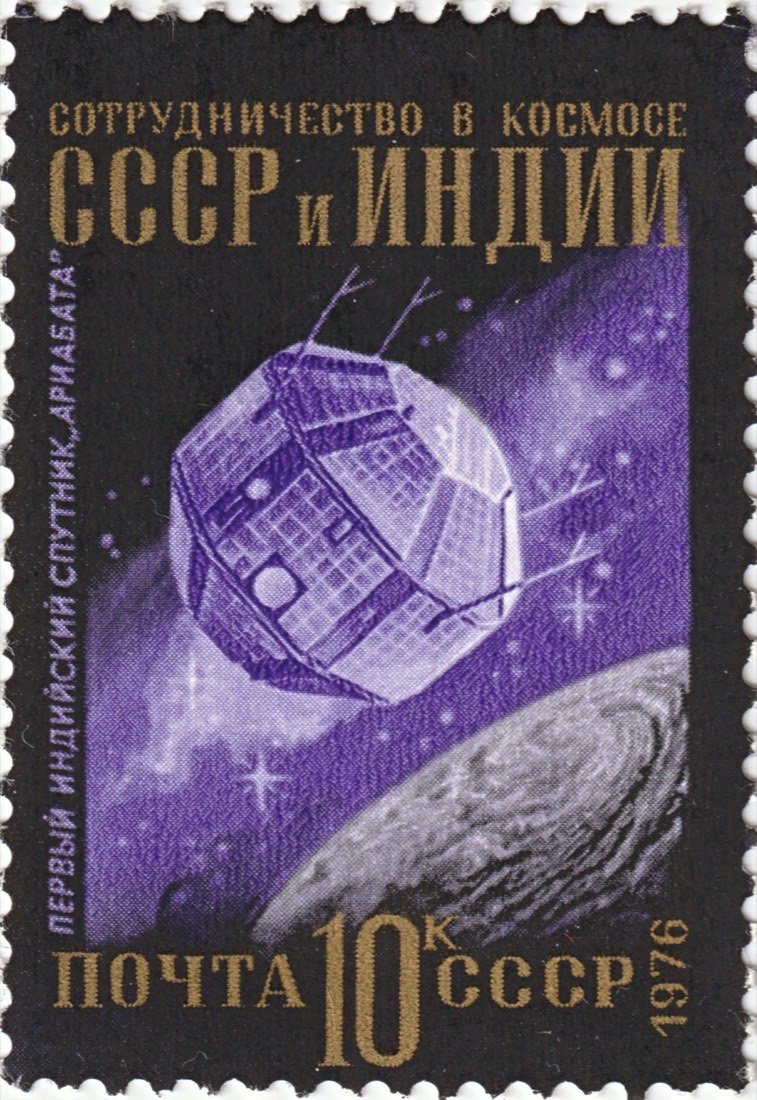
India’s first satellite, designed and built by ISRO in Bengaluru, is launched from Kapustin Yar in the Soviet Union. It carries X-ray astronomy, aeronomy and solar physics experiments. A power-supply fault ends the experiments after a few days, but the satellite proves ISRO can design, build and control a spacecraft.
Space Commission and Department of Space Official
After Sarabhai’s sudden death in December 1971, the government sets up the Space Commission and the Department of Space, and ISRO moves under the department in September. Satish Dhawan runs ISRO until 1984. The Thumba complex is renamed the Vikram Sarabhai Space Centre.
1969
ISRO is formed Official
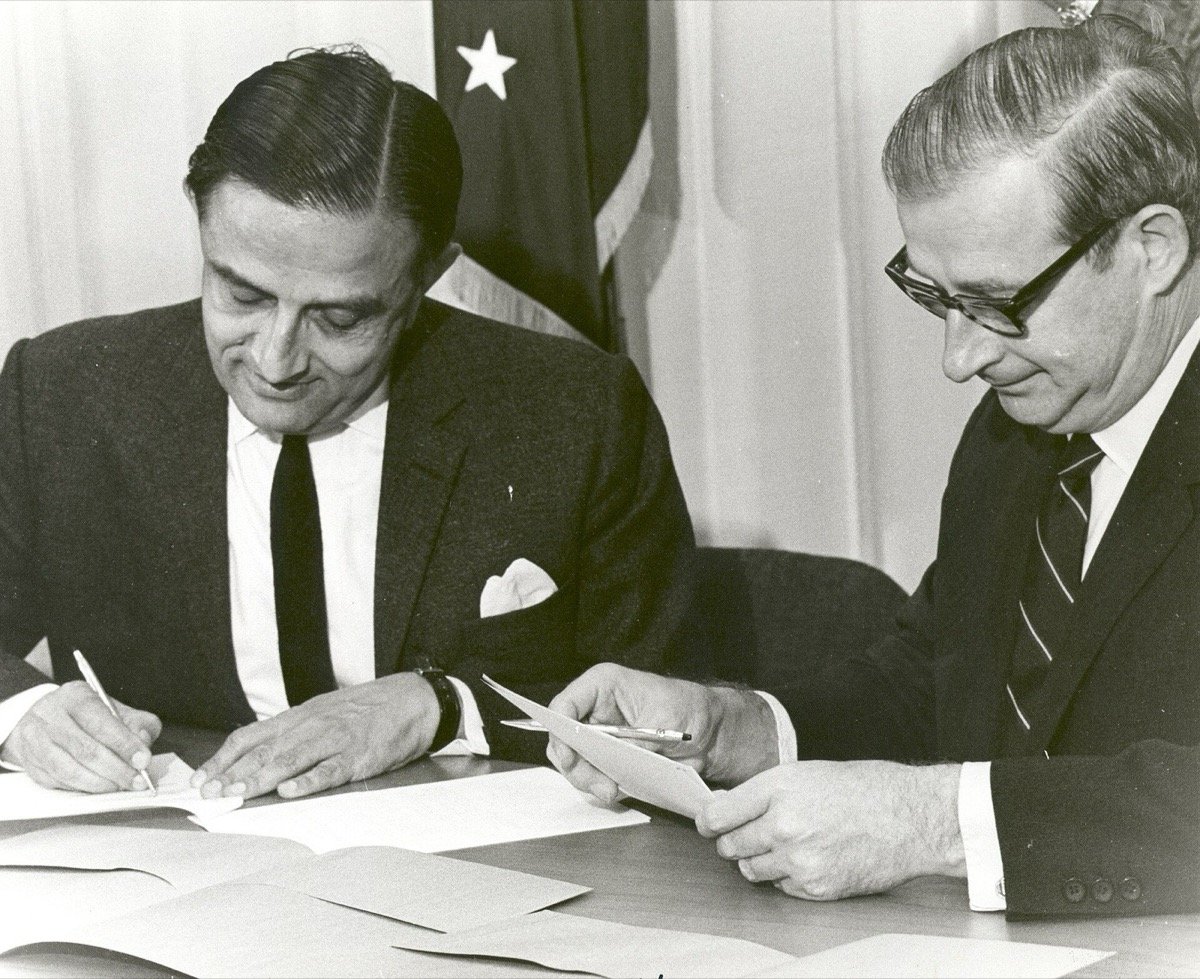
The Indian Space Research Organisation takes over from INCOSPAR. A month later Sarabhai signs an agreement with NASA for the Satellite Instructional Television Experiment (SITE), which beams educational TV to 2,400 villages in 1975–76 — the clearest early example of his idea that space should serve development.
1968
TERLS dedicated to the United Nations Official
Prime Minister Indira Gandhi dedicates the Thumba Equatorial Rocket Launching Station to the United Nations. Scientists from the United States, the Soviet Union, France, the United Kingdom, Japan and other countries fly experiments from Thumba, a rare place where Cold War rivals shared a launch pad.
1967
RH-75: the first Indian rocket Official
Four years after the Nike-Apache, India launches the RH-75, a small sounding rocket 75 mm in diameter, designed and built in India. The Rohini series grows into the RH-200, RH-300 and RH-560, and the solid-propellant experience feeds directly into SLV-3.
Space Science and Technology Centre set up Official
The Space Science and Technology Centre opens at Thumba to develop rockets, propellants and payloads in India rather than only launching foreign ones. It is the seed of what becomes the Vikram Sarabhai Space Centre.
1963
The first rocket: a Nike-Apache from Thumba Official
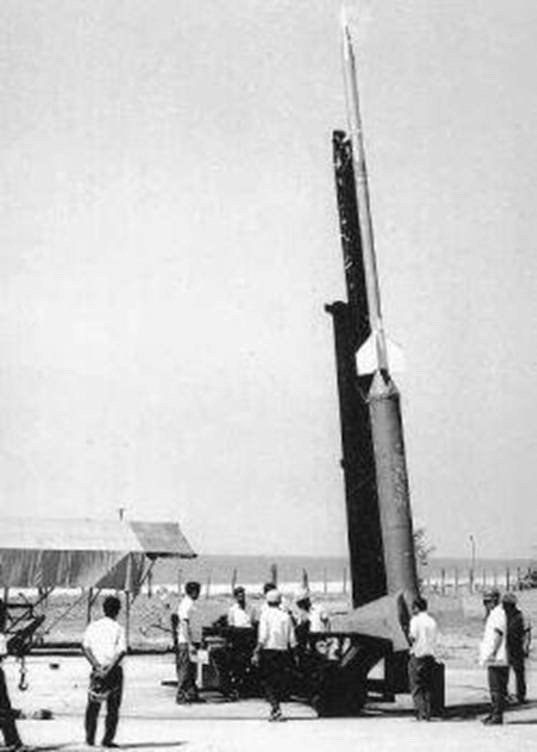
At about 6:25 pm, a two-stage Nike-Apache supplied by NASA lifts off from the beach at Thumba. Its French payload releases a sodium-vapour trail at roughly 100–120 km, glowing orange in the twilight, and cameras on the ground photograph it to measure upper-atmosphere winds and turbulence. The rocket was assembled in the church; the launch team was Indian.
Why it matters: it was a scientific experiment, not a show of national power. That framing — space as a tool for research and development — defined the programme.
INCOSPAR picks Thumba; a church moves out Official
The Indian National Committee for Space Research, set up in 1962 under Vikram Sarabhai with Homi Bhabha’s backing, chooses Thumba because the magnetic equator runs almost overhead. The site holds a fishing village and the St Mary Magdalene Church. Bishop Peter Bernard Pereira puts the scientists’ request to his congregation, which agrees to move to a new church nearby. The church becomes the office and laboratories, and the Bishop’s House the director’s office.
From 35 kg to 3,900 kg
Launch mass of India’s milestone spacecraft.
The jump on the chart is the story of the rockets more than the spacecraft. SLV-3 could lift about 40 kg to low orbit; PSLV made 1,000–1,500 kg missions to the Moon and Mars possible, using clever orbit-raising instead of a bigger rocket; LVM3, ISRO’s heaviest launcher, carried the 3,900 kg Chandrayaan-3 stack and is being human-rated for Gaganyaan.
How Long Each First Took
Every First, and Whose Rocket It Rode
Import first, build next: the pattern in one table.
| Year | Milestone | Rocket | Who built it |
|---|---|---|---|
| 1963 | First sounding rocket, Thumba | Nike-Apache | USA (NASA); French payload |
| 1967 | First Indian sounding rocket | RH-75 | India |
| 1975 | First Indian satellite, Aryabhata | Kosmos-3M | Soviet Union |
| 1979 | First orbital attempt (failed) | SLV-3 E1 | India |
| 1980 | First orbit on an Indian rocket, Rohini RS-1 | SLV-3 | India |
| 1994 | First successful PSLV | PSLV-D2 | India |
| 2008 | First Moon mission, Chandrayaan-1 | PSLV-C11 | India |
| 2013–14 | First Mars mission, Mangalyaan | PSLV-C25 | India |
| 2019 | Lunar orbiter (lander lost), Chandrayaan-2 | GSLV Mk III-M1 | India |
| 2023 | First soft landing, Chandrayaan-3 | LVM3-M4 | India |
The People Who Built It
A few names stand for thousands of engineers, technicians and fishing families who gave up their land.
Vikram Sarabhai
Physicist who led INCOSPAR and ISRO, chose Thumba and argued space must serve development. Died in December 1971; VSSC and the Chandrayaan landers carry his name.
Homi J. Bhabha
Head of India’s atomic energy programme, under which INCOSPAR was set up and funded in 1962.
Bishop Peter Bernard Pereira
Took the scientists’ request to his congregation, which agreed to move so that its church could become a laboratory.
A. P. J. Abdul Kalam
One of the young engineers at Thumba in the 1960s, later project director of SLV-3, which reached orbit in 1980.
Satish Dhawan
ISRO chairman 1972–84, who built its management culture and took public responsibility for the 1979 SLV-3 failure.
U. R. Rao
Led the team that built Aryabhata and later chaired ISRO (1984–94), when PSLV first succeeded.
Failure Came First, Every Time
The neat list of firsts hides how often each one followed a failure. SLV-3 failed on its first flight in 1979. ASLV failed on its first two flights in 1987 and 1988. PSLV’s first flight in 1993 did not reach orbit. Early GSLV flights struggled for years with the cryogenic upper stage, after technology-transfer restrictions in the 1990s forced India to develop its own. Chandrayaan-2’s lander crashed in 2019. In each case ISRO flew again with a redesigned vehicle.
The pattern is being tested again now. PSLV, ISRO’s most reliable rocket, failed in May 2025 and again in January 2026, both times in its third stage. ISRO returned to flight with a GSLV in September 2026; PSLV’s return and the first uncrewed Gaganyaan flight are the programme’s next proofs.
India’s Space Programme in 2026
India now has a human spaceflight programme, an astronaut who has lived on the International Space Station (Shubhanshu Shukla, 2025), a docking capability demonstrated in orbit (SpaDeX, 2025), a growing private launch and satellite industry regulated through IN-SPACe, and a list of approved missions: Gaganyaan test flights, Chandrayaan-4 sample return, a joint lunar polar mission with Japan, and the first module of the Bharatiya Antariksh Station. The stated long-term goals are a national space station by 2035 and an Indian on the Moon by 2040.
Thumba is still part of it. TERLS launches Rohini sounding rockets for atmospheric science, as it did in 1963, and the Vikram Sarabhai Space Centre that grew around the old church designs the launch vehicles. The rocket assembly hall that started in a church is now a campus.
Corrections to Claims Circulating Online
“Launched at 6:55 pm IST”
The Nike-Apache flew at about 6:25 pm local time, 12:55 GMT. 6:55 appears to mix the two.
“Rockets from the US, Russia and France”
In the 1960s the early M-100 rockets came from the Soviet Union, not Russia.
“India became the sixth country to reach orbit”
That is ISRO’s count. Tallies including the UK’s 1971 Black Arrow launch make India seventh.
“PSLV became operational in 1994”
Its first flight, in September 1993, failed. The October 1994 flight was its first success.
“Thumba’s satellite on a bullock cart”
That photograph shows the APPLE satellite in 1981. Thumba’s 1960s image is a nose cone on a bicycle.
2024–2026
Accounts that end in 2023 miss Shubhanshu Shukla, SpaDeX, NISAR, two PSLV failures and the Gaganyaan delay.
Did You Know?
- Cold War neighbours: at TERLS, American, French and Soviet rockets flew from the same range in the 1960s.
- An orange cloud: the first launch’s sodium trail lit up in the setting sun and could be seen from Thiruvananthapuram.
- Two-rupee satellite: Aryabhata was printed on India’s two-rupee note from 1976 to 1997.
- A record: PSLV-C37 launched 104 satellites on one flight in February 2017.
- Names that recur: Vikram is the Chandrayaan landers’ name, Sarabhai’s first name.
- Still flying: Rohini sounding rockets descended from the 1967 RH-75 still launch from Thumba.
Quick Quiz: Thumba to the Moon
1. Which building at Thumba served as the first office and laboratory?
2. Which country supplied the first Thumba rocket?
3. Why Thumba?
4. What was India’s first home-built sounding rocket?
5. Where was Aryabhata launched from?
6. At what time did Chandrayaan-3 land?
Explore More Timelines
People Also Ask
Frequently Asked Questions
Why the Thumba Story Still Matters
India did not start with the technology it eventually wanted. It started with a site the physics made valuable, a borrowed rocket, a church for a laboratory and a clear idea of what space was for. The Moon landing was built on that: sounding rockets taught propulsion and tracking, foreign launches taught satellite design, failures taught the rest.
That is the lesson the Thumba launch still carries in 2026, as ISRO works through two PSLV failures and prepares its first uncrewed human-spaceflight test. Every one of its firsts came after something did not work.
Related AiTimeline Stories
⚠️ Editorial Note
Last updated 5 October 2026. Items marked Official rest on ISRO, VSSC and India Meteorological Department records; items marked Target are planned dates that have already slipped and may slip again. The bicycle account comes from participants’ recollections and later reporting rather than an official record. Spacecraft masses are ISRO’s launch-mass figures.
Sources & further reading
Every dated entry above was checked against these references. Last reviewed 5 October 2026.
- VSSC: Profile - TERLS, St Mary Magdalene Church and the first launch (21 Nov 1963)
- VSSC Space Museum: About - the church where the first rocket systems were assembled (museum since 1985)
- IMD Mausam journal: Meteorological support for two-stage rockets at Thumba
- ISRO: SLV-3 - India's first experimental satellite launch vehicle (Rohini RS-1, 18 Jul 1980)
- ISRO: Chandrayaan-1 mission (PSLV-C11, 2008)
- ISRO: Mars Orbiter Mission spacecraft (Mars orbit, 24 Sep 2014)
- ISRO: Chandrayaan-3 details (landing, 23 Aug 2023)
- ISRO: Launch missions from Sriharikota (incl. PSLV-C62, GSLV-F17, 2026)