Bhagat Singh Execution: Redefining Justice in Colonial India
Explore the Bhagat Singh execution, the Lahore Conspiracy Case, the controversial 1930 Special Tribunal, the Gandhi-Irwin Pact and colonial justice.
Latest Story
The Bhagat Singh execution is usually told as a story of one man’s courage. This page starts instead with the court. On 1 May 1930 Viceroy Lord Irwin issued Ordinance III, which moved the Lahore Conspiracy Case out of the ordinary courts into a Special Tribunal of three judges, with no High Court appeal and hearings that could go on without the accused. Five months later Bhagat Singh, Sukhdev and Rajguru were sentenced to death. We follow the case from the 1928 Saunders shooting to the hanging on 23 March 1931, and mark where sources differ.
The tribunal that sentenced them no longer existed when they were hanged. The ordinance was never passed by the Central Assembly and lapsed on 31 October 1930, 24 days after the verdict. A habeas corpus petition argued that no court was left to issue an execution warrant. The Lahore High Court dismissed it on 24 February 1931.
💡 Short Answer
Bhagat Singh, Sukhdev and Rajguru were hanged at Lahore Central Jail on the evening of 23 March 1931. They were sentenced on 7 October 1930 by a Special Tribunal created by Ordinance III of 1930, which removed the High Court appeal and let hearings proceed without the accused. The Privy Council refused leave on 11 February 1931. Mercy appeals and Gandhi’s request to Viceroy Irwin failed, and the bodies were cremated in secret near the Sutlej.
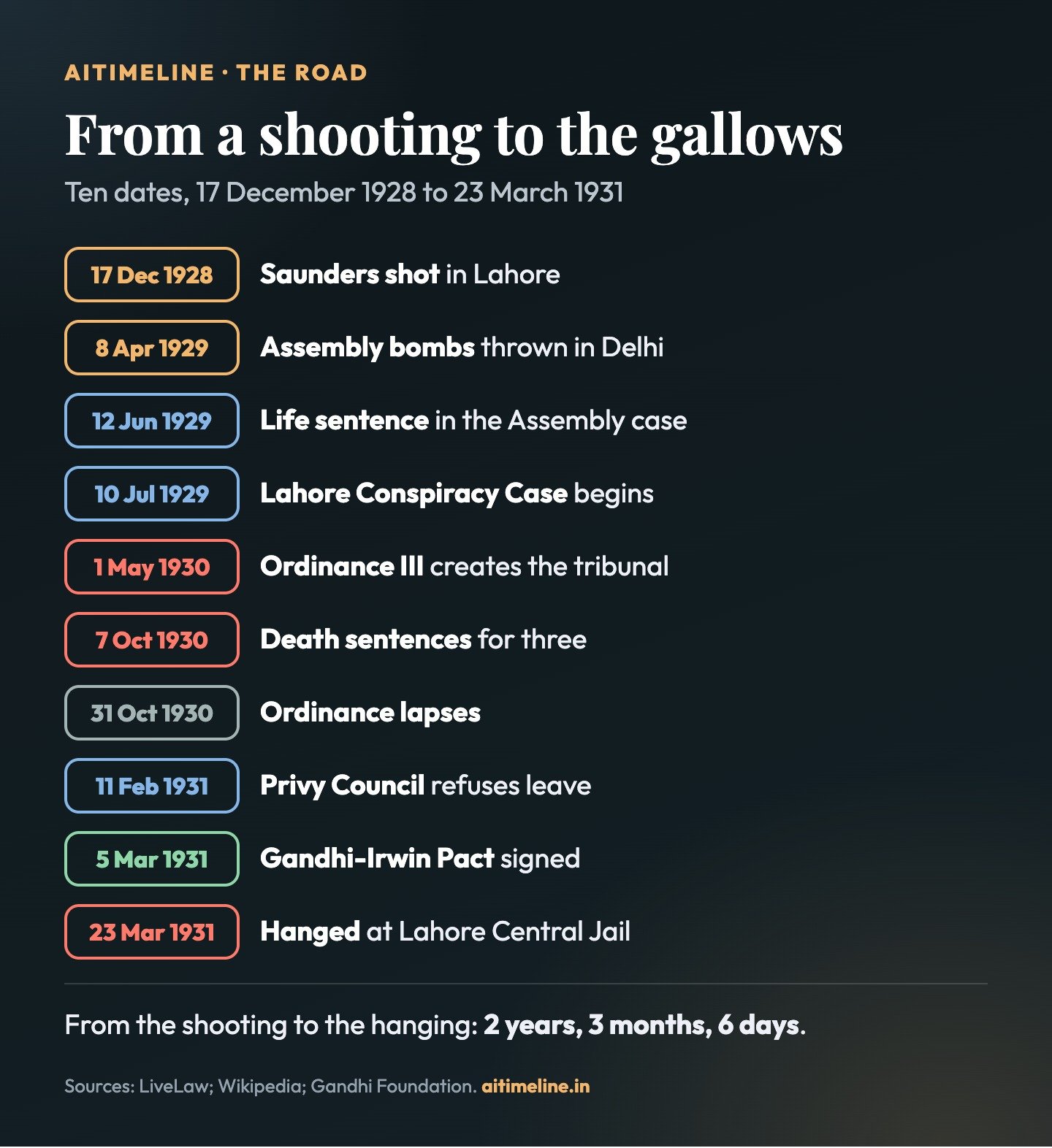
The Lead Picture: From a Shooting to the Gallows
Ten dates, 17 December 1928 to 23 March 1931.
Bhagat Singh Execution: Key Questions
What the Record Shows
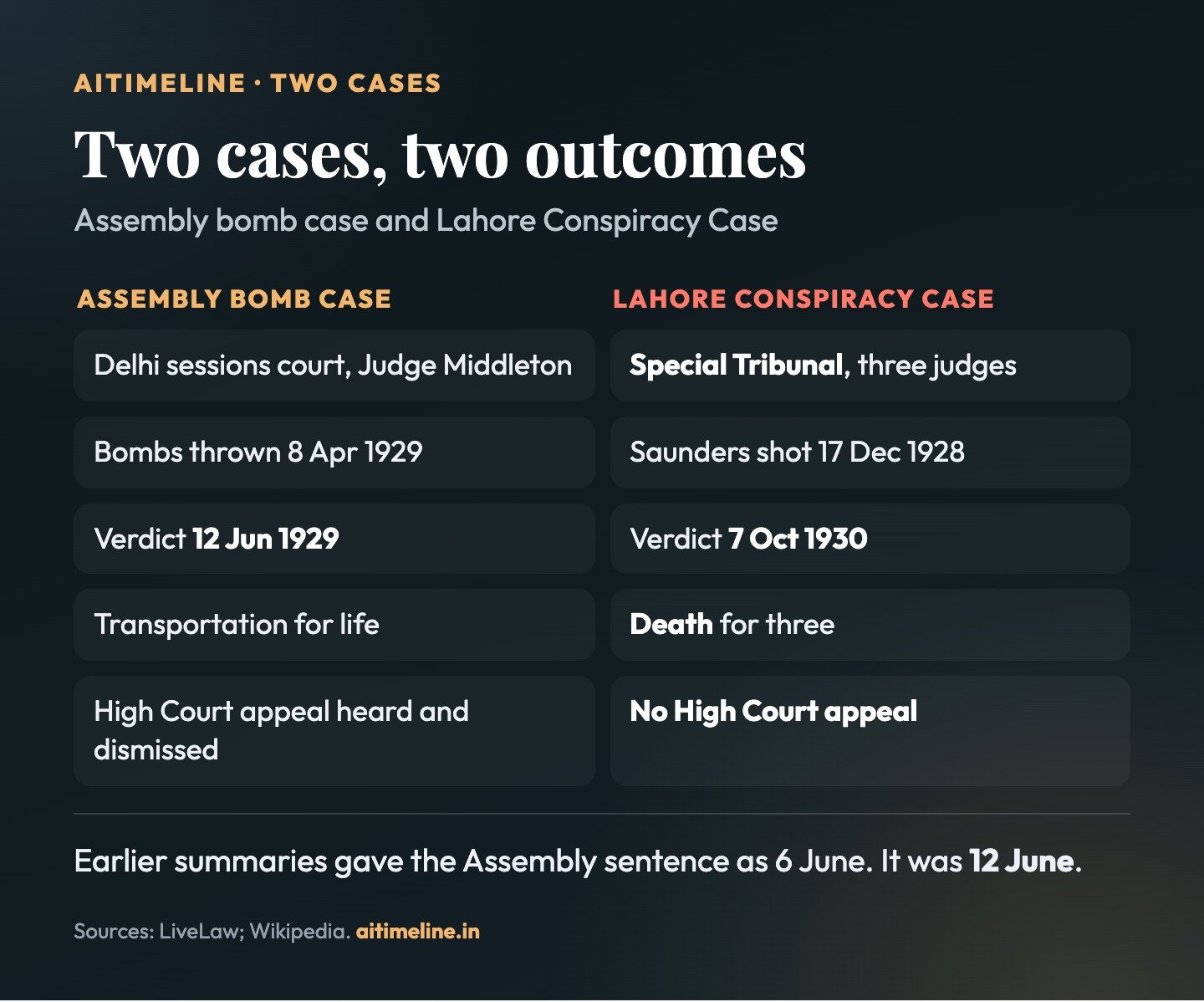
- Two separate cases: the Assembly bomb case ended in life transportation on 12 June 1929; the Lahore Conspiracy Case ended in death sentences on 7 October 1930.
- The tribunal was created by decree: Ordinance III of 1930 replaced the ordinary trial with three High Court judges and removed the High Court appeal.
- Hearings continued in absence: several were ex parte, after the accused refused to attend.
- Thin evidence: 457 witnesses were examined, no defence evidence was led, and the case relied mainly on five approvers.
- One appeal route: the Privy Council, which refused leave on 11 February 1931 and upheld the ordinance.
- The ordinance lapsed first: it expired on 31 October 1930, and the High Court still declined to stop the hanging.
- The pact did not cover them: the 5 March 1931 settlement freed prisoners not convicted of violence.
- Corrections: Rajguru was 22; the Assembly sentence was 12 June, not 6 June; the memorial dates from 1968, not 1961.
Timeline: The Lahore Conspiracy Case and the Hanging, 1928 to 1931
Newest first. Labels mark context, law, politics, events and court rulings.
Shaheed Diwas: the date is still marked every year Context
The observance: 23 March is observed as Shaheed Diwas, in memory of Bhagat Singh, Sukhdev and Rajguru. Tributes are paid at the National Martyrs Memorial at Hussainiwala, near Firozpur, and across India.
What we could not confirm: We found no new court ruling or official reopening of the case. The legal questions below are historical and are argued from the record, not from a pending case.
Hussainiwala National Martyrs Memorial opens Context
The memorial: The National Martyrs Memorial at Hussainiwala is dedicated to the three men and stands near where their remains were cremated on the Sutlej bank. A Tribune report says it took the government about four decades to build a proper memorial there.
Date caution: We use 1968 as the opening year, from the memorial’s reference entry. Earlier summaries gave 1961, which we could not support, so it is dropped.
Karachi Congress: Gandhi meets black flags, and the resolution calls it ‘vengeance’ Politics
The protests: The hangings came on the eve of the Congress session at Karachi. Gandhi faced black-flag demonstrations by angry young people, and mourning strikes were called in several cities.
The resolution: While disapproving of political violence, the Congress placed on record its admiration of the bravery of the three and called their execution ‘an act of wanton vengeance and a deliberate flouting of the unanimous demand of the nation for commutation’.
Gandhi’s view: In Young India of 29 March 1931 Gandhi praised their courage but said they should not be imitated, and that violence was not the way.
The bodies are removed in secret Event
What was reported: The bodies were taken out of the jail and cremated under cover of darkness outside the village of Ganda Singh Wala, near Hussainiwala, and the ashes were thrown into the Sutlej, according to accounts compiled by Wikipedia.
The press: The Tribune’s front page of 25 March 1931 carried the headline ‘Dead Bodies Secretly Disposed Of’, and said the three had been executed at about 7.15 pm on Monday.
Evening execution at Lahore Central Jail Court
The hanging: Bhagat Singh, Sukhdev and Rajguru were hanged on the evening of 23 March 1931. The Tribune gave about 7.15 pm; other accounts say 7.30 pm. Irwin’s own note of 19 March recorded the ‘slated hanging’ as 24 March, so it was carried out about a day early.
Who signed: One account says no magistrate was willing to supervise and that an honorary magistrate, Nawab Muhammad Ahmed Khan Kasuri, did so and signed fresh warrants, because the originals had expired. We treat this as reported, not settled.
Ages: Bhagat Singh and Sukhdev were 23. Rajguru was 22. Earlier summaries gave all three as 23.
Last petitions in the Lahore High Court Context
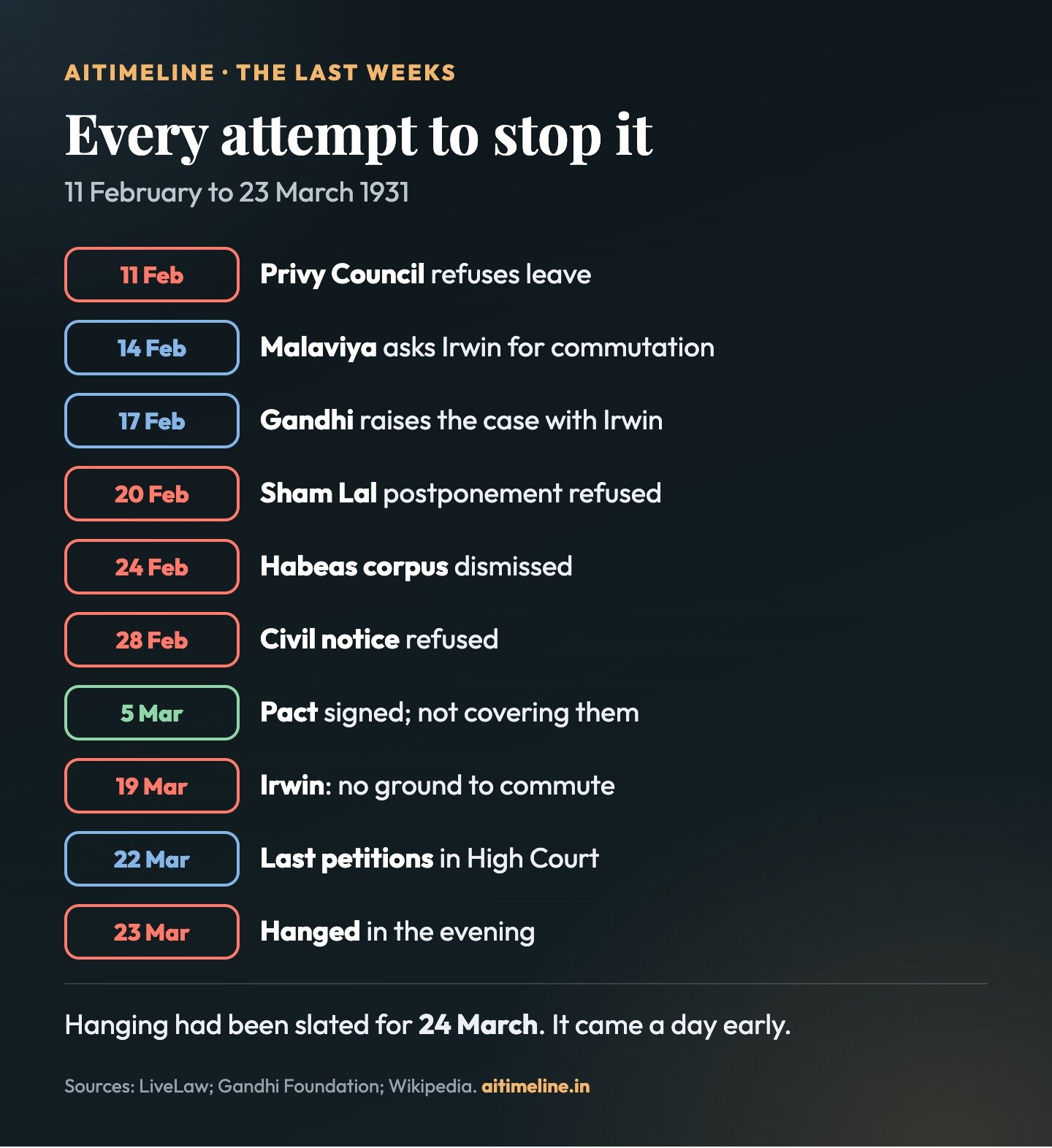
The petitions: Two more petitions were filed on 22 March 1931. One said a new cause of action had arisen after the Local Government rejected a representation under Section 401 of the Criminal Procedure Code. The other sought leave to appeal to the Privy Council against the earlier order dismissing the habeas corpus petition.
The outcome: Neither stopped the hanging.
Irwin records why he will not commute Politics
The note: On 19 March Irwin recorded that Gandhi asked about Bhagat Singh because newspapers had announced the hanging for 24 March, the day the new Congress president was due at Karachi. Irwin wrote that he could find no basis on which to commute the sentence.
The reasons: According to Gandhi-side accounts, Irwin also rejected postponement: it would be improper on political grounds once orders were passed, inhuman to the family, and open to a Congress claim that it had been tricked.
Gandhi-Irwin Pact is signed Politics
The agreement: The pact ended the Civil Disobedience Movement for the time being and provided for the release of political prisoners not convicted of violence. The three men, convicted of murder, were outside that category.
The debate: Critics say Gandhi should have made commutation a condition. Defenders say he raised it, that the Viceroy refused, and that Congress was bargaining for wider concessions. Nehru said on 10 March that insisting on release might have led to an earlier hanging. This is judgement, not settled fact.
Habeas corpus dismissed; the Government rejects a civil notice Court
The argument: A habeas corpus petition said the Special Tribunal had ceased to exist, so no authority was left to issue a fresh execution warrant. Justice Bhide dismissed it on 24 February 1931, noting that the Local Government could in any case commute under Section 402.
The civil notice: A notice under Section 80 of the Civil Procedure Code proposed a suit to stop the execution. On 28 February the Government refused to wait the two months the notice required, and directed that preparations proceed.
Mercy appeals and a memorial reach the Viceroy Politics
The appeals: Madan Mohan Malaviya wrote to Irwin on 14 February asking for commutation to transportation for life. On 16 February advocate Sham Lal asked for postponement because the three were defence witnesses in a second Lahore case; the Punjab Chief Secretary refused on 20 February.
The public memorial: A memorial of 18 February said the trial was ex parte, that there had been no appeal to the High Court, and that Bhagat Singh’s father had not been allowed to produce evidence on the Saunders killing. Bhagat Singh’s mother also asked for mercy, much against his wishes.
Privy Council refuses to hear the appeal Court
The decision: The Privy Council dismissed the Special Leave Petition on 11 February 1931 and gave reasons on 27 February. It rejected the argument that the Governor-General could not create the tribunal by ordinance without a genuine emergency, and upheld the ordinance.
The only door: The ordinance had removed the High Court appeal, so a petition to the Privy Council was the only legal route left. The warrant for 27 October 1930 had been put on hold while it was pending.
The ordinance lapses Law
What happened: The ordinance was never approved by the Central Assembly or the British Parliament and lapsed on 31 October 1930, as a Wikipedia summary of the Supreme Court’s later comments records. The tribunal ceased to exist, with the sentences still to be carried out.
Why it mattered: This produced the February 1931 argument that no court could now issue an execution warrant. The argument was rejected.
The Special Tribunal sentences three men to death Court
The verdict: The Tribunal found the part of Bhagat Singh, Sukhdev and Rajguru in the murder of Saunders proved, and sentenced them to death. Of the others, three were acquitted, Kundan Lal got seven years and Prem Dutt five, and seven were sentenced to transportation for life.
The date set: The Tribunal fixed 27 October 1930 for the hanging. The Privy Council petition put it on hold.
The basis: The prosecution relied mainly on five approvers, and LiveLaw notes that there was no direct evidence against Bhagat Singh and the others.
Prosecution closes after 457 witnesses; no defence evidence Law
The numbers: By 26 August 1930 the prosecution had examined 457 witnesses and closed its case, giving up the rest. No defence witnesses were produced. The case rested largely on five approvers: Jai Gopal, Phonindra Nath Ghosh, Man Mohan Bannerji, Hans Raj Vohra and Lalit Kumar Mukerji.
Absence: Several hearings were held ex parte, in the accused’s absence, under Section 9 of the ordinance, after the accused refused to attend. Prosecution arguments ended on 10 September.
Challenge to the ordinance is dismissed as premature Court
The argument: A petition said the Viceroy could create such a tribunal only in a breakdown of law and order, and that none had occurred. It was dismissed as premature.
The same point again: The same argument, that there was no real emergency, went to the Privy Council and was rejected there in February 1931.
Ordinance III of 1930 creates the Special Tribunal Law
The ordinance: Irwin declared an emergency on 1 May 1930 and promulgated the Lahore Conspiracy Case Ordinance (Ordinance III of 1930). It set up a Special Tribunal of three High Court judges. It took away the usual right of appeal or revision under the Criminal Procedure Code, and allowed the tribunal to proceed in the accused’s absence.
The start: The tribunal began hearing the case in Lahore on 5 May 1930, at Poonch House.
A limit of our reading: We could not read the ordinance text: the government PDF is a scanned 1861-1938 compilation whose OCR has no legible 1930 text. We therefore cite section numbers only where a law journalist’s account gives them (Section 9, absence).
Hunger strike ends after 116 days Event
The strike: Bhagat Singh and fellow prisoners had refused food to demand political-prisoner treatment: equal food, clothing, books and a daily newspaper, and no forced labour. He ended the strike on 5 October 1929 after 116 days, according to Wikipedia, heeding a Congress resolution and his father’s request.
The cost: Jatindra Nath Das, on the same strike, had died on 13 September after 63 days.
Jatin Das dies after 63 days Context
The death: Jatindra Nath Das died on 13 September 1929 after a 63-day hunger strike. The jail committee had recommended his unconditional release, but the government offered only bail.
The reaction: Two members of the Punjab Legislative Council resigned in protest, and Jawaharlal Nehru’s adjournment motion in the Central Assembly censured the treatment of the prisoners.
The Lahore Conspiracy Case begins Court
The charges: Bhagat Singh and 27 other prisoners were charged with the murder of Saunders, a conspiracy to murder Scott and waging war against the King. Bhagat Singh was carried into court on a stretcher while on hunger strike.
A separate case: This was separate from the Assembly bomb case, in which he was already convicted.
Assembly bomb case: life transportation Court
The sentence: Bhagat Singh and Batukeshwar Dutt were convicted under Section 307 of the Indian Penal Code and Section 3 of the Explosive Substances Act and sentenced to transportation for life on 12 June 1929.
What followed: Dutt was sent to the Andamans. Bhagat Singh was moved to Punjab to face the Saunders killing. Earlier summaries gave a 6 June date, which is wrong.
Bombs in the Central Legislative Assembly Event
The act: Bhagat Singh and Dutt threw low-intensity bombs in the Assembly on 8 April 1929 in protest against the Public Safety Bill and the Trade Disputes Bill. The bombs were meant not to kill; a few members had minor injuries.
The surrender: They threw leaflets, shouted slogans and gave themselves up, expecting the court to become a platform for their politics.
J.P. Saunders is shot in Lahore Event
The killing: Bhagat Singh and Rajguru shot Assistant Superintendent of Police J.P. Saunders on 17 December 1928 outside the police headquarters. A head constable, Chanan Singh, was also killed.
The mistake: They had meant to kill Superintendent J.A. Scott, whom they blamed for the lathi charge that preceded Lajpat Rai’s death. A mistaken identification led them to shoot Saunders.
Lajpat Rai is injured in a protest, and dies Context
The protest: On 30 October 1928 a demonstration against the all-white Simon Commission was charged by police in Lahore, and Lala Lajpat Rai was injured. He died on 17 November 1928.
The response: His death angered the revolutionaries of the Hindustan Socialist Republican Association, who planned to avenge him.
The Special Tribunal: What Changed
Ordinary trial against the Ordinance III trial.
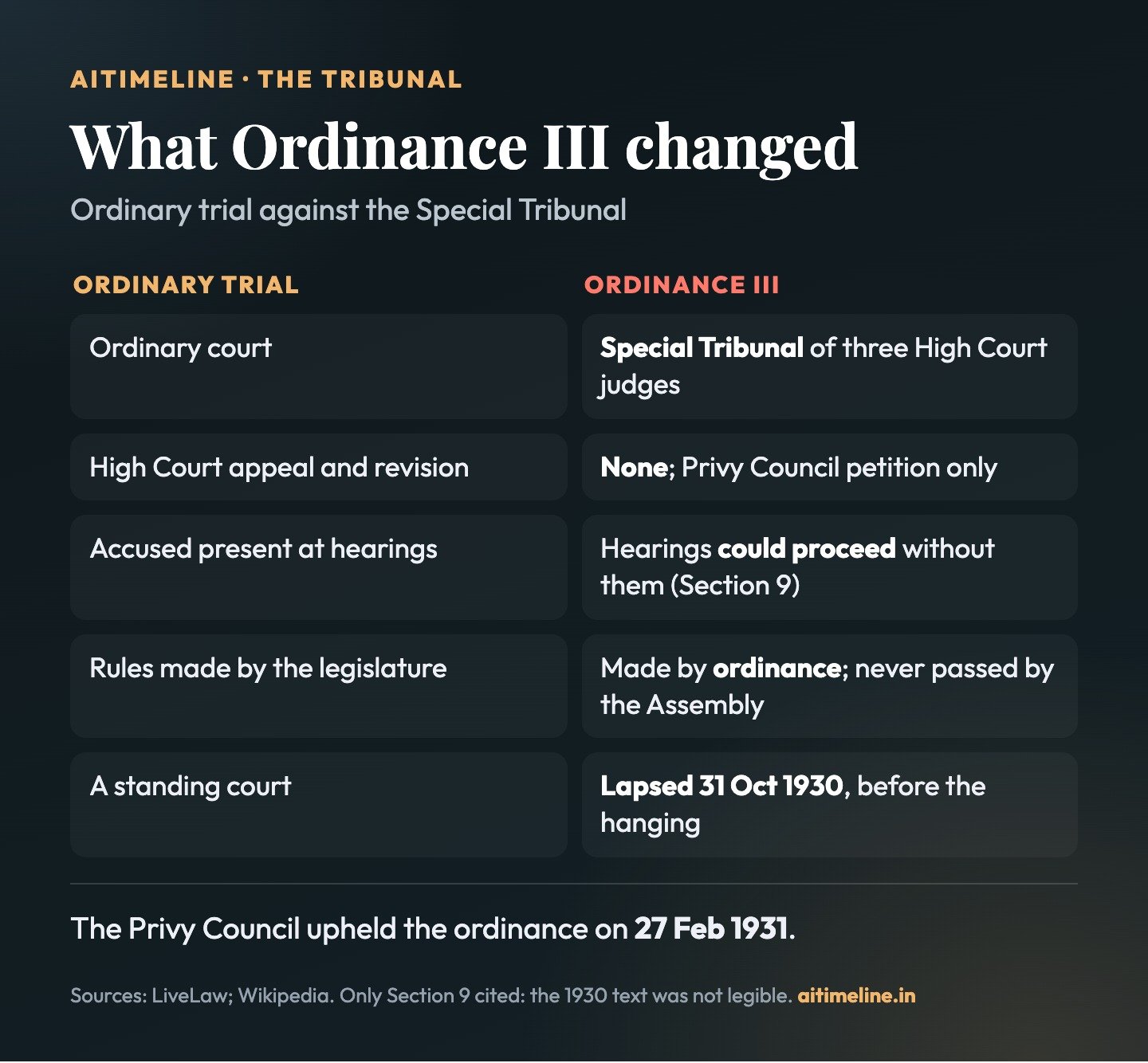
The government said the ordinance was needed to prevent delay. The accused, and later the Congress, said an executive order had been used to change the rules of a prosecution the government itself was bringing. Two courts, the Lahore High Court in July 1930 and the Privy Council in February 1931, were asked whether the ordinance was valid. Both let it stand.
What we could not read. The government’s ordinance PDF is a scan of an 1861-1938 compilation whose text is not legible for 1930, so we quote section numbers only where LiveLaw gives them. The Supreme Court’s later description of the trial is quoted from a Wikipedia summary, not from the judgment.
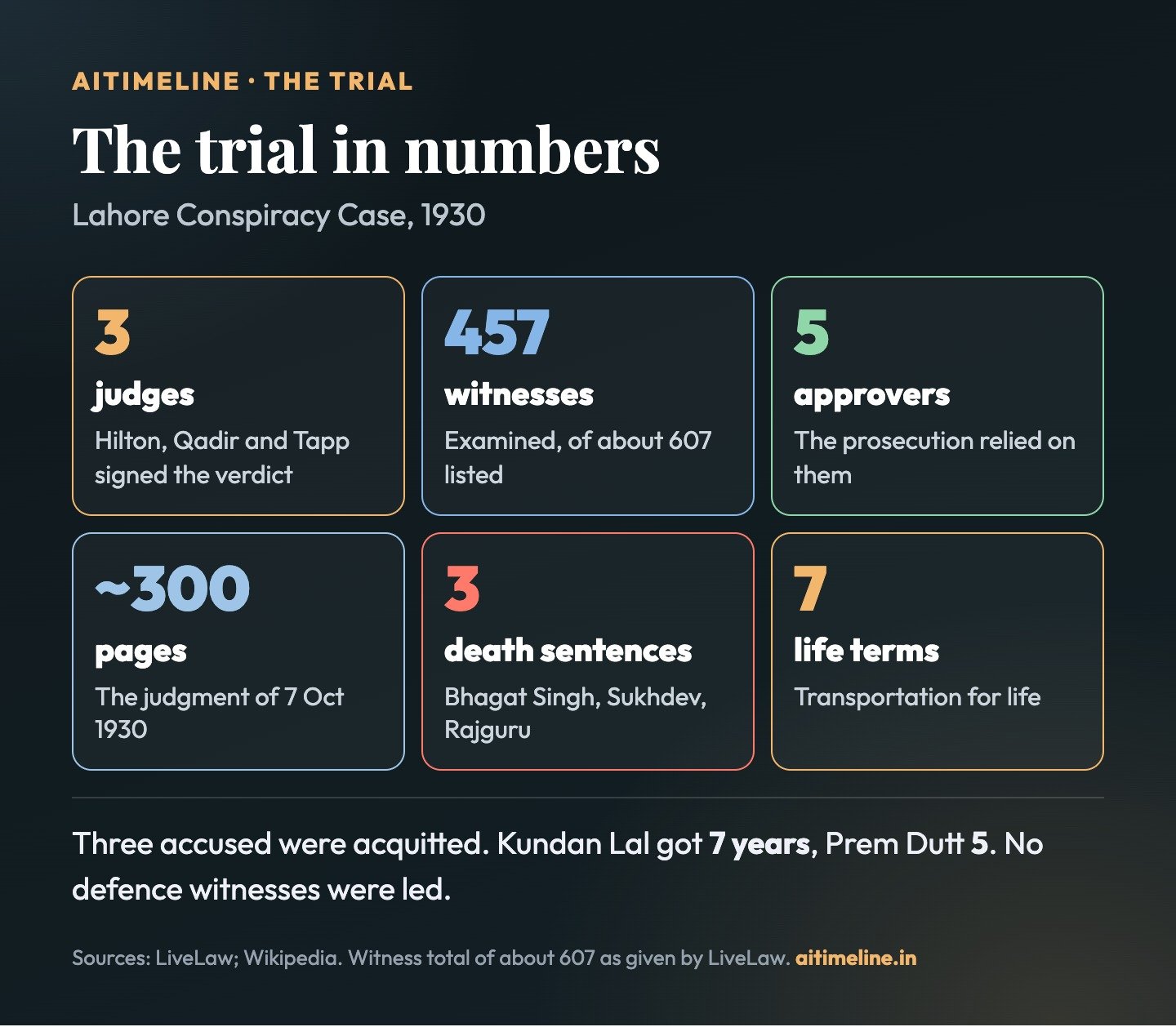
The Trial in Numbers
From the tribunal’s proceedings, 1930.
The Last Weeks: Every Attempt, in Order
11 February to 23 March 1931.
The Gandhi-Irwin Debate: What the Record Shows
Documented, disputed and not established.
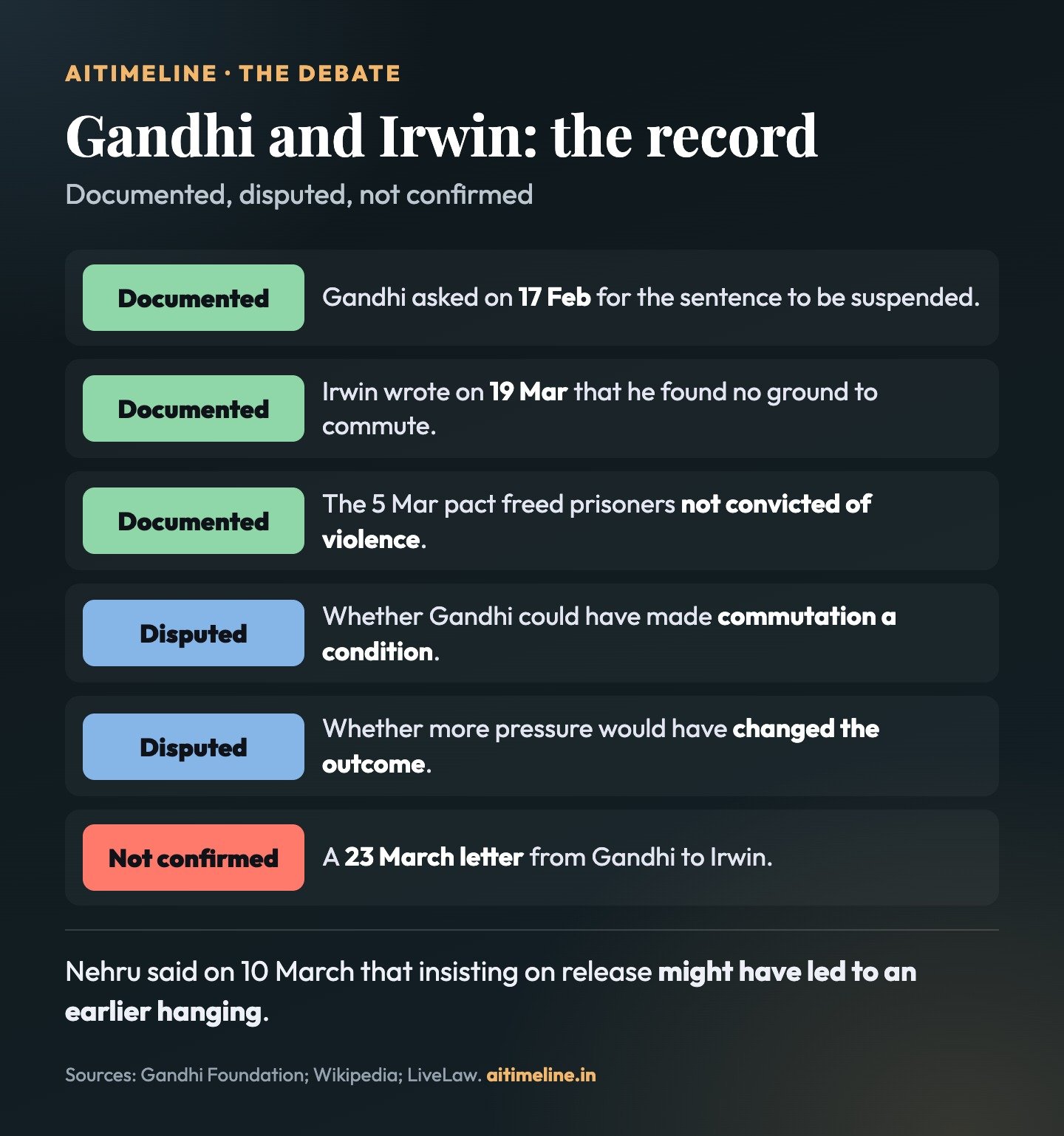
Critics say Gandhi should have made commutation a condition of the pact. Defenders say he raised it, the Viceroy refused, and the pact was about broader concessions. Nehru said on 10 March that pressing for release might have led to an earlier hanging. All of that is judgement. What is documented is that Gandhi asked on 17 February for suspension on humanitarian grounds, and that Irwin wrote on 19 March that he could not find grounds to commute.
The Three Men
Dates of birth and ages at death.
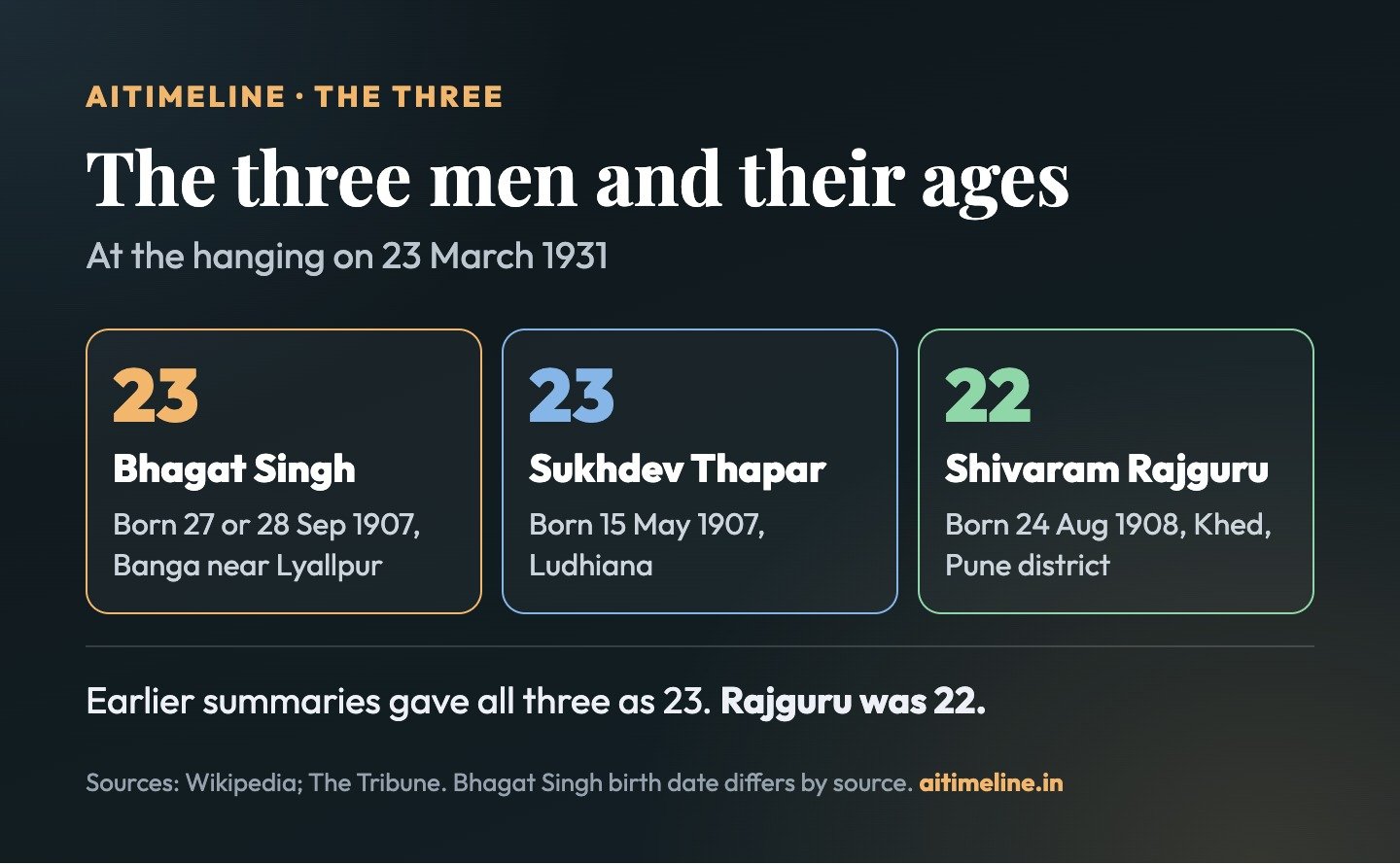
Bhagat Singh’s birth date is given as 27 September in Wikipedia and 28 September in many Indian sources, so we state both. His writings on socialism, communalism, workers’ rights and atheism, including the essay ‘Why I Am an Atheist’, are a large part of why he is remembered as more than a revolutionary act.
Source Gaps and Corrections
| Claim in earlier summaries | What we found | Status |
|---|---|---|
| Rajguru was 23 | Born 24 Aug 1908, so 22 | Corrected |
| Assembly sentence 6 June 1929 | 12 June 1929 (Judge Middleton) | Corrected |
| Hunger strike began July 1929 | Ended 5 Oct 1929 after 116 days | Restated |
| Memorial established 1961 | Opened 1968; 1961 unsupported | Dropped |
| Bench: Coldstream, Haidar, Hilton | Verdict bench was Hilton, Qadir, Tapp | Final bench only |
| Gandhi appeal on 23 March | Not confirmed from sources read | Not stated |
| Ordinance section numbers | PDF text not legible for 1930 | Only Section 9 cited |
Conclusion: Why the Process Matters
The hanging of Bhagat Singh, Sukhdev and Rajguru is remembered for their courage, but the case is also a study of how a state can change the rules of a trial. An ordinance created the court, removed the usual appeal and lapsed before the sentence was carried out, and the courts of the day let it stand.
What the record cannot settle is whether Gandhi could have changed the outcome, and whether every detail of the last days, such as the exact hour of the hanging, is as the surviving accounts say. We have marked those points. We could not read the ordinance’s text, and a reader who needs the exact wording should go to the original.
Explore More Timelines
People Also Ask
Frequently Asked Questions
⚠️ Editorial Note
This page draws on LiveLaw’s legal account of the trial, the Gandhi Foundation’s account of Gandhi’s efforts, Wikipedia’s summary of the case and contemporary newspapers. We corrected details in earlier summaries: Rajguru was 22, the Assembly sentence was 12 June 1929, the Hussainiwala memorial opened in 1968, and the Privy Council proceeding was a petition for special leave. We could not read the ordinance’s 1930 text, so we cite section numbers only where a source does. Accounts differ on the hour of the hanging and on Bhagat Singh’s birth date, and we give both. This article is editorial history, not legal advice.
Related Stories
Sources & further reading
Every dated entry above was checked against these references. Last reviewed 27 November 2026.
- LiveLaw: Legal Proceedings Led To Martyrdom Of Bhagat Singh, Sukhdev And Rajguru
- Gandhi Foundation: Gandhi and Bhagat Singh
- Wikipedia: Bhagat Singh
- The Tribune: Martyrdom of Bhagat Singh, Rajguru, Sukhdev
- Wikipedia: Hussainiwala National Martyrs Memorial
- Indian Express: Could Gandhi have done more to save Bhagat Singh?
- Government of India: Ordinances 1861-1938 (scanned compilation)