Food Warning Labels India: FSSAI Rules and Supreme Court Timeline
India's food warning label policy explained: FSSAI proposals, red hexagon warnings, Supreme Court's 2026 decision and what changes for consumers.
Latest Story
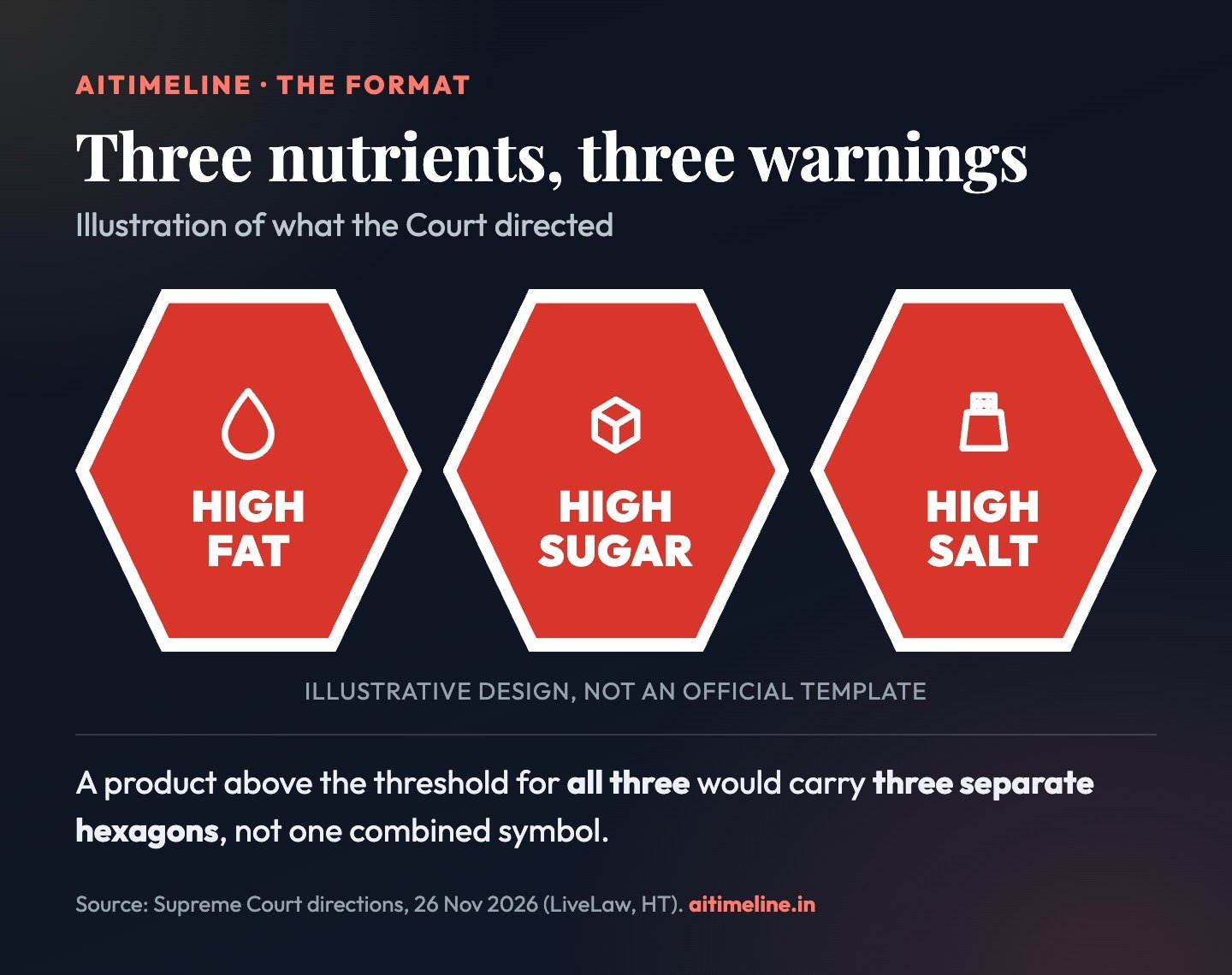
On 26 November 2026 the Supreme Court told FSSAI to bring in separate red hexagon warnings for packaged foods high in fat, sugar or salt. This guide covers food warning labels in India: the years of drafts, star ratings and consultations behind the ruling, what the Court actually ordered, and what still has to happen before a warning appears on a packet.
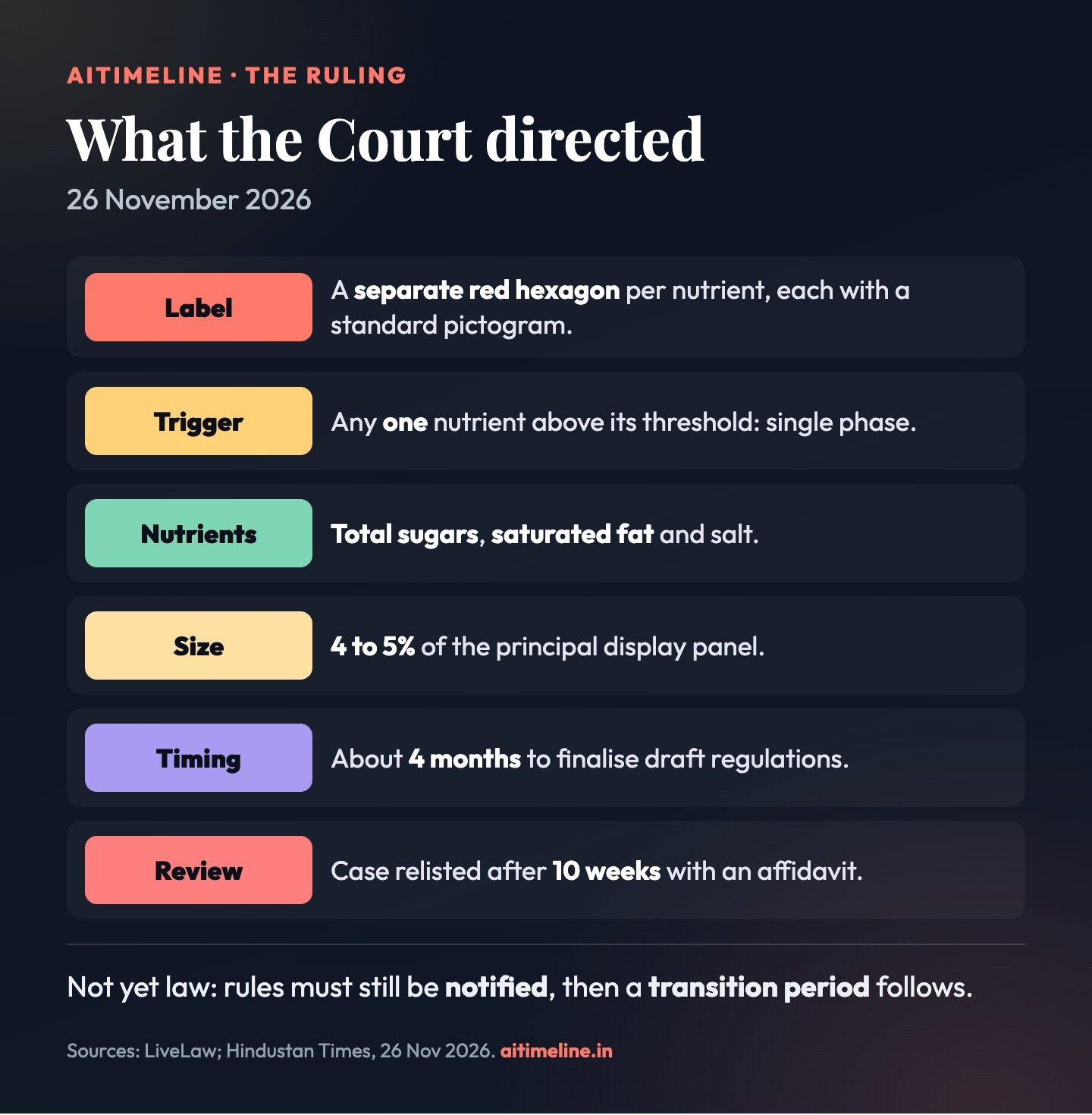
The red warnings are not yet compulsory. The Court gave FSSAI about four months to finalise draft regulations. They must then be notified, and industry gets a transition period. Until then, packets look as they do today.
💡 Short Answer
India is moving to front-of-pack warnings on packaged food. On 26 November 2026 the Supreme Court directed FSSAI to use a separate red hexagon for HIGH FAT, HIGH SUGAR and HIGH SALT, each with a pictogram, covering any product above the threshold for even one nutrient. Thresholds must use total sugars and saturated fat. FSSAI has about four months to finalise the draft rules; labels become mandatory only after notification and a transition period.
What the Supreme Court Ordered
3S and Our Health Society v. Union of India, Writ Petition (Civil) 437 of 2024.
Food Warning Labels India: Key Questions
The Warning-Label Story in Eight Points
- Court direction: separate red hexagons for fat, sugar and salt.
- Not yet law: regulations must be drafted, consulted on and notified.
- Single phase: FSSAI’s plan to start with products high in two or more nutrients was dropped.
- New yardstick: total sugars and saturated fat, not added sugar and added fat.
- 2024 values: the dietary-guideline thresholds cannot be adopted unchanged.
- Star rating shelved: the 2022 Indian Nutrition Rating drew over 14,000 comments and no consensus.
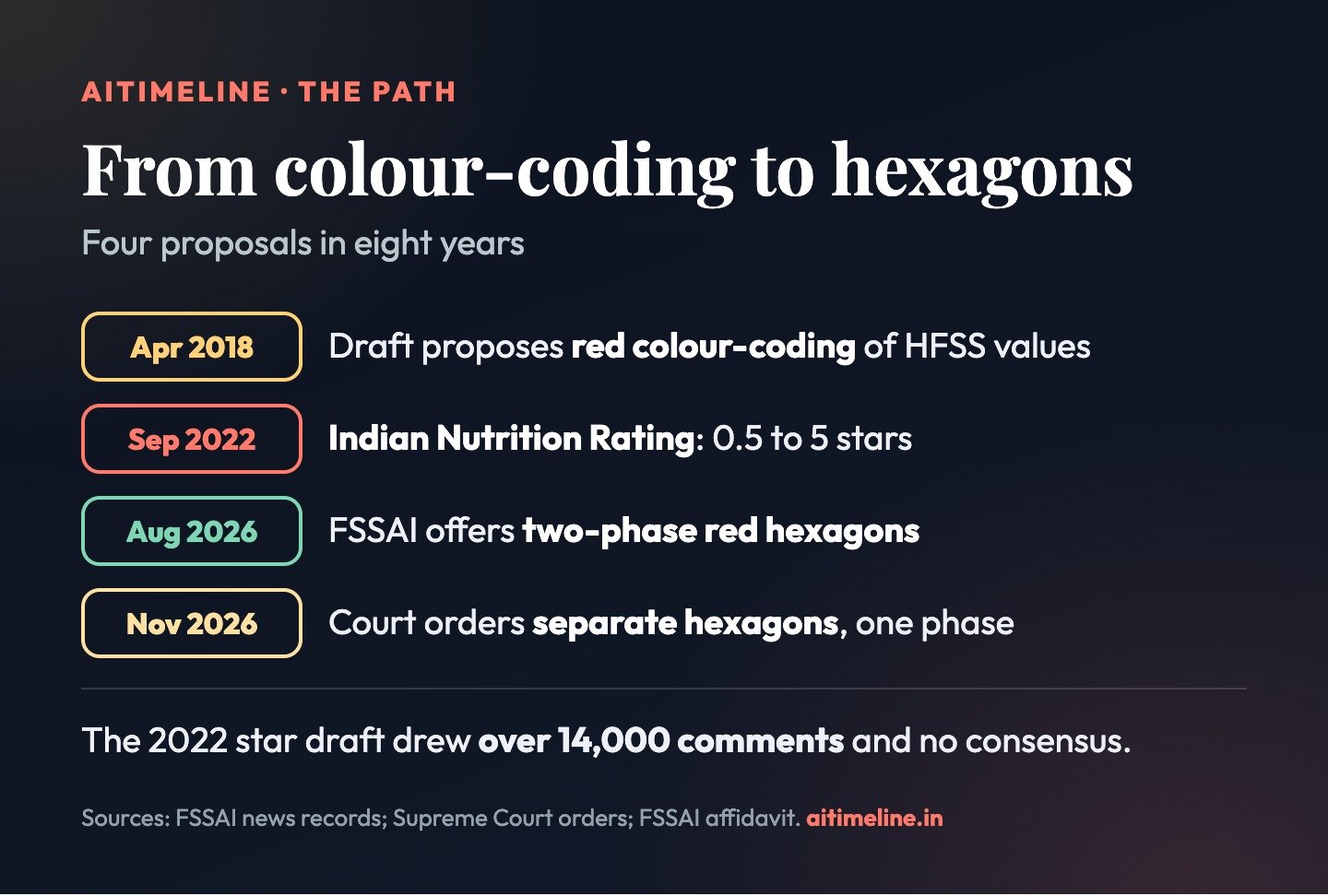
- Long road: red colour-coding was first floated in an April 2018 draft.
- Next checkpoint: the Court relists the case after 10 weeks.
Timeline: India’s Food Warning Labels, 2006 to 2026
Newest first. Labels mark background, proposals, court orders, regulator steps and rulings.
Supreme Court orders separate red hexagon warnings Ruling
The directions: FSSAI must frame a single-phase regime: a separate red hexagon for each of HIGH FAT, HIGH SUGAR and HIGH SALT, each with a standard pictogram, instead of one combined hexagon. Thresholds must use total sugars and saturated fat, not added sugar and added fat, and be neither too low nor too high.
Size and timing: Each hexagon should take 4 to 5% of the principal display panel, in line with international practice, unless FSSAI records reasons for departing. FSSAI gets about four months to finalise the draft regulations, and the matter returns after 10 weeks for a progress affidavit.
Beyond labels: The Centre must enforce the 2020 labelling regulations strictly and build practical nutritional literacy into school teaching. The Court grounded the duty in Article 21: the right to health and to make informed choices.
Court questions the July 2028 timeline Court
What happened: The bench asked why implementation had to stretch as far as July 2028 and why consultation had to begin afresh. FSSAI then proposed about four months to finalise the regulations, followed by a year-long transition for food businesses.
FSSAI drops the two-nutrient trigger Proposal
What changed: After the 10 September hearing FSSAI told the Court it would trigger a warning when a product exceeds the threshold for any one nutrient. LiveLaw reports a red hexagon on a white square, thresholds drawn from the 2024 dietary guidelines and a separate ‘CONTAIN NON CALORIC SWEETENER’ warning for products with non-caloric sweeteners.
Timeline offered: FSSAI said it needed roughly four months to issue and finalise the draft and proposed a 365-day implementation period after notification.
Court questions the two-phase plan Court
Concerns: The bench asked why products high in a single nutrient should wait for Phase II, noting that the petitioner called the two-or-more trigger scientifically unjustified. It saw no fixed timeline between the phases and flagged that the 2024 guidelines and FSSAI’s 2022 draft define HFSS foods differently.
Questions on thresholds: It also asked about trans-fat, the definition of sweetened beverages, label design and colour, and why added sugar was used when a 2021 stakeholder meeting had favoured total sugar and saturated fat.
FSSAI proposes red hexagons in two phases Proposal
The proposal: A red hexagonal warning for foods high in any two or more of added fat, added sugar and salt, reading HIGH FAT, HIGH SUGAR or HIGH SALT, in type one point larger than the nutrition table. Phase II would extend it to products high in any one nutrient.
Exemptions: Single-ingredient foods and items inherently rich in fat, sugar or salt, such as ghee, edible oil, salt, sugar, jaggery and honey, would be exempt from the warning.
Two weeks to decide, or the Court will direct Court
What the Court said: The bench gave the Centre and FSSAI two weeks to take a decision on front-of-pack labelling. It rejected the stance that India cannot match international standards, asking whether India should remain ‘an underdeveloped country’.
The industry-side worry: The Additional Solicitor General argued that traditional Indian foods could carry warnings under the proposed thresholds. The bench replied that it only wanted the buyer to know what is being consumed.
Union asks for six more weeks Court
What happened: The Union sought more time to comply with the February directions. The bench noted that a report had been filed only the previous day, which neither the Court nor the petitioner had seen, and ordered copies to be furnished.
Court is not satisfied with FSSAI’s compliance Court
What the affidavit said: FSSAI told the Court there was no consensus among stakeholders on the Indian Nutrition Rating draft and that it would do further research and consultation before any next step.
The Court’s view: The bench said prima facie that the exercise so far had ‘not yielded any positive or good result’, said the petitioner’s suggestion of a front-of-package warning ‘makes some sense’ and asked FSSAI to consider it and revert.
Health ministry answers Lok Sabha Regulator
The answer: The government said FSSAI had notified the draft front-of-pack amendment on 13 September 2022, had submitted the Expert Committee’s report to the Supreme Court and that the matter was sub-judice. It cited two FSSAI studies: a nutrient threshold study and a consumer perception survey.
Draft amendment on bold-letter nutrition information Regulator
What it was: FSSAI notified a draft Labelling and Display amendment on presenting nutrition information in bold letters. It is separate from the warning-symbol system and did not introduce HFSS warnings.
Court disposes of the petition with directions Court
The order: Recording the government’s decision to amend the labelling regulations, the Court disposed of the petition and directed the Expert Committee to submit recommendations at the earliest, within three months, with the matter to be listed again to report compliance.
FSSAI becomes a party to the case Court
What happened: The Court allowed FSSAI’s application and impleaded the regulator in the PIL filed by 3S and Our Health Society, which sought front-of-pack warnings on foods high in sugar, salt and saturated fat.
ICMR-NIN revises the Dietary Guidelines for Indians Background
What it says: Guideline 15 advises minimising high-fat, high-sugar, high-salt and ultra-processed foods and sets threshold criteria. For 100 g of solid food they are 250 kcal, 625 mg salt, 3 g added sugar and 4.2 g added fat; for 100 ml of liquid, 70 kcal, 175 mg, 2 g and 1.5 g.
Why it matters here: The Court held on 26 November that these values cannot be adopted as they stand, because they were calculated on added sugar and added fat rather than total sugars and saturated fat.
Expert Committee examines the star-rating draft Proposal
What happened: FSSAI constituted an Expert Committee to review the feedback on the Indian Nutrition Rating. Its report and a revised draft were to go to the Scientific Committee and then the Food Authority.
The outcome: By January 2026 FSSAI told the Court the committee had flagged stakeholder concerns about the rating algorithm and that there was no consensus.
FSSAI proposes the Indian Nutrition Rating Proposal
The model: The draft proposed a star-rating label on the front of pre-packaged foods, crediting beneficial nutrients with caps so poor products could not score high on small amounts of them.
The response: FSSAI told the Court it received over 14,000 comments from businesses, associations, consumers and public-health groups.
Stakeholder meeting favours total sugar and saturated fat Background
Why it matters: The Court noted that this meeting had reached a consensus in favour of total sugar and saturated fat for front-of-pack purposes, which FSSAI’s 2026 proposal on added sugar and added fat departed from.
Labelling and Display Regulations, 2020 notified Background
What they did: The regulations consolidated labelling and display requirements for packaged food, including nutrition information. They did not create a mandatory interpretive warning for high-fat, high-sugar or high-salt products.
FSSAI proposes red colour-coding Proposal
The idea: The draft proposed front-of-pack declaration of energy, fat, trans-fat, sugar and salt per serve, with HFSS values highlighted in red. FSSAI said in June 2019 that a revised draft was ready for notification.
The legal framework Background
Background: The 2006 Act created FSSAI to set science-based food standards and gave it powers over labelling. The Packaging and Labelling Regulations, 2011 set the earlier rules for information on packaged food.
Two Phases or One?
The change that mattered most between August and November.
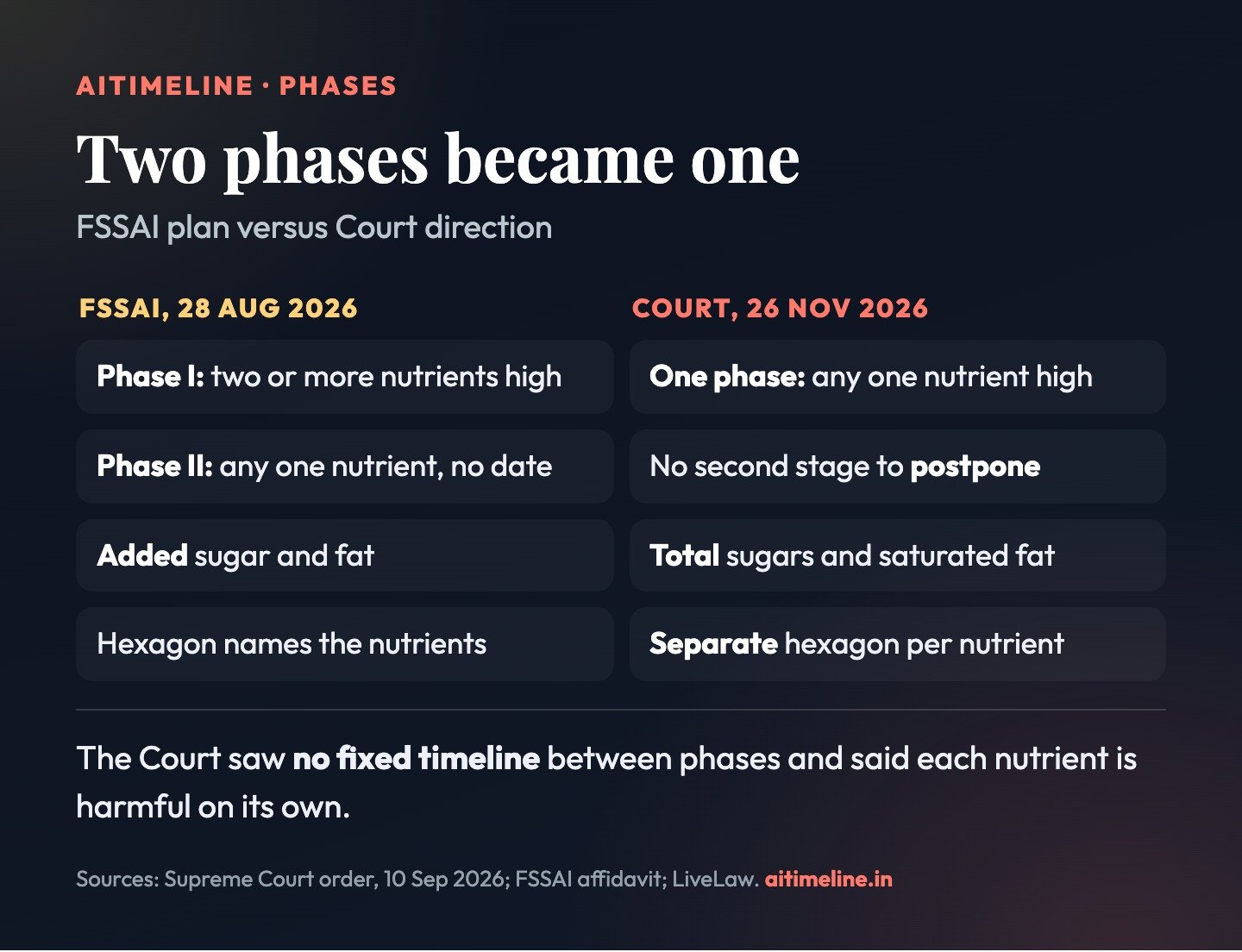
| Feature | FSSAI, 28 Aug 2026 | Court, 26 Nov 2026 |
|---|---|---|
| Trigger | Two or more nutrients first | Any one nutrient |
| Sugar and fat measure | Added sugar, added fat | Total sugars, saturated fat |
| Label | Hexagon naming the nutrients | Separate hexagon per nutrient |
| Phasing | Phase I and II | Single phase |
| Size | Text one point larger than table | 4 to 5% of front panel |
The Threshold Fight
Where the numbers come from, and why they must change.
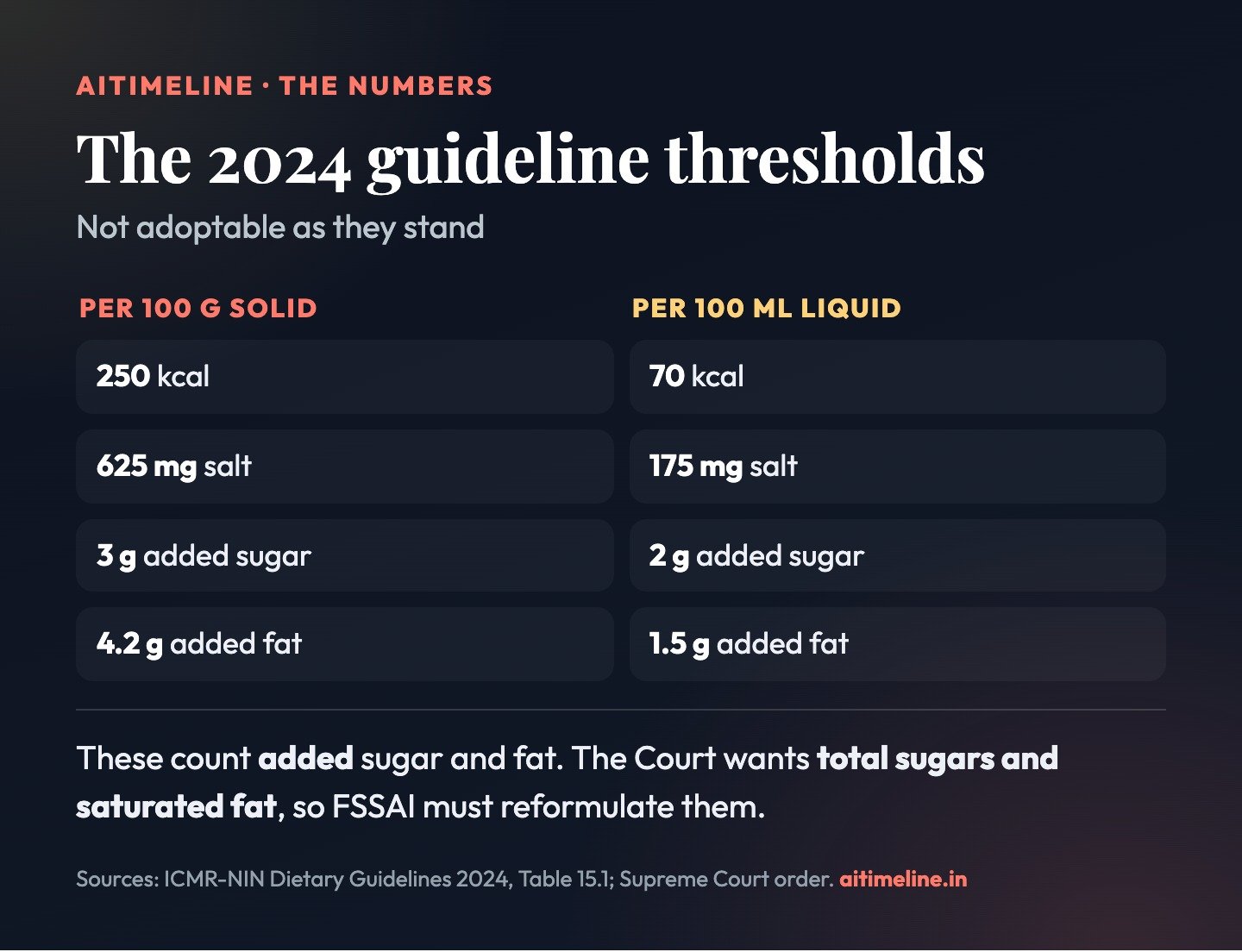
FSSAI’s proposal drew its cut-offs from Table 15.1 of the ICMR-NIN Dietary Guidelines for Indians, 2024. Those figures count added sugar and added fat. The Court noted that a 2021 stakeholder meeting had preferred total sugar and saturated fat, and held that the 2024 values cannot be adopted as they stand. FSSAI must reformulate thresholds on evidence. Too low, and nearly every pack carries a warning, breeding label fatigue. Too high, and most products escape.
How Other Countries Label Food
India’s red hexagon is closest to the warning systems of the Americas and Israel.
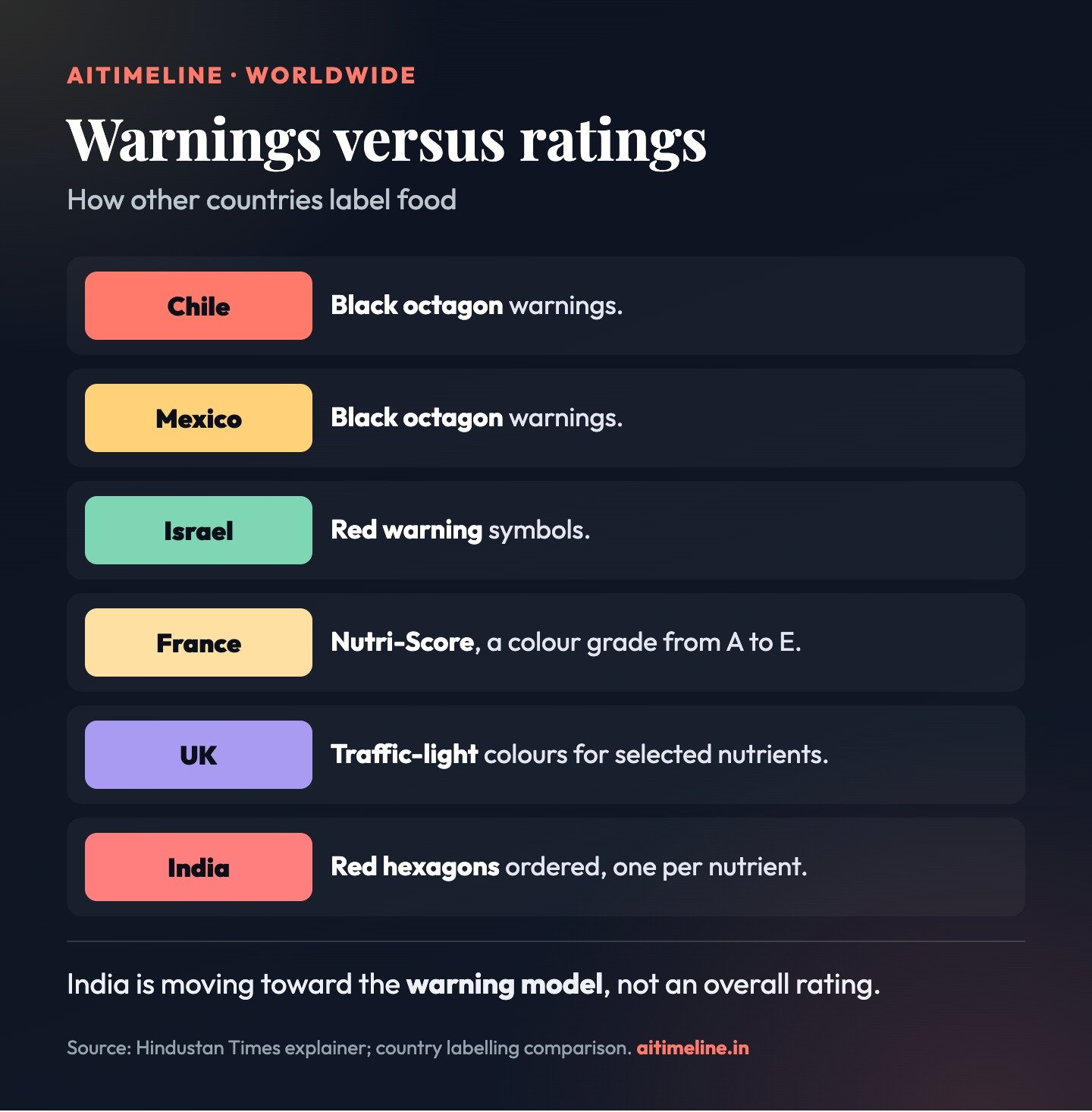
| Country | System | Type |
|---|---|---|
| Chile | Black octagon warnings | Warning |
| Mexico | Black octagon warnings | Warning |
| Israel | Red warning symbols | Warning |
| France | Nutri-Score, A to E | Rating |
| United Kingdom | Traffic-light colours | Colour code |
| India (ordered) | Red hexagons for fat, sugar, salt | Warning |
The Industry Concerns
Food makers have raised concerns on thresholds, reformulation costs, repackaging and how a red symbol shapes buying. In August the Additional Solicitor General argued that traditional Indian foods could attract warnings and that small enterprises could face knock-on effects. The bench replied that it only wanted buyers to know what they are consuming. Reuters reported that the Court also criticised multinational firms that resist labels in India while using them elsewhere, and that the companies had not immediately responded; we could not open the Reuters article ourselves, so treat that detail as reported.
What Happens Next
Ruling to shelf: the remaining steps.
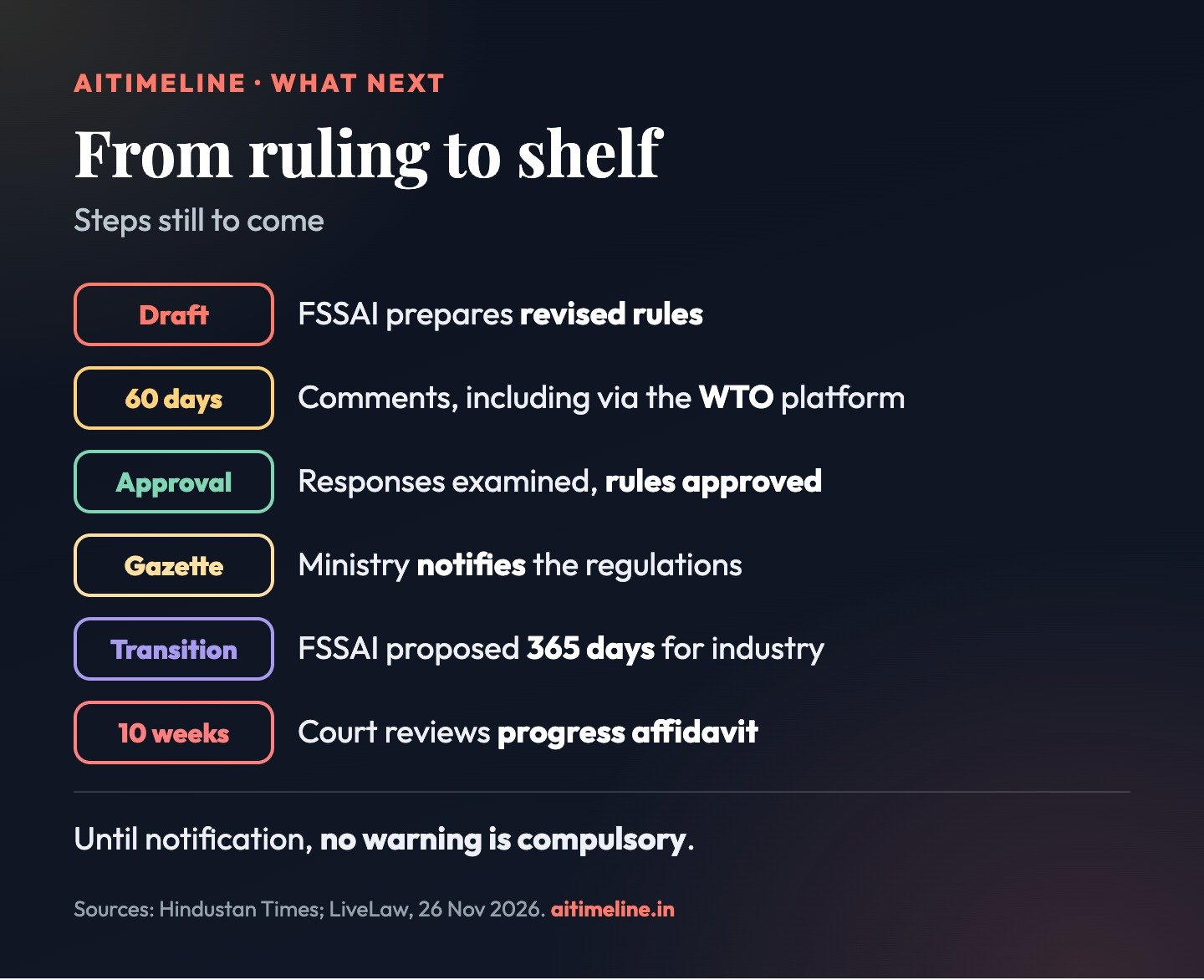
| Stage | What must happen |
|---|---|
| Draft | FSSAI prepares revised front-of-pack amendments |
| Consultation | 60 days of comments, domestic and via the WTO platform |
| Approval | Responses examined; regulations approved |
| Notification | Ministry publishes in the Official Gazette |
| Transition | FSSAI proposed 365 days for businesses; final length to be set |
| Review | Case relisted after 10 weeks for a progress affidavit |
The Court also warned FSSAI against letting consultation become a hunt for absolute consensus among industry and public-health advocates, saying that could delay the regime indefinitely.
Conclusion: A Long-Debated Label, Now With a Deadline
India has debated front-of-pack labelling since at least 2018, through red colour-coding, a star rating and a two-phase hexagon plan. The 26 November ruling gives the idea a deadline and a design.
What it does not do is put a warning on any packet today. That depends on FSSAI’s draft, the thresholds it chooses, and how closely the Court watches the next ten weeks. A product without a warning will still not be automatically healthy.
Explore More Timelines
People Also Ask
Frequently Asked Questions
⚠️ Editorial Note
This timeline relies on the Supreme Court orders of 4 August and 10 September 2026, LiveLaw and Hindustan Times reports of the 26 November directions, FSSAI’s own news records and the Lok Sabha answer of 12 December 2025. Several details differ from the brief we received: FSSAI’s Labelling and Display Regulations were notified on 17 November 2020 per its affidavit to the Court, not in December; the ICMR-NIN guidelines came out in May 2024, not April; the 2014 recommendation appears in an MP’s question, not in the ministry’s reply; the 4 to 5% size is a minimum unless FSSAI records reasons; the one-year transition is FSSAI’s proposal; and the 9 April 2025 order followed, not preceded, the February 2025 draft. We could not open the Reuters report. The hexagons shown are an illustration, not an official template. This is editorial information, not medical or legal advice.
Related Stories
Sources & further reading
Every dated entry above was checked against these references. Last reviewed 26 November 2026.
- Supreme Court of India: 3S and Our Health Society v. Union of India, order of 10 September 2026 (2026 INSC 988)
- Supreme Court of India: 3S and Our Health Society v. Union of India, order of 4 August 2026
- LiveLaw: Packaged foods need separate pictorial warnings on high fat, sugar or salt, Supreme Court (26 Nov 2026)
- Hindustan Times: Supreme Court tightens food labelling norms, gives FSSAI four months to finalise them (26 Nov 2026)
- Hindustan Times explainer: Supreme Court pushes for warning labels on packaged foods, how the world does it
- Lok Sabha Unstarred Question 2255: Status of Front of Pack Labelling Policy (12 Dec 2025)
- FSSAI in the news: red colour-coded labels on packaged foods high in fat, sugar and salt (BusinessLine, 13 Apr 2018)
- ICMR-NIN: Dietary Guidelines for Indians 2024
- FSSAI: Labelling and Display regulations and amendments