26/11 Coastal Security: India’s Maritime Defence Timeline
Explore how India strengthened coastal security after 26/11 through radar networks, Coast Guard reforms, marine police and Sea Vigil 2026 drills.
Latest Story
On the night of 26 November 2008, ten armed terrorists reached Mumbai by sea and attacked the city for about 60 hours, killing 166 victims. The attacks exposed the absence of an integrated system to detect, track and respond to suspicious boats. This timeline traces how India’s coastal security was rebuilt since then, from the Navy’s new role and marine police stations to radar networks, the NMDA project and the nationwide Sea Vigil exercises, and what is still unfinished.
Official counts of Phase II police infrastructure differ. MHA’s scheme page, updated 25 November 2026, says 120 of 131 sanctioned coastal police stations, 37 of 60 jetties and 6 of 10 operation centres have been built. We could not open the MHA annual report that other summaries cite. Sea Vigil 26 results are not public. PIB published the plan on 11 November 2026; we found no findings, so none are reported.
💡 Short Answer
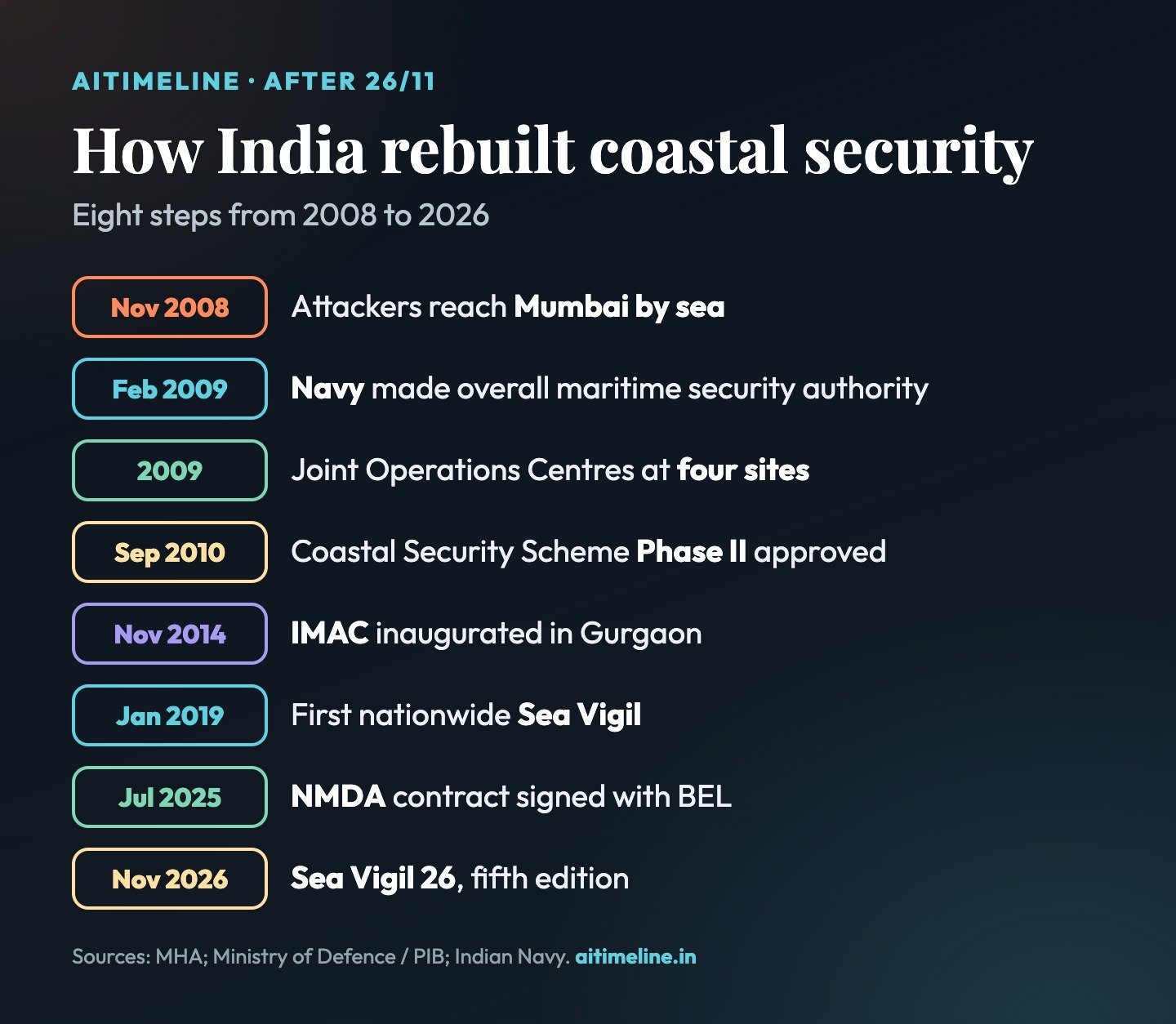
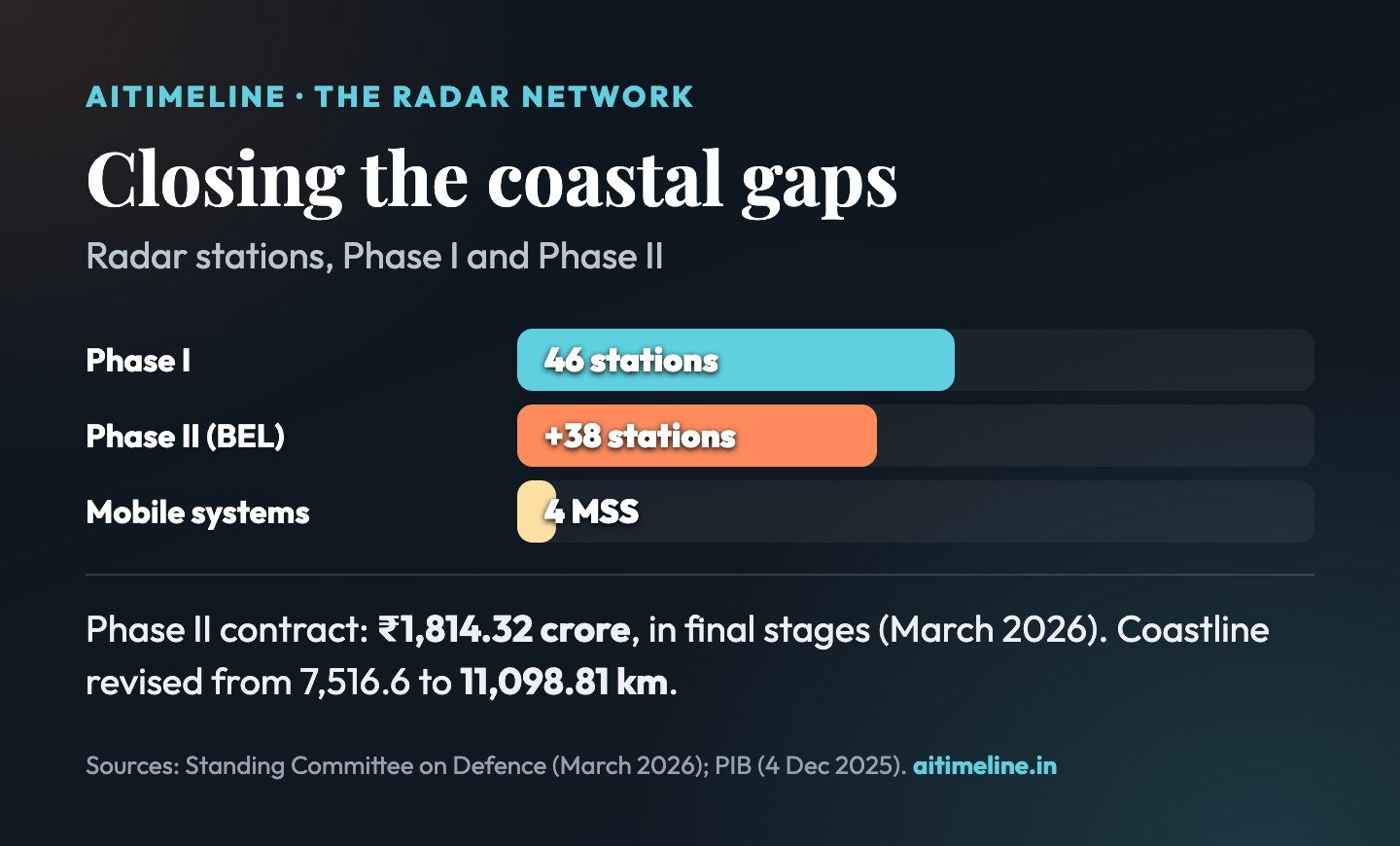
After 26/11, the Navy was made responsible for overall maritime security (February 2009), the Coast Guard for coastal security in territorial waters, and state marine police for local policing. India added Joint Operations Centres, the IMAC information hub (2014), a Coastal Surveillance Network with 46 radar stations and 38 more being completed, the NMDA upgrade (July 2025) and Sea Vigil exercises since 2019. Phase II of the police scheme is still incomplete.
How India Rebuilt Coastal Security After 26/11
Eight steps from 2008 to 2026.
India’s Coastal Security: Key Questions
From a Security Failure to a Continuous Mission
- A sea route, not a land gap: the attackers hijacked the fishing vessel Kuber and landed in inflatable boats.
- Clear roles: Navy overall, Coast Guard in territorial waters, marine police locally.
- Technology layer: radar, AIS, IMAC and NC3I now feed a common operational picture.
- NMDA is next: an AI-enabled upgrade contracted in July 2025, with no public cost or date.
- Police build-out lags: Phase II is past its 2020 extension and still unfinished.
- Drills are the test: Sea Vigil audits hundreds of locations and now includes offshore assets.
- Threats widened: narcotics, poaching, drones, infrastructure and cyber sit beside terrorism.
- The coast is longer on paper: 11,098.81 km, a new measurement not new territory.
Timeline: India’s Coastal Security, 1993 to 2026
Newest first. Labels mark pre-26/11 background, reforms, networks, schemes and exercises.
Sea Vigil 26: the fifth nationwide coastal defence exercise Exercise
What happened: The Navy led Sea Vigil-26 across the whole coastline and Exclusive Economic Zone, with all coastal states and Union Territories, the Coast Guard, Coastal Security Police, Customs and fishing communities taking part. A Coastal Defence and Security Readiness Evaluation ran from 11 to 17 November, followed by a sea phase on 18 and 19 November.
Why it matters: PIB describes Sea Vigil as a way to validate the measures introduced after 26/11, and a build-up to the Navy’s biennial TROPEX. At the time of writing no official results had been published, so this article does not report any findings.
Parliamentary committee: radar Phase II in final stages Network
What it recorded: The committee noted that Phase I of the Chain of Static Sensors included 46 radar stations. A contract with Bharat Electronics Limited covers 38 more radar stations and four Mobile Surveillance Systems at Rs 1,814.32 crore, described as being in final stages of implementation.
Scale today: The Ministry of Defence told the committee the Coast Guard deploys about 50 to 55 ships and 10 to 12 aircraft daily across India’s maritime zones. An April 2025 reply gave a lower daily figure of 18 to 20 ships, so the two statements are not directly comparable.
Navy signs the National Maritime Domain Awareness contract Network
The project: The Navy signed a contract with BEL for the NMDA project, which upgrades the NC3I network to an NMDA network with AI-enabled software and turns the Information Management and Analysis Centre at Gurugram into a multi-agency centre.
What is not public: PIB gave no contract value or completion date.
India’s coastline is re-measured at 11,098.81 km Before 26/11
The change: A MoPSW circular of 29 April 2025 promulgated the revised length, up from 7,516.6 km. The Ministry of Earth Sciences confirmed it in a parliamentary reply on 4 December 2025. The new figure uses GIS software and high-resolution high-water-line data.
What it is not: It is a new measurement of the existing coast, not new territory. Gujarat’s coastline, for example, rose from 1,214.70 km to 2,340.62 km on paper.
Coast Guard reports a decade of operations Reform
The numbers: Over ten years the Coast Guard reported 300,296 boarding operations, 153 coastal security exercises, 451 coastal security operations, 458 security drills and 3,645 joint coastal patrol sorties. It seized 179 boats and arrested 1,683 people for illegal entry into Indian waters.
Reading them: The figures cover many activities, including poaching and narcotics, not only counter-terrorism.
Sea Vigil 24: 21 agencies, 550 surface assets Exercise
Scale: PIB reported over 21 agencies across six ministries, more than 550 surface assets and 60 air sorties with about 200 flying hours. A preceding readiness evaluation audited more than 950 critical coastal locations.
Focus: Protecting oil rigs, single point moorings, cable landing stations, non-major ports and nuclear installations, plus simulated merchant-ship hijacking. The Air Force deployed air defence systems on offshore platforms.
First Sea Vigil: a nationwide test of the post-26/11 system Exercise
What happened: The Navy’s first Sea Vigil covered the whole coastline and EEZ, with press accounts citing about 150 ships and 40 aircraft. It was designed to test readiness against sea-borne attacks like 26/11.
Counts differ: Some accounts say all 13 coastal states and Union Territories took part, others say nine states and four Union Territories. The scope was the same.
IMAC inaugurated at Gurgaon Network
What it does: IMAC is the nodal centre of the National Command Control Communication and Intelligence network. It collects maritime data from radars, AIS and other sources to build a common operational picture for the Navy and Coast Guard.
Later upgrade: In July 2025 the Navy contracted to turn IMAC into a multi-agency NMDA centre.
Coastal Security Scheme: Phase I and Phase II Scheme
Phase I: Implemented 2005 to 2011 at Rs 646 crore: 73 coastal police stations, 97 check posts, 58 outposts, 30 barracks, 204 interceptor boats, 153 jeeps and 312 motorcycles.
Phase II: Approved in September 2010 for 2011-16 at about Rs 1,580 crore, then extended to March 2020. It sanctioned 131 stations, 60 jetties and 10 Marine Police Operation Centres. MHA’s scheme page, updated 25 November 2026, says 120 stations, 37 jetties and 6 centres have been built. A December 2024 PIB release counts 204 coastal police stations operational across both phases.
Joint Operations Centres and an apex committee Reform
Coordination: Joint Operations Centres were set up at four sites, bringing the Navy, Coast Guard and other agencies together. An apex committee under the Cabinet Secretary was formed to review coastal security.
Date caveat: Sources describe the centres as created in 2009; we did not find a single commissioning date for all four.
Home Minister outlines the response in Parliament Reform
What followed: The Union Home Minister gave an initial assessment of the attacks and announced measures to strengthen security. A review of coastal and maritime security began across the Ministries of Home Affairs, Defence, Shipping and Fisheries.
Ten attackers reach Mumbai by sea Before 26/11
What happened: Ten terrorists travelled from Karachi, hijacked the Indian fishing vessel Kuber, then reached Mumbai in inflatable boats. Attacks hit Chhatrapati Shivaji Terminus, the Taj Mahal Palace Hotel, the Oberoi-Trident, Leopold Cafe and Nariman House. The assault lasted about 60 hours and killed 166 victims. Nine attackers were killed and one captured alive.
The gap: No integrated system detected, tracked and responded to suspicious boats along the coast.
Coastal Security Scheme Phase I begins Scheme
Context: The scheme was already running when the attacks exposed wider weaknesses. It gave coastal police stations, boats and vehicles, but not an integrated surveillance and command system.
Mumbai bombings and Operation Swan Before 26/11
The warning: The March 1993 Mumbai blasts exposed sea routes for smuggling explosives into India. Operation Swan, a coordinated patrol effort along vulnerable stretches of the Gujarat and Maharashtra coast, followed. Sources we could read give limited detail on its scope and duration.
Who Does What?
No single organisation runs coastal security.
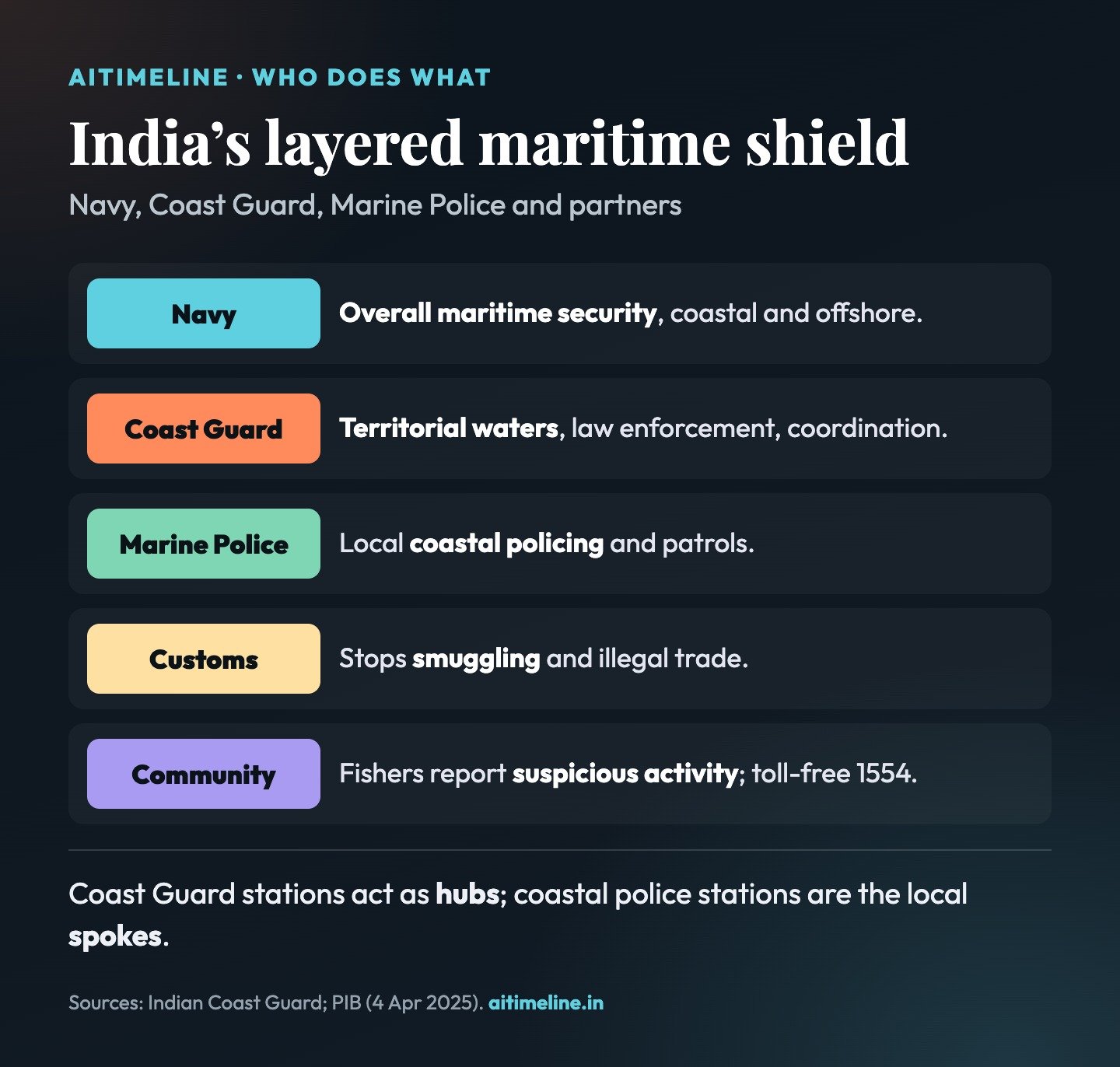
| Organisation | Principal responsibility |
|---|---|
| Indian Navy | Overall maritime security, coastal defence and offshore security |
| Indian Coast Guard | Coastal security in territorial waters, law enforcement, coordination |
| State Marine Police | Coastal policing, local patrols and response |
| Customs | Smuggling and illegal trade |
| Intelligence agencies | Collecting and sharing security intelligence |
| Port authorities, CISF | Security of designated port and industrial facilities |
| Fisheries departments | Vessel registration, links with fishing communities |
The Coast Guard also works with marine police on a hub-and-spoke model: Coast Guard stations are hubs and coastal police stations the local spokes. Coastal states and Union Territories have standard operating procedures that set out each agency’s role, and a toll-free number, 1554, lets fishers report events at sea.
The Technology Behind the Shield
Sensors, identity data and shared pictures.
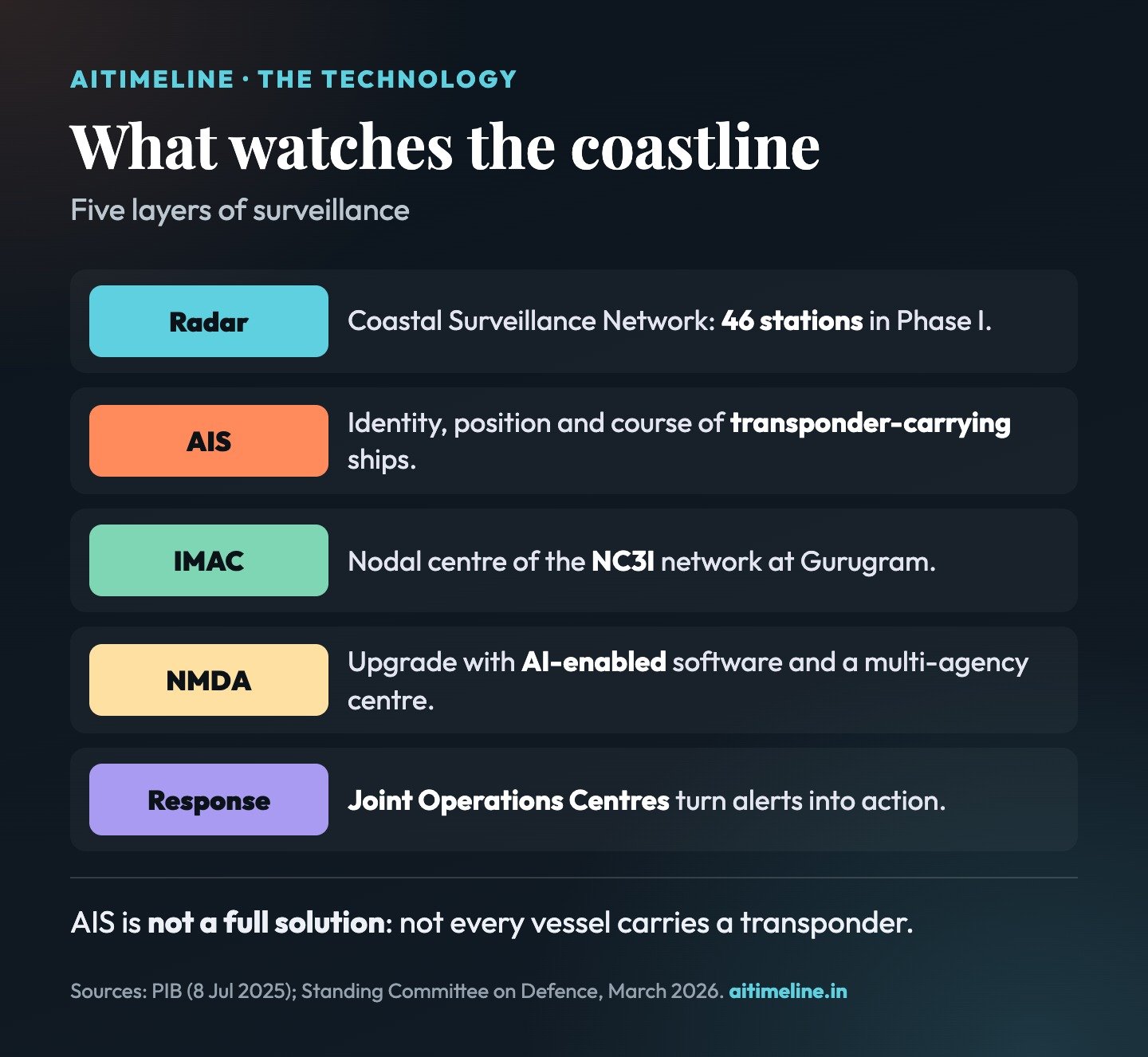
Coastal Surveillance Network. Shore radars, AIS receivers and cameras watch vessel movement. AIS. It reveals identity, position and course, but only for vessels that carry a transponder, so it has to be combined with radar, intelligence and patrols. IMAC and NC3I. IMAC is the nodal centre of the network. NMDA. The July 2025 contract upgrades the network with AI-enabled software and turns IMAC into a multi-agency centre. Response. Radar detection is not enough; joint centres and standard procedures exist to get information to the right agency quickly.
The Coastal Security Scheme
Police infrastructure built after 26/11.
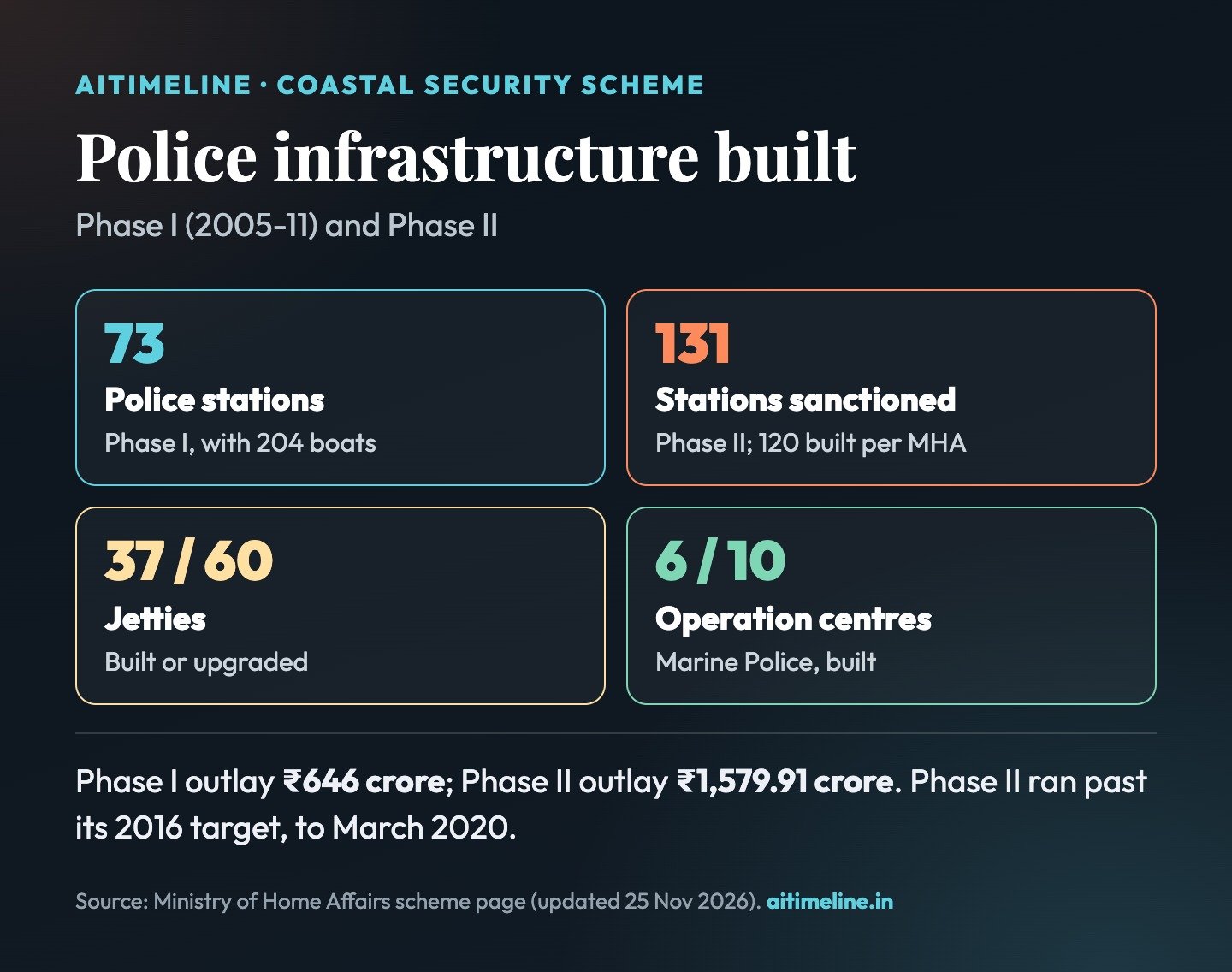
| Item | Phase I (2005-11) | Phase II (sanctioned) | Phase II built (MHA) |
|---|---|---|---|
| Coastal police stations | 73 | 131 | 120 |
| Jetties | – | 60 | 37 |
| Marine Police Operation Centres | – | 10 | 6 |
| Interceptor boats | 204 | Additional boats planned | – |
| Four-wheelers | 153 jeeps | 131 | All procured |
| Two-wheelers | 312 | 242 | All procured |
| Outlay | Rs 646 crore | About Rs 1,580 crore | – |
Phase II was meant to run from April 2011 to March 2016 and was extended to March 2020. Other official statements count stations as operational, and a December 2024 PIB release put operational coastal police stations at 204 across both phases, so totals vary with whether a station is counted as constructed or functioning.
Sea Vigil: Testing the System
Five editions since 2019.
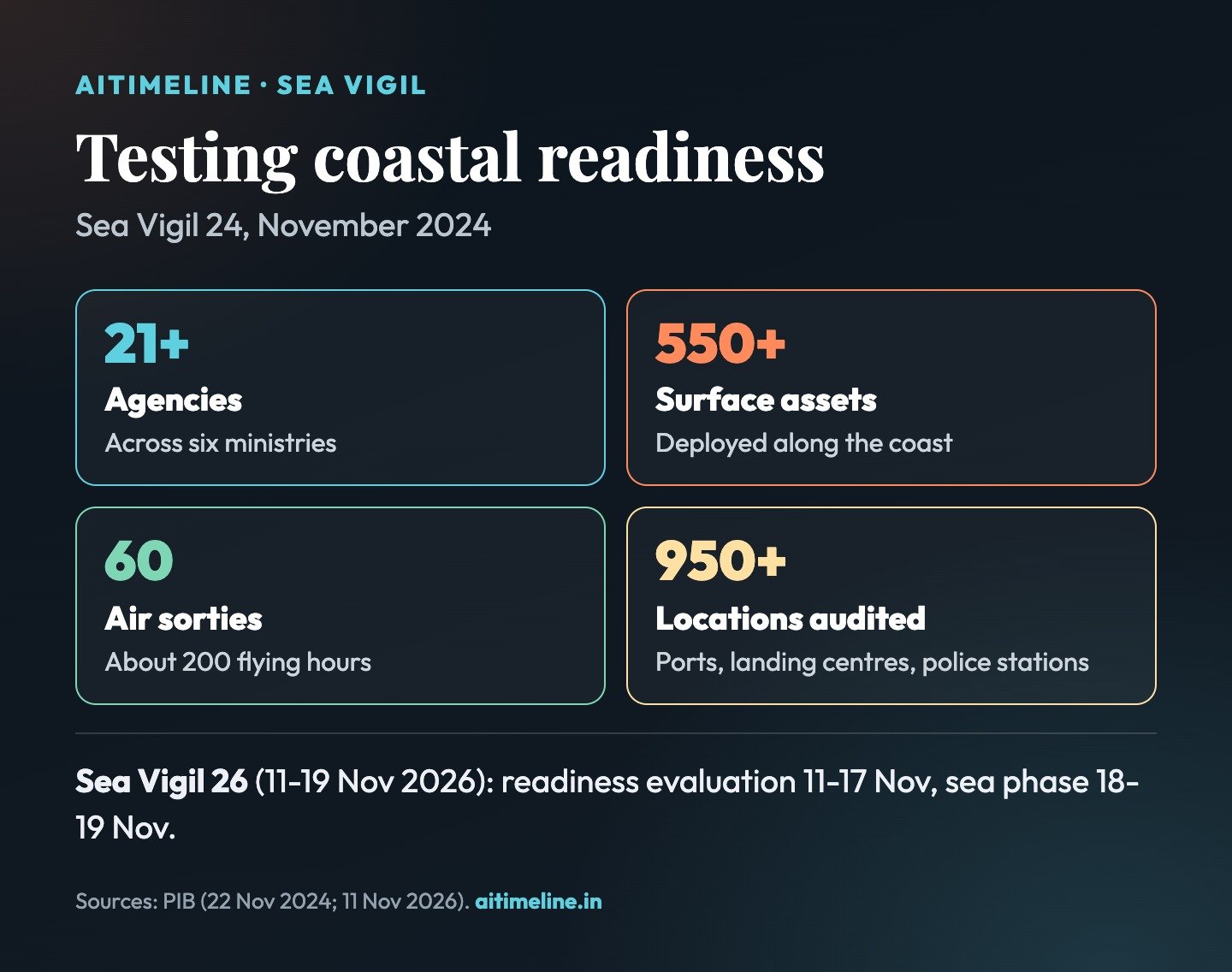
The Navy conceived Sea Vigil in 2018 to validate the post-26/11 measures. The 2024 edition added protection of oil rigs, moorings, cable landing stations and nuclear installations, simulated merchant-ship hijacking, and air defence systems on offshore platforms. Sea Vigil-26 followed the same two-phase pattern and was described as a build-up to the Navy’s TROPEX.
New Threats and What Remains Hard
The mission now extends past terrorism.
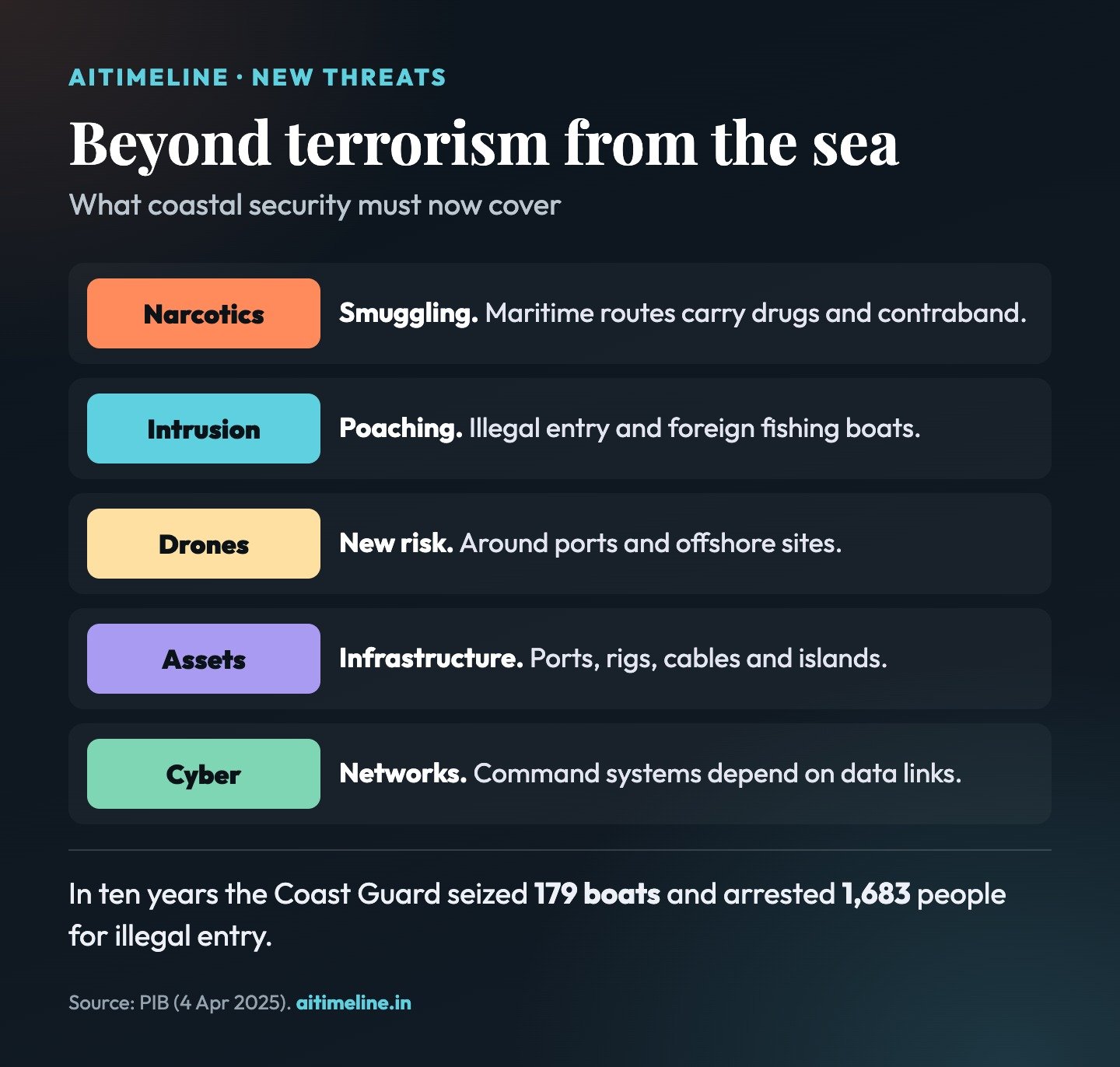
Six areas need continuous attention. Completion: radar Phase II and police Phase II are unfinished. Marine police capacity: trained crews, working boats and suitable jetties. Coordination: information must move between central forces, state police, ports and intelligence agencies. Small vessels: registering and tracking large numbers of fishing boats is hard. Community engagement: fishers need reporting channels that work. New technology: AI, drones and cyber systems need new skills.
Conclusion: A Continuous Maritime Mission
The 26/11 attacks showed that a maritime gap could become a national emergency on land. The response reorganised responsibility, built a layered network and created regular nationwide drills. The latest steps, including the NMDA contract, the radar expansion and Sea Vigil 26, show the work continuing.
No radar chain or patrol fleet can guarantee complete protection by itself. It takes working technology, trained people, fast intelligence sharing and cooperation with the communities that live and work along the coast.
Explore More Timelines
People Also Ask
Frequently Asked Questions
⚠️ Editorial Note
Figures come from PIB, the Ministry of Home Affairs and the Standing Committee on Defence. Some counts differ between official statements, notably Phase II police infrastructure and daily Coast Guard deployment, and we say so where it applies. We could not open the MHA annual report for 2023-24, and found no confirmed commissioning date for all four Joint Operations Centres or detail on Operation Swan’s scope. Sea Vigil 26 results were not public at the time of writing. This article is editorial information, not official policy or security advice.
Related Stories
Sources & further reading
Every dated entry above was checked against these references. Last reviewed 26 November 2026.
- Ministry of Home Affairs: Coastal Security Scheme
- Indian Coast Guard: Coastal Security
- PIB: Improvement in Coastal Security (4 Apr 2025)
- PIB: Indian Navy signs contract with BEL for NMDA project (8 Jul 2025)
- Standing Committee on Defence, Lok Sabha: Nineteenth Report, Demands for Grants 2026-27
- PIB: Indian Navy to coordinate Sea Vigil-26 (11 Nov 2026)
- PIB: Sea Vigil 24 concludes (22 Nov 2024)
- PIB: Parliament Question, Coastline of the Country (4 Dec 2025)
- Indian Navy: Two-Day Coastal Defence Exercise Sea Vigil Concludes (January 2019)
- Ministry of Home Affairs / PIB: Coastal police stations operationalised (December 2024)