UK Fiscal U-Turns: A Timeline of Policy Reversals Since 2016
Explore a decade of UK fiscal U-turns, from Brexit and austerity to COVID spending, the 2022 mini-budget reversal, tax changes and 2026 fiscal rules.
Latest Story
UK fiscal U-turns are the moments when a government reverses a tax, spending or borrowing policy it has recently announced. This timeline follows ten years of them, from the 2016 abandonment of the budget-surplus target, through austerity, the pandemic and the September 2022 mini-budget, to the October 2026 Budget. It also separates real reversals from the many policy shifts that only look like them.
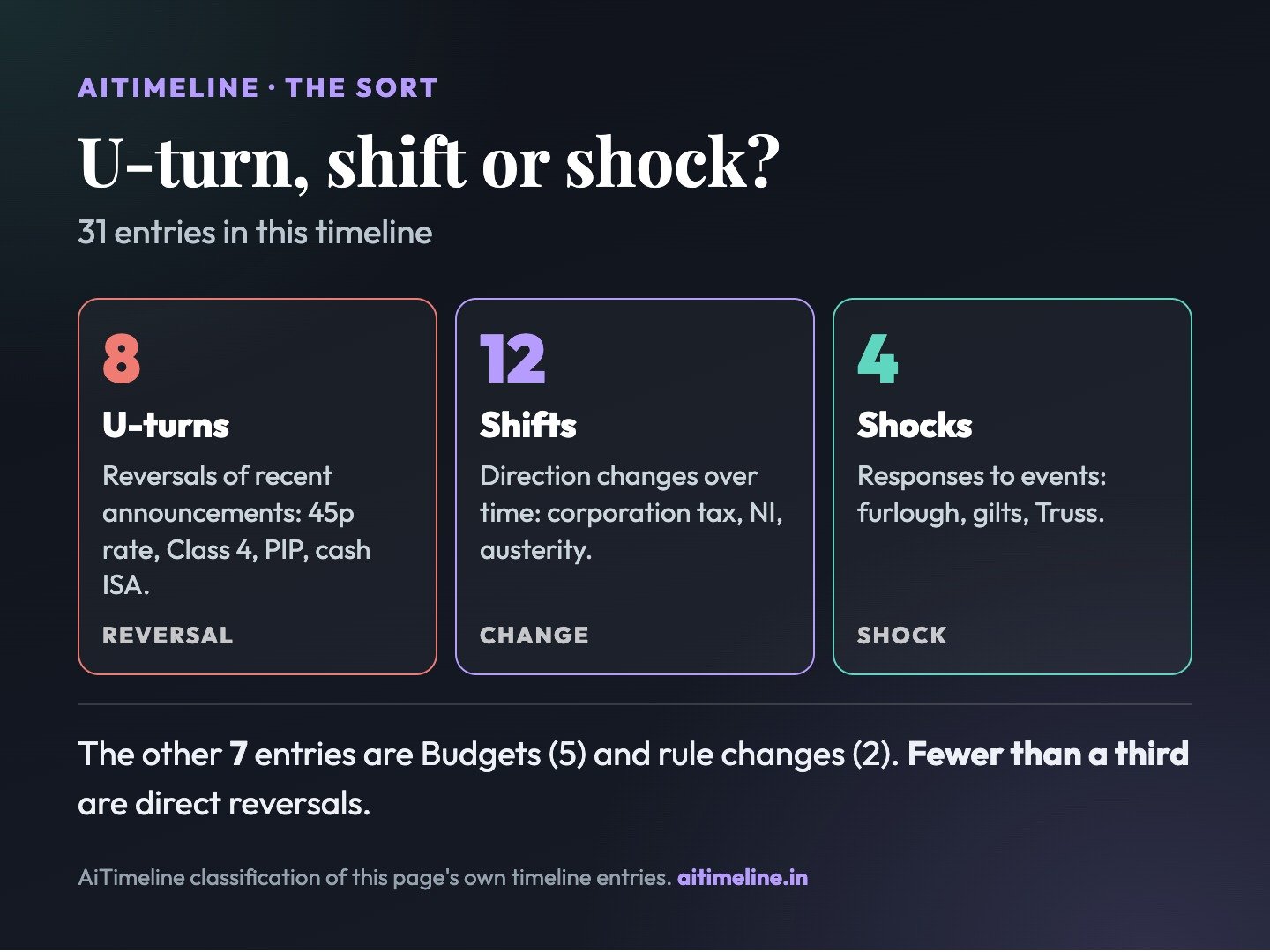
A U-turn reverses something recently announced. Of the 31 entries below, 8 are direct reversals. The rest are shifts of direction, responses to shocks, rule changes or Budgets. The £45bn mini-budget figure is the cost of the tax cuts as announced, not the amount implemented.
💡 Short Answer
The UK changed fiscal direction repeatedly between 2016 and 2026: it dropped the budget-surplus target in 2016, eased austerity in 2018-19, spent heavily in the pandemic, and in September 2022 announced about £45bn of tax cuts that were mostly reversed within weeks. Since then governments have cut and raised National Insurance, raised corporation tax to 25% and diluted welfare cuts. The 2026 Budget kept the fiscal rules but scrapped the planned cash ISA cut.
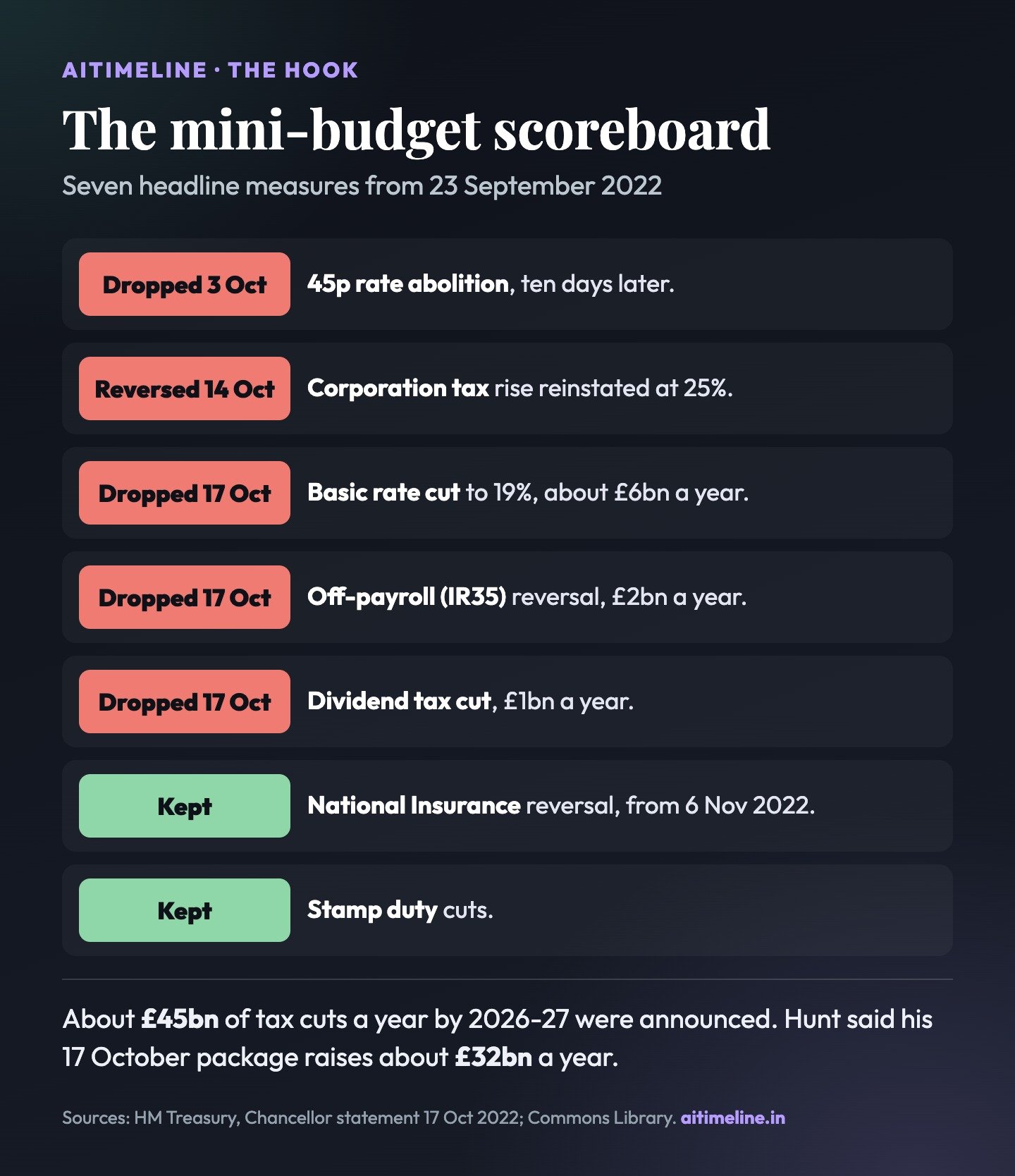
The Mini-Budget Scoreboard
Seven headline measures from 23 September 2022, and what became of each.
UK Fiscal U-Turns: Key Questions
What Ten Years of Reversals Show
- 8 of 31 entries are direct U-turns: the rest are shifts, shocks, rules or Budgets.
- The mini-budget lasted 24 days: from 23 September to Hunt’s statement on 17 October 2022.
- Two measures survived: the National Insurance reversal and the stamp duty cut.
- Corporation tax: the 17% plan was scrapped in 2020, the rate rose to 25% in 2023.
- 2016 and 2017 had U-turns too: the PIP cuts were withdrawn in five days, the Class 4 rise in one week.
- Welfare was diluted in 2025: 49 Labour MPs voted against the Bill at second reading.
- 2026 reversed one policy: the cash ISA cut. The framework stayed.
- Credibility is the constraint: the 2022 episode shows markets and the OBR set limits.
Timeline: UK Fiscal Reversals and Shifts, 2016 to 2026
Newest first. Labels mark U-turns, shifts, shocks, rules and Budgets.
After Budget 2026: the framework survives Budget
The position: Budget 2026 did not rewrite the fiscal rules. The OBR says both rules are met in 2029-30, by £15bn on the stability rule and £24bn on the investment rule, but gives only a 56% chance on the first and 54% on the second.
What to watch: Gilt yields, energy prices, inflation and receipts. The OBR says a one percentage point rise in rates could add £16bn to borrowing, more than the whole buffer.
OBR verdict: both fiscal rules met, narrowly Budget
The figures: The OBR’s central forecast meets the current-budget mandate for 2029-30 by £15bn (exactly £14.5bn) and the debt target, public sector net financial liabilities falling as a share of GDP, by £24bn (£24.4bn). The £15bn is £7bn lower than at Budget 2025.
The caveat: The OBR puts the chance of meeting the mandate at 56%. Receipts rise from 41.4% of GDP this year to 42.9% by 2031-32, and the tax-to-GDP ratio passes its previous record of 37.2% in 2027-28.
Healey scraps the cash ISA cut U-turn
What changed: Budget 2025 announced that the cash ISA limit would fall to £12,000 for under-65s from April 2027. Healey said he would not go ahead: the limit stays at £20,000 a year for people of all ages.
The replacement: He said the government would work with the sector on a new Starter ISA to reward first-time investors. It is the clearest direct U-turn of the 2026 Budget.
Selective tax rises, not a broad increase Shift
Banks: A temporary 3 percentage point rise in the bank surcharge, from 3% to 6%, from 1 January 2027 to 31 March 2028. The OBR estimates it raises £1.5bn over the 15 months, after some profit shifting.
Gambling and savings: Machine Games Duty rises from 20% to 25% for higher-stakes machines. Tax rates on property and savings income rise by a further two percentage points from April 2027, with no change to income tax on employment or dividends. The OBR puts the savings and property measure at about £1bn a year from 2028-29.
Energy support: VAT cut extended, £100 rebate Shift
What was announced: The cut in VAT on domestic electricity from 5% to 0%, due to end in April 2027, is extended to July 2027. A £100 payment goes to households in council tax bands A to D in England, costing £2.6bn this year. Gas standing charges are to be removed through Ofgem from next year.
Scope: The payment covers households in council tax bands A to D in England, and the VAT cut applies to domestic electricity, not all domestic energy. Some summaries describe both more broadly.
The 30-year gilt yield hits a 28-year high Shock
What happened: The 30-year gilt yield jumped 13 basis points to 6.036%, its highest since January 1998. The move came amid inflation and borrowing worries and oil above $100 a barrel.
Why it matters here: It is the context for the Budget’s tone: higher borrowing costs are one reason the OBR cut the margin from £23.6bn in March to about £15bn. Our companion story covers the gilt market in detail.
Reeves’s Budget: higher taxes, two-child limit scrapped Budget
The package: Tax rises worth about £26bn by 2029-30, extended threshold freezes and the abolition of the two-child limit on benefits from April 2026. ICAEW says the Budget lifted headroom from about £10bn to about £22bn. The tax burden rose to a post-war high.
The reversals: The Institute for Government lists reversals of earlier cuts to winter fuel payments and disability benefits among the Budget’s giveaways, alongside the scrapping of the two-child limit.
Welfare cuts diluted after a Labour rebellion U-turn
The concessions: On 27 June ministers said current Personal Independence Payment (PIP) claimants would not be affected. On 1 July, shortly before the vote, plans to tighten PIP eligibility were shelved until a review of the benefit.
The cost: The Bill passed second reading by 335 votes to 260, with 49 Labour MPs voting against. The IFS said the concessions cut projected savings by at least £1.5bn a year, and the Resolution Foundation said the package would make no net savings in 2029-30.
Spring Statement: welfare savings sought Shift
The plan: The government announced reforms to disability and health-related benefits, including tighter PIP eligibility and a cut in the health element of Universal Credit for new claimants, to save about £5bn a year by 2030.
The debate: Critics said the plans would hurt disabled people, and backbench opposition grew over the following three months.
Reeves’s first Budget raises taxes on employers and assets Shift
The measures: Employer National Insurance rises from 13.8% to 15% and its threshold falls from £9,100 to £5,000, from April 2025. Capital gains tax rates rise, VAT is applied to private school fees, the non-domicile regime is reformed and the Energy Profits Levy rises.
The context: Labour’s manifesto ruled out rises in income tax, employee National Insurance and VAT. The Budget reversed the direction of the Conservatives’ National Insurance cuts, but it is a change of government, not a reversal by the same one.
Employee National Insurance falls to 8% Shift
The cut: A further two percentage point cut in the main employee rate, from 10% to 8%. The main self-employed Class 4 rate falls from 9% to 6% from April 2024, after a one point cut in the Autumn Statement.
The direction: Two years earlier the rate had gone up. Within six months of Autumn Statement 2023 it had fallen by four percentage points.
Autumn Statement: employee National Insurance cut to 10% Shift
The cut: Jeremy Hunt cut the main employee rate from 12% to 10% from 6 January 2024. It followed the April 2022 rise and its November 2022 reversal.
The pattern: National Insurance went up, was reduced as part of the mini-budget unwind, then cut again in two stages.
Corporation tax reaches 25% Shift
The rate: The main corporation tax rate rose from 19% to 25% for companies with profits above £250,000. A 19% small profits rate applies below £50,000, with marginal relief in between.
The path: Announced in March 2021, confirmed in October 2021, cancelled in the September 2022 mini-budget, reinstated in October 2022 and implemented on schedule.
Autumn Statement: tax rises and spending restraint Budget
The package: Hunt announced a £55bn consolidation. Income tax and National Insurance thresholds stay frozen to April 2028, the additional rate threshold falls from £150,000 to £125,140, capital gains tax and dividend allowances are cut and the Energy Profits Levy rises to 35%.
The direction: This was the turn from rapid tax cutting to consolidation, and it came with an OBR forecast, which the mini-budget had lacked.
Truss resigns; the Autumn Statement date moves Shock
The leadership: Liz Truss resigned on 20 October after 49 days in office. Rishi Sunak became Prime Minister on 25 October and kept Jeremy Hunt as Chancellor.
The date: The medium-term fiscal plan had been due on 31 October. On 26 October the Treasury confirmed that the statement and OBR forecast would instead come on 17 November.
Hunt reverses most of the rest of the mini-budget U-turn
Dropped: The basic rate cut to 19% (about £6bn a year), the dividend tax cut (£1bn), the reversal of off-payroll (IR35) reforms (£2bn), the VAT-free shopping scheme for visitors (£2bn) and the alcohol duty freeze (£600m). The Energy Price Guarantee was cut short to April 2023.
Kept: The abolition of the Health and Social Care Levy, stamp duty changes, the higher Annual Investment Allowance and wider investment tax reforms. Hunt said the measures raised about £32bn a year.
Corporation tax rise reinstated; Kwarteng sacked U-turn
The reversal: Liz Truss said the planned increase in corporation tax to 25% would go ahead after all, reversing the mini-budget’s decision to keep the rate at 19%.
The Chancellor: Kwasi Kwarteng was replaced by Jeremy Hunt the same day.
The 45p rate abolition is dropped U-turn
The reversal: Kwasi Kwarteng announced that the government would not abolish the 45% additional rate of income tax. It was the first major reversal after the Growth Plan.
The reason: Conservative MPs had objected publicly, and the announcement did not calm markets.
Sterling slumps and the Bank of England steps in Shock
The reaction: Sterling fell to a record low against the US dollar on 26 September, and gilt yields rose sharply. Investors questioned how the tax cuts would be financed and why there was no OBR forecast.
The intervention: On 28 September the Bank of England announced temporary purchases of long-dated gilts, up to £65bn, to stabilise markets after pressure on pension funds using liability-driven strategies.
The mini-budget: the Growth Plan Shift
The announcements: Abolish the 45% additional rate, cut the basic rate to 19% from April 2023, cancel the corporation tax rise, reverse the National Insurance increase, repeal the off-payroll reforms, cut stamp duty and cut dividend tax rates.
The gap: There was no accompanying OBR forecast. The package was costed at about £45bn a year by 2026-27, which is the sum announced, not the amount ultimately implemented.
National Insurance rises 1.25 points Shift
The rise: National Insurance contributions rose by 1.25 percentage points for employees and employers to fund health and social care.
The reversal: The increase was reversed from 6 November 2022 as part of the mini-budget, and that reversal survived Hunt’s statement of 17 October.
Corporation tax: 19% to 25% Shift
The announcement: On 3 March 2021 Rishi Sunak announced that the main rate would rise to 25% from April 2023, with a small profits rate of 19%. The Autumn Budget of 27 October 2021 confirmed it.
Context: The 2016 plan to cut the rate to 17% had already been scrapped in March 2020, so the 2021 rise reversed the 2020 freeze rather than the original plan.
The Coronavirus Job Retention Scheme Shock
The scheme: The government said it would pay 80% of the wages of furloughed employees up to £2,500 a month. The priority moved from reducing borrowing to protecting jobs.
The scale: In November 2020 the OBR forecast borrowing of about £394bn for 2020-21, the highest in peacetime.
Sunak scraps the cut to 17% U-turn
The reversal: Rishi Sunak’s first Budget cancelled the planned cut in corporation tax from 19% to 17%. Estimates put the saving at about £6bn a year.
The context: It was also the first Budget to include coronavirus support measures, a week before the pandemic reshaped fiscal policy.
Spending Round ends the squeeze on departments Shift
The round: A one-year Spending Round set departmental budgets for 2020-21, with extra money for the NHS, schools, police and local government.
The shift: It confirmed the move away from the austerity-era approach announced the year before.
The NHS settlement and the end of austerity Shift
The NHS: On 17-18 June 2018 the Prime Minister announced an average real-terms funding increase of 3.4% a year for five years.
The Budget: Hammond’s 29 October Budget added money for public services, and the government said the era of austerity was coming to an end, subject to the economy and Brexit.
The first single autumn Budget Rules
The change: Autumn Budget 2017 was the first under the one-fiscal-event-a-year model announced in November 2016, with the Spring Statement reserved for updates.
The timetable: The Treasury published its paper on the new Budget timetable and tax policy process on 6 December 2017, after the Budget.
The National Insurance rise lasts a week U-turn
The reversal: A week after the Spring Budget, Hammond dropped the planned rise in Class 4 National Insurance, from 9% to 10% in April 2018 and 11% in April 2019. He said it breached a manifesto commitment not to raise National Insurance.
What stayed: The abolition of Class 2 contributions still went ahead from April 2018.
The surplus target is dropped Rules
The change: Philip Hammond said the government would no longer aim for a surplus in 2019-20. The OBR forecast a deficit of £21.9bn instead. The replacement mandate was a structural deficit below 2% of GDP in 2020-21.
The process: He also announced a single fiscal event each year, held in the autumn.
Osborne’s disability benefit cuts withdrawn U-turn
The sequence: George Osborne’s Budget of 16 March included changes to PIP. Iain Duncan Smith resigned as Work and Pensions Secretary on 18 March, calling the cuts, worth about £4bn, a compromise too far.
The reversal: On 21 March his successor Stephen Crabb told the Commons that the government would not go ahead with the PIP changes.
Budget 2016: corporation tax to 17% Budget
The plan: The Budget confirmed plans to cut corporation tax to 17% by April 2020, alongside changes to capital gains tax and business rates.
The context: The government was still pursuing deficit reduction. Three months later the Brexit vote changed the outlook.
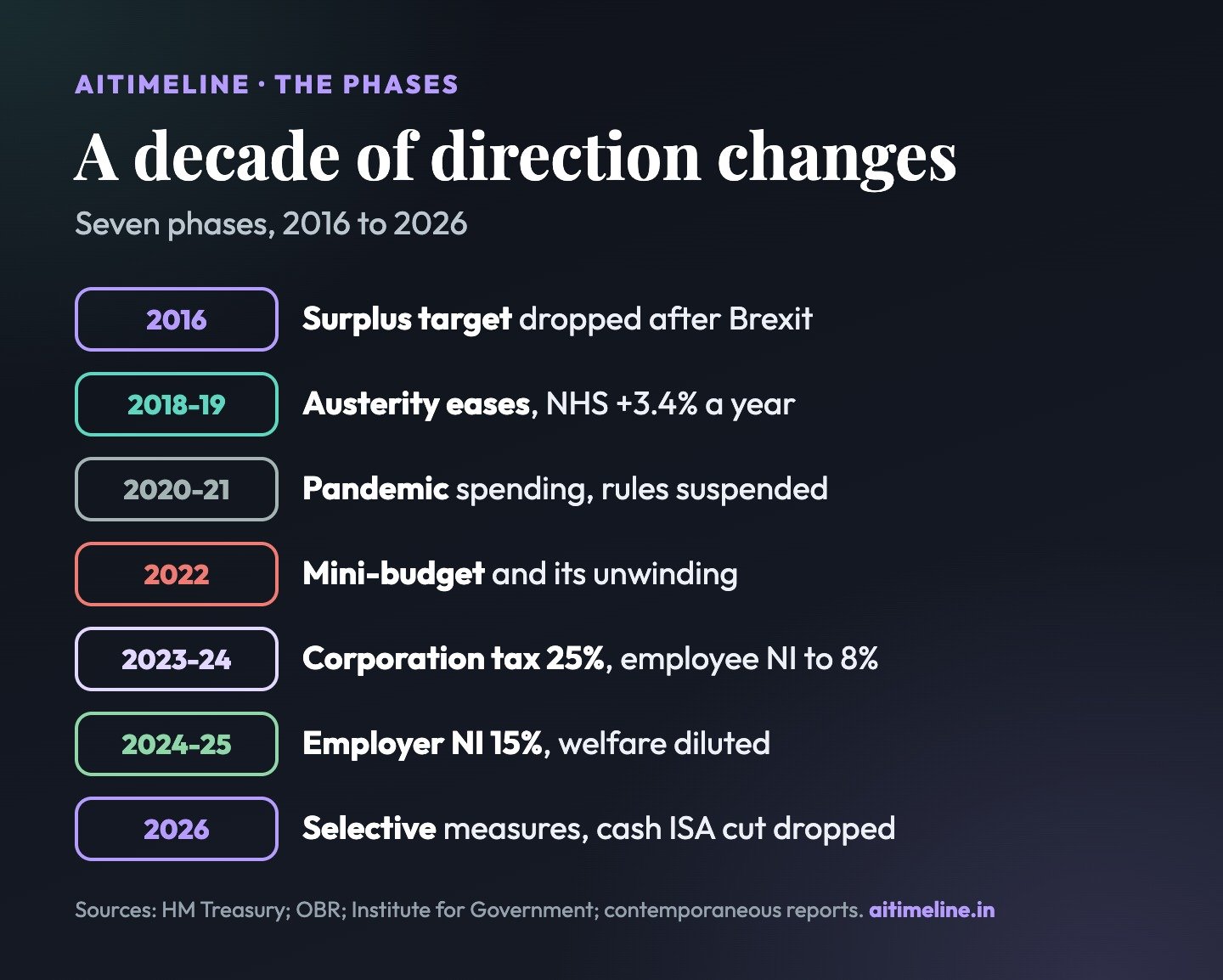
A Decade of Direction Changes
Seven phases, each with a different priority.
Corporation Tax: From 17% to 25%
The clearest example of a policy changing direction.
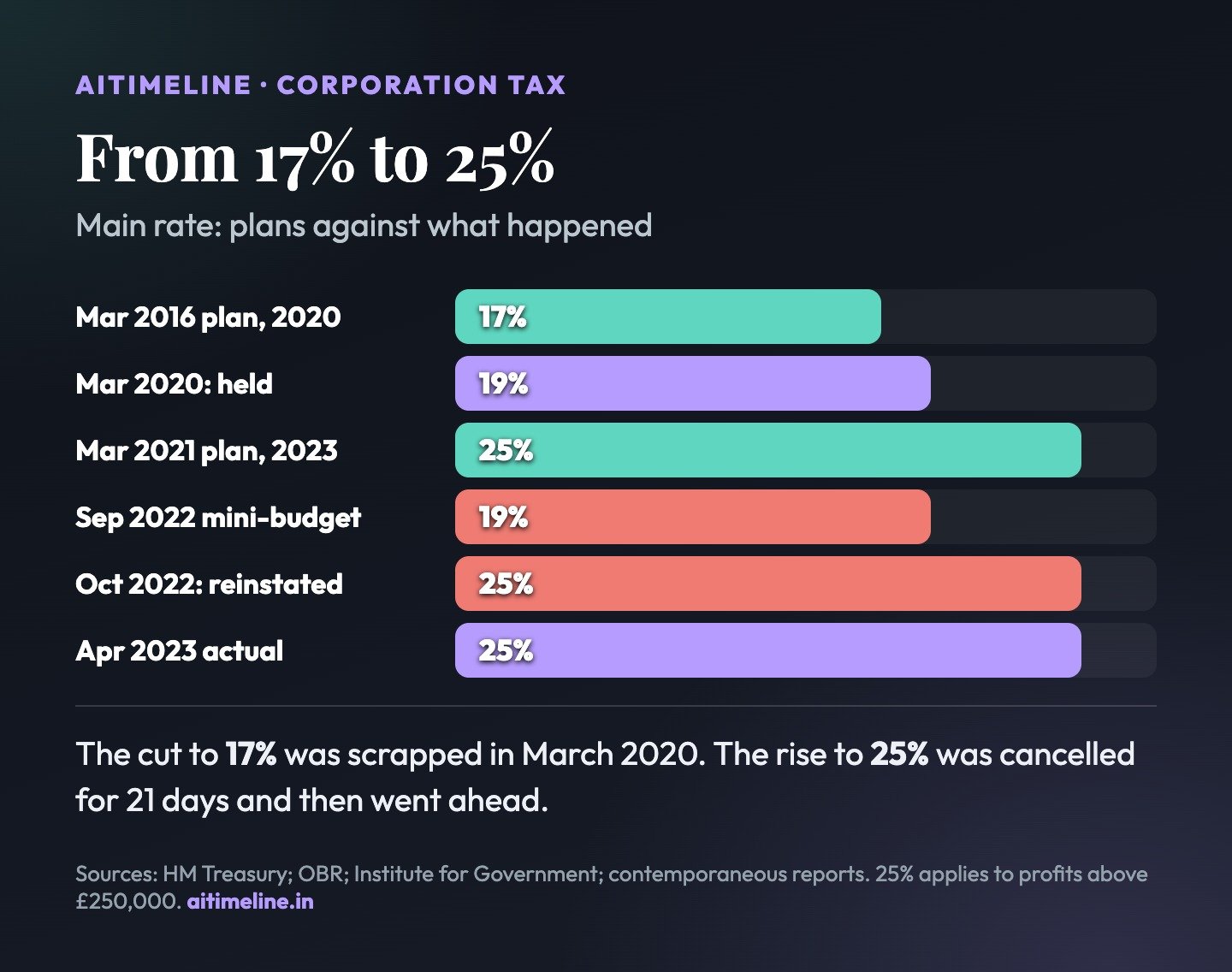
The 2016 Budget confirmed plans to cut the main rate to 17% by April 2020. Rishi Sunak scrapped that cut in March 2020 and announced the rise to 25% in March 2021, for profits above £250,000, with a 19% small profits rate. The mini-budget cancelled the rise, Liz Truss reinstated it on 14 October 2022, and the 25% rate took effect on 6 April 2023.
National Insurance: Up, Down, Then Up for Employers
Main rates by date, employees and employers.
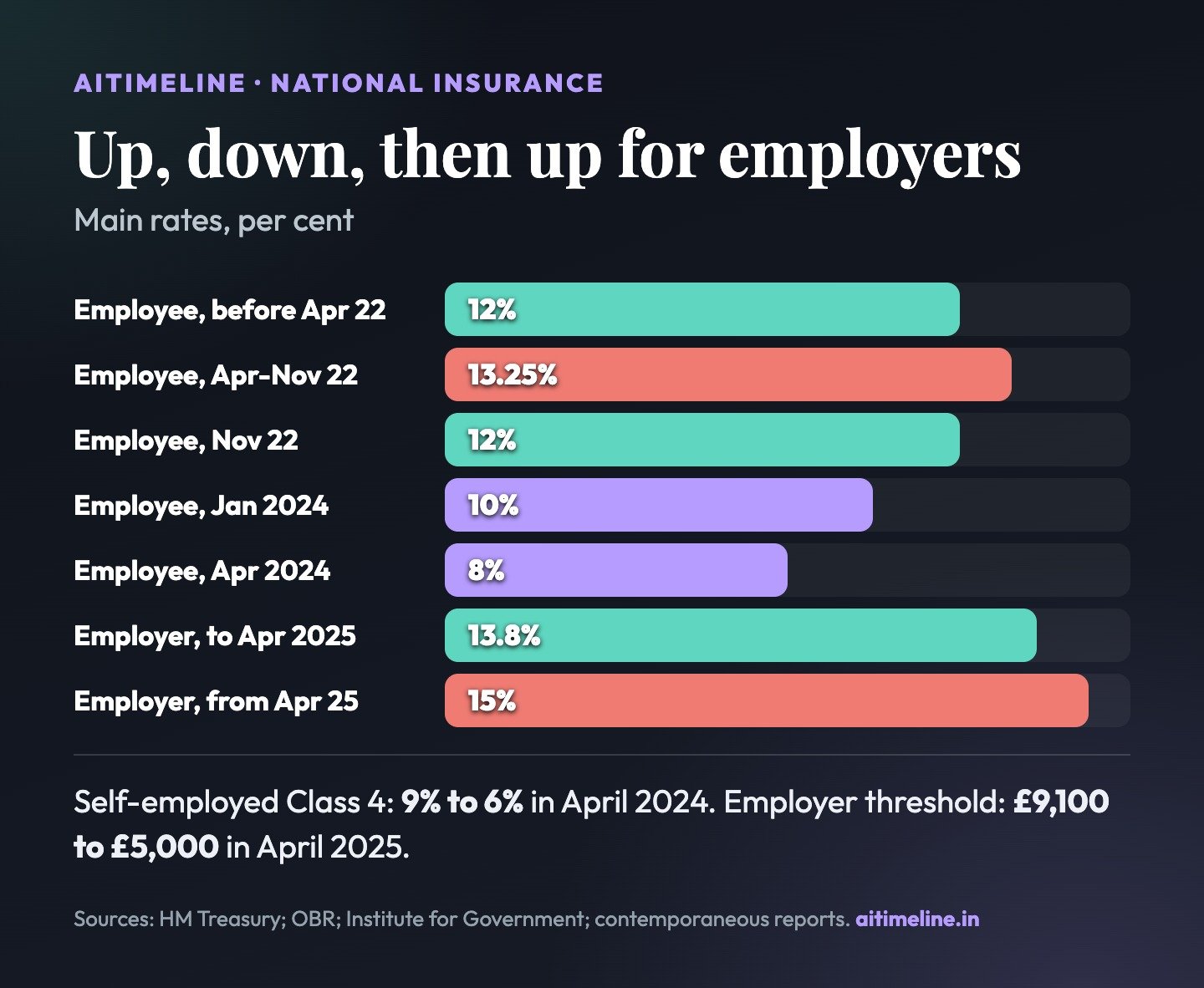
The April 2022 rise of 1.25 points funded health and social care and lasted seven months. Employee rates were then cut twice in 2024. The October 2024 Budget moved in the other direction for employers, raising the rate to 15% and lowering the threshold to £5,000 from April 2025. Different groups were affected differently: lower employee contributions raised take-home pay, while the employer changes raised payroll costs.
Welfare: Savings Sought, Then Softened
Three reversals, from 2016 to 2025.
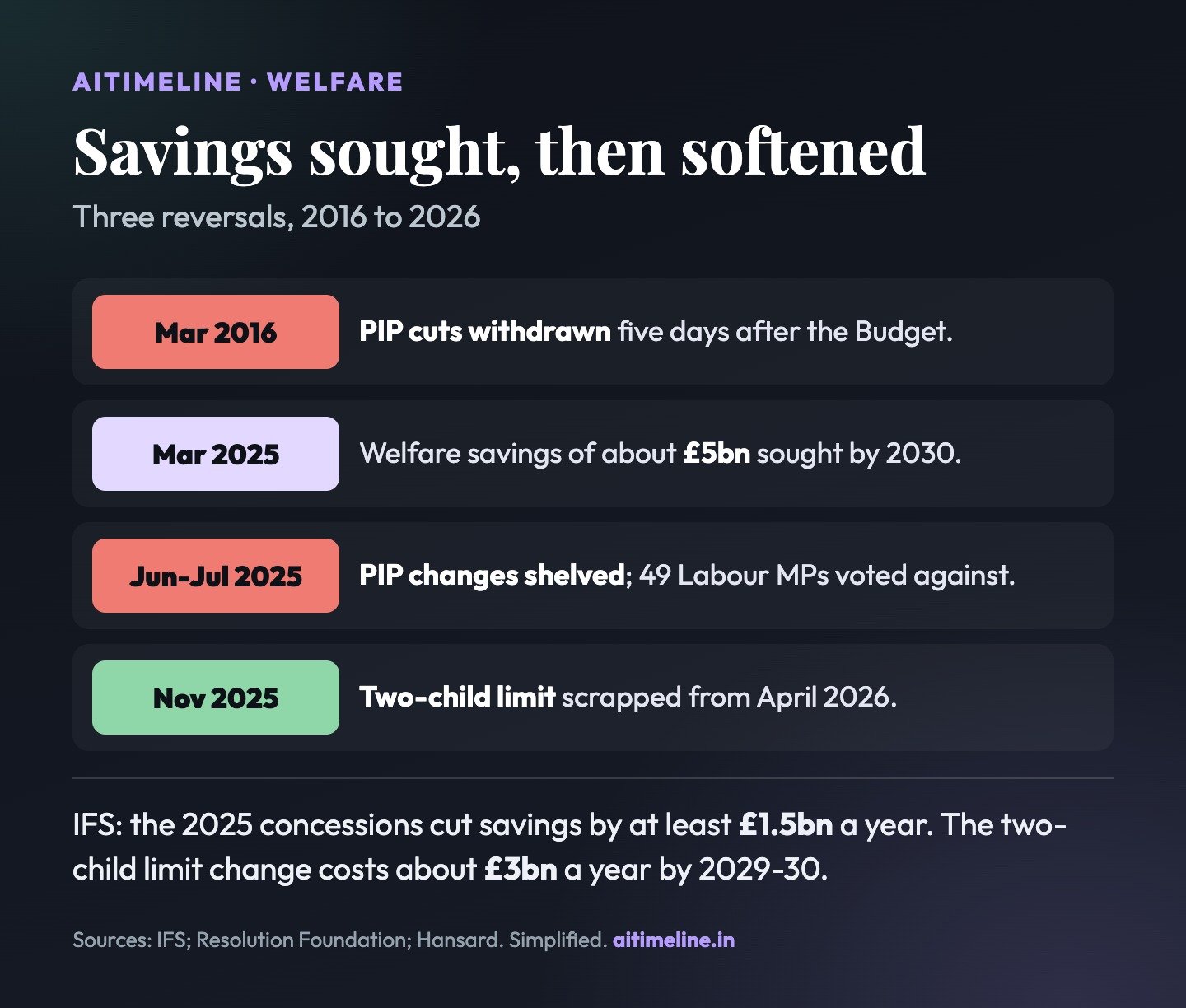
Disability benefits have been the site of two separate reversals. In 2016 the Treasury withdrew PIP changes after the Work and Pensions Secretary resigned. In 2025 ministers shelved tighter PIP eligibility until a review, and the IFS estimated the concessions cut projected savings by at least £1.5bn a year. The Budget of November 2025 then scrapped the two-child limit.
The Fiscal Rules Keep Changing
Targets for borrowing and debt, 2016 to 2026.
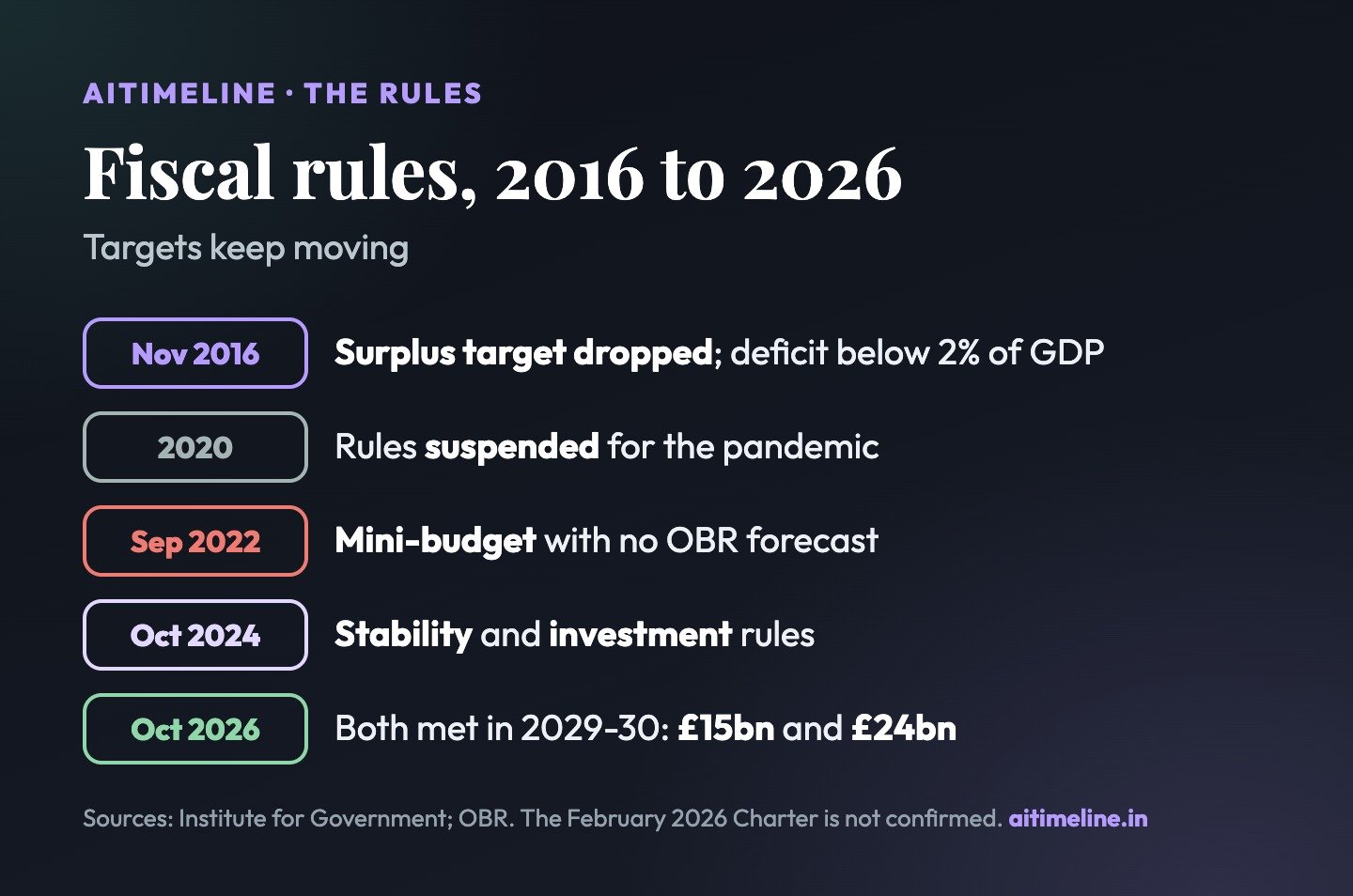
The current framework has a stability rule, which requires day-to-day spending to be covered by tax receipts in the third year of the forecast, and an investment rule, which requires public sector net financial liabilities to fall as a share of GDP. The OBR says both are met in 2029-30, with 56% and 54% probabilities. A revised Charter in February 2026 is reported in some summaries; this page has not confirmed it, and the Institute for Government describes the 2024 Charter as the current framework.
U-Turn, Shift or Shock?
The 31 timeline entries sorted by what actually happened.
Why Governments Reverse Fiscal Policy
Economic shocks: Brexit, the pandemic and the 2022 energy crisis forced plans to change. Market reaction: in 2022 the pound fell and gilt yields surged, and the Bank of England stepped in. Politics: in 2016, 2017 and 2025 backbench or Cabinet opposition forced reversals within days or weeks. Forecasts: the OBR’s revisions change how much room there is. New governments: a Chancellor can revise what a predecessor started.
Key Figures
| Measure | Figure |
|---|---|
| Corporation tax 2016 plan | 17% by 2020 |
| Corporation tax main rate from April 2023 | 25% |
| Mini-budget tax cuts announced, by 2026-27 | About £45bn |
| Hunt’s 17 October 2022 package | About £32bn a year |
| Autumn Statement 2022 consolidation | £55bn |
| Employee NI before Jan 2024 / from Apr 2024 | 12% / 8% |
| Employer NI from April 2025, threshold | 15%, £5,000 |
| Budget 2025 tax rises by 2029-30 | About £26bn |
| 2026 margin, stability / investment rule | £15bn / £24bn |
Conclusion: A Decade of Changing Priorities
From 2016 to 2026 the UK’s fiscal course changed repeatedly, through a referendum, a pandemic, an energy shock, two changes of governing party and several Chancellors. Some changes were reversals within days: the 2016 PIP cuts, the 2017 Class 4 rise, the 45p rate in 2022. Others were slower changes in direction, such as corporation tax rising from a planned 17% to 25%.
The mini-budget remains the sharpest example, because it combined large announced tax cuts, no independent forecast and a market response that forced reversal within weeks. The 2026 Budget kept the framework, which suggests the lesson was credibility rather than a particular tax rate.
Explore More Timelines
People Also Ask
Frequently Asked Questions
⚠️ Editorial Note
Figures come from HM Treasury, the OBR, the Institute for Government and contemporaneous reporting. We corrected several details found in earlier summaries: the 2017 Budget was on 22 November, the NHS settlement was announced in June 2018, the 17% corporation tax cut was scrapped in March 2020, and the 2026 energy support covers electricity VAT and a payment for council tax bands A to D in England. The February 2026 Charter is not confirmed. This article is editorial information, not financial advice.
Related Stories
Sources & further reading
Every dated entry above was checked against these references. Last reviewed 26 November 2026.
- HM Treasury: Chancellor's statement, 17 October 2022
- Office for Budget Responsibility: Economic and fiscal outlook, October 2026
- HM Treasury: Budget 2026 speech
- Deloitte: Retaining the cash ISA limit at 20,000 (Budget 2026)
- Institute for Government: Autumn Budget 2025, Rachel Reeves's announcements
- Institute for Government: Current UK fiscal rules
- Al Jazeera: UK government backs down on disability benefit cuts after rebellion (27 Jun 2025)
- HM Treasury: Corporation tax main rate at 19% in 2020 (March 2020)
- HM Treasury: Autumn Statement 2016, Philip Hammond's speech
- Office for Budget Responsibility: Overview of the November 2016 Economic and fiscal outlook
- HM Treasury: The new Budget timetable and the tax policy making process
- Prime Minister sets out 5-year NHS funding plan (June 2018)