US Presidential Primaries: How Nominations Moved from Party Bosses to Voters
Explore the history of US presidential primaries, from party conventions and the 1968 reforms to Super Tuesday, delegates and modern elections.
Latest Story
US presidential primaries are the state contests that decide how many delegates each candidate takes to a party’s national convention. For most of the 19th century and the early 20th, party leaders chose nominees at those conventions, and voters had little say. Progressive Era reformers began adding primaries from 1901, but the decisive break came after the 1968 Democratic convention in Chicago, when new rules put primary and caucus voters in charge of most delegates. This page traces that shift, from the first conventions to the Democratic calendar set for 2028, and flags where the sources disagree.
A primary picks a party’s nominee, not the president. Each party writes its own rules and states run most contests, so the Democratic and Republican systems differ. The Electoral College, not the primaries, decides the presidency. And a primary win has not always meant the nomination: Roosevelt in 1912 and Kefauver in 1952 won the voters and lost the convention.
💡 Short Answer
US presidential primaries began as Progressive Era reforms in Florida in 1901 and Wisconsin in 1905, but party leaders still controlled most nominations until 1968. After the violent Chicago convention, Democrats adopted the McGovern-Fraser reforms, which moved delegate selection to primary and caucus voters. Today each party sets its own delegate rules, states run most contests, and the Electoral College, not the primaries, elects the president.
The Lead Picture: Key Dates, 1901 to 2028
Ten dates in order.
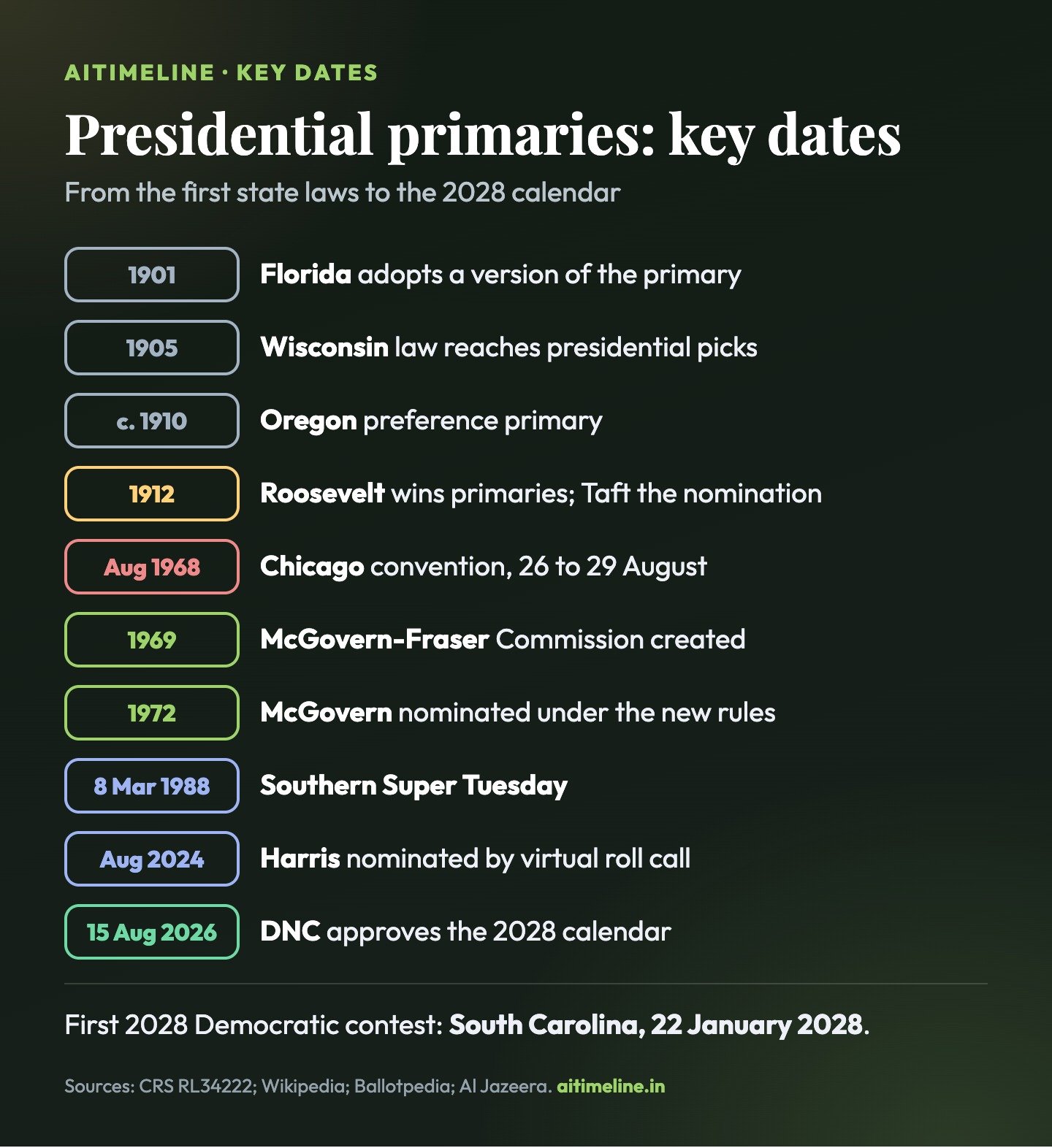
US Presidential Primaries: Key Questions
What the Record Shows
- Conventions came first: national nominating conventions began in 1831 and 1832, and party leaders steered them.
- Reform started early: Florida in 1901, Wisconsin in 1905 and Oregon around 1910 added primaries, but conventions still decided.
- Winning votes was not enough: Roosevelt in 1912 and Kefauver in 1952 won primaries and lost the nomination.
- 1968 was the break: Johnson quit, Robert Kennedy was shot and Humphrey won the nomination at a convention marked by clashes.
- The rules changed in 1969-72: the McGovern-Fraser Commission moved power to primary and caucus voters.
- Primaries multiplied: Democratic primary states rose from 15 in 1968 to 40 by 2000, per CRS.
- The calendar is a fight: front-loading, Super Tuesday and early-state influence keep recurring.
- Superdelegates are restricted: they cannot generally vote on the first ballot unless a candidate has a pledged majority.
- The 2028 map is set for Democrats: South Carolina first on 22 January, New Hampshire’s law still clashes.
Timeline: US Presidential Primaries, 1831 to 2026
Newest first. Labels mark background, state laws, party rules, contests, conventions and today.
Where the system stands on 29 November 2026 Today
What is in force: Each party writes its own delegate-selection rules, and state law decides how most primaries are run. The next presidential contests are in 2028; the Democratic early-state lineup is set (see the 15 August 2026 entry).
What we did not check: We did not verify the Republican National Committee’s 2028 delegate rules or calendar, so this page makes no claim about them.
Open questions: Whether early states keep outsized influence, whether more states open their primaries, how parties weigh leaders against voters, and how easy it is for working people to take part.
The full DNC approves the 2028 early-state calendar Party rules
The lineup: South Carolina votes first on 22 January 2028, then Nevada on 1 February, New Hampshire on 8 February, New Mexico on 15 February, Michigan on 22 February and Virginia on 29 February (Ballotpedia, Al Jazeera).
Who lost the early slot: Iowa Democrats, whose caucus opened the Democratic calendar from 1972 to 2020, are not in the early window. The DNC’s Rules and Bylaws Committee said the new lineup was the most diverse early window in party history.
The New Hampshire problem: New Hampshire law requires its primary to be held at least seven days before any other primary. The state’s Democratic chair said the committee vote does not change the realities governing its primary.
The Rules and Bylaws Committee picks six early states Party rules
The process: The committee adopted selection criteria in October 2025: rigorousness, fairness and efficiency. It then voted on 24 July 2026 to choose six states.
Who applied and lost: Delaware, Georgia, Illinois, Iowa, Tennessee and North Carolina applied but were not selected.
Penalties: In June 2026 the committee raised penalties for unsanctioned early primaries: a state can lose delegates, candidates who take part can be barred from DNC debates, and the state can be fined $270,000 (Ballotpedia).
Haley exits, Biden withdraws, Harris is nominated by roll call Contest
Republicans: Donald Trump won most early contests and Nikki Haley suspended her campaign on 6 March 2024, having won only Vermont and Washington, D.C. She was the first woman to win a Republican presidential primary contest, in D.C. on 3 March.
Democrats: Joe Biden became the presumptive nominee on 12 March 2024, then withdrew on 21 July. Kamala Harris was nominated through a virtual roll call held from 1 to 5 August, ahead of the party’s August convention.
What it showed: Party rules, not primaries alone, set the path when an unexpected event changes a race.
Biden recovers in South Carolina, then COVID-19 hits the calendar Contest
The race: Joe Biden’s strong South Carolina result and his Super Tuesday wins consolidated support in a large Democratic field that included Bernie Sanders, Elizabeth Warren and Pete Buttigieg.
The pandemic: Several states postponed their contests and election officials widened early voting and absentee options. The cycle showed how much voting rules matter in an emergency.
Superdelegates become a flashpoint, then are restricted Party rules
2016: Donald Trump won the Republican nomination from a large field including Ted Cruz, Marco Rubio and John Kasich. Hillary Clinton beat Bernie Sanders on the Democratic side.
The reform: Sanders supporters criticised unpledged superdelegates. A DNC reform commission worked in 2016-17, and in 2018 the party barred superdelegates from voting on the first ballot unless a candidate already has a pledged-delegate majority (Wikipedia, citing DNC rules).
A later change: For 2024 the DNC adopted rules letting superdelegates take part in a virtual roll call even without a pledged majority.
Both parties try to slow front-loading Party rules
What the rules said: The two national parties cooperated on a calendar that discouraged states from voting before the first Tuesday in March, with exemptions for four early states (CRS).
Defiance: Florida set a primary for 31 January 2012 against Republican rules, which led South Carolina and Nevada to schedule early events too. States that broke the rules faced delegate penalties.
Obama and Clinton fight to the last primaries Contest
The race: Barack Obama built a delegate lead over Hillary Clinton through state wins, caucus organisation and fundraising. The role of superdelegates became a major issue.
The penalty fight: The DNC stripped Florida of its delegates on 25 August 2007 for holding a January primary, and Michigan forfeited its delegates for the same reason. On 31 May 2008 the party agreed to seat both delegations with half a vote each; full voting rights were restored at the convention (CRS).
Southern Super Tuesday Contest
The idea: States in the South organised a joint March primary to boost the region’s voice. Attempts to set up regional primaries elsewhere in the 1970s failed.
The result: The event did not strengthen the South’s role in the way its backers hoped, and by 1996 seven states had left it. But the multi-state primary day stayed, and later calendars still centre on Super Tuesday.
Superdelegates debut Party rules
The change: The 1984 Democratic convention was the first to include superdelegates: automatic, unpledged delegates who need not declare a candidate preference (CRS).
Why: They were added in response to rule changes that had sharply reduced the influence of party leaders and officeholders. CRS says the party added them after Jimmy Carter’s 1980 defeat as a counterbalance to rank-and-file voters.
Ford edges Reagan at the Kansas City convention Convention
The contest: President Gerald Ford faced former California Governor Ronald Reagan through state primaries and caucuses. Neither had a clear majority going into the convention.
The outcome: Ford won the nomination on the first ballot, 1,187 to 1,070 delegates.
McGovern wins the first nomination under the new rules Contest
The shift: McGovern won the first nomination decided under the reformed Democratic rules, in which primary and caucus results chose most convention delegates.
The reach: Many states switched to primaries to comply with the new national party rules, and Republicans also changed their rules in the early 1970s. The number of states with Democratic primaries rose from 15 in 1968 to 40 by 2000 (CRS).
The McGovern-Fraser Commission rewrites the rules Party rules
Why: The 1968 convention left the party in disarray, divided over substance and procedure.
What it asked for: More open and public delegate-selection procedures, wider participation by ordinary members, and better representation of women, minorities and young people.
Who led it: Senator George McGovern chaired it, followed by Representative Donald Fraser. The report was written in under nine months.
Chicago: a convention in the streets Convention
Inside: Delegates nominated Vice President Hubert Humphrey, who had entered the race in April and carried no primary state. Eugene McCarthy and George McGovern were also candidates.
Outside: Around 10,000 protesters gathered in Grant Park on 28 August, and police clashed with demonstrators. Protesters chanted ‘the whole world is watching’ as police dragged some across Michigan Avenue.
The charge: Critics said party insiders overrode voters. CRS says the confrontations and credentials disputes ‘spurred Democrats to completely change the party’s nominating rules’.
Johnson withdraws; Robert Kennedy is shot Contest
The challenge: Eugene McCarthy’s strong New Hampshire showing exposed anti-war feeling inside the Democratic Party. President Lyndon Johnson announced on 31 March that he would not seek renomination.
Kennedy: Senator Robert F. Kennedy entered the race and won the California and South Dakota primaries on 4 June. He was shot at the Ambassador Hotel in Los Angeles on 5 June and died the next day, about 25 hours later.
Kennedy uses Wisconsin and West Virginia to prove he can win Contest
The argument: John F. Kennedy used selected primaries to show party leaders he could win, including in states with large Protestant populations, where his Catholicism was an issue.
The limit: His nomination still depended on delegations and party leaders. Primaries and traditional party influence worked together.
Kefauver wins the primaries; Stevenson wins the nomination Contest
The upset: Estes Kefauver beat President Harry Truman in New Hampshire and won 12 primaries by Wikipedia’s tally, with 64.6 percent of the primary vote.
The convention: The Democratic convention nominated Adlai Stevenson, who had not run in the primaries. On the Republican side Dwight Eisenhower defeated Robert Taft.
Between the wars: After the First World War the Progressive movement faded, several states dropped their primaries, and party leaders kept control (CRS).
Roosevelt wins the primaries; Taft keeps the nomination Contest
The result: Former President Theodore Roosevelt won about 51.5 percent of the Republican primary vote against President William Howard Taft, by Wikipedia’s tally.
Why it failed: Taft used the support of southern delegates, 83 percent of whom voted for him, to win the nomination at the convention (Wikipedia). Roosevelt then ran as a Progressive.
By 1916: At least 20 states had a presidential primary in some form (CRS).
Oregon creates the presidential preference primary State law
What it did: Oregon became the first state to create a presidential preference primary, which requires delegates to support the winner at the national convention (Wikipedia).
A caution: Sources differ on the exact year Oregon’s law was approved; 1910 is the date most give.
Wisconsin’s law reaches presidential nominations State law
The step: CRS says Wisconsin’s 1905 law was the first to provide for the primary in presidential nominations. Wikipedia describes it as the first to eliminate the caucus and mandate direct selection of national convention delegates.
Florida adopts an early primary State law
The step: Florida was the first state to adopt a version of the primary in 1901. The brief called it an early presidential primary law; the CRS wording is narrower, and we follow CRS.
National conventions replace congressional caucuses Background
The start: The Anti-Masonic Party held an early national nominating convention in 1831, and the Democrats followed in 1832. State delegations then chose nominees, but party leaders, alliances and regional organisations steered the outcome.
The problem: Ordinary voters had little direct control, which fed the reform movement that later produced primaries.
From Party Bosses to Voters
Who chose the nominee, and when.
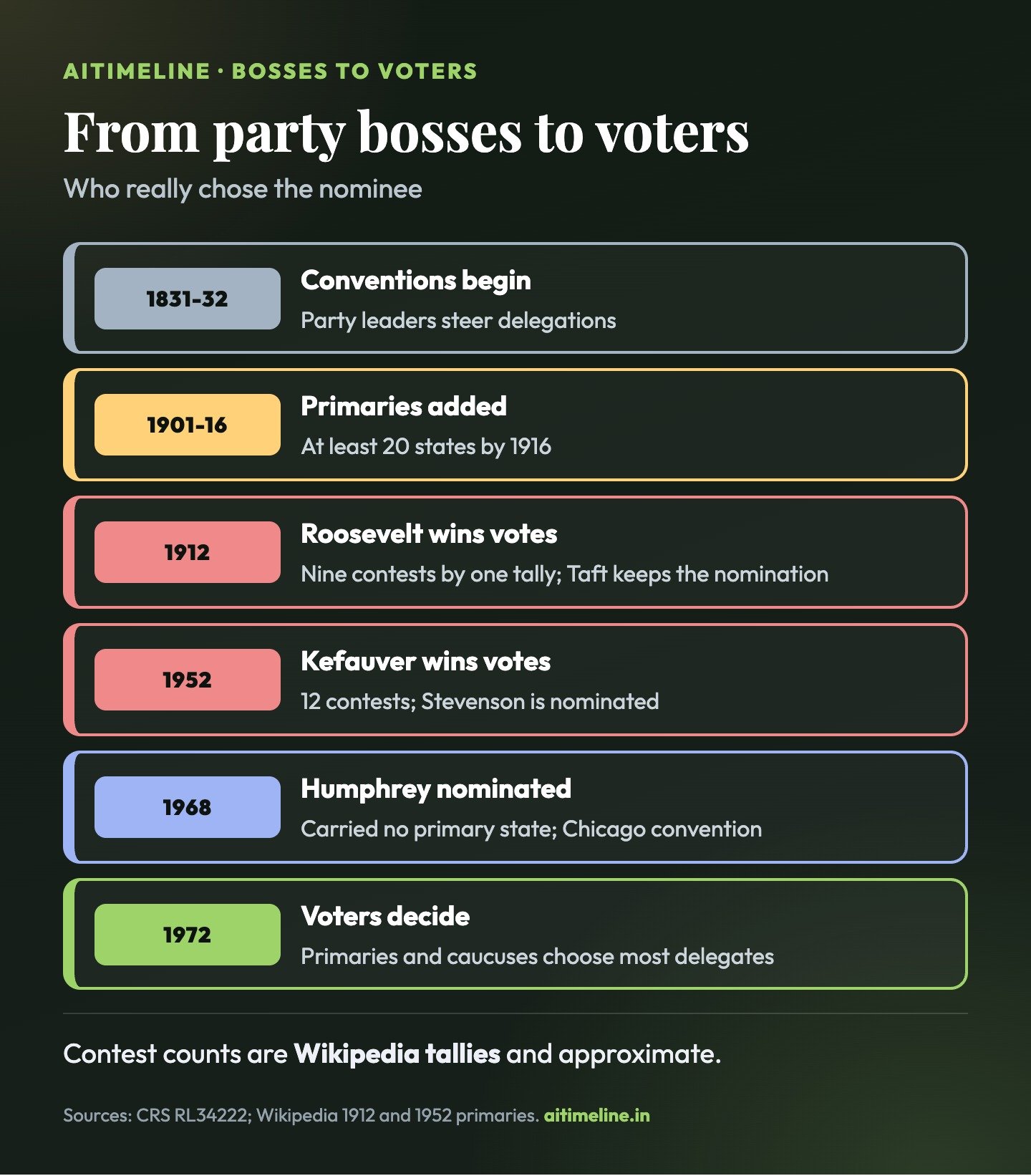
Counts of 1912 and 1952 contests come from Wikipedia’s tallies, which sources define differently, so treat them as approximate. The shared lesson holds: before 1968, primary results often did not bind convention delegates.
1968 and the Road to Reform
Five steps, 1968 to 1972.
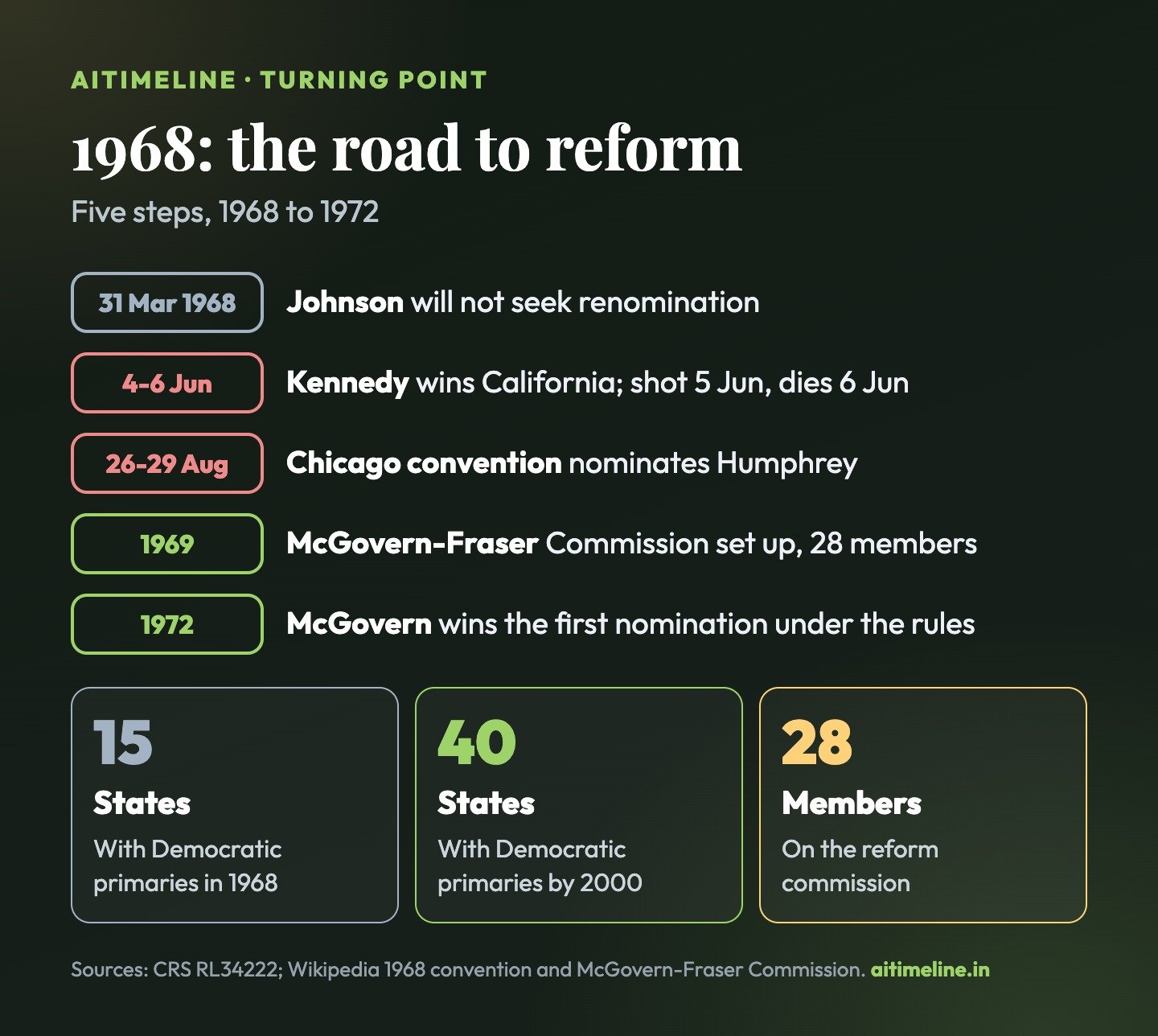
The Congressional Research Service says the Chicago confrontations and credentials disputes spurred Democrats to change their nominating rules completely, moving the power to choose delegates from party leaders to rank-and-file voters.
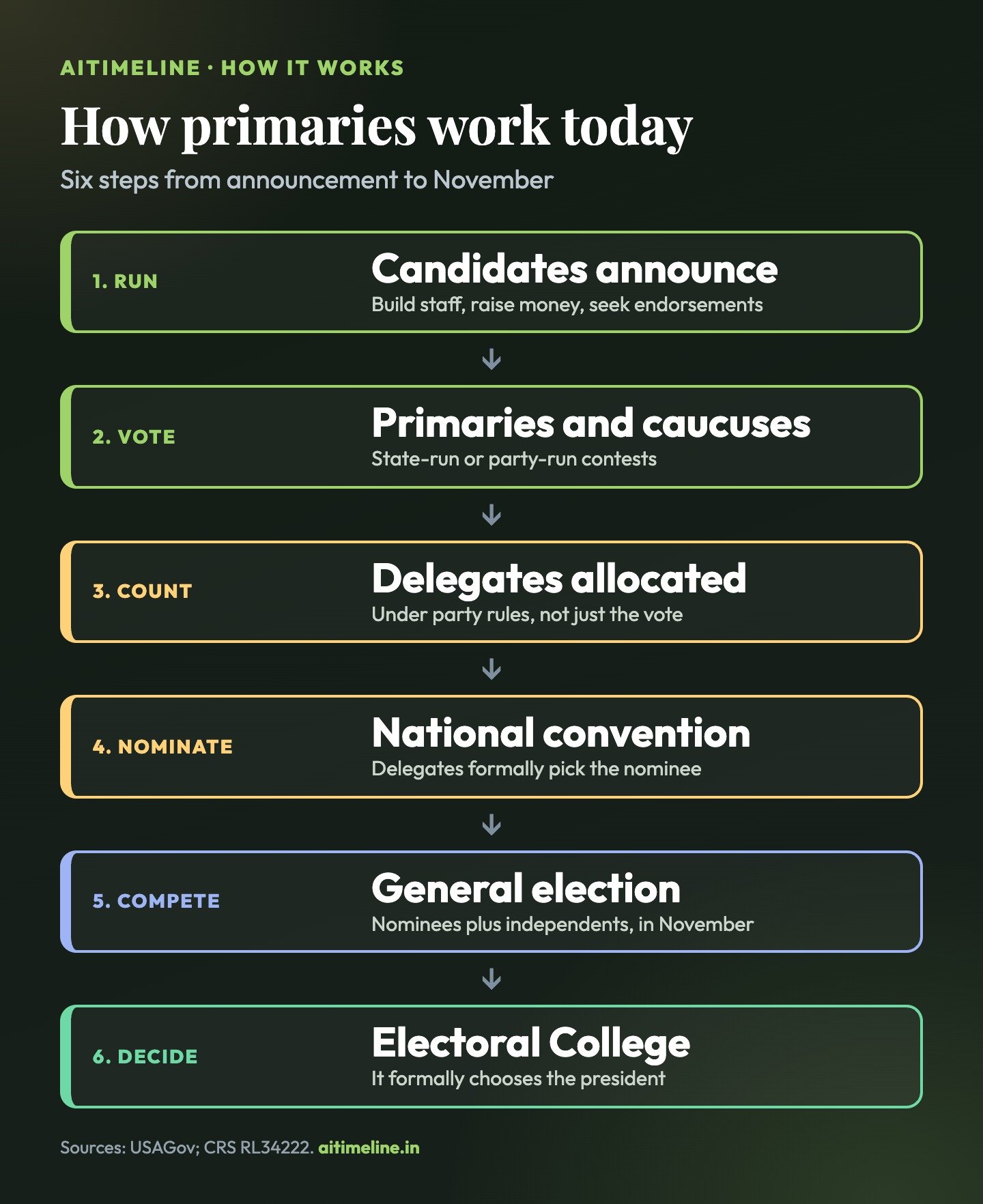
How the Modern System Works
Six steps from announcement to November.
| Feature | Primary | Caucus |
|---|---|---|
| Format | Election using ballots | Party meeting or gathering |
| Run by | State or party | Generally the party |
| Voting | Usually a secret ballot | May involve public grouping, discussion or a secret ballot |
| Access | Often easier for voters | Can require time and attendance at a set hour |
| Output | Delegates under party rules | Delegates under party selection rules |
Open primaries let voters choose which party’s contest to join, subject to state rules. Closed primaries admit only registered party members. Semi-closed systems admit some unaffiliated voters. Rules differ by state and party.
Primary vs General Election
Two different contests with different rules.
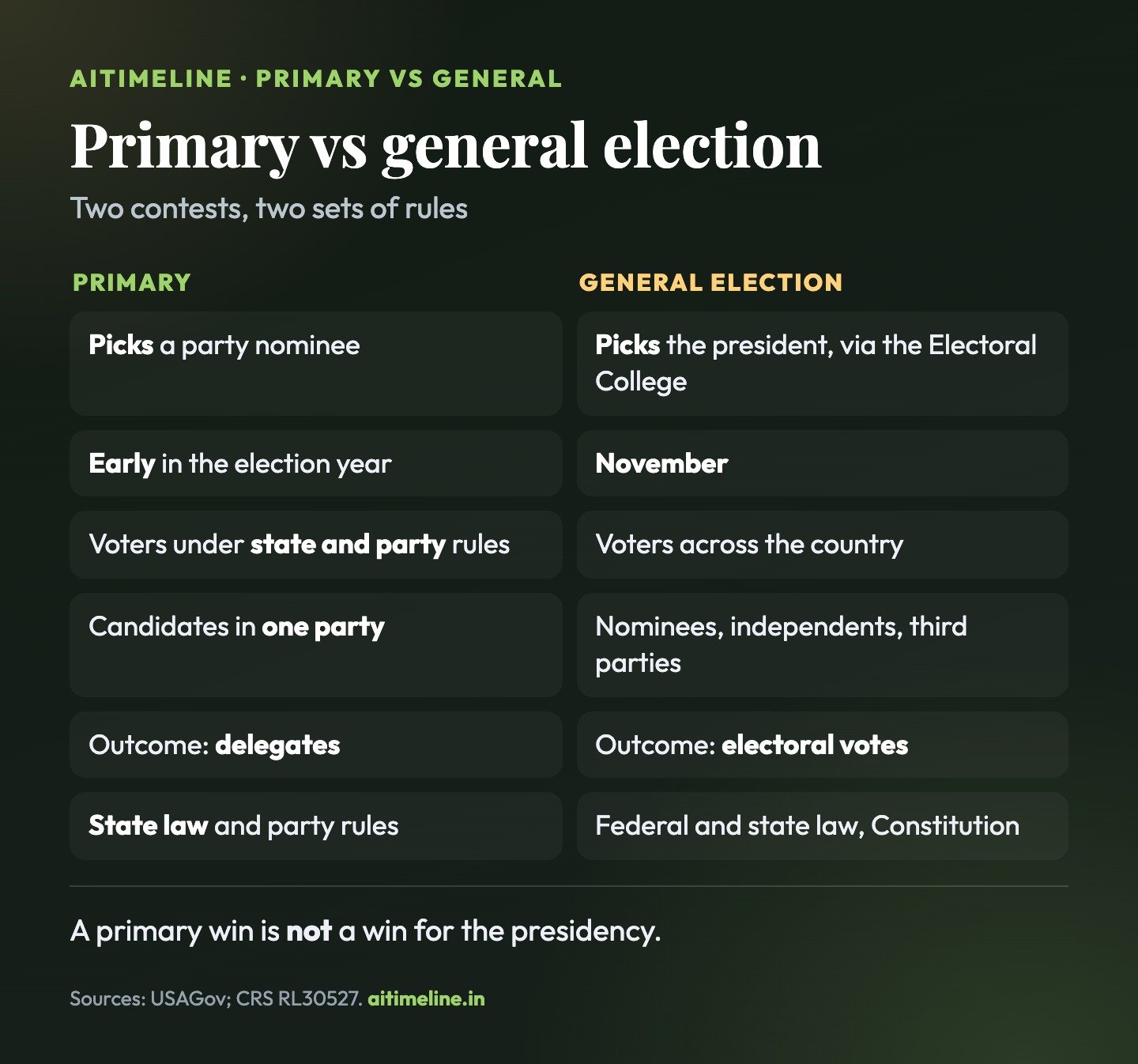
The national popular vote and the Electoral College vote are separate parts of the presidential system. The primary process decides who reaches the general election; the general election decides who gets the Electoral College votes.
Delegates and Superdelegates
Who casts the convention votes.
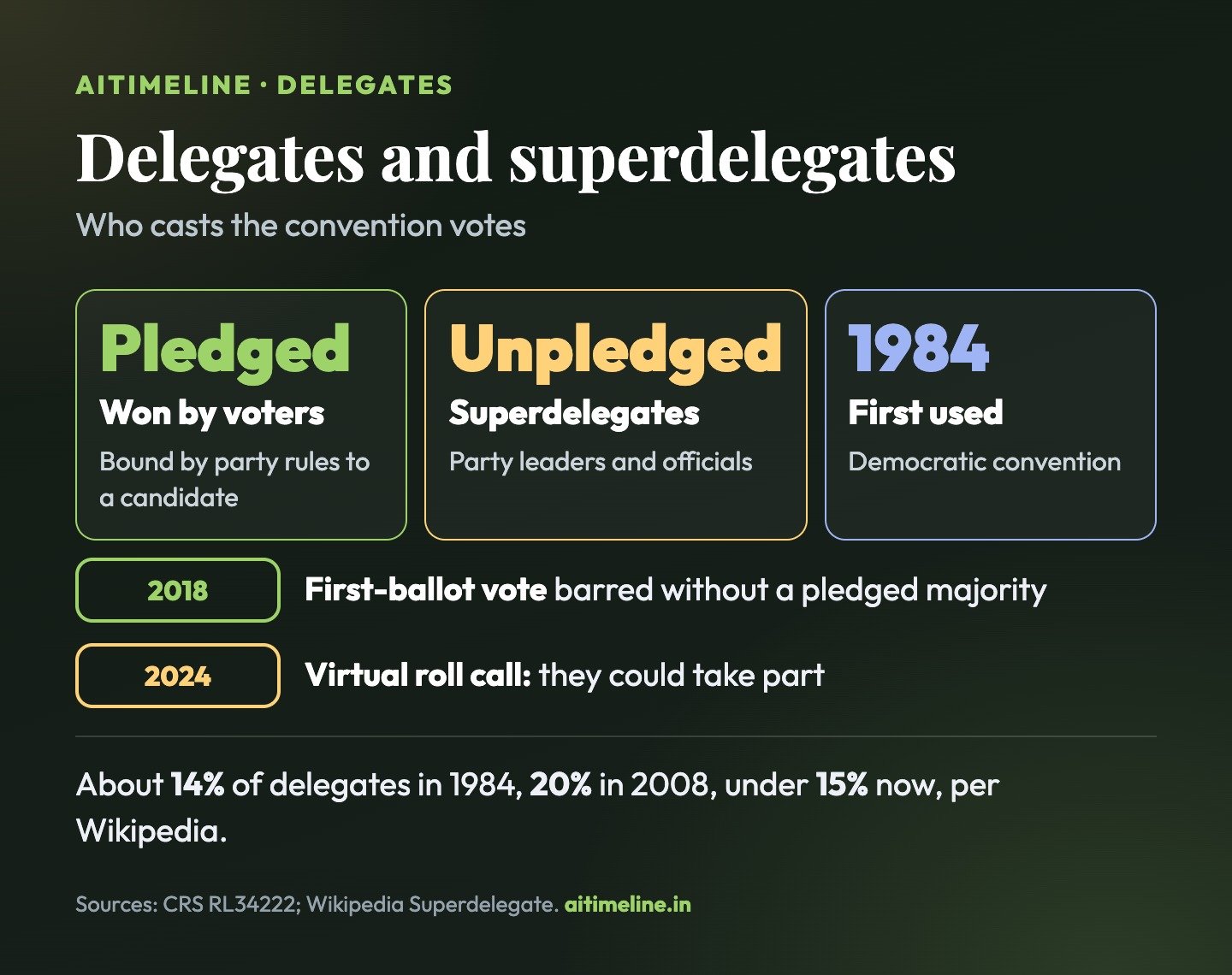
Sources give different shares of superdelegates over time. Wikipedia reports about 14 percent in 1984, about 20 percent in 2008 and slightly under 15 percent now; we use those as approximate and attributed.
The Calendar: Super Tuesday to 2028
How the order of states became a fight.
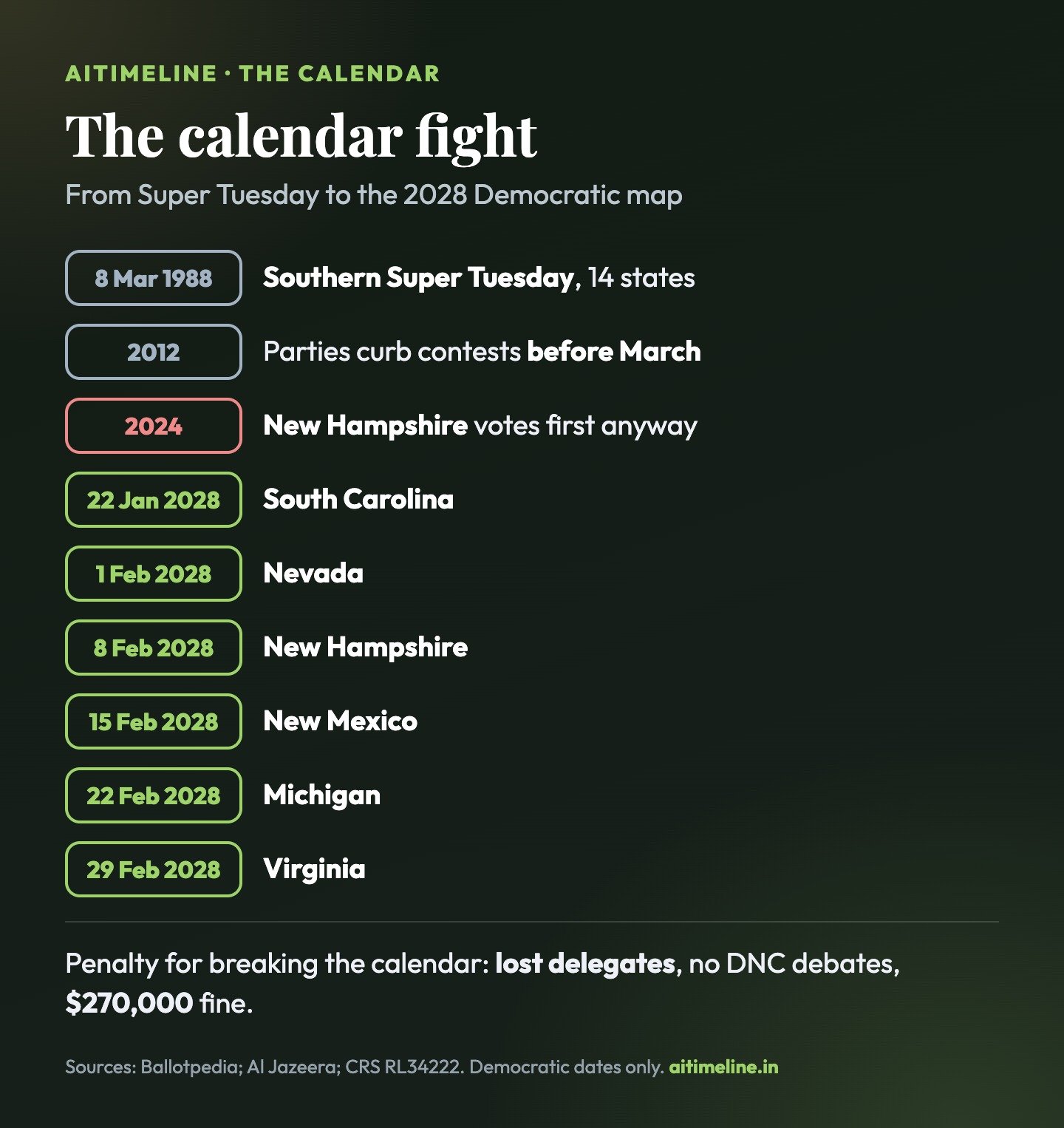
The 2028 dates are Democratic only. Dates for the Republican National Committee were not checked for this page and may differ.
Source Gaps and Corrections
| Claim in the brief | What we found | Status |
|---|---|---|
| Florida adopts an early presidential primary law, 1901 | CRS says Florida adopted a version of the primary; Wikipedia calls it the first presidential primary | Worded narrowly |
| Robert Kennedy assassinated on 5 June 1968 | Shot on 5 June, died on 6 June, about 25 hours later | Corrected |
| Harris nominated following the convention’s virtual roll call | The virtual roll call ran 1 to 5 August, before the convention | Corrected |
| Roosevelt won nine of the 13 primaries | Wikipedia’s tally shows nine wins, two for Taft and two for La Follette; counts vary by source | Attributed |
| Kefauver won 12 of 15 primaries | Wikipedia credits Kefauver with 12 contests won; we could not confirm the total of 15 | 12 kept, 15 dropped |
| Southern Super Tuesday of southern and border states | CRS counts 14 southern states | Corrected |
| Superdelegates barred after the 2016 cycle | DNC adopted the 2018 reform; a 2024 change let them vote in the virtual roll call | Clarified |
| Current system as of 29 November 2026 | Added the DNC’s 2028 calendar; Republican 2028 rules not checked | Updated |
| Reuters, AP and other wire coverage | Al Jazeera’s article credits AP; the wire stories themselves were not read | Attributed |
Conclusion: From Party Leaders to Millions of Voters
The 19th-century convention gave party leaders the decisive voice. Progressives added primaries from 1901, but delegates stayed mostly under party control until the 1968 Chicago convention exposed the gap between voters and insiders. The McGovern-Fraser reforms moved that power to primary and caucus voters, and the number of primary states grew.
The system still has seams: early-state influence, front-loading, money, turnout, delegate formulas and the role of party leaders. The 2028 Democratic calendar, approved on 15 August 2026, shows that fight is live, with New Hampshire’s state law again set against the party’s lineup.
Explore More Timelines
People Also Ask
Frequently Asked Questions
⚠️ Editorial Note
This page draws on the Congressional Research Service’s reports on the presidential nominating process, Wikipedia’s articles on primaries, individual contests and the McGovern-Fraser Commission, Ballotpedia and Al Jazeera for the 2028 Democratic calendar, and USAGov. Wikipedia is a secondary source and counts are approximate. The Constitution does not mention primaries; the Electoral College and the party nominating process are separate systems. Updated 29 November 2026. This is not legal advice.
Related Stories
Sources & further reading
Every dated entry above was checked against these references. Last reviewed 29 November 2026.
- Congressional Research Service: The Presidential Nominating Process and the National Party Conventions, 2016 (RL34222)
- Congressional Research Service: Presidential Elections in the United States: A Primer (RL30527)
- USAGov: Primary and caucus elections
- Wikipedia: United States presidential primary
- Wikipedia: 1912 Republican Party presidential primaries
- Wikipedia: 1952 Democratic Party presidential primaries
- Wikipedia: 1968 Democratic National Convention
- Wikipedia: McGovern-Fraser Commission
- Wikipedia: Superdelegate
- Ballotpedia News: DNC announces proposed early states for 2028 Democratic presidential calendar (31 July 2026)
- Al Jazeera: US Democrats finalise major shakeup to 2028 presidential primary calendar (15 August 2026)