Hyderabad Vet Case: The Crime, Encounter and Unanswered Legal Questions
Follow the 2019 Hyderabad veterinarian case, the arrest and police shooting of four accused, Sirpurkar Commission findings and High Court proceedings.
Latest Story
The Hyderabad veterinarian case began with the rape and murder of a 26-year-old government veterinarian near Shamshabad on 27 November 2019, a crime that set off protests across India. Four men were arrested two days later. Before they could be tried, all four were shot dead by Telangana Police on 6 December 2019 in what police called an encounter. A Supreme Court-appointed commission later concluded that the firing was deliberate and named 10 police personnel for trial, but the Telangana High Court has barred action on that report while officers challenge it. This page sets out both cases, the crime and the shooting, in order, and separates findings from verdicts.
💡 Short Answer
A veterinarian went missing near the Tondupally toll plaza on 27 November 2019; her burnt body was found at Chatanpally the next day. Four men were arrested on 29 November and shot dead by police on 6 December, before any trial. The Supreme Court-appointed Sirpurkar Commission reported on 28 January 2022 that they were deliberately fired upon, and recommended that 10 police personnel be tried for murder. On 1 May 2024 the Telangana High Court told the state not to act on the report against the officers while their challenge is pending. No final ruling, FIR or trial of the police had been reported as of 10 November 2026.
Hyderabad Veterinarian Case: Key Questions
The Case in Nine Points
- The crime: a veterinarian went missing near Tondupally toll plaza on 27 November 2019; her body was found the next day.
- Police delay: three personnel were suspended on 30 November for delay in registering the missing-person complaint.
- Arrests: four lorry workers were arrested on 29 November and remanded to Cherlapally prison.
- The shooting: all four were killed on 6 December 2019, nine days after the crime.
- Two inquiries: a state SIT backed the police; the Supreme Court’s commission did not.
- The finding: the Sirpurkar Commission said the firing was deliberate and named 10 personnel for trial.
- Minors: the commission said two of the four were under 18, by school records.
- The stay: on 1 May 2024 the High Court barred coercive action on the report, pending the officers’ challenge.
- Unresolved: no FIR, trial or final ruling on the police had been reported by 10 November 2026.
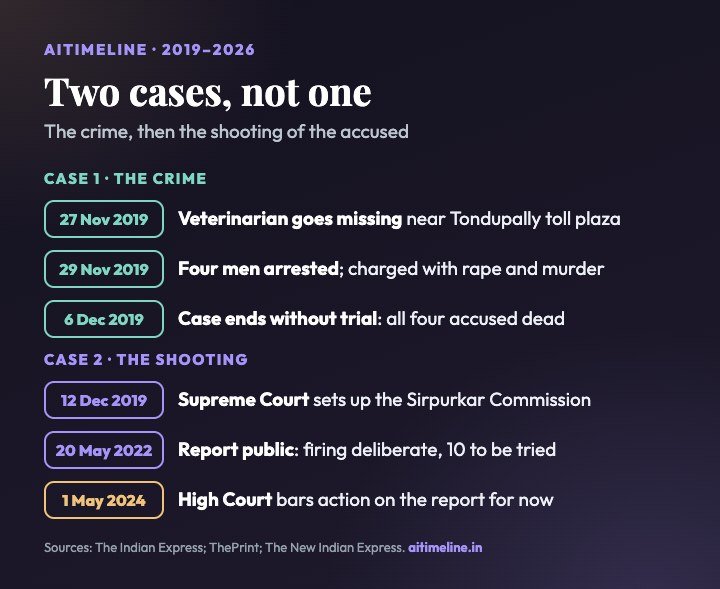
Two Cases, Not One
The rape-and-murder prosecution ended with the deaths of the accused. The shooting became a separate accountability case.
| Issue | The original crime | The police shooting |
|---|---|---|
| Date | 27 November 2019 | 6 December 2019 |
| Accused | Four arrested men | Police personnel present at the shooting |
| Investigated by | Cyberabad police | State SIT; NHRC; Supreme Court-appointed commission |
| Key outcome | No trial; all four accused died | Commission recommended trial of 10 personnel |
| Legal position now | Closed without conviction | Pending in Telangana High Court; interim bar on action |
Nine Days in 2019
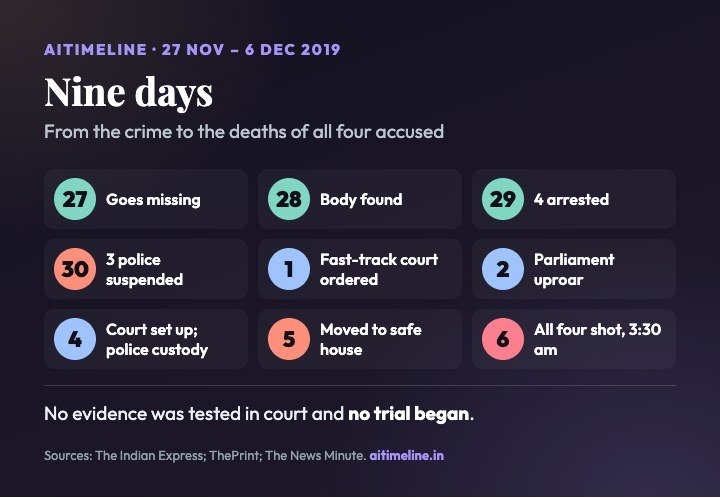
The speed of events shaped everything that followed. Public anger was directed first at the police, over the delay in acting on the family’s complaint on the night she went missing, and then at the slow pace of Indian trials. Members of Parliament called for lynching and castration. Within a week of the arrests, the men were dead, and the crowds that had demanded swift justice gathered at the scene to cheer the police.
Timeline: Hyderabad Veterinarian Case, 2019–2026
Newest first. Colour shows the strand each event belongs to.
Where the case stands Courts
Settled: The Supreme Court-appointed Sirpurkar Commission found on 28 January 2022 that the four men were deliberately shot, and named 10 police personnel for trial. The Supreme Court made the report public and sent the matter to the Telangana High Court on 20 May 2022.
Not settled: A single judge’s interim order of 1 May 2024 bars the state from taking coercive steps against the officers on the basis of the report. The public-interest petitions seeking a murder FIR are still before a Division Bench.
What we could not find: We found no reported final judgment, no FIR naming the 10 personnel and no criminal trial of any officer up to 10 November 2026. The latest hearing we could confirm was on 30 September 2024.
Five years on, still no case against the police Courts
The position: Five years after the shooting, ThePrint reported that there was “no formal case against the policemen”. The petitions had last been heard on 30 September 2024, and all sides were waiting for a new date.
The families: Their lawyer, P.V. Krishnamachary, said the families wanted the killings declared illegal under Article 21, a CBI or NIA investigation, and compensation of Rs 1 crore for each family.
The officers: Of the 10 personnel named, ACP V. Surender had retired; the others were still serving, several of them promoted in the normal course.
Division Bench hears pleas for a murder FIR Courts
The demand: Senior advocate Vrinda Grover, for the women’s and civil-rights groups behind the PILs, asked the court to order an FIR against all 10 personnel. She relied on the Supreme Court’s 2014 guidelines on police encounters in PUCL v State of Maharashtra.
Delay: On 4 September the bench faulted the state government for repeatedly seeking more time to state its position.
The stay surfaces: On 9 September the bench was told about the single judge’s May 2024 order. The Advocate General suggested hearing all the matters together, and the PILs were adjourned to 30 September.
High Court bars action on the commission report Courts
The order: Hearing writ petitions by police officers who challenged the report, the judge directed the state government not to take coercive steps against them on the basis of the commission’s findings. Reports described this as a stay of the report.
The petitioners: Seven of the 10 personnel filed petitions at first. The then Farooqnagar tahsildar Jaravath Pandu and the then Shadnagar station officer A. Sridhar also challenged adverse remarks about them. Later reports said the protection covered all 10 personnel.
The argument: Their counsel argued that a commission of inquiry could report facts but had overstepped by recommending prosecution, and that the officers had not been properly heard.
Police party allowed to be heard Courts
The ruling: The Division Bench allowed the police personnel to be impleaded as intervenors in the PILs and heard at the final stage. It noted that an accused normally has no right to be heard before an FIR is registered.
Why it allowed it: The state’s Special Investigation Team had filed a closure report favourable to the police. If that report were set aside and a fresh investigation ordered, the officers said, their rights would be affected.
The PIL demand: The petitions sought to set aside the SIT’s conclusion, a CBI investigation and a murder case under Section 302 IPC in place of the existing FIR, which had been registered under Section 307 against the four dead men.
Lead officer leaves the force Police
What happened: V. Surender, the Shadnagar ACP who investigated the rape-and-murder case and was present at the shooting, took voluntary retirement with about three years of service left, ThePrint reported. He went on to practise as an advocate at the Telangana High Court.
His account: He told ThePrint he had always wanted to become a lawyer, rejecting reports that he left over postings or the case.
Arguments on the juveniles and the press conference Courts
Grover’s points: She said the weapons were formally seized only on 13 December 2019, a week after the shooting, and that the Commissioner’s press conference was held before the inquest was complete and before the FIR reached the magistrate.
Juveniles: She argued that police kept two of the four in prison although records showed they were juveniles, which she called a violation of juvenile justice rules.
Families of the four go to the High Court Courts
What they asked: The families sought a declaration that the killings were illegal and violated the right to life under Article 21, a murder case against the police and an independent investigation.
Alongside: Their petition joined PILs filed by women’s and people’s organisations seeking a judicial probe and action on the commission report.
Supreme Court releases the report Courts
Sealed cover rejected: Telangana, represented by senior advocate Shyam Divan, asked that the report stay sealed. The bench refused, saying the inquiry was a public one and nothing in the report was confidential.
Sent to Hyderabad: The court ordered copies to be given to the parties and transferred the proceedings to the Telangana High Court to decide what action should follow.
What the commission concluded Inquiry
The finding: The commission said it did not believe the police account and concluded that the four were “deliberately fired upon with an intent to cause their death”.
No private defence: It found the men had not snatched weapons, tried to escape, assaulted or fired at the police on 6 December 2019, so there was no occasion for the right of private defence.
Recommendation: It recommended that 10 personnel be tried under Section 302 (murder) read with Section 34, and Section 201 (causing disappearance of evidence) read with Section 302 IPC.
Minors: Going by school records, the commission said Jollu Shiva and Chintakunta Chennakeshavulu were minors at the time.
Commission submits its report Inquiry
What it examined: Case diaries, forensic and post-mortem reports, photographs and video of the scene, and the evidence of witnesses including police officers and officials.
Delays: Its work was slowed by the Covid-19 pandemic and its six-month deadline was extended.
Forty-seven days of hearings Inquiry
Witnesses: The commission held hearings on 47 days and examined 57 witnesses, according to its secretary. ThePrint reported 54 witnesses, including 15 policemen.
Arguments and visit: Lawyers argued from 16 to 26 November 2021, and the commission inspected the places linked to the case on 5 December 2021.
Perjury warning: The panel warned police witnesses of perjury over inconsistent answers, notably those of the sub-inspector from whom a 9 mm pistol was said to have been snatched.
Second post-mortem by AIIMS doctors Courts
Why: The first post-mortems were done on 6 December. Petitioners questioned them, and the High Court ordered a fresh examination by a forensic team from AIIMS, New Delhi.
After: Once the second autopsy was done, the bodies were handed to the families, more than two weeks after the deaths.
Andhra Pradesh passes the Disha Bill Public & politics
What it proposed: The Andhra Pradesh Disha Bill, named after the pseudonym the police gave the victim, proposed fast-tracked investigation and trial in sexual offences against women and children, and the death penalty for rape in some cases.
Status: It needed the President’s assent and, as of mid-2021, was still awaiting it.
Supreme Court orders an independent inquiry Courts
The commission: The court set up a three-member Commission of Inquiry: retired Supreme Court judge V.S. Sirpurkar, former Bombay High Court judge Rekha P. Sondur Baldota and former CBI director D.R. Kaarthikeyan.
Its brief: To inquire into the circumstances in which the four died and report within six months. The court also stayed the related proceedings in the Telangana High Court.
State forms an SIT on the shooting Police
The team: A seven-member Special Investigation Team took over the Shadnagar police case on the shooting.
The case it took over: The FIR named the four dead men, under sections including 307 (attempt to murder), 332 and 224 IPC and the Arms Act, on the police account that they attacked officers and tried to escape.
NHRC sends a team Inquiry
What it did: The NHRC took suo motu cognisance of the deaths on 6 December and sent a team, which visited the site, examined the bodies and questioned officials between 7 and 11 December 2019.
Why: Custodial deaths and encounter killings must be reported to the NHRC under its own guidelines.
High Court orders bodies preserved Courts
The order: Acting on a representation from activists, the High Court directed that the bodies be preserved and the post-mortems video-recorded. The preservation order was later extended, and the bodies moved to Gandhi Hospital for lack of morgue space.
All four accused shot dead Police
The police account: Police said the men were taken before dawn to the place where the body was burnt, to recover the victim’s phone, power bank and watch. They said the men threw stones and sticks, two snatched pistols and fired, and officers fired back in self-defence.
The Commissioner: Cyberabad Police Commissioner V.C. Sajjanar said the exchange lasted about 10 minutes and that the men were not handcuffed.
Reaction: Crowds gathered at the site, showered police with petals and celebrated. Lawyers, activists, Amnesty International India and Human Rights Watch called it a likely extrajudicial killing and asked for an independent inquiry.
Accused moved to a safe house Police
What police said: The four were taken from jail to a guest house used as a safe house, police said, because of threats from angry crowds, and to be questioned about whether they were involved in other crimes.
What the commission found: It later concluded the men were not genuinely interrogated there and that the stated reason for the safe house was false.
Fast-track court set up Public & politics
The decision: The state set up a fast-track court to try the four accused, after the Chief Minister’s announcement on 1 December. Police also obtained the men’s custody for questioning.
Outrage in Parliament Public & politics
What was said: MPs in both Houses demanded the strictest punishment. Some called for public lynching or castration; Defence Minister Rajnath Singh said the government was open to every suggestion.
Promised change: The Home Ministry said it would amend the IPC and CrPC for faster trials, and pushed the 112 emergency number.
Chief Minister orders a fast-track trial Public & politics
Government: Chief Minister K. Chandrashekar Rao called the crime ghastly, promised help to the family and ordered a fast-track court.
The family’s neighbours: Residents of the family’s colony locked the gates to politicians, film stars and media, with placards reading “No sympathy, only action, justice”.
Protests, and three police suspended Police
Protests: Large crowds outside Shadnagar police station demanded the accused be handed over; police used lathis to disperse them, and a magistrate remanded the men at the station itself.
Suspensions: A sub-inspector and two head constables were suspended for delay in registering the family’s missing-person complaint on the night of 27–28 November. The family said officers argued over jurisdiction.
Four men arrested Crime & arrests
The accused: Mohammed Arif, Jollu Shiva, Jollu Naveen and Chintakunta Chennakeshavulu, lorry workers, were arrested and charged with offences including murder, rape and abduction.
Custody: They were remanded in 14-day judicial custody and held at Cherlapally Central Prison.
Body found near Shadnagar Crime & arrests
Discovery: Her burnt body was found under a bridge at Chatanpally, in the Shadnagar area on the Hyderabad–Bengaluru highway. Her family identified her from a locket.
A veterinarian goes missing Crime & arrests
What happened: The 26-year-old government veterinarian parked her scooter near the toll plaza and returned in the evening to find a flat tyre. At about 9:22 pm she called her sister, said she was scared, and asked her to stay on the line.
The allegation: Police said four men who had offered help abducted, sexually assaulted and killed her.
Who Were the Four Accused?
All four died before trial. None was convicted.
| Name | Reported work | Note |
|---|---|---|
| Mohammed Arif | Lorry driver | Police said he snatched a pistol; commission disbelieved it |
| Chintakunta Chennakeshavulu | Lorry worker | A minor at the time, per the commission |
| Jollu Shiva | Lorry cleaner | A minor at the time, per the commission |
| Jollu Naveen | Lorry cleaner | Cousin of Jollu Shiva |
Police said the four had confessed after their arrest, and the remand report set out a detailed account of the crime. None of it was tested by a court. The commission’s finding that two of the men were juveniles raised a further question: under juvenile justice law they should not have been held or questioned as adults.
Two Accounts of One Shooting
The police version on 6 December 2019, and what the commission made of it.
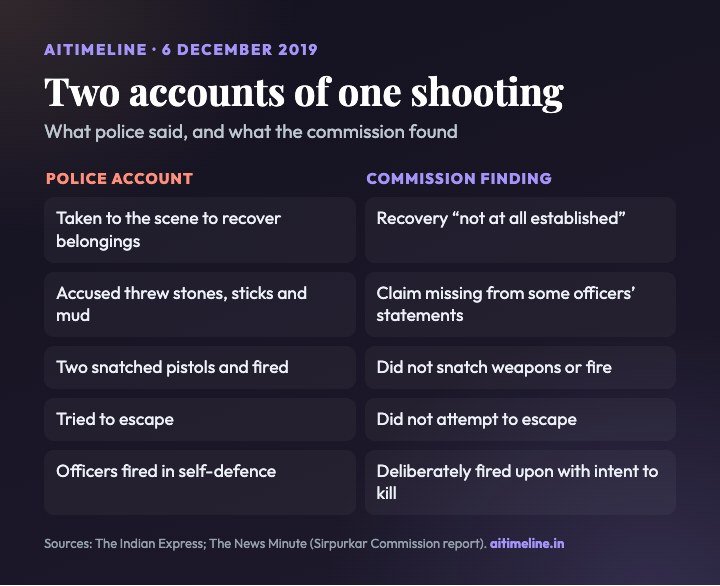
Cyberabad Police Commissioner V.C. Sajjanar told reporters at the site that the accused had attacked the police party, ignored calls to surrender and kept firing, and that the exchange lasted about 10 minutes. He described the victim’s phone, power bank and watch as recovered from the bushes. Before the commission, he later described some of those statements as erroneous.
The commission questioned almost every link in the chain: why the men were moved to a safe house on 5 December, why they were taken into agricultural fields about 500 metres off the highway, how the recovered articles were identified, and why weapons were formally seized only a week later.
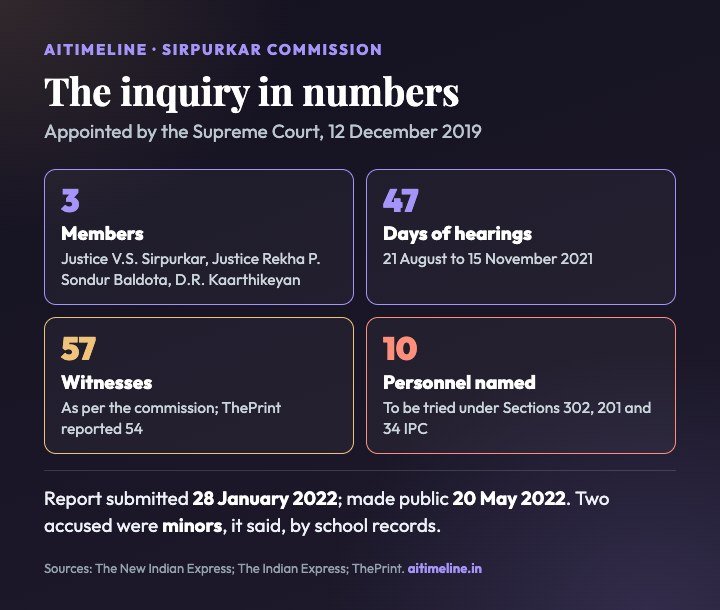
What the Sirpurkar Commission Found
A Commission of Inquiry appointed by the Supreme Court on 12 December 2019.
The four were “deliberately fired upon with an intent to cause their death”, with knowledge that the firing would result in death.
The men did not snatch weapons, try to escape, assault or fire at the police on 6 December 2019.
With no attack, there was no occasion for private defence, and no good-faith defence under Section 76 IPC.
Conduct after the deaths in “falsifying the record” showed common intention to screen the offenders.
Jollu Shiva and Chintakunta Chennakeshavulu were minors at the time, going by school records.
Ten personnel to be tried under Section 302 read with 34, and Section 201 read with 302 IPC.
The 10 Personnel Named in the Report
Named for trial by an inquiry commission. Not charged, and not convicted.
| # | Name | Reported position since |
|---|---|---|
| 1 | V. Surender | Then ACP Shadnagar; voluntary retirement July 2023 |
| 2 | K. Narasimha Reddy | Inspector rank |
| 3 | Shaik Lal Madhar | Inspector rank |
| 4 | Mohammed Sirajuddin | Serving |
| 5 | Kocherla Ravi | Inspector rank |
| 6 | K. Venkateswarlu | Inspector rank |
| 7 | S. Arvind Goud | Serving |
| 8 | D. Janakiram | Serving |
| 9 | R. Balu Rathod | Serving |
| 10 | D. Srikanth | Serving |
Positions are as reported by ThePrint in December 2024. The named personnel deny wrongdoing and have challenged the report in the High Court, arguing it is biased and that they were not fairly heard.
Why the High Court Stayed Action on the Report
An interim order, not a verdict.
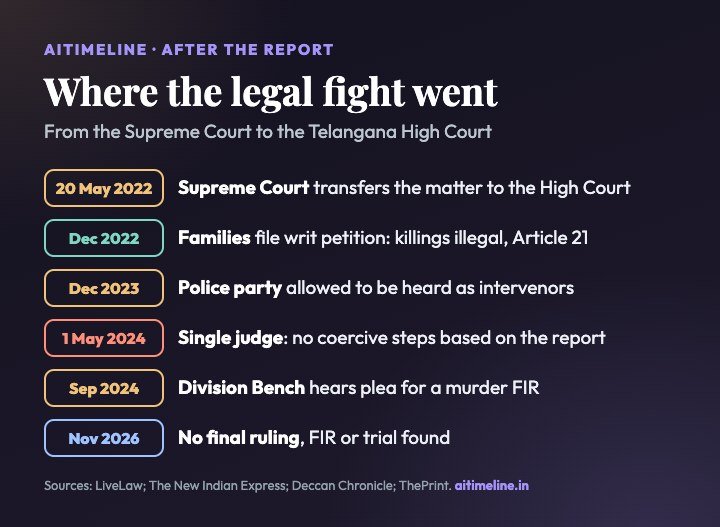
Police officers named in the report filed writ petitions arguing that a commission of inquiry can find facts but cannot decide guilt, and that it had ignored evidence they put forward. On 1 May 2024 Justice B. Vijaysen Reddy directed the state government not to take coercive steps against them on the basis of the report until the next hearing. The then Farooqnagar tahsildar and the then Shadnagar station officer, who were criticised in the report but not named for trial, also challenged it.
The order did not set aside the commission’s findings or hold that the shooting was lawful. It froze their use against the officers while the challenge is decided. Meanwhile, a Division Bench hearing PILs by women’s and civil-rights groups, which want an FIR for murder and a CBI investigation, was told of the order in September 2024 and asked that all the matters be placed together.
“In our considered opinion, the accused were deliberately fired upon with an intent to cause their death and with the knowledge that the firing would invariably result in the death of the deceased suspects.”
Justice V.S. Sirpurkar Commission report, January 2022
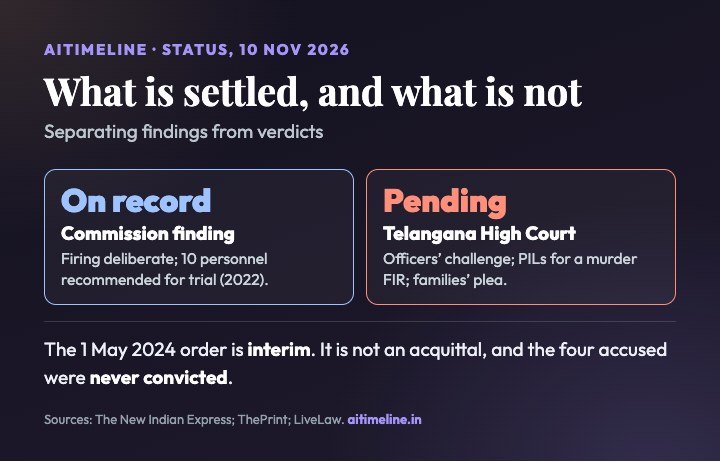
✅ On record
- The four accused died in police firing on 6 December 2019.
- The commission found the firing deliberate and named 10 personnel (2022).
- The Supreme Court made the report public and sent it to the High Court.
❓ Pending
- The officers’ challenge to the report.
- PILs seeking an FIR for murder and a CBI probe.
- The families’ plea for a declaration and compensation.
Why the Case Still Matters
- Women’s safety: the crime renewed demands for responsive policing, safer public spaces and help lines such as 112.
- Zero FIR: the jurisdiction dispute on the night she went missing led to fresh reminders that police must register complaints wherever the crime occurred.
- Encounter killings: the public celebration showed how far frustration with slow courts had gone; the commission’s finding showed the cost.
- Police accountability: it is a rare case where a Supreme Court-appointed inquiry named police for murder. Whether that leads to a trial is still undecided.
- Juvenile justice: the finding that two of the men were minors raised questions about how their ages were checked.
- Due process: because the four died untried, the crime itself was never adjudicated.
Legal Terms Explained
- Encounter: the term Indian police use for a shootout with suspects. “Fake encounter” refers to an alleged staged killing.
- Commission of Inquiry: a fact-finding body; its report is a recommendation, not a conviction.
- Interim order: a temporary direction pending the final decision of a case.
- Coercive steps: actions such as registering a case, arresting or prosecuting a person.
- PUCL guidelines: the Supreme Court’s 2014 rules on investigating police encounter deaths, including mandatory FIRs.
- Private defence: the legal right to use force to protect oneself, which the police claimed and the commission rejected.
Explore More Timelines
People Also Ask
Frequently Asked Questions
Checked against The Indian Express, The New Indian Express, ThePrint, LiveLaw, The News Minute, Deccan Chronicle and The Hans India.
⚠️ Editorial Note and Legal Status
The victim is not named on this page, as Indian law requires; “Disha” is a pseudonym the police introduced. “Encounter” describes the police account; the event itself is described as a police shooting because that account is disputed. The finding that the firing was deliberate is the Sirpurkar Commission’s, not a court’s, and the 10 personnel it named have not been charged or convicted. The four deceased men were accused, never convicted. Corrections to the brief this page began from: the three police personnel were suspended on 30 November 2019, not 4 December; the NHRC took cognisance on 6 December; the High Court ordered the AIIMS post-mortem on 21 December and it was done on 23 December; and the High Court order on police intervenors was reported on 29 December 2023. We could not confirm a 20 December 2022 hearing date, and found no hearing after 30 September 2024 or any final judgment up to 10 November 2026.
Related Reading on AiTimeline
Sources & further reading
Every dated entry above was checked against these references. Last reviewed 10 November 2026.
- The Indian Express: SC panel says book 10 cops for killing 4 accused in Hyderabad rape and murder (20 May 2022)
- The Indian Express: Hyderabad vet rape-murder case, a timeline since November 27 to 'encounter' (6 December 2019)
- The New Indian Express: Sirpurkar Commission submits report on 2019 encounter (31 January 2022)
- The New Indian Express: Relief to cops in Disha 'encounter' case as Telangana HC stays Sirpurkar panel report (2 May 2024)
- ThePrint: SC moves 2019 Hyderabad encounter case to Telangana HC (20 May 2022)
- ThePrint: Five years after encounter of accused, plea to book cops for murder drags on in HC (5 December 2024)
- LiveLaw: High Court allows police who allegedly staged encounter to be impleaded as intervenors (29 December 2023)
- The News Minute: Disha case encounter, nine things Hyderabad cops allegedly lied about (21 May 2022)
- The Hans India: Disha encounter, PILs in HC seeking registration of FIR under Section 302 IPC against police (10 September 2024)
- Deccan Chronicle: Disha encounter case, HC slams government's delaying tactics (4 September 2024)
- The Hans India: Telangana government constitutes SIT to probe Disha's four suspects encounter case (9 December 2019)