Justice Kurian Joseph Committee Report: The Delimitation Debate Explained
Explore the Justice Kurian Joseph Committee's delimitation report, its 2126 freeze proposal, North-South representation debate and India's 2026 Bill.
Latest Story
The Justice Kurian Joseph Committee report asks a blunt question: should population growth decide how much political power a state holds in Parliament? Tamil Nadu’s committee said no, and recommended freezing inter-state Lok Sabha seat shares until 2126 or until fertility rates converge. The Union government’s revised November 2026 package says yes to expansion but freezes shares only until 2051. We set out both, say which numbers come from filings and which from commentary, and flag what Parliament has yet to decide.
A recommendation is not law, a Bill is not an Act, and a projection is not an allocation. The 2126 freeze is advice to a state government. The 2051 freeze sits in a draft Bill not yet debated. The Tamil Nadu 29 and Bihar 50 seat figures are illustrative projections from a commentary, not an official count.
💡 Short Answer
A Tamil Nadu committee led by retired Supreme Court judge Kurian Joseph recommended in February 2026 that inter-state Lok Sabha seat shares stay frozen until 2126, or until fertility rates converge, and that the House stay at 550. The state discontinued the committee on 6 November 2026. The Union Cabinet then cleared a package raising seats 50% to an 850-seat Lok Sabha with shares frozen until 2051. It is not yet law.
The Lead Picture: Key Dates, 1976 to 2026
Ten dates in order.
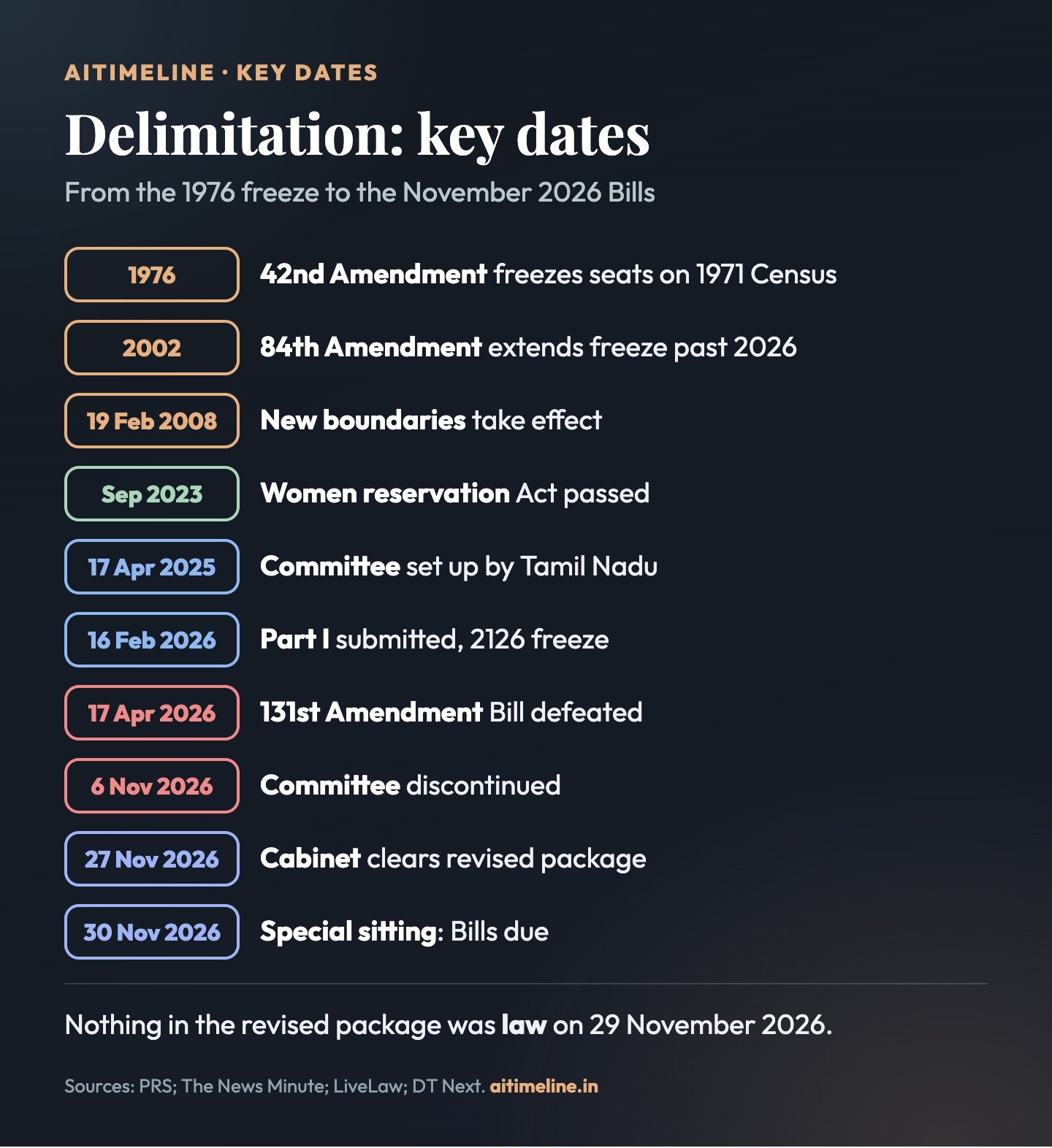
Justice Kurian Joseph Committee: Key Questions
What the Record Shows
- The freeze is old: state-wise Lok Sabha seats have rested on 1971 Census figures since 1976.
- The committee was a state body: constituted in April 2025, non-statutory, advising Tamil Nadu only.
- 2126 is a long-stop: the freeze would end earlier if fertility rates converge.
- It also argued against a bigger House: 550 maximum, not 800 to 900.
- The Union plan is different in kind: expand every state by 50% and freeze shares until 2051.
- April’s package failed: the 131st Amendment Bill missed the two-thirds majority on 17 April 2026.
- Women’s reservation is the engine: the 2023 Act links the quota to a Census and delimitation.
- The committee is gone, its report is not: the 6 November order did not withdraw Part I.
- Nothing is law yet: the revised Bills were due in the Lok Sabha on 30 November.
Timeline: The Delimitation Freeze, 1976 to 2026
Newest first. Labels mark constitutional roots, the committee, Union Bills, Parliament and where it stands.
Special sitting: the revised Bills are due in the Lok Sabha Parliament
What is scheduled: The News Minute reports that the Constitution (132nd Amendment) Bill is to be tabled in the Lok Sabha on Monday, 30 November, in a special sitting announced by the Union government on 26 November. A constitutional amendment of this kind needs a two-thirds majority of members present and voting, besides a majority of the House’s total strength.
What we could not confirm: Reports describe a Presidential recommendation under Article 117(3) on 28 November and sittings through 3 December, with the Rajya Sabha from 2 December. We could not open a source that states those dates, so treat them as reported, not verified.
The committee’s findings return to the debate Where it stands
The News Minute: On 28 November The News Minute set out what the Justice Kurian Joseph Committee had said on delimitation, the day after the Union draft Bill was published. It noted that the TVK government had since disbanded the committee.
The Wire: The same day The Wire carried a note by two authors, one of them a member of the committee, arguing against the 132nd Amendment Bill. It is advocacy, not a neutral count, and it is the source of the illustrative seat figures used later on this page.
Union Cabinet clears a revised seat-expansion package Union Bills
The proposal: The draft Constitution (132nd Amendment) Bill raises the Lok Sabha ceiling from 550 to 850: 815 seats from states (up from 530) and 35 from Union Territories (up from 20). The Assembly maximum rises from 500 to 650. The News Minute says all states would see a 50% increase in Lok Sabha and Assembly seats, and that delimitation would use the latest Census figures and then be frozen again until 2051.
What changed from April: The News Minute notes that the April Bill had no written uniform-increase provision, only an oral assurance from Home Minister Amit Shah. The revised draft puts the 50% rise in the text. A companion Delimitation (Second) Bill and a related Union Territories Bill are reported with it; we could not verify the Union Territories Bill’s exact title.
Tamil Nadu discontinues the committee The committee
The order: A government order dated 6 November, signed by the Public Secretary according to DT Next, discontinued the non-statutory High Level Committee on Union-State Relations with immediate effect. LiveLaw quotes the order as saying the committee had considerable similarity and overlap with the functions of the Tamil Nadu State Law Commission.
What follows: The Secretary and Committee Officer were told to hand all records to the Law Commission and report compliance. DT Next adds that Part II, due by 31 May 2027, will not now be produced by the committee, and that member M. Naganathan had resigned. The state government is headed by Chief Minister Joseph Vijay of the TVK.
Tamil Nadu State Law Commission is reconstituted The committee
Why it matters: DT Next says the committee had become redundant once the Tamil Nadu State Law Commission was reconstituted on 7 August 2026. LiveLaw’s report does not give that date, so it rests on a single source.
The stated overlap: The government’s argument is that a body with a broader mandate on inter-state and Centre-State relations already exists. Critics quoted in commentary see a retreat from the committee’s stance; the order itself gives no such motive.
The 131st Amendment Bill fails in the Lok Sabha Parliament
The vote: The News Minute says the Bill was defeated, with 211 of the 489 members present voting against it, and that a two-thirds majority of members present and voting was needed. It gives no figure for votes in favour. Other reports give different tallies, so we state no vote count here.
The consequence: PRS lists the Delimitation Bill, 2026 as infructuous on the same day, because it depended on the constitutional amendment. The accompanying Union Territories Bill did not proceed either.
Three Bills introduced: 131st Amendment, Delimitation, Union Territories Union Bills
The package: PRS records that the Constitution (131st Amendment) Bill, 2026, the Delimitation Bill, 2026 and the Union Territories Laws (Amendment) Bill, 2026 were introduced on 16 April. The delimitation Bill used the latest published Census as of the commission’s constitution, which PRS says implies 2011.
Women’s reservation: PRS observes that the Bills removed the condition tying the one-third quota to the first Census after the 2023 Act, and that, as drafted, women’s reservation would then not apply to the 2029 Lok Sabha election. The revised November package reframes delimitation as a requirement for implementing the quota.
Part I of the report is submitted The committee
The delimitation chapter: The committee recommended extending the freeze on inter-state Lok Sabha seat allocation, based on the 1971 Census, until 2126 or until fertility rates converge, whichever is earlier. A commentary by two authors says convergence means every state within about 10% of the national average; the news reports describe it only as a narrow band, so the exact test is not settled in public sources.
The rest of the package: It also recommended capping the Lok Sabha at 550, calling a House of 800 to 900 too unwieldy, and six Rajya Sabha seats per state, abolishing the 12 nominated seats and requiring Rajya Sabha members to be domiciled in the state. For delimitation bodies it proposed a Union Commission for Lok Sabha seats and independent State Commissions for Assembly seats, with multi-party membership, panel-based appointment, legislative scrutiny and limited judicial review before election notification. It proposed decadal rotation of Scheduled Caste constituencies and territorial stability for Scheduled Tribe seats.
Why 2126: The report relied on projections that India’s population peaks around 2061 to 2062 at roughly 1.7 billion (UN World Population Prospects 2024) and that fertility keeps falling, so states converge later.
Tamil Nadu sets up the committee The committee
Members and mandate: Chaired by retired Supreme Court judge Kurian Joseph, with retired IAS officer K. Ashok Vardhan Shetty and M. Naganathan, former Vice Chairman of the Tamil Nadu State Planning Commission. The mandate was Union-State relations broadly: autonomy, the Governor’s office, language, elections, education, health and finances, with delimitation as one part.
The gap in the record: Some summaries mention a national seminar on 23 August 2025. We could not find a source for that date and do not rely on it.
Women’s Reservation Act: the quota waits for a Census Constitutional roots
The link to delimitation: The 2023 Act reserves one-third of Lok Sabha and Assembly seats for women. As PRS describes it, the quota applies from the first Census after the Act’s commencement and after delimitation based on that Census.
Why it matters now: That condition is the bridge between women’s reservation and seat redistribution. Every later Bill, and every objection to it, runs through it.
The 2002 commission redraws boundaries, not shares Constitutional roots
What it did: Set up on 12 July 2002 under retired Supreme Court judge Kuldip Singh, the commission used the 2001 Census to redraw constituencies. Its orders took effect from 19 February 2008 for most states and Union Territories, and 20 March 2008 for Tripura and Meghalaya, and the 2008 Karnataka Assembly election was the first to use them.
What it did not do: Because of the freeze, the commission could change boundaries within a state but not the number of seats a state held. Delimitation in several north-eastern states was deferred.
84th Amendment extends the freeze to the first Census after 2026 Constitutional roots
The rule: The amendment continued the freeze on each state’s total seats until 2026 and barred inter-state redistribution until the first Census conducted after 2026. It allowed constituencies to be rationalised on updated figures without altering the totals.
The deadline problem: Because the 2021 Census slipped, the first Census after 2026 is the one with reference date 1 March 2027 (PRS). That is why the question returned in 2026.
42nd Amendment freezes seat shares on 1971 figures Constitutional roots
The freeze: Parliament froze the total seats in each state, using the 1971 Census, until the 2001 Census. The aim was that states promoting family planning should not lose seats to states that did not.
The result: The Lok Sabha’s state-wise seat counts have stayed unaltered since 1971. Population has moved since then, so a vote in a fast-growing state now counts for less than a vote in a slow-growing one.
Commissions in 1952, 1962 and 1972 Constitutional roots
Before the freeze: Constituencies for the first general election of 1951-52 were drawn under a 1951 order, with 489 seats. Commissions were set up under Acts of 1952, 1962 and 1972, the last chaired by retired Supreme Court judge J.L. Kapur.
The pattern: Each round reallocated seats among states after a Census. The 1976 freeze ended that cycle.
2126 Versus 2051: How Long a Freeze?
The central difference, in years.
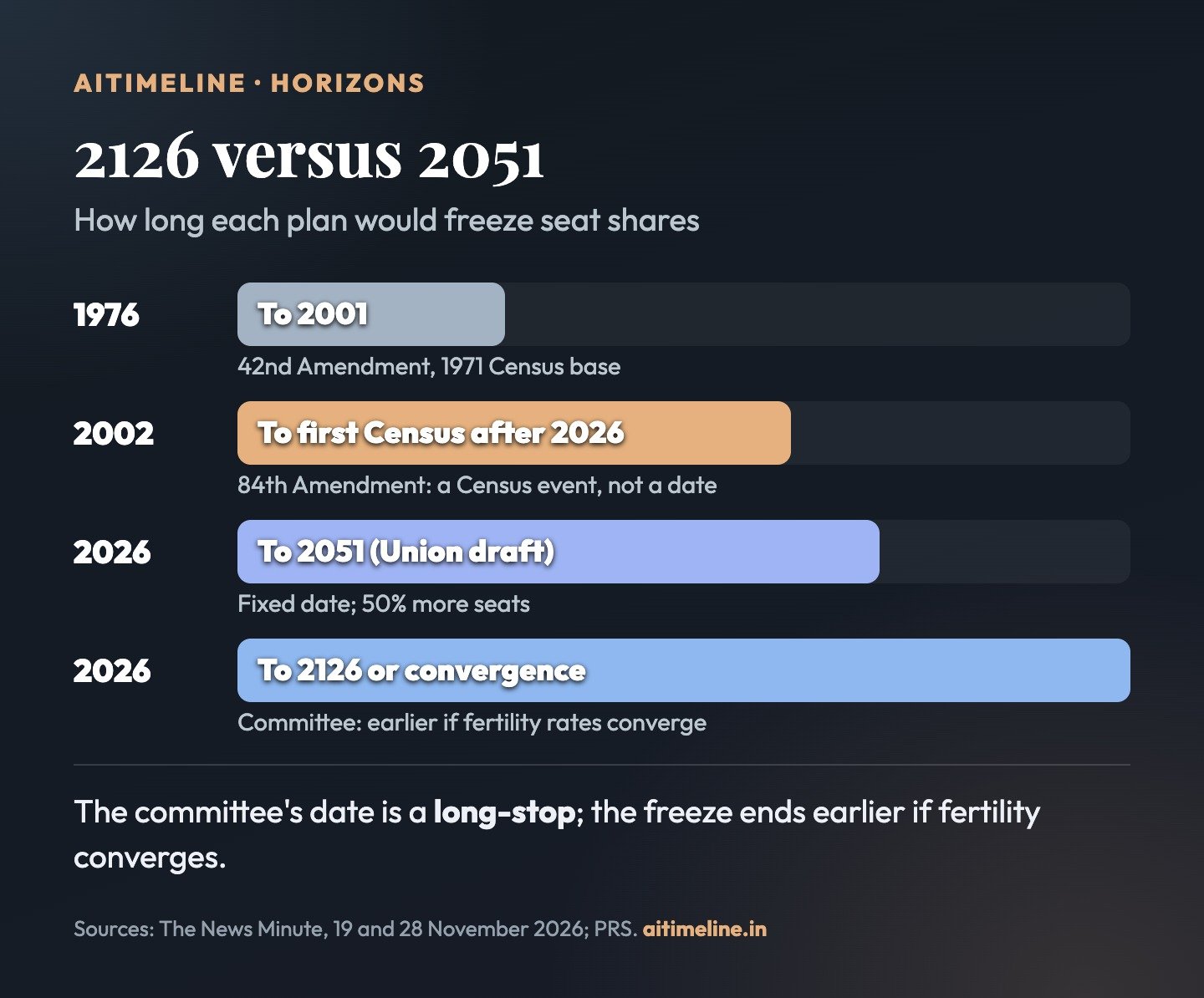
The committee wants a long freeze with an early exit if fertility converges. The Union package wants a shorter, fixed freeze but pairs it with a 50% expansion. Neither is a settlement: one is advice from a state body that no longer exists, the other a draft Bill awaiting a two-thirds vote.
The Committee Versus the Union Package
Same worry, different answers.
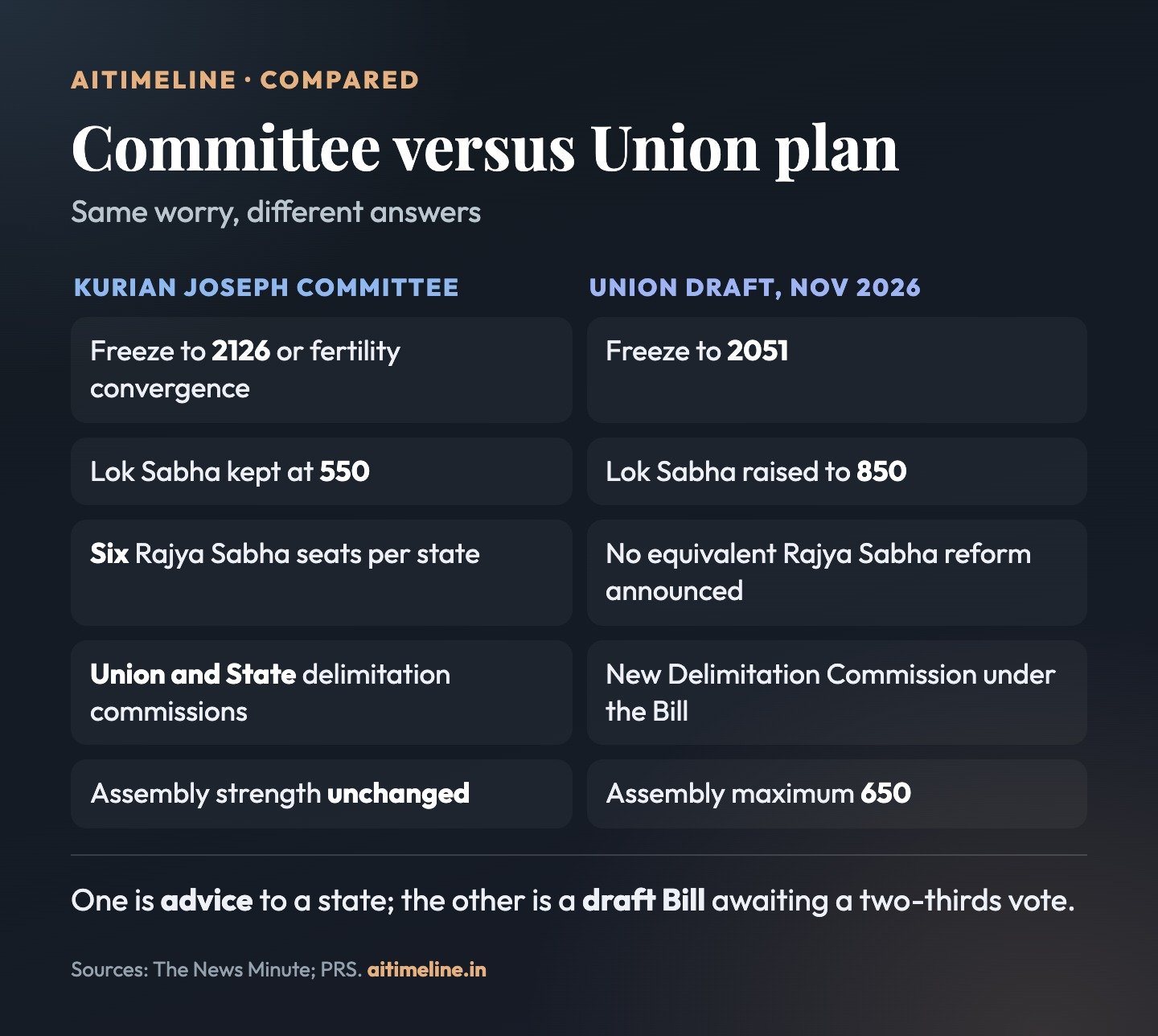
The committee’s vision is a smaller House, a stronger Rajya Sabha and a federal safeguard that lasts. The Union plan keeps every state’s share and adds seats for all, and ties the exercise to women’s reservation. The News Minute notes that the April Bill left the uniform rise to an oral assurance; the revised draft writes it into the text.
The Numbers in the Revised Draft
As reported on 27 November 2026.
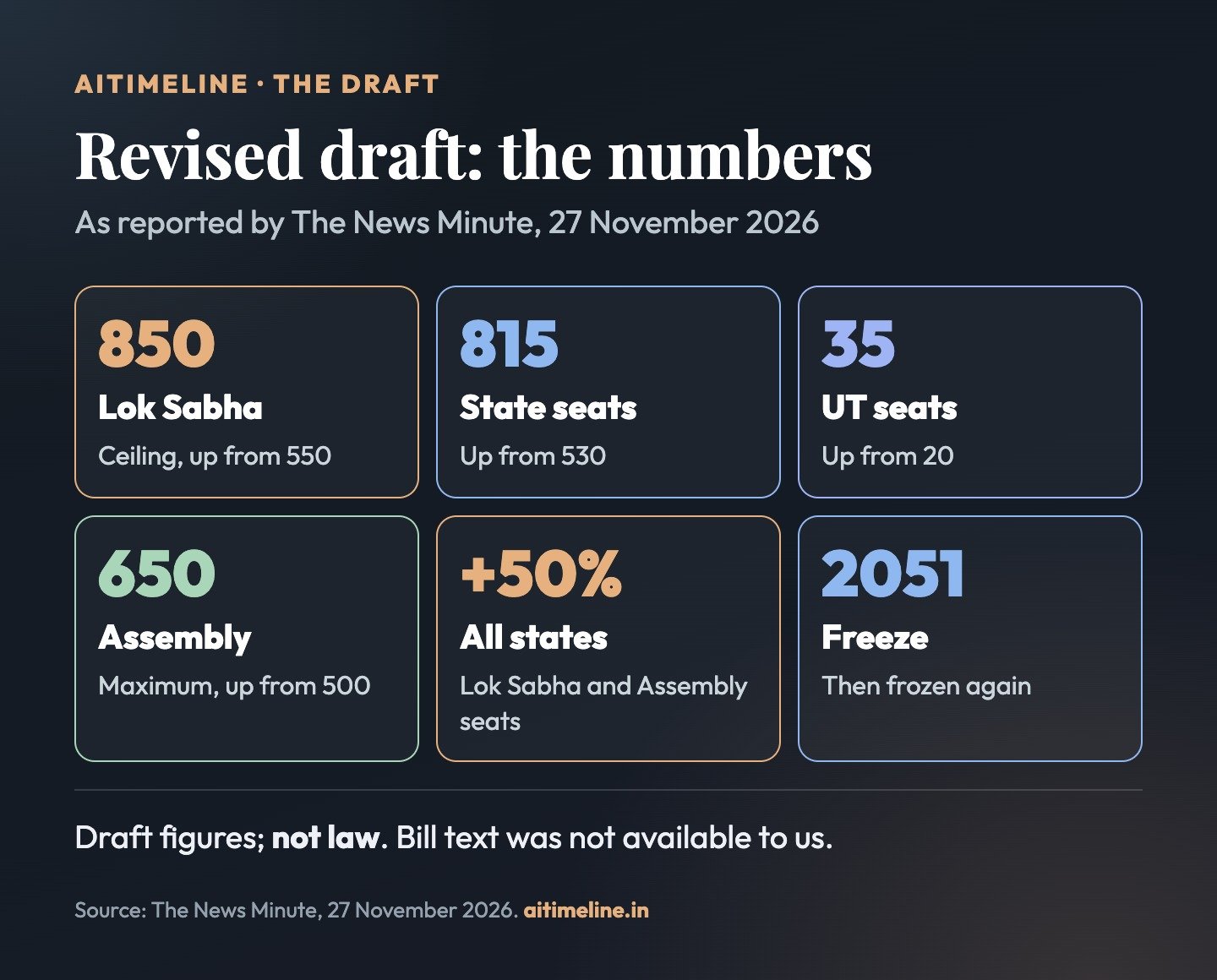
These figures come from the News Minute’s reading of the draft. We could not open the Bill text, and the Reuters and Indian Express reports were not accessible to us, so the exact statutory wording is unverified.
An Illustration: Tamil Nadu and Bihar
Commentary figures, not an official allocation.
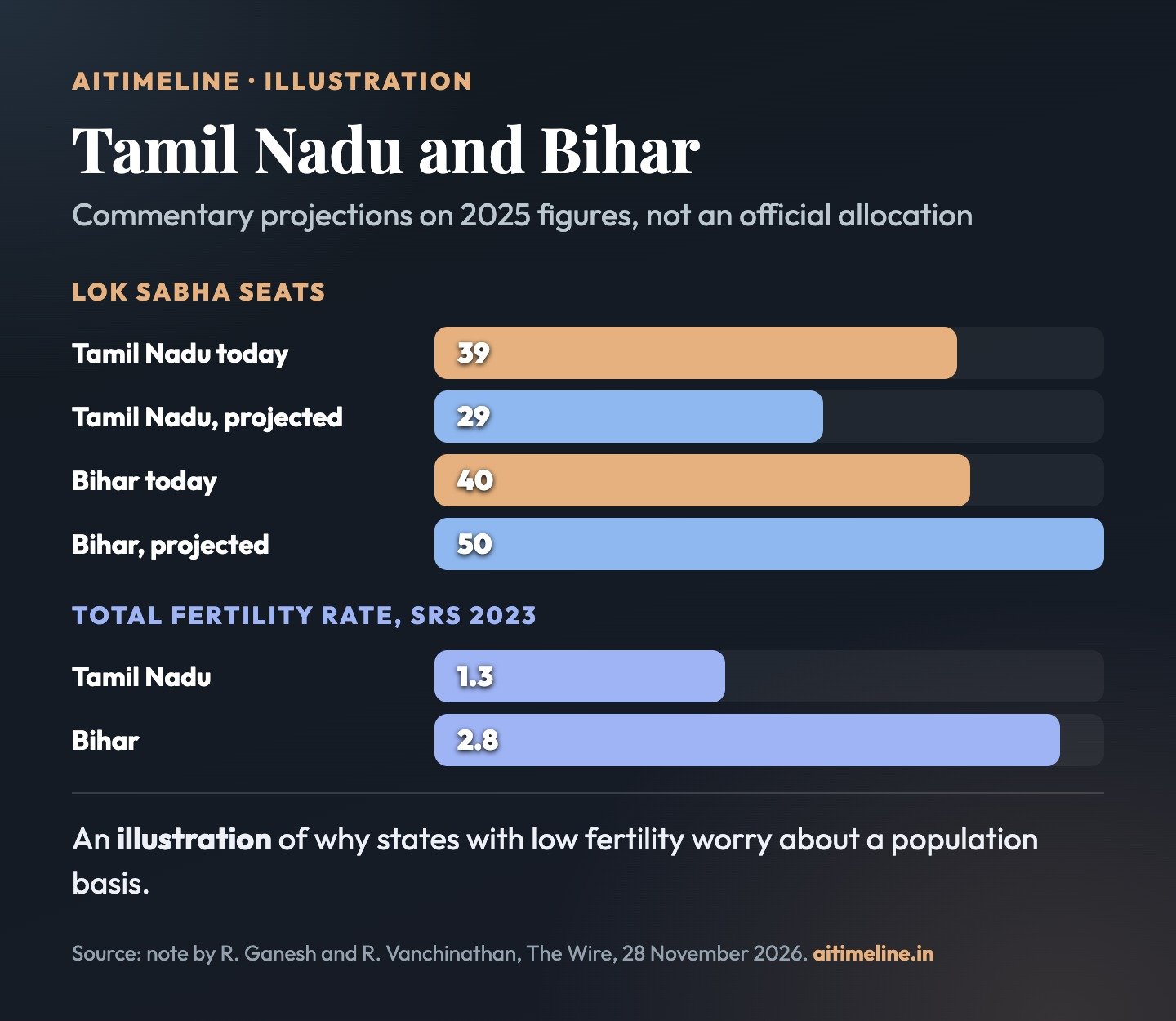
The figures come from a note by two authors, one a committee member, and they are projections on a population basis. They show why a freeze matters to states with low fertility. They do not show what any Bill would do, and the same note claims Tamil Nadu’s 39 seats would become 58 or 59 under the revised draft.
The Committee’s Wider Reform Package
Delimitation was one chapter among many.
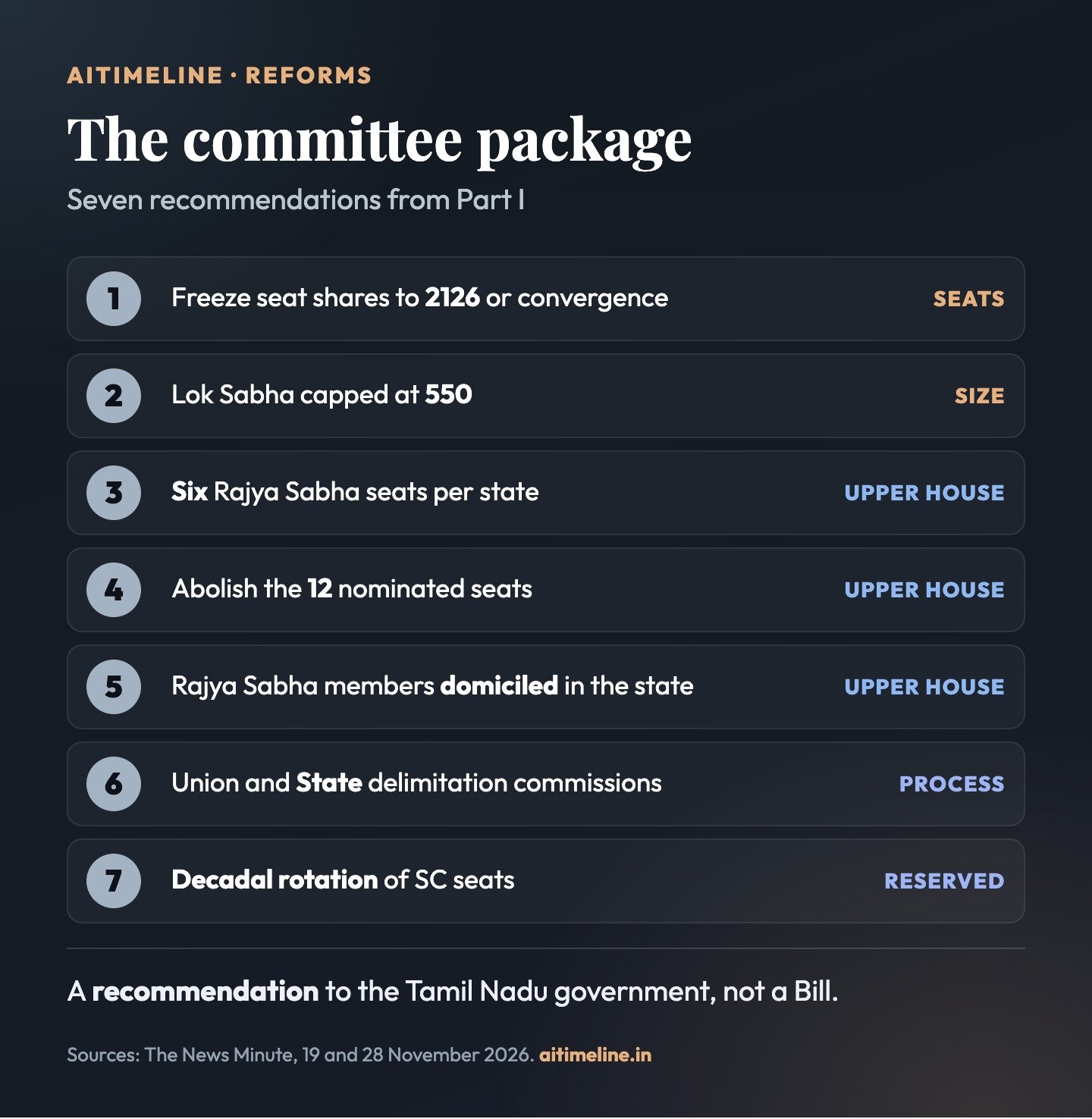
The Rajya Sabha ideas are the most distinctive. The committee called six seats the median of the present range of one to 31, and argued that nominated members dilute the chamber’s federal character. Whether any of these would be adopted is uncertain: the committee was a state body and the Union package carries none of them.
What Happens Next
Open questions as of 29 November 2026.
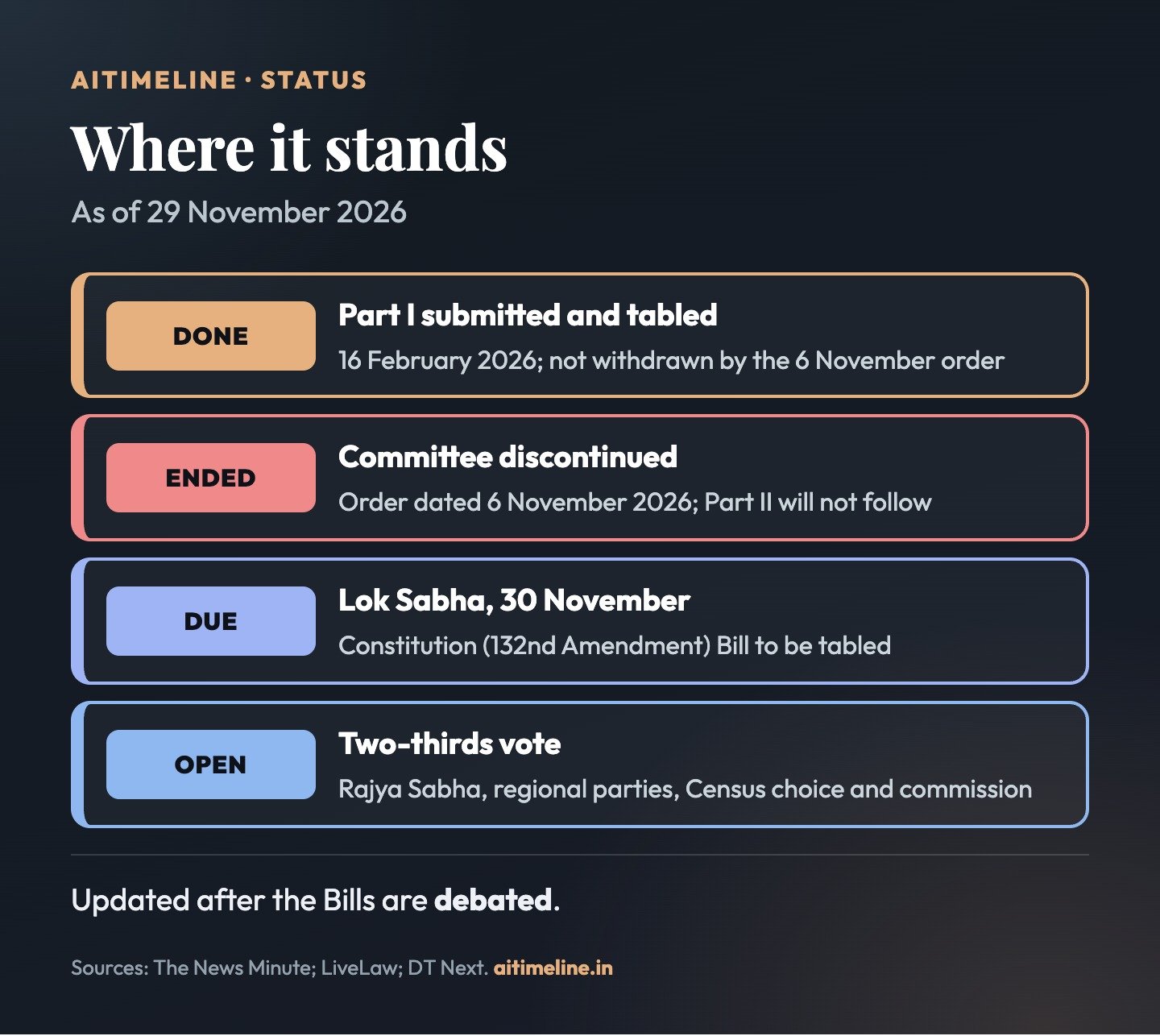
The decisive tests are whether the Lok Sabha reaches two-thirds, how regional parties vote, what the Rajya Sabha does, and whether a Delimitation Commission can be constituted in time for women’s reservation to take effect. We could not confirm whether the target is the 2029 general election. This page will be refreshed after the Bills are debated.
Source Gaps and Corrections
| Claim in the brief or draft | What we found | Status |
|---|---|---|
| Illustrative table: Tamil Nadu 29, Bihar 50, TFR 1.3 and 2.8 | Not in the committee news reports. It appears in a note by two authors, one a committee member | Attributed |
| Part I had ten chapters | No source found for a chapter count | Dropped |
| National seminar on 23 August 2025 | No source found for the date | Dropped |
| President’s Article 117(3) recommendation on 28 November; sittings 30 Nov to 3 Dec | Only the 30 November tabling in a special sitting is confirmed | Hedged |
| 131st Amendment vote 298 to 230 | News Minute says 211 of 489 present voted against; counts differ between outlets | Count not stated |
| 84th Amendment passed 2001 | The commission record dates the Act to 2002 | 2002 used |
| Third commission in 1972 | The Act is of 1972; the commission is dated 1973 in the record | Both given |
| Women’s reservation in force for 2029 | PRS says the April Bills would not bring it to 2029; no source for the revised timetable | Unverified |
| TN Law Commission reconstituted 7 August 2026 | Reported by DT Next only | Single source |
Conclusion: A Test of Federal Balance
The committee put a precise worry on the record: that states which stabilised their populations could lose relative weight in the House. Its answer was a long freeze, a smaller Lok Sabha and a stronger Rajya Sabha. Its own state has since closed the committee.
The Union government’s answer is different: grow every state’s seats by half and freeze shares until 2051. Whether that protects regional influence, or only postpones the argument, will be decided in a vote that had not yet happened when this page was updated.
Explore More Timelines
People Also Ask
Frequently Asked Questions
⚠️ Editorial Note
This page draws on news reports, the PRS bill record, the Tamil Nadu government order as reported, and commentary. The committee’s 2126 proposal is a recommendation, not law, and the Union package is a draft not yet passed. Commentary figures are marked as such. It is editorial journalism and takes no side on the Bills.
Related Stories
Sources & further reading
Every dated entry above was checked against these references. Last reviewed 29 November 2026.
- The News Minute: Delimitation debate, what the Justice Kurian Joseph Committee said (28 November 2026)
- The News Minute: Tamil Nadu panel recommends sweeping reforms to balance Union-State relations (19 February 2026)
- The News Minute: Draft delimitation Bill, 50% increase in seats and freeze till 2051 (27 November 2026)
- PRS Legislative Research: The Delimitation Bill, 2026
- LiveLaw: Tamil Nadu government discontinues the High Level Committee on Union-State Relations (November 2026)
- DT Next: TVK government scraps the Justice Kurian Joseph panel (7 November 2026)
- The Wire: What Tamil Nadu's own committee found on delimitation (28 November 2026, commentary)
- Wikipedia: Delimitation Commission of India