UPI Goes Global: How India’s Payment System Reached 11 Countries
Explore UPI's global expansion from Bhutan in 2021 to 11 countries in 2026, including merchant QR payments, Singapore PayNow and Project Nexus.
Latest Story
UPI international expansion is the story of how India’s Unified Payments Interface, built in 2016 for bank-to-bank payments at home, began working in other countries. The first market abroad was Bhutan in July 2021. By 24 August 2026 the government reported UPI operational in 11 foreign countries, through merchant QR codes, person-to-person remittances or both. This page traces each step in order, separates the merchant and remittance links, and flags where the sources disagree.
“Operational” is not “everywhere”. A country on the list has at least one partner bank or network connected, not every shop or bank. Merchant payments and remittances are different services: the first lets a traveller pay a business, the second sends money between people. And signing is not launching: Project Nexus is an agreement, and we found no official confirmation that it is live.
💡 Short Answer
UPI began in India in April 2016 and first went abroad in July 2021 in Bhutan. Singapore followed, and in February 2023 it became the first country with a UPI person-to-person remittance link, through PayNow. By 24 August 2026 the government counted 11 foreign countries: Bhutan, Singapore, the UAE, France, Mauritius, Sri Lanka, Nepal, Qatar, Cambodia, Greece and the Maldives. Nine have merchant QR links and four have remittance links, and availability depends on participating banks, apps and merchants.
The Lead Picture: Key Dates, 2016 to 2026
Eleven dates in order.
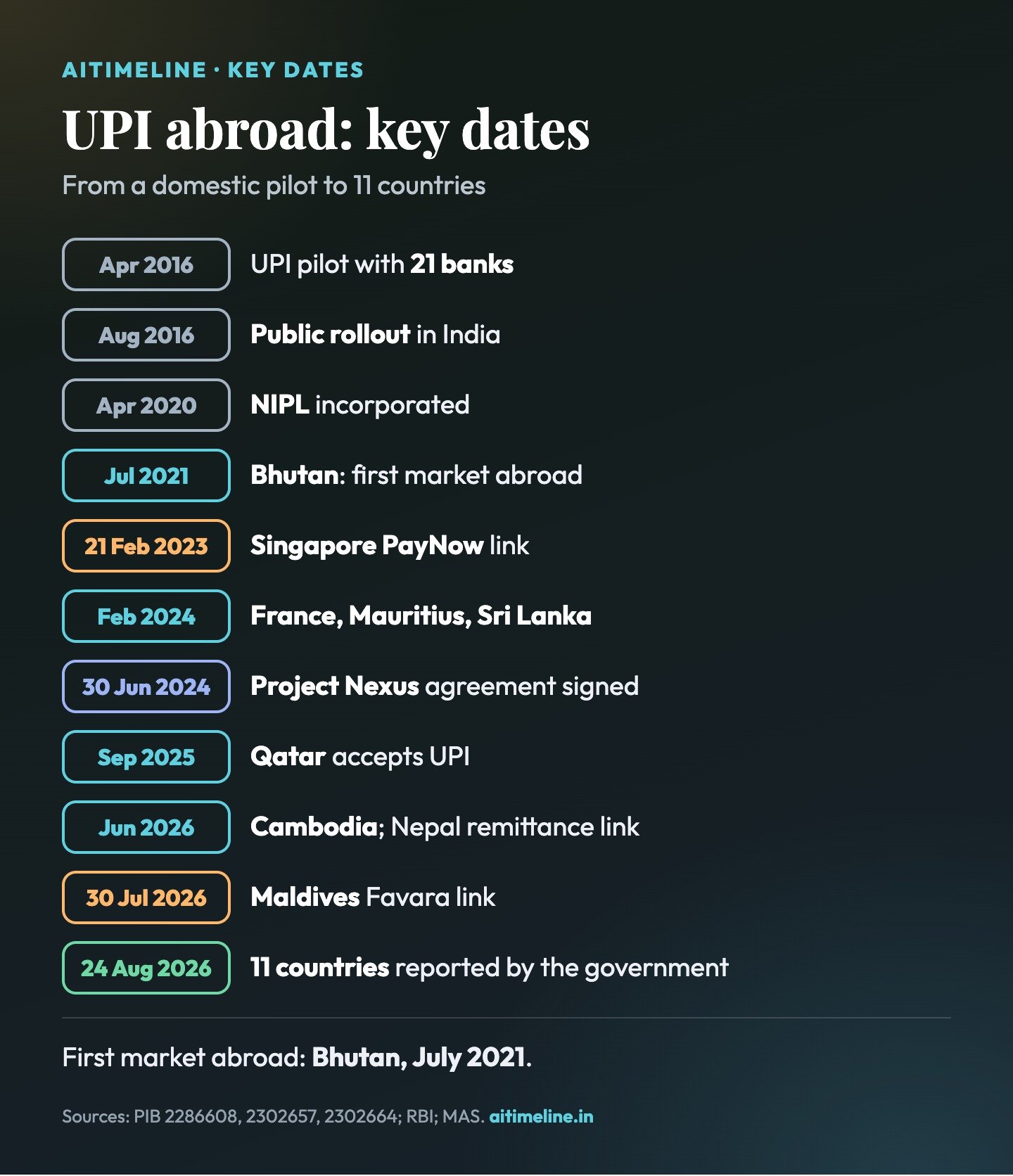
UPI International Expansion: Key Questions
What the Record Shows
- It started at home: UPI launched in April 2016 with 21 banks and handled 1.78 crore transactions in FY 2016-17.
- NIPL is the vehicle: NPCI International was incorporated in April 2020 to take UPI and RuPay abroad.
- Bhutan came first: July 2021, with Singapore in August 2021 and the UAE in April 2022.
- PayNow was the first remittance link: 21 February 2023, with a Rs 60,000 daily cap for Indian senders at launch.
- 2024 was the broad year: France, Mauritius and Sri Lanka in February, Nepal in March.
- 2026 added remittances: Greece in May, Nepal in June and the Maldives on 30 July, plus Cambodia’s QR link on 3 June.
- The count mixes two services: nine merchant-QR corridors and four remittance corridors across 11 countries.
- Nexus is an agreement: signed 30 June 2024, expected live by 2026, not confirmed live by anything we found.
- Coverage varies: access depends on partner banks, apps and merchants, not on a country’s name appearing on a list.
Timeline: UPI International Expansion, 2016 to 2026
Newest first. Labels mark background, merchant QR links, remittance links, platforms, milestones and today.
Where the network stands on 29 November 2026 Today
What is live: The government’s tables show 11 countries and 13 live corridors: nine merchant-QR links and four person-to-person remittance links. Singapore and Nepal appear in both groups.
What we did not check: We did not confirm whether any country was added after the 24 August 2026 release, whether Project Nexus has gone live, or how many merchants accept UPI in each market.
Open questions: Whether Nexus starts on the 2026 timetable RBI gave in 2024, when Cambodia’s two-way phase begins, whether the Maldives adds QR payments, and what fees and exchange rates travellers pay.
The government reports UPI operational in 11 foreign countries Milestone
The count: Two releases dated 24 August 2026 list the United Arab Emirates, France, Bhutan, Sri Lanka, Nepal, Singapore, Mauritius, Qatar, Cambodia, Greece and the Maldives, and say UPI is live for acceptance and/or cross-border remittances.
The home numbers: The same release gives 24,162 crore transactions and about Rs 314 lakh crore in value for FY 2025-26, 741 banks live in July 2026, and a record 2,366 crore transactions in July 2026.
The global share: It says UPI accounts for nearly 49 percent of the world’s real-time payment volume, recognised by the IMF. One release says 2025 and another says 2024 for that figure, and we did not check it against the IMF note, so we attribute it to the government.
The Maldives links its Favara system with UPI Remittance
What went live: The Maldives’ instant-payment system, Favara, was connected with UPI for person-to-person remittances. Senders use mobile banking apps to send money to UPI-enabled bank accounts in India.
How it got here: Coverage of the Maldives Monetary Authority announcement says NIPL and the authority signed the agreement in July 2025 and that testing and certification took about ten days.
What is allowed: Reports list family-maintenance remittances in both directions and gift remittances outward from India as permitted purposes. Later phases are expected to add QR merchant payments.
Nepal adds a UPI link for person-to-person transfers Remittance
What it does: The UPI-NPI linkage lets users send money across the border using mobile numbers and virtual payment addresses, without sharing bank account details. NCHL runs the infrastructure behind Nepal’s National Payments Interface.
How it fits: It sits beside the merchant-QR link with Fonepay that opened in March 2024, so Nepal now has both types of connection.
Cambodia goes live through KHQR Merchant QR
What launched: UPI acceptance went live through Bakong’s KHQR, Cambodia’s national QR code. The press release says the first phase lets Indian travellers pay at more than 4.5 million Cambodian merchants.
Who attended: The ceremony was attended by the National Bank of Cambodia’s Governor, Dr Chea Serey, and senior representatives of the Reserve Bank of India.
What comes next: The first phase prioritises incoming Indian travellers. A later phase would let Cambodian visitors use their own banking apps to scan UPI QR codes in India.
Greece begins UPI-based remittances through Eurobank Remittance
The start: Eurobank said on 21 May 2026 that it had activated a cross-border remittance service from Greece to India through UPI. NIPL and Eurobank had signed a memorandum of understanding in February 2024.
The ceremony: Union minister Piyush Goyal announced the rollout after a live demonstration at Eurobank’s Athens headquarters, in coverage dated 30 June 2026.
The scope: A Cyprus Mail report says the first stage supports outgoing payments from Indian citizens living in Greece to recipients in India.
Qatar accepts UPI through Qatar National Bank Merchant QR
The launch: QNB announced on 24 September 2025 that merchants it serves could accept QR-based UPI payments through point-of-sale terminals. Qatar Duty Free at Hamad International Airport was the first merchant live.
The background: NIPL and QNB first announced the partnership in July 2024.
The limits: Acceptance covers select outlets, so travellers should carry a card or some local currency as a backup. Later reports say Lulu Group stores joined.
India signs on to Project Nexus Platform
The agreement: The BIS and the central banks of Malaysia, Thailand, the Philippines, Singapore and India signed the agreement on 30 June 2024 in Basel. Indonesia stayed involved as a special observer.
The aim: Nexus is meant to connect domestic fast-payment systems through one platform, so each country links once instead of building a separate link for every partner. The platform can be extended to more countries.
The timetable: RBI’s release, dated 1 July 2024, said the platform was expected to go live by 2026. We found no official confirmation that it has.
Nepal accepts UPI through Fonepay Merchant QR
The launch: NIPL and Fonepay announced on 8 March 2024 that Indian users could pay at Nepali merchants by scanning compatible QR codes with UPI apps. The government lists the start as March 2024.
Early use: A Business Standard report in August 2024 said cross-border UPI payments in Nepal had passed 100,000 within about six months.
Mauritius and Sri Lanka join Merchant QR
The event: Prime Minister Narendra Modi, Sri Lanka’s then-president Ranil Wickremesinghe and Mauritius’s Prime Minister Pravind Jugnauth jointly launched UPI services on 12 February 2024.
Mauritius: RuPay card services also began in Mauritius the same day.
Who benefits: The Ministry of External Affairs said the service covers Indian nationals travelling to Sri Lanka and Mauritius, and Mauritian nationals travelling to India.
UPI reaches the Eiffel Tower Merchant QR
What launched: UPI acceptance began in France in February 2024, with the Eiffel Tower the first merchant to accept it. One report places the Paris launch on 2 February 2024, at a Republic Day reception.
The partner: The government’s table lists Lyra Network as the French partner institution.
UPI and Singapore’s PayNow are linked Remittance
The link: Prime Ministers Narendra Modi and Lee Hsien Loong witnessed the launch of the cross-border link between UPI and PayNow. The central bank heads made token transfers.
The limits: At launch an Indian user could send up to Rs 60,000 a day, about SGD 1,000. In Singapore, selected DBS customers could send up to SGD 200 a transaction and SGD 500 a day, rising to SGD 1,000 for all DBS customers by 31 March 2023.
The banks: Four Indian banks could send and receive: SBI, Indian Overseas Bank, Indian Bank and ICICI Bank. Axis Bank and DBS India could receive. Singapore users were served by DBS and Liquid Group.
The firsts: MAS said it was the first real-time payment linkage on scalable cloud infrastructure and the first to include a non-bank financial institution.
The UAE begins accepting UPI Merchant QR
The start: The government’s table lists April 2022 as the UAE start, with three partner institutions: Mashreq Bank PSC (NeoPay), Network International and Magnati.
Why it matters: The UAE is home to a large Indian community, which is why it was an early target.
Singapore accepts UPI at merchants Merchant QR
The start: The government’s table dates merchant acceptance in Singapore to August 2021, through NETS Singapore, HitPay Payment Solutions and LiquidPay Group.
A separate link: This is different from the PayNow remittance link of February 2023.
Bhutan becomes the first market abroad Merchant QR
The launch: NPCI said Bhutan was the first country to adopt UPI standards for its QR deployment. The service was to be accepted at merchants served by the Royal Monetary Authority.
The audience: NPCI said more than 200,000 Indian tourists visit Bhutan each year, which was the expected benefit.
NPCI creates an international arm Background
The mandate: PIB says NIPL is a wholly owned NPCI subsidiary set up to take UPI and the RuPay card scheme to international markets. It serves Indian travellers and the diaspora, and helps partner countries build UPI-like systems or RuPay-like card schemes.
UPI starts at home with 21 banks Background
The start: UPI began as a pilot in April 2016 with 21 member banks. It went public in August 2016, and the BHIM app followed in December 2016.
The first year: In FY 2016-17 it handled 1.78 crore transactions worth about Rs 0.07 lakh crore, with 44 banks live.
The 11 Countries and Their Corridors
By payment type, as listed by the government.
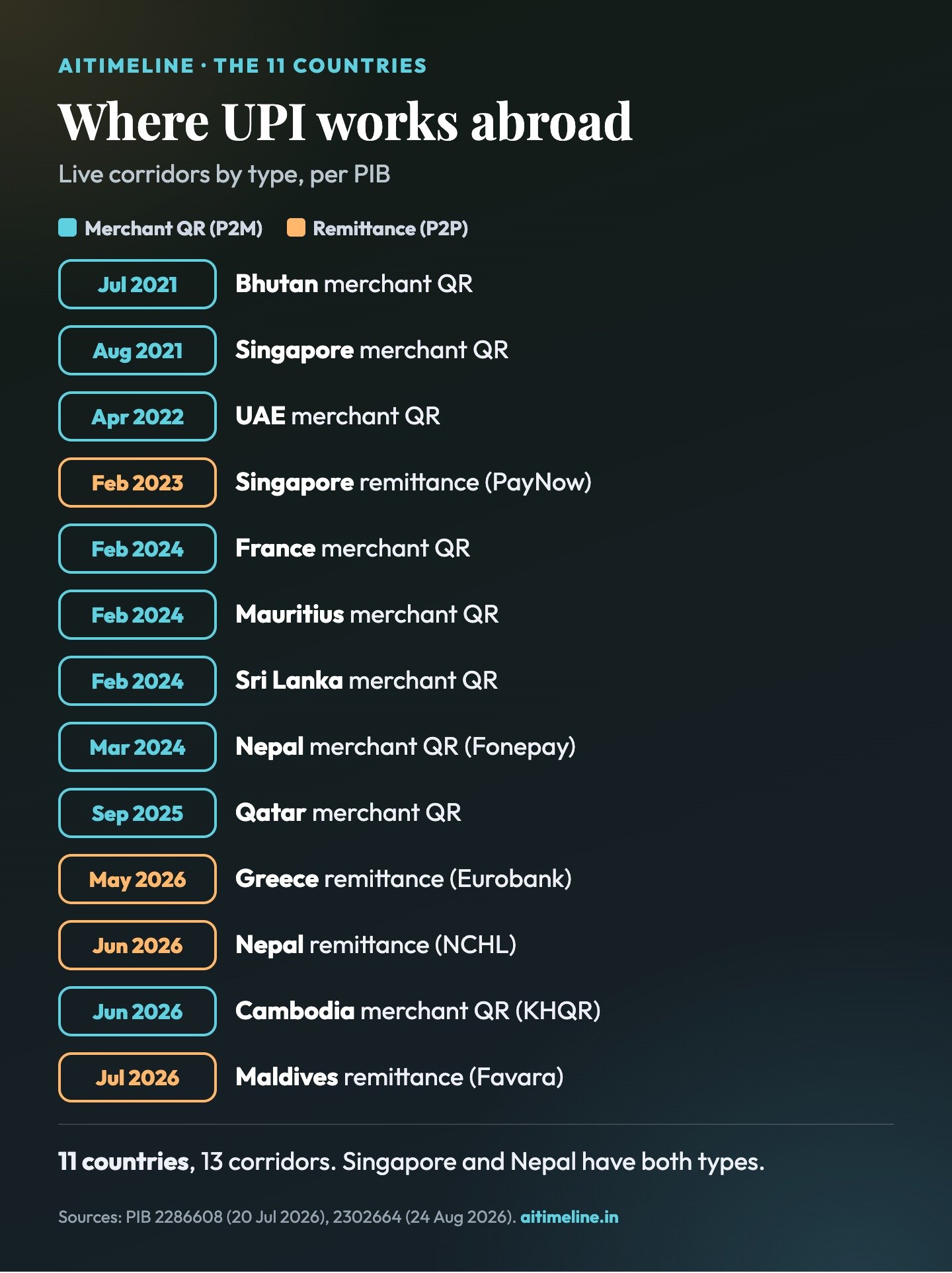
| Country | Live since | Type | Partner institution |
|---|---|---|---|
| Bhutan | July 2021 | Merchant QR | Royal Monetary Authority of Bhutan |
| Singapore | Aug 2021; Feb 2023 | Merchant QR; remittance | NETS, HitPay, LiquidPay; BCS PayNow |
| UAE | April 2022 | Merchant QR | Mashreq NeoPay, Network International, Magnati |
| France | Feb 2024 | Merchant QR | Lyra Network |
| Mauritius | Feb 2024 | Merchant QR | Bank of Mauritius |
| Sri Lanka | Feb 2024 | Merchant QR | LankaPay |
| Nepal | Mar 2024; Jun 2026 | Merchant QR; remittance | Fonepay; Nepal Clearing House |
| Qatar | Sep 2025 | Merchant QR | Qatar National Bank |
| Greece | May 2026 | Remittance | Eurobank |
| Cambodia | Jun 2026 | Merchant QR | ACLEDA Bank |
| Maldives | 30 Jul 2026 | Remittance | Maldives Monetary Authority (Favara) |
The government’s 20 July 2026 table, before the Maldives went live, lists 12 corridors. The Maldives link makes 13 across 11 countries. Availability is not nationwide or universal: it depends on participating banks, payment apps, merchants and local rules.
Three Ways UPI Goes Abroad
Merchant QR, linked systems and technology partnerships.
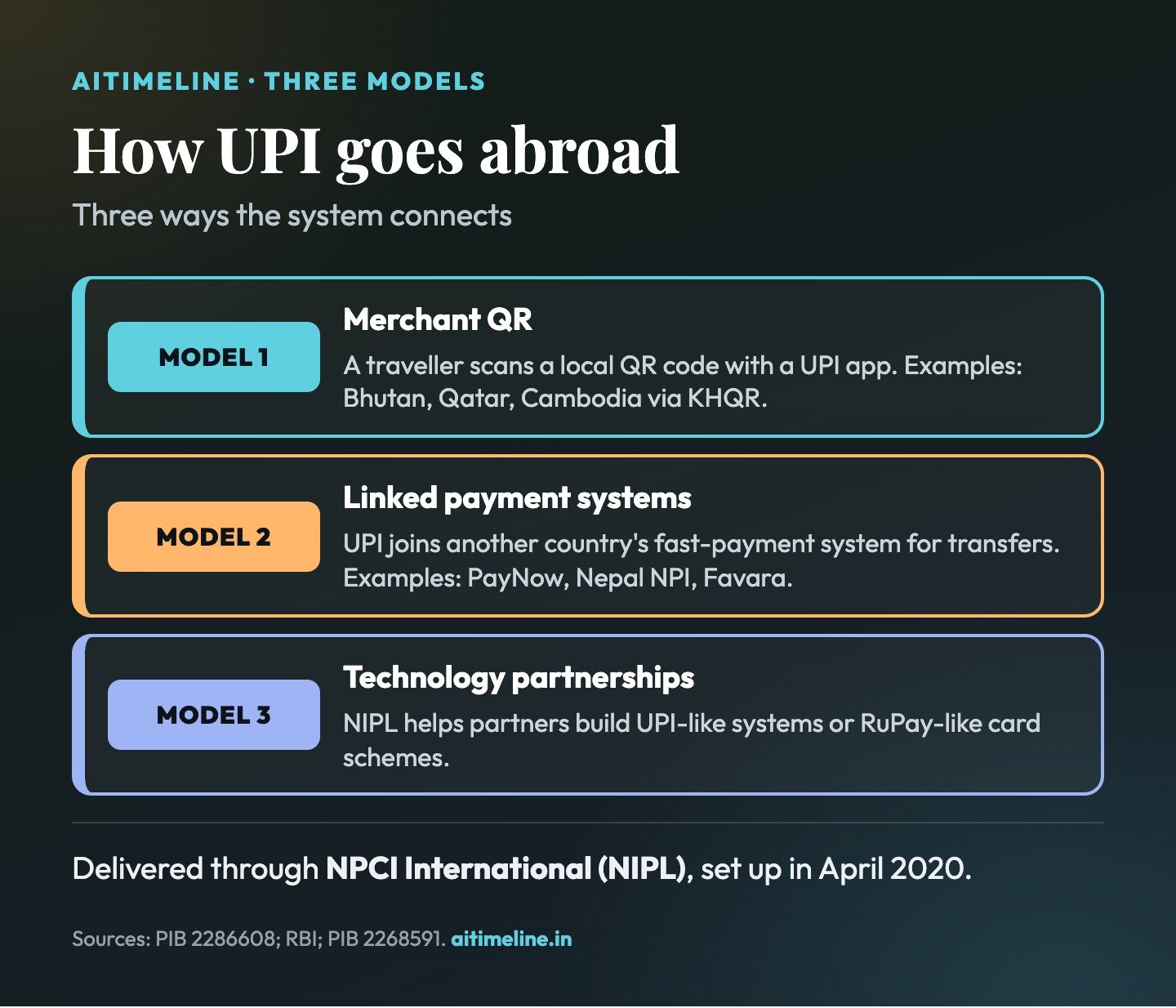
The first two models have live corridors on this page. The third comes from PIB’s description of NIPL’s mandate: helping partner countries build UPI-like systems or RuPay-like card schemes. We did not find a specific live example in the sources we used, so we treat it as a stated aim, not a count.
How a QR Payment Abroad Works
The general flow, in five steps.
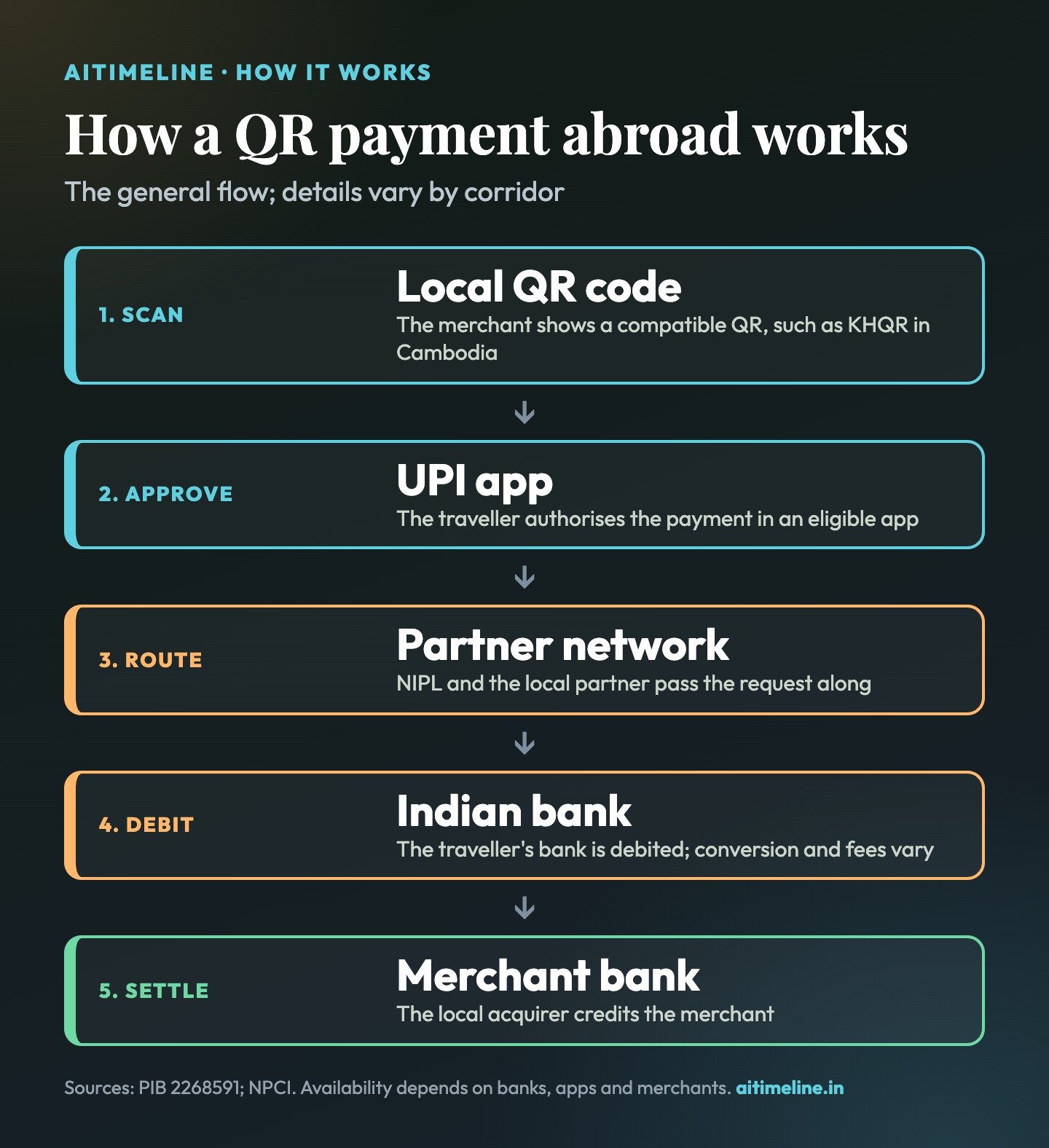
The government releases do not publish a single settlement or fee model, so this flow is general. Exchange rates, fees, limits and who bears dispute handling can differ by corridor and by app.
UPI and PayNow: The First Remittance Link
21 February 2023, India and Singapore.
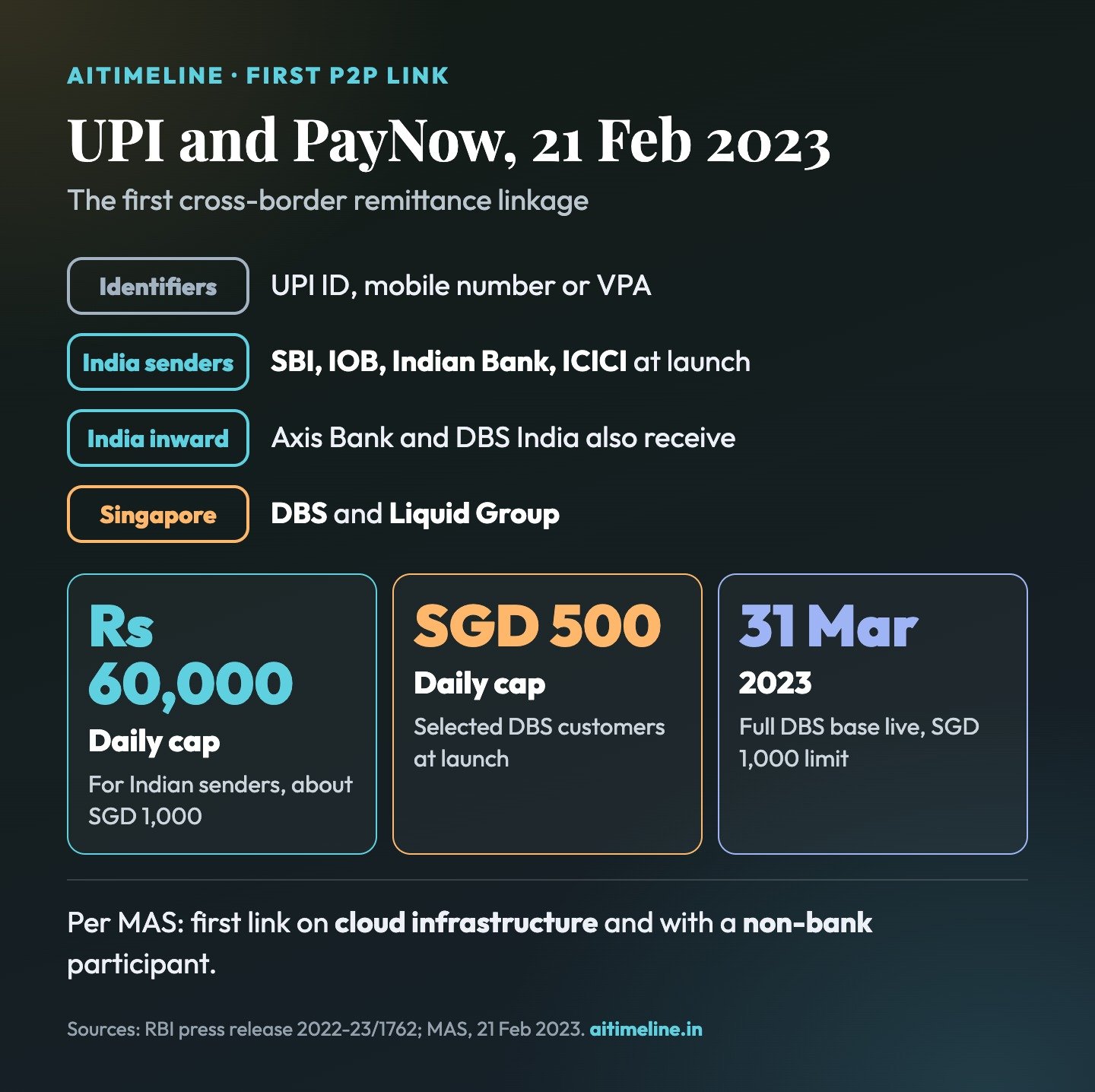
The RBI said the link aligned with the G20’s priorities of faster, cheaper and more transparent cross-border payments. The limits above are launch limits and later changed.
The Domestic Engine Behind the Expansion
UPI volume in crore transactions, FY 2021-22 to FY 2025-26.
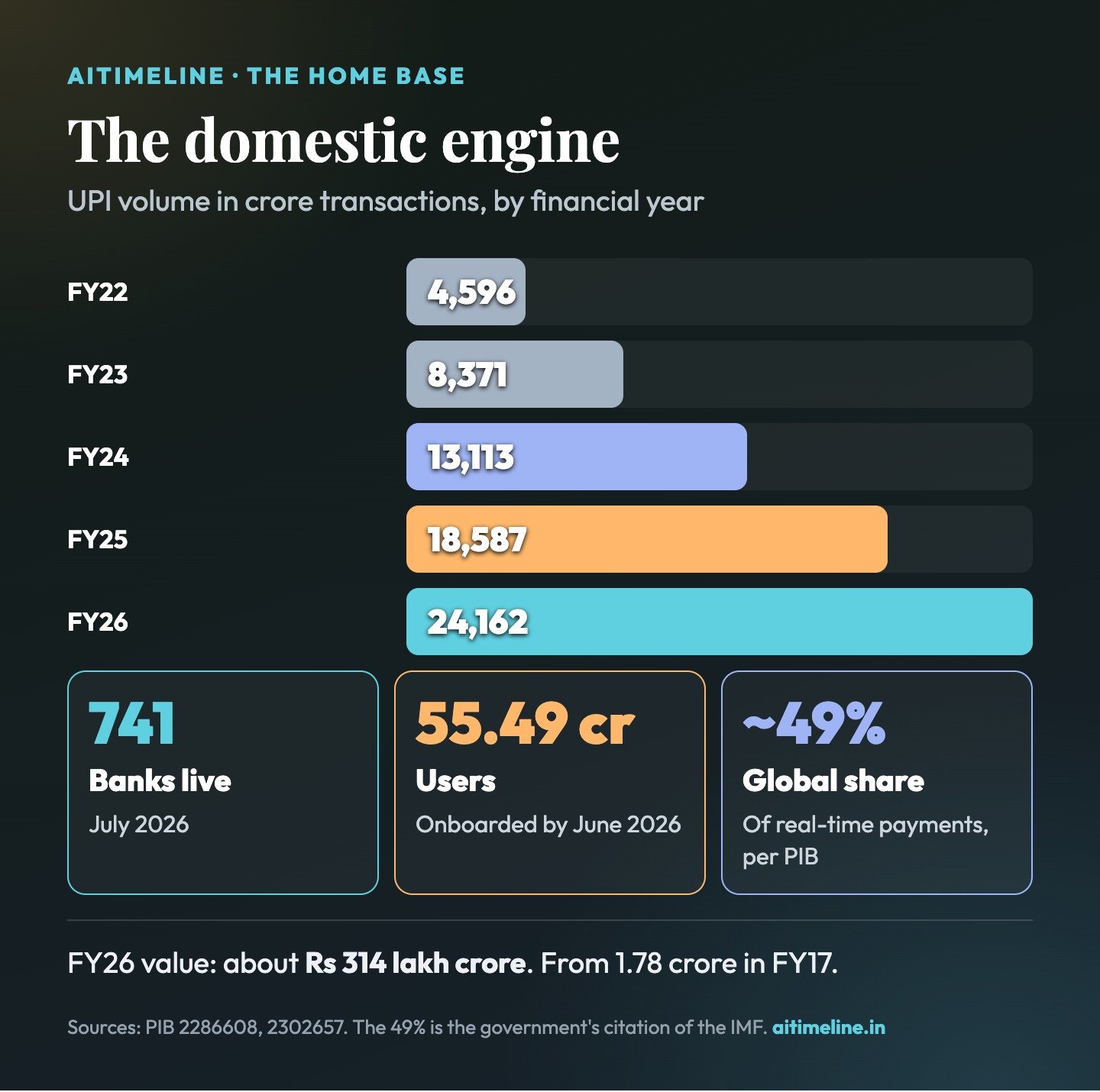
The government says person-to-merchant transactions made up 63 percent of FY 2025-26 volume and person-to-person transfers 71 percent of value. It reports 2,366 crore transactions in July 2026, the highest monthly volume so far. The 49 percent global-share figure is the government’s citation of the IMF, which we did not check against the IMF note.
What Comes Next
Open items as of 29 November 2026.
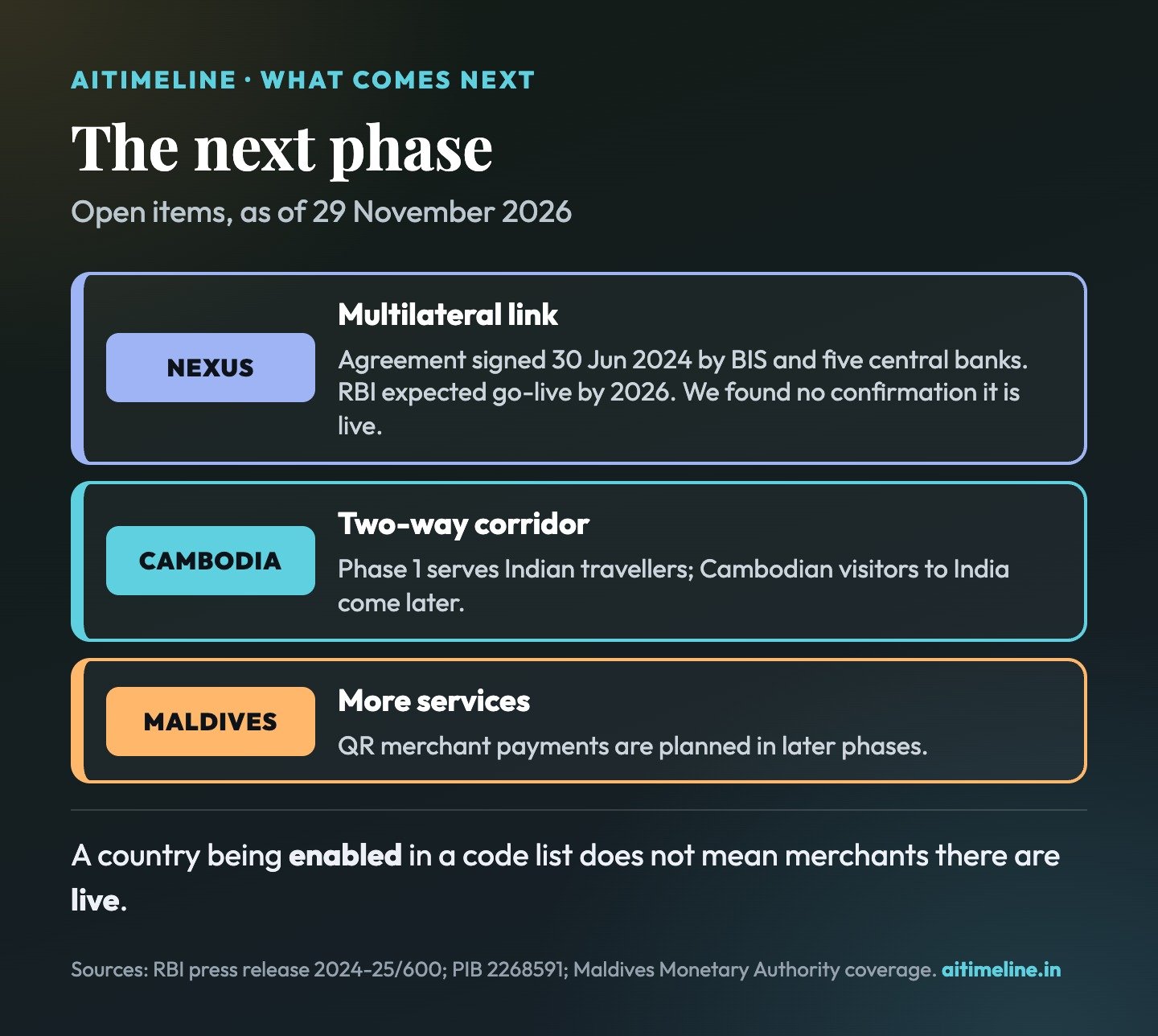
A legal-update summary says NPCI’s 29 April 2026 circular added Bahrain, Cambodia, Canada, Kuwait, New Zealand, Oman, South Africa and Switzerland to the country and currency codes enabled for UPI Global Acceptance. We could not open the circular, and enabling a code in participating institutions’ systems does not by itself mean merchants there are live.
Source Gaps and Corrections
| Claim in the brief | What we found | Status |
|---|---|---|
| Cambodia (3 June) listed before Greece (May 2026) | Greece’s service went live on 21 May 2026, before Cambodia | Reordered |
| Greece live in May 2026 | PIB’s 20 July table says May; its 24 August release says June; the ceremony was late June | Both dates shown |
| RBI announced the Nexus signing on 30 June 2024 | The signing was 30 June in Basel; the RBI release is dated 1 July | Corrected |
| UPI reached the Eiffel Tower on 1 February 2024 | PIB says February 2024; one outlet says 2 February | Hedged |
| UAE partnership was with Mashreq Bank | PIB lists three partners: Mashreq NeoPay, Network International and Magnati | Expanded |
| UPI is 49% of global real-time payments, 2025 | PIB gives 2025 in one release and 2024 in another; not checked against the IMF note | Attributed |
| NPCI April 2026 circular enables eight countries | Only a legal-update summary was readable; the NPCI PDF returned 403 | Attributed |
| Merchant payments in Maldives | The Maldives link is remittances only so far; QR payments are a later phase | Clarified |
| Status as of 29 November 2026 | The latest official count we found is 24 August 2026 | Dated |
Conclusion: From a Home Network to Linked Corridors
UPI’s first step abroad, in Bhutan in 2021, was modest: a QR code accepted by merchants that a visiting Indian could pay. The Singapore PayNow link in 2023 showed that two national fast-payment systems could be joined for person-to-person transfers. The 2024 additions broadened the merchant map, and the 2026 additions in Greece, Nepal and the Maldives were remittance links.
What the record does not show is how many merchants and users each corridor reaches, what fees travellers pay, or whether Project Nexus will join these separate links into one network. The government’s count of 11 countries is a count of connections. The next chapter depends on coverage, cost and the Nexus timetable.
Explore More Timelines
People Also Ask
Frequently Asked Questions
⚠️ Editorial Note
This page draws on Press Information Bureau releases of 20 July, 3 June and 24 August 2026, Reserve Bank of India and Monetary Authority of Singapore releases on PayNow and Project Nexus, NPCI and NIPL announcements, and news coverage of the Greece, Nepal, Qatar, France, Mauritius, Sri Lanka and Maldives launches. Several NPCI and Eurobank pages returned 403 to automated readers, so we relied on coverage of them. Updated 29 November 2026. This is not financial advice; check your bank or app for fees and limits.
Related Stories
Sources & further reading
Every dated entry above was checked against these references. Last reviewed 29 November 2026.
- PIB: UPI completes 10 years of digital payments revolution (24 Aug 2026)
- PIB: UPI, transforming India's payment landscape (24 Aug 2026)
- PIB: UPI transactions and countries using UPI, Lok Sabha reply (20 Jul 2026)
- PIB: NPCI International and ACLEDA Bank launch UPI payments in Cambodia via KHQR (3 Jun 2026)
- Reserve Bank of India: UPI-PayNow linkage launch (21 Feb 2023)
- Monetary Authority of Singapore: Launch of real-time payments between Singapore and India (21 Feb 2023)
- Reserve Bank of India: RBI and ASEAN countries to create a platform for cross-border retail payments, Project Nexus (1 Jul 2024)
- NPCI: BHIM UPI to foray into Bhutan with the Royal Monetary Authority (2021)
- NPCI International: UPI is now accepted in Nepal (Mar 2024)
- Business Today: After France, UPI services now available in Sri Lanka and Mauritius (12 Feb 2024)
- Gulf Times: QNB enables UPI acceptance in Qatar, Qatar Duty Free first live merchant (Sep 2025)
- Eurobank: UPI-based remittance service from Greece to India (21 May 2026)
- Kathmandu Post: Nepal, India launch digital remittance service for migrant workers (9 Jun 2026)
- All India Radio News: Favara-UPI cross-border payment corridor goes live between Maldives and India (31 Jul 2026)
- IMF Fintech Note: Growing Retail Digital Payments, the Value of Interoperability (Jun 2025)