Apollo 13 Failures: How NASA Fixed Critical Spacecraft Issues
Explore the Apollo 13 explosion, NASA's emergency rescue fixes, the oxygen tank investigation and the spacecraft redesign made before Apollo 14 flew.
Latest Story
Apollo 13 failures began with one oxygen tank. On 13 April 1970, about 200,000 miles from Earth, oxygen tank 2 in the Service Module ruptured and took the spacecraft’s power, water and oxygen with it. The Moon landing was cancelled and the crew used the Lunar Module as a lifeboat. All three astronauts landed safely on 17 April. NASA’s Review Board then traced the accident to a chain of earlier mistakes, and the oxygen system was redesigned before Apollo 14. This page follows the rescue and the repair in order, and notes where sources differ.
The failure was a chain, not one part. A 1965 voltage change, a 1968 drop and a 1970 ground-test boil-off all came before the stir switch. “Houston, we’ve had a problem” has two speakers: Swigert said it first and Lovell repeated it. And the fixes are two separate stories: the improvised rescue in flight, and the redesign on the ground afterwards.
💡 Short Answer
Apollo 13 launched on 11 April 1970. At 55 hours 54 minutes 53 seconds, after the crew switched on fans in oxygen tank 2, a short circuit ignited damaged Teflon insulation and the tank failed. The crew moved into the Lunar Module, rigged a carbon dioxide adapter from bags, cardboard, tape and a hose, and splashed down on 17 April. NASA’s Review Board reported on 15 June 1970, and Apollo 14 flew in January 1971 with a redesigned oxygen system.
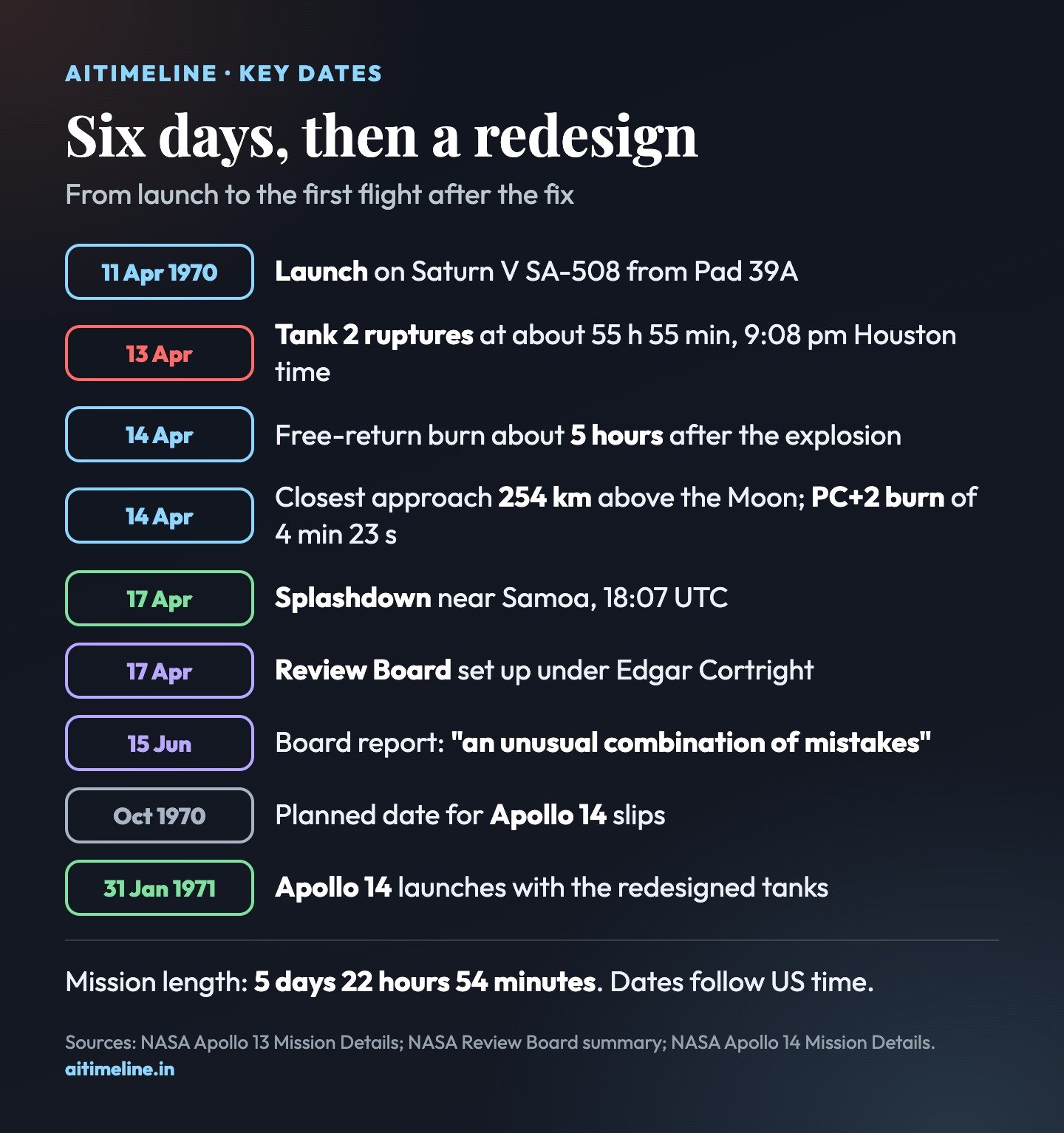
The Lead Picture: Six Days, Then a Redesign
Nine dates from launch to the first flight after the fix.
Apollo 13 Failures: Key Questions
What the Record Shows
- A chain of small things: a 1965 voltage change, a 1968 drop and a 1970 boil-off all preceded the explosion.
- The gauge hid it: the heater temperature gauge read only to 85 F while the heater tube likely reached about 1,000 F.
- 93 seconds: tank 2’s fans went on at 55:53:20 and telemetry dropped at 55:54:53.
- Two voices: Swigert and Lovell both reported the problem, 15 seconds apart.
- A lifeboat stretched: the Lunar Module’s 45-hour design life became about 90 hours.
- Improvised hardware: the carbon dioxide adapter used items already aboard.
- Navigation by the Sun: debris hid the stars, so Lovell aligned on the Sun for the PC+2 burn.
- The Board’s verdict: “an unusual combination of mistakes coupled with a somewhat deficient and unforgiving design.”
- The fix was redesign: fans and thermostat switches removed, a third tank added, wiring sheathed.
- Apollo 14 paid the delay: its launch moved from October 1970 to 31 January 1971.
Timeline: Apollo 13, 1965 to 1971
Newest first. Labels mark background, flight, crisis, rescue, investigation and today.
Where the record stands on 29 November 2026 Today
What is settled: NASA’s Review Board traced the accident to oxygen tank 2 and a chain of earlier mistakes, and the oxygen system was redesigned for Apollo 14 and later flights.
A distance note: Wikipedia says Apollo 13 reached 400,171 km from Earth on 14 April and held the human distance record until Artemis II’s lunar flyby in 2026. We did not check that against a NASA release.
What we did not check: We did not read the full Review Board report, only NASA’s summaries of it, so some engineering detail here is second-hand.
Apollo 14 flies with the redesigned oxygen system Investigation
The flight: Apollo 14 launched on 31 January 1971 and landed in the Fra Mauro region on 5 February, the site Apollo 13 had been meant to reach.
What changed: A third oxygen tank in bay 1 with an isolation valve, no stirring fans, no thermostat switches in the heater circuits, a heater temperature sensor and stainless-steel-sheathed wiring.
Extras: Wikipedia and the Smithsonian also list an emergency water supply of about 19 litres in the Command Module and an extra battery in the Service Module.
Cortright briefs the House committee Investigation
What he said: Cortright set out the Board’s recommendations: redesign and recertify the Service Module oxygen storage system, review every Apollo system using cryogenic oxygen, and make sure anomaly reviews include the full history of a component.
Management: The Board also asked for stronger management and organisation so that engineering and manufacturing processes were properly understood.
The Review Board publishes its report Investigation
The finding: Cortright said the accident “was not the result of a chance malfunction in a statistical sense but, rather, it was the result of an unusual combination of mistakes coupled with a somewhat deficient and unforgiving design.”
The panels: Four panels examined the mission timeline, manufacturing and testing, design, and project management, working with a Manned Spacecraft Center team led by James McDivitt.
How long: NASA’s history office says seven weeks of investigation; the NASA SP-4029 summary says nearly two months.
The Review Board is created the day the crew lands Investigation
Who: NASA Administrator Thomas Paine named Edgar Cortright, director of the Langley Research Center, as chairman. Four days later seven members were named, including Apollo 11 commander Neil Armstrong.
Why it matters: The inquiry started before the crew had left the recovery ship, so evidence and test records were still fresh.
Splashdown in the South Pacific Rescue
Re-entry: Odyssey came in on a shallow path. The communications blackout lasted about six minutes against the roughly four expected, and controllers feared the heat shield had failed, according to Wikipedia.
Landing: The capsule came down southeast of American Samoa, about 6.5 km from the recovery ship. All three astronauts survived; Haise had developed a serious urinary tract infection from too little water.
Afterwards: President Nixon awarded the crew the Presidential Medal of Freedom and the same honour went to the Mission Operations team.
Powering up a cold Command Module Rescue
The procedure: Flight controllers wrote the power-up documents in three days instead of the usual three months, using the Lunar Module’s remaining power.
The cabin: Water droplets covered walls, panels and wire harnesses. NASA says safeguards added after the 1967 Apollo 1 fire meant no arcing took place.
Separation: The Service Module went about four hours before landing and the crew saw a whole panel missing. Aquarius was released about three hours later.
Carbon dioxide: the square-to-round adapter Rescue
The problem: Aquarius was built for two men for about two days and now held three. After about a day and a half a warning light showed carbon dioxide at a dangerous level, reaching 14.9 mmHg.
The fix: The Command Module’s lithium hydroxide canisters were square; the Lunar Module’s openings were round. Mission Control worked out a way to connect them using plastic bags, cardboard, a suit hose and duct tape.
The result: NASA’s technical brief says carbon dioxide fell to about 1 mmHg after the rig went in.
The PC+2 burn and the sun as a guide star Rescue
The burn: Two hours after closest approach to the Moon, Lovell fired Aquarius’s descent engine to speed the trip home and steer toward the Pacific. Wikipedia says it was within a foot per second of the target.
Navigation: Debris from the explosion hid the stars, so Lovell aligned the platform on the Sun. NASA says the alignment was less than half a degree off.
The saving: NASA’s mission page says the burn cut the total trip to about 142 hours.
Around the far side of the Moon Rescue
Why this path: Before the accident the craft had left a free-return path to aim at Fra Mauro. Controllers first put it back on a free-return course with a burn of about 35 seconds, roughly five hours after the explosion.
The view: The crew photographed the Moon from the Lunar Module while the shut-down Command Module sat nearby.
The distance: Wikipedia gives 400,171 km from Earth at closest approach to the Moon.
Aquarius becomes the lifeboat Rescue
The call: One hour and 29 seconds after the bang, Lousma told the crew the oxygen was going to zero and controllers were thinking about the Lunar Module lifeboat. Swigert said the crew had been thinking the same.
The move: With about 15 minutes of Command Module power left, Haise and Lovell floated into the Lunar Module while Swigert finished the last chores.
The stretch: The Lunar Module had a 45-hour design life and was stretched to about 90. NASA says the crew cut power use to a fifth and water to six ounces a day each.
“Houston, we’ve had a problem” Crisis
What was said: Swigert said “Okay, Houston, we’ve had a problem here.” Capcom Jack Lousma asked him to say again, and Lovell replied “Houston, we’ve had a problem. We’ve had a main B bus undervolt.”
What followed: Warning lights showed two of three fuel cells lost. Thirteen minutes after the bang Lovell saw gas venting from the Service Module. Oxygen tank 1 kept losing pressure, which NASA later tied to damage from tank 2.
The first reflex: Before anything else the crew tried to close the hatch to the Lunar Module, as a submarine crew would, but it would not stay shut.
Tank 2 ruptures at 55 hours 54 minutes 53 seconds Crisis
The stir: At 55:52:58 Mission Control asked the crew to stir the cryogenic tanks. Fans in tank 2 went on at 55:53:20. Tank 2 pressure peaked near 1,008 psia at 55:54:45.
The bang: At 55:54:53 telemetry dropped for 1.8 seconds. Oxygen escaping at high speed blew off the bay 4 panel and damaged the high-gain antenna, and oxygen tank 1 or its plumbing was also damaged.
The result: Without oxygen the fuel cells could not make electricity. The Command Module’s normal supply of power, light and water was gone.
Launch, with an early engine shutdown Flight
The anomaly: At about five and a half minutes the centre engine of the S-II stage shut down two minutes early. The other four engines burned 34 seconds longer and the S-IVB nine seconds longer to reach orbit.
The cause: Wikipedia attributes it to pogo oscillations amplified by turbopump cavitation, and says a fix existed but was not yet fitted.
The mood: NASA’s account says it looked like the smoothest flight of the programme. At 46 hours 43 minutes a capcom said, “We’re bored to tears down here.”
Swigert replaces Mattingly Background
The swap: Backup lunar module pilot Charles Duke exposed the crew to German measles. Ken Mattingly had no immunity and was replaced by Jack Swigert.
The date: NASA’s SP-4029 summary says Swigert was named on 10 April, the day before launch; Wikipedia and a NASA summary say three days before. We show both because the sources differ.
Tank 2 will not drain: the eight-hour boil-off Background
The problem: Tank 1 emptied normally but tank 2 only dropped to about 92 percent. Gaseous oxygen pressure through the vent line did not help.
The workaround: After a conference the test director chose to boil the oxygen off with the in-tank heater. It ran on 65 V ground power for about eight hours over five heater cycles.
The hidden damage: The thermostat switches were rated for 28 V. NASA says the heater tube likely reached about 1,000 F, but the gauge read only to 85 F, so nobody saw it. Teflon wire insulation was very likely damaged.
The oxygen tank assembly is dropped Background
What happened: Engineers removing the tank shelf to make design changes dropped it about two inches. Technicians recorded it but did not think it had caused damage.
The path: The assembly was installed in Apollo 13’s Service Module in November 1968. NASA says the drop possibly damaged the fill and drain system.
Heater voltage raised, thermostat switches left behind Background
The change: NASA says improvements in 1965 raised the permissible heater voltage in the oxygen tanks from 28 to 65 V DC, the level used by ground support equipment.
The gap: The thermostat switches were not modified to match. Under 65 V they could weld shut instead of opening at about 80 F.
Ninety-Three Seconds to the Bang
Ground elapsed time, from the NASA chronology.
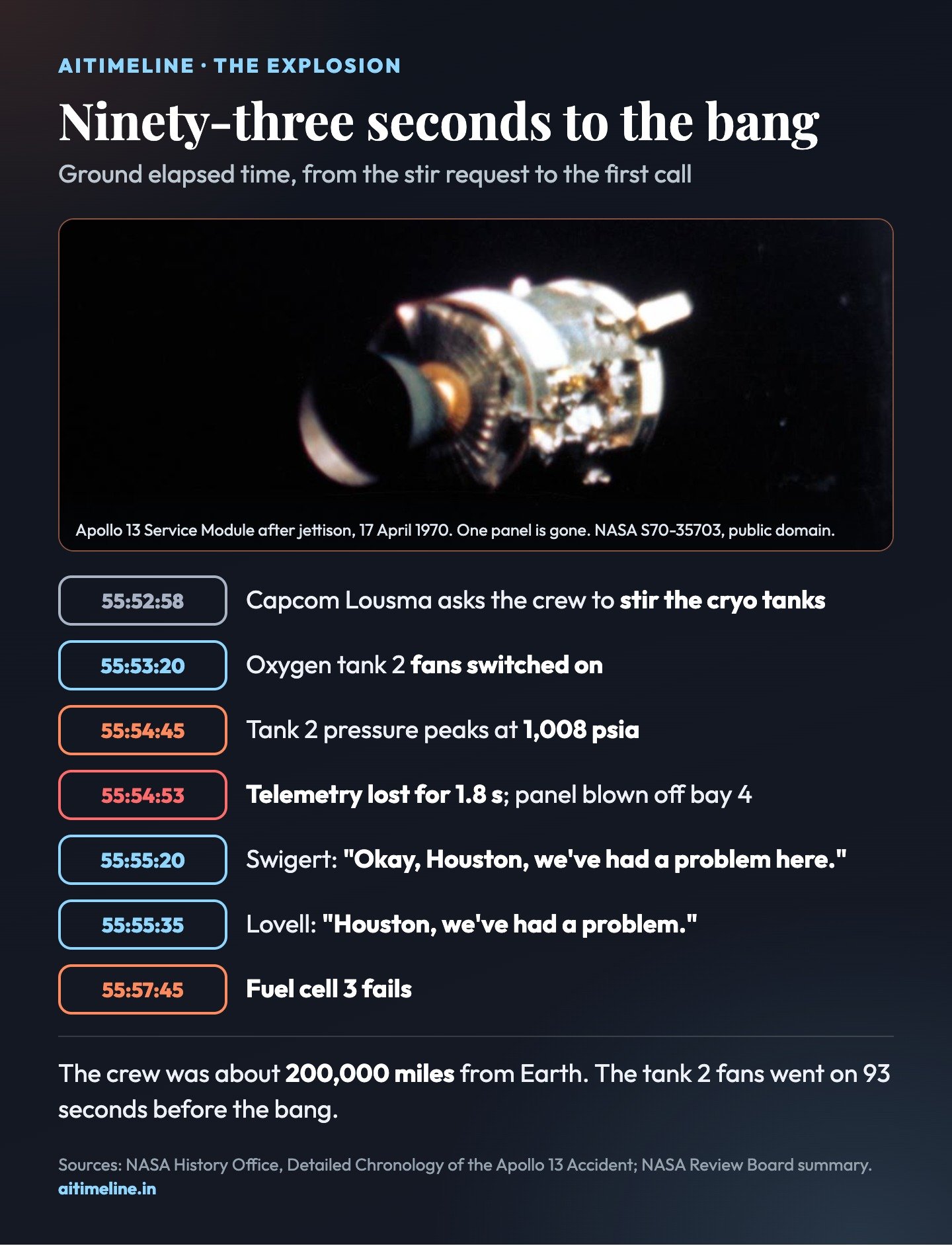
The NASA chronology records the stir request, the fans, the pressure peak and the telemetry loss to the second. The Review Board said data were not adequate to show precisely how tank 2 lost its integrity, but tests showed that a short circuit of roughly 10 to 20 joules was enough to ignite the Teflon in the tank.
How a Hidden Fault Got Built In
1965 to the stir switch.
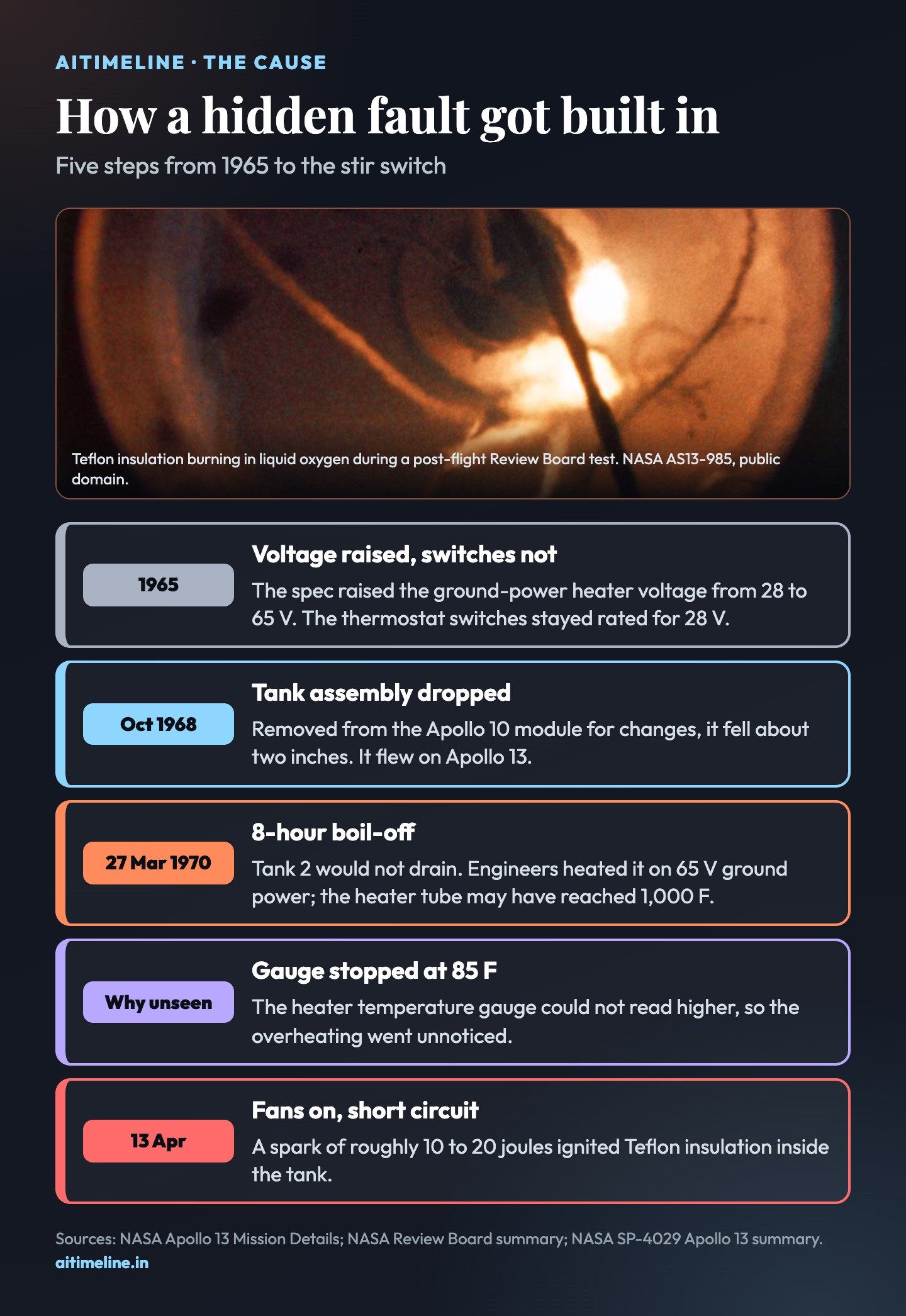
No single step in this chain looked fatal on its own. The drop was logged, the boil-off emptied the tank, and the gauge showed nothing unusual. NASA’s summary says the damaged tank was effectively “a potential bomb the next time it was filled with oxygen.” The Board’s finding is a statement about process: each step was reviewed alone, and nobody looked at the whole history.
A Two-Person Lander, Stretched
Power, water, warmth and weight loss.
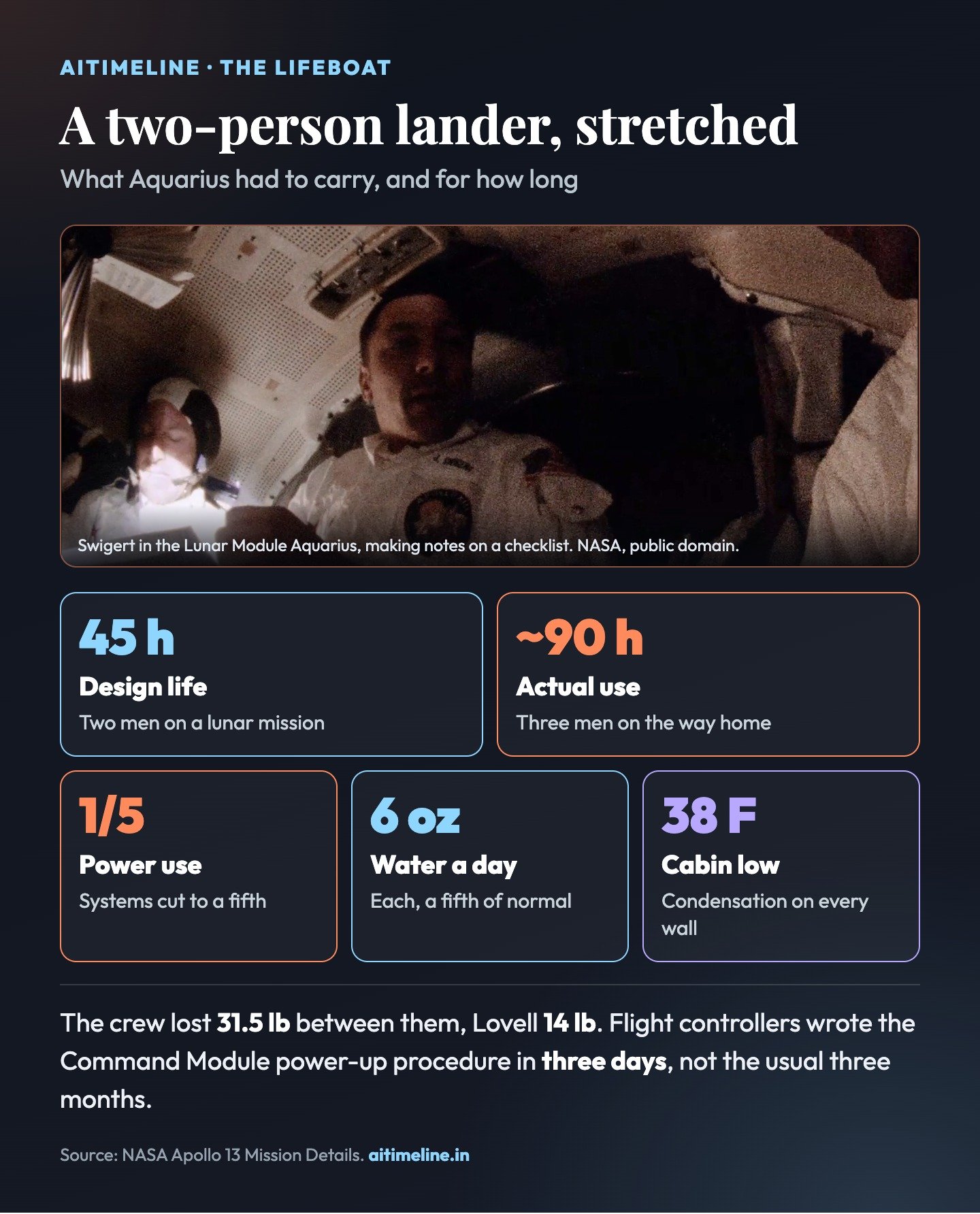
NASA says oxygen was never the limit: the full descent-stage tank alone would have sufficed, and 28.5 lb remained at jettison. Water was the concern, and the crew finished with 28.2 lb, about 9 percent. The Lunar Module also finished with about 20 percent of its electrical power.
Square Canisters, Round Holes
The improvised adapter, step by step.
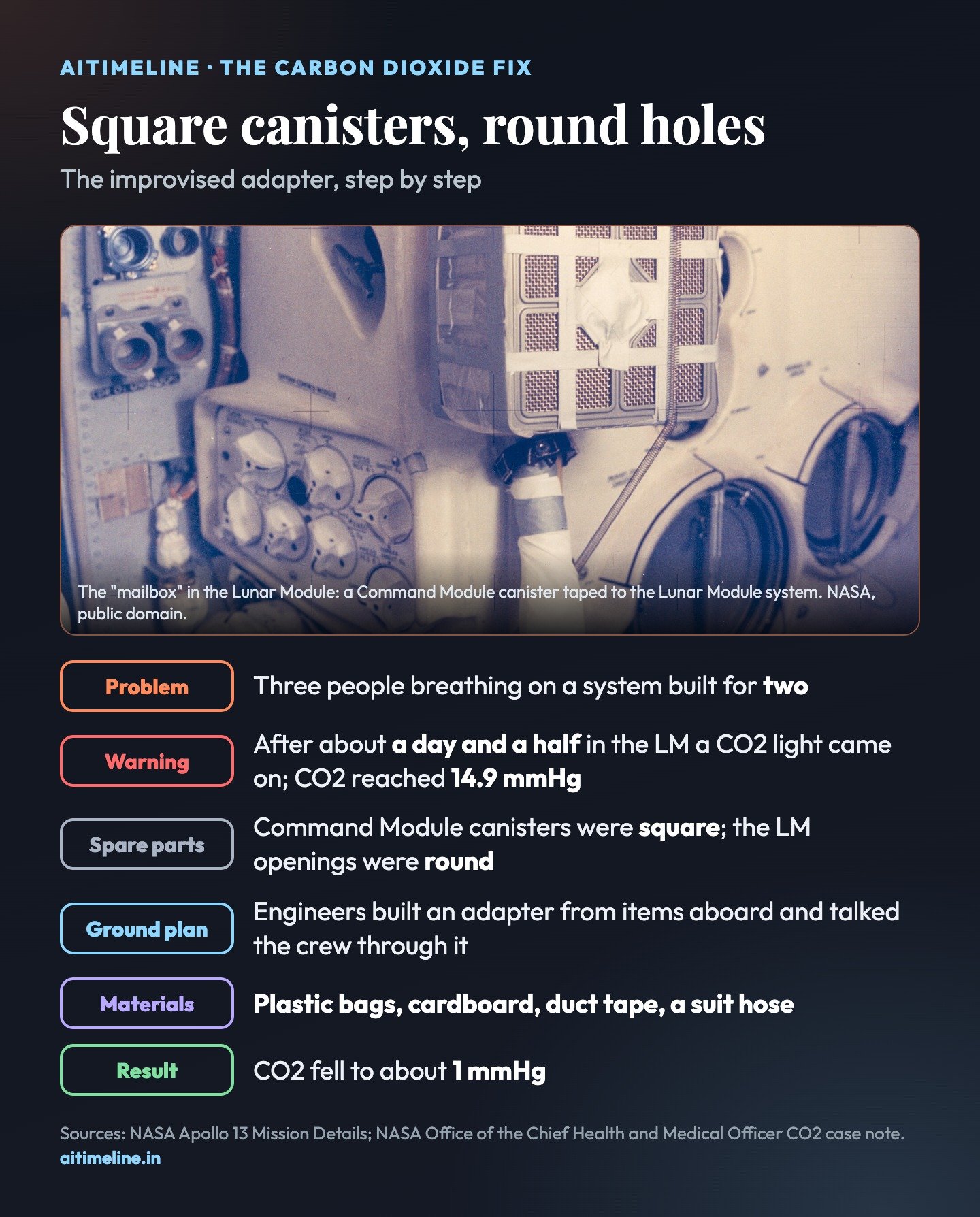
The adapter, known as the mailbox, is among the most photographed objects of the mission. NASA’s technical brief uses the episode to illustrate why crew-interface commonality matters: hardware doing similar jobs should fit together.
The Oxygen Tank, Redesigned
Apollo 13 against Apollo 14 and later flights.
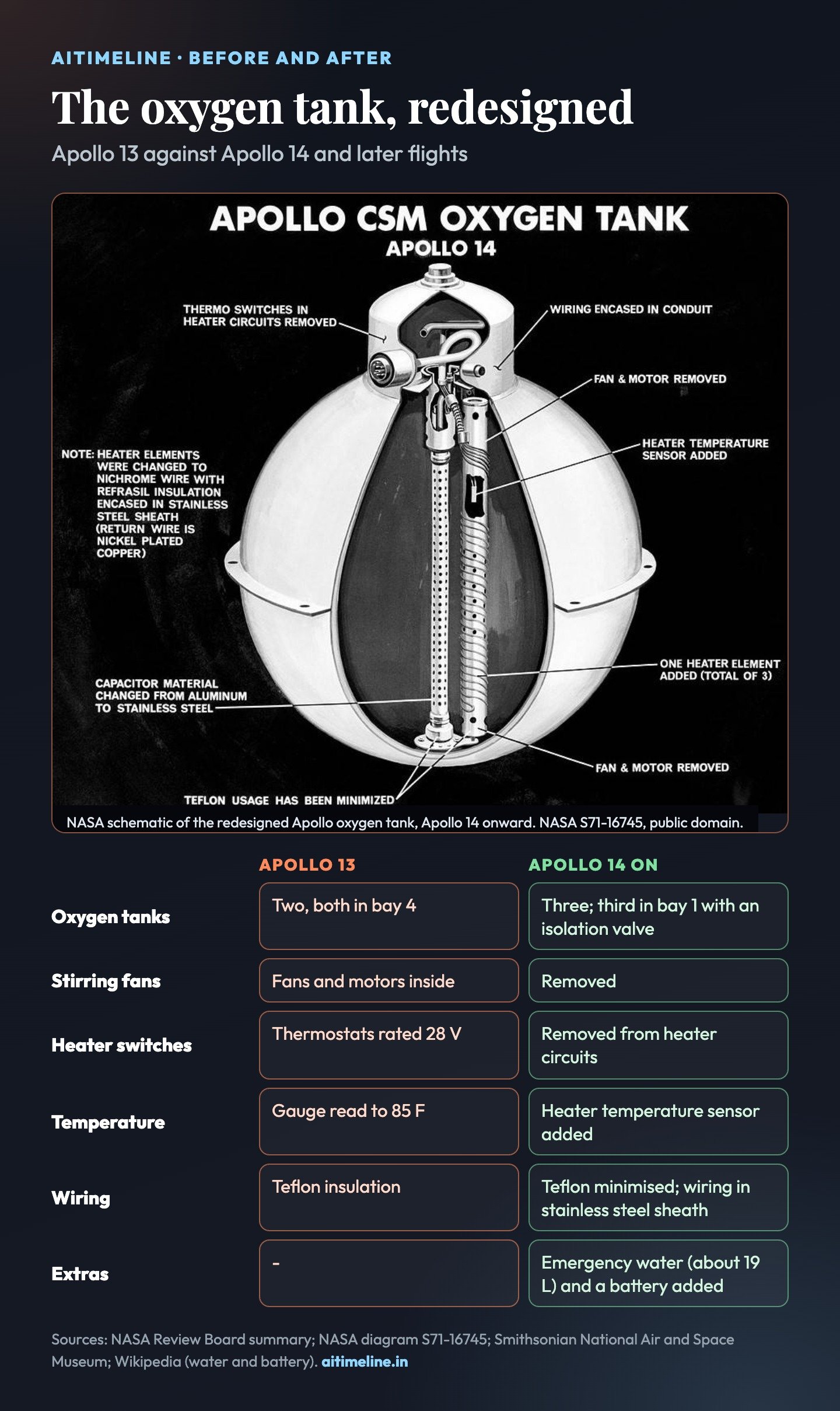
| Change | Why it mattered | Source |
|---|---|---|
| Third tank in bay 1, isolation valve | One failure could no longer take all the oxygen | Wikipedia; Smithsonian |
| Fans and motors removed | Removes electrical equipment from inside the tank | NASA diagram; NASA Board summary |
| Heater thermostat switches removed | Removes the part that failed under 65 V | NASA diagram; Smithsonian |
| Heater temperature sensor added | Overheating would now be visible | NASA diagram |
| Wiring in stainless steel sheath | Protects insulation from damage and ignition | NASA Board summary; Wikipedia |
| Emergency water, extra battery | More margin if the main supplies failed | Wikipedia; Smithsonian |
One point differs between sources: NASA’s Board summary says the thermostats were “upgraded”, while NASA’s own schematic and the Smithsonian say the thermostat switches were removed from the heater circuits. We follow the schematic.
From Inquiry to Apollo 14
The Review Board and its recommendations.
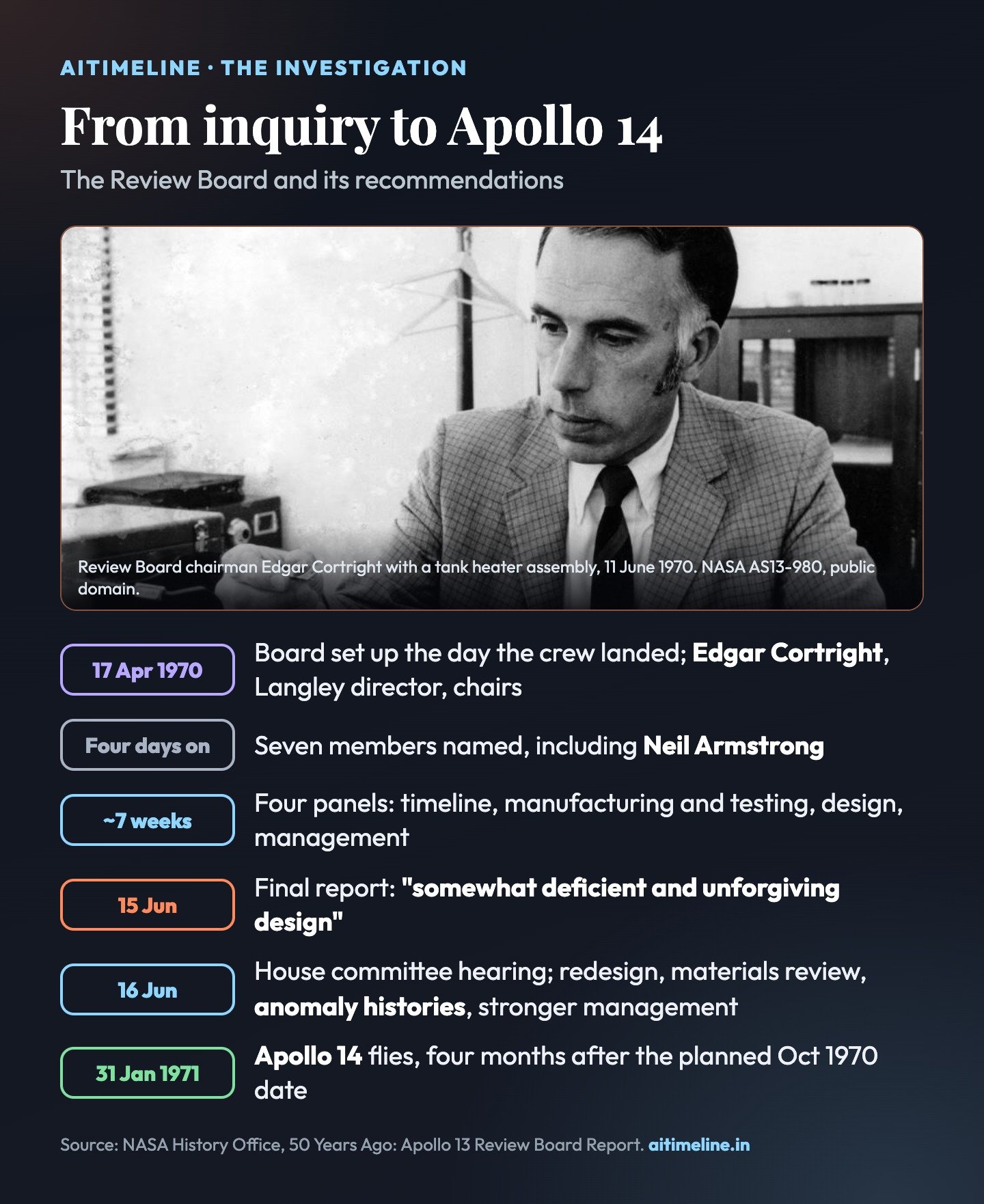
The Board’s recommendations were practical: redesign and recertify the oxygen storage system, review every Apollo system using cryogenic oxygen, make anomaly reviews cover a component’s full history, and strengthen management of engineering and manufacturing. Apollo 14 then used the redesigned tanks.
Source Gaps and Corrections
| Claim in the brief | What we found | Status |
|---|---|---|
| Swigert reported “Houston, we’ve had a problem” | Swigert said “Okay, Houston, we’ve had a problem here”; Lovell then said “Houston, we’ve had a problem” | Corrected |
| About 200,000 miles from Earth | NASA gives 200,000 in one page and 205,000 in another | Hedged |
| The tank was repaired and tested before Apollo 13 | NASA says it was dropped about two inches in October 1968 and engineers believed no damage resulted | Clarified |
| Overheating “likely” damaged wiring | NASA says the heater tube likely reached about 1,000 F; the figure is an estimate | Attributed |
| An engine shut down in the second stage | The centre engine shut down two minutes early; Wikipedia attributes it to pogo | Specified |
| Thermostats improved in the redesign | NASA’s schematic and the Smithsonian say they were removed; one NASA article says “upgraded” | Both shown |
| Swigert’s late replacement of Mattingly | NASA SP-4029 says he was named 10 April; other summaries say three days before launch | Both shown |
| The redesign added a third tank and insulation changes | Emergency water and an extra battery were also added (Wikipedia, Smithsonian) | Expanded |
| Review Board “seven-week” investigation | NASA’s history office says seven weeks; SP-4029 says nearly two months | Both shown |
| Detail from the full Review Board report | We used NASA’s summaries and chronology, not the full report text | Disclosed |
Conclusion: A Rescue, Then a Repair
Apollo 13 is remembered for the rescue: the lifeboat, the adapter, the burn by the Sun’s light. The Review Board’s work is the quieter half. It showed that a spacecraft could pass each test and still carry a flaw built from several small decisions, and that the fix was to remove the part that failed and add margin around it.
Open questions remain about detail rather than outline: the exact way tank 2 lost its integrity, and which of several accounts is right on dates and distances. The NASA record is consistent on the chain of causes and on what changed afterwards.
Explore More Timelines
People Also Ask
Frequently Asked Questions
⚠️ Editorial Note
This page draws on NASA’s Apollo 13 mission pages, the NASA History Office chronology and Review Board summaries, NASA SP-4029, a NASA technical brief on carbon dioxide, the Smithsonian National Air and Space Museum and Wikipedia where noted. Photographs are NASA images in the public domain and are credited on each card. We read NASA’s summaries of the Review Board report, not the full report. Updated 29 November 2026.
Related Stories
Sources & further reading
Every dated entry above was checked against these references. Last reviewed 29 November 2026.
- NASA: Apollo 13 Mission Details
- NASA: Apollo 13, The Successful Failure
- NASA History: 50 Years Ago, Apollo 13 Review Board Report (15 Jun 2020)
- NASA History Office: Detailed Chronology of Events Surrounding the Apollo 13 Accident
- NASA History: 50 Years Ago, Apollo 13 Passes Countdown Test
- NASA History: NASA Lewis Aided Apollo 13 Investigation
- NASA SP-4029: Apollo 13 Mission Summary
- NASA OCHMO: Carbon Dioxide technical brief (Apollo 13 case)
- Smithsonian National Air and Space Museum: Apollo 13 AMA Recap
- NASA NTRS: Report of Apollo 13 Review Board, Final Report (1970)
- NASA: Apollo 14 Mission Details
- Wikipedia: Apollo 13