Anil Menon’s First Spacewalk: What He and Jessica Meir Actually Did Outside the ISS
NASA confirms Anil Menon's first ISS spacewalk with Jessica Meir lasted 6h 27m on Aug 6, 2026 - prepping a power channel for a future solar array.
Latest Story
About 400 kilometres up, there is no floor under an astronaut’s boots – just a visor, a checklist, and the Earth going by underneath at 28,000 kilometres an hour. On August 6, 2026, NASA astronauts Anil Menon and Jessica Meir stepped into that environment through the International Space Station’s Quest airlock, and spent the next six hours and twenty-seven minutes doing something that will never get its own movie: routing hardware onto a power channel so that, months from now, a new solar array can be unrolled in the right spot. No dramatic repair, no emergency. Just the kind of exacting, unglamorous work that keeps a 27-year-old orbiting laboratory running – and that happens to be, for one of the two astronauts doing it, the single hardest thing he had ever trained for. What exactly did Menon and Meir do out there, and why did it take two human beings in pressurized suits to do it? That’s the actual story.
🧠 AI Overview Summary
On August 6, 2026, NASA astronauts Anil Menon and Jessica Meir completed a 6-hour, 27-minute spacewalk outside the International Space Station (8:33 a.m. to 3:00 p.m. EDT), designated US Spacewalk 96 – the 281st spacewalk in ISS history. They installed the seventh and final set of mounting hardware on the station’s 3B power channel, clearing the way for a future roll-out solar array (iROSA) to be attached later in 2026. It was Menon’s first career spacewalk and Meir’s sixth. Near the end of the EVA, a carbon dioxide sensor on Menon’s suit gave an unexpected reading; it normalized after the suit was removed, but NASA delayed the next spacewalk (US EVA 97) to August 18 while engineers review it.
What Menon and Meir Actually Did, and Why
What’s Actually Confirmed
- NASA’s numbers are exact, not estimates: 6 hours 27 minutes, 8:33 a.m. to 3:00 p.m. EDT, Menon’s 1st EVA, Meir’s 6th.
- The primary objective was completed: mounting hardware for the station’s 3B power channel, the last of seven such installations NASA has run across multiple 2026 spacewalks.
- No solar array was installed during this EVA – Menon and Meir prepared the channel; the actual roll-out array arrives and gets attached in a separate future step.
- A carbon dioxide sensor on Menon’s suit gave an unexpected reading near the end of the EVA. He reported no other issues, and the reading normalized once the suit came off.
- That sensor event pushed the next spacewalk (US EVA 97) to August 18 while engineers evaluate whether to swap suits – a real operational consequence, not a footnote.
- This was Expedition 75’s first spacewalk, under commander Jessica Meir, who took command from Roscosmos’s Sergey Kud-Sverchkov on July 26, 2026.
- Menon is a NASA astronaut, not an ISRO astronaut – his Indian heritage (Kerala roots, on his father’s side) is real and documented, but this mission has no institutional connection to India’s Gaganyaan programme.
- It was the 281st spacewalk in the ISS program’s history, dating to December 1998.
The August 6 Spacewalk, By the Numbers
Completed
Official Record
In Progress
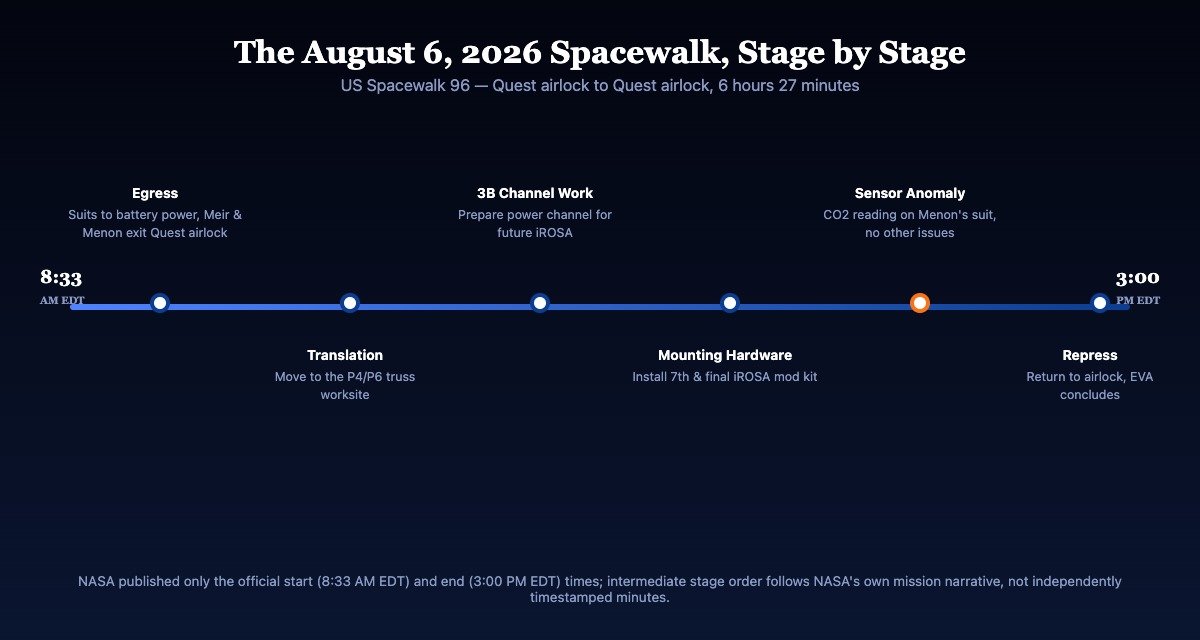
NASA published only the official start and end times – everything between is the mission’s own narrated sequence, not independently timestamped minutes.
What Happened on August 6, 2026
The confirmed sequence, without invented timestamps
At 8:33 a.m. EDT, Menon and Meir switched their Extravehicular Mobility Unit suits to internal battery power inside the Quest airlock – the formal, NASA-recognized start of the EVA – and moved out into vacuum. From there they translated along handrails to their worksite on the station’s power truss, where the day’s task list centered on one specific piece of infrastructure: power channel 3B. Over the following hours they installed a modification kit – the physical mounting hardware a future solar array will eventually bolt onto – completing what NASA has described as the seventh and final set of this kind of mounting hardware across its 2026 spacewalk campaign. NASA’s own reporting does not break the EVA into a minute-by-minute public timeline beyond the start and end times, so this account follows the stages NASA’s mission narrative confirms occurred, without assigning invented clock times to each one.
Both astronauts completed their primary objective. Toward the end of the spacewalk, a carbon dioxide sensor built into Menon’s suit returned a reading NASA characterized as “unexpected.” Menon himself reported no other symptoms or issues at the time, and standard procedure continued: the pair completed their return to the airlock and repressed at 3:00 p.m. EDT, closing out a 6-hour, 27-minute EVA. Once Menon’s suit was off and back inside the station, the sensor’s reading returned to normal – but NASA has been explicit that engineers need “the coming days” to evaluate whether that suit should be swapped before its next use, which is why the following spacewalk moved from its original date to August 18.
| Time (EDT) | Event | Status | Source |
|---|---|---|---|
| 8:33 AM | Suits switch to battery power; EVA officially begins, Quest airlock | Confirmed | NASA ISS blog, Aug 6 2026 |
| Mid-EVA | Translation to P4/P6 truss worksite; 3B channel mounting-hardware installation | Confirmed (no exact time published) | NASA ISS blog, Aug 6 2026 |
| Late in EVA | Unexpected CO2 sensor reading on Menon’s suit; no other issues reported | Confirmed (no exact time published) | NASA ISS blog, Aug 7 2026 |
| 3:00 PM | Return to Quest airlock; repress; EVA concludes (total 6h 27m) | Confirmed | NASA ISS blog, Aug 6 2026 |
NASA did not publicly specify exact clock times for the intermediate translation, hardware-installation or sensor-anomaly stages – this article does not estimate them.
What Were They Actually Installing?
In plain terms: Menon and Meir were not installing a solar panel. They were installing the bracket-and-cable hardware – NASA calls it a modification kit – that a future solar array needs already in place before it can ever be attached. Think of it as running conduit and mounting a bracket on a wall before the new light fixture arrives, rather than hanging the fixture itself.
More technically: the ISS delivers power to its systems through a set of designated power channels, each fed by a pair of solar array wings on the station’s truss. Channel “3B” is one of these. NASA’s iROSA (ISS Roll-Out Solar Array) program adds a newer, more efficient array in front of each channel’s original array – but that requires new mounting struts, electrical connections and a modification kit physically attached to the truss structure first, which is exactly the mounting-hardware task Menon and Meir completed. NASA described this as the seventh and final set of this specific hardware installed across its 2026 EVA series, meaning the prep work for this round of upgrades is now structurally complete on the 3B channel – the array itself is a separate delivery and separate future installation.
Put together, the work supports the station’s broader power upgrade: more efficient current-generation panels supplementing arrays that have been generating electricity in orbit since the early 2000s, extending both the station’s available power budget and, by extension, the research it can support.
How the ISS Actually Generates Electricity
The International Space Station runs entirely on sunlight. Its solar arrays – the large panel “wings” visible in every photo of the station – contain photovoltaic cells that convert sunlight directly into electrical current, the same basic principle as a rooftop solar panel, just built for vacuum, radiation and 16 sunrises a day. That power charges batteries for the roughly 35 minutes per 90-minute orbit when the station is in Earth’s shadow, then runs everything on board directly the rest of the time: life support, experiments, communications, temperature control, lighting.
The original arrays, installed during station assembly beginning around 2000, use silicon photovoltaic cells on rigid, folded panels that unfurl like an accordion. After two-plus decades in orbit, exposed to atomic oxygen, radiation and thermal cycling, their output has degraded from their beginning-of-life performance – a normal, expected aging process for any solar hardware, not a failure. Rather than replace the entire array structure (a far larger and riskier undertaking), NASA’s approach has been to add newer, more efficient panels alongside the old ones on the same mounting points – which is the entire reason astronauts need to go outside and physically prep each channel first.
Why NASA Is Adding New Solar Arrays
ISS Roll-Out Solar Arrays (iROSA), explained
An iROSA is exactly what its name says: a solar array that rolls out, the way a tape measure unspools, rather than unfolding from a rigid accordion structure. That design lets it launch tightly wound into a compact cylinder – far less mass and volume than a rigid panel of equivalent output – then deploy autonomously once installed. Each iROSA uses triple-junction gallium arsenide solar cells, a more efficient photovoltaic technology than the station’s original silicon cells, and the finished arrays are roughly 20% lighter than rigid panels delivering the same power.
NASA began adding iROSAs to the station in 2021, installing them in front of – not instead of – the original arrays on select power channels. With the program’s earlier arrays already in place, station-wide power generation has increased by more than 30%. The mounting hardware Menon and Meir installed on August 6 prepares the 3B channel for what NASA has referred to as a seventh array in this series, continuing that same upgrade approach: newer panels layered onto proven mounting infrastructure, channel by channel, spacewalk by spacewalk.
It’s worth being precise about scope here: this is a space station power upgrade, not a template for any lunar or Mars solar-power system – different environment, different structure, different engineering constraints entirely.
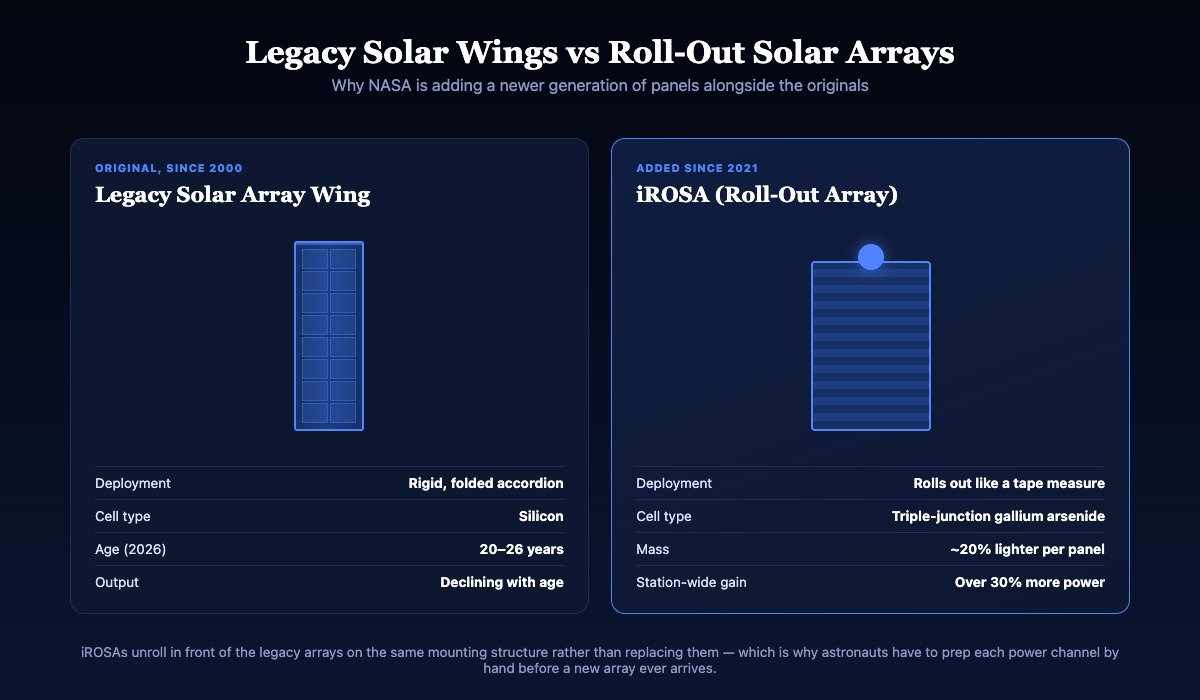
Newer panels layer onto the same mounting structure as the originals – which is why the prep work has to happen by hand, on the outside of the station, before a new array ever arrives.
Anil Menon: Flight Surgeon, Engineer, First-Time Spacewalker
Anil Menon’s path to the outside of the space station ran through two entirely different careers first. Born October 15, 1976, and raised in Minneapolis, Minnesota, to Ukrainian and Indian immigrant parents, he studied neurobiology at Harvard before turning to medicine and engineering: a master’s in mechanical engineering and a medical degree, both from Stanford, followed by residencies in emergency medicine and aerospace medicine. Before he was ever a NASA astronaut, he was a practicing emergency physician, a U.S. Air Force flight surgeon who flew more than 100 sorties in F-15s, and – notably – SpaceX’s first-ever flight surgeon, helping stand up the medical side of the company’s human spaceflight program for its Demo-2 crewed test flight. He joined NASA as a flight surgeon in 2014, supporting ISS crew members through Soyuz missions, before NASA selected him as an astronaut candidate in its 2021 class; he reported for astronaut duty in January 2022.
Menon launched to the ISS on July 14, 2026, aboard Roscosmos’s Soyuz MS-29, alongside cosmonauts Pyotr Dubrov and Anna Kikina, on a mission expected to run roughly eight months. He initially joined the outgoing Expedition 74 crew before transitioning to Expedition 75 under Jessica Meir’s command on July 26. His August 6 EVA – preparing the 3B power channel – was his first spacewalk and his primary technical assignment of the mission’s early weeks.
Why a First Spacewalk Is Such a Big Deal
Every astronaut who has ever done a spacewalk trained for it first in a 40-foot-deep pool at NASA’s Neutral Buoyancy Laboratory, running full task sequences underwater in a suit weighted to simulate zero gravity, over and over, until the choreography of translating, tethering, and operating tools with thick pressurized gloves becomes close to automatic. It is genuinely different from anything else in human spaceflight: unlike launch or reentry, where the vehicle does most of the work, an EVA is hours of continuous, physically taxing manual work, conducted in a one-person spacecraft (the suit itself), with mission control watching every step and a more experienced crewmate as the immediate safety backstop.
That is precisely the role Jessica Meir played for Menon on August 6 – not just a task partner, but the astronaut whose five prior EVAs meant she could recognize, in real time, whether something unfolding outside the station was routine or not. Even veteran astronauts describe a first EVA as one of the most demanding days of a career: full-body physical workload against a pressurized glove and suit for six-plus hours, the mental load of executing a precise task list with no easy do-overs, and total dependence on a communication loop to Mission Control that never really goes quiet. None of that is exaggeration for effect – it’s the baseline reality NASA’s own training program is built around, which is exactly why first EVAs are still treated as a milestone worth marking, without needing to inflate the description of what happened.
Jessica Meir: From Comparative Physiologist to Station Commander
Jessica Meir’s route to commanding the space station started in ocean science, not aerospace. She holds a PhD in comparative physiology, with doctoral research examining how animals – emperor penguins and bar-headed geese among them – survive in extreme low-oxygen environments, work she conducted in part through the Scripps Institution of Oceanography. NASA selected her as an astronaut in 2013. Her first spaceflight, launched via Soyuz MS-15 in September 2019 as part of Expedition 61/62, produced a moment that made global headlines: on October 18, 2019, she and Christina Koch conducted the first all-female spacewalk in history, replacing a failed battery charge-discharge unit on the station’s Port-6 truss. Two more spacewalks with Koch followed in January 2020, both continuing station battery-replacement work, bringing her first-flight EVA total to three.
Meir returned to spaceflight in 2026, this time in command: she launched as commander of SpaceX Crew-12 on February 13, 2026, arriving at the ISS the next day alongside NASA’s Jack Hathaway, ESA’s Sophie Adenot and Roscosmos’s Andrey Fedyaev. She conducted two further spacewalks with NASA astronaut Chris Williams that spring and summer – March 18 (Williams’ first EVA, prepping IROSA channels 2A and 3B) and June 30 (replacing a failed Canadarm2 wrist joint) – before becoming Expedition 75’s commander on July 26, 2026, taking the handover from Roscosmos’s Sergey Kud-Sverchkov. Her sixth career EVA, alongside Menon on August 6, brought her cumulative spacewalk time to 42 hours and 33 minutes.
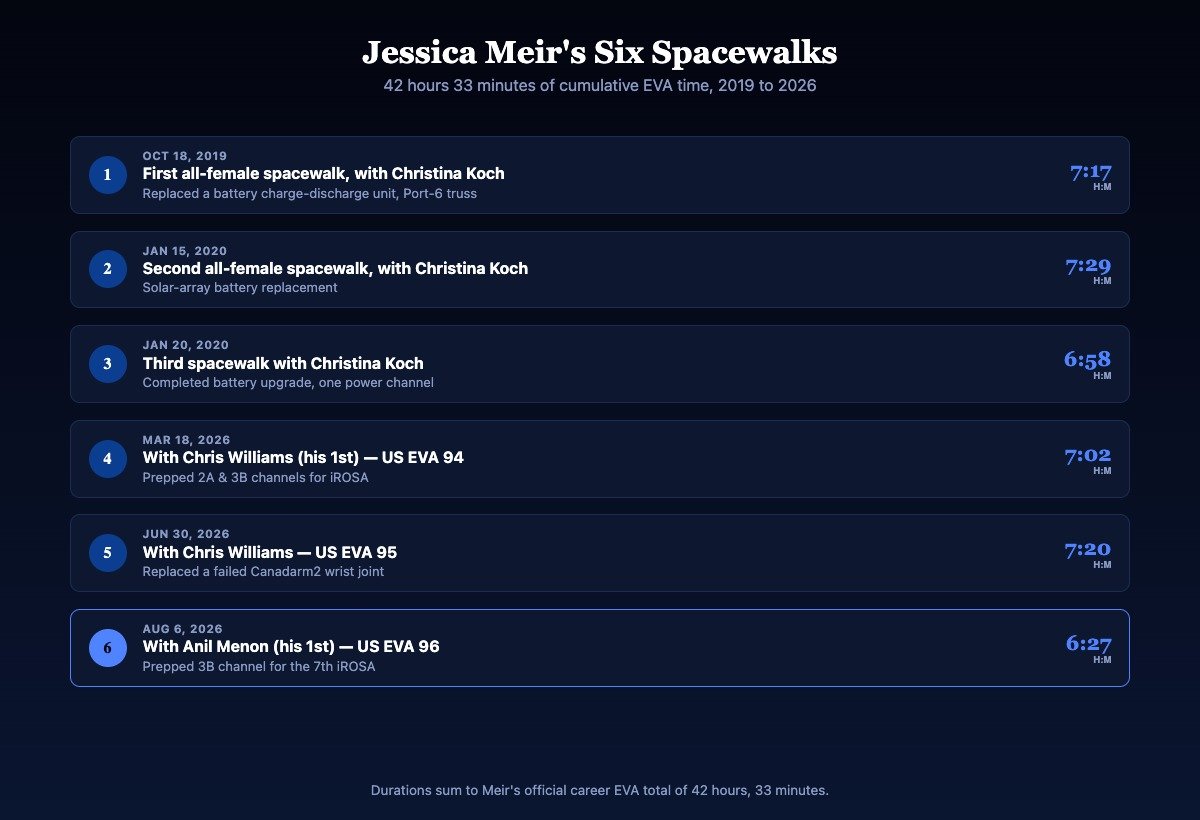
Six EVAs, three different partners, one consistent thread: battery and power-system work.
Jessica Meir’s Complete Spacewalk History
| # | Date | Partner | Objective | Duration |
|---|---|---|---|---|
| 1 | Oct 18, 2019 | Christina Koch | Battery charge-discharge unit replacement (first all-female spacewalk) | 7h 17m |
| 2 | Jan 15, 2020 | Christina Koch | Solar-array battery replacement (second all-female spacewalk) | 7h 29m |
| 3 | Jan 20, 2020 | Christina Koch | Completed battery upgrade, one power channel | 6h 58m |
| 4 | Mar 18, 2026 | Chris Williams (his 1st) | US EVA 94 – prep 2A & 3B channels for iROSA | 7h 02m |
| 5 | Jun 30, 2026 | Chris Williams | US EVA 95 – replaced failed Canadarm2 wrist joint | 7h 20m |
| 6 | Aug 6, 2026 | Anil Menon (his 1st) | US EVA 96 – prep 3B channel for 7th iROSA | 6h 27m |
Total career EVA time: 42 hours, 33 minutes. Note the multi-year gap between EVA 3 (Jan 2020) and EVA 4 (Mar 2026) – Meir’s second spaceflight began in February 2026.
Expedition 75
Expedition 75 began on July 26, 2026, when outgoing commander Sergey Kud-Sverchkov (Roscosmos) formally handed control of the station to Jessica Meir at a change-of-command ceremony, shortly before Kud-Sverchkov, cosmonaut Sergei Mikaev and NASA’s Chris Williams departed for landing in Kazakhstan, closing out Expedition 74. Expedition 75’s crew combines Meir’s Crew-12 team – Meir, Jack Hathaway, Sophie Adenot and Andrey Fedyaev – with the Soyuz MS-29 arrivals who joined a few weeks earlier: Anil Menon, Pyotr Dubrov and Anna Kikina.
With two experienced power-system spacewalkers already on board (Meir and, on the Russian side, Kud-Sverchkov’s EVA experience during Expedition 74) and a fresh iROSA delivery approaching later in the year, Expedition 75 was always going to be a spacewalk-heavy stretch – NASA had three EVAs planned for August alone before the crew even finished handover activities.
The Three August 2026 Spacewalks
| EVA | Date | Astronauts | Objective | Status |
|---|---|---|---|---|
| US Spacewalk 96 | Aug 6, 2026 | Jessica Meir, Anil Menon | 3B power channel mounting hardware (7th iROSA prep) | COMPLETED |
| US Spacewalk 97 | Rescheduled to Aug 18, 2026 | Not yet named at time of publication | Replace a Space-to-Ground antenna for Mission Control data/comms | RESCHEDULED |
| US Spacewalk 98 | Aug 25, 2026 (planned) | Not yet named at time of publication | Power-channel cabling/data relay work, Harmony-module docking aid replacement, HD camera swap | SCHEDULED |
US Spacewalk 97’s delay is a direct, disclosed consequence of the CO2 sensor reading on Menon’s suit during EVA 96 – not an unrelated scheduling change.
Why Astronauts Still Do This By Hand
The ISS has a capable robotic arm system – Canadarm2, plus the smaller Dextre manipulator – and mission planners use them whenever a task allows it, precisely because robotic work carries no life-support risk. But robots on the station still can’t fully substitute for a human EVA on tasks like this one: routing and connecting cables through tight clearances, torquing bolts to precise specifications by feel, visually inspecting hardware for damage a camera might not catch at the right angle, and adapting on the fly when something doesn’t fit exactly as planned. Mounting-hardware installation involves exactly this kind of fine manipulation and real-time judgment – Canadarm2 can position an astronaut or move large payloads, but it doesn’t have hands. That gap between “wanted these bolts torqued and this cable routed” and “a robot can currently do that unsupervised in vacuum” is the entire reason EVA remains one of the most demanding, and most necessary, forms of human spaceflight.
Inside the Spacesuit
NASA’s EMU (Extravehicular Mobility Unit) is, functionally, a one-person spacecraft. It supplies oxygen from a backpack life-support system, scrubs exhaled carbon dioxide (the exact system that flagged the unexpected reading on Menon’s suit), circulates cooling water through a garment worn against the skin to manage heat the vacuum can’t carry away by convection, and maintains an internal pressure low enough to allow movement but high enough to keep an astronaut’s blood and tissue functioning normally. The helmet includes a sun visor and communications equipment linking the astronaut to their crewmate and to Mission Control continuously throughout the EVA. Gloves are the suit’s most technically difficult component: pressurized fabric and joints stiff enough to hold shape against internal pressure, yet still required to manipulate small tools and connectors for hours. A SAFER unit (Simplified Aid For EVA Rescue) – a small self-contained propulsion backpack – and a tether system are both standard safeguards against the scenario of an astronaut becoming separated from the station.
How Dangerous Is a Spacewalk?
Honestly assessed: an EVA carries real risk, and NASA’s entire preparation process is built around managing it rather than pretending it away. The suit is the only thing standing between an astronaut and vacuum, temperature swings that run from roughly +120°C in direct sunlight to -100°C in shadow, unshielded radiation, and the small but nonzero chance of a micrometeoroid or orbital debris impact. Tether discipline, redundant life-support systems, a buddy system with a more experienced crewmate, exhaustive pre-EVA equipment checks, and direct real-time monitoring from Mission Control all exist specifically to manage those risks down to a level NASA is willing to accept for planned, essential maintenance work. The CO2 sensor event on August 6 is itself a useful illustration of how that system is supposed to work: an anomaly was detected, monitored, and – rather than dismissed – used to justify delaying the next EVA until engineers could review it on the ground. That is redundancy functioning as intended, not a near-miss story.
The View From Outside
The ISS completes an orbit of Earth roughly every 90 minutes, which means a six-and-a-half-hour EVA spans multiple sunrises and sunsets – each one arriving and departing far faster than anything on Earth, the terminator line sweeping across the planet below in minutes rather than hours. Outside the suit there is no sound to carry, no air to carry it in; whatever an astronaut hears during an EVA is the suit’s own systems and the voice loop to Mission Control and their EVA partner. NASA has not published a specific quote from Menon or Meir describing this particular spacewalk’s view or experience, so none is invented here – but the physical contrast is built into the job itself: routine, checklist-driven engineering work, performed inside one of the most visually extraordinary vantage points a human being can occupy.
Why This Spacewalk Matters to the ISS’s Future
None of this is a single dramatic save. It’s a station in its late operational decades – NASA and its partners have discussed a planned deorbit around the end of the decade – being kept at full research capacity in the meantime through exactly this kind of incremental hardware work: aging silicon arrays supplemented rather than replaced, mounting points prepped channel by channel, one EVA at a time. More available power means more capacity for the station’s research program, more margin against any single system’s degradation, and more operational reliability for the years the ISS has left. US Spacewalk 98 later in August, notably, is explicitly tied by NASA to preparations connected to the station’s eventual deorbit planning – a reminder that even “routine maintenance” spacewalks in 2026 sit inside a station with a defined, if still years-off, endpoint.
ISS Timeline: The Short Version
US Spacewalk 98 planned
What: Power-channel cabling and data-relay connections, a docking navigational aid swap on the Harmony module, and a high-definition camera replacement – work NASA has tied to preparations connected to the station’s eventual deorbit.
US Spacewalk 97 rescheduled to Aug 18
What: A Space-to-Ground antenna replacement, delayed from its original date while engineers evaluate the CO2 sensor reading from Menon’s suit on EVA 96. Spacewalkers not yet named as of this article’s publication.
Menon and Meir complete US Spacewalk 96
What: 6h 27m EVA; 3B power channel mounting hardware installed; Menon’s 1st, Meir’s 6th spacewalk; CO2 sensor anomaly noted late in the EVA.
Expedition 75 begins
What: Command handover from Kud-Sverchkov to Meir; Williams, Kud-Sverchkov and Mikaev depart, landing in Kazakhstan, closing Expedition 74.
Menon launches on Soyuz MS-29
What: Launched with Roscosmos cosmonauts Pyotr Dubrov and Anna Kikina; joins Expedition 74 ahead of the transition to Expedition 75.
Meir’s 5th spacewalk (US EVA 95)
What: Replaced a failed Canadarm2 wrist joint. Duration 7h 20m.
Meir’s 4th spacewalk (US EVA 94)
What: Prepped IROSA channels 2A and 3B – the first EVA in the mounting-hardware series that August 6 completed. Duration 7h 02m.
Meir launches as Crew-12 commander
What: Launched with Jack Hathaway, Sophie Adenot and Andrey Fedyaev; arrived at the ISS Feb 14, beginning her second spaceflight.
Menon reports for astronaut duty
What: Began astronaut candidate training after his 2021 NASA selection, following eight years as a NASA flight surgeon.
Meir’s 2nd and 3rd spacewalks
What: Continued the station’s solar-array battery replacement campaign. Combined with EVA 1, brought her first-flight total to 21h 44m.
Meir’s 1st spacewalk – first all-female EVA
What: Replaced a failed battery charge-discharge unit on the Port-6 truss – the first all-female spacewalk in spaceflight history. Duration 7h 17m.
Meir selected as a NASA astronaut
What: Selected after a career in comparative physiology research, including doctoral work through Scripps Institution of Oceanography.
NASA begins installing iROSA arrays
What: First roll-out solar arrays added to the station, beginning the upgrade program that August 6, 2026’s mounting-hardware work continues.
Continuous human presence begins
What: Expedition 1 arrives; the ISS has been continuously crewed ever since, and its original solar arrays are the same generation now being supplemented by iROSA.
First ISS module launches
What: Zarya launches, followed weeks later by Unity – the start of the assembly process, and the reference point for “the 281st ISS spacewalk” that August 6, 2026 became.
Anil Menon vs Jessica Meir: Complementary, Not Competing
Two very different paths to the same worksite
The point isn’t who has “more” experience – it’s the standard EVA pairing model: an experienced spacewalker paired with a first-timer, so the crew always has someone who has done this before.
The India Connection – Carefully Stated
Anil Menon’s Indian heritage is real, documented, and worth explaining accurately rather than either ignoring or overselling it. His father’s family traces to Ottapalam in Kerala; Indian outlets have reported him as the first person of Kerala origin, and among the first of Indian heritage generally, to perform a spacewalk. That is a legitimate, sourced fact. What it does not mean: Anil Menon is not an ISRO astronaut, has no operational assignment with India’s space agency, and this was not “India’s first spacewalk” – no astronaut selected and flown by ISRO has yet conducted an EVA. He is, straightforwardly, a NASA astronaut on a NASA/Roscosmos mission, whose family background happens to include Indian roots several generations back.
That distinction matters for a country that is watching its own human-spaceflight program develop in parallel. India’s interest in Menon’s mission sits alongside – not inside – its Gaganyaan programme, ISRO’s own effort to launch Indian astronauts on an Indian-built spacecraft. The two are unconnected institutionally: different agency, different spacecraft, different training pipeline, different timeline. NASA and ISRO do cooperate on specific, documented programs – the NISAR Earth-observation satellite, launched jointly, is the clearest current example – but that cooperation has not extended to Gaganyaan crew training or hardware, and nothing about Menon’s NASA assignment changes that.
Anil Menon / Soyuz MS-29
NASA astronaut, 2021 selection class, flying to the ISS on a Roscosmos Soyuz under a long-standing NASA-Roscosmos seat-exchange arrangement. No ISRO affiliation.
Gaganyaan
ISRO’s independent human-spaceflight programme: an Indian-built crew capsule, Indian-trained astronauts, launched on an Indian rocket. Institutionally separate from NASA’s ISS operations.
Explore More Timelines
Myth vs Fact
❌ Common Myths
- Anil Menon is an ISRO astronaut.
- This was India’s first spacewalk.
- Menon and Meir installed the complete new solar array on August 6.
- A spacewalk means astronauts are completely exposed to the vacuum of space.
- Spacewalks are mainly emergency repairs.
✅ What’s Actually True
- Menon is a NASA astronaut with no operational ISRO role; his Indian heritage is a family/heritage fact, not an institutional one.
- No ISRO-trained astronaut has yet performed a spacewalk – Gaganyaan has not yet flown a crewed mission.
- They installed mounting hardware only; the roll-out solar array itself is a separate future delivery and installation.
- The EMU spacesuit is a self-contained life-support system – pressure, oxygen, cooling and communications all included.
- Most modern ISS spacewalks, including this one, are planned maintenance and upgrade work, not emergency response.
Things Worth Knowing
- Meir’s six spacewalk durations sum to exactly her official career total: 42 hours, 33 minutes.
- August 6, 2026 was the 281st spacewalk in ISS history – a program running continuously since December 1998.
- The CO2 sensor that flagged an anomaly on Menon’s suit is part of the same life-support loop that scrubs exhaled carbon dioxide throughout an EVA.
- Meir’s doctoral research, before she became an astronaut, examined how emperor penguins and bar-headed geese survive extreme low-oxygen conditions – a scientific background with an odd resonance for someone who now manages oxygen supply for a living in vacuum.
- iROSA arrays are roughly one-quarter the launch volume of a rigid array with equivalent output, because they roll up rather than fold.
- Menon logged over 100 F-15 combat sorties as a flight surgeon before ever training as an astronaut.
⚠️ Editorial Note
This article distinguishes NASA’s confirmed, official figures (spacewalk duration, start/end times, EVA counts) from reported operational details (the CO2 sensor evaluation, the EVA 97 reschedule) and from this publication’s own explanatory synthesis (the plain-language power-system and spacesuit explainers). Where NASA has not published an exact timestamp or detail, this article says so explicitly rather than estimating. No quotes are attributed to Anil Menon or Jessica Meir in this article because none from this specific spacewalk were found in NASA’s or other authoritative reporting at time of publication. Details reflect the best publicly available reporting as of August 9, 2026, and will be revised as NASA publishes further updates – including once US Spacewalk 97’s crew is named.
Sources & further reading
Every dated entry above was checked against these references. Last reviewed 15 September 2026.
- NASA - Astronauts Complete Spacewalk for Solar Array Modifications
- NASA - Space Station Crew Wraps Busy Week, Plans New Date for US Spacewalk 97
- NASA - Spacewalkers Prepare to Exit Station for Solar Array Mod Work
- NASA - Astronaut Anil Menon biography
- NASA - Astronaut Jessica U. Meir biography
- NASA - International Space Station Spacewalks
- NASA - Impact Story: Roll-Out Solar Arrays
- Space.com - NASA astronauts conduct 6.5-hour spacewalk to prep ISS for solar array upgrade