NVIDIA History: From Gaming Graphics to AI Dominance
NVIDIA history from the 1993 founding and GeForce 256 to CUDA, AlexNet, Hopper, Blackwell and Rubin, and how data centres grew to 12x gaming revenue.
Latest Story
NVIDIA did not set out to build the AI industry. In 1993 three engineers started a company to make video games look better. The chip they eventually built, the GPU, did one thing well: thousands of simple calculations at the same time. Thirty-three years later that same idea runs the world’s AI. This NVIDIA history follows the chain of decisions that got it there: GeForce 256 in 1999, CUDA in 2006, AlexNet in 2012, Tensor Cores in 2017, Hopper in 2022, Blackwell in 2024 and Vera Rubin in 2026, and the numbers that show how far it moved. In fiscal 2026 NVIDIA earned $193.7 billion from data centres and $16.0 billion from gaming.
💡 Short Answer
NVIDIA was founded in 1993 to make 3D graphics chips for PC games. In 1999 it launched the GeForce 256, which it called the first GPU. In 2006 CUDA let anyone program its GPUs for general maths. When AlexNet trained on two NVIDIA gaming cards in 2012, deep learning moved onto GPUs, and NVIDIA rebuilt its chips, systems and software around AI. In fiscal 2026 Data Center earned $193.7 billion, about 90% of revenue, against $16.0 billion from gaming.
How NVIDIA Became an AI Company: Key Questions
NVIDIA’s Transformation in Ten Lines
- 1993: Founded to make 3D graphics chips for PC games.
- 1995-1997: The NV1 nearly kills the company; the RIVA 128 saves it.
- 1999: Nasdaq IPO and the GeForce 256, marketed as the first GPU.
- 2006: CUDA turns every GeForce card into a programmable parallel computer.
- 2012: AlexNet trains on two gaming GPUs and deep learning moves to NVIDIA.
- 2016-2017: DGX-1 systems and Volta Tensor Cores: chips designed for AI first.
- 2019-2020: Mellanox gives NVIDIA the networking that joins thousands of GPUs.
- 2022-2023: Hopper H100 meets the ChatGPT boom; NVIDIA hits $1 trillion.
- 2024-2026: Blackwell and Rubin turn the product from a chip into a whole rack.
- FY2026: $215.9 billion revenue, about 90% from data centres.
The One Idea Behind Everything: Parallel Computing
Why a chip for games ended up running AI.
A CPU is built to do many different things, one after another, very quickly. It is good at branching logic: open this file, check that condition, jump there. A GPU is built to do one simple thing to millions of pieces of data at the same time. Shading a 4K game frame means running similar maths on about 8.3 million pixels, sixty times a second.
Training a neural network turns out to be the same kind of work: multiplying huge grids of numbers, billions of times. Nobody at NVIDIA designed the GeForce for that in 1999. But when researchers went looking for cheap parallel maths in the 2000s, the most powerful parallel processors in the world were sitting in gaming PCs.
NVIDIA’s history can be read as one technology being repurposed again and again: 3D graphics, programmable GPUs, scientific computing, CUDA, deep learning, AI supercomputers, generative AI, AI factories. The skill was in noticing each new use and building for it before rivals did.
One idea, seven forms: tap each stage
The same principle, doing many simple calculations at once, turned into a different product every few years. Tap a stage to see what changed.
The Revenue Shift: Gaming Versus Data Center
The clearest evidence of how far NVIDIA moved.
For most of its life NVIDIA was a gaming company in its accounts. As late as fiscal 2022 (ended January 2022) Gaming was its largest segment at $12.5 billion. Data Center passed it the following year. Then generative AI arrived: Data Center tripled in fiscal 2024, more than doubled in fiscal 2025, and reached $193.7 billion in fiscal 2026.
Gaming did not shrink to get there. It grew from $4.1 billion in fiscal 2017 to $16.0 billion in fiscal 2026. It simply became small next to the data-centre business.
NVIDIA Timeline: 1993 to 2026
Newest first. Products, deals and turning points.
A 96.2 billion dollar quarter
NVIDIA reports record revenue of $96.2 billion for the quarter ended 26 July 2026, up 106% from a year earlier. Data Center brings in $89.0 billion, up 117%. Edge Computing, the new segment that now holds PCs, gaming, workstations, robotics and cars, is $7.2 billion. It guides to about $108 billion for the next quarter, and says Vera Rubin is deployed at CoreWeave, Google Cloud, Microsoft Azure, Oracle and Nebius.
Vera Rubin enters full production
On 20 May NVIDIA reports $81.6 billion for its first fiscal-2027 quarter and retires its old reporting lines. It now reports two platforms, Data Center and Edge Computing, so gaming no longer has its own line. On 31 May it says Vera Rubin is ramping into full production across 350+ factories in 30 countries, with 150+ partners in Taiwan. The flagship Vera Rubin NVL72 links 72 Rubin GPUs and 36 Vera CPUs; NVIDIA claims up to 10x agent throughput versus Grace Blackwell. Earlier that month, on 13 May, NVIDIA became the first company valued at $5.5 trillion.
GTC 2026: Rubin, Groq LPUs and Feynman
Jensen Huang presents Vera Rubin as seven chip types working as one AI supercomputer, now including a Groq 3 LPU for fast inference. The roadmap adds Rubin Ultra in a new Kyber rack for 2027 and an architecture called Feynman for 2028. The pitch is no longer a faster GPU each year but a new generation of the whole data centre.
Fiscal 2026: $215.9 billion
NVIDIA closes fiscal 2026 with $215.9 billion in revenue, up 65%. Data Center: $193.7 billion, of which networking is $31.4 billion. Gaming: $16.0 billion, up 41%. Professional Visualization $3.2 billion, Automotive $2.3 billion. Data Center is now about 90% of the company and more than 12 times gaming.
Rubin unveiled; China door opens a crack
At CES, NVIDIA introduces the Rubin platform as six chips designed together: Vera CPU, Rubin GPU, NVLink 6 Switch, ConnectX-9 SuperNIC, BlueField-4 DPU and Spectrum-6 Ethernet switch. On 15 January the US Commerce Department moves H200 exports to China from presumed denial to case-by-case licensing, with a 25% cut to the US government and volume caps. Chinese buyers, following Beijing’s guidance, hold back.
The Groq deal
NVIDIA agrees to pay about $20 billion to license the inference-chip technology of Groq and hire founder Jonathan Ross, who earlier helped start Google’s TPU project, along with other leaders. Groq stays an independent company. It is NVIDIA’s largest deal ever and its first big move into non-GPU AI chips.
Intel, OpenAI and $5 trillion
NVIDIA takes a $5 billion stake in Intel (18 September) and signs a letter of intent with OpenAI to invest up to $100 billion as OpenAI deploys at least 10 gigawatts of NVIDIA systems (22 September). On 29 October 2025 NVIDIA becomes the first company worth $5 trillion, barely three months after passing $4 trillion on 9 July.
DeepSeek shock and the H20 ban
After Chinese lab DeepSeek releases a strong model it says was trained cheaply, NVIDIA shares fall about 17% on 27 January, erasing about $589 billion in value, the largest one-day loss in US market history. In April the US requires licences for the H20, the chip NVIDIA had designed to meet earlier China rules; NVIDIA takes a $4.5 billion charge.
Blackwell and the world’s most valuable company
NVIDIA announces Blackwell: two dies joined into one GPU with 208 billion transistors, sold in rack systems such as the GB200 NVL72 (72 GPUs, 36 Grace CPUs). A 10-for-1 stock split takes effect on 10 June; on 18 June NVIDIA briefly becomes the world’s most valuable company at about $3.3 trillion. In November it replaces Intel in the Dow Jones Industrial Average.
The first chip company worth $1 trillion
Six months after ChatGPT launched on 30 November 2022, NVIDIA forecasts about $11 billion in quarterly sales, far above expectations, as cloud companies race to buy H100s. On 30 May 2023 it becomes the first chipmaker valued at $1 trillion. Fiscal 2024 Data Center revenue triples to $47.5 billion.
Hopper, H100 and export controls
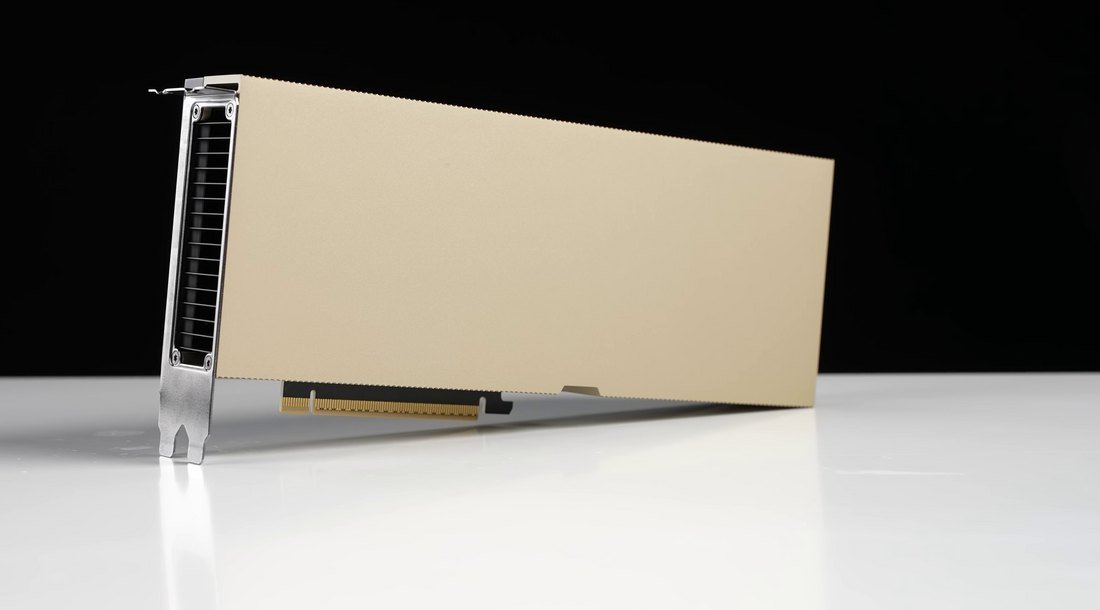
NVIDIA announces the Hopper architecture. The H100 has 80 billion transistors and a Transformer Engine tuned for the model design behind large language models. In February NVIDIA had abandoned its $40 billion Arm takeover under regulatory pressure. In October the US bans exports of the A100 and H100 to China, the start of a restriction fight that is still running in 2026.
Grace: NVIDIA’s own CPU
NVIDIA announces Grace, an Arm-based data-centre CPU built to feed its GPUs over NVLink. Paired chips follow: Grace Hopper (announced 2022) and Grace Blackwell. With Grace, NVIDIA can sell CPU, GPU and network as one design.
Mellanox and Ampere
NVIDIA agrees to buy Israeli networking company Mellanox for $6.9 billion (March 2019), closing in April 2020. In May 2020 it launches Ampere: the A100 data-centre GPU with 54 billion transistors and, later that year, GeForce RTX 30 cards for gamers. In September 2020 it announces its bid for Arm.
RTX reinvents gaming with AI
The Turing architecture and GeForce RTX 20 series add RT Cores for real-time ray tracing and Tensor Cores for DLSS, which uses a neural network to upscale game frames. Hardware designed for AI returns to the market NVIDIA started in.
Volta and Tensor Cores
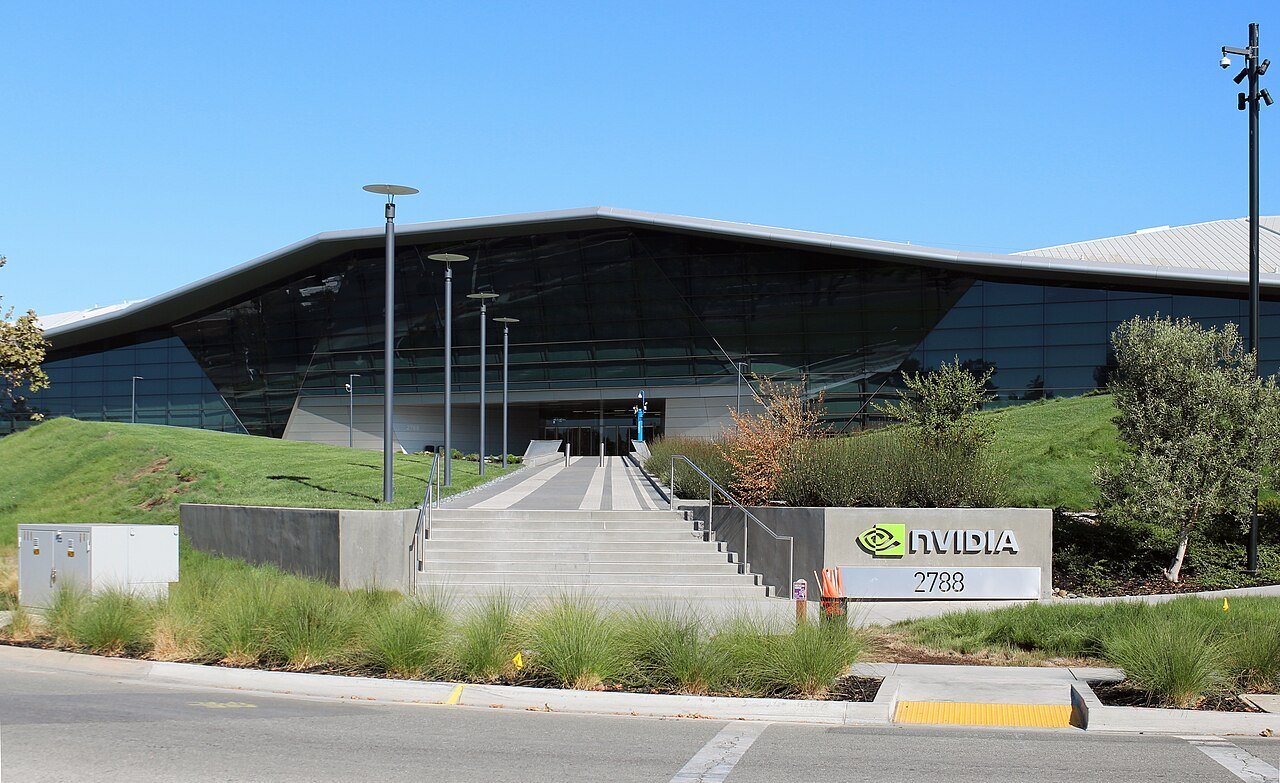
The Tesla V100 packs 21.1 billion transistors and the first Tensor Cores, units built for the matrix maths of neural networks. NVIDIA rates it at 120 teraflops for deep learning. From here, NVIDIA designs its flagship chips for AI first. The same year its new Santa Clara headquarters, Endeavor, opens.
DGX-1: the AI supercomputer in a box
NVIDIA unveils the DGX-1: eight Pascal P100 GPUs, networking and tuned deep-learning software in one $129,000 system. In August Jensen Huang hand-delivers the first unit to a small non-profit lab called OpenAI. NVIDIA is now selling systems, not just chips.
AlexNet trains on two gaming cards
Alex Krizhevsky, Ilya Sutskever and Geoffrey Hinton of the University of Toronto win the ImageNet competition with AlexNet, a deep neural network trained on two GeForce GTX 580 cards. Its top-5 error is 15.3%; the runner-up scores 26.2%. Almost overnight, computer-vision research moves to deep learning on NVIDIA GPUs.
Tegra, and the first GPU deep-learning papers
NVIDIA launches Tegra, a low-power system-on-chip for phones and tablets. Phones mostly go to Qualcomm and Apple, but Tegra lives on in cars, robots and, from 2017, the Nintendo Switch. In 2009 Stanford researchers Rajat Raina, Anand Madhavan and Andrew Ng show GPUs can train large neural networks up to about 70 times faster than CPUs.
Tesla: GPUs for scientists
NVIDIA ships the Tesla product line, GPUs without a display output, sold for high-performance computing, and releases CUDA 1.0. It is a second market beyond games: simulations, medical imaging, oil exploration and finance.
CUDA: the decision that changed everything
NVIDIA launches the GeForce 8800 GTX with a unified, programmable architecture, and with it CUDA, a way to program the GPU in a C-like language for any parallel maths. Every GeForce card becomes a small parallel computer. For years it costs money and draws scepticism from investors who see only a gaming company.
3dfx, GeForce 3 and the Xbox
NVIDIA buys the graphics assets of fallen rival 3dfx (December 2000). The GeForce 3 (2001) adds programmable vertex and pixel shaders, letting developers write small programs that run on the GPU. NVIDIA’s NV2A chip powers Microsoft’s first Xbox, launched in November 2001.
IPO and the GeForce 256
NVIDIA lists on Nasdaq at $12 a share. In August it announces the GeForce 256 and calls it the world’s first GPU, because it moves transform and lighting from the CPU to the graphics chip. The name outlives every product of the era.
RIVA 128 saves the company
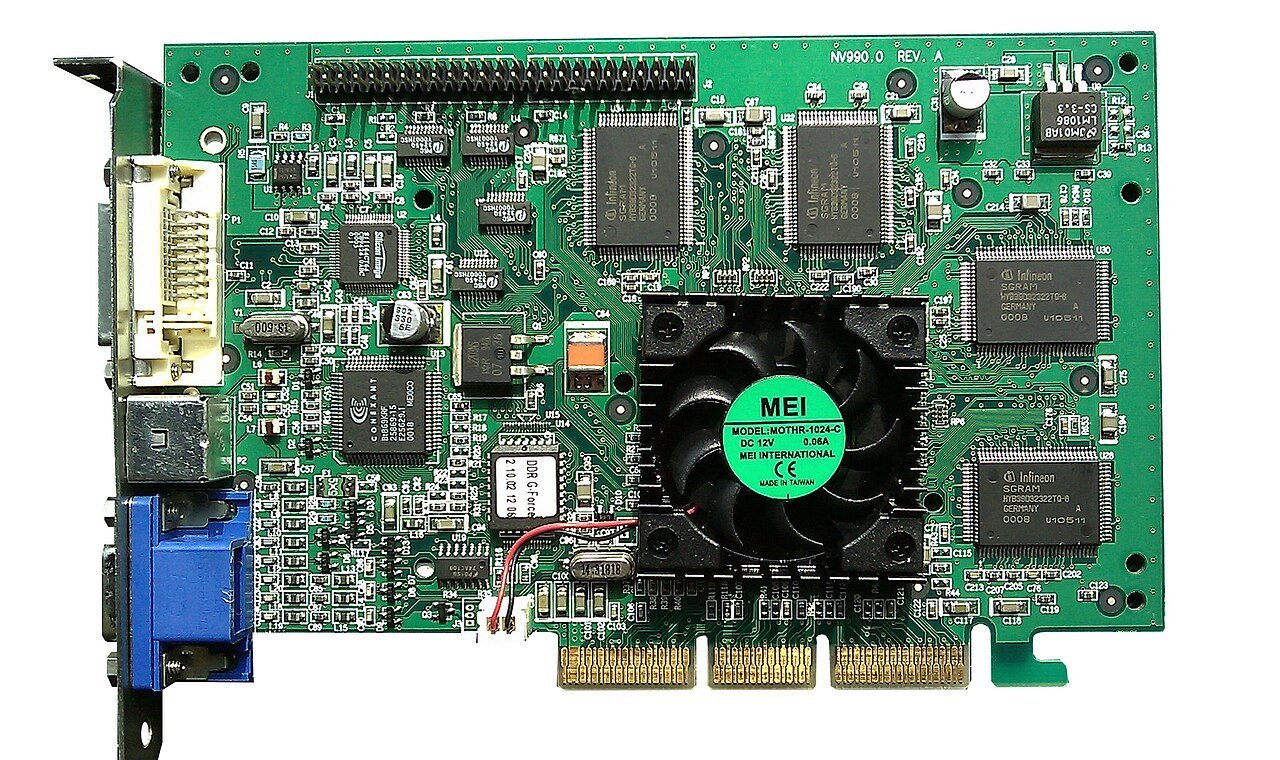
After the NV1 failure, NVIDIA bets on Microsoft’s Direct3D standard. The RIVA 128 (1997) combines fast 2D and 3D and sells about a million units in four months, according to NVIDIA. The RIVA TNT follows in 1998.
NV1: the near-fatal first chip
NVIDIA’s first product, the NV1, combines 2D and 3D graphics, audio and a game port. It renders with curved quadrilaterals while Microsoft’s new Direct3D uses triangles. It sells poorly, a follow-up chip for Sega is dropped, and Huang has since said the company had to lay off about half its staff.
Three engineers, one idea
Jensen Huang, 30, Chris Malachowsky and Curtis Priem found NVIDIA to make 3D graphics chips for PCs. Their bet: games and multimedia would need a dedicated processor doing thousands of similar calculations at once, something a CPU does badly. Huang is still CEO 33 years later.
The Real NVIDIA Secret: CUDA
Why fast chips alone do not explain the lead.
If NVIDIA’s rise were only about faster chips, rivals with fast chips would have caught up. AMD, Intel and Google all make capable AI hardware. What is harder to copy is the software.
CUDA launched in 2006 and ran only on NVIDIA GPUs. Around it NVIDIA built libraries for almost every kind of maths: cuBLAS for linear algebra, cuDNN for neural networks (2014), TensorRT for running trained models, NCCL for splitting work across many GPUs, and hundreds more under the CUDA-X name. Popular AI frameworks such as PyTorch and TensorFlow were tuned for these libraries first.
The result is a network effect. A researcher who has written and optimised CUDA code has a reason to stay. A cloud provider offering NVIDIA hardware can run almost any AI software on day one. A start-up hiring engineers finds that most of them already know CUDA. The hardware is more valuable because of the software, and the software more valuable because of the hardware.
🔧 Hardware only
- 1999 GPU
- 2006 faster GPU
- 2012 AI researchers try it
- 2017 AI accelerator
- Open question: would developers have followed?
🧩 Hardware plus software
- GPU, then CUDA
- Libraries (cuDNN, TensorRT, NCCL)
- Researchers and frameworks
- Cloud platforms and AI start-ups
- Generative AI and AI factories
The NVIDIA Flywheel
| Step | What happens | Real example |
|---|---|---|
| 1. Build hardware | New GPU, CPU and network chips | Hopper (2022), Blackwell (2024), Rubin (2026) |
| 2. Build software | CUDA, libraries, compilers, AI tools | cuDNN, TensorRT, NCCL, CUDA-X |
| 3. Attract developers | Researchers build on the platform | AlexNet (2012), PyTorch and TensorFlow |
| 4. Attract customers | Clouds and companies deploy NVIDIA | Microsoft, Google, Amazon, Meta, Oracle, CoreWeave |
| 5. Grow the ecosystem | More models, apps and tools | ChatGPT and the generative-AI wave |
| 6. Reinvest | Revenue funds the next generation | An annual architecture cadence since 2024 |
Five jobs. Which chip does each best?
Guess first, then tap. The answer explains why a gaming chip ended up running AI.
NVIDIA’s Data-Centre Architectures at a Glance
Transistor counts are NVIDIA’s own figures for each flagship chip.
| Architecture | Year | Flagship | Transistors | What was new |
|---|---|---|---|---|
| Pascal | 2016 | P100 / DGX-1 | 15.3 billion | NVLink, first DGX system |
| Volta | 2017 | V100 | 21.1 billion | Tensor Cores |
| Ampere | 2020 | A100 | 54 billion | One chip for training and inference; GPU partitioning |
| Hopper | 2022 | H100 | 80 billion | Transformer Engine |
| Blackwell | 2024 | B200 / GB200 NVL72 | 208 billion | Two dies as one GPU; rack-scale systems |
| Rubin | 2026 | Vera Rubin NVL72 | Not compared here | CPU, GPU and networking designed as one platform |
| Rubin Ultra | 2027 (planned) | Kyber rack | — | Roadmap |
| Feynman | 2028 (planned) | — | — | Roadmap |

The Transformation in One Table
| Era | Core identity | Main computing problem |
|---|---|---|
| 1993-1998 | Graphics start-up | Better 3D graphics on PCs |
| 1999-2005 | GPU company | Real-time 3D, programmable shading |
| 2006-2011 | GPU computing platform | Scientific and parallel workloads |
| 2012-2016 | AI accelerator | Deep-learning research |
| 2017-2021 | AI and HPC platform | Training neural networks; ray tracing for games |
| 2022-2023 | AI supercomputing company | Large language models |
| 2024-2026 | AI infrastructure company | Training, inference and AI agents at rack scale |
But Gaming Did Not Disappear
The phrase “a gaming company became an AI company” is only half right. NVIDIA still sells GeForce RTX cards, and DLSS, its AI upscaling, is in hundreds of games. Gaming revenue rose 41% to a record $16.0 billion in fiscal 2026. Its chips are also inside the Nintendo Switch and its successor.
What changed in 2026 is the bookkeeping. From May, NVIDIA reports gaming inside Edge Computing with PCs, workstations, AI-RAN base stations, robots and cars. The more accurate description of the whole story: NVIDIA expanded from graphics into accelerated computing, and AI became the biggest use of that platform.
NVIDIA’s Competition
| Rival | AI chip | Approach |
|---|---|---|
| AMD | Instinct MI series | Merchant GPUs with the open ROCm software stack |
| TPU | In-house chips for its own cloud and models | |
| Amazon | Trainium, Inferentia | In-house chips for AWS customers |
| Microsoft | Maia | In-house accelerator for Azure |
| Meta | MTIA | In-house chips for ranking and inference |
| Intel | Gaudi and future GPUs | Merchant accelerators; NVIDIA also became an investor in 2025 |
| Chinese firms | Huawei Ascend and others | Domestic alternatives while US exports are restricted |
The biggest competitive threat is awkward: several of NVIDIA’s largest customers are also designing their own chips. The open question for the next chapter is whether CUDA stays as valuable as AI hardware becomes more varied. That is a live debate, not a settled fact.
The Challenges Ahead
⚡ Physical limits
- Energy: data centres need power grids that take years to build
- Supply chain: leading chips depend on TSMC in Taiwan and scarce HBM memory
- Capital: a single AI campus can cost tens of billions of dollars
🌐 Market limits
- Export controls: no China data-centre compute revenue assumed in 2026 guidance
- Customer chips: TPU, Trainium, Maia and MTIA
- AI economics: customers must earn back what they spend
🤔 Did You Know?
- NVIDIA’s founders sketched the company over meals at a Denny’s diner in San Jose; in 2023 the restaurant added a plaque.
- The first DGX-1 went to OpenAI in 2016, six years before ChatGPT.
- Networking earned $31.4 billion in fiscal 2026, more than NVIDIA’s whole revenue in fiscal 2021.
- On 27 January 2025 NVIDIA lost about $589 billion in market value in one day, and still ended the year bigger.
The Bigger Story
Viewed backwards, NVIDIA’s history looks almost accidental. Three engineers wanted better 3D graphics. The GPU became a processor in its own right. CUDA opened it to general computing. AlexNet showed what it could do for AI. Tensor Cores made AI the design priority. Hopper arrived just as large language models needed it. Blackwell and Rubin turned the GPU into one part of a whole AI data centre.
In one sentence: NVIDIA started by accelerating pixels, learned to accelerate mathematics, and became a platform for accelerating AI. The biggest shifts in technology do not always begin with a new invention. Sometimes the infrastructure already exists, and a new kind of software discovers what it can do.
Quiz: Can You Follow NVIDIA’s Evolution?
Tap a question to reveal the answer.
1. When was NVIDIA founded?
2. Which product did NVIDIA call the first GPU?
3. Why was CUDA important?
4. What did AlexNet train on in 2012?
5. Which company did NVIDIA buy to own GPU networking?
6. Which architecture followed Ampere?
7. In which fiscal year did Data Center first beat Gaming?
8. What is Vera Rubin?
Explore More Timelines
People Also Ask
Frequently Asked Questions
Related AiTimeline Stories
⚠️ Editorial Note
Checked against NVIDIA’s corporate history page, its fiscal 2026 annual report and CFO commentary, its first- and second-quarter fiscal 2027 press releases (20 May and 26 August 2026), its 31 May 2026 Vera Rubin production release, and CNBC, Reuters and Bloomberg coverage of the Groq, Intel, OpenAI and China export stories. Corrections to circulating summaries: Grace was announced in 2021, not 2022; Vera Rubin’s full-production announcement came on 31 May 2026; and NVIDIA stopped reporting Gaming as a separate segment from May 2026. Performance multiples such as 10x agent throughput are NVIDIA’s own claims. Market values are snapshots. AiTimeline has no commercial relationship with NVIDIA. This is not investment advice.
Sources & further reading
Every dated entry above was checked against these references. Last reviewed 28 September 2026.
- NVIDIA: Corporate timeline
- NVIDIA: Financial results for fourth quarter and fiscal 2026 (25 February 2026)
- NVIDIA CFO commentary, Q4 and fiscal 2026 (SEC filing)
- NVIDIA: Financial results for second quarter fiscal 2027 (26 August 2026)
- NVIDIA: Vera Rubin ramps into full production (31 May 2026)
- Krizhevsky, Sutskever, Hinton: ImageNet Classification with Deep Convolutional Neural Networks (NeurIPS 2012)
- CNBC: Nvidia buying AI chip startup Groq's assets for about $20 billion (24 December 2025)
- CNBC: US clears H200 chip sales to 10 China firms (14 May 2026)
- Wikipedia: Nvidia