Unusually Large Footprints: The First Adult T. Rex Trackway Discovery Timeline
Four giant footprints found in North Dakota are likely the first known adult T. rex trackway, made 66.5 million years ago. See the discovery timeline.
Latest Story
In 2025, a Colorado high-school teacher noticed unusually large, three-toed impressions in a North Dakota badlands rock — and researchers now say they are the first known trackway made by an adult Tyrannosaurus rex. Four footprints, spaced roughly 4 metres apart across a 7-metre trail, were left an estimated 66.5 million years ago. A peer-reviewed paper published on 8 September 2026 in the Journal of Vertebrate Paleontology calls the animal responsible “likely attributable to an adult Tyrannosaurus rex” — and turns a single strange rock into a rare record of how the world’s most famous predator actually moved.
🧠 AI Overview Summary
In 2025, Kent Hups, a Colorado high-school teacher and fossil hunter, spotted unusually large three-toed impressions on U.S. Forest Service land near Marmarth, North Dakota, in the Hell Creek Formation. Excavation revealed four connected footprints forming a roughly 7-metre (23-foot) trackway, each print about 1 metre (3 feet) long, with a stride of about 4 metres (13 feet). A paper published 8 September 2026 in the Journal of Vertebrate Paleontology, led by Peter Falkingham of Liverpool John Moores University with Denver Museum of Nature & Science curator Tyler Lyson, describes it as “likely attributable to an adult Tyrannosaurus rex” — the first known sequence of tracks from an adult of the species, versus only two isolated adult footprints known worldwide before it. Stride spacing puts its walking speed at roughly 3.4–4.5 mph. Three of the four footprints are due to be airlifted by helicopter to the Denver Museum this autumn.
The T. Rex Trackway: Key Questions
Four Steps, 66.5 Million Years, in Eight Lines
- Kent Hups, a Colorado high-school teacher, found the tracks in 2025 while volunteering on a fossil dig on U.S. Forest Service land near Marmarth, North Dakota.
- Excavation revealed four connected three-toed footprints, arranged left-right-left-right across roughly 7 metres (23 feet).
- Each footprint measures about 1 metre (3 feet) long, with a stride of roughly 4 metres (13 feet) between them.
- The rock is dated to about 66.5 million years old, near the very end of the Cretaceous Period.
- Researchers call it “likely attributable to an adult Tyrannosaurus rex” — deliberately cautious language, based on size, shape and context rather than direct proof.
- Only two isolated adult T. rex footprints were previously known worldwide — this is the first known connected sequence, a genuine trackway.
- Stride spacing suggests a walking speed of about 3.4–4.5 mph — a brisk walk, not a chase, for an animal estimated to weigh several tons.
- Three of the four footprints are due to be helicoptered out this autumn to the Denver Museum of Nature & Science for preparation and further research.
The Footprint That Stopped a Fossil Hunter
A strange shape in the rock, and a question that took excavation to answer.
In 2025, Kent Hups — a high-school teacher from Northglenn, Colorado, and an amateur fossil hunter — was volunteering on a paleontology dig on U.S. Forest Service land near Marmarth, in the Hell Creek Formation of southwestern North Dakota. The Hell Creek badlands are already famous for producing some of the world’s best Tyrannosaurus rex and Triceratops skeletons. Footprints are a different matter entirely: they are far rarer than bones, because preserving one requires soft sediment, a clean impression, rapid burial and tens of millions of years of undisturbed survival before erosion happens to expose it again at just the right moment.
While working the terrain, Hups noticed an unusual rocky shape that looked less like weathered stone and more like a footprint. His first task wasn’t to announce a discovery — it was to measure it, photograph it, and ask whether the shape actually behaved like a track. He brought it to Dr. Tyler Lyson, senior curator of vertebrate paleontology at the Denver Museum of Nature & Science, who was initially skeptical: rocks can weather into remarkably convincing shapes. Excavation changed that. What looked like a single strange impression turned out to be one of four, arranged in a walking sequence.
Why Scientists Think It Was T. Rex
Not one clue, but several, combined with deliberately cautious language.
The Enormous Size
Each footprint is roughly 1 metre (3 feet) long — among the largest theropod tracks known from the region.
Three-Toed Shape
The prints are tridactyl, consistent with the basic foot anatomy of large theropod dinosaurs.
Narrow Toe Proportions
The relatively narrow three-toed configuration is consistent with an enormous tyrannosaur rather than another theropod group.
The Local Fossil Record
The Hell Creek Formation is exceptionally rich in T. rex remains — making it the most likely trackmaker on the surrounding evidence.
The paper’s own phrasing is deliberate: “likely attributable to an adult Tyrannosaurus rex,” not proof the animal was directly observed. That distinction matters in paleontology — researchers are naming the most probable trackmaker from physical evidence, the combination of size, shape and context, rather than claiming certainty a fossil track can rarely provide on its own.
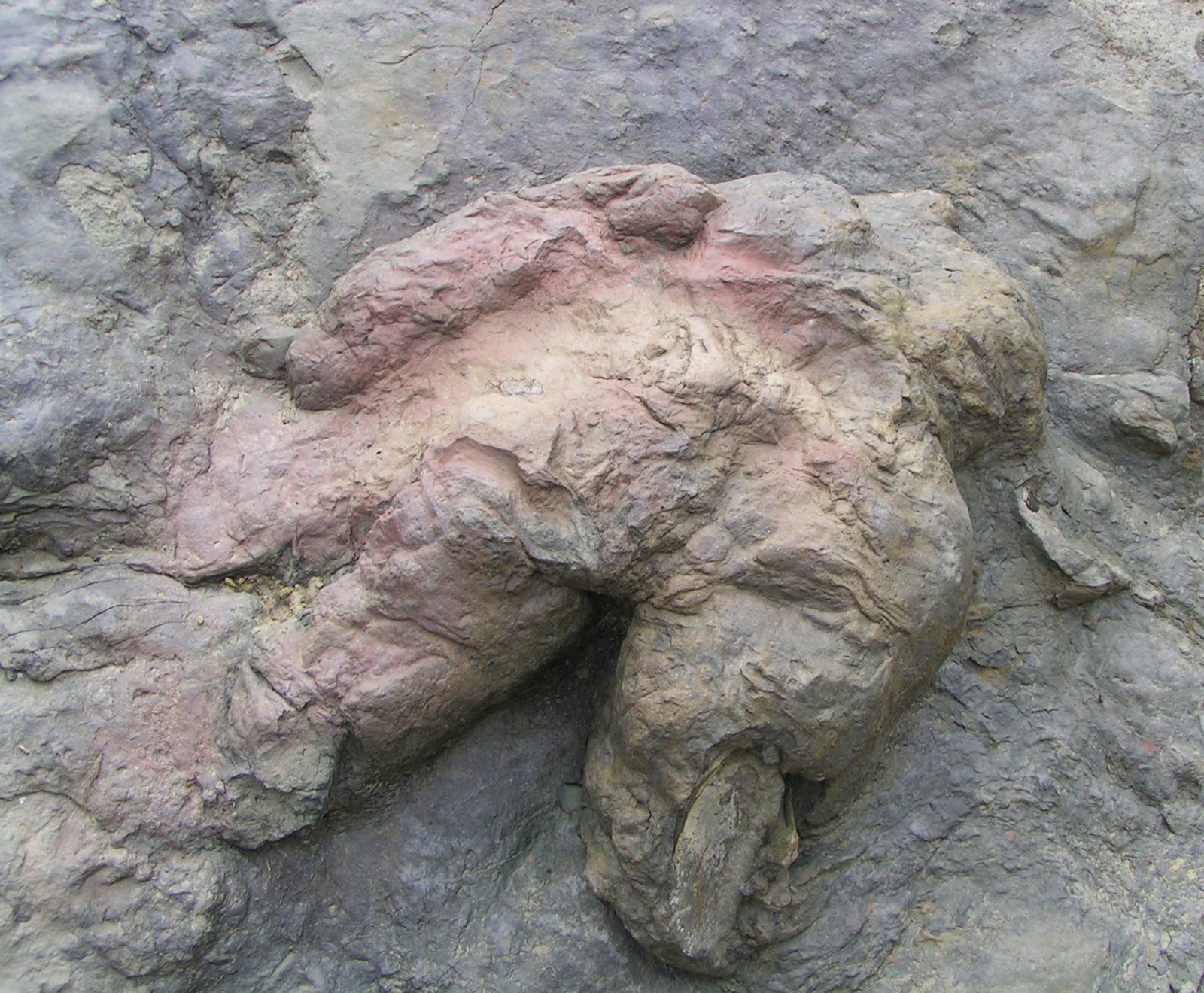
A cast of a probable Tyrannosaurus footprint (Tyrannosauripus pillmorei) at Philmont Scout Ranch, New Mexico — one of the very few adult tyrannosaur tracks known before the North Dakota trackway. It is a different specimen, shown here to illustrate the kind of evidence involved. Credit: Rufous-crowned Sparrow / Wikimedia Commons, CC BY-SA.
What Makes a Trackway Different From a Bone?
A skeleton reveals anatomy. A trackway reveals behaviour — something bones generally cannot.
Bones vs. Trackways
- A skeleton can reveal skull shape, teeth, limb proportions, joints and muscle-attachment sites.
- A trackway can reveal direction of travel, stride length, foot placement, walking pattern, approximate speed and interaction with the ground surface.
- As Dr. Tyler Lyson put it: “Bones tell us an enormous amount about these animals, but footprints capture a moment of behaviour. With a trackway, we can actually follow an animal as it moved across the landscape. That is incredibly rare for T. rex.”
- The distance between the North Dakota footprints — about 4 metres (13 feet) — combined with estimated body size, is what lets researchers calculate a walking speed of roughly 3.4–4.5 mph.
- A footprint contains no DNA, no muscle, no heartbeat — only where the animal’s foot touched the ground. From that alone, researchers can reconstruct part of a movement.
The Discovery Timeline
Newest first — from a single strange impression to a helicopter recovery plan.
Helicopter Recovery Planned
Plan: Three of the four footprints are due to be airlifted out by helicopter this autumn and taken to the Denver Museum of Nature & Science for preparation and further research, because the remote badlands location rules out simpler removal methods.
Peer-Reviewed Paper Published
Outcome: “A large tridactyl trackway from the Upper Cretaceous Hell Creek Formation of North Dakota, likely attributable to an adult Tyrannosaurus rex” is published, formally describing the trackway and naming it the first known adult T. rex trackway.
High-Resolution 3D Documentation
Process: Researchers documented the trackway using detailed measurements and high-resolution 3D surface scanning, producing digital models that could be examined without repeatedly disturbing the original site and used to create physical reproductions.
Four-Footprint Trackway Confirmed
Finding: Excavation revealed the strange shape was one of four connected three-toed footprints, forming a walking sequence roughly 7 metres (23 feet) long, with each print about 1 metre (3 feet) long and a stride of about 4 metres (13 feet).
Kent Hups Notices the First Impression
Discovery: Kent Hups, a Colorado high-school teacher volunteering on a fossil dig in the Hell Creek Formation, notices an unusually large, three-toed impression in the rock and brings it to Denver Museum researchers for investigation.
The Trackway Is Made
Event: A large theropod, most likely an adult Tyrannosaurus rex, walks across soft sediment in what is now southwestern North Dakota, leaving four footprints that are buried, preserved and eventually exposed by erosion tens of millions of years later.
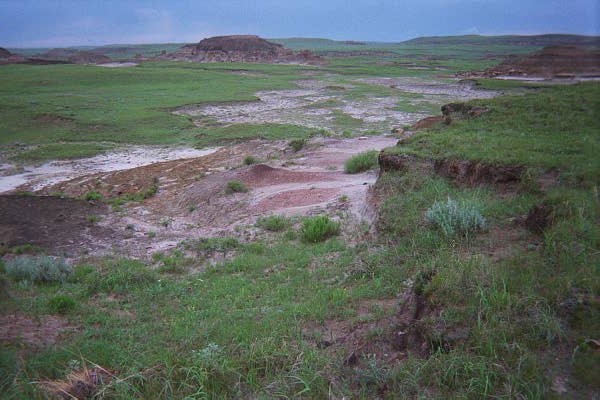
Badlands exposures of the Hell Creek Formation in the Dakotas — the same Late Cretaceous rock unit, famous for T. rex and Triceratops fossils, in which the new trackway was found. Credit: Circa24 / Wikimedia Commons, CC BY-SA 3.0.
⚠️ Editorial Note
The research paper deliberately uses the phrase “likely attributable to an adult Tyrannosaurus rex” rather than stating the trackmaker as fact. This article keeps that same cautious framing throughout — the identification is a scientific attribution built from track size, shape and geological context, not a direct observation of the animal that made it.
Famous Footprint Discoveries in History
The North Dakota trackway joins a long line of moments where a strange mark in rock changed what scientists knew.
| Year Found | Discovery | Age | Significance |
|---|---|---|---|
| 2026 | North Dakota T. rex trackway | ≈66.5 million years | First known adult T. rex trackway; walking speed estimated from stride |
| 2025 | Britain’s “Dinosaur Highway”, Oxfordshire | ≈166 million years | 200+ footprints, five trackways, mostly giant sauropods |
| 2021 | White Sands human footprints, New Mexico | ≈21,000–23,000 years | Pushed back the accepted timeline of humans in North America |
| 1978 | Laetoli footprints, Tanzania | ≈3.6 million years | ≈70 footprints over 27 m; earliest clear evidence of upright hominin walking |
| 1931 | White Sands “giant” tracks, New Mexico | Pleistocene | Initially thought human; later identified as large Ice Age mammal tracks |
| 1909 | Glen Rose tracks, Texas | ≈113 million years | Early American dinosaur-track research; some “giant human” claims later debunked |
The pattern across a century of footprint science repeats: a strange mark is found, skepticism is the correct first response, and only careful excavation and comparison — not a single glance — separates a genuine trackway from a convincingly weathered rock. The Laetoli trail showed early hominins walking upright millions of years before any tool or bone could prove it. The 2021 White Sands dating pushed the accepted arrival of humans in the Americas back by thousands of years, and had to survive an independent redating in 2023 before wide acceptance. The North Dakota trackway now adds a comparable behavioural record for Tyrannosaurus rex — not what it looked like, but how it moved.
Explore More Timelines
People Also Ask
Frequently Asked Questions
Related AiTimeline Stories
Sources & Further Reading
⚠️ Editorial Note
This timeline compiles publicly available reporting on the North Dakota trackway, the peer-reviewed Journal of Vertebrate Paleontology paper, and background on comparable historic footprint discoveries. It is editorial and AI-assisted content, not an official statement from the Denver Museum of Nature & Science, Liverpool John Moores University or the paper’s authors; figures and dates are provided for reference and may contain inaccuracies despite verification efforts.