AI and Unemployment: What the 2026 Evidence Actually Shows
A graduate finishing a degree in 2026 is entering a labour market their parents would not fully recognise. It is not that entire professions have vanished. It is that many of the small, repetitive tasks a graduate used to be handed on day one — drafting a first version, summarising a document, writing routine code, answering a standard support ticket — are increasingly done first by an AI system, with a person reviewing the output rather than producing it from scratch. Whether that adds up to “AI is taking jobs” or “AI is changing what a job is” depends on which company, which occupation and which country you look at, and the honest answer, in August 2026, is that both are happening at once, at a scale nobody has definitively measured yet.
Is AI causing unemployment or just changing jobs? ILO, OECD, IMF, BLS and Fed 2026 data fact-checked, plus a full India IT and GCC jobs breakdown.
Latest Story
This guide asks one question and refuses to answer it with a slogan: is AI causing unemployment, or mainly changing what people do at work? The short version, built entirely from primary sources — the International Labour Organization (ILO), the OECD, the IMF, the U.S. Bureau of Labor Statistics (BLS), the Federal Reserve, Eurostat, Stanford’s AI Index and Digital Economy Lab, and company-by-company layoff records — is that both displacement and augmentation are occurring, but the scale of AI-caused aggregate unemployment remains uncertain. This is not a hedge to avoid taking a position. It is what the evidence, read carefully and dated correctly, actually supports.
🧠 AI Overview Summary
AI is changing jobs and automating some tasks, but current evidence does not establish that AI has already caused economy-wide mass unemployment. U.S. unemployment sat at 4.1% and euro-area unemployment at 6.2–6.3% in mid-2026, with no official agency attributing the level to AI. The clearest measured effect is narrower: employment among 22–25-year-olds in the most AI-exposed U.S. occupations is running about 19% below its expected trend (Stanford, August 2026). The bigger near-term effects show up as reduced hiring, entry-level pressure, changing skill requirements and shifting wage growth — not a collapse in total employment.
AI and Unemployment: Key Questions
What This Investigation Found
- No major statistical agency — ILO, OECD, IMF, BLS, Eurostat or the Federal Reserve — attributes current aggregate unemployment levels to AI as of August 2026.
- AI exposure is not the same as job loss. ILO’s own exposure index explicitly warns it measures “potential exposure, not actual job losses,” and estimates GenAI is more likely to transform jobs than eliminate them outright.
- The clearest real signal is narrow: 22–25-year-olds in the most AI-exposed U.S. occupations show employment about 19% below trend, a gap that has widened through 2025–2026 (Stanford Digital Economy Lab).
- Company-stated “AI layoffs” are inconsistent — several firms (Amazon, Cisco, TCS, IBM) gave contradictory or denying statements about AI’s role within days of announcing cuts.
- Challenger, Gray & Christmas data shows AI’s share of stated U.S. layoff reasons jumped from about 4.5% of 2025’s total to 24–33% of monthly cuts by mid-2026 — a real and fast-moving trend, though the firm’s own analysts warn some of it may be “AI-washing” of ordinary cost cuts.
- Real AI-linked job creation (about 1.3 million roles over three years, per LinkedIn/WEF data) is smaller in absolute terms than 2026’s AI-attributed layoffs in the U.S. alone — but both numbers are tiny next to total employment.
- Wages have moved before headline employment has: entry-level pay in AI-exposed U.S. sectors hasn’t fallen, but hiring has slowed and time-to-hire has grown from about 20 to 32 days since 2023.
- India’s story is not simple decline: legacy IT-services hiring has stalled while AI-focused Global Capability Centres are growing hiring almost twice as fast as traditional outsourcing.
- Economists at Goldman Sachs, MIT and the NBER find no clean economy-wide productivity link to AI yet, even though sector-specific gains (customer support, software development) are real and measurable.
- Every institution that has studied this closely hedges heavily in its own language — “canaries… not causal,” “no signs of widespread displacement,” “projections… dependent on assumptions” — which is itself the most honest finding in this entire investigation.
The Central Question: Is AI Causing Unemployment, or Changing the Job?
Why this is the right question to ask instead of “will AI destroy jobs.”
Every recent wave of “AI takes jobs” coverage conflates several distinct things: a model’s estimate of which tasks AI could theoretically do, a company’s stated reason for a layoff, a survey of what employers expect to do by 2030, and an actual, measured change in how many people are working. These are not the same kind of evidence, and treating them as interchangeable is the single most common error in this debate — on both the alarmist and dismissive sides.
Sorted by what they actually are: forecasts (the World Economic Forum’s 2030 jobs projections, built from a 2024 employer survey); models (the ILO’s and IMF’s task-exposure indexes, which estimate what AI could theoretically automate, not what it has); surveys (Federal Reserve business-adoption surveys, PwC’s AI Jobs Barometer); observational data (Stanford’s payroll-based employment tracking, job-posting counts); and official employment statistics (BLS, Eurostat, ILO unemployment rates, which measure the actual labour force). None of the big, viral numbers — “40% of jobs exposed,” “92 million jobs displaced,” “170 million jobs created” — are observed outcomes. They are models and forecasts, several years old in some cases, still being recirculated as if freshly measured.
Once those categories are kept separate, the honest 2026 answer holds: both displacement and augmentation are occurring, but the scale of AI-caused aggregate unemployment remains uncertain. Displacement is real and measurable in specific, narrow slices of the labour market — entry-level roles in the most AI-exposed U.S. occupations. Augmentation is also real and widespread — the large majority of AI-exposed employment is in occupations AI can currently assist with, not fully replace. What is not yet supported by any primary source is the claim that AI has driven an economy-wide rise in joblessness.
AI Exposure Does Not Mean Your Job Will Disappear
A job is a bundle of tasks. AI usually touches some of them, not all.
The single most misused statistic in this debate is “occupational exposure.” The ILO’s Generative AI and Jobs index estimates that about 25% of global employment sits in occupations with some task exposure to generative AI, and just 3.3% falls in the highest-exposure category — but the ILO’s own researchers are explicit that this is “potential exposure, not actual job losses,” and that “GenAI’s effect is more likely to transform jobs than eliminate them,” because full automation of an occupation requires automating essentially all of its tasks, and most occupations still need real human involvement even where AI helps.
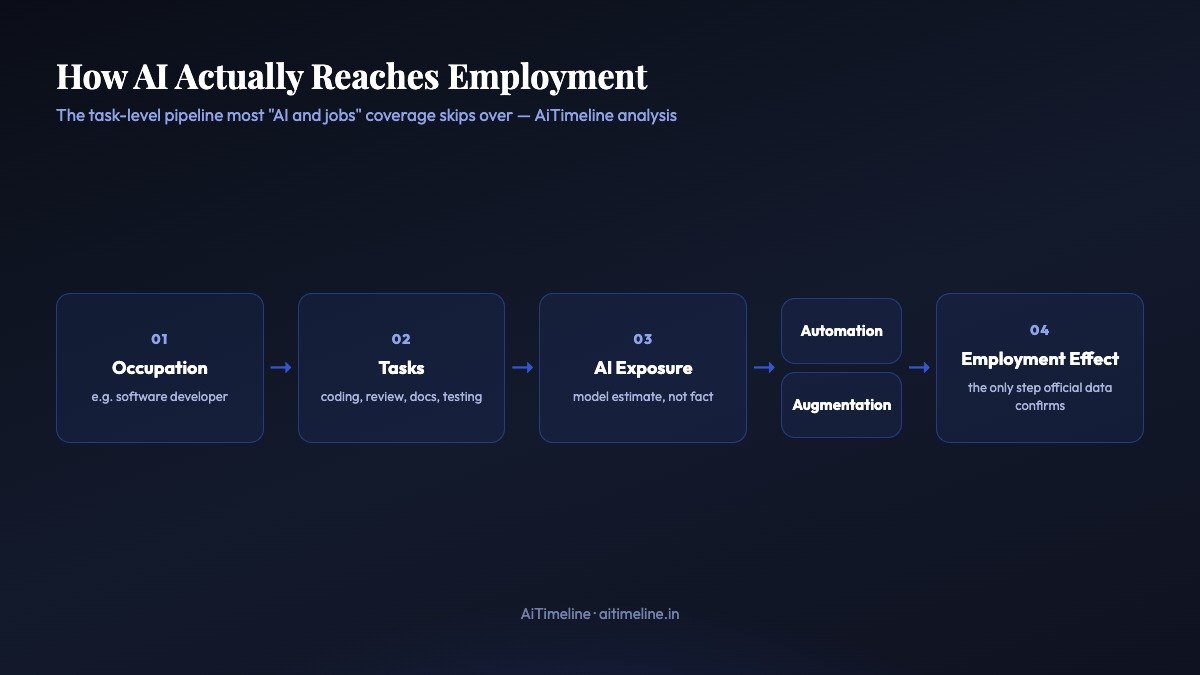
The reasoning chain matters: a job sits inside an occupation, which is made up of many individual tasks. AI capability is assessed at the task level, producing an exposure estimate. From there, a task can be automated (AI does it with no human involved), augmented (AI assists, a human still does the work), or left untouched. Only the sum of what happens across all of an occupation’s tasks determines the actual employment effect — and that final step depends on company decisions, productivity effects on demand, and how fast displaced workers can be redeployed, none of which the exposure index measures.
Take a software developer. In 2025–2026, AI tools increasingly handle code generation, debugging assistance, first-draft documentation and test-case writing. None of that adds up to “software developer eliminated” — it adds up to a role where a larger share of routine implementation work is AI-assisted, while architecture decisions, debugging judgment on unfamiliar systems, code review and client-facing scoping remain human. The evidence backs this reading: software-developer job postings in the U.S. actually rose about 15% in the year after Anthropic’s Claude Code launched in February 2025, even as overall postings fell 7% — but 71% of that increase was in senior roles, not entry-level ones (Indeed Hiring Lab, July 2026). The task changed before the occupation did, and it changed unevenly by seniority.
The same logic applies to customer-service AI, accounting automation, legal research tools, content generation and data analysis: these systems automate individual tasks — a first-draft response, a document search, a reconciliation step — without automatically eliminating the entire occupation around them. Companies can also respond to task automation in ways that never show up as a layoff at all: reducing new hiring instead of firing existing staff, redesigning a job’s task mix, or letting productivity gains expand output and demand for the remaining human work. Each of these leaves employment statistics looking calm while the actual content of jobs is shifting underneath.
📈 Reading the pipeline
Job → Occupation → Tasks → AI exposure → Automation or augmentation → Employment effect. Coverage of “AI and jobs” usually starts at exposure and jumps straight to employment effect, skipping the two steps in between where most of the real-world variation happens.
A Timeline of AI and Employment
From early automation debates to the 2026 evidence base — verified milestones only.
ILO’s Global Youth Report and a Mid-Year Layoff Surge
What happened: The ILO’s “Global Employment Trends for Youth 2026” (11 August 2026) confirmed global youth unemployment at 12.4% in 2025 (~67 million people) and a NEET rate of 20% (~257–260 million). Separately, Challenger, Gray & Christmas data showed AI becoming the single most-cited U.S. layoff reason for five consecutive months by July 2026, with 112,713 AI-cited cuts January–July, versus roughly 55,000 for all of 2025.
Why it matters: Two real trends, moving in the same direction but not proven to share one cause — youth joblessness and AI-attributed layoffs both rose through 2026, on different data sources.
Enterprise Adoption Broadens, GenAI Exposure Index Published
What happened: The ILO published its refined Generative AI and Jobs exposure index (May 2025); Federal Reserve survey data showed GenAI adoption among large firms rising from 33% (2023) to 79% (2025); Stanford’s “Canaries in the Coal Mine” study first identified the youth employment gap in AI-exposed occupations, then at 13–16%.
Why it matters: This is the year exposure modelling and observational payroll data both matured enough to be usable — before this, most “AI and jobs” claims rested on smaller, less rigorous studies.
The IMF’s “40% Exposed” Estimate
What happened: The IMF published its Staff Discussion Note estimating roughly 40% of global employment exposed to AI (60% in advanced economies, ~27% in low-income countries) — the source of the most widely recirculated “AI exposure” statistic in media coverage since.
Why it matters: This figure is a task-based model estimate from January 2024, not new data — yet it was re-cited by IMF leadership at Davos in January 2026 as though freshly current, illustrating how quickly a dated model estimate can be mistaken for a live measurement.
ChatGPT and Mainstream Generative AI Adoption
What happened: OpenAI’s ChatGPT (November 2022) and the rapid enterprise rollout of large language models through 2023 moved generative AI from a research curiosity to a mainstream workplace tool within roughly a year.
Why it matters: Nearly every “AI and jobs” statistic now in circulation dates its baseline to this period. The New York Fed later found that AI-exposed job-posting declines actually began before ChatGPT’s release, complicating any simple “before/after ChatGPT” narrative.
The Transformer Architecture
What happened: Google researchers published the transformer neural-network architecture, the technical foundation underlying nearly every large language model built since.
Why it matters: A narrow technical paper with no economic effect at the time underpins the entire 2022-onward generative AI economy — and the labour-market debate that followed it.
Machine Learning Enters the Workplace
What happened: Machine-learning systems moved from research labs into recommendation engines, fraud detection, logistics optimisation and early customer-service chatbots through the 2010s, well before generative AI existed.
Why it matters: AI’s workplace footprint predates the current generative-AI wave by roughly a decade; the debate did not start in 2022, only its intensity did.
Outsourcing and Digital Automation
What happened: Falling telecom and logistics costs, combined with China’s 2001 WTO accession, accelerated the offshoring of manufacturing and, increasingly, back-office and IT services — the decade India’s IT-services and BPO industry scaled into a global export sector.
Why it matters: Today’s “will AI hollow out India’s IT-services model” question is a direct sequel to this earlier globalisation-driven build-out, not an unrelated new risk.
The Internet and Software Transformation
What happened: Commercial internet adoption from 1993 restructured retail, publishing, travel and communication industries, eventually showing up as a genuine productivity acceleration in official U.S. statistics in the late 1990s.
Why it matters: This is the clearest historical case where a general-purpose technology’s productivity effect showed up in national statistics within roughly a decade of mainstream adoption — a faster resolution than the 1980s’ “productivity paradox.”
Computerisation of the Office
What happened: Personal computers and spreadsheet software automated calculation and record-keeping tasks previously done by clerical staff, while economist Robert Solow observed in 1987 that computers were “everywhere but in the productivity statistics.”
Why it matters: Solow’s paradox is the standard historical reference point economists reach for when AI’s economic effects seem to lag its visible workplace presence — a pattern researchers explicitly flag as potentially repeating with AI in the mid-2020s.
Early Automation Debates and Industrial Robotics
What happened: Programmable industrial robots (following Unimate’s 1961 factory debut) spread through automotive manufacturing, while economists and policymakers in the U.S. debated automation’s employment effects seriously enough that a 1964 presidential commission studied “technology, automation and economic progress” directly.
Why it matters: “Will machines cause mass unemployment” is not a new question raised by AI — it was a formal U.S. policy question sixty years earlier, and mass unemployment did not follow, though specific manufacturing job categories did decline.
AI and Automation’s Origins
What happened: The 1956 Dartmouth workshop coined the term “artificial intelligence,” while postwar factory automation (including early numerically controlled machine tools) began reshaping manufacturing employment.
Why it matters: The intellectual and industrial roots of today’s debate are seventy years old; “AI and jobs” is a question every generation since has asked about its era’s new machines.
What Has Actually Happened by 2026?
Comparing 2023’s predictions against the observed record, so this stays a fact-check, not a forecast piece.
In 2023, predictions ranged widely: some economists warned of rapid, broad job losses; others predicted AI would mainly boost productivity with modest labour effects, echoing prior technology waves. Neither extreme has been confirmed by 2026’s actual data. Mass layoffs at economy-wide scale were not observed — U.S. unemployment sat at 4.1% in July 2026, close to pre-generative-AI norms, and euro-area unemployment held at 6.2–6.3%. Occupation-specific pressure was observed, concentrated in young, AI-exposed U.S. workers, where Stanford’s payroll data shows a real and widening gap.
Hiring slowed more than firing rose. Federal Reserve data found firms “overwhelmingly intend to retrain workers rather than fire them,” and time-to-hire in the U.S. lengthened from about 20 days in early 2023 to 32 days by March 2026 — a “low-hire, low-fire” pattern the Fed’s own Beige Book used to describe most of the country through 2026, rather than a wave of active terminations. Wages did not collapse in AI-exposed sectors; computer-systems-design wages actually rose faster than the economy-wide average since 2022, even as employment growth in the same sector lagged.
Productivity did not clearly accelerate economy-wide because of AI, despite individual-tool gains. Goldman Sachs found “no meaningful relationship between productivity and AI adoption at the economy-wide level” as of March 2026, and an NBER survey of roughly 6,000 executives found more than 80% reported no measurable AI productivity gains at the firm level — even as narrower studies show real 26–73% output gains in specific tasks like software development and marketing content. AI-attributed layoffs accelerated late, not early: they were a minor, single-digit share of 2025’s total U.S. job cuts, then rose sharply through 2026, becoming the most-cited single reason by July.
Why Young Workers May Feel AI’s Impact First
A real, measured gap — and several competing explanations for it.
The single strongest piece of observational evidence in this entire investigation concerns young workers. Stanford’s Digital Economy Lab, using high-frequency ADP payroll data across more than 730 occupations, found that employment among 22–25-year-olds in the most AI-exposed U.S. occupations — concentrated in software and customer-service roles — is running about 19% below where it would sit had it tracked the employment of less-exposed peers the same age, as of the study’s August 2026 update. That gap has widened three times since the study began: from roughly 13%, to 16%, to 19% across successive revisions through 2025–2026, as more months of data came in. Employment for 35–40-year-olds in the identical occupations kept growing over the same period.
Why would young workers feel this first? Entry-level roles are disproportionately built from exactly the tasks generative AI is best at: drafting, summarising, first-pass coding, routine research and standard-response customer support — work that is repetitive and well-structured enough to be a training ground for juniors, and also well-structured enough for AI to assist with or absorb. Younger workers also have fewer years of accumulated, tacit, hard-to-codify experience, the kind AI complements rather than replaces. The New York Fed’s own research on job postings found something similar in AI-exposed vacancy data, though it added an important caution: the decline in AI-exposed job postings actually began before ChatGPT’s November 2022 release, making it “difficult to interpret” as purely an AI effect.
That caution matters, because youth unemployment has several other well-documented causes that have nothing to do with AI: weaker post-pandemic hiring normalisation, higher interest rates raising the cost of expansion, demographic bulges in some regions, a persistent mismatch between what universities teach and what employers need, and continued offshoring and corporate restructuring unrelated to automation. The ILO’s own August 2026 youth report frames AI as one contributor to “a harder road to decent work” alongside these other forces — not the sole or even necessarily primary cause of the global 12.4% youth unemployment rate and 20% NEET rate it documents. The Stanford researchers themselves are the most disciplined voice on this point, describing their own findings as “early, descriptive indicators — canaries in the coal mine — rather than causal estimates.”
If AI Does the Junior Work, Where Do Senior Workers Come From?
A risk worth naming clearly, and labelling clearly as a hypothesis.
Many professions historically function as pipelines: a junior lawyer drafts memos a partner used to write, learning judgment by doing the mechanical work first; a junior developer fixes small bugs before architecting systems; a junior analyst builds the models a senior analyst will later interpret for a client. If AI increasingly absorbs exactly that entry-level, mechanical layer of work, the risk is not only fewer junior jobs today — it is fewer people moving through the apprenticeship that has historically produced tomorrow’s senior professionals.
This is a hypothesis, not an established finding. No primary source in this research base has yet measured a shrinking pipeline into senior roles caused by AI; the evidence so far documents an entry-level hiring and employment gap, not a downstream shortage of experienced workers, which by definition would take years to become visible. It is, however, a mechanism several economists and the Federal Reserve’s own qualitative Beige Book reporting have flagged as worth watching, precisely because a labour-market effect like this could be real and significant well before it shows up in any headline unemployment number.
Are AI-Related Layoffs Really Caused by AI?
A company-by-company fact-check — because “restructuring” and “AI automation” are not the same thing.
Media coverage tends to label any layoff at a technology company an “AI layoff.” The underlying company statements tell a messier story: some firms have given direct, on-record causal credit to AI; others have explicitly denied it while cutting jobs at the same time; several have contradicted themselves within days.
| Company | 2025–26 Cuts | What the Company Actually Said | Best Classification |
|---|---|---|---|
| Salesforce | ~4,000 (of 9,000 support staff) | CEO: “I’ve reduced it from 9,000 heads to about 5,000, because I need less heads” — direct AI credit | AI automation |
| CrowdStrike | ~500 (5%) | CEO: “AI flattens our hiring curve” — direct, on record | AI automation |
| Accenture | ~11,000 | CEO: “Those we cannot reskill will be exited,” while AI/data staff grew from 40,000 to 77,000 | AI automation / reallocation |
| Amazon | ~14,000, reported reaching ~30,000 | Announcement cited AI; CEO Jassy two days later: “not even really AI-driven — not right now” | Contradictory statements |
| IBM | Low single digits % of ~270,000 | CEO blamed pandemic-era “over-hiring,” a “natural correction” — except in HR, where AI agents replaced staff directly | Overhiring correction (mostly) |
| TCS | ~12,000 (~2%) | Media called it an “AI overhaul”; CEO cited restructuring, client demand shifts and cost optimisation, weakest growth since the pandemic | Restructuring / weak demand |
| Target | ~1,800 (~8% of corporate staff) | Incoming CEO cited internal “complexity,” no AI mention at all | Restructuring |
| Paramount | ~2,000+ across regions | Tied explicitly to Skydance merger cost-savings target; no AI mention | Merger / restructuring |
| UPS | ~48,000 | Bulk tied to closing 93 facilities amid falling Amazon shipping volume; only a smaller corporate slice called “partially” AI-related | Weak demand (mostly) |
| Klarna | ~40% of workforce via AI, later reversed | CEO credited an AI bot with the work of 700 agents, then publicly admitted the cuts “went too far” and began rehiring humans | AI automation, then correction |
The aggregate data backs this cautious reading. Challenger, Gray & Christmas — the most established U.S. layoff tracker — recorded roughly 1.17 to 1.2 million total U.S. job cuts in 2025, the highest since 2020, of which only about 54,836 (under 5%) explicitly cited AI. AI ranked fifth as a stated reason that year, well behind government DOGE actions, broad economic conditions, store closures and general restructuring. That changed fast in 2026: AI’s monthly share climbed to 25% in March, then became the single most-cited reason for five consecutive months by July, with 112,713 AI-cited cuts in the first seven months alone — roughly a fivefold jump in AI’s share of stated causes compared with all of 2025.
Even Challenger’s own vice president has flagged the limits of this data: “naming AI in a layoff announcement can win over investors while pushing current and prospective employees away,” meaning some firms may have an incentive to cite AI whether or not it was the real driver. MIT economist David Autor made a similar point publicly: it is easier for a company to attribute cuts to “AI-related efficiencies” than to admit weak profitability or a bloated cost base. The honest conclusion sits between two extremes: AI-cited layoffs are real, rapidly rising, and in several cases directly confirmed by CEOs on the record — but the label is applied inconsistently, sometimes contradicted by the same company within days, and the underlying tracker itself warns its own numbers can be inflated by “AI-washing.”
AI May Change Pay Before It Changes Employment
Wage and hiring data move first — and they are moving now.
Labour-market impact rarely shows up as a headline unemployment spike first. It shows up as slower hiring, longer job searches, changing skill premiums and shifting wage growth — effects that are real but easy to miss if the only thing being tracked is the unemployment rate. Several of these channels are visible now. U.S. computer-systems-design wages rose 16.7% since late 2022, versus 7.5% economy-wide (Dallas Fed), even as employment growth in the same AI-exposed sector lagged the rest of the economy — wages up, hiring soft, at the same time, in the same sector. Job postings that mention AI-related skills carry a measurable wage premium, estimated at up to 56% by PwC’s 2026 Global AI Jobs Barometer, up from about 25% a year earlier, though estimates vary considerably by methodology and should be read as directional rather than precise.
Recent U.S. college graduates are a useful bellwether: unemployment for 22–27-year-olds ran 5.6–5.7% in mid-2026, versus 4.2% overall — the fifth straight year graduate unemployment has exceeded the national rate, historically unusual — with underemployment near 41–43%, close to 2020 pandemic-era highs. Whether this is primarily an AI effect or primarily a broader weak-hiring cycle for new graduates is genuinely contested among the researchers who study it; both explanations have real support, and this article does not adjudicate between them beyond what the underlying data shows.
The Federal Reserve’s own synthesis, delivered by Governor Michael Barr in February 2026, is the most measured official statement available: “there is little evidence that AI has had a meaningful impact on wage growth or the distribution of income gains, at least so far,” and “the most dire predictions about an AI job transition have not come to fruition so far” — with the Fed’s own model estimating AI’s aggregate 2026 U.S. employment effect at under 0.4%, a figure Barr himself cautioned depends heavily on the assumptions used.
The Productivity Paradox
One worker being more productive can mean fewer jobs, or more demand — and both mechanisms are real.
AI making one worker more productive has two theoretically opposite effects, and this is precisely why economists cannot infer total employment outcomes from automation capability alone. If output demand is fixed, a company needing fewer hours of labour per unit of output needs fewer workers — a labour-saving effect. But if lower production costs get passed on as lower prices, or free up capital to expand into new products or markets, demand can rise enough to require just as many workers, or more — a demand-expanding effect. Historically, both mechanisms have operated simultaneously across different sectors of the same economy.
The 2026 data shows this tension directly, rather than resolving it. U.S. non-farm business productivity rose a real 2.2–2.9% through the first half of 2026 (BLS), and labour’s share of that output fell to 52.9% — the lowest level in the BLS series since 1947, consistent with, though not proof of, productivity gains not fully flowing through to worker pay. Yet Goldman Sachs found “no meaningful relationship between productivity and AI adoption at the economy-wide level” as of March 2026, and an NBER survey of roughly 6,000 corporate executives found more than 80% reported no measurable firm-level productivity gain from AI at all — even though narrower studies find real 26% gains in software development and up to 73% in marketing-content output. MIT economist and Nobel laureate Daron Acemoglu’s own modelling puts AI’s total-factor-productivity contribution at roughly 0.05% per year over the next decade, an order of magnitude below Goldman’s separate 7% global GDP estimate — a gap that reflects genuinely different assumptions about how much of the workforce’s actual task mix AI can touch, not a factual dispute about data everyone agrees on.
The Jobs AI May Create
Real, but currently smaller in scale than the layoffs attributed to AI.
New AI-related roles are genuinely appearing: AI engineer was LinkedIn’s fastest-growing U.S. job title heading into 2026, with postings up 143% year-over-year, and four of LinkedIn’s top five fastest-growing titles were AI-related. Cumulative new AI-centric roles reached roughly 1.3 million over three years, per LinkedIn data cited by the World Economic Forum in January 2026, including AI engineers, AI product managers, AI governance and safety specialists, data engineers and AI trainers. AI governance and ethics roles alone grew 125–150% year-over-year, though the absolute count remains small — under 2,000 U.S. postings since January 2026.
Not every “AI job” is a genuinely new occupation, though. Indeed’s own data on “prompt engineer” is the clearest cautionary case: search interest and postings spiked in early 2023, then settled back down within a year as the function got absorbed into broader AI Engineer, AI Trainer or AI product-manager titles rather than surviving as a standalone role — a rebranded skill, not a durable new occupation. Distinguishing a genuinely new occupation (AI safety researcher, a role with no clean pre-AI analogue) from an existing occupation with new required skills (a developer now expected to know how to direct AI coding tools) from a renamed job title (some “AI Engineer” postings are software-engineering roles retitled for recruiting appeal) matters for judging how much real net job creation is happening.
Scale is the key caveat: Indeed’s AI-mention share of all U.S. job postings peaked at just 4.2% in December 2025, and total AI-attributed layoffs in the U.S. through August 2026 (roughly 205,000) already exceeded the entire cumulative three-year total of new AI-centric roles LinkedIn has tracked. Neither number is large relative to the roughly 160 million-person U.S. workforce, but the comparison is a useful corrective to the idea that AI job creation is currently outpacing AI-attributed job destruction — on the numbers gathered here, in 2026, it has not clearly done so yet, though this could change as new AI-native industries mature.
The More Likely Near-Term Future: Human + AI
The practical dividing line increasingly runs between workers who use AI well and workers who don’t — not between “AI jobs” and “human jobs.”
Across every occupation examined in this research — doctors using AI for diagnostic support and documentation, lawyers using it for first-pass research and drafting, developers using it for code generation and debugging, teachers using it for lesson materials and grading assistance, accountants using it for reconciliation and anomaly detection, journalists using it for research synthesis and transcription — the pattern is augmentation, not replacement, as the currently dominant mode. The practical competitive pressure this creates is not “AI versus the human worker” so much as “the worker who has learned to direct AI tools effectively versus the worker who has not,” within the same occupation.
This is visible directly in wage-premium and job-posting data: AI-skill-tagged postings carry a real wage premium, and postings explicitly seeking AI fluency are growing far faster than postings overall. It does not mean every worker must become a technologist — it means the specific skill of using AI tools competently within an existing profession is increasingly what separates workers experiencing AI as career leverage from workers experiencing it as competitive pressure.
Automation vs. Augmentation
Which Jobs Are Most Exposed to AI?
Not a “50 jobs that will disappear” list — a framework, because that list would be unsupported by evidence.
Occupations with more repetitive cognitive work, structured digital output, standardised language generation and routine data processing currently show higher AI exposure. Occupations built around high-stakes judgment, physical presence, relationship-building, unstructured environments or complex accountability currently show lower exposure. The careful phrasing matters: these are jobs currently less exposed or harder to automate with today’s AI — not jobs “safe from AI,” a claim no primary source here supports as a permanent guarantee.
| Occupation | AI Exposure | Likely Task Automation | Human Contribution That Remains |
|---|---|---|---|
| Software developer | High | Code generation, debugging assistance, documentation | Architecture, judgment on unfamiliar systems, code review |
| Copywriter / content producer | High | First drafts, routine copy variants, summarisation | Brand judgment, original reporting, strategic messaging |
| Data analyst | High | Query writing, standard report generation, cleaning | Framing the right question, stakeholder interpretation |
| Customer service agent | High | Standard-response tickets, FAQ handling | Escalations, complex complaints, relationship repair |
| Translator | High | Draft translation of standard text | Cultural nuance, literary/legal precision, live interpretation |
| Accountant | Medium-high | Reconciliation, anomaly flagging, first-pass categorisation | Judgment calls, client advisory, audit sign-off |
| Financial analyst | Medium-high | Model-building drafts, standard research synthesis | Investment judgment, client relationships, accountability |
| Graphic designer | Medium | Concept variants, asset generation | Original creative direction, client taste-matching |
| Legal researcher / paralegal | Medium | Case-law search, first-pass drafting | Strategy, courtroom judgment, client counsel |
| Teacher | Medium-low | Lesson-material drafting, grading assistance | Classroom relationships, motivation, in-person judgment |
| Salesperson | Medium-low | Lead research, first-draft outreach | Trust-building, negotiation, relationship maintenance |
| Lawyer | Medium-low | Document review, research drafts | Courtroom advocacy, high-stakes judgment, client trust |
| Doctor | Low-medium | Documentation, diagnostic-support flagging | Diagnosis ownership, patient relationship, procedures |
| Nurse | Low | Documentation assistance, scheduling | Direct patient care, physical tasks, real-time judgment |
| Electrician / plumber | Low | Diagnostics support, parts lookup | Physical, on-site skilled labour |
| Truck driver | Low (current AI); higher long-term with autonomous vehicles | Route optimisation | Physical driving, loading judgment, current regulatory limits on autonomy |
AI and Employment in India
A story of two labour markets inside one industry, not simple decline.
India’s traditional IT-services giants slowed hiring sharply through 2025–2026. TCS, Infosys, Wipro and HCL together added a net of only about 3,910 staff over the twelve months to January 2026 — an unusually slow pace for an industry that has historically been a major graduate employer. In one recent quarter, TCS’s headcount actually fell by roughly 11,000, and by nearly 20,000 in an earlier quarter (June–September 2025), while Wipro and HCL posted smaller net gains. All four companies told investors they are using AI more heavily to deliver client work while simultaneously trying to hire and retrain staff with AI skills — TCS alone announced a plan to train 100,000 employees in “AI orchestration” by mid-2026.
At the same time, a different and faster-growing part of the same broad industry is expanding. India’s Global Capability Centres (GCCs) — in-house technology and operations hubs multinational companies run directly from India, distinct from outsourced IT-services vendors — grew to about 2,120 centres employing roughly 2.36 million professionals in FY2026, adding an estimated 510,452 jobs for the year, with AI, data science and intelligent-automation skills required in 64% of new roles. GCCs added roughly 200,000 net employees in FY2026, against only about 110,000 by traditional IT-services firms in the same period — GCCs are now growing hiring nearly twice as fast as the outsourcing model AI is putting pressure on. Entry-level hiring (0–3 years’ experience) makes up 30% of GCC roles and is growing 18% year-over-year, partially offsetting the freshers slowdown at the legacy IT-services firms. Tier-2 cities such as Coimbatore, Jaipur, Kochi and Ahmedabad are growing GCC hiring faster (23% year-over-year) than Bengaluru, the traditional hub.
India’s own workforce readiness data is genuinely double-edged. NASSCOM’s 2026 AI-Native Talent Index found roughly 90% of engineering graduates and early-career professionals are AI-native or AI-proficient, a strong readiness signal — but NASSCOM’s own SVP separately warned of the risk of a workforce “heavily dependent on AI tools” without deep independent engineering judgment underneath that fluency. NASSCOM’s broader Technology Sector Strategic Review projects AI-related job demand crossing 1 million roles by 2026, while only about 16% of India’s IT professionals are currently AI-skilled — a real, stated skills gap sitting underneath the readiness numbers. Government investment has been inconsistent: the IndiaAI Mission’s 2026 budget allocation fell to Rs 1,000 crore, down from Rs 2,000 crore the prior year (of which only about Rs 800 crore was actually spent), against an original five-year mission vision of Rs 10,370 crore — described by one policy analyst as “a contraction… at a critical stage,” even as India signed a January 2026 memorandum with the World Economic Forum on a 120-million-worker global reskilling push.
India’s BPO and customer-service sector, which handles roughly 40% of the global outsourced customer-experience market, shows the augmentation pattern clearly in industry data: AI is estimated to cut repetitive support workload by 35–45% and average handle time by 20–30% in hybrid AI-human models, consistent with task automation rather than full occupational replacement. Not every voice agrees this will stay contained — investor Vinod Khosla has publicly warned India’s IT and BPO sector “could almost completely disappear” within five years — but this is a single outlier prediction, not a position supported by NASSCOM, government data or the GCC hiring numbers above, and it is presented here as a contested claim, not a fact.
On India’s youth labour market specifically: the ILO’s global 12.4%/67-million youth-unemployment figure does not break out India individually. India’s own government data (Periodic Labour Force Survey, via the Ministry of Labour) put youth (15–29) unemployment at 9.9% in 2025, down from 10.9% in 2022, with a sharp urban-rural gap (13.6% urban versus 8.3% rural) and a larger gender gap (17.7% female versus 14.3% male). Southern Asia, including India, also has the highest informal-employment rate in the Asia-Pacific region — around 85% in 2025 — a structural feature that shapes how any AI-driven formal-sector hiring caution actually lands on workers, since a large share of the workforce sits outside formal employment statistics altogether.
How AI’s Employment Effects Compare Across Economies
The United States is not a global proxy — labour-market structure changes the picture substantially.
| Economy | 2026 Unemployment (Official) | Youth Unemployment | Notable AI-Labour Feature |
|---|---|---|---|
| United States | 4.1% (July 2026, BLS) | Recent-grad (22–27) unemployment 5.6–5.7%, above overall rate 5 years running | Strongest observed AI-linked entry-level employment gap; deepest AI adoption data |
| European Union / Euro Area | 6.2–6.3% (mid-2026, Eurostat) | EU 15.5%, euro area 14.8% (June 2026); wide country spread (Germany 7.1% to Sweden 25.9%) | Stronger labour protections likely slow visible AI-driven layoffs versus the U.S. |
| India | Not directly comparable (large informal sector, ~85% in Southern Asia) | Government data: 9.9% (15–29, 2025), down from 10.9% in 2022 | Split story: legacy IT-services hiring stalls, AI-focused GCC hiring grows ~2x faster |
| United Kingdom | Tracked separately from EU post-Brexit; broadly similar direction to EU trends | Comparable pressure on graduate hiring reported in same period | Included in the same OECD/Fed research base as the U.S. and EU |
| Japan & South Korea | Structurally low unemployment, ageing workforces | Lower youth-unemployment pressure than U.S./EU in this data set | Demographic labour shortages may make AI augmentation more welcome than threatening |
The clearest cross-country lesson: labour-market structure changes how the same underlying AI capability shows up in employment data. The U.S., with weaker job-protection norms and faster hiring/firing cycles, shows the clearest observed entry-level employment gap in this research. The EU’s stronger labour protections likely slow how quickly AI-linked workforce changes become visible as layoffs, without necessarily changing the underlying pressure on hiring. India’s story is not decline versus growth but reallocation — from one employment model (outsourced IT services) toward another (in-house GCCs) within the same broad industry. Ageing economies like Japan and South Korea, facing labour shortages rather than surpluses, may experience AI adoption primarily as welcome augmentation rather than threat — a reminder that “AI and unemployment” is not one global story but several regional ones running in parallel.
AI May Widen the Gap Between Countries
Compute, capital and skills are not evenly distributed — and neither, likely, will AI’s economic gains be.
The IMF’s own 2024 exposure model found AI exposure itself scales with development: about 60% of employment in advanced economies is exposed to AI, versus roughly 27% in low-income countries — a pattern the IMF reads as double-edged rather than simply better or worse for poorer countries. Lower exposure in low-income economies partly reflects less AI-substitutable formal-sector employment today, but it also reflects less access to the compute infrastructure, capital, digital connectivity and AI-relevant skills needed to capture AI’s productivity benefits when they do arrive. Advanced economies face more near-term labour disruption risk but are also better positioned to capture AI’s productivity gains; many developing economies face less immediate disruption but also risk missing the upside, a genuine risk of AI widening global economic inequality between, not just within, countries. Who ultimately captures AI’s productivity gains — workers through wages, companies through profit margins, consumers through lower prices, capital owners through returns, or governments through taxation — remains genuinely unresolved in the data reviewed here, and is more a live policy question than a settled economic fact.
Three Scenarios, Not Predictions
Clearly labelled possibilities, each with its own conditions and warning signs to watch.
Augmentation Scenario
Conditions: Productivity gains broadly translate into higher demand and new products, not just cost-cutting. Risk: Benefits concentrate among AI-skilled workers and capital owners even if overall employment holds. Signal to watch: Job postings and hiring recover broadly across seniority levels, not just at the senior end.
Transition Scenario
Conditions: Task automation displaces specific roles while new AI-adjacent and AI-complementary roles emerge at a broadly offsetting pace, as in most past technology waves. Risk: The transition is painful and uneven even if the net numbers eventually balance, particularly for entry-level and older displaced workers. Signal to watch: Whether reskilling and redeployment actually happen at the pace companies claim.
Displacement Scenario
Conditions: Automation capability and adoption speed outrun the economy’s ability to create offsetting demand or redeploy workers fast enough. Risk: Persistent, structurally elevated unemployment or underemployment, concentrated first in entry-level and highly-exposed occupations. Signal to watch: A sustained rise in headline unemployment or long-term joblessness that current official statistics have not yet shown, as of August 2026.
Where the Evidence Places Us Now
Official statistics from every agency reviewed here are most consistent with an early transition scenario — localised displacement, broad augmentation, no confirmed economy-wide displacement signal yet. This could shift in either direction as more 2026–2027 data accumulates.
How to Actually Measure AI’s Employment Impact
Unemployment alone is the wrong single number to watch.
A rigorous framework tracks several indicators together, because AI’s effects can show up in any one of them well before headline unemployment moves: the unemployment rate itself, labour-force participation, job openings and hiring rates, layoff counts and stated reasons, wage growth by sector and skill level, hours worked, productivity statistics, AI adoption rates by firm size and sector, occupational employment shifts, and entry-level hiring specifically as a leading indicator. Unemployment alone is a lagging, blunt instrument: workers who stop looking for work drop out of the labour-force count entirely without appearing as “unemployed,” while reduced hiring can suppress opportunity for years without ever registering as a layoff. Watching hiring rates, time-to-hire and entry-level postings alongside the unemployment rate gives a much earlier and more honest read on where this is actually heading.
Explore More Timelines
AiTimeline Analysis: What AI May Actually Do to Work
Original observations from this investigation, clearly separated from the sourced facts above.
- AI changes tasks before it eliminates occupations. Every case examined here shows task-level automation running well ahead of occupation-level elimination — the gap between the two is where most of the real policy and career decisions actually need to be made.
- Entry-level workers are experiencing this transition earlier and more sharply than senior workers, based on the Stanford payroll data — which means workforce policy responses aimed at “AI and jobs” broadly may be missing the specific population where the measurable effect is currently concentrated.
- Reduced hiring is economically significant even when unemployment does not spike — a 32-day average time-to-hire versus 20 days in 2023 represents real lost opportunity that a headline unemployment rate will never capture.
- Productivity gains can be labour-saving and demand-expanding at once, in different parts of the same economy, which is exactly why aggregate productivity and aggregate employment data can move in seemingly contradictory directions simultaneously without either being wrong.
- AI skills are becoming a labour-market filter, not just a resume line item — the wage-premium and posting-growth data suggests AI fluency is increasingly a baseline screening criterion within many occupations, not an optional specialisation.
- The biggest disruption may occur in how people enter professions, not in whether the professions survive — consistent with the entry-level pipeline risk this investigation flags as a hypothesis worth monitoring closely over the next several years.
- Workers with skills that complement AI appear to be gaining more than workers whose tasks are directly substitutable, a pattern visible in the wage and hiring data across nearly every sector examined here.
- How AI’s gains get distributed matters as much as how many jobs are gained or lost — a productive economy with concentrated gains and diffuse costs is a very different outcome from one where gains and adjustment costs are broadly shared.
- A country or company can show high AI adoption without experiencing mass unemployment — the Federal Reserve’s own adoption-versus-layoff data shows adoption rates far outrunning any measurable negative employment effect so far.
- Today’s layoff headlines cannot yet answer AI’s long-term employment effect — the Challenger data’s own volatility (a fivefold jump in AI’s share of stated causes within roughly six months) shows how quickly the picture can still change in either direction.
- Company statements about “AI layoffs” should be read as claims, not verified facts, given how many companies examined here gave contradictory or denying statements about the same rounds of cuts.
- India’s experience shows AI’s labour effect is really about which employment model wins within an industry, not simply whether a country’s tech sector grows or shrinks — GCCs and legacy IT services are moving in opposite directions inside the same broad workforce.
✅ What the 2026 Evidence Supports
- Task-level automation and augmentation are real and measurable, across many occupations
- Entry-level, AI-exposed U.S. roles show a genuine, widening employment gap
- AI-cited layoffs are rising sharply as a share of total U.S. job cuts in 2026
- Hiring has slowed and time-to-hire has lengthened in AI-exposed sectors
❌ What the 2026 Evidence Does Not Support
- That AI has caused an economy-wide, aggregate rise in unemployment
- That any single “% of jobs exposed” figure equals jobs actually lost
- That every technology-company layoff in 2025–2026 was genuinely AI-caused
- That AI job creation is currently outpacing AI-attributed job losses at scale
Frequently Asked Questions
30+ direct answers on AI, jobs and unemployment, each sourced to the evidence above.
Related AiTimeline Coverage
⚠️ Editorial Note & Methodology
This article was researched and fact-checked in August 2026 against primary sources: the ILO (“Generative AI and Jobs,” May 2025; “Global Employment Trends for Youth 2026,” August 2026), OECD (Employment Outlook 2026; Economic Outlook June 2026), IMF (SDN/2024/001; SDN/2026/001), U.S. Bureau of Labor Statistics, Federal Reserve (Governor Barr speech, February 2026; FEDS Notes, March 2026), Eurostat, Stanford AI Index 2026 and Stanford Digital Economy Lab, NASSCOM, and Challenger, Gray & Christmas layoff tracking, cross-checked against Reuters, CNBC, Bloomberg and company statements where individual layoffs are discussed. Every statistic is labelled by evidence type (forecast, model, survey, observational data, or official employment statistics). Some figures cited via secondary reporting (where a primary-source page blocked direct access) are noted as such in the underlying research and were cross-verified against at least one other reputable source before inclusion. This is educational, editorial content, not employment, financial, immigration or career advice. Labour-market conditions vary by country, sector and individual circumstance.
Sources & further reading
Every dated entry above was checked against these references. Last reviewed 15 September 2026.
- ILO - Global Employment Trends for Youth 2026
- ILO - Generative AI and Jobs: A Refined Global Index of Occupational Exposure
- IMF - Gen-AI: Artificial Intelligence and the Future of Work
- Federal Reserve - Governor Barr on AI and the Labor Market
- Stanford Digital Economy Lab - Canaries in the Coal Mine?
- Challenger, Gray & Christmas - 2025 Year-End Report
- World Economic Forum - Future of Jobs Report 2025