Gen Z Careers in the AI Era: Specialist, Generalist or Hybrid?
In 2021, two students graduate from the same university, six months apart in age, with almost nothing else in common in how they spent the previous four years. Priya spent hers going deep: machine learning theory, a thesis on model interpretability, two research internships, one language — Python — mastered well enough to contribute to an open-source library before she graduated. Marcus spent his differently: a business core, a data analytics minor, a semester learning UX design, a part-time role running social media for a campus startup, and by his final year, an increasingly fluent habit of using whatever AI tool had just launched to do each of those things faster. Neither path looked obviously smarter at the time. Career advisors would have called Priya’s focused and Marcus’s scattered.
Five years later, in 2026, both are doing well — but the reasons are almost mirror images of each other. Priya is a machine learning engineer at a mid-sized AI company, and her value is precisely her depth: she can debug a model failure mode that would take a generalist weeks to even diagnose. Marcus runs product strategy at a fifteen-person startup, and his value is precisely his breadth: he can move from a customer interview to a rough prototype to a go-to-market plan in the same week, using AI tools to compress work that once required three separate specialists. Neither of them “won” the specialist-versus-generalist debate, because it was never a single debate with one right answer. It was always a question of which problem you’re solving — and this guide exists to help you answer that question for yourself, using actual labour-market evidence rather than either side’s confident opinion.
Evidence-based guide to Gen Z careers: what WEF, LinkedIn and Stanford data show about AI specialists, generalists and hybrid professionals today.
Latest Story
Gen Z — broadly, those born between the late 1990s and around 2012 — is the first generation entering the workforce with generative AI tools already embedded in ordinary work from day one. That timing matters because AI is reshaping careers unevenly: it is automating some narrow, repetitive tasks, augmenting a much larger share of knowledge work by speeding up execution, and creating entirely new career paths that didn’t exist five years ago. Research from the World Economic Forum, LinkedIn and Stanford’s Digital Economy Lab converges on a specific, evidence-backed answer to the specialist-versus-generalist question that dominates career advice today: employers increasingly reward people who combine genuine depth in one domain with practical AI fluency and the ability to work across functions — a profile researchers call T-shaped or, with two areas of depth, Pi-shaped. This guide explains what the actual data shows, separates verified labour statistics from industry opinion, and lays out a framework for deciding how to build your own career, without pretending any single answer fits everyone.
🧠 AI Overview Summary
Evidence from the World Economic Forum, LinkedIn and Stanford’s Digital Economy Lab suggests neither pure specialists nor pure generalists are best positioned for the AI era. The strongest evidence points to a hybrid or “T-shaped” profile: genuine depth in one domain combined with practical AI fluency and the ability to collaborate across functions. Specialization still matters for regulated fields like healthcare and law; breadth still matters for entrepreneurship and early-stage roles. AI is reported to be transforming far more jobs than it eliminates, but has been linked to measurably reduced entry-level hiring in AI-exposed occupations specifically.
Who, What, Why, When, Where and How
What to Understand Before Reading Further
- The specialist-versus-generalist question has no single correct answer — the right profile depends heavily on the specific field, and this guide will show you how that varies.
- Evidence increasingly favours a hybrid, “T-shaped” profile: real depth in one domain plus broad, practical AI fluency, over either extreme alone.
- AI changes tasks faster than it changes professions. The ILO finds jobs are roughly six times more likely to be transformed than eliminated outright.
- Stanford’s Digital Economy Lab found a measurable, specific effect: workers aged 22-25 in the most AI-exposed occupations saw employment decline meaningfully faster than older workers in the same roles, and faster than younger workers in low-exposure roles.
- WEF’s Future of Jobs Report 2025 projects 39% of core skills will change by 2030, with AI and big data literacy topping employer demand across nearly every major industry.
- LinkedIn data shows a 177% increase in members adding AI-related skills to their profiles since 2023 — nearly five times the growth rate of any other skill category.
- Regulated and licensure-based fields (medicine, law, engineering credentialing) still reward deep specialization; AI augments these roles rather than replacing their foundational training.
- Fast-moving, cross-functional fields (product management, design, entrepreneurship) increasingly reward breadth paired with AI tool fluency over narrow depth alone.
- This guide makes no guarantee about salaries or job security for any specific path, and does not predict which individual professions will or won’t be automated.
- The most consistently cited durable skills across every report reviewed here are critical thinking, adaptability, communication and continuous learning — not any single technical skill.
Executive Summary
The whole argument in about 150 words
Generative AI’s rapid adoption since late 2022 has intensified a long-running career debate: should Gen Z specialize deeply in one field or build broad, adaptable knowledge across several? Evidence from the World Economic Forum, LinkedIn and Stanford’s Digital Economy Lab does not support either extreme as a universal answer. WEF’s Future of Jobs Report 2025 projects 39% of core skills will change by 2030, with AI and big data literacy as the fastest-growing employer demand. Stanford’s ADP payroll analysis found a specific, measurable effect: employment for 22-to-25-year-olds in highly AI-exposed occupations has declined meaningfully faster than for older workers in the same fields. The ILO’s research suggests AI is roughly six times more likely to transform a job’s tasks than eliminate the job outright. Together, this evidence points toward a hybrid, “T-shaped” career strategy — deep expertise in one domain, paired with genuine AI fluency and cross-functional adaptability — as the most evidence-supported long-term approach, while acknowledging that specific fields still reward different balances of depth and breadth.
⏱️ One-Minute Summary
- Neither pure specialization nor pure generalism is the evidence-backed universal answer.
- Hybrid, “T-shaped” professionals — deep in one field, broadly AI-fluent — are the profile most reports favour.
- WEF: 39% of core skills will change by 2030; AI/big data is the top-demanded skill category.
- Stanford: 22-25 year-olds in AI-exposed occupations show measurably reduced employment growth.
- ILO: jobs are ~6x more likely to be transformed by AI than fully automated.
- Regulated fields still reward depth; fast-moving, cross-functional fields increasingly reward breadth plus AI fluency.
Who Gen Z Is, and How AI Is Actually Changing Work
The generational and technological context behind this debate
Gen Z generally refers to those born from the late 1990s through around 2012, making the oldest members of this generation now in their late twenties and the youngest still in secondary education. What distinguishes this generation’s entry into the workforce is not simply that they grew up with smartphones and social media — that was already true of many late Millennials — but that they are the first generation to begin professional careers with generative AI tools already a normal, expected part of ordinary knowledge work, from writing and coding to research and design.
Automation vs Augmentation: A Distinction That Matters
Automation means a task or process is performed by a machine or system with little to no human involvement — the historical pattern of assembly-line robotics or, more recently, automated customer-service chatbots handling routine queries end to end. Augmentation means a human remains in the loop, using AI to work faster or better, but retaining judgment, oversight and final decision-making — a radiologist using an AI tool to flag areas of concern in a scan, then applying clinical judgment to the diagnosis. The distinction matters enormously for career planning, because the two produce very different labour market effects: automation tends to reduce headcount for a specific task; augmentation tends to change what a role requires without necessarily reducing how many people are needed to do it.
Research consistently finds augmentation is the more common pattern in knowledge work specifically. The International Labour Organization’s 2025 analysis of generative AI’s occupational impact found that jobs are approximately six times more likely to be transformed — meaning their task composition changes significantly — than to be automated outright. A separate survey of South Korean firms that had adopted AI found 71% reported AI substituting only about 10% of an average employee’s tasks, not replacing the role itself. This is genuinely useful context against alarmist “AI will take your job” framing: the dominant documented pattern is task-level change, not wholesale job elimination.
New Career Paths and Emerging Skills
At the same time, entirely new job categories have emerged that did not meaningfully exist before 2022: prompt engineering, AI governance and safety roles, AI product management, and specialized AI implementation consulting. LinkedIn’s workforce data shows AI Engineer and AI Consultant ranking among the fastest-growing job titles in multiple major labour markets as of 2025-26. Alongside these new titles, existing roles across nearly every industry increasingly list AI literacy as an expected competency, even for positions with no formal AI engineering component — marketing roles that expect familiarity with AI content tools, operations roles that expect comfort with AI-assisted analytics, and management roles that expect judgment about when and how to deploy AI tools responsibly.
Why the Specialist vs Generalist Debate Matters Today Specifically
This debate is not new — versions of it have run through career advice literature for decades. What makes it newly urgent is the speed at which AI tools have compressed the time needed to execute many previously specialist-gated tasks. A single person with baseline AI fluency can now draft reasonably competent code, produce a passable first draft of a design, or generate an initial data analysis — tasks that previously required routing to a specialist. That compression does not eliminate the value of deep specialists (someone still needs to catch what the AI gets subtly wrong, and someone still needs to push beyond what existing tools can generate), but it does change the calculus for early-career workers deciding where to invest years of focused effort.
💼 Career Insight
AI changes tasks faster than professions, making continuous learning more valuable than static knowledge. A specific tool, technique or even programming language can become significantly less central to a role within a few years, while the underlying profession persists in a changed form. This is why workforce researchers increasingly emphasise the ability to keep learning throughout a career as more predictive of long-term success than any single credential earned early on.
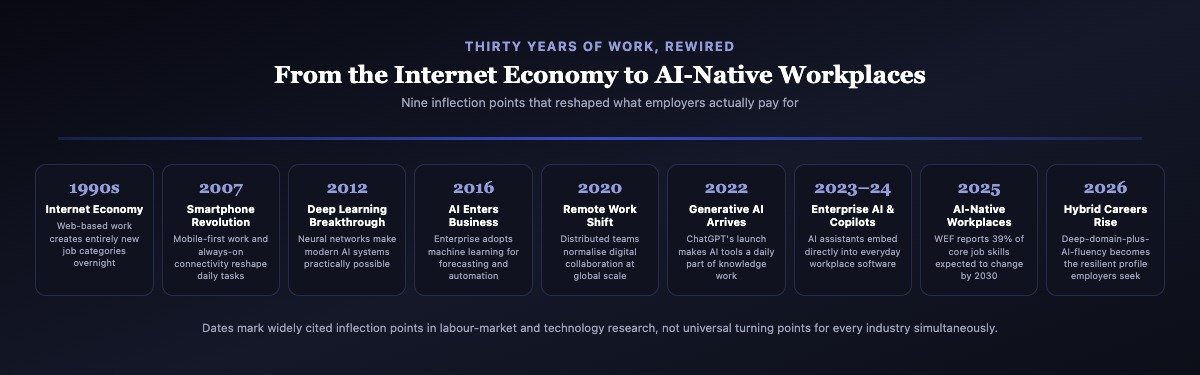
The Complete Timeline: Thirty Years of Work, Rewired
Each entry labelled: verified workforce report, employer survey, academic research, or expert commentary
The Internet Economy Creates New Career Categories
Technology change. Widespread commercial internet adoption through the 1990s created entirely new categories of work — web design, e-commerce operations, digital marketing — that had no direct pre-internet equivalent.
Labour market impact. Early internet-era careers rewarded broad, self-taught competence, since formal degree programmes for these new roles largely didn’t exist yet; generalists who could learn fast had a genuine structural advantage.
Current relevance. This period established a durable pattern later repeated with mobile and AI: genuinely new technology waves initially reward adaptable generalists, because formal specialist training pipelines take years to catch up.
Global Outsourcing Reshapes Which Skills Command a Premium
Labour market impact. Widespread outsourcing of routine technical and support work to lower-cost labour markets shifted premium value in higher-cost economies toward roles requiring judgment, client-facing communication, or coordination across distributed teams.
Career evolution. This period foreshadowed a dynamic AI now accelerates: routine, well-specified technical tasks became commoditised, while roles requiring contextual judgment and cross-team coordination held or gained value.
The Smartphone Revolution Redefines “Always-On” Work
Technology change. The 2007 launch of the smartphone era created mobile-first work patterns and a genuinely new discipline — mobile app development and design — almost overnight.
Career evolution. As with the internet economy a decade earlier, the earliest successful mobile-era professionals were largely self-taught generalists, since university curricula took years to formalise mobile development programmes.
Deep Learning Breakthroughs Make Modern AI Possible
Technology change. Breakthroughs in deep neural network training around 2012 — most famously in image recognition — demonstrated that neural networks could outperform prior approaches at previously difficult tasks, reigniting large-scale investment in AI research.
Career evolution. This period created the first substantial wave of dedicated machine learning specialist roles, distinct from general software engineering, as the technical depth required to train and tune these models genuinely exceeded generalist capability.
AI Enters Mainstream Business Operations
Labour market impact. By the mid-2010s, machine learning moved from research labs into mainstream enterprise use — recommendation systems, fraud detection, demand forecasting — creating steady, if still specialist-gated, demand for data science and ML roles.
Current relevance. This period built the professional infrastructure (bootcamps, master’s programmes, certifications) that would later make AI specialist training far more widely accessible than it was in 2012.
Remote Work Accelerates Digital and Cross-Functional Skills
Labour market impact. The rapid, largely involuntary shift to remote and distributed work during 2020 normalised digital collaboration tools and asynchronous work patterns across industries that had previously resisted them.
Career evolution. This period increased the premium on self-directed digital literacy and cross-functional communication, since remote workers needed to coordinate across teams without the informal in-person context that had previously smoothed collaboration gaps.
Generative AI Adoption Goes Mainstream
Technology change. The late-2022 public launch of accessible generative AI tools made large language models a daily part of ordinary knowledge work for the first time, well beyond specialist AI practitioners.
Labour market impact. This is the inflection point most workforce researchers now treat as the start of the current specialist-versus-generalist reassessment: suddenly, baseline AI fluency became relevant to nearly every knowledge-work role, not only technical ones.
Enterprise AI Deployment and Workplace Copilots
Labour market impact. AI assistants embedded directly into everyday workplace software (document editors, spreadsheets, coding environments) during this period, moving AI from a standalone tool to an integrated feature of daily task execution.
Employer expectations. Surveyed employers increasingly began citing AI fluency as a hiring consideration even for non-technical roles during this period, a trend that would be quantified more precisely in 2025 workforce reports.
WEF and LinkedIn Quantify the Skills Shift
Labour market data. The World Economic Forum’s Future of Jobs Report 2025 projected that 39% of core job skills will change by 2030, with AI and big data ranked the fastest-growing skill demand across the industries surveyed, and estimated 92 million jobs displaced against 170 million created — a net gain of 78 million by 2030.
Employer survey. The same report found roughly half of surveyed employers plan to reorient their business strategy in response to AI, 80% plan to upskill existing workers in AI-related skills, and about two-thirds plan to specifically hire for AI skills.
Verified workforce report. Separately, LinkedIn reported a 177% increase in members adding AI-related skills to their profiles since 2023 — nearly five times the average growth rate across all tracked skills — with AI Engineer and AI Consultant ranking among the fastest-growing job titles in major markets.
Stanford Documents a Specific Entry-Level Effect
Academic research. A Stanford Digital Economy Lab working paper, using actual ADP payroll records (not job postings or surveys) covering 2021 through mid-2025, found that workers aged 22 to 25 in the most AI-exposed occupations — including software engineering and customer service — experienced a 16% relative decline in employment following generative AI’s spread.
Independent analysis. Critically, the same study found more experienced workers in those same occupations did not show this decline, and employment was not declining among young workers in occupations with low AI exposure — suggesting a specific, task-exposure-driven effect rather than a broad generational employment crisis.
Current relevance. Follow-up analysis through April 2026 found the effect intensifying: employment in highly AI-exposed occupations for 22-25 year-olds shrinking at roughly 3.8% to 4% per year, against roughly 2% annual growth for the least-exposed occupations in the same age group.
The Rise of Hybrid AI Careers
Career evolution. Through 2026, hiring commentary and workforce researchers increasingly converge on the hybrid, T-shaped profile — deep domain expertise plus broad AI fluency — as the most resilient career strategy documented across multiple independent sources, rather than pure specialization or pure generalism.
Current relevance. This is the point this guide’s own analysis picks up: rather than resolving into a single winning strategy, the evidence base has converged on a framework — which this guide lays out in detail in the sections that follow.
🏆 Employer Insight
Many organizations increasingly seek professionals with deep expertise in one domain and the ability to collaborate across disciplines using AI tools. This shows up consistently across the WEF, LinkedIn and OECD research cited in this guide: employers are not abandoning specialization, but they are adding an expectation of AI fluency and cross-functional collaboration on top of it, rather than treating either quality as sufficient alone.
A Careers and AI Glossary
The terms this debate cannot be explained without
- AI Specialist
- A professional with deep technical expertise in a specific AI-related domain, such as machine learning engineering, AI research or data science.
- AI Generalist
- A professional with broad, practical working knowledge of AI tools, applying them across multiple functions rather than specialising in AI development itself.
- Hybrid Professional
- Someone combining genuine depth in one non-AI domain with practical AI fluency, allowing them to apply AI tools effectively within their specialist field.
- T-Shaped Skills
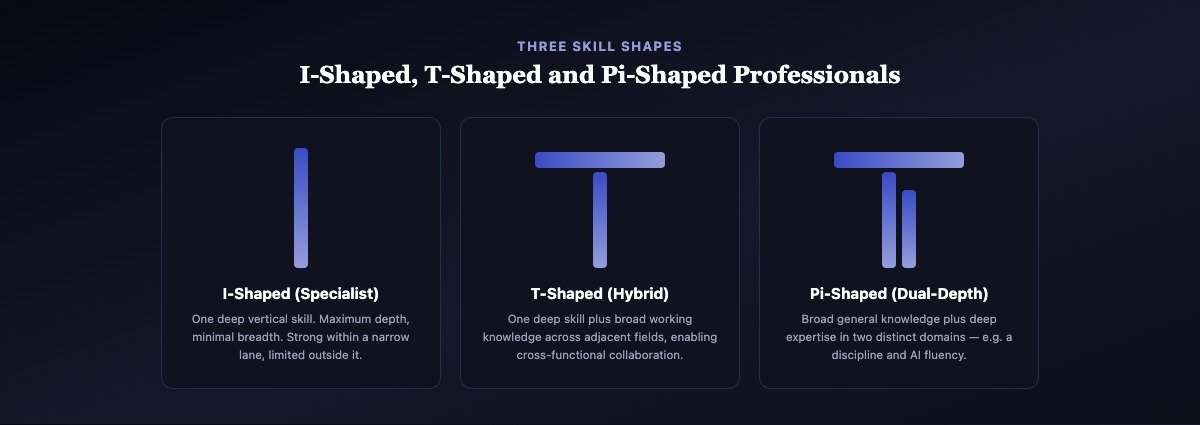
- A skills profile with deep expertise in one vertical domain (the “stem” of the T) plus broad working knowledge across adjacent fields (the “bar”).
- Pi-Shaped Skills
- An extension of T-shaped skills with deep expertise in two distinct domains atop a broad base of general knowledge, resembling the Greek letter pi.
- Cross-Functional Expertise
- The ability to work effectively across different organisational functions (engineering, design, marketing, operations) rather than remaining siloed in one.
- Prompt Engineering
- The practice of crafting inputs to AI language models to reliably produce useful, accurate outputs for a specific task or workflow.
- AI Governance
- Policies, oversight structures and practices ensuring AI systems are deployed responsibly, safely and in compliance with relevant regulation.
- AI Literacy
- A working understanding of what AI tools can and cannot reliably do, sufficient to use them effectively and evaluate their outputs critically.
- Automation
- A task or process performed by a machine or system with little to no ongoing human involvement.
- Augmentation
- A process where AI assists a human who remains in the loop, retaining judgment and final decision-making authority.
- Human Judgment
- The capacity to weigh context, values, ambiguity and consequence in a decision — a capability current AI systems cannot reliably replicate.
Should Students Specialise Early? The Case for Both Sides
What deep expertise buys you, and what broad knowledge buys you instead
The Case for Deep Expertise
Specialization remains genuinely valuable for several concrete reasons the evidence supports. First, in regulated and licensure-based fields — medicine, law, structural engineering, accounting — deep, credentialed expertise is not optional; it is a legal and professional requirement that AI tools do not bypass, since these fields require accountable human judgment backed by formal qualification. Second, specialists retain a durable advantage in diagnosing what AI gets wrong: an experienced radiologist recognises a subtle AI misclassification that a generalist simply cannot catch, because catching it requires the same depth of pattern recognition the AI itself was trained to approximate. Third, specialist depth compounds: early specialization, if it holds up as the field evolves, tends to produce faster progression to genuinely scarce, high-value expertise than a broader but shallower path.
The Case for Broad Knowledge
Breadth offers a different, equally evidence-supported set of advantages. First, broad exposure across disciplines provides optionality in a labour market where WEF projects 39% of core skills will change within five years — a generalist can pivot toward wherever demand shifts more readily than someone whose entire training was built around one narrow, potentially disrupted skill set. Second, generalists are structurally better positioned for early-stage and cross-functional roles — startup environments, product management, entrepreneurship — where the job itself requires moving fluidly across functions a specialist would need to delegate. Third, in the specific historical pattern this guide’s timeline documents, genuinely new technology waves (the internet, mobile, and now AI) have repeatedly rewarded early generalists simply because formal specialist training pipelines take years to catch up to a fast-moving frontier.
How AI Changes Entry-Level Jobs Specifically
This is where the evidence gets most concrete and most important for Gen Z specifically. Stanford’s Digital Economy Lab research, using real payroll data rather than surveys, found that entry-level hiring has declined measurably in occupations with high AI task-exposure — not universally, but specifically where AI tools can already perform a meaningful share of what junior employees in that role used to do. This matters because entry-level jobs have traditionally served two functions: getting paid to do useful work, and learning the tacit, on-the-job knowledge that eventually builds toward more senior expertise. If AI tools absorb the routine tasks that used to constitute junior work, the open question — not yet definitively answered in the research reviewed for this guide — is how the next generation acquires that tacit expertise at all. This is a genuinely unresolved concern raised by multiple researchers, not a settled finding, and it is one reason this guide avoids confident predictions about any single career path’s safety.
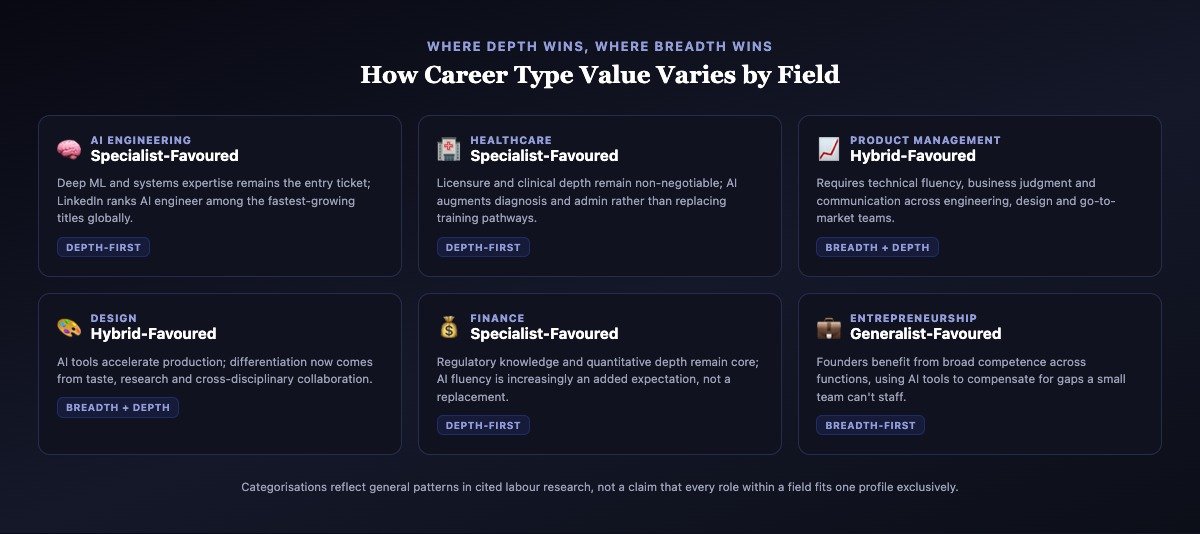
Which Industries Reward Specialists
Based on the evidence and industry patterns reviewed for this guide, specialization continues to carry the clearest premium in: healthcare (licensure and clinical depth remain non-negotiable), law (regulatory and jurisdictional expertise resists generalisation), advanced engineering disciplines (structural, aerospace, and similar fields with safety-critical certification requirements), and AI research and engineering itself (building and maintaining the underlying systems requires genuine technical depth that tools cannot yet replicate).
Which Industries Reward Generalists
Conversely, breadth carries a clearer premium in: early-stage entrepreneurship (small teams cannot afford to hire a specialist for every function), product management (the role is explicitly cross-functional by design), marketing and communications (increasingly spans content, data, and platform-specific skills that shift faster than any single specialization), and general management and operations (coordinating across specialist functions requires breadth more than depth in any one of them).
📚 Learning Insight
Strong fundamentals remain valuable even as AI accelerates execution. An AI tool can generate a plausible-looking first draft of code, analysis or design far faster than a human, but evaluating whether that output is actually correct, appropriate and complete still requires the underlying fundamentals a specialist spent years building. This is why nearly every workforce report reviewed for this guide treats foundational domain knowledge as a prerequisite for using AI tools well, not a thing AI makes optional.
Why Hybrid Professionals Are Increasingly Valued
The case for T-shaped and Pi-shaped careers, and how to build one
The term T-shaped originated inside McKinsey & Company in the 1980s as an internal framework for developing consultants, was first used in a professional publication by David Guest in a 1991 article, and was later popularised more broadly by Tim Brown, CEO of the design firm IDEO. The vertical stroke of the T represents deep expertise in one domain; the horizontal bar represents broad working knowledge across adjacent fields, enabling genuine collaboration rather than superficial familiarity. A newer variant, Pi-shaped, describes professionals with two areas of deep expertise atop that same broad base — commonly, in the AI era, a primary domain (say, marketing, or nursing, or mechanical engineering) plus genuine depth in applying AI tools within that domain specifically.
Why does this profile keep showing up as the evidence-favoured answer across independently produced reports? Because it directly addresses the two failure modes each pure extreme carries. A pure specialist risks obsolescence if their narrow domain is disrupted or absorbed by tools, and often struggles to communicate or collaborate effectively outside that domain. A pure generalist risks being unable to go deep enough to solve genuinely hard problems, and can struggle to establish credibility in fields that reward demonstrated expertise. A T-shaped or Pi-shaped professional is structurally insulated against both failure modes simultaneously: real depth provides defensible expertise and problem-solving capability; genuine breadth (increasingly including AI fluency specifically) provides adaptability and collaboration capacity.
How to Actually Build a T-Shaped Profile
In practical terms, based on the patterns in the workforce research reviewed for this guide, building a T-shaped or Pi-shaped profile means: choosing one domain to genuinely master rather than sampling many superficially; treating AI tool fluency as a second, deliberately developed competency rather than something absorbed passively; seeking projects and roles that require cross-functional collaboration, since that is where the “horizontal bar” of the T actually gets exercised and demonstrated; and continuing to invest in the depth skill even as AI tools make some of its component tasks faster, since depth is what lets you catch and correct what those tools get wrong.
How to Future-Proof a Career, Concretely
Every major report reviewed for this guide — WEF, LinkedIn, OECD, ILO — converges on a similar, if not identical, list of durable priorities: build genuine AI literacy (not necessarily AI engineering skill, but a working understanding of what current tools can and cannot reliably do); maintain and deepen one area of real domain expertise rather than abandoning depth entirely; actively practise cross-functional communication and collaboration, since this is consistently cited as harder to automate than technical execution; treat learning as continuous rather than front-loaded into a degree, since WEF’s 39%-by-2030 figure means the specific skills in demand when you graduate will meaningfully differ from those in demand five years later; and develop judgment — the capacity to evaluate ambiguous, high-stakes situations where there is no clearly correct AI-generatable answer — since this is the single most consistently cited “durable” human skill across every source this guide draws on.
🧠 AI Insight
AI is more likely to augment many knowledge workers than replace entire professions outright. This is the single most consistent finding across the ILO, OECD and WEF research cited throughout this guide: task-level transformation vastly outpaces full occupational elimination in the data currently available. That does not mean no jobs are at risk — Stanford’s entry-level findings show a real, specific effect — but it does mean sweeping claims that AI will “eliminate” a named profession outright are not well-supported by the current evidence base, and this guide deliberately avoids making them.
Comparison Tables: The Debate Side by Side
Eight reference tables covering skill profiles, industries and career types
Specialist vs Generalist
| Aspect | Specialist | Generalist |
|---|---|---|
| Core strength | Deep problem-solving in one domain | Adaptability across changing demands |
| Best suited to | Regulated, licensure-based fields | Early-stage, cross-functional roles |
| Main risk | Narrow-domain disruption or obsolescence | Insufficient depth for hard problems |
| AI-era advantage | Catches what AI gets subtly wrong | Adapts quickly as skill demand shifts |
Generalist vs Hybrid
| Aspect | Pure Generalist | Hybrid (T-Shaped) |
|---|---|---|
| Depth | Shallow across many areas | Genuinely deep in one area |
| Breadth | Wide but often superficial | Wide and functionally useful |
| Credibility risk | May struggle to establish expert credibility | Depth provides defensible expertise |
| Evidence support | Favoured in early technology waves | Favoured across most current 2025-26 workforce reports |
Technical Skills vs Human Skills
| Aspect | Technical Skills | Human Skills |
|---|---|---|
| Examples | Coding, data analysis, AI tool operation | Communication, judgment, adaptability, leadership |
| AI substitution risk | Higher for narrowly-specified tasks | Lower; consistently cited as durable |
| WEF 2025 finding | AI/big data is the top-growing demand | Resilience, flexibility, leadership also rising sharply |
| Career implication | Necessary but not sufficient alone | Increasingly the differentiator between similarly-skilled candidates |
AI Engineering vs AI Product Management
| Aspect | AI Engineering | AI Product Management |
|---|---|---|
| Core skill | Building and training AI/ML systems | Deciding what AI features to build and why |
| Profile type | Specialist (I-shaped or deep T) | Hybrid (T-shaped or Pi-shaped) |
| Typical background | Computer science, ML, statistics | Varies: business, design, engineering plus AI fluency |
| LinkedIn 2025-26 finding | Among the fastest-growing job titles globally | Growing demand as AI features scale across products |
Traditional Careers vs AI-Enabled Careers
| Aspect | Traditional Career Path | AI-Enabled Career Path |
|---|---|---|
| Skill stability | Relatively stable over a career | WEF projects 39% of core skills changing by 2030 |
| Entry point | Degree, then role-specific ramp-up | Degree plus demonstrated AI tool fluency |
| Learning model | Front-loaded, then periodic updates | Continuous, ongoing throughout career |
| Differentiator | Years of experience | Depth combined with adaptability and AI fluency |
Industry Demand by Career Type
| Industry | Favoured Profile | Why |
|---|---|---|
| Healthcare | Specialist | Licensure and clinical depth are non-negotiable |
| Law | Specialist | Jurisdictional and regulatory expertise resists generalisation |
| AI Engineering | Specialist / Deep T | Building AI systems requires genuine technical depth |
| Product Management | Hybrid | Explicitly cross-functional by design |
| Design | Hybrid | AI accelerates production; differentiation is judgment and taste |
| Entrepreneurship | Generalist | Small teams need broad competence across every function |
Timeline Summary
| Year | Workforce Change | Career Impact |
|---|---|---|
| 1990s | Internet economy emerges | Rewards early generalists in a new field |
| 2000s | Global outsourcing | Commoditises routine tasks, rewards judgment |
| 2007 | Smartphone revolution | Creates mobile-first generalist opportunity |
| 2012 | Deep learning breakthroughs | Establishes AI specialist as a real career category |
| 2016 | AI enters mainstream business | Builds AI specialist training pipelines |
| 2020 | Remote work acceleration | Raises baseline digital and cross-functional skill expectations |
| 2022 | Generative AI adoption | Makes AI fluency relevant to nearly every knowledge role |
| 2023-24 | Enterprise AI and copilots | AI fluency becomes an implicit hiring expectation |
| 2025 | WEF/LinkedIn quantify the shift | Confirms hybrid AI-fluent profiles as fastest-growing demand |
| 2025 (Nov) | Stanford documents entry-level effect | Shows measurable, specific impact on young workers in AI-exposed roles |
| 2026 | Hybrid AI careers rise | Converges evidence toward the T-shaped career strategy |
Who’s Who: The Organisations Behind This Research
The institutions named throughout this guide, in one place
World Economic Forum
Publisher of the Future of Jobs Report, the source of this guide’s 39%-skills-change and 92M/170M jobs displacement/creation figures.
Publisher of workforce and skills data drawn from its global membership, including the 177% AI-skill growth figure cited here.
Stanford Digital Economy Lab
Source of the ADP payroll-based research on entry-level employment effects in AI-exposed occupations.
International Labour Organization (ILO)
UN agency whose research finds jobs roughly six times more likely to be transformed by AI than fully automated.
OECD
Source of cross-national research on AI’s task-level substitution effects, including the Korean-firm survey cited in this guide.
OpenAI
Developer of ChatGPT, whose late-2022 public launch is widely cited as the inflection point for mainstream generative AI adoption.
Google DeepMind
A leading AI research organisation whose work has shaped both the underlying technology and the specialist career category around it.
Anthropic
An AI safety-focused research company whose work has informed public and employer discussion of AI governance and responsible deployment.
Microsoft
A major enterprise AI deployer, whose Copilot integrations across office software are frequently cited in “AI enters the workplace” research.
IDEO
The design firm whose CEO, Tim Brown, is widely credited with popularising the T-shaped skills concept beyond its original consulting-industry origin.
Myth vs Fact
Common misconceptions, checked against the cited research
✓ Verified Facts
- WEF’s Future of Jobs Report 2025 projects 39% of core job skills will change by 2030.
- LinkedIn recorded a 177% increase in members adding AI skills to profiles since 2023.
- Stanford’s ADP payroll research found a 16% relative employment decline for 22-25 year-olds in highly AI-exposed occupations.
- The ILO finds jobs roughly six times more likely to be transformed by AI than fully automated.
- T-shaped skills terminology originated inside McKinsey in the 1980s and was popularised later by IDEO’s Tim Brown.
✗ Common Myths
- Myth: “AI will eliminate entire professions.” Fact: The dominant documented pattern is task-level transformation, not wholesale occupational elimination, though specific effects on young workers in high-exposure roles are real.
- Myth: “Specialists are now obsolete; only generalists survive.” Fact: Regulated and licensure-based fields continue to reward deep specialization strongly; the evidence favours hybrid profiles, not pure generalism.
- Myth: “Generalists are now obsolete; only AI specialists get hired.” Fact: Fast-moving, cross-functional fields like entrepreneurship and product management continue to reward breadth, often paired with AI fluency.
- Myth: “This research proves entry-level jobs are disappearing everywhere.” Fact: Stanford’s findings are specific to occupations with high AI task-exposure; low-exposure entry-level roles show no comparable decline.
- Myth: “Learning to prompt AI well is the only skill that matters now.” Fact: Every major report cited here treats AI fluency as necessary but insufficient alone, alongside genuine domain depth and durable human skills.
💡 Interesting Facts
- Did You Know? Many emerging job descriptions now include AI literacy even when the role is not an AI engineering position — a shift LinkedIn and WEF data both independently confirm across marketing, operations and management listings.
- The “T-shaped” concept predates the internet-era generalist debate by decades, having originated as an internal McKinsey consultant-development framework in the 1980s.
- Stanford’s research is notable for using actual ADP payroll records rather than surveys or job postings — a methodological detail that makes its entry-level findings unusually hard to dismiss as anecdotal.
- The 92 million jobs WEF projects will be displaced by 2030 is smaller than the 170 million projected to be created in the same period — a net positive figure frequently omitted when this report is cited to support alarmist framing.
- South Korean firm survey data found 71% of AI-adopting companies reported AI substituting only about 10% of an average employee’s tasks — a concrete illustration of augmentation outpacing full automation in practice.
👀 Future Watch
What to monitor going forward, from official sources only: future WEF Future of Jobs Reports and their updated skills-change projections; academic research extending Stanford’s entry-level employment analysis to additional occupations and time periods; employer hiring trend data from LinkedIn, ADP and similar payroll-based sources; and education reform announcements as universities and training providers adjust curricula in response to AI’s documented labour market effects. This section deliberately avoids predicting specific job losses; it tracks only documented research and reporting.
Explore More Timelines
People Also Ask
Frequently Asked Questions
100 questions on AI careers, skills and the specialist-versus-generalist debate
Why the Future Belongs to Adaptive Professionals
Return to Priya and Marcus, five years out from the same graduation. The temptation is to declare a winner — to say the specialist path or the generalist path was “right” — but that temptation is exactly what the evidence in this guide argues against. Priya’s depth let her diagnose a model failure a generalist couldn’t touch. Marcus’s breadth, paired with AI tools that compressed weeks of specialist work into days, let him move a fifteen-person company forward faster than a narrower background would have allowed. Both are, in the language this guide has used throughout, quietly hybrid: Priya has learned enough about product and communication to explain her technical judgment to non-specialists; Marcus has gone deep enough in product strategy specifically that his breadth isn’t superficial anymore. Neither stayed purely I-shaped or purely flat.
The specialist-versus-generalist debate is increasingly giving way to a hybrid model, and the evidence gathered throughout this guide — from WEF’s skills-change projections to LinkedIn’s AI-skill growth data to Stanford’s sobering, specific findings about entry-level hiring — points in a consistent direction without pretending to offer certainty. The strongest long-term career strategy for many people is to build deep expertise in one domain while developing AI literacy, communication, critical thinking, collaboration and continuous learning alongside it. Not instead of depth. Not instead of breadth. Both, deliberately built, reinforcing each other.
What this guide cannot tell you is which specific domain to choose, what your specific salary will be, or whether your specific job title will exist in ten years in its current form — and any guide that claims to know those things with certainty is offering false confidence the underlying research does not support. What the evidence does support is this: career success in the years ahead will depend less on picking the perfectly safe specialization and more on adaptability, sound judgment, and the ability to work effectively alongside AI rather than trying to compete directly with it on the narrow tasks it now does well. That is not a hedge. It is, as closely as the current evidence allows, the actual answer.
Related Reading on AiTimeline
Passkeys Explained: Moving Beyond Passwords
Kimi K3: History and Timeline of Moonshot AI’s Frontier Model
The U.S. Economy: 250 Years of Growth, Slowdown and Inflation
Youth Unemployment in India: A Data-Led Timeline
Sources & further reading
Every dated entry above was checked against these references. Last reviewed 15 September 2026.