Brazil’s Disease-Fighting Mosquitoes: How Wolbachia Fights Dengue
Brazil releases Wolbachia mosquitoes - not genetically modified - to reduce dengue, Zika and chikungunya spread. Niteroi evidence and 2026 status inside.
Latest Story
The insect responsible for spreading dengue is also part of Brazil’s strategy for slowing it down. That is not a contradiction – it is the premise behind one of the country’s largest public-health programs: releasing Aedes aegypti mosquitoes carrying a naturally occurring bacterium called Wolbachia into cities where dengue, Zika and chikungunya circulate every year.
The mosquitoes are not genetically modified. Brazil’s Ministry of Health and the program’s operators are explicit about this: Wolbachia occurs naturally in an estimated half of all insect species, and introducing it into a laboratory colony of Aedes aegypti does not alter the mosquito’s genome. What it does is interfere with the ability of dengue, Zika and chikungunya viruses to replicate inside the mosquito – which reduces, but does not guarantee zero, the chance that a bite transmits infection.
Brazil began releasing these mosquitoes – locally nicknamed Wolbitos – in September 2014, with Niterói recognized by the Ministry of Health as the first Brazilian city to fully implement the method. A decade on, the program spans 11-plus project sites, has a purpose-built biofactory capable of producing 100 million mosquito eggs a week, and is central to Brazil’s response to a disease that infected more than 6.4 million people in 2024 alone. This article lays out what the evidence actually shows, what happened in Niterói specifically, and what the method can and cannot do.
Latest Update — April 2026
Dengue cases fall sharply as combined measures continue
Brazil’s Ministry of Health reported in April 2026 that probable dengue cases fell 75% in the first months of the year compared with the same period in 2025: 227,500 cases from 1 January to 11 April 2026, versus 916,400 in the same window a year earlier. The Ministry attributed the decline to a combination of measures rather than any single tool – expanded ovitrap surveillance (present in 1,600 municipalities, with a target of 2,000 by year-end), continued expansion of the Wolbachia method toward 72 priority municipalities, sterile-insect-technique releases, and the rollout of Instituto Butantan’s single-dose dengue vaccine, with 1.4 million doses administered to children and adolescents aged 10-14 and a pilot program for ages 12-59 beginning in three municipalities in 2026. As with earlier results, the Ministry credits Wolbachia as one contributing factor among several, not the sole driver of the drop.
🧠 Quick Answer
Brazil releases Aedes aegypti mosquitoes carrying Wolbachia, a naturally occurring bacterium that reduces (without eliminating) the mosquito’s ability to transmit dengue, Zika and chikungunya. The mosquitoes are not genetically modified. Brazil’s releases began in September 2014, with Niterói as the first city to fully implement the method; the program has since expanded to 11-plus municipalities and is backed by a biofactory that opened in July 2025. It is one tool within Brazil’s broader dengue-control strategy, not a replacement for it.
Brazil’s Wolbachia Mosquitoes: Key Questions
What the Program Actually Does, and Doesn’t
- Not genetic modification: Wolbachia is a naturally occurring bacterium, and Brazil’s Ministry of Health explicitly says Wolbitos are not transgenic.
- It reduces transmission, not mosquito numbers: the goal is to establish Wolbachia in the wild population, not to kill every Aedes aegypti.
- Niterói has the strongest evidence: a peer-reviewed 2021 study found 69% fewer dengue cases, 56% fewer chikungunya, 37% fewer Zika versus a control area.
- The effect has lasted years, not months: Wolbachia remained established in Niterói’s mosquito population at high prevalence at least five years after release.
- Brazil began in September 2014, with Niterói as the first city to fully implement the method; large-scale deployment followed in 2017.
- A dedicated biofactory opened in July 2025 in Curitiba, with capacity for 100 million mosquito eggs a week.
- 140 million people across 40 municipalities is a stated future goal, not a 2026 fact – as of the biofactory’s 2025 launch, the program directly protected an estimated 5 million people.
- Wolbachia is not sterile-insect technique or a gene-drive: those aim to suppress mosquito populations; Wolbachia replacement aims to spread a trait through them.
- It doesn’t replace other dengue control: breeding-site removal, insecticides, surveillance and community action remain part of Brazil’s strategy.
- Brazil recorded 6.48 million probable dengue cases in 2024 – the context driving the program’s scale-up.
How Can a Mosquito Help Fight Dengue?
The mechanism, step by step
Aedes aegypti is the mosquito primarily responsible for spreading dengue, Zika and chikungunya between people in Brazil. It picks up a virus by biting an infected person, and can pass that virus on through a later bite – but only if the virus successfully replicates inside the mosquito’s own body first. That step is where Wolbachia intervenes.
- Aedes aegypti can carry and transmit dengue, Zika and chikungunya viruses between people through its bites.
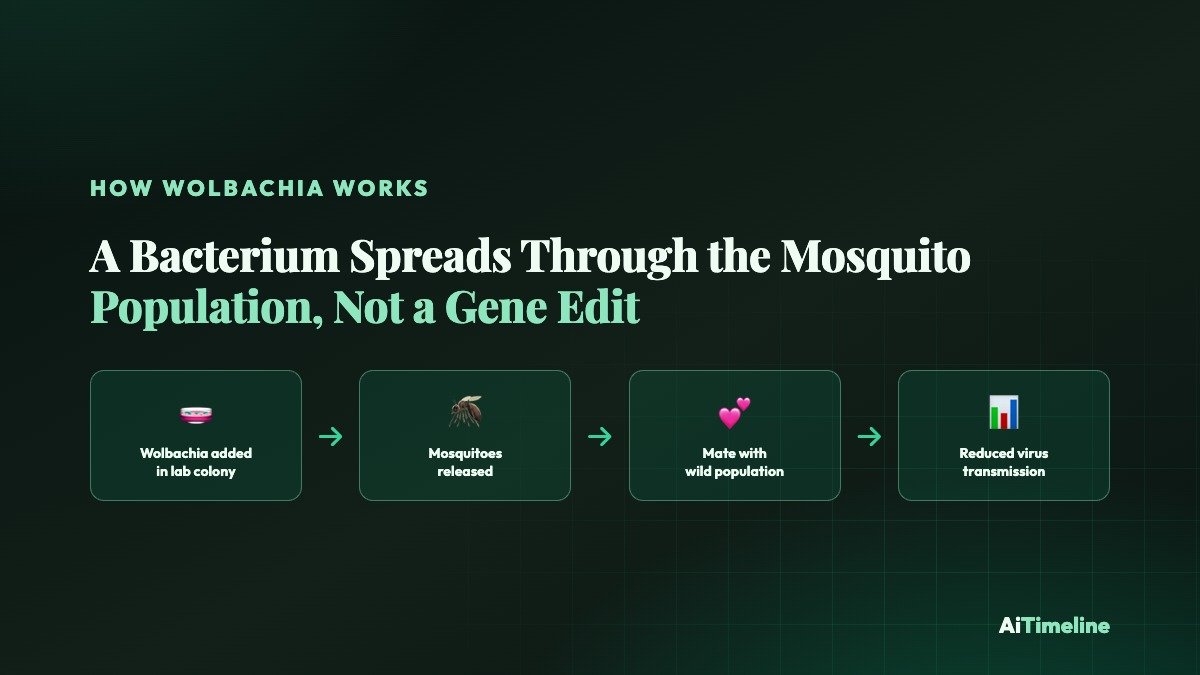
- Wolbachia is introduced into a laboratory colony of Aedes aegypti – the bacterium occurs naturally in many other insect species but not typically in this one.
- Inside the mosquito, Wolbachia competes for cellular resources the viruses need, interfering with how efficiently dengue, Zika and chikungunya replicate.
- Wolbachia-carrying mosquitoes are released into a target neighborhood over a period of weeks to months.
- They mate with the local wild mosquito population.
- Wolbachia passes to offspring at very high rates – a mechanism called cytoplasmic incompatibility helps it spread even faster through the population over generations.
- As Wolbachia becomes established at high prevalence, a growing share of the local Aedes aegypti population has a reduced ability to transmit these viruses – which is associated with fewer human cases, as documented in Niterói.
The mechanism reduces transmission risk; it does not sterilize mosquitoes, does not kill them outright, and does not make every single mosquito virus-free. It is a population-level, probabilistic effect, not a guarantee at the level of any one bite.
Are These Mosquitoes Genetically Modified?
No – and the distinction matters for how the method is regulated and understood
✅ What Is True
- Wolbachia is a naturally occurring bacterium, present in an estimated 50%-plus of insect species.
- It is introduced into Aedes aegypti through lab breeding, not gene editing.
- The mosquito’s own DNA is not altered by this method.
- Brazil’s Ministry of Health explicitly describes Wolbitos as not transgenic.
❌ What This Is Not
- Not a genetically modified organism (GMO) – no genes are edited or inserted into the mosquito’s genome.
- Not the sterile insect technique (SIT), which uses radiation to make released males infertile.
- Not a gene-drive system, which forcibly spreads an engineered genetic trait.
- Not an insecticide – no chemical agent is being deployed against mosquitoes.
Wolbachia Is Not the Same as Sterile-Insect Technology
Several distinct technologies get lumped together in casual coverage of “mosquito control,” and they work in fundamentally different ways. Wolbachia replacement – Brazil’s approach – aims to establish a self-sustaining, naturally spreading trait (reduced viral transmission) throughout a wild mosquito population; released mosquitoes are meant to breed successfully. The sterile insect technique (SIT) does the opposite: it releases mosquitoes (often irradiated or otherwise sterilized males) specifically so they cannot produce viable offspring, gradually suppressing the local population. Genetic modification and gene-drive approaches directly edit a mosquito’s DNA – sometimes to be self-limiting (die off after a few generations), sometimes to spread a trait through a gene drive far more aggressively than Wolbachia’s natural spread. Insecticide-based control is chemical, not biological, and kills mosquitoes on contact or ingestion rather than modifying a population trait.
The practical difference: Wolbachia replacement wants the released mosquitoes to breed and spread the bacterium through many generations. SIT and most genetic-suppression methods want population numbers to fall. Confusing the two leads to two common but incorrect claims about Brazil’s program – that mosquitoes are being genetically engineered (they are not), and that the goal is to reduce the number of mosquitoes in a city (it isn’t – a Wolbachia-carrying population can be just as large as a wild one).
Why a Mosquito Can Become a Public-Health Tool
Aedes aegypti is not “good” or “bad” – it is a mosquito that behaves like a mosquito, biting, breeding in standing water, and moving between people, largely unchanged in behavior by carrying Wolbachia. The intervention does not turn it into a beneficial insect or a medical device. What changes is a single, specific biological property: its capacity to let certain viruses replicate well enough inside it to pass them on.
That reframing matters because it explains why the strategy works with mosquito biology rather than against it. Decades of dengue control have focused almost entirely on killing mosquitoes or removing their breeding sites – approaches that face resistance, require constant re-application, and struggle at city scale. Wolbachia instead tries to change what happens when a mosquito that already exists bites someone. It is a quieter, slower-acting idea, and its success depends less on any single release event than on whether the trait actually takes hold and persists in the wild population for years – which is precisely what Niterói’s data show happening.
Brazil’s Wolbachia Timeline
Reverse-chronological. Dates verified against Brazilian government, Fiocruz and World Mosquito Program sources
Expansion Toward 40 Municipalities Continues
Wolbito do Brasil’s stated ambition is to reach more than 40 municipalities by the end of 2026, with a Ministry of Health commitment to extend coverage to roughly 7 million additional people every six months. Not every planned municipality has completed deployment as of this writing – treat individual city status as developing, not fixed.
Wolbito do Brasil Biofactory Opens in Curitiba
A joint venture of the World Mosquito Program, Fiocruz and the Institute of Molecular Biology of Paraná (IBMP) opened what is described as the world’s largest Wolbachia mosquito biofactory, with capacity for 100 million eggs a week (about 5 billion a year initially). At launch, the program directly protected an estimated 5 million people, with 140 million across 40 municipalities described as a multi-year goal, not an immediate figure.
Six New Municipalities Begin Implementation; Record Dengue Year
Brazil’s Ministry of Health formally incorporated Wolbachia into its national dengue strategy as six additional municipalities began implementation. The same year, Brazil recorded 6,484,890 probable dengue cases and 5,972 deaths – part of the worst global dengue epidemic on record, with more than 14 million cases worldwide.
Peer-Reviewed Niterói Results Published
A quasi-experimental study covering four Niterói release zones (83 km², about 373,000 residents) found Wolbachia deployment associated with a 69% reduction in dengue, 56% in chikungunya and 37% in Zika versus a matched control area, with Wolbachia prevalence of 33%-90% across zones by March 2020.
Large-Scale Deployment Begins
Brazil moved from pilot-scale releases to large-scale deployment, reaching an estimated 3.2 million people across its initial municipalities – the point at which the program shifted from a controlled trial footing toward a broader public-health rollout.
Brazil’s First Wolbachia Releases
Following government approval and more than two years of community engagement and monitoring, Brazil conducted its first field releases of Wolbachia-carrying mosquitoes. Brazil’s Ministry of Health recognizes Niterói as the first Brazilian city to fully implement the method; Fiocruz served as the local research and implementation partner under Ministry of Health guidance.
World Mosquito Program Established
Building on earlier Australian trials, the World Mosquito Program was established at Monash University to develop and scale the Wolbachia method globally as a not-for-profit public-health initiative.
Wolbachia Shown to Block Dengue Replication
Researchers led by Professor Scott O’Neill published findings that Wolbachia could interfere with dengue virus replication in Aedes aegypti – the scientific foundation that made a public-health application possible, later built on by field research in Cairns, Australia, before reaching Brazil.
Wolbachia First Described
Wolbachia pipientis was first identified in the common house mosquito, Culex pipiens, by researchers Marshall Hertig and S. Burt Wolbach – decades before anyone linked it to dengue control.
How Wolbachia establishes itself in a wild Aedes aegypti population — AiTimeline
Why Niterói Matters
Brazil’s strongest real-world case study
Niterói, a city of roughly 500,000 across the bay from Rio de Janeiro, is where Brazil’s Ministry of Health says the Wolbachia method was first fully implemented, and it remains the country’s best-documented example. Releases ran across four zones between 2017 and 2019, and by March 2020 Wolbachia prevalence in local Aedes aegypti ranged from 33% to 90% depending on the zone – evidence the bacterium was successfully establishing itself in the wild population, not just in released insects.
The peer-reviewed evaluation, published in PLOS Neglected Tropical Diseases in July 2021, used a controlled interrupted time-series design comparing disease notifications in the release area against a matched, historically synchronous control area. It found Wolbachia deployment associated with a 69% reduction in dengue (95% CI: 54%-79%), a 56% reduction in chikungunya (95% CI: 16%-77%) and a 37% reduction in Zika (95% CI: 1%-60%) in the release area relative to the control. The study’s own authors describe this as an association from a non-randomized, quasi-experimental design – a real limitation – though the use of a matched parallel control and a decade of pre-intervention data helps address confounding.
Later analysis adds a stronger, more current data point: during Brazil’s record 2024 dengue epidemic, Niterói recorded a dengue incidence of 374 cases per 100,000 residents – versus roughly 1,884 per 100,000 across Rio de Janeiro state and about 3,157 per 100,000 nationally. Researchers estimate Wolbachia prevented at least three-quarters of the dengue burden Niterói might otherwise have experienced that year, with Wolbachia still present at high prevalence in the local mosquito population five years after release, and up to seven years at the earliest release sites.
What this does not show: that dengue was eliminated in Niterói (it was not – cases still occurred), or that every city will see identical results (transmission dynamics, mosquito density and coverage levels vary by location). It shows a large, statistically supported, multi-year reduction in disease burden in a real Brazilian city – which is why Niterói anchors the evidence base for the national program.
What Does the Science Say?
Separating evidence by strength and setting
| Evidence type | What it shows | Key limitation |
|---|---|---|
| Laboratory studies (2005-2011) | Wolbachia interferes with dengue virus replication inside Aedes aegypti | Lab conditions don’t capture real-world transmission dynamics |
| Early field trials (Australia, 2011+) | Wolbachia can establish and persist in wild mosquito populations after release | Small-scale, lower-transmission settings than urban Brazil |
| Niterói quasi-experimental study (2021, PLOS NTD) | 69% fewer dengue, 56% fewer chikungunya, 37% fewer Zika cases vs. control | Non-randomized; association, not a randomized-controlled-trial-level causal claim |
| Indonesia randomized trial (Yogyakarta, published 2021, NEJM) | Cluster-randomized trial found roughly 77% reduction in symptomatic dengue in Wolbachia-treated clusters | Single-city trial; strongest study design available for this method to date |
| Niterói long-term/epidemic-surge analysis (2025) | Sustained high Wolbachia prevalence 5+ years post-release; large reduction during 2024’s record epidemic | Observational; compares against regional/national averages, not a randomized control |
| Global program data (World Mosquito Program, ongoing) | Multiple countries report reduced dengue incidence in Wolbachia areas | Program-reported; strongest where paired with independent peer-reviewed analysis |
The strongest single study design behind this method is the Yogyakarta, Indonesia, cluster-randomized controlled trial, published in the New England Journal of Medicine in 2021, which randomized city clusters to receive Wolbachia releases or not – a design that better isolates causation than Niterói’s quasi-experimental approach. Brazil’s own evidence base is observational and quasi-experimental, but consistent in direction and magnitude with the randomized Indonesian result, which is why both are cited together rather than either alone.

From Niterói’s first releases to a nationwide biofactory — AiTimeline
Brazil’s Wolbachia Biofactory
Wolbito do Brasil, Curitiba
Curitiba, Paraná
A joint venture of the World Mosquito Program, Fiocruz and the Institute of Molecular Biology of Paraná (IBMP), operating as Wolbito do Brasil. Opened the week of 23 July 2025.
100 million eggs/week
Roughly 5 billion eggs annually at initial capacity – described as the world’s largest facility of its kind, built specifically to supply Brazil’s national Wolbachia strategy.
~5 million people (2025)
The population directly protected when the biofactory opened. Expansion to 140 million people across roughly 40 municipalities is described by program officials as a goal “in the coming years,” not an already-achieved 2026 figure.
~7 million people / 6 months
Brazil’s Ministry of Health has stated a commitment to extend coverage to roughly seven million additional people every six months as the biofactory ramps up supply.
Why Brazil Needs New Tools Against Dengue
Brazil recorded 6,484,890 probable dengue cases and 5,972 deaths in 2024, per the Ministry of Health’s Arbovirus Monitoring Panel – part of a global epidemic year that saw more than 14 million dengue cases worldwide, roughly double prior epidemic peaks. Early 2025 case counts (359,725 cases and 152 deaths reported by 20 February 2025) suggest the burden remained substantial into the following year, though full-year 2025 and 2026 figures should be checked against the Ministry’s live panel rather than assumed from this article.
Several factors converge to sustain that burden: Aedes aegypti thrives in dense urban environments with inconsistent water infrastructure, where residents often store water in open containers that double as breeding sites; Brazil’s tropical and subtropical climate supports year-round mosquito activity in much of the country; rapid urbanization has expanded the mosquito’s habitat into new areas; and human mobility helps move both mosquitoes and circulating virus strains between regions. Rising average temperatures and shifting rainfall patterns are widely documented as factors that can expand the geographic and seasonal range in which Aedes aegypti thrives, though climate change is one contributing factor among several, not the sole driver of Brazil’s dengue burden.
What Wolbachia Cannot Do
The limitations that keep this a partial tool, not a solution on its own
❌ Limitations
- It does not kill or remove every mosquito from an area.
- It does not immediately eliminate dengue, Zika or chikungunya transmission.
- It does not protect against every mosquito-borne disease (yellow fever transmission dynamics, for instance, differ).
- It does not replace sanitation or breeding-site removal.
- It does not replace public-health surveillance and outbreak response.
- Coverage and establishment take months to years, not days.
- Results can vary meaningfully by city, mosquito density and local transmission intensity.
- Long-term monitoring is required to confirm Wolbachia prevalence stays high over time.
Are Wolbachia Mosquitoes Safe?
Wolbachia is not a novel or exotic organism introduced to Brazil – it already occurs naturally in an estimated majority of insect species worldwide, including many mosquitoes people encounter without incident. The Wolbachia strain used in this program (wMel) has been studied for safety and assessed by health authorities in multiple countries prior to and during deployment, and released mosquito populations are monitored for both Wolbachia prevalence and any unexpected effects. The method does not involve pesticides or genetic modification of the mosquito. That said, no public-health intervention should be described in absolute terms: this article does not claim the method is “100% safe” in every conceivable circumstance, only that it has been assessed and approved by the relevant Brazilian and international health authorities as part of an ongoing, monitored public-health program.
Community Acceptance
Brazil’s program has consistently paired mosquito releases with community consultation – the World Mosquito Program reports that Brazil’s initial 2014 releases followed more than two years of community engagement and monitoring before deployment began, and that pattern of local education and consultation has continued as the program expanded. Public acceptance matters practically, not just ethically: a method that depends on released mosquitoes breeding successfully in a neighborhood needs residents who understand what’s being released and why, are not actively working against the program (for instance, by using insecticides that also kill the released Wolbachia mosquitoes), and can report concerns to public-health authorities. This article does not include invented resident quotes or testimonials – community sentiment should be sourced directly from WMP, Fiocruz or Ministry of Health community-engagement reporting, not fabricated for effect.
Brazil’s Wolbachia Program in Global Context
| Country | Notable site | Evidence type | Reported outcome |
|---|---|---|---|
| Brazil | Niterói | Quasi-experimental (2021) + long-term observational (2025) | 69% fewer dengue cases vs. control; sustained high Wolbachia prevalence 5+ years |
| Indonesia | Yogyakarta | Cluster-randomized controlled trial (2021, NEJM) | ~77% reduction in symptomatic dengue in treated clusters |
| Australia | Cairns, Queensland | Early field trials and long-term monitoring (2011+) | First large-scale demonstration Wolbachia establishes and persists in the wild |
| Colombia | Multiple cities incl. Medellín | Program-reported and observational data | Reported reductions in dengue incidence in Wolbachia-covered areas |
Brazil is not the only country using this method, and it is not straightforwardly “the best” – Indonesia’s randomized trial is the strongest single study design in the world for this intervention, while Brazil’s contribution is scale and duration: more cities, more years of post-release monitoring, and a purpose-built national supply chain. Each country’s numbers come from a different study design and should not be directly compared as if they measured the same thing.
How Does Wolbachia Compare to Other Dengue Tools?
| Method | How it works | Target | Advantage | Limitation |
|---|---|---|---|---|
| Wolbachia replacement | Bacterium spreads through population, reducing viral replication in mosquitoes | Population-level transmission risk | Self-sustaining once established; no repeat chemical application | Slow to establish; needs years of monitoring; effect size varies by site |
| Insecticides (adulticides/larvicides) | Chemically kill mosquitoes or larvae | Mosquito numbers directly | Fast-acting, useful in outbreak response | Resistance develops; requires repeated application; limited residual effect |
| Source reduction | Removing standing water / breeding sites | Mosquito reproduction | No chemicals; community-driven; cheap | Labor-intensive; requires sustained behavior change citywide |
| Dengue vaccination | Immunizes individuals against the virus | Human susceptibility, not the mosquito | Directly protects the vaccinated person | Efficacy varies by prior dengue exposure and serotype; not universally recommended for all ages/groups |
| Sterile insect technique (SIT) | Releases sterilized males to suppress population | Mosquito population size | Reduces mosquito numbers directly, no chemicals | Requires continuous mass releases; doesn’t spread a self-sustaining trait |
| Genetic/gene-drive approaches | Directly edits mosquito DNA to suppress or alter populations | Mosquito genome | Potentially very fast population effects | Regulatory and ecological questions remain more contested; limited large-scale deployment to date |
Explore More Timelines
Original AiTimeline Analysis
Editorial observations, not reported facts
AiTimeline Analysis
- The strategy changes mosquito biology rather than relying solely on mosquito elimination – a fundamentally different bet than most 20th-century vector control.
- Local establishment matters more than any single release event: Niterói’s value as a case study comes from years of sustained Wolbachia prevalence, not the initial release itself.
- Community acceptance functions as part of the technology, not a public-relations add-on – a method that depends on successful mosquito breeding cannot succeed without local buy-in.
- Program dashboards can measure Wolbachia prevalence and coverage, but only independent epidemiological data (like the 2021 PLOS study) can show public-health impact.
- Brazil’s scale – a purpose-built 100-million-egg-a-week biofactory – makes this one of the largest tests anywhere of whether biological vector control can operate as routine public-health infrastructure, not a boutique pilot.
- Niterói is a useful case study precisely because it has multiple years of post-release data, including through a record epidemic year, rather than a single before/after snapshot.
- Wolbachia does not remove the need for traditional dengue control – Brazil’s own strategy keeps breeding-site removal, insecticide use and surveillance running in parallel.
- The central open question is not whether mosquitoes can carry Wolbachia (that’s established), but whether coverage and prevalence can be sustained as the program scales to dozens of new municipalities with different mosquito densities and transmission intensities.
- National biofactory capacity changes the economics of deployment – moving from research-scale rearing to industrial-scale production is what makes a 40-municipality target logistically plausible.
- Brazil is effectively running the largest real-world test of whether Wolbachia can become durable public-health infrastructure rather than a time-limited intervention – the answer will likely take years, not months, to fully confirm.
Frequently Asked Questions
28 questions people are asking about Brazil’s Wolbachia mosquito program
Sources & Further Reading
This article draws on Brazil’s Ministry of Health, Fiocruz, the World Mosquito Program, and peer-reviewed studies published in PLOS Neglected Tropical Diseases and other scientific journals. Effectiveness claims are sourced to peer-reviewed literature where available; deployment status is sourced to Brazilian government and program-operator reporting.
Sources & further reading
Every dated entry above was checked against these references. Last reviewed 20 September 2026.
- PLOS Neglected Tropical Diseases: Effectiveness of Wolbachia-infected mosquito deployments in Niterói, Brazil (2021)
- World Mosquito Program: Brazil global progress page
- Fiocruz: Brazil gains the world's largest mosquito biofactory to combat arboviruses (2025)
- World Mosquito Program: World's Largest Wolbachia Biofactory Opens in Brazil
- MDPI: Long-Term Durability and Public Health Impact of City-Wide wMel Wolbachia Mosquito Releases in Niterói, Brazil, During a Dengue Epidemic Surge (2025)
- Agência Brasil: Dengue cases in Brazil surpass 6.4M in 2024
- World Health Organization: Vector-borne diseases