The Generative AI Evolution: From ChatGPT to Autonomous Coding Agents Timeline
Follow AI evolution from ChatGPT and coding copilots to reasoning models and autonomous coding agents, with key milestones from 2022 to 2026.
Latest Story
The story of generative AI since 2022 is not really the story of chatbots getting better at conversation. It is the story of AI’s role changing — from a system that talks, to one that assists, to one that reasons through hard problems, to one that reaches for tools, to one that can open a code editor, make a change, run the tests and try again. The generative AI evolution from ChatGPT to today’s coding agents is a chain of fairly distinct capability jumps, each of which unlocked the next, and each of which is easy to overstate if you are not careful about what “autonomous” actually means at each stage.
How Did AI Evolve From ChatGPT to Coding Agents?
🧠 Direct Answer — AI Overview
ChatGPT introduced mass-market conversational generative AI in November 2022. The next phase added stronger reasoning, tool use and software-development capabilities through 2023 and 2024. Coding agents then began moving beyond generating snippets toward planning tasks, modifying files, running code, testing changes and iterating with less human intervention — a shift that accelerated through 2025 and continues, unevenly, into 2026.
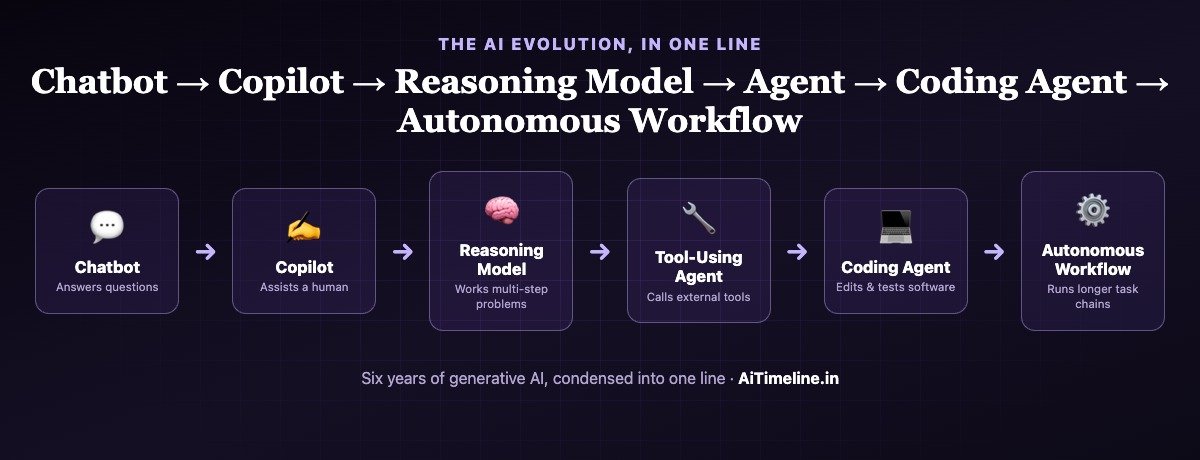
The AI Evolution in One Line
A single capability ladder, not a hierarchy every product climbs in full — most real systems in 2026 sit across two or three of these rungs at once, not cleanly on one.
ChatGPT to Coding Agents: Key Questions
Key Takeaways
- The central shift since 2022 is not “chatbots got smarter” — it is that AI’s role moved from producing information to taking actions, one capability layer at a time: chatbot, copilot, reasoning model, tool-using agent, coding agent, autonomous workflow.
- ChatGPT (November 2022) did not invent generative AI or large language models; it made conversational AI radically more accessible, reaching a mass audience faster than any consumer software product before it.
- GPT-4 (March 2023) raised the reasoning and instruction-following ceiling and pushed AI further into professional workflows, including software development.
- 2023 was the year AI moved into the developer’s actual environment — GitHub Copilot’s evolution and a wave of open-weight models (Llama 2, Mistral) put AI assistance and self-hosted experimentation directly into engineering workflows.
- 2024 introduced reasoning models — OpenAI’s o1-preview (September 2024) and full o1 (December 2024) spent more computation working through hard problems before answering, materially improving math and coding performance.
- Devin (March 2024), from Cognition Labs, was marketed as the “first AI software engineer.” Independent reviews found a real gap between that framing and Devin’s measured, single-agent SWE-bench Verified performance — a pattern worth remembering before taking any coding-agent’s marketing at face value.
- By 2025, AI-native coding environments — Cursor, Claude Code, OpenAI’s Codex line, Google’s Antigravity — turned the editor itself into an agentic interface, not just an autocomplete box.
- Agentic coding in 2025-2026 shifted the unit of work from “write this function” to “understand this repository, implement the feature, run the tests, fix what fails, and prepare the change” — still with a human reviewing before merge in the overwhelming majority of real deployments.
- “Zero-prompt development” remains an aspirational description of where the industry is heading, not an accurate description of how most software actually gets shipped in 2026.
- The single largest industry event of 2026 in this space — SpaceX’s announced $60 billion acquisition of Cursor’s parent company, Anysphere — is itself evidence of how much capital now treats coding agents as strategic infrastructure, not a niche developer tool.
AI Evolution Timeline: 2022–2026
The milestones that actually moved the technology forward, in the order they happened.
ChatGPT Changes the AI Conversation
What happened: OpenAI released ChatGPT as a free research preview on November 30, 2022, built initially on GPT-3.5-era technology. It reached an estimated one million users within five days — a pace no consumer software product had matched before.
Why it mattered: Generative AI and large language models already existed; GPT-3 had been publicly available since 2020, and research labs had been publishing transformer-based language work for years. ChatGPT’s contribution was not the underlying science — it was a free, conversational interface simple enough that anyone could use it without knowing what a language model was.
GPT-4 Raises the Capability Ceiling
What happened: OpenAI released GPT-4 on March 14, 2023, with stronger reasoning and instruction-following than GPT-3.5, image-input capability described in OpenAI’s own technical report, and rapidly broadening use in professional and coding tasks. Image input rolled out to ChatGPT’s consumer product gradually over the following months rather than to every user simultaneously on day one.
Why it mattered: GPT-4 is a distinct system from the GPT-3.5 model that powered ChatGPT’s launch, and from the further multimodal and reasoning-focused updates OpenAI shipped in the two years after it. Treating “GPT-4” and “ChatGPT” as interchangeable, or assuming every later multimodal feature shipped on day one, misdates the actual rollout.
AI Moves Into the Developer Workflow
What happened: GitHub Copilot, first released in 2021 and already the best-known AI coding assistant, expanded through 2023 with chat-based interaction and enterprise features, while Anthropic’s Claude 2 and other frontier chat models added stronger code generation and much larger context windows.
Why it mattered: AI was no longer answering questions in a separate chat window; it was increasingly embedded inside the editor itself — suggesting completions, explaining unfamiliar code and helping debug, without the developer leaving their IDE. GitHub Copilot was a major, well-known entrant into AI-assisted coding, not the first such system ever built.
Open Models Expand the AI Developer Ecosystem
What happened: Meta released Llama 2 in July 2023 with weights available for research and commercial use, and the newly founded Mistral AI released its 7B model that September. Both are more precisely described as open-weight — the trained parameters are downloadable and usable — rather than fully open-source in the sense of published training data and code.
Why it mattered: Open-weight models let developers run inference locally, fine-tune on private data and experiment without an API bill, lowering the barrier to building and studying AI systems outside a handful of large labs.
Reasoning Models Arrive: o1
What happened: OpenAI released o1-preview and o1-mini on September 12, 2024, followed by the full o1 model and o1 pro mode on December 5, 2024. Instead of producing the first plausible answer, these models spend additional inference-time computation working through a problem — a high-level description of the approach, not a disclosure of any specific hidden reasoning content.
Why it mattered: This was a major public milestone in the shift toward reasoning-oriented models, not the invention of the underlying idea of extended computation before answering, which researchers had explored in various forms earlier. o1 measurably improved performance on competition mathematics, coding and scientific problem-solving benchmarks.
Devin and the “AI Software Engineer” Claim
What happened: Cognition Labs introduced Devin in March 2024, marketed as “the first AI software engineer,” capable of planning, writing, testing and debugging code across a full development environment with a terminal, browser and editor.
Why it mattered: Devin’s launch popularized the idea of an autonomous coding agent as a distinct category from a coding assistant. It is also a case study in separating a product’s marketing framing from independently measured results — covered in full in the dedicated Devin section below.
AI-Native Editors Take Shape
What happened: Cursor, built by Anysphere, grew from a niche AI-native code editor into one of the fastest-growing developer tools of the decade. Anthropic launched Claude Code, a terminal-based agentic coding tool, in February 2025. Windsurf (formerly Codeium) became the subject of a collapsed OpenAI acquisition attempt in 2025 before being absorbed by Cognition, Devin’s maker.
Why it mattered: The IDE itself became an AI interaction surface — not a text editor with an assistant bolted on, but an environment built around an agent that can see and act on the whole codebase.
Coding Agents Move From Suggestions to Tasks
What happened: The typical instruction given to an AI coding tool shifted from “write this function” to “understand this repository, implement the feature, run the tests, fix what fails, and prepare the change.” Repository-wide context, tool use and iterative test-and-fix loops became standard features across Cursor, Claude Code, GitHub Copilot Workspace and OpenAI’s Codex line.
Why it mattered: This is the practical difference between a copilot and a coding agent, made concrete: less turn-by-turn direction, more delegated task ownership — without removing the human from the loop entirely.
The 2026 Frontier: Longer, Not Fully Autonomous
What happened: As of August 2026, leading coding agents — OpenAI’s Codex on GPT-5.6, Anthropic’s Claude Code on Claude Opus 5, Google’s Antigravity 2.0, and Cursor (now the subject of SpaceX’s pending $60 billion acquisition) — can navigate real repositories, plan multi-file changes, execute shell commands, run tests, diagnose failures and revise code across longer working sessions than a year earlier.
Why it mattered, and what it isn’t: This is agentic execution with reduced supervision on well-scoped tasks, not independently verified “fully autonomous software engineering.” That distinction is the subject of the frontier and autonomy-levels sections below.
ChatGPT to o1: Why Reasoning Became the Next AI Battleground
Earlier-generation chat models are built to generate a fast, plausible-sounding response in a single pass. Reasoning-oriented models like OpenAI’s o1 family instead spend additional computation working through a problem step by step before producing a final answer — a shift researchers describe as moving more effort into inference time rather than only into training time.
This is a genuinely useful capability shift for coding specifically: a model that can work through “what does this function actually need to do, and what could break it” before writing code is less likely to produce a plausible-looking but wrong implementation. It is not evidence of human-like consciousness or genuine understanding — “reasoning model” is a description of a computational technique, specifically extended chain-of-thought-style processing before the final response, not a philosophical claim about the system’s inner experience. This article does not reproduce or reveal the private reasoning content of any specific model; it describes the general approach at a high level only.
From Chatbots to AI Agents, and When AI Learned to Use Tools
A chatbot primarily responds to whatever a user just said. An agent can be given a goal, break it into steps, use tools to gather information or take action, observe the result of each step, and continue toward the goal with reduced turn-by-turn human direction. There is no single, universally agreed technical definition of “AI agent” across the industry — different products implement planning, memory and tool-calling in different ways — but the core elements recur: a goal, a plan, access to tools, some form of memory or state, an execution step, and a feedback loop that lets the system correct course.
Tool use is the hinge this whole shift turns on. A model that can only generate text is limited to what it already knows. A model that can call a web search, run code in a sandboxed interpreter, execute terminal commands, control a browser or query a database can check its own assumptions and act on the result — a loop that looks roughly like Generate → Retrieve → Execute → Observe → Correct. That loop, applied specifically to a software repository, is what a coding agent actually is.
What Makes a Coding Agent Different From a Copilot?
| Capability | Coding Copilot | Coding Agent |
|---|---|---|
| Code completion | Yes | Yes |
| Explain code | Yes | Yes |
| Edit multiple files | Sometimes | Yes, commonly |
| Plan a multi-step task | Limited | Stronger, depends on product/configuration |
| Run tests | Limited/varies | Often |
| Inspect the whole repository | Limited/varies | Yes, commonly |
| Iterate after a test failure | Limited | Often |
| Execute terminal commands | Varies | Often |
| Long-running tasks | Limited | Increasingly common |
| Human supervision needed | Usually high | Can be reduced, depending on workflow and task scope |
Not every product on the market has every capability listed above at every tier — this is a description of the category shift, not a claim about any single tool.
Devin and the “AI Software Engineer” Idea
Cognition Labs positioned Devin, at its March 2024 launch, as the first AI software engineer capable of independently completing real engineering tasks. That framing is a useful line to draw between two different things: what a product is designed to do, and what independent evaluation actually measures.
Cognition’s own reported figures for Devin 2.0 put its score at roughly 45.8% on SWE-bench Verified under a standard, single-agent, no-intervention evaluation — a real result, but one that trails the frontier models covered in the benchmarks section below, several of which report scores above 90% on the same benchmark by mid-2026. Reviews from third-party outlets have also reported real-world task-completion rates in a considerably wider and lower range on complex tasks, alongside cases of extended, unproductive working cycles. This article treats those independent, lower figures as reported by review outlets rather than as a single authoritative measurement, precisely because no one benchmark number fully captures a coding agent’s real-world reliability.
None of this means Devin was unimportant — it popularized the coding-agent category and pushed the rest of the industry to compete on genuine task completion, not just code suggestion quality. It is, however, a clear example of why this article treats a product’s own marketing claims and independent, third-party evaluation as two different sources, not one.
2024–2026: The Rise of AI-Native Coding Environments
The IDE itself became an AI interaction surface, not a text editor with an assistant bolted on.
Cursor (Anysphere)
Grew from a niche fork of VS Code into one of the fastest-growing developer tools of the decade, with reported annualized revenue rising from roughly $100 million in January 2025 to around $4 billion by mid-2026. SpaceX announced a definitive, all-stock agreement to acquire Anysphere for $60 billion on June 16, 2026, expected to close in Q3 2026.
Claude Code (Anthropic)
Launched February 2025 as a command-line agentic coding tool: it can read a repository, edit files, run terminal commands and iterate on test failures. Anthropic added subagents, an auto mode that reduces manual permission prompts, self-hosted cloud environments and cross-session messaging through 2025 and 2026 — all configurable, not enabled by default without setup.
OpenAI Codex
OpenAI’s current agentic coding line, spanning a CLI, IDE integrations and a cloud workspace, defaults to GPT-5.6 (Sol/Terra/Luna tiers, generally available July 9, 2026) — distinct from the original 2021 Codex model that powered early GitHub Copilot and was later deprecated.
Google Antigravity
Google retired Gemini CLI on June 18, 2026, replacing it with Antigravity 2.0, a full IDE built around multi-agent orchestration and browser control, alongside Jules V2, Google’s asynchronous cloud coding agent that clones a repository, makes a change and returns a pull request.
Windsurf (formerly Codeium)
OpenAI’s reported $3 billion agreement to acquire Windsurf, announced May 2025, collapsed by July 2025. Google subsequently hired Windsurf’s CEO and a group of senior engineers in a licensing-style deal, and Cognition — Devin’s maker — acquired the remaining company, later integrating Devin’s agent into the Windsurf editor.
Open-Weight Coding Agents
Frameworks and open-weight models built for local and self-hosted agentic coding expanded through 2026, led by active release cadences from Alibaba’s Qwen line and DeepSeek, while Meta paused new open-weight Llama releases in favor of a closed frontier line, leaving its 2025 Llama 4 Scout and Maverick models as the current open Meta releases.
Is “Zero-Prompt Development” Actually Here?
“Zero-prompt development” — the idea of software shipping from a business requirement with no human writing a single instruction — is a real direction the industry is moving toward, built on natural-language specifications, issue-driven development, background coding agents and automated pull requests. It is not, as of August 2026, an established industry standard or a universal reality. Nearly every serious deployment of a coding agent still involves a human writing the initial task description and reviewing the resulting change before it merges.
The more accurate summary: the industry is moving toward lower-touch software development, with real, measurable reductions in how much a human has to specify and check by hand — but fully promptless development remains an aspirational description, not something most teams are actually running in production.
The New AI Software Development Loop
This loop is increasingly automated at steps 2 through 6. Steps 7 and 8 remain overwhelmingly human in real deployments as of 2026.
What Humans Still Do
Judgment that stays human
- Requirements: deciding what should be built, and why, given real business and user constraints an AI cannot infer on its own.
- Architecture: system-level design decisions with long-term maintenance and scaling consequences.
- Security and risk management: judging what a change could break, and whether the blast radius of an error is acceptable.
- Debugging complex, ambiguous failures: the cases where the problem isn’t in the code an agent just touched, but in an interaction it can’t see.
- Code review and accountability: someone has to be responsible for what ships, and that remains a human role.
- Product judgment: knowing which feature is worth building at all, independent of how cheaply an agent could build it.
Is AI Replacing Software Developers?
AI is automating parts of software development faster than it is eliminating the profession itself. Repetitive coding, boilerplate generation, routine testing, documentation, debugging of well-understood failures and mechanical code migration are all genuinely faster with a capable coding agent in 2026 than they were in 2022. System design, product engineering judgment, architecture, security ownership and domain expertise remain areas where a human is doing work an agent is not positioned to fully own.
What Happens to Software Engineering Jobs?
India’s technology sector illustrates the mixed picture well. NASSCOM projects AI-related job demand in India could cross one million roles by 2026, even as India’s Ministry of Electronics and Information Technology has cited a figure of only around 16% of the existing IT workforce as currently AI-skilled — a real gap between demand and readiness, not a story of straightforward job loss. Separately, entry-level IT hiring has come under real pressure: industry reporting has put the contraction in entry-level roles at roughly 20–25% as employers shift toward AI-assisted, more senior hiring rather than large annual fresher intakes.
The pattern that emerges is not simple replacement. Some roles are shrinking, particularly the most repetitive entry-level coding work. Existing roles are evolving to require working alongside AI tools rather than writing every line by hand. And new roles are emerging — NASSCOM has pointed to positions like “Forward Deployed Engineer,” focused on integrating and deploying AI systems into real client environments, as an example of demand shifting rather than simply disappearing. This article does not publish a specific job-loss number as fact, because no single reliable figure for “jobs eliminated by AI coding agents” currently exists.
Chatbot vs Copilot vs Coding Agent
| Generation | Main Interaction | Typical Output |
|---|---|---|
| Chatbot | Conversation | An answer |
| Copilot | Developer + editor | Code assistance |
| Reasoning model | Problem + extended reasoning | A worked-through solution |
| Coding agent | Goal + tools | Repository changes |
| Agentic workflow | Goal + feedback loop | Multi-step task execution |
These categories overlap in real products — a single 2026 coding agent typically combines reasoning, tool use and multi-step execution at once, rather than fitting cleanly into one row.
Are AI Agents Truly Autonomous?
Most 2026 coding agents operate confidently at levels 2 and 3 on well-scoped tasks. Level 4 — independently managing an ambiguous, large-scope engineering goal — remains technically and operationally difficult, and is not the honest default description of any mainstream product today.
Why Autonomous Coding Is Harder Than Code Generation
What makes the last mile hard
- Hallucinated APIs and assumptions: a plausible-looking function call that doesn’t actually exist in the library being used.
- Security vulnerabilities: code that passes tests but introduces an exploitable flaw the test suite never checked for.
- Dependency problems: a fix that works locally but breaks under a different package version or environment.
- Regressions: a change that fixes the reported bug while quietly breaking an unrelated feature.
- Test-coverage gaps: passing tests that don’t actually exercise the part of the system that matters.
- Destructive commands: a terminal-capable agent that runs something irreversible without enough caution.
- Context-window limitations: a large, unfamiliar codebase that doesn’t fully fit in what the model can reason over at once.
- Hidden requirements: business rules and edge cases that were never written down anywhere the AI could read.
How Do We Measure Coding Agents?
SWE-bench, introduced by researchers at Princeton in 2023, tests whether a model can resolve real, historical GitHub issues end-to-end. SWE-bench Verified, released in 2024, is a human-validated subset that removes noisy, unsolvable or under-specified issues from the original set — it is now the more commonly cited version. Terminal-Bench separately measures an agent’s ability to complete tasks inside a real terminal environment.
| Model / Agent | Benchmark | Reported Score | Date | Source |
|---|---|---|---|---|
| GPT-5.6 Sol (Codex default) | Terminal-Bench 2.1, xhigh effort | 89.5% | Jul 2026 | OpenAI |
| Claude Opus 5 (Claude Code default) | Terminal-Bench 2.1, max effort | 89.1% | Jul 2026 | Anthropic |
| Devin 2.0 (single-agent, no intervention) | SWE-bench Verified | ~45.8% | 2025 (Cognition-reported) | Cognition Labs |
| Leading frontier models (varies by leaderboard) | SWE-bench Verified | Roughly 90–97%, methodology-dependent | Aug 2026 | Independent leaderboards |
Benchmark scores do not equal real-world software-engineering autonomy: SWE-bench and Terminal-Bench measure performance on a fixed, curated task set, not on the ambiguous, poorly specified, organization-specific work most engineers actually do. Independent leaderboard scores also vary meaningfully by scaffolding and evaluation methodology, which is why this table reports a range rather than a single definitive number for the frontier.
Why Coding Agents Could Change Software Development Economics
Where the cost structure shifts
- Developer time: less time spent on boilerplate and routine debugging, redirected toward review, architecture and judgment calls.
- Inference cost: running a capable coding agent over a long session has a real, metered token cost that scales with task length and model tier.
- Cloud compute: cloud-hosted agent sessions (like async cloud coding agents) add infrastructure cost beyond the model call itself.
- Team size and structure: some organizations are restructuring around smaller teams doing more AI-assisted implementation with the same or fewer engineers.
- Testing and maintenance costs: automated test generation and iteration can lower some costs while raising others, like reviewing AI-generated test coverage for real correctness.
This article does not publish a specific developer-productivity percentage figure, because no single, reliably sourced number currently applies across products, teams and task types.
Open Models vs Closed AI Coding Agents
| Factor | Open-Weight Models | Closed Coding Agents |
|---|---|---|
| Cost | No per-token API fee; hardware/hosting cost instead | Metered per-token or subscription pricing |
| Privacy | Code can stay entirely on private infrastructure | Depends on the provider’s data-handling terms |
| Customization | Fine-tunable on private codebases | Limited to product-level configuration |
| Frontier performance | Competitive on some tasks, generally behind top closed models on hardest benchmarks | Typically leads current SWE-bench/Terminal-Bench leaderboards |
| Hardware requirements | Meaningful local GPU/infra investment for the largest models | None — runs on the provider’s infrastructure |
| Ecosystem | Fast-moving, led by Qwen and DeepSeek release cadence in 2026 | Deep IDE and tool integration from OpenAI, Anthropic, Google |
Neither approach is a universal winner — the right choice depends on privacy requirements, budget, in-house infrastructure and how close to the frontier a given task actually needs to be.
What the AI Coding Revolution Means for India
India’s IT services sector built its scale on exactly the kind of work coding agents now automate fastest — large teams delivering repetitive implementation and maintenance work for global clients. That makes India simultaneously exposed to real automation pressure and positioned to benefit from productivity gains and new AI-related demand, rather than facing a single clean outcome in either direction.
This is an evolving scenario shaped by client demand, skilling investment and enterprise adoption speed — not a guaranteed future for every Indian IT organization on the same timeline.
The Biggest Change Isn’t Better Chatbots
It is easy to read this whole timeline as a story about chatbots getting incrementally smarter. That undersells what actually happened. ChatGPT produced text and code on request. Reasoning models spent more computation working through hard problems before answering. Agents learned to use tools. Coding agents learned to modify real software. Autonomous workflows now execute longer sequences of engineering tasks with reduced supervision. The throughline across all five steps is not quality of conversation — it is AI’s gradual movement from producing information to taking actions in a real system, with real consequences if it gets something wrong.
In 2022, a developer could ask an AI to write a function and would check the result themselves. By 2026, the more interesting question is whether an AI can understand the repository, decide what needs to change, make the changes, run the tests, recover from failures, and hand a reviewable result back to a human engineer — and, just as importantly, whether that human engineer’s judgment about what to build and whether it’s safe to ship still sits at the center of the process. As of today, it does.
Where AI Coding Goes Next
AI Evolution Timeline Table
| Year | Milestone | Technology Shift | Developer Impact |
|---|---|---|---|
| 2022 | ChatGPT | Conversational generative AI | AI becomes mainstream |
| 2023 | GPT-4 / coding copilots | Stronger reasoning + coding assistance | AI enters development workflows |
| 2024 | Reasoning models (o1) + Devin | Extended inference-time compute + agentic software claims | Multi-step problem solving; the “AI software engineer” idea enters the conversation |
| 2025 | Agentic coding expands (Cursor, Claude Code, Codex) | Repository-level, tool-using workflows | Less manual implementation, more supervised delegation |
| 2026 | Advanced coding agents; Cursor/SpaceX deal | Longer-running workflows; consolidation and major capital investment | Human role shifts further toward supervision and review |
Product Timeline
| Product | Maker | Launched |
|---|---|---|
| ChatGPT | OpenAI | November 2022 |
| GPT-4 | OpenAI | March 2023 |
| GitHub Copilot Chat | GitHub / Microsoft | 2023 |
| Devin | Cognition Labs | March 2024 |
| o1-preview / o1 | OpenAI | September / December 2024 |
| Claude Code | Anthropic | February 2025 |
| GPT-5 | OpenAI | 2025 |
| Codex (GPT-5.6 default) | OpenAI | GA July 2026 |
| Claude Opus 5 | Anthropic | July 2026 |
| Antigravity 2.0 / Jules V2 | Replacing Gemini CLI, June 2026 |
Explore More Timelines
People Also Ask
Frequently Asked Questions
Related Coverage
⚠️ Editorial Note
This page separates a product’s marketing framing from independently reported evaluation wherever the two diverge, most notably in the Devin and benchmarks sections. Historical milestones above the “Latest Update” box are not rewritten as the story continues; new developments are appended to the latest-update section instead. Figures for fast-moving items like the SpaceX-Cursor deal and current model defaults reflect reporting available as of August 22, 2026, and should be independently reverified before being cited elsewhere, since this is a genuinely fast-changing space.
Sources & further reading
Every dated entry above was checked against these references. Last reviewed 15 September 2026.