India–China Economic Relations Timeline 2026: FDI, Trade & Manufacturing
India-China economic relations from 2020 Press Note 3 curbs to the 2026 FDI reset: the 10% rule, 60-day window, and 29 proposals reported by August 2026.
Latest Story
India-China economic relations have moved through three distinct phases since 2020: a hard shutdown after the Galwan clash, a manufacturing-first attempt to reduce dependence through China+1, and now, from March 2026, a calibrated reopening of a narrow category of foreign investment. This is not a return to the pre-2020 environment — investment from China is still restricted by default, screened case by case, and capped in most sectors. What has changed is that a defined slice of non-controlling investment can now move faster, and the government has started publishing numbers showing how often that route is actually used. This page tracks that shift from the 2020 Press Note 3 restrictions through the March 2026 FDI amendment to the 29 proposals reported by August 20, 2026, and explains what changed, what didn’t, and why the answer isn’t as simple as “China is back.”
📌 What Is India’s 2026 Economic Reset With China? — AI Overview
India’s 2026 economic reset with China is a selective easing of investment restrictions, not a full normalization of economic ties. Under changes notified in March 2026, non-controlling investment of up to 10% beneficial ownership from land-bordering countries can use the automatic route, and a defined 60-day approval window now applies to a specified list of manufacturing sectors. Sectoral caps, ownership conditions and case-by-case screening for control or strategic sensitivity all remain in place — the policy is aimed at attracting capital, technology and manufacturing capacity without reopening the door Press Note 3 closed in 2020.
India-China FDI: Key Questions
Key Takeaways
- India is not choosing between “China” and “no China.” The 2026 policy reduces strategic dependence where it can while selectively using Chinese-linked capital and supply chains where economically useful and politically acceptable.
- Press Note 3 (April 2020) required government approval for all investment from land-bordering countries, aimed at preventing opportunistic takeovers during the pandemic; it was never a China-only rule on paper, but China was its most commercially significant target.
- The March 10, 2026 Cabinet decision, notified as Press Note 2 of 2026, is the first structural easing of that framework in six years — not a repeal of it.
- The 10% non-controlling automatic route and the 60-day approval window are two separate, narrower mechanisms, not a blanket reopening; majority ownership and control must still sit with resident Indian entities in fast-track cases.
- By August 20, 2026, 29 proposals worth ₹4,895.65 crore had used the revised framework — real but modest activity, spread across multiple non-Chinese reporting jurisdictions.
- Despite six years of investment restrictions, India-China trade never stopped growing: bilateral trade hit $151.1 billion in FY26, making China India’s top trading partner, ahead of the US.
- India’s trade deficit with China hit a record $112 billion-plus in FY26 — investment curbs restricted equity capital, not the flow of goods.
- The electronics paradox: India can expand domestic assembly capacity while remaining heavily dependent on Chinese-origin components, machinery and industrial inputs upstream. “Manufactured in India” doesn’t mean “independent of China.”
- Solar (~90% of polysilicon) and pharmaceuticals (65%+ of APIs) show the same structural dependence in different sectors — China+1 diversification is real but partial, not complete decoupling.
- National-security screening, sectoral caps and control-based scrutiny remain in force for anything above the 10% non-controlling threshold — economic engagement has not translated into strategic trust.
What Changed From 2020 to 2026?
The framework didn’t disappear. It grew a narrow, defined exception.
| Issue | 2020 (Press Note 3) | 2026 (Revised Framework) |
|---|---|---|
| Land-border country investment | Government approval required, all sectors | Selective relaxation for non-controlling stakes |
| Non-controlling ownership | Subject to full approval framework regardless of size | Up to 10% can qualify for the automatic route, subject to conditions |
| Sectoral caps | Apply | Still apply |
| Strategic/sensitive sectors | Scrutiny | Continued scrutiny |
| Approval timeline | No defined window; often 6-12 months or longer | 60-day timeline for specified manufacturing proposals |
| Control & majority ownership | N/A — approval required to hold any control | Must remain with resident Indian entities in fast-track cases |
| Stated policy objective | Prevent opportunistic acquisitions during COVID-19 | Attract capital, technology and manufacturing while retaining safeguards |
Not every investment below 10% automatically qualifies for the automatic route in every circumstance — conditions on the investing entity and the sector still apply. This is a calibrated exception, not a repeal.
April 2020: Press Note 3 Changes India’s FDI Rules
On April 17, 2020, India’s Department for Promotion of Industry and Internal Trade (DPIIT) issued Press Note 3 of 2020, mandating prior government approval for foreign direct investment from any country sharing a land border with India — China (including Hong Kong and Macau), Pakistan, Bangladesh, Nepal, Bhutan, Myanmar and Afghanistan — regardless of sector. The rule also applied to beneficial ownership routed through third-country entities, so an investment structured through, say, a Mauritius or Singapore vehicle with land-bordering-country beneficial ownership was still covered.
The government’s stated objective was to prevent opportunistic takeovers of Indian companies whose valuations had collapsed during the early COVID-19 market crash. Press Note 3 did not name China explicitly, but China was by far the most commercially significant investor among the countries it covered, and it quickly became known in business and legal circles as the “China clause” of India’s FDI policy.
In practice, the note replaced automatic-route access with a case-by-case government review via the Foreign Investment Facilitation Portal, adding months of uncertainty to any land-bordering-country investment, however small or strategically inconsequential.
June 2020: Galwan Deepens the Economic Security Question
What happened: On the night of June 15, 2020, Indian and Chinese soldiers clashed in the Galwan Valley in eastern Ladakh, fighting hand-to-hand with fists, stones and improvised weapons at over 14,000 feet. Twenty Indian soldiers were killed; China later acknowledged four of its own soldiers died, though Indian military assessments have suggested the actual Chinese toll may have been higher. It was the deadliest India-China border clash in more than four decades.
Interpretation, kept separate from fact: Galwan did not itself create new economic policy — Press Note 3 had already been issued two months earlier. But against the backdrop of the border confrontation, existing investment restrictions gained clear public and political backing, consumer sentiment turned sharply against Chinese brands, and the appetite for any near-term economic normalization with China effectively disappeared for years. The clash is best understood as the event that hardened and legitimized an economic-security posture that was already forming, not as the single cause of it.
2020: Chinese Apps Become a Major Economic-Security Issue
On June 29, 2020, India’s Ministry of Electronics and IT blocked 59 mobile apps with Chinese ownership links, including TikTok, UC Browser, WeChat, Club Factory and CamScanner, citing activities “prejudicial to sovereignty and integrity of India” and unauthorized transmission of user data to servers outside India. A second, larger round followed on September 2, 2020, banning 118 more apps, including the hugely popular PUBG Mobile. Further rounds followed later in 2020, extending the total list well beyond these two headline actions.
The app bans mattered economically beyond the affected companies themselves: they established that data flows and digital infrastructure, not just physical investment and trade, were now treated as part of India’s economic-security perimeter with China — a framing that later extended to telecom equipment, e-commerce platforms and, eventually, the FDI screening this page tracks.
2021–2023: India Pushes Manufacturing and China+1
With direct Chinese investment restricted, India’s policy response shifted toward building manufacturing capacity through its own incentive schemes rather than through Chinese capital. The Production Linked Incentive (PLI) schemes, rolled out across electronics, mobile manufacturing, pharmaceuticals, solar modules, specialty steel and other sectors from 2020 onward, offered production-linked subsidies to companies — domestic and multinational — that expanded manufacturing in India.
Global electronics brands, most visibly smartphone assemblers, expanded Indian production as part of a broader “China+1” strategy: companies diversifying at least one additional manufacturing base beyond China to reduce concentration risk, without abandoning China as a supplier. India competed for this diversification alongside Vietnam, Mexico, Thailand and Indonesia.
What this period did not achieve: a replacement of China in India’s supply chains. India increasingly pursued diversification in assembly and final-stage manufacturing while remaining dependent on Chinese components, machinery and industrial inputs upstream — a dependency the next two sections examine directly.
Electronics Reveal the Paradox
Domestic assembly capacity and Chinese-origin supply chains can both expand at the same time.
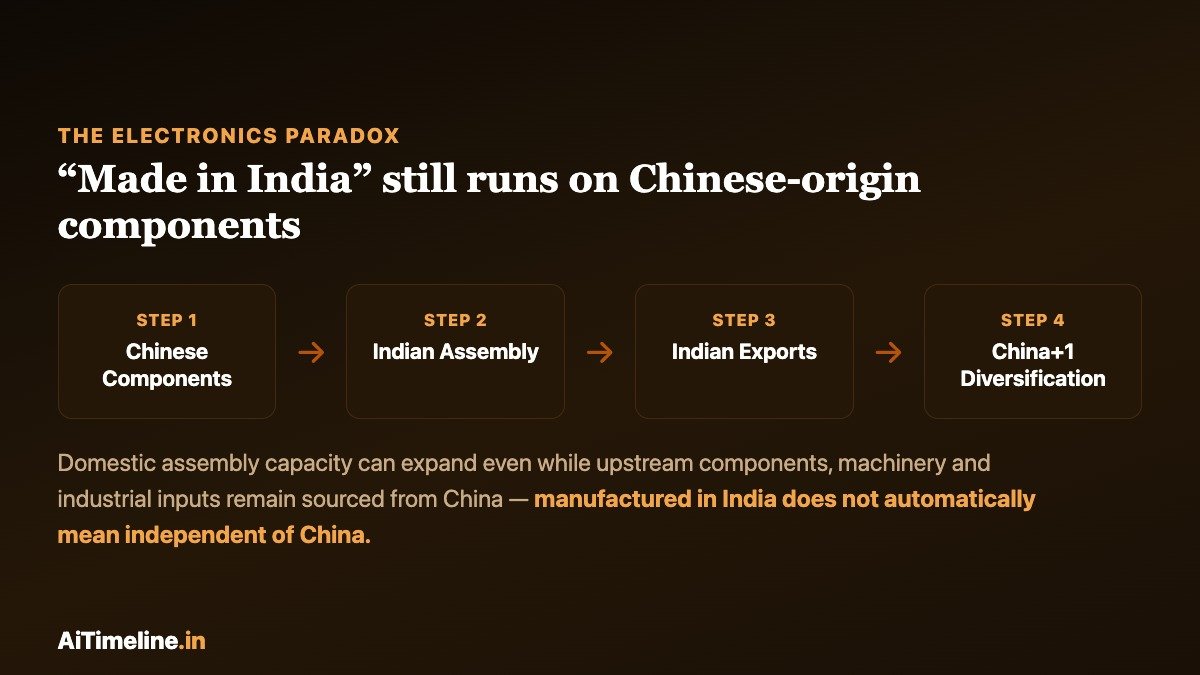
India can increase domestic assembly while still relying on Chinese-origin components and equipment upstream.
India can genuinely increase domestic assembly of smartphones, electronics and other finished goods while still relying heavily on Chinese-origin components, capital equipment and upstream industrial inputs to do it. A phone “assembled in India” can carry a display, processor, or battery cell sourced from Chinese or Chinese-linked suppliers, and the machinery used on the assembly line itself is frequently Chinese-made. “Manufactured in India” does not automatically mean “independent of China” — it means the last, most visible stage of production happened domestically.
2024–2025: India Discovers the Limits of Decoupling
By 2024-2025, the gap between India’s stated diversification goals and its actual import composition had become harder to ignore in specific sectors. Electronics manufacturers continued importing displays, semiconductors and printed circuit board assemblies predominantly from China and South Korea. Solar module makers, despite crossing 200 GW of annual manufacturing capacity by mid-2026, remained reliant on Chinese polysilicon and wafers for the vast majority of their raw-material needs. Machinery and capital goods for new factories, active pharmaceutical ingredients (APIs), and certain battery and industrial inputs all showed similar patterns — not uniform dependence across the whole economy, but acute, sector-specific dependence in exactly the areas India was trying hardest to build out.
This is not a claim that India is equally dependent on China everywhere; the dependence is concentrated in specific, identifiable input categories, which is precisely why the March 2026 policy response targeted named manufacturing sub-sectors rather than the economy broadly.
2025: Economic Pragmatism Returns to the Relationship
Through 2025, business groups, industry bodies and parts of the Indian government increasingly argued that a blanket investment freeze was constraining the very manufacturing expansion India wanted, particularly in sectors where Chinese equipment suppliers, technology partners or component makers had no ready non-Chinese substitute at competitive cost. This period saw renewed border-diplomacy engagement alongside quieter industry-level discussions about supply-chain requirements for solar, electronics and batteries — groundwork that preceded, and helps explain the timing of, the March 2026 policy change. This should be read as a shift toward economic pragmatism on specific, bounded questions, not as a broader political reconciliation, which the record available as of August 2026 does not support.
March 10, 2026: India Amends the FDI Framework for Land-Border Countries
On March 10, 2026, the Union Cabinet approved changes to India’s FDI policy for countries sharing a land border with India, notified by DPIIT as Press Note 2 of 2026 and implemented through amendments to the FEMA Non-Debt Instruments Rules. The government described the changes as intended to unlock greater FDI, support startups and deep-tech investment, improve ease of doing business, facilitate manufacturing partnerships, provide technology access, and strengthen India’s integration into global supply chains — alongside a new expedited approval timeline for specified investments in critical manufacturing sectors.
The amendment does not repeal Press Note 3’s core requirement. It carves out two specific, bounded exceptions within it: a non-controlling ownership threshold below which government approval is no longer required, and a fixed decision timeline for a defined list of manufacturing proposals that still need approval. Both are covered in the next two sections.
What Does the 10% FDI Rule Actually Mean?
The revised framework allows non-controlling beneficial ownership of up to 10% from land-bordering-country investors to use the automatic route, provided the investor does not exercise control over the Indian company and the Indian investee reports the investment to DPIIT after the fact. The beneficial-ownership test applies at the investor-entity level: a global fund with a Chinese limited partner holding below 10% of that fund, and exercising no control, can generally invest in India without a separate Press Note 3 approval for that fund. Any land-bordering-country entity holding more than 10% beneficial ownership, or exercising control at any shareholding level, still requires prior government approval.
✅ What the 10% rule DOES do
- Lets small, non-controlling, passive investment move without a case-by-case government approval
- Applies the beneficial-ownership test at the investing entity level, including through fund structures
- Requires after-the-fact reporting to DPIIT so the government can track usage
- Signals a risk-based approach that separates minority stakes from strategic acquisitions
❌ What the 10% rule does NOT do
- Does not mean unrestricted Chinese investment in India
- Does not remove sectoral caps or restricted-sector rules
- Does not remove government approval for stakes above 10% or for any controlling investment
- Does not give Chinese entities unrestricted control of Indian companies
- Does not mean India has abandoned national-security screening
What Is the 60-Day FDI Approval Timeline?
For investments that still require government approval, the March 2026 policy introduced a defined 60-day decision timeline for a specified list of manufacturing sub-sectors — replacing what had previously been an open-ended process that routinely took six to twelve months or longer, making financing and joint-venture planning difficult. This does not mean every Chinese-linked investment gets automatic approval within 60 days; it means proposals in these named categories get a committed decision window, positive or negative, rather than an indefinite wait. In these fast-track cases, majority shareholding and control of the Indian investee must remain with resident Indian citizens or Indian-owned entities at all times.
| Sub-sector category | Examples |
|---|---|
| Capital goods manufacturing | Industrial machinery, production equipment |
| Electronic capital goods & components | Electronics manufacturing equipment, components |
| Polysilicon & ingot-wafer production | Upstream solar supply-chain inputs |
| Advanced battery components | Battery-grade materials and cells |
| Rare earth magnets | Magnet manufacturing for motors, electronics |
| Rare earth processing | Refining and processing of rare-earth inputs |
August 2026: 29 FDI Proposals Put the New Framework to the Test
As of August 20, 2026, the Commerce Ministry reported that 29 FDI proposals worth approximately ₹4,895.65 crore (about $511.5 million) had been received under the revised framework since March 2026. The proposals covered information technology, artificial intelligence, manufacturing, pharmaceuticals, data centres, transport services and information & communication.
The reporting entities were based in jurisdictions including Mauritius, the United States, South Korea, Japan, Singapore, Luxembourg and the Cayman Islands — not a list of purely Chinese investors. Writing “China invested ₹4,895 crore” would misstate what the government has actually disclosed. The more accurate framing: 29 proposals were reported under the revised framework, illustrating that the new rules are beginning to operate across multiple sectors and jurisdictions — some of which may carry non-controlling Chinese-linked beneficial ownership under the 10% threshold, and some of which may not involve Chinese capital at all.
Does This Mean Chinese Investment Is Back?
Not in the sense of a wholesale reopening. Selective, non-controlling investment is genuinely easier to execute than it was in 2020. But ownership and control conditions remain, strategic sectors stay sensitive, Chinese-incorporated entities can still face approval requirements above the 10% threshold, structures involving Hong Kong require careful case-by-case treatment, and sectoral caps have not moved. The realistic description of India’s position is not “China” versus “no China” — it is a deliberate attempt to reduce strategic dependence while selectively using Chinese-linked capital, supply chains and technology where economically useful and politically acceptable.
India-China Economic Relations Timeline: 2020–2026
The full record, newest first.
29 FDI Proposals Reported Under the Revised Framework
What happened: The Commerce Ministry disclosed that 29 FDI proposals worth ₹4,895.65 crore (~$511.5M) had been reported since March 2026, from entities based in Mauritius, the US, South Korea, Japan, Singapore, Luxembourg and the Cayman Islands.
Why it matters: It’s the first hard evidence of the revised framework actually operating, five months after Cabinet approval — and a reminder that “reported proposals” is not the same claim as “Chinese investment.”
Cabinet Approves FDI Amendment for Land-Border Countries
What happened: On March 10, 2026, the Union Cabinet approved a 10% non-controlling automatic-route threshold and a 60-day approval window for specified manufacturing sectors, notified as Press Note 2 (2026).
Why it matters: The first structural easing of Press Note 3 since 2020 — a calibrated exception, not a repeal.
Economic Pragmatism Returns to the Relationship
What happened: Industry bodies and parts of government argued the investment freeze was constraining manufacturing expansion in sectors with no ready non-Chinese substitute; border diplomacy and supply-chain discussions continued through the year.
Why it matters: This groundwork explains the timing of the March 2026 policy change; it is not evidence of a broader political reconciliation.
–25
India Discovers the Limits of Decoupling
What happened: Despite manufacturing growth, India’s electronics, solar and pharmaceutical sectors showed acute, sector-specific dependence on Chinese components, polysilicon/wafers and APIs.
Why it matters: Full decoupling proved economically unrealistic in exactly the sectors India was trying hardest to build — a key driver of the 2026 policy’s sector-targeted design.
–23
PLI Schemes and China+1 Manufacturing Push
What happened: India rolled out Production Linked Incentive schemes across electronics, mobile manufacturing, pharmaceuticals and solar, attracting multinational assemblers pursuing China+1 diversification.
Why it matters: India grew as a manufacturing and assembly base without direct Chinese capital — but largely at the assembly stage, not upstream.
Chinese Mobile Apps Restricted in Multiple Rounds
What happened: 59 apps banned June 29, 2020 (including TikTok); 118 more banned September 2, 2020 (including PUBG Mobile); further rounds followed later in the year.
Why it matters: Extended India’s economic-security perimeter with China from physical investment into data and digital infrastructure.
Galwan Valley Clash
What happened: On June 15, 2020, Indian and Chinese soldiers clashed in the Galwan Valley; 20 Indian soldiers and at least 4 Chinese soldiers (per China’s own later disclosure) were killed.
Why it matters: Hardened political and public backing for the economic-security restrictions already introduced two months earlier — not their original cause.
Press Note 3 Introduced
What happened: DPIIT issued Press Note 3 on April 17, 2020, requiring government approval for all FDI from land-bordering countries, citing the risk of opportunistic pandemic-era acquisitions.
Why it matters: The foundational restriction that every subsequent policy change in this timeline modifies, rather than replaces.
Master Timeline Table
| Date | Event | Economic Impact | Why It Matters |
|---|---|---|---|
| Apr 2020 | Press Note 3 | Investment restrictions on land-bordering countries | Security becomes central to FDI policy |
| Jun 2020 | Galwan clash | Strategic tensions harden | Political backing for economic curbs solidifies |
| 2020 | App restrictions | Digital-sector decoupling | Technology/data security rises alongside FDI curbs |
| 2021–23 | PLI schemes, China+1 | Assembly & manufacturing growth | India attracts non-Chinese-capital production |
| 2024–25 | Supply-chain pressure | Sector-specific China dependence persists | Full decoupling proves economically unrealistic |
| Mar 2026 | Press Note 2 (2026) amendment | Selective FDI easing (10% rule, 60-day window) | Capital, technology and manufacturing access, with safeguards |
| Aug 2026 | 29 proposals reported | ₹4,895.65 Cr across multiple jurisdictions | Revised framework confirmed operating in practice |
India-China Trade: The Relationship Never Really Disappeared
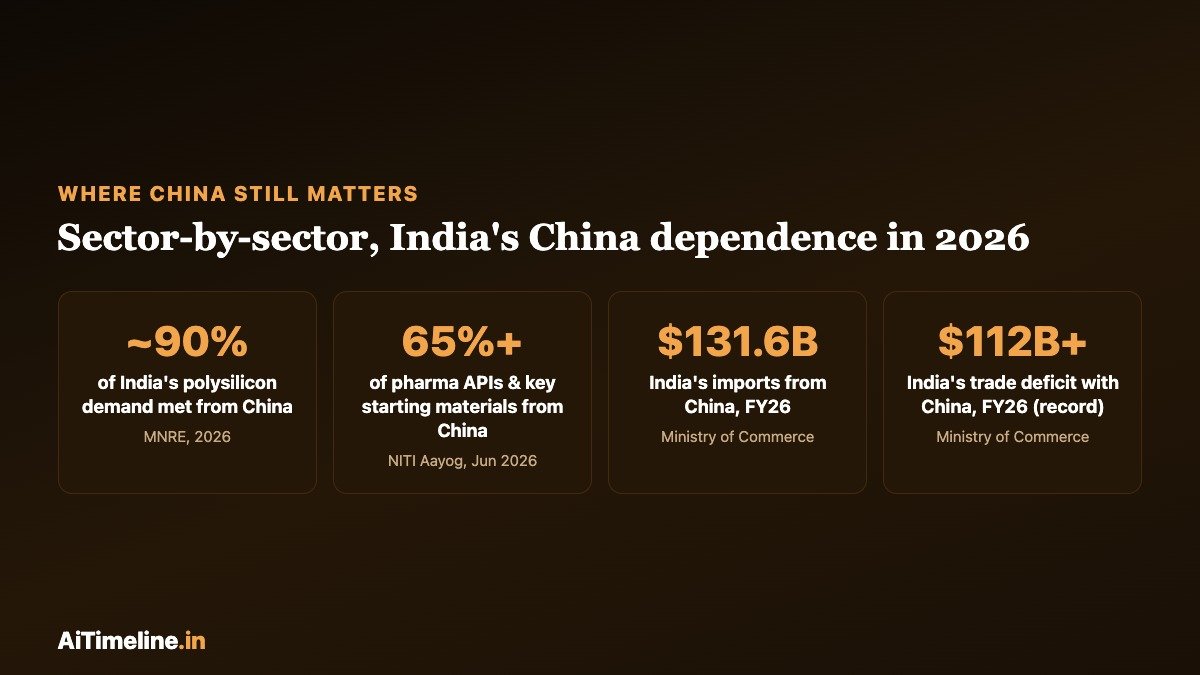
Investment restrictions curbed equity capital, not the underlying flow of goods.
Despite six years of investment restrictions, bilateral trade never stopped growing. In FY26 (April 2025-March 2026), India-China trade reached $151.1 billion, overtaking $140.2 billion in trade with the United States and making China India’s largest trading partner, according to Ministry of Commerce data. India’s exports to China rose 36.66% to $19.47 billion, driven mainly by chemicals, minerals and engineering goods, while imports from China rose 16% to $131.63 billion — still overwhelmingly electronics, machinery, chemicals, active pharmaceutical ingredients and solar-supply-chain inputs.
The lesson is straightforward: Press Note 3 restricted equity investment from China. It did not, and was never designed to, restrict the flow of goods between the two economies — and goods trade is where the real economic interdependence sits.
Why India Still Runs a Large Trade Deficit With China
India’s trade deficit with China widened to a record $112 billion-plus in FY26, up from $99.2 billion in FY25, per Ministry of Commerce data. Structurally, this is because India imports large volumes of intermediate and capital goods required to scale its own manufacturing — electronics components, industrial machinery, solar-supply-chain inputs and pharmaceutical ingredients — while exporting comparatively lower-value chemicals, minerals and engineering goods in return.
This creates the central paradox of India’s China strategy: India wants to reduce strategic dependence on China while also needing Chinese-linked supply chains to scale its own manufacturing quickly. Restricting Chinese equity investment does nothing to close this gap on its own — if anything, it can slow the very domestic capacity-building that would eventually reduce import dependence.
China+1: Why India Wants Diversification Without Full Decoupling
“China+1” generally describes companies diversifying production to at least one additional country beyond China to reduce concentration risk — not abandoning China as a supplier. India competes for this diversified manufacturing alongside several other economies, each occupying a different niche.
Vietnam
Positioned as the primary China+1 alternative for electronics and light manufacturing; proximity to Shenzhen enables a “China for parts, Vietnam for assembly” model.
Mexico
Nearshoring advantage for the US market under USMCA trade terms, strong in automotive and appliance manufacturing.
Thailand
Established electronics and auto-parts supply base with mature industrial infrastructure.
Indonesia
Growing electronics and battery-materials manufacturing, backed by domestic nickel resources.
India competes in this field primarily for electronics, batteries, solar and general industrial manufacturing — sectors where it has scale, English-language business infrastructure and PLI-scheme incentives working in its favor, but where component-level dependence on China (examined above) remains a real constraint on how fast it can move up the value chain.
Why AI and Data Centres Add a New Layer
India’s AI infrastructure buildout — servers, GPUs, networking equipment, power systems and data centre construction — adds a new dimension to the same underlying question: reliable access to hardware and components at scale. Data centres and AI featured explicitly among the sectors covered by the 29 FDI proposals reported in August 2026, reflecting how capital-intensive infrastructure investment now intersects with the land-bordering-country FDI framework. This does not mean Chinese companies dominate India’s AI infrastructure buildout — that claim isn’t supported by available evidence — but it does mean India’s semiconductor and component supply-chain choices, discussed next, increasingly matter for AI infrastructure too, not just for consumer electronics.
Semiconductors: The Strategic Middle Ground
India’s semiconductor ambitions sit apart from its China-dependence story in one important way: the country’s own emerging fab capacity is being built with Taiwanese, American and Japanese partners, not Chinese ones. Tata Electronics’ $11 billion fab in Dholera, developed with Taiwan’s Powerchip Semiconductor Manufacturing Corp, is targeting first silicon for 28nm and 55nm logic chips in 2026-2027, and India’s Semiconductor Mission has grown from an initial $10 billion incentive plan to roughly $18 billion in committed support. Five semiconductor plants are expected to be operational in India by the end of 2026.
Even so, semiconductor self-reliance doesn’t happen overnight: India has no leading-edge logic fab below 7nm, and for advanced chips — AI accelerators, GPUs, high-end mobile processors — Taiwan’s TSMC, Korea’s Samsung and Intel Foundry remain the only realistic options well into the next decade. China factors into this picture mainly as a source of mature-node components, legacy chips and manufacturing equipment for less advanced production — a supply-chain dependence distinct from, and generally less strategically sensitive than, leading-edge fabrication.
Solar Manufacturing Shows the Same Dilemma
India’s solar module manufacturing capacity crossed 200 GW annually by mid-2026, with over 190 GW of that capacity meeting the government’s Approved List of Models and Manufacturers (ALMM) standard. But the upstream supply chain tells a different story: India still meets roughly 90% of its polysilicon demand from China, and wafer imports remain overwhelmingly China-dependent despite the growth in domestic module assembly. The Ministry of New and Renewable Energy is drafting a dedicated PLI scheme targeting over 10 GW of domestic polysilicon capacity, and has extended the ALMM framework to cover ingots and wafers from June 2028 — both explicit attempts to close this specific gap, not evidence that it has closed yet.
Pharmaceuticals: Another Area of Supply-Chain Dependence
India is one of the world’s largest pharmaceutical producers by volume, but remains dependent on imported active pharmaceutical ingredients (APIs) and key starting materials for a significant share of its output. A NITI Aayog report from June 2026 put India’s dependence on China for APIs and key starting materials at around 65%, with other estimates ranging higher for specific categories; dependence is particularly acute for certain antibiotics, vitamins and fermentation-based products, where Chinese supply is close to dominant. This is not a claim that all APIs are Chinese-sourced — it varies sharply by product category, and India has built domestic capacity for 26 of a targeted list of critical APIs and intermediates as of mid-2025, with more in progress.
From Free Trade to Economic Security
The throughline across every sector examined above — electronics, solar, semiconductors, pharmaceuticals — is a shift in how India evaluates economic relationships with China: from a pure trade-efficiency lens toward one that weighs trade, security, technology access and supply-chain resilience together. The 2026 FDI changes are the clearest expression of this shift in investment policy specifically, but the same logic runs through the PLI schemes, the ALMM solar framework, and the semiconductor mission’s choice of non-Chinese fab partners.
What Each Side Wants From the New Framework
What India Wants
More manufacturing capacity, technology access, capital inflows, supply-chain integration, deep-tech investment, electronics capacity, employment and domestic value addition — per DPIIT’s own stated rationale for the March 2026 changes.
What Chinese Companies Likely Want
Access to India’s large consumer market, manufacturing partnerships, supply-chain participation in electronics, EVs, batteries and industrial equipment, and technology partnerships — commercial motivations inferred from the sectors where interest has concentrated, not stated Chinese government objectives.
Who Could Benefit From the India-China Economic Reset?
Indian manufacturers
Potential access to components, machinery and technology partnerships currently gated by approval delays.
Chinese suppliers
Potential access to India’s large and growing consumer and industrial market.
Global companies
Potentially more diversified, resilient supply chains spanning both India and China.
Indian startups & consumers
Potential access to capital and technology for startups; potentially lower costs in some categories for consumers.
Who Could Lose?
⚠️ Risk Areas
- Domestic firms facing stronger competition from newly-enabled non-controlling foreign entrants
- Companies in strategic sectors that remain exposed to external supply-chain dependence despite the new rules
- Manufacturers unable to localize upstream inputs, who stay structurally reliant on imports
- Industries vulnerable to sudden supply disruption if border tensions resurface, given the trade relationship’s continued depth
Why India Has Not Fully Removed the Security Barrier
Border tensions with China remain unresolved in several sectors of the Line of Actual Control. Critical infrastructure, data, telecom and strategic technology remain subject to beneficial-ownership and control scrutiny regardless of the 10% threshold. The central idea running through this entire policy shift: economic engagement does not automatically mean strategic trust. India’s 2026 framework is designed to let capital move where the risk is judged low, while keeping the same screening apparatus in place for everything else.
India-China Relationship Scorecard
| Area | Direction in 2026 | Why |
|---|---|---|
| FDI rules | 🟠 Selective easing | 10% non-controlling automatic route, subject to conditions |
| Manufacturing | 🟠 More cooperation possible | Supply-chain needs in specified sub-sectors |
| Electronics | 🟠 Interdependent | China remains dominant upstream supplier |
| Trade | 🔴 Imbalanced | Record $112B+ deficit, FY26 |
| AI infrastructure | 🟠 Emerging | Hardware and data-centre demand rising |
| Semiconductors | 🟡 Diversifying | Fab partnerships with Taiwan, US, Japan — not China |
| National security | 🔴 High scrutiny | Border tensions and control-based screening unchanged |
| China+1 | 🟢 Expanding | India competing with Vietnam, Mexico, Thailand, Indonesia |
Explore More Timelines
People Also Ask
Frequently Asked Questions
India-China Economic Reset: What Happens Next?
India’s 2026 FDI changes should be understood as a calibrated economic adjustment, not a full return to the pre-2020 investment environment. The next phase depends on border stability, how many more investment proposals get approved and actually funded, the depth of new manufacturing partnerships, progress on electronics and solar supply chains, semiconductor development with non-Chinese partners, the pace of Chinese capital participation under the 10% threshold, continued national-security screening, and India’s own ability to build domestic alternatives in the sectors examined above.
India’s challenge is no longer simply deciding whether to do business with China. It is deciding where economic interdependence remains useful — and where strategic dependence is too risky.
Related Coverage
⚠️ Editorial Note
This page separates official government policy statements (DPIIT press notes, Cabinet decisions, Ministry of Commerce data) from independent analysis and interpretation, and labels each accordingly. Figures on FDI proposals, trade and sector dependence are dated and sourced to primary or reputable outlets; where reporting entities’ jurisdictions are disclosed but their ultimate beneficial ownership is not, this page does not assume Chinese origin. This is a living page, intended to be updated as the Commerce Ministry discloses further FDI proposal data. Nothing on this page is investment advice.
Sources & further reading
Every dated entry above was checked against these references. Last reviewed 15 September 2026.
- PIB — Investment from Land Border Sharing Countries (Press Note 3, 2020)
- News on Air — Cabinet Eases FDI Norms for Land-Bordering Countries (March 10, 2026)
- Business Standard — Press Note 3 Easing Brings Rs 4,896 Cr FDI Across 29 Projects
- Business Standard — China Becomes India's Top Trade Partner in FY26
- Carnegie Endowment — India's Press Note 3 Gamble: Opening the FDI Door to China
- Down To Earth — MNRE Weighs Polysilicon PLI Scheme
- Forbes — India Bans TikTok and 58 Other Chinese Apps (June 29, 2020)
- Vistra — Cabinet Decision Changes FDI Guidelines for Land-Bordering Countries