Blood Moon Timeline 2026–2030: Next Total Lunar Eclipse, Dates & Visibility
The next Blood Moon is Dec. 31, 2028. Track every lunar eclipse through 2030 with NASA-sourced dates, magnitudes, totality times and visibility.
Latest Story
On the night of August 27 into August 28, 2026, Earth’s shadow swallowed most of the Moon — but not all of it. Skywatchers across the Americas, Europe and Africa saw the lunar disc turn a deep coppery red for a few hours, dramatic enough that headlines everywhere called it a Blood Moon. NASA’s own eclipse catalog classifies it differently: a deep partial lunar eclipse, umbral magnitude 0.930, with 96.3% of the Moon’s visible disc inside Earth’s umbra at maximum — not all of it. That last sliver matters. A true Blood Moon, in the sense astronomers actually use the term, is what happens during a total lunar eclipse, when the entire Moon sits inside Earth’s shadow and turns red from edge to edge. The next time that happens is December 31, 2028. This page tracks every lunar eclipse from 2026 through 2030 — what already happened, what’s next, and why the Moon turns red at all.
Was August 28, 2026 a Blood Moon?
❌ Not a total one
NASA’s Goddard Space Flight Center catalog and its Scientific Visualization Studio classify the August 28, 2026 event as a deep partial lunar eclipse — not a total lunar eclipse. At greatest eclipse, around 04:13 UTC, the umbral magnitude reached 0.930, meaning about 93% of the Moon’s diameter crossed into Earth’s dark umbral shadow. NASA also publishes a separate, area-based measure called obscuration, which reached 96.3% of the Moon’s visible disc for this same eclipse. Both numbers are correct and both come from NASA — magnitude measures how much of the Moon’s diameter is covered, obscuration measures how much of its visible area is covered.
What neither number reached was 100%. A thin edge of the Moon stayed outside Earth’s umbra for the entire eclipse, so there was no totality — the threshold astronomers use for a true Blood Moon. The eclipse was visible from the Americas, Europe, Africa and the eastern Pacific; it had already ended before moonrise in India, so it was not visible from the Indian subcontinent at all.
🧠 Quick take
The August 28, 2026 lunar eclipse was a deep partial eclipse, not a total Blood Moon — NASA lists its umbral magnitude as 0.930, with 96.3% of the Moon’s visible disc inside Earth’s shadow at maximum, just short of totality. 2026’s actual total lunar eclipse already happened, on March 3. The next lunar eclipse of any kind is a barely-visible penumbral one on February 20, 2027, and no total lunar eclipse occurs anywhere in NASA’s 2027 catalog. The next total lunar eclipse — the next true Blood Moon — falls on December 31, 2028, visible across Europe, Africa, Asia, Australia and the Pacific, followed by two more totals in 2029.
Next Lunar Eclipse vs. Next True Blood Moon
Two different search intents, two different dates — this is the distinction most eclipse coverage blurs.
February 20, 2027 — Penumbral
The Moon crosses only Earth’s faint outer penumbral shadow. Expect subtle, uneven dimming — not a color change, and not a Blood Moon.
December 31, 2028 — the next true Blood Moon
Umbral magnitude 1.246; totality lasts about 71 minutes. Visible across Europe, Africa, Asia, Australia and the Pacific.
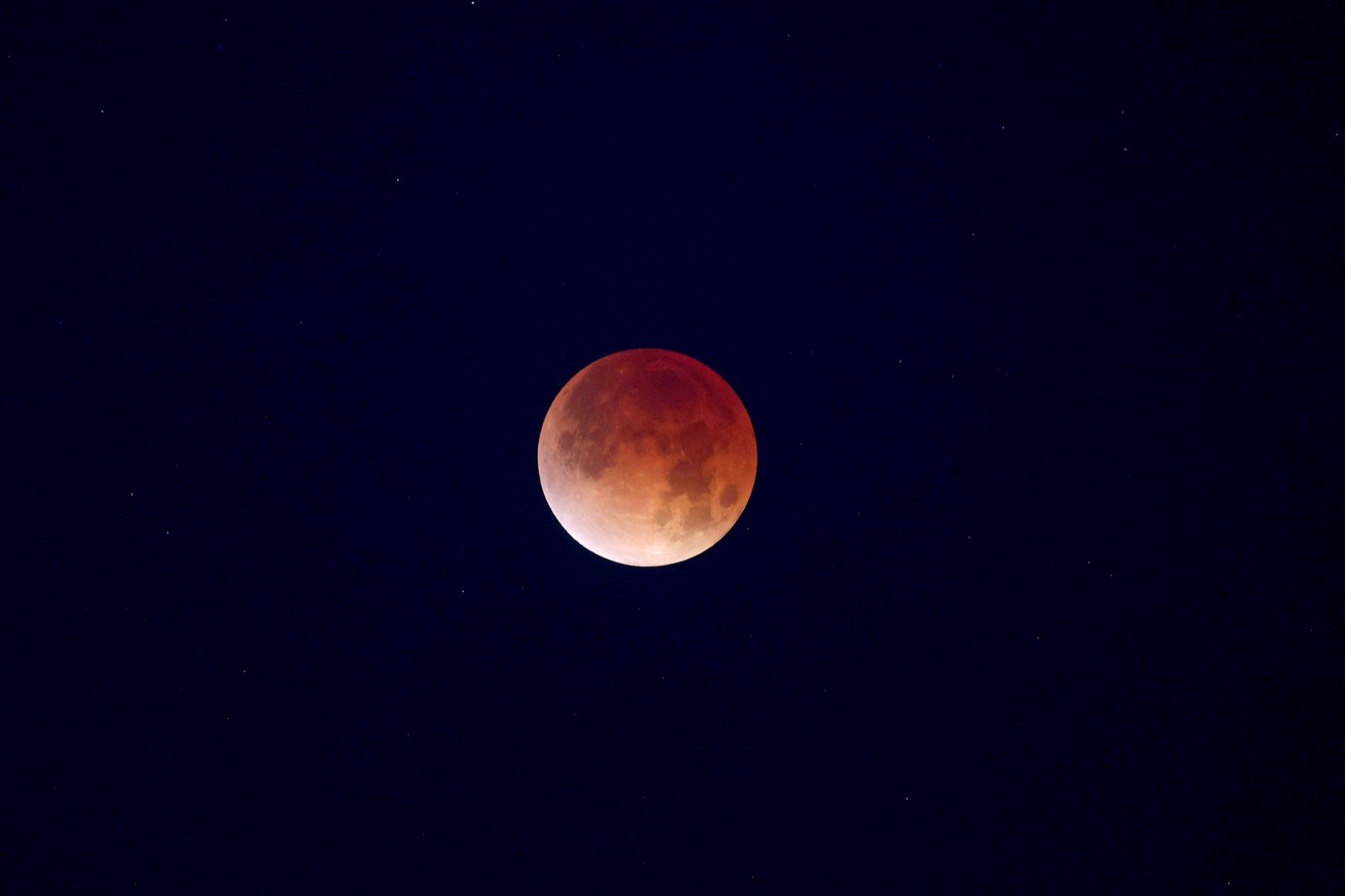
2026’s only total lunar eclipse, photographed March 3 over New Orleans. Credit: NASA/Michael DeMocker
How a Lunar Eclipse Works
A lunar eclipse happens only at full Moon, when Earth lies roughly between the Sun and the Moon and the Moon passes through some or all of Earth’s shadow. Earth’s shadow has two parts: a pale outer penumbra, where sunlight is only partly blocked, and a dark inner umbra, where direct sunlight is blocked completely. How deeply the Moon crosses into the umbra determines the type of eclipse — and whether it produces a Blood Moon at all.
Eclipses don’t happen at every full Moon because the Moon’s orbit is tilted about 5 degrees relative to Earth’s orbit around the Sun. Most months, the full Moon passes above or below Earth’s shadow entirely. A lunar eclipse can only occur when a full Moon lines up near one of the two points — called nodes — where the Moon’s tilted orbital plane crosses Earth’s, which is also why eclipses cluster in predictable seasons rather than happening randomly.
| Step | What happens |
|---|---|
| 1. Alignment | Earth moves between the Sun and a full Moon, close enough to one of the Moon’s orbital nodes for a shadow to fall on it. |
| 2. Penumbra entry | The Moon enters Earth’s outer penumbral shadow first. Dimming is subtle and often goes unnoticed. |
| 3. Umbra entry | The Moon begins crossing into Earth’s dark umbral shadow. A visible dark “bite” appears on the lunar disc — this is a partial eclipse. |
| 4. Totality (if reached) | If the Moon’s whole diameter enters the umbra, the eclipse becomes total. Sunlight filtered through Earth’s atmosphere turns the Moon red — the Blood Moon. |
| 5. Exit | The Moon crosses back out through the umbra, then the penumbra, in reverse order. |
Why Does the Moon Turn Red?
During totality, Earth blocks direct sunlight from reaching the Moon — but not all light. Some sunlight passes through Earth’s atmosphere on its way to the Moon, and the atmosphere filters it. Shorter blue and violet wavelengths scatter more readily off air molecules (the same effect, called Rayleigh scattering, that makes the daytime sky blue), while longer red and orange wavelengths pass through and bend into Earth’s shadow. That filtered, reddened sunlight is what illuminates the eclipsed Moon. NASA describes it with a memorable image: it’s as if all of Earth’s sunrises and sunsets, happening simultaneously around the planet’s rim, were projected onto the Moon at once. That’s a helpful analogy, not a literal mechanism — the real physics is scattering, plus absorption and refraction as sunlight bends through the full depth of Earth’s atmosphere before reaching the lunar surface.
Not every total lunar eclipse looks the same shade of red. The exact color depends on how much dust, cloud and volcanic aerosol is in Earth’s atmosphere at the time — more particulate matter generally means a darker, browner eclipse; a cleaner atmosphere produces a brighter copper or orange tone. Astronomers rate this with the Danjon scale, a simple 0-to-4 visual classification developed for describing how dark or bright a given total eclipse appears.
| Danjon value | Appearance |
|---|---|
| L = 0 | Very dark eclipse; Moon almost invisible, especially at mid-totality. |
| L = 1 | Dark, grey or brownish; surface details hard to make out. |
| L = 2 | Deep red or rust-colored, with a darker center and a brighter outer rim. |
| L = 3 | Brick red, often with a brighter, sometimes yellowish rim on the umbra’s edge. |
| L = 4 | Bright copper-red or orange, with a distinctly bluish, very bright rim. |
⚠️ “Blood Moon” is not an official astronomy term
Astronomers classify these events as total lunar eclipses. “Blood Moon” is a popular, widely-used name for the reddened Moon seen during totality — useful shorthand, but not a term you’ll find in NASA’s own eclipse catalogs.
The Three Types of Lunar Eclipse
Penumbral
The Moon passes only through Earth’s faint outer shadow. Usually a slight, uneven dimming — easy to miss, no color change.
Partial
Part of the Moon enters Earth’s dark umbra, producing a visible dark “bite.” The shadowed part can look reddish even without totality.
Total
The entire Moon enters Earth’s umbra. This is the only type that produces a full, edge-to-edge red Moon — the true Blood Moon.
Deep ≠ Total
A partial eclipse can reach a very high magnitude (like August 2026’s 0.930) and still never become total. Only 100% counts.
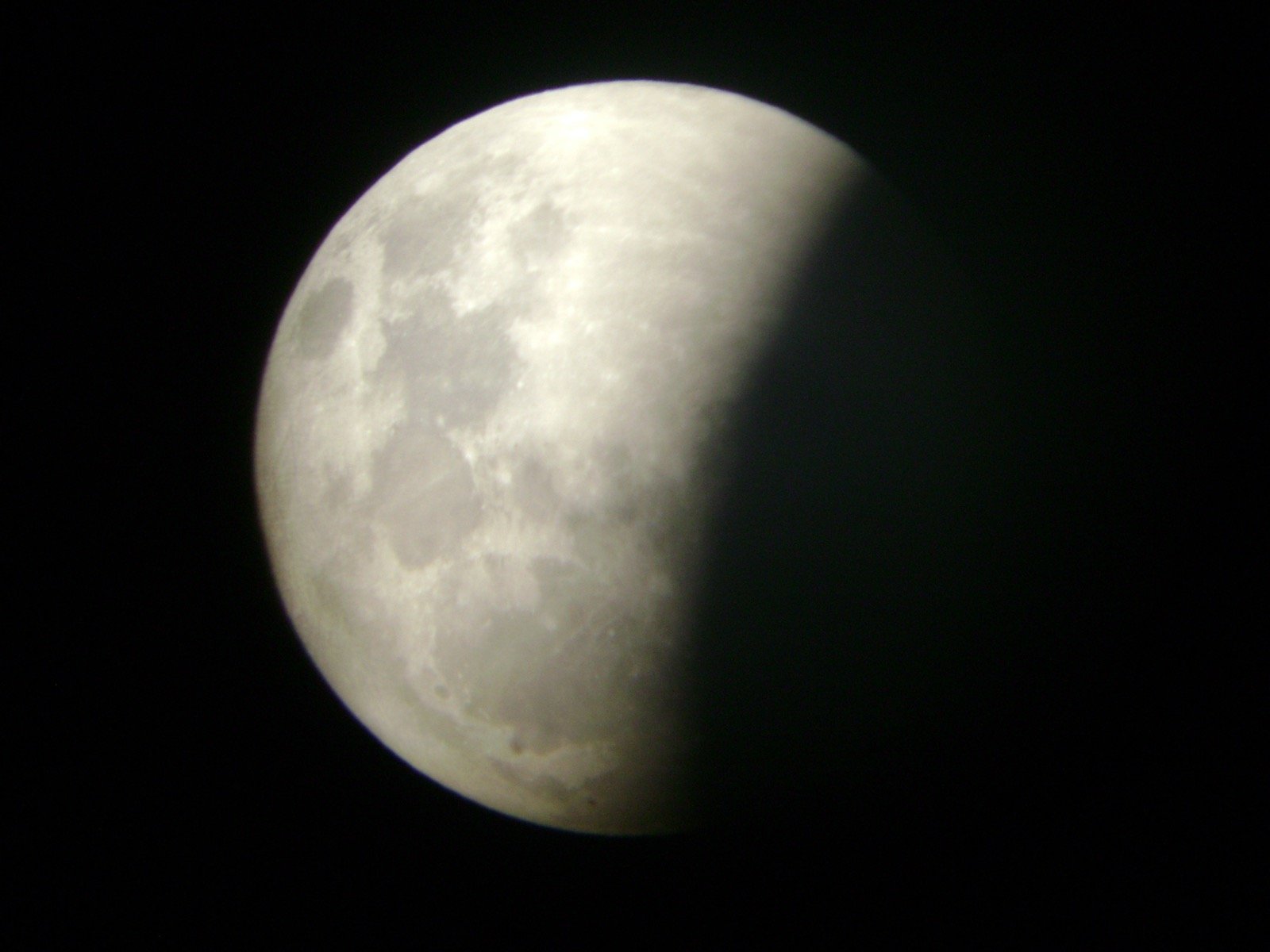
The August 27-28, 2026 partial lunar eclipse, photographed near its early partial phase. Credit: Fernando de Gorocica / Wikimedia Commons, CC BY-SA 4.0
Lunar Eclipse Timeline, 2026–2030
Every lunar eclipse NASA’s catalog lists in this five-year window, in order. Past events are marked; the highlighted card is the next true Blood Moon.
2026’s Only Total Lunar Eclipse
Umbral magnitude 1.151. The entire Moon spent about 59 minutes fully inside Earth’s umbra, turning red from edge to edge, best placed for the Pacific, eastern Asia, Australia and the western Americas.
A Deep Partial Eclipse, Not a Total One
Umbral magnitude 0.930; NASA’s separate obscuration measure put 96.3% of the Moon’s visible disc inside the umbra at maximum. Visible from the Americas, Europe, Africa and the eastern Pacific; not visible from India.
A Faint, Easy-to-Miss Penumbral Eclipse
The Moon passes only through Earth’s pale outer penumbral shadow. Expect slight, uneven dimming of the full Moon rather than any visible reddening.
2027’s Second Penumbral Eclipse
Visible mainly from the Pacific, eastern Africa, Asia and Australia. Like February’s, this is a subtle shading event, not a color-change event.
2027’s Third and Faintest Eclipse
Favors the Pacific and the Americas. NASA’s catalog contains no total — and no partial — lunar eclipse anywhere in 2027.
A Very Shallow Partial Eclipse
Only a thin bite of the Moon’s edge grazes Earth’s umbra, visible mainly from the Americas, Europe and Africa.
A More Noticeable Partial Eclipse
Centered over the Indian Ocean, visible across Europe, Africa, Asia and Australia — including, weather permitting, India’s late-night sky.
2028
New Year’s Eve Blood Moon — the Next Total Lunar Eclipse
Phases (UTC): penumbral begins 14:04, partial begins 15:08, totality begins 16:16, greatest eclipse 16:52, totality ends 17:28, partial ends 18:36, penumbral ends 19:40. The entire Moon sits inside Earth’s umbra for about 71 minutes, visible across Europe, Africa, Asia, Australia and the Pacific — arriving in India’s evening sky, roughly 9:46 p.m. to 10:58 p.m. IST.
The Longest Totality of the Decade
The deepest of the three upcoming total eclipses — the Moon passes almost through the center of Earth’s umbra, for about 1 hour 42 minutes of totality (02:31–04:13 UTC). Best placed for the Americas, Europe, Africa and the Middle East; the greatest-eclipse moment falls in India’s mid-morning, so the Indian subcontinent misses this one.
The Third Total Eclipse of This Run
Totality lasts about 54 minutes (22:15–23:09 UTC), centered over Europe and Africa and also visible from the Americas and much of Asia. In IST that falls in the pre-dawn hours of December 21 — the Moon would be low in India’s western sky as totality ends.
A Moderate Partial Eclipse
Centered over the Indian Ocean, visible from Europe, Africa, Asia and Australia. No total lunar eclipse occurs anywhere in NASA’s 2030 catalog.
Closing Out the Window
A faint penumbral eclipse, visible from the Americas, Europe, Africa and Asia — the last one tracked in this page’s five-year window.
Full Lunar Eclipse Calendar, 2026–2030
All figures from NASA Goddard Space Flight Center’s eclipse catalog (eclipse.gsfc.nasa.gov).
| Date | Type | Umbral magnitude | Totality | Main visibility |
|---|---|---|---|---|
| Mar 3, 2026 | Total | 1.151 | ~59 min | Pacific, E Asia, Australia, W Americas |
| Aug 28, 2026 | Partial | 0.930 | — | Americas, Europe, Africa, E Pacific |
| Feb 20, 2027 | Penumbral | −0.057 | — | Americas, Europe, Africa, Asia |
| Jul 18, 2027 | Penumbral | −1.068 | — | Pacific, E Africa, Asia, Australia |
| Aug 17, 2027 | Penumbral | −0.525 | — | Pacific, Americas |
| Jan 12, 2028 | Partial | 0.066 | — | Americas, Europe, Africa |
| Jul 6, 2028 | Partial | 0.389 | — | Europe, Africa, Asia, Australia |
| Dec 31, 2028 | Total | 1.246 | ~71 min | Europe, Africa, Asia, Australia, Pacific |
| Jun 26, 2029 | Total | 1.844 | ~102 min | Americas, Europe, Africa, Middle East |
| Dec 20, 2029 | Total | 1.117 | ~54 min | Americas, Europe, Africa, Asia |
| Jun 15, 2030 | Partial | 0.502 | — | Europe, Africa, Asia, Australia |
| Dec 9, 2030 | Penumbral | −0.163 | — | Americas, Europe, Africa, Asia |
Which of These Can India See?
A quick day/night check using UTC-to-IST conversion (UTC+5:30) for each event’s moment of greatest eclipse. This tells you whether it’s night or day in India, not exact moonrise or moonset — check local timing closer to each date.
| Date | Type | Greatest eclipse (IST) | India visibility |
|---|---|---|---|
| Mar 3, 2026 | Total | 5:04 pm | Not visible — Indian afternoon |
| Aug 28, 2026 | Partial | 9:43 am | Not visible — Indian morning |
| Feb 20/21, 2027 | Penumbral | 4:43 am | Possibly, very faint — low, pre-dawn |
| Jul 18, 2027 | Penumbral | 9:33 pm | Visible at night, but very subtle |
| Aug 17, 2027 | Penumbral | 12:44 pm | Not visible — Indian midday |
| Jan 12, 2028 | Partial | 9:43 am | Not visible — Indian morning |
| Jul 6, 2028 | Partial | 11:50 pm | Visible at night |
| Dec 31, 2028 | Total | 10:22 pm | Visible — India’s best shot at this Blood Moon |
| Jun 26, 2029 | Total | 8:52 am | Not visible — Indian morning |
| Dec 20/21, 2029 | Total | 4:12 am | Partly — low in western sky before moonset, check locally |
| Jun 15/16, 2030 | Partial | 12:03 am | Visible, just past midnight |
| Dec 9/10, 2030 | Penumbral | 3:58 am | Possibly, very faint — pre-dawn |
📌 India’s headline date
Of the three upcoming total lunar eclipses, only December 31, 2028 falls at night in India. That makes it the one Indian skywatchers should mark — the June 2029 and December 2029 totals largely miss the Indian subcontinent’s night sky.
Is It Safe to Watch a Blood Moon?
✅ Lunar eclipse
- Completely safe to view with the naked eye, binoculars or a telescope
- You’re looking at the Moon reflecting filtered sunlight, not at the Sun
- No special glasses or filters required, at any phase
⚠️ Solar eclipse (for comparison)
- Requires certified eclipse glasses or filters at every phase except brief totality
- You’re looking toward the Sun directly
- Improper viewing can cause permanent eye damage
📸 Photographing a Blood Moon
- Use a tripod or steady support — even a small telephoto lens benefits from stabilization
- Reduce exposure as totality approaches; the Moon dims significantly once inside the umbra
- Manually focus on the Moon rather than relying on autofocus in low light
- A timer or remote shutter avoids camera-shake blur
- Avoid heavy digital zoom on a phone — a small real telephoto lens or a spotting-scope adapter does far better
Blood Moon Myths vs. Science
Myth
- The Moon physically changes color
- A Blood Moon causes natural disasters
- Watching a lunar eclipse is dangerous
- Every total lunar eclipse looks the same shade of red
Fact
- Earth’s atmosphere filters and redirects sunlight onto the Moon; the Moon itself is unchanged
- There is no credible scientific evidence linking lunar eclipses to disasters
- Lunar eclipses are safe to view directly, unlike solar eclipses
- Color varies by eclipse, from very dark to bright copper, per the Danjon scale above
💡 Blood Moon, Supermoon, Blue Moon — not the same thing
These terms describe unrelated phenomena and don’t automatically combine. A Supermoon is a full Moon that’s near its closest approach to Earth (perigee), making it look slightly larger and brighter — a distance effect, unrelated to eclipses. A Blue Moon is a calendar quirk: either the second full Moon in one calendar month, or the third of four full Moons in one season — the Moon doesn’t actually turn blue. A Blood Moon is specifically the reddened Moon of a total lunar eclipse. A “Super Blood Moon” only happens when a total lunar eclipse coincides with a Supermoon — none of the total eclipses tracked on this page (Dec 2028, Jun 2029, Dec 2029) is confirmed as a Supermoon at the time of writing; that depends on the Moon’s exact distance on each date, checked separately closer to the event.
Key Takeaways
- August 28, 2026 was a deep partial eclipse (magnitude 0.930), not a total Blood Moon.
- 2026’s only total lunar eclipse already happened, on March 3, 2026.
- No total lunar eclipse appears anywhere in NASA’s 2027 catalog — all three of that year’s eclipses are penumbral.
- The next true Blood Moon is December 31, 2028, a New Year’s Eve total eclipse with about 71 minutes of totality.
- Two more total eclipses follow in 2029: June 26 (~102 minutes, the longest) and December 20 (~54 minutes).
- No total lunar eclipse is scheduled for 2030 either.
- “Blood Moon” is not an official astronomy term — astronomers call the event a total lunar eclipse.
- The Moon’s red color comes from sunlight bent and filtered through Earth’s atmosphere, not from the Moon itself changing.
- Lunar eclipses are 100% safe to watch with the naked eye — no eclipse glasses needed, unlike a solar eclipse.
- Of the three upcoming total eclipses, only December 31, 2028 falls at night in India.
Blood Moon: Key Questions
Explore More Timelines
People Also Ask
Frequently Asked Questions
Related Timelines on AiTimeline
More space and science coverage from AiTimeline.
✉ Editorial note, sources and limitations
Last reviewed: 30 August 2026. This page is a general astronomy reference. It is not a substitute for checking official, date-specific visibility guidance closer to each eclipse, and none of the local-time or India-visibility notes above replace a proper moonrise/moonset check for your exact location. Every eclipse type, date, magnitude and totality duration is drawn directly from NASA Goddard Space Flight Center’s eclipse catalogs (eclipse.gsfc.nasa.gov) and NASA Science / NASA Scientific Visualization Studio analysis of the August 2026 event, all published by NASA. Where a figure could be read two ways — like the 0.930 magnitude versus the 96.3% obscuration for the August 2026 eclipse — both are reported with their source and their precise meaning explained, rather than collapsed into one number. This page will be updated as each tracked eclipse passes and as NASA’s catalog extends beyond 2030.
Sources & further reading
Every dated entry above was checked against these references. Last reviewed 15 September 2026.
- NASA Science — Eclipses and the Moon
- NASA Goddard Scientific Visualization Studio — Aug 27-28, 2026 Deep Partial Lunar Eclipse
- NASA GSFC Eclipse Catalog — Lunar Eclipses of 2026
- NASA GSFC Eclipse Catalog — Lunar Eclipses of 2027
- NASA GSFC Eclipse Catalog — Lunar Eclipses of 2028
- NASA GSFC Eclipse Catalog — Lunar Eclipses of 2029
- NASA GSFC Eclipse Catalog — Lunar Eclipses of 2030
- Positional Astronomy Centre, India Meteorological Department