Nuclear Propulsion to Mars: A Timeline of Faster Space Travel
Nuclear propulsion to Mars, from Project Rover and NERVA tests to NASA's SR-1 Freedom reactor spacecraft due in 2028, and what it means for crewed trips.
Latest Story
Getting to Mars faster is less about burning more fuel than about burning it better. Nuclear propulsion to Mars has been studied since the late 1940s: the US ground-tested about 20 nuclear rocket reactors and engines between 1959 and 1972, then cancelled the programme before any flew. In 2026 the idea is back. NASA plans to launch Space Reactor-1 Freedom, a robotic nuclear-electric spacecraft, to Mars in late 2028, and on 8 October 2026 it signed a new space nuclear agreement with the US Department of Energy. This page traces every major step, separates tests from targets, and explains what a nuclear engine could and could not change for astronauts.
💡 Short Answer
No spacecraft has yet reached Mars using nuclear propulsion. The US ground-tested nuclear thermal rockets under Rover and NERVA from 1959 to 1972, then cancelled them in 1973. NASA now plans SR-1 Freedom, a robotic craft driven by a roughly 20-kilowatt reactor and electric thrusters, for launch in late 2028. Crewed nuclear Mars trips have no confirmed date.
Nuclear Propulsion to Mars: Key Questions
Nuclear Propulsion to Mars in Ten Points
- 1955: Project Rover began at Los Alamos to heat hydrogen with a reactor.
- 1959–1972: about 20 nuclear rocket reactors and engines were ground-tested in Nevada.
- 1965: SNAP-10A became the only US fission reactor operated in orbit, for power.
- 1973: Rover and NERVA were cancelled before any flight.
- 2005 and 2025: Project Prometheus and DARPA’s DRACO were also cancelled.
- 2025: NASA ran 100+ cold-flow tests on a flight-like reactor unit.
- March 2026: NASA announced SR-1 Freedom, a nuclear-electric craft for Mars.
- May 2026: a directive set a 2036 planning goal for round-trip Mars missions.
- 8 October 2026: NASA and DOE signed a space nuclear power and propulsion agreement.
- Still unresolved: fuel, shielding, radiators, testing, launch approval and steady funding.
Why Mars Needs a Better Engine
Chemical rockets are superb for launch. For a crewed trip to Mars, they make every kilogram expensive.
A chemical rocket burns fuel with an oxidiser and gets a big push quickly, but the best hydrogen-oxygen engines reach a specific impulse of only about 450 seconds. To go faster you need much more propellant, and the extra propellant needs its own propellant. Mars also moves: Earth and Mars line up for efficient transfers only about every 26 months.
A longer journey means more radiation from cosmic rays, more food, water and oxygen, and fewer options if something goes wrong. A more efficient engine can help with all of these. It cannot by itself make a Mars mission safe.
Pick a propulsion option and see the kind of trip it buys
Durations are illustrative ranges from published NASA and DOE mission studies, not schedules. Real numbers depend on the launch year, vehicle mass and time spent at Mars. Nothing you click is recorded.
Choose an option above
Two ways to use a reactor to cross space
Both use controlled fission. One uses the reactor’s heat directly; the other turns it into electricity first.
Same reactor physics, opposite trade-offs: push hard briefly, or push gently for months.
Nuclear Propulsion to Mars: The Full Timeline, 1940s–2026
Newest first. Tags show what was flown, ground-tested, completed, cancelled or only targeted.
2026
NASA and the Energy Department sign a space nuclear pact 2026 Policy
NASA Administrator Jared Isaacman and Energy Secretary Chris Wright sign a memorandum covering the whole chain: fuel production, research, testing, launch integration and operations. NASA’s release names SR-1 Freedom (launch 2028) and Lunar Reactor-1 for the Moon by 2030.
Why it matters: a space reactor needs DOE fuel, labs and safety approvals as much as NASA rockets. This is the agreement that is supposed to stop those two agencies working at different speeds.
2026
One office for everything nuclear, and a Mars deadline 2026 Policy
Isaacman puts all space nuclear work under a Space Reactor Office inside a new Research and Technology Mission Directorate, with Steve Sinacore as acting director. The office must deliver an integrated plan in 60 days, and a 60-day study comparing nuclear thermal, nuclear electric and chemical propulsion for unrefuelled round-trip crewed and cargo missions to Mars by 2036.
Why it matters: 2036 is a planning target, not a funded mission. But it is the first time in decades a NASA chief has tied a Mars date to a propulsion decision.
2026
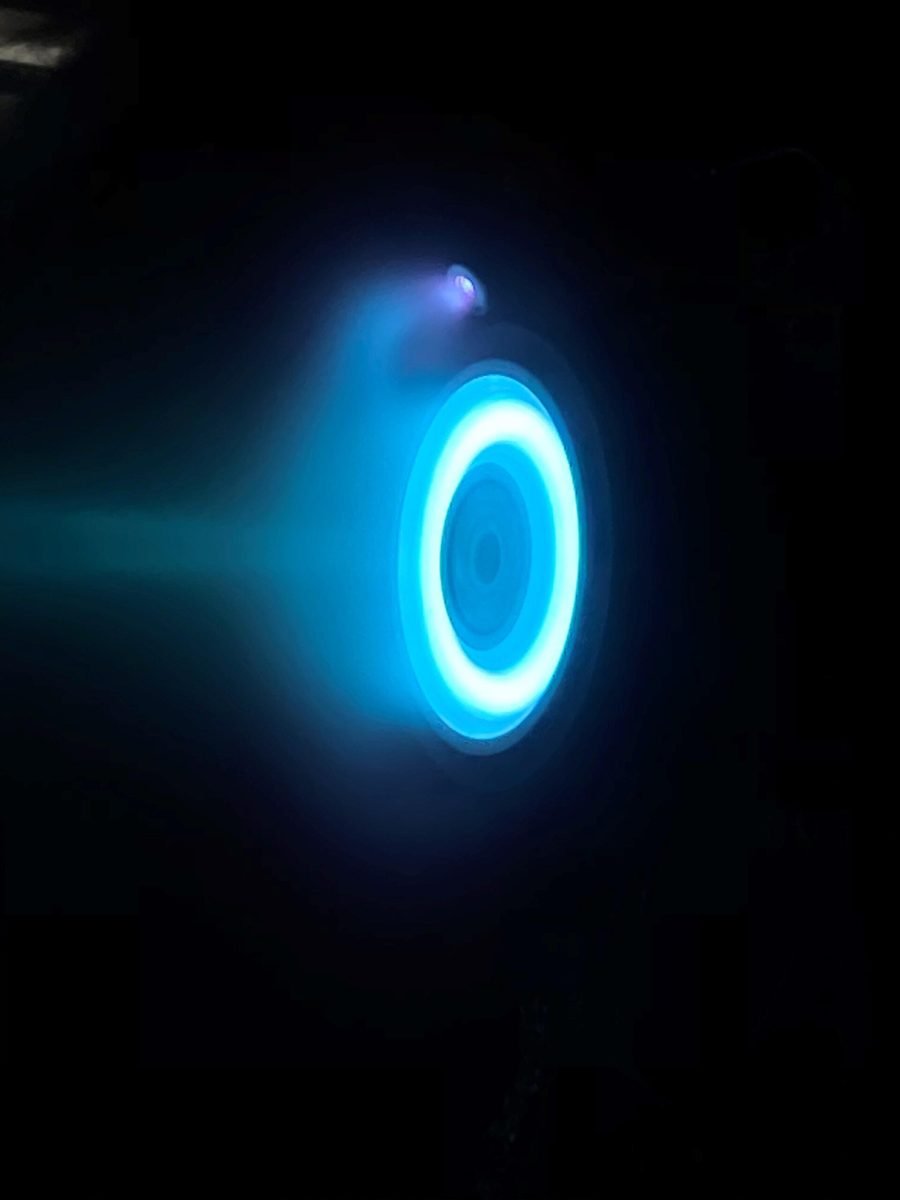
A record-power plasma thruster revealed 2026 Ground test
Over five ignitions, the thruster reaches up to 120 kilowatts, more than 25 times the power of the Hall thrusters on NASA’s Psyche probe, with its tungsten electrode passing 2,800°C. It is the first time in years a lithium MPD thruster has been fired in the US. The goal is 500 kW to 1 MW per thruster.
Why it matters: a crewed nuclear-electric ship needs thrusters that can swallow megawatts. This is a step towards that, still far from flight.
2026
NASA announces SR-1 Freedom 2026 Target
NASA unveils Space Reactor-1 Freedom, billed as the first fission-powered interplanetary spacecraft. A roughly 20-kilowatt-electric reactor with a closed Brayton-cycle converter will drive Hall thrusters, using the 48-kW electric propulsion system from Gateway’s Power and Propulsion Element. The 12-tonne craft would take about a year to reach Mars and release SkyFall, three Ingenuity-derived helicopters looking for subsurface ice.
Why it matters: it would be the first time a nuclear reactor drives a spacecraft beyond Earth orbit. It is robotic and small; a crewed ship would need around 100 times more power.
2025
Cold-flow tests on a flight-like reactor unit Completed
Engineers at NASA Marshall push gas through a full-scale, flight-like reactor core, 44 by 72 inches, built by BWX Technologies, without any nuclear fuel. More than 100 tests show the design resists destructive vibration and pressure waves from the propellant flow.
Why it matters: NASA calls it the most detailed flow data for a flight-like space reactor in more than 50 years. Fifty-eight years earlier, NERVA’s XE engine also arrived at its test stand in a cold-flow setup.
2025
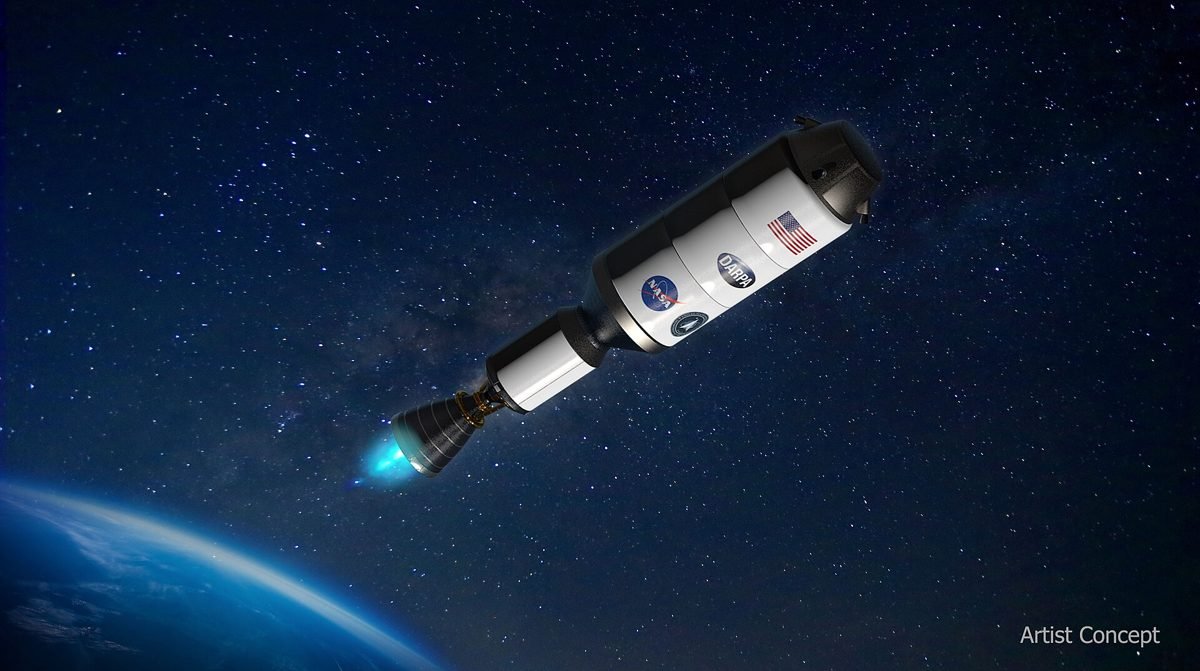
DRACO is cancelled Cancelled
The DARPA and NASA plan to fly a nuclear thermal engine in Earth orbit, announced in January 2023 with Lockheed Martin and BWXT chosen that July, gets no money in the FY2026 budget request. DARPA winds it down and hands knowledge to NASA. Reasons cited include cost, nuclear ground-test and approval hurdles, and cheaper reusable launch weakening the case for saving propellant.
Why it matters: it was the closest the US had come to flying a nuclear rocket engine since NERVA.
MARVL: radiators robots could build in space Ground test
Langley starts work on a radiator system for a crewed nuclear-electric ship, split into modules that robots could assemble in orbit because the full panels would not fit inside any rocket fairing. Liquid metal coolant would carry the reactor’s waste heat out to the panels.
Why it matters: for nuclear electric propulsion, getting rid of heat is as hard as making it.
Three reactor designs for a Mars engine Completed
After a February 2021 call for proposals, NASA and the Energy Department pick three teams for nuclear thermal reactor design contracts worth about $5 million each: BWXT with Lockheed Martin, General Atomics with Aerojet Rocketdyne and X-energy, and Ultra Safe Nuclear Technologies with Blue Origin and others.
Why it matters: nuclear thermal propulsion was back in NASA’s budget for the first time since the early 1990s, built on modern HALEU fuels.
Mar 2018
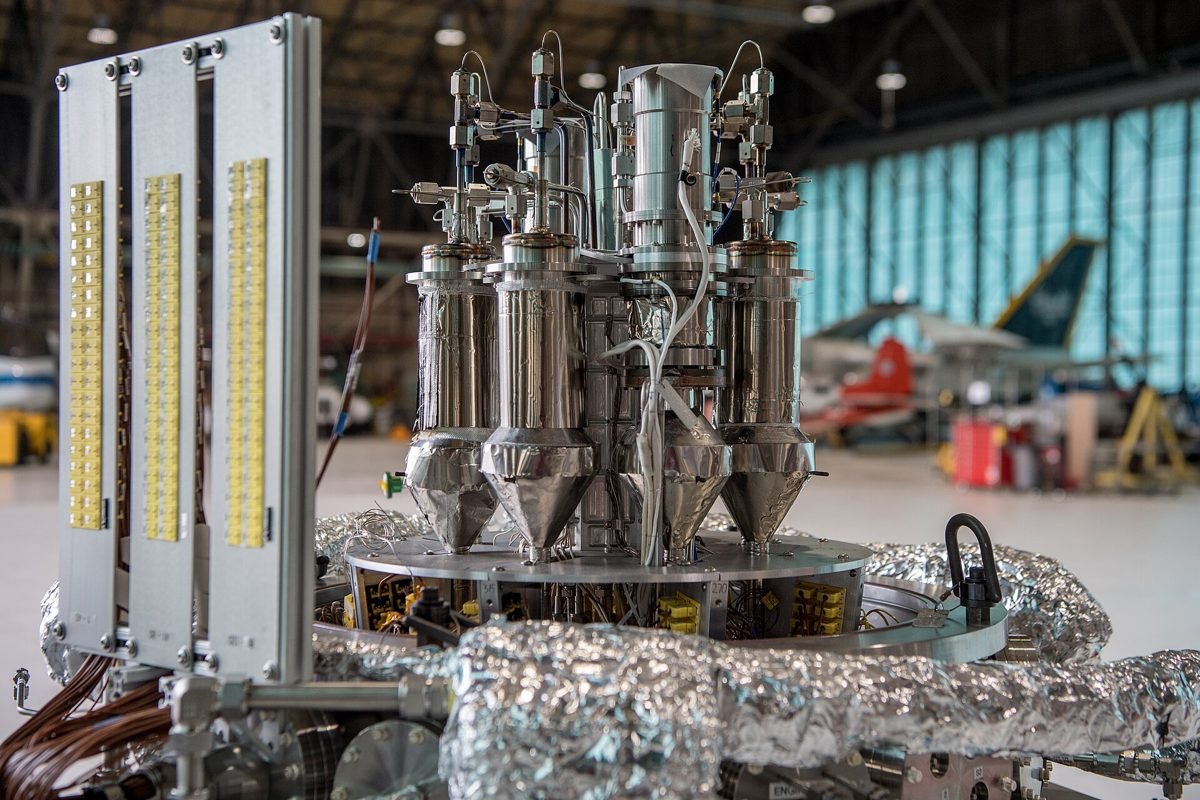
KRUSTY runs a small space reactor at full power Ground test
NASA and DOE test a 1-kilowatt-class Kilopower reactor with a uranium core, heat pipes and Stirling engines, including a full-power run of about 28 hours. It is the first new US space fission reactor test in roughly 40 years.
Why it matters: it showed a space reactor could be designed and tested on a modest budget, and fed directly into surface-power plans and LR-1.
2005
Project Prometheus and a nuclear Jupiter probe Cancelled
NASA launches Project Prometheus to build space reactors, starting with the Jupiter Icy Moons Orbiter, a nuclear-electric spacecraft to tour Europa, Ganymede and Callisto. By 2005 it is cancelled as NASA moves money to the Moon and Mars exploration plan.
Why it matters: nuclear electric propulsion had a real mission and still lost to a shift in budget priorities, the same pattern as NERVA.
1990s
Nuclear electric propulsion enters Mars plans
The SP-100 programme works on a 100-kilowatt space reactor, and NASA’s Mars studies after the 1989 Space Exploration Initiative compare nuclear thermal and nuclear electric vehicles. A short-lived early-1990s nuclear thermal effort also runs. None reaches flight.
Why it matters: the trade-offs mapped then, high thrust versus high efficiency, are the same ones NASA is studying in 2026.
Rover and NERVA are cancelled Cancelled
With Apollo winding down, the crewed Mars plan dropped and NASA’s budget cut, the nuclear rocket programme loses its vehicle and is ended in January 1973. Over its life, Rover and NERVA had tested about 20 reactors and engines.
Why it matters: the technology largely worked on the ground. It was the mission and the money that disappeared.
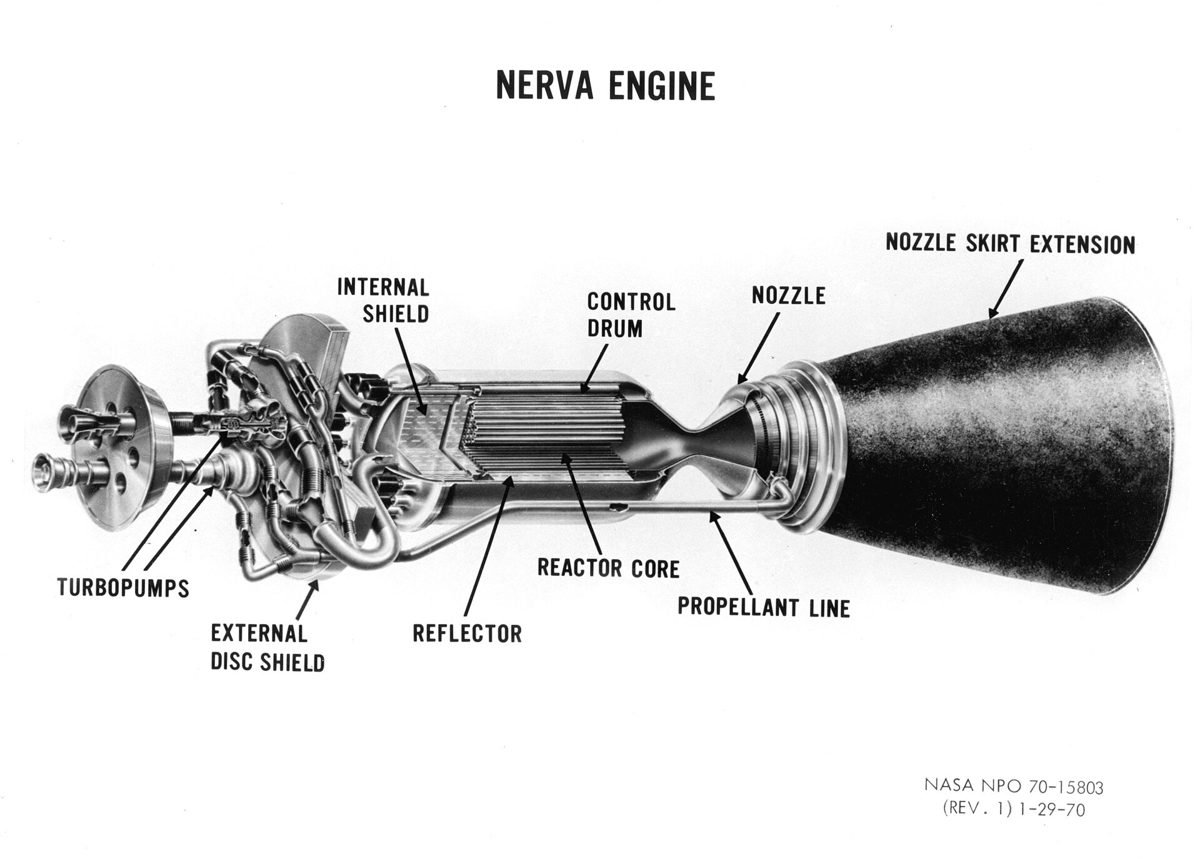
XE-Prime: a flight-like engine fires Ground test
The XE-Prime engine, the closest thing to a flight NERVA, is fired pointing downward in a test stand that simulates the low pressure of space, with repeated restarts. NASA’s history records the tests as successful.
Why it matters: restarting reliably is exactly what a Mars engine has to do. It never got the chance to show it in space.
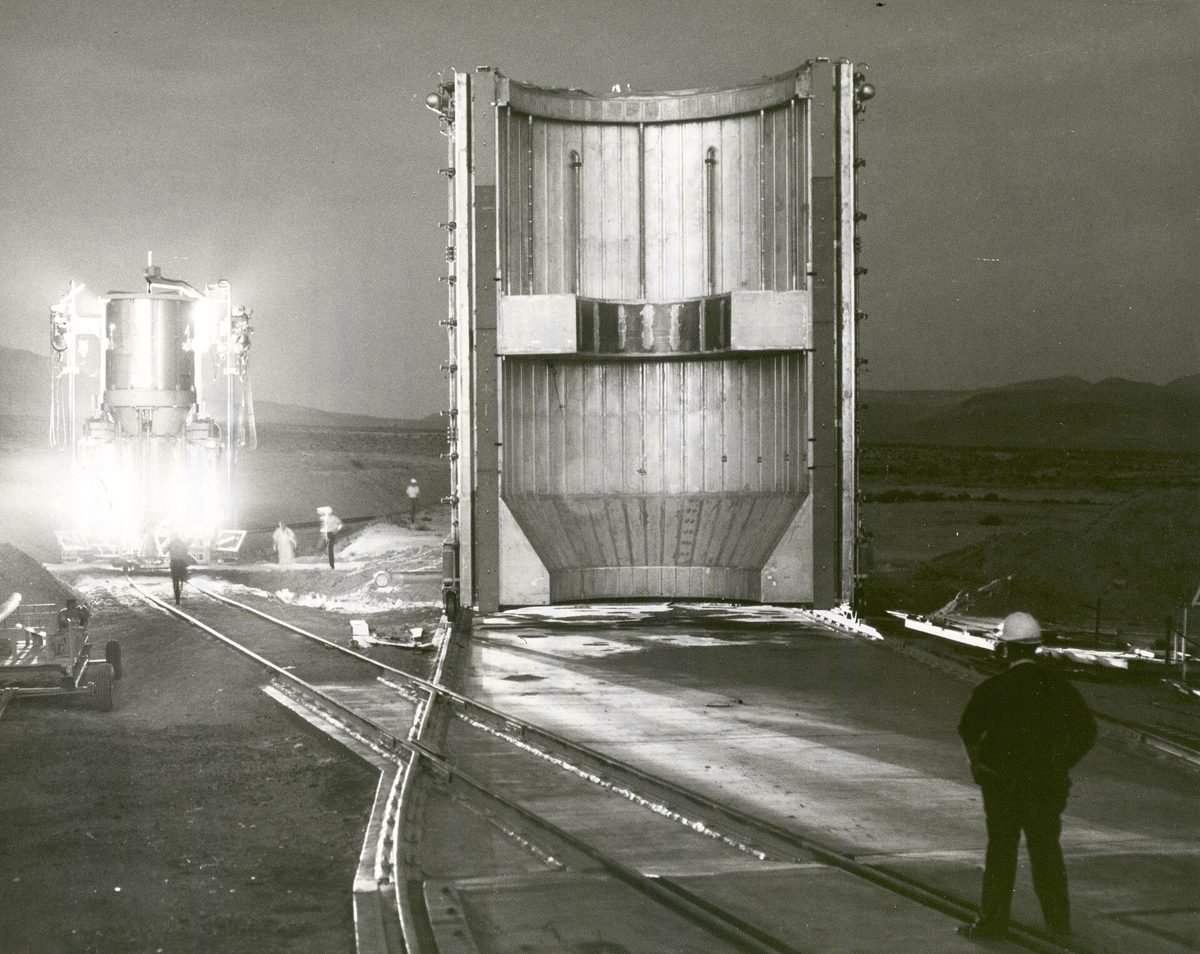
Phoebus 2A: the most powerful nuclear rocket reactor Ground test
Los Alamos runs Phoebus 2A at around 4,000 megawatts of thermal power, the most powerful nuclear rocket reactor ever tested. The small Pewee reactor tests new fuel the same year.
Why it matters: it showed the physics could scale to the size a crewed Mars engine would need.
1965
SNAP-10A: the only US reactor in orbit Flown
The US launches SNAP-10A, a small fission reactor making about 500 watts of electricity. It also carries a small experimental ion thruster. The reactor runs for 43 days before an electrical fault shuts it down; it is still in orbit.
Why it matters: it remains the only US fission reactor operated in space, and an early, tiny pairing of a reactor with electric propulsion.
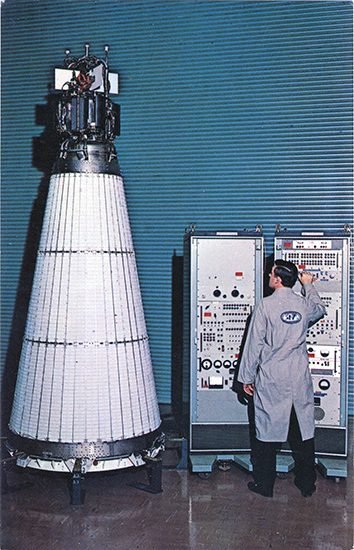
NERVA turns research towards a flight engine
NASA and the AEC, working through a joint Space Nuclear Propulsion Office, start NERVA to turn Rover reactors into an engine for a real vehicle, with Aerojet and Westinghouse as industrial partners. Wernher von Braun’s teams sketch nuclear upper stages and Mars ships.
Why it matters: the goal moved from proving physics to building hardware for a mission.
1959
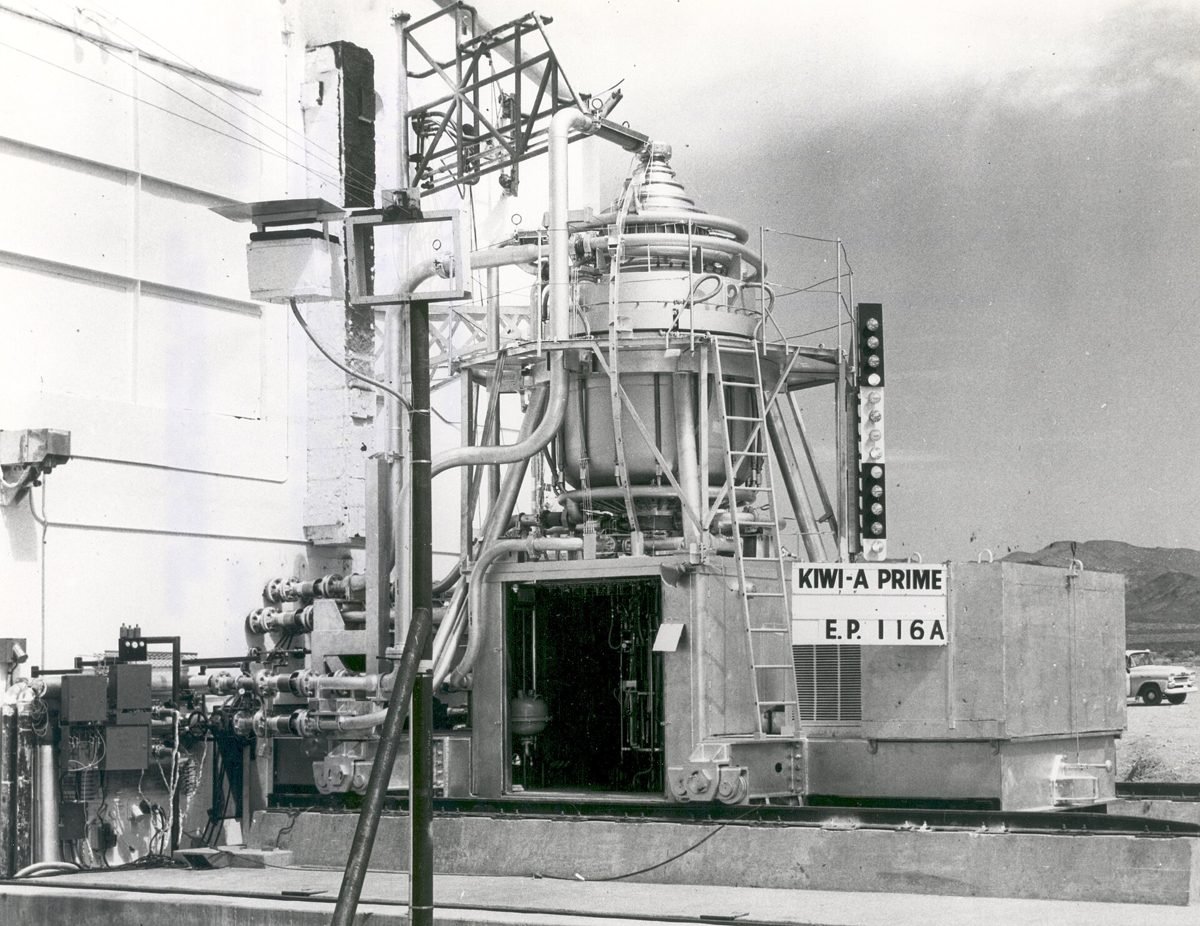
Kiwi-A: the first nuclear rocket reactor test Ground test
The first Kiwi reactor, named after the flightless bird because it was never meant to fly, is run in the Nevada desert. Kiwi tests continue to 1964, including a deliberate destruction test in 1965 to study what happens in an accident.
Why it matters: nuclear rockets moved from paper to real hardware heating real hydrogen.
Project Rover begins
The US starts Project Rover to find out whether a reactor can heat hydrogen to well over 2,000°C without falling apart. The original military interest was a nuclear upper stage for missiles; that use soon faded and the space case took over.
Why it matters: Rover laid the experimental base for every nuclear thermal design since.
1940s
The first nuclear rocket ideas
Soon after the Second World War, US scientists and engineers begin studying whether fission could power a rocket. They see the promise, a far more efficient engine, and the problems: heat, materials, cost and radiation.
Why it matters: nuclear propulsion becomes an engineering question, not just science fiction.
Seventy years in eleven cards
Swipe or scroll sideways. Green tags are things that happened; amber tags are targets; red tags are cancellations.
Project Rover
Los Alamos sets out to heat hydrogen with a reactor.
Completed
Kiwi-A
First nuclear rocket reactor runs in Nevada.
Ground test
SNAP-10A
Only US reactor operated in orbit, for power.
Flown
XE-Prime
Flight-like NERVA engine fired and restarted.
Ground test
NERVA ends
Cancelled before any flight.
Cancelled
Prometheus ends
Nuclear-electric Jupiter probe dropped.
Cancelled
KRUSTY
Small space reactor runs at full power.
Ground test
DRACO ends
Orbital nuclear thermal demo cancelled.
Cancelled
Cold-flow tests
100+ tests on a flight-like reactor unit.
Completed
SR-1 Freedom
Nuclear-electric craft due to launch for Mars.
Target
Crewed Mars goal
NASA planning target for round trips.
Target
→ swipe for more
From Watts to Megawatts
The power gap between what has been tested and what a crewed nuclear-electric ship would need.
Every Major US Space Nuclear Programme at a Glance
Propulsion and the power reactors it depends on. Dates are programme lifetimes.
| Programme | Years | Type | Outcome |
|---|---|---|---|
| Project Rover (Kiwi, Phoebus, Pewee) | 1955–1973 | Nuclear thermal reactors | Ground-tested; cancelled |
| NERVA (NRX, XE-Prime) | 1961–1973 | Nuclear thermal engine | Ground-tested; cancelled |
| SNAP-10A | 1965 | Space power reactor | Flew; 43 days of operation |
| SP-100 | 1983–1994 | Space power reactor | Not flown |
| Project Prometheus / JIMO | 2003–2005 | Nuclear electric | Cancelled |
| Kilopower / KRUSTY | 2015–2018 | Small fission power | Ground-tested |
| NASA NTP reactor designs | 2021– | Nuclear thermal | Design and cold-flow tests |
| DRACO | 2023–2025 | Nuclear thermal flight demo | Cancelled |
| SR-1 Freedom | 2026– | Nuclear electric flight to Mars | Target launch late 2028 |
| Lunar Reactor-1 | 2026– | Surface fission power | Target ready by 2030 |
Tap each hurdle to reveal it
Six engineering and programme problems that stand between today’s tests and a crewed nuclear ship.
1. Fuel that does not melt
2. Shielding without the weight
3. Radiators the size of a building
4. Keeping hydrogen cold for months
5. Proving it before it flies
6. Money that outlasts politics
The physics was proven in the 1960s. Integration, testing and funding are the real hurdles.
What Would a Faster Mars Journey Actually Change?
| Mission challenge | Potential benefit | What remains unresolved |
|---|---|---|
| Transit time | Shorter or more flexible transfers | Duration depends on vehicle and trajectory |
| Propellant mass | Less propellant for the same mission | Reactor, shielding and radiators add mass |
| Crew radiation dose | Less time exposed to cosmic rays | Solar storms and reactor radiation remain |
| Mission flexibility | Wider departure and abort options | The whole vehicle must be tested and qualified |
| Cargo delivery | Efficient haulage of heavy cargo | High-power reactors and thrusters still immature |
Faster propulsion is a system-level achievement. A better engine helps, but so do vehicle design, trajectory planning, life support, radiation protection and reliable power.
Corrections and Updates to Common Claims
Checked against NASA, DOE and DARPA records and reporting up to 9 October 2026.
“NASA announced SR-1 Freedom in October 2026”
SR-1 Freedom was announced in March 2026. The 8 October 2026 news was a NASA and Energy Department agreement on space nuclear power and propulsion.
“DRACO was completed”
DRACO never flew. It was cancelled in 2025 after the FY2026 budget request gave it no funding, and DARPA ended the programme.
“Cold-flow tests ran in 2026”
The 100+ tests ran from July to September 2025. NASA reported the completed campaign in January 2026.
“No nuclear reactor has ever flown”
No nuclear rocket engine has flown, but power reactors have: SNAP-10A in 1965 and dozens of Soviet reactors on satellites.
“Nuclear rockets will get us to Mars in weeks”
Few-week trips come from early concept studies. Built or tested technology points to transits of several months.
“SR-1 is the first crewed nuclear Mars ship”
SR-1 is robotic and about 20 kilowatts. A crewed nuclear-electric ship would need roughly 100 times as much power.
When Could Astronauts Ride a Nuclear Engine to Mars?
There is no confirmed date. NASA’s May 2026 directive set 2036 as a planning goal for unrefuelled round-trip crewed and cargo missions to Mars and asked for a study comparing nuclear thermal, nuclear electric and chemical propulsion. No crewed nuclear vehicle has been funded, designed in detail or approved.
- Ground qualification: fuel, reactor, power conversion and thrusters proven on the ground, including hot-fire testing that meets today’s environmental rules.
- Flight demonstration: a reactor running a spacecraft in deep space, which is what SR-1 Freedom is meant to do.
- Integrated design: propulsion combined with shielding, life support, communications and abort options.
- Human rating and approval: safety, reliability, launch authorisation and money that lasts the full programme.
Explore More Timelines
People Also Ask
Frequently Asked Questions
The Engine Is Only the Beginning
The history of nuclear propulsion is a story of strong engineering repeatedly running into budgets and shifting priorities. Rover and NERVA showed that nuclear thermal rockets work on the ground; Prometheus and DRACO showed how easily a mission can disappear. In 2026 the work is moving again, with new reactor hardware tests, much more powerful electric thrusters and a planned robotic reactor-driven flight to Mars.
The real breakthrough will not be reaching Mars a few months sooner. It will be making repeatable, safer and more capable journeys to Mars practical.
Related AiTimeline Stories
⚠️ Editorial Note
Last updated 9 October 2026. Future dates (SR-1 Freedom in 2028, Lunar Reactor-1 by 2030, crewed Mars missions by 2036) are NASA targets and planning goals, not commitments, and are labelled as such. Trip durations and specific-impulse figures are typical published ranges; the interactive capsule is illustrative. Historical test details are drawn from NASA and Los Alamos histories. Images: public domain (NASA, AEC, DARPA), credited in captions. Sources are listed below.
Sources & further reading
Every dated entry above was checked against these references. Last reviewed 9 October 2026.
- NASA - Space Reactor-1 Freedom mission page
- NASA - NASA, Energy Department Advance New Era of Nuclear-Powered Exploration (8 Oct 2026)
- NASA - A Message From Administrator Jared Isaacman: Space Reactor Office and Mars propulsion study (22 May 2026)
- American Nuclear Society - NASA announces plan for space nuclear propulsion by 2028 (25 Mar 2026)
- ExecutiveGov - NASA completes nuclear propulsion cold-flow test campaign (BWXT unit)
- Phys.org - NASA fires up powerful lithium-fed thruster for trips to Mars (Apr 2026)
- Breaking Defense - DARPA's DRACO nuclear propulsion project roars no more (Jun 2025)
- NASA - Nuclear propulsion could help get humans to Mars faster