India Car Fuel Timeline 1991–2026: How CNG, Hybrid and EV Cars Challenged Petrol
India car fuel timeline 1991-2026: petrol, diesel, CNG, hybrid, EV, E20 and FAME, tracking how alt-fuel cars edged past petrol sales in August 2026.
Latest Story
For decades, buying a car in India began with one basic question: petrol or diesel? CNG was mostly for taxis, hybrids were rare, and electric cars felt like a distant promise. But in 2026, India’s passenger-vehicle market crossed a psychological line. This India car fuel timeline tracks how CNG cars India, hybrid cars India and EV cars India together reportedly outsold petrol cars for the first time. Petrol did not disappear. The market simply stopped being a one-fuel story.
Data last verified: 7 September 2026. Sales-share figures are sourced from FADA vehicle retail data; policy dates are sourced from PIB, NITI Aayog, the Ministry of Heavy Industries and MoRTH.
🧠 Quick Answer
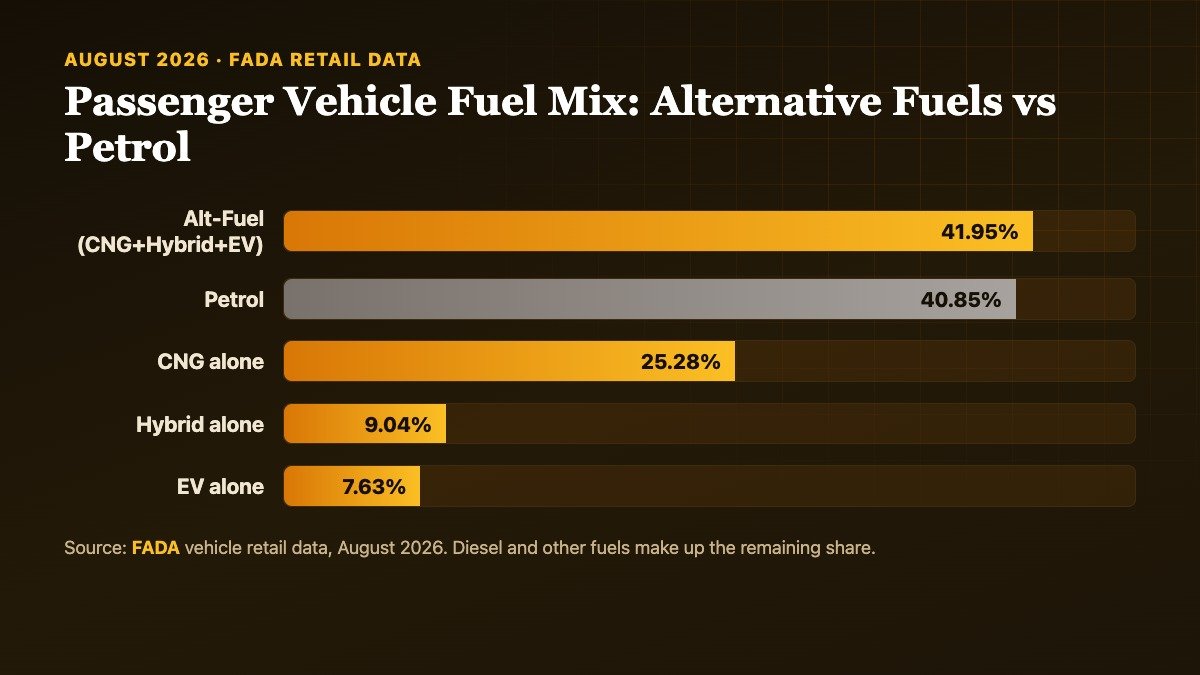
In August 2026, FADA data showed alternative-fuel passenger vehicles — CNG, hybrid and electric cars combined — accounted for 41.95% of India’s passenger-vehicle retail sales, narrowly ahead of petrol cars at 40.85%. This does not mean EVs alone overtook petrol: within that 41.95%, CNG alone was 25.28%, hybrids 9.04%, and EVs 7.63%. Petrol remains the single largest individual fuel type; it is only the combined alternative-fuel category that has edged ahead.
India Car Fuel Shift: Key Questions
What the data and the history both show
- India’s car market opened up after 1991 liberalisation, gradually expanding consumer choice beyond a handful of licensed manufacturers.
- Petrol dominated small and family cars for decades, and diesel grew strongly through the 2000s among high-mileage users and SUV buyers.
- Diesel’s advantage weakened after 2014 price deregulation and the 2020 shift to BS6 emission norms, which raised the cost of small-car diesel engines.
- CNG moved from taxis to mainstream factory-fitted cars, expanding across hatchbacks and sedans through the 2020s on the strength of running-cost savings.
- India’s EV push accelerated through FAME-I (2015), FAME-II (2019), PLI battery manufacturing (2021) and expanding charging infrastructure.
- E20 petrol milestone reached in 2025, ahead of the original 2030 target, adding a new variable to the petrol-buyer conversation.
- In August 2026, CNG + hybrid + EV combined (41.95%) edged past petrol (40.85%) in passenger-vehicle retail sales, according to FADA — a milestone, not a rout.
- The real shift is not “EVs replace petrol” but “India becomes a multi-fuel car market,” where CNG wins on running cost, hybrids win on convenience, and EVs win when charging fits a buyer’s life.
🔴 Confirmed vs interpretation
🟢 Confirmed (FADA data, Aug 2026): alt-fuel 41.95%, petrol 40.85%, CNG 25.28%, hybrid 9.04%, EV 7.63%, total retail 24,23,201 units. 🟡 Interpretation (this article’s framing): that this reflects India becoming a genuinely multi-fuel market rather than any single fuel “winning” — a reading, not a government or FADA statement.
What Are Alternative-Fuel Cars in India?
In India’s passenger-vehicle market, alternative-fuel cars usually means CNG, hybrid and electric vehicles considered together, as distinct from petrol and diesel. CNG cars run on compressed natural gas, either as factory-fitted duo-fuel variants or aftermarket kits. Hybrid cars combine a petrol engine with an electric motor and a small battery, without needing external charging. EVs (electric vehicles) run entirely on battery power, charged from the grid. FADA’s monthly retail data groups these three under one “alternative fuel” bucket precisely because, individually, none of them is close to petrol’s scale — it’s their combined growth that has become the story of 2026.
India’s Car Fuel Timeline: 1991 to 2026
From a two-fuel market to a five-fuel one
Every 2026 fuel-share headline sits on top of three decades of policy and market shifts. Reading the sequence below is the fastest way to understand why “CNG + hybrid + EV overtook petrol” is a milestone worth explaining carefully — not a sudden event.
India’s Car Market Opens Up
What happened: Economic liberalisation began reshaping the automobile sector, gradually replacing the licensed, limited-choice market with more competition and foreign partnerships.
Why it matters: Without this opening, the sheer variety of fuel choices Indian buyers weigh today — petrol, diesel, CNG, hybrid, EV — would not exist.
Delhi’s Pollution Crisis Reframes the Fuel Debate
What happened: Delhi’s worsening air pollution pushed the Supreme Court and policymakers to look beyond petrol and diesel, especially for buses, taxis and public transport.
CNG Becomes Visible in Delhi
What happened: Following a 1998 Supreme Court order, Delhi’s public transport fleet — buses, taxis and autos — converted to CNG by the early 2000s.
Why it matters: This made compressed natural gas familiar to millions of urban commuters, even though CNG was still mostly a commercial and taxi fuel at this stage.
Factory-Fitted CNG Enters the Mainstream
What happened: Automakers began offering factory CNG variants of popular hatchbacks, making the fuel more trustworthy for private buyers than aftermarket conversions.
Why it matters: Lower running cost became the strongest selling point — a theme that carries all the way through to the 2026 milestone.
Ethanol Blending Begins Slowly
What happened: India began experimenting with ethanol blending in petrol under an early Ethanol Blended Petrol Programme. Adoption was limited, but it laid the foundation for the later E20 push.
Diesel Reaches Its Strongest Consumer Moment
What happened: Diesel cars gained popularity on fuel economy and a large price gap versus petrol at the pump. Hatchbacks, sedans and SUVs increasingly offered diesel options.
Diesel Price Deregulation Changes the Equation
What happened: India deregulated diesel prices, removing the structural price advantage diesel cars had long held over petrol.
Why it matters: Diesel began losing appeal in smaller passenger cars from this point forward — the first real crack in the old petrol-vs-diesel binary.
FAME-I Starts India’s EV Policy Push
What happened: India launched the Faster Adoption and Manufacturing of (Hybrid and) Electric Vehicles — FAME — Phase I, later extended to March 2019. EVs remained niche, but the policy foundation was set.
National Policy on Biofuels Expands Ethanol Ambition
What happened: India’s National Policy on Biofuels – 2018 broadened the feedstock base for ethanol production, making blending part of energy security and agriculture strategy, not just fuel policy.
FAME-II Expands Electric Mobility Incentives
What happened: FAME-II supported electric two-wheelers, three-wheelers, buses and, to a lesser degree, passenger EVs, while also funding charging infrastructure. It concluded in March 2024.
BS6 Emission Norms Hit Diesel Economics
What happened: India shifted to Bharat Stage VI emission standards. Cleaner diesel technology became more complex and expensive, especially for small cars, and several automakers scaled back small-diesel offerings.
CNG Becomes a Family-Car Fuel
What happened: Factory-fitted CNG expanded across hatchbacks, sedans and compact models from multiple automakers. Buyers increasingly weighed a higher upfront cost against lower running cost over ownership.
Ethanol Roadmap Pushes India Toward E20
What happened: NITI Aayog and government agencies laid out a roadmap for 20% ethanol blending, advancing the original 2030 target to 2025.
Battery Manufacturing Becomes Industrial Policy
What happened: The Cabinet approved the PLI scheme for Advanced Chemistry Cell (ACC) battery storage, linking EV growth to domestic battery manufacturing rather than pure import dependence.
EVs, Hybrids and CNG Rise Together
What happened: EVs gained attention through new models and expanding charging networks. Hybrids appealed to buyers worried about range and charging. CNG kept growing on fuel-cost savings. By this stretch, the market had genuinely become multi-fuel — not a two-way petrol/diesel contest.
India Reaches Its E20 Ethanol Milestone
What happened: Government sources confirmed India achieved 20% ethanol blending in petrol, five years ahead of the original 2030 target set by the NITI Aayog roadmap.
Why it matters: It created both energy-security benefits (lower crude-oil import dependence) and new consumer questions about older-vehicle compatibility and mileage — both entering the car-buying conversation in 2026.
Alternative Fuels Nearly Catch Petrol
What happened: FADA’s monthly retail data showed the combined CNG + hybrid + EV share closing in on petrol’s share of passenger-vehicle sales, setting up the following month’s milestone.
CNG + Hybrid + EV Overtake Petrol
What happened: FADA reported that alternative-fuel passenger vehicles together outsold petrol cars for the first time in India’s history — 41.95% versus petrol’s 40.85% — on a record “biggest-ever August” of 24,23,201 total retail registrations, up 17.51% year-on-year. A little over a year earlier, petrol had led alternative fuels by nearly 11 percentage points.
Why it matters: This is a market-share milestone, not the death of petrol. Within the 41.95%, CNG alone (25.28%) still outsells hybrid (9.04%) and EV (7.63%) combined.
PETROL DID NOT DISAPPEAR.
THE MARKET SIMPLY STOPPED BEING A ONE-FUEL STORY.
Fuel Comparison: Petrol, Diesel, CNG, Hybrid, EV and E20
There is no single best fuel — only a best fit for a given buyer
| Fuel Type | Why Buyers Choose It | Main Limitation | Best-Fit Buyer |
|---|---|---|---|
| Petrol | Simple, widely available, lower upfront cost | Running cost can be higher than CNG | Low-to-medium usage family buyers |
| Diesel | Torque, highway range, favoured in SUVs | Higher BS6 complexity and urban-restriction concerns | High-mileage SUV/highway users |
| CNG | Low running cost | Boot-space loss, refuelling queues, station availability | City users and high-mileage owners |
| Hybrid | Fuel efficiency without charging dependence | Higher upfront price | Urban + highway mixed users |
| EV | Low running cost, smooth drive, policy support | Price, charging access, range and resale concerns | Home-charging users and city commuters |
| E20 Petrol | Supports ethanol blending, cuts oil-import dependence | Older-vehicle compatibility and mileage questions | Petrol buyers with E20-compatible cars |
Why CNG Grew So Fast
CNG’s rise from a taxi-only fuel to a 25.28% passenger-vehicle share rests on a few consistent factors: a meaningfully lower running cost than petrol, factory-fitted options from mainstream automakers (removing the trust gap that aftermarket kits carried), an expanding network of CNG pumps beyond metro cores, and years of taxi and fleet familiarity that made private buyers comfortable with the fuel. Petrol-price sensitivity does the rest — every fuel-price spike pushes budget-conscious, high-mileage buyers a little further toward CNG.
Why Hybrids Became Attractive
Hybrids solve a specific anxiety: better mileage without charging dependence. That matters most in traffic-heavy Indian cities, where stop-start driving actually favours a hybrid’s electric-assist efficiency. For buyers who want lower running costs but aren’t ready to plan their day around a charger, and for premium and SUV buyers who want efficiency without range anxiety, hybrids have become the middle path between petrol and EV.
Why EVs Are Growing — But Not Yet Dominant
EV registrations are rising from a smaller base than CNG or hybrid, and August 2026’s 7.63% share reflects that: it’s real growth, not market dominance. Buyers like the low running cost and smooth drive, and the fuel enjoys the strongest policy support of the three. But real barriers remain — upfront price, charging access (especially for apartment dwellers without dedicated parking), highway charging availability, battery-life concerns, and resale-value uncertainty. The August 2026 milestone is a CNG-plus-hybrid-plus-EV story; treating it as “EVs overtook petrol” overstates where EVs alone actually stand.
E20 Petrol: What It Actually Means
India’s E20 petrol push — petrol blended with 20% ethanol — is fundamentally about reducing crude-oil import dependence, supporting domestic ethanol production (and, by extension, sugarcane and grain farmers), and modestly lowering some tailpipe emissions. Government sources confirmed India reached the E20 target in 2025, five years ahead of the original 2030 NITI Aayog roadmap.
In 2026, customer questions around mileage and compatibility with older vehicles became a genuine part of the car-buying conversation — not because of confirmed widespread engine damage, but because many vehicles built before ethanol-blending norms were finalised weren’t originally engineered or warrantied for E20. This is a live consumer question, not a settled verdict either way; buyers of older petrol cars are advised to check their vehicle’s ethanol compatibility with the manufacturer.
Thirty-five years compressed into eight stages — each one still shaping which fuel a buyer picks today.
Which Fuel Wins in India?
Illustrative estimator — not purchase advice
💡 Human Reality Check
- Petrol did not disappear. The market simply became more complicated.
- India’s car buyer is no longer choosing only between petrol and diesel.
- CNG wins on running cost, hybrids win on convenience, EVs win when charging fits your life.
- The fuel shift is happening one household calculation at a time.
Explore More Timelines
People Also Ask
Frequently Asked Questions
Related AiTimeline Coverage
⚠️ Editorial & Sources Disclaimer
This article is editorial coverage of publicly available government and industry data, not financial or purchase advice. Sales-share figures are sourced from FADA vehicle retail data (August 2026); policy dates are sourced from PIB, NITI Aayog, the Ministry of Heavy Industries and MoRTH. Every figure was verified as of 7 September 2026. Nothing here should be read as a recommendation to buy a specific fuel type, model or brand.
Sources & further reading
Every dated entry above was checked against these references. Last reviewed 15 September 2026.
- FADA/Reuters - alternative fuels overtake petrol, August 2026
- PIB - Cabinet approves FAME India Phase II
- PIB - Cabinet approves National Policy on Biofuels 2018
- Ministry of Heavy Industries - FAME-II scheme
- Ministry of Petroleum & Natural Gas - National Policy on Biofuels 2018
- PIB - PLI scheme for Advanced Chemistry Cell battery storage