Enron Scandal Timeline: Hidden Debts, Failed Audits and Wall Street’s Wake-Up Call
Enron scandal timeline: hidden debt, the 2001 bankruptcy, Arthur Andersen, the Lay and Skilling verdicts and the Sarbanes-Oxley reforms that followed.
Latest Story
This Enron scandal timeline follows the company that Wall Street trusted until it did not. Enron reported about $101 billion of revenue in 2000 and was named America’s Most Innovative Company six years running, yet on 8 November 2001 it restated four years of earnings, cutting net income by $591 million, and on 2 December 2001 it filed for bankruptcy. Its auditor, Arthur Andersen, was convicted of obstruction in 2002, a verdict the Supreme Court reversed in 2005; its chairman, Kenneth Lay, was convicted in 2006 but died before sentencing, so the conviction was vacated; and Congress passed the Sarbanes-Oxley Act. For the 2008 crash, see the Lehman Brothers collapse; for fraud at home, the Satyam fraud.
💡 Short Answer
Enron, a Houston energy trader, used partnerships and aggressive accounting to hide debt and overstate results. After a $1.01 billion charge on 16 October 2001, a restatement on 8 November and a junk rating on 28 November, it filed for Chapter 11 on 2 December 2001. Skilling and Fastow went to prison; Lay’s conviction was vacated after his death; Andersen’s conviction was reversed in 2005.
Enron: Key Questions
The Enron Story in Ten Points
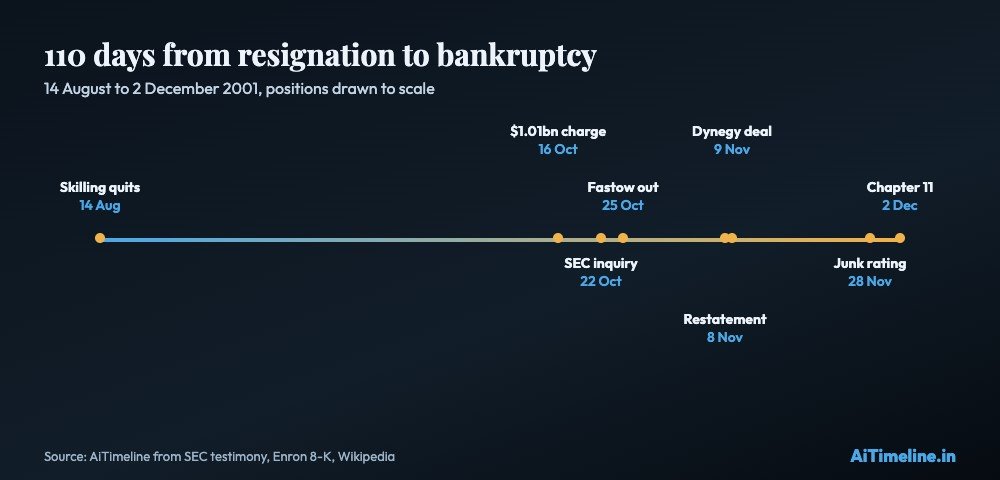
- The collapse: 110 days from Skilling’s resignation (14 August 2001) to bankruptcy (2 December 2001).
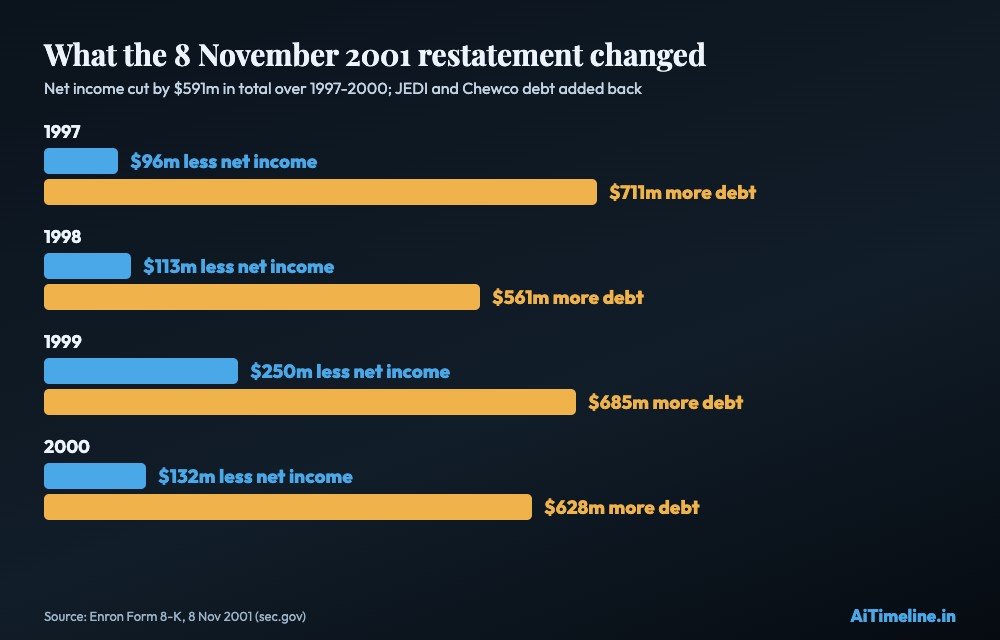
- The restatement: $591 million off 1997–2000 net income, per Enron’s own Form 8-K; secondary sources give $586m or $569m.
- The debt: consolidating JEDI and Chewco added $711m, $561m, $685m and $628m of debt in 1997–2000.
- The trigger: credit ratings fell to junk on 28 November 2001, and Dynegy ended its rescue.
- The jury: Lay and Skilling were convicted on 25 May 2006.
- Lay: died on 5 July 2006; the conviction was vacated on 17 October 2006, which is not an acquittal.
- Andersen: convicted in 2002, reversed unanimously on 31 May 2005; the firm did not return.
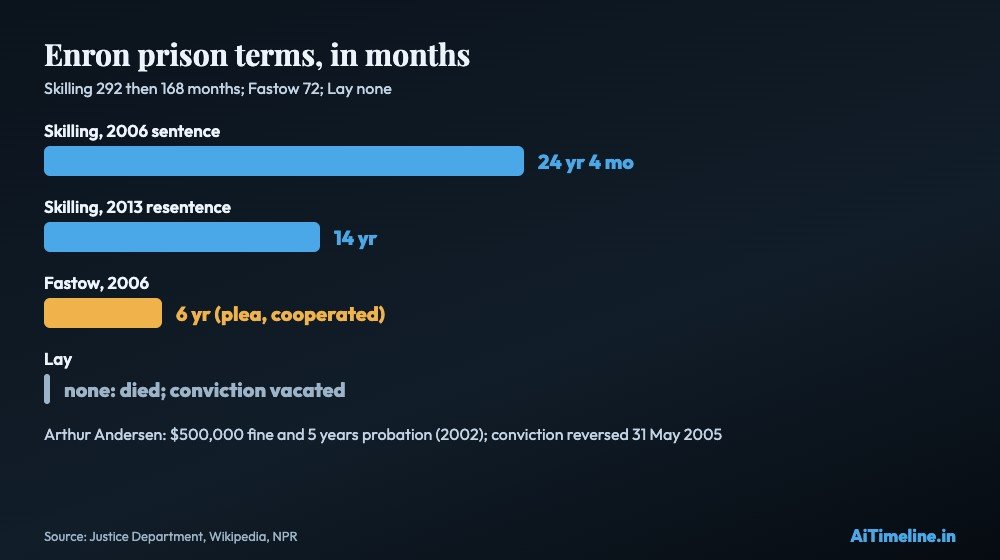
- Skilling: 292 months in 2006, 168 months in 2013, released 21 February 2019.
- The reform: Sarbanes-Oxley, signed 30 July 2002.
- The caution: Enron’s trading was investigated in the 2000–01 Western energy crisis, but it was not the only cause.
Enron Scandal Timeline, Latest First
Each entry is tagged by thread and ends with why it matters. Use the filter to isolate the company, the auditor, the courts or the reform.
The company, the auditor, the courts or the reform? Filter the timeline by thread.
–
Skilling is released from federal custody Courts and cases
Jeffrey Skilling was moved from prison to a halfway house in Texas on 30 August 2018 and released from federal custody on 21 February 2019, after about 12 years in prison (Wikipedia).
His release closed the last prison term of the three main Enron defendants: Andrew Fastow had been freed in December 2011, and Kenneth Lay never served a sentence.
A federal judge bars Skilling from public-company office Courts and cases
Judge Melinda Harmon granted the SEC summary judgment and permanently barred Skilling from serving as an officer or director of a public company on 8 December 2015 (Wikipedia). The SEC had sued him in February 2004. The AiTimeline draft brief dated this order to 2016; the court order is dated 2015.
This is a civil regulatory remedy, separate from the criminal sentence.
Skilling is resentenced to 168 months Courts and cases
On 21 June 2013 Judge Sim Lake accepted a deal that cut Skilling’s sentence from 24 years and four months to 14 years (168 months). Skilling gave up about $42 million for victims of the fraud (Wikipedia). In the agreement, prosecutors and Skilling recommended the reduced term in return for, among other things, his giving up further challenges to the conviction and sentence.
Andrew Fastow is released Courts and cases
Fastow, the former chief financial officer who built the LJM partnerships, was released on 16 December 2011 after serving his six-year sentence, having moved to a Houston halfway house on 18 May 2011 (Wikipedia). He had pleaded guilty and cooperated with prosecutors.
The Fifth Circuit upholds Skilling’s convictions again Courts and cases
After the Supreme Court’s 2010 ruling, the Fifth Circuit again affirmed Skilling’s convictions on 6 April 2011, held that the errors in the prosecution case were harmless, denied a new trial, and vacated his sentence for resentencing (Jurist). The Supreme Court denied review on 16 April 2012, and resentencing followed in 2013.
The Supreme Court narrows “honest services” fraud in Skilling’s case Courts and cases
On 24 June 2010 the Supreme Court held that the honest-services fraud law covers only bribery and kickback schemes, which did not include the conduct alleged against Skilling, and that pretrial publicity and community prejudice did not deny him a fair trial (Wikipedia). The Court sent the case back to the Fifth Circuit to decide the effect on his convictions.
This did not acquit Skilling. His remaining convictions, on other fraud theories, were upheld in 2011.
Skilling is sentenced to 24 years and four months Courts and cases
Judge Sim Lake sentenced Skilling to 24 years and four months in prison and ordered about $45 million to be applied to restitution for victims (Justice Department). The sentence was later reduced through appeals and a negotiated resentencing.
Lay’s conviction is vacated Courts and cases
Judge Lake vacated Kenneth Lay’s conviction and dismissed the indictment on 17 October 2006, applying the doctrine of abatement: under Fifth Circuit precedent, a defendant’s death while the case is pending erases the conviction because he never had a full appeal (NBC News). The ruling blocked the government’s bid to seek $43.5 million in forfeiture in that case, though civil claims against the estate remained possible.
This is a legal technicality of death, not a finding of innocence. The jury verdict happened; the law treats the case as if it had not reached final judgment.
Fastow is sentenced to six years Courts and cases
Fastow was sentenced to six years in prison followed by two years of probation on 26 September 2006 (Wikipedia). He had been indicted on 78 counts on 31 October 2002 and pleaded guilty on 14 January 2004 to two counts of conspiracy involving wire and securities fraud. He testified at the Lay and Skilling trial.
Kenneth Lay dies before sentencing Courts and cases
Lay died of heart disease on 5 July 2006, weeks after his conviction and before sentencing (Wikipedia; NBC News). Because he died before sentencing, no sentence was imposed.
A Houston jury convicts Lay and Skilling Courts and cases
On 25 May 2006 the jury convicted Kenneth Lay on all six counts it considered: conspiracy, two counts of wire fraud and three counts of securities fraud. Judge Lake separately convicted him of one count of bank fraud and three counts of making false statements to banks. Skilling was convicted on 19 of 28 counts: conspiracy, 12 counts of securities fraud, one count of insider trading and five counts of making false statements to auditors; he was acquitted on nine insider-trading counts (Justice Department).
The Supreme Court overturns Arthur Andersen’s conviction Auditor
The Supreme Court unanimously reversed Andersen’s obstruction conviction on 31 May 2005 (Cornell LII). It held that the jury instructions did not properly convey the law: they did not require that Andersen was conscious of wrongdoing, and did not require a link between the persuasion and a particular official proceeding, which must at least be foreseen. The AiTimeline draft brief gave 1 June; the decision is dated 31 May.
The Court did not find that Andersen’s conduct was blameless; it decided the instructions were wrong. By then the firm had already surrendered its licences, and it was not retried.
Enron emerges from bankruptcy Company
Enron emerged from Chapter 11 in November 2004 under a court-approved plan (Wikipedia). It sold its last major subsidiary, Prisma Energy International, on 7 September 2006.
Fastow pleads guilty Courts and cases
On 14 January 2004 Fastow pleaded guilty to two counts of wire and securities fraud conspiracy (Wikipedia). Skilling surrendered to the FBI on 19 February 2004 (Wikipedia).
The Sarbanes-Oxley Act becomes law Reform
President George W. Bush signed the Sarbanes-Oxley Act on 30 July 2002 after the House passed the final bill 423–3 and the Senate 99–0 on 25 July (Wikipedia). It created the Public Company Accounting Oversight Board (PCAOB), required chief executives and chief financial officers to certify financial reports, restricted auditors from selling certain non-audit services to the companies they audit (Section 201), required an assessment of internal controls (Section 404) and made it a crime to destroy records to obstruct a federal investigation (Section 802).
Enron was not the only scandal behind the law; WorldCom and others contributed. But the collapse became its defining case.
Andersen is fined and put on probation Auditor
Judge Melinda Harmon fined the firm $500,000 and sentenced it to five years of probation, the maximum for the obstruction conviction. Its US payroll had by then fallen from about 28,000 to fewer than 1,000 (NPR).
Andersen surrenders its audit licences Auditor
After the conviction, Andersen gave up its licences to audit public companies on 31 August 2002, which effectively ended the firm’s US audit business. It lost about two-thirds of its roughly 28,000 US staff, and its practices were sold to other firms (Wikipedia).
A jury convicts Arthur Andersen of obstruction Auditor
A Houston jury found Arthur Andersen guilty of obstruction of justice on 15 June 2002 for destroying records related to Enron (Wikipedia). The Justice Department had announced the indictment on 14 March 2002 (Justice Department).
This is the verdict the Supreme Court overturned on 31 May 2005; it remained in force when the firm collapsed.
The Powers Report blames executives and the board Company
A special committee of Enron’s board led by University of Texas law dean William Powers Jr. released its 218-page report on 1 February 2002. It concluded that failures at many levels, including self-enrichment by employees, inadequately designed controls and a culture that encouraged pushing limits, caused the problems, and it placed heavy blame on Lay and Skilling (Salon). One Enron SEC filing dates the release 1 February; Salon’s report implies 2 February.
Press accounts of the report said the dealings inflated Enron’s profits by almost $1 billion.
Federal investigations widen Courts and cases
After the bankruptcy, federal criminal investigators and congressional committees began examining executives, accounting and the role of auditors and banks (Wikipedia).
Thousands of workers lose their jobs Company
Contemporary reports said Enron laid off about 4,000 employees at its Houston headquarters the day after the bankruptcy filing. Many employees held Enron stock in retirement plans, so they lost jobs and savings together. AiTimeline did not independently verify the layoff figure and gives it as reported.
Enron files for Chapter 11 bankruptcy Company
Enron’s board voted on 1 December 2001 and the company filed for Chapter 11 protection on 2 December, listing assets of $63.4 billion and liabilities of about $23 billion; it also sued Dynegy for $10 billion (Wikipedia; SEC testimony). It was then the largest bankruptcy in US history, a record WorldCom passed in 2002.
Shares that had traded near $90 in August 2000 closed at $0.26 on 30 November 2001 (historical price data).
Credit ratings fall to junk and Dynegy walks away Company
On 28 November 2001 several ratings agencies cut Enron’s long-term debt below investment grade, and Dynegy terminated the merger, citing breaches including a material adverse change (SEC testimony). The stock closed that day at $0.61 (Wikipedia).
The downgrade mattered because many of Enron’s financing arrangements were tied to its credit rating, so a fall in confidence triggered obligations the company could not meet.
Enron discloses an accelerated $690 million note Company
Enron filed its third-quarter Form 10-Q on 19 November 2001. It disclosed a restructuring expected to hurt fourth-quarter earnings and a $690 million note payable to a limited partnership that was accelerated after a debt downgrade (SEC testimony). The draft brief also said the auditor could not finish its quarterly review; AiTimeline could not verify that and omits it.
Dynegy agrees to buy Enron Company
Dynegy announced on 9 November 2001 that it would acquire Enron for about $9 billion in Dynegy stock plus the assumption of about $13 billion of debt (SEC testimony). Wikipedia reports that Dynegy’s board voted on 7 November and the companies confirmed the deal on 8 November (Wikipedia).
Enron restates four years of earnings Company
In a Form 8-K filed on 8 November 2001 Enron restated 1997–2000 and said earlier statements should not be relied on. Reported net income fell by $96 million in 1997, $113 million in 1998, $250 million in 1999 and $132 million in 2000, a total of $591 million (from $2,680 million to $2,089 million). Consolidating the JEDI and Chewco partnerships added debt of $711 million, $561 million, $685 million and $628 million in the same four years (Enron Form 8-K). The draft brief gave about $586 million; that figure appears in a Congressional Research Service summary, while the filing itself totals $591 million. A third figure, $569 million, appears in SEC testimony.
The CFO is replaced and the SEC opens an inquiry Company
The SEC announced on 22 October 2001 that it was investigating suspicious deals (Wikipedia). Fastow told two directors on 23 October that he had made about $45 million from LJM. Enron replaced him as chief financial officer on 24 October (SEC testimony), and the board removed him and placed him on leave on 25 October (Wikipedia).
Enron reports a $1.01bn charge Company
On 16 October 2001 Enron announced a $1.01 billion after-tax charge to third-quarter earnings and disclosed a $1.2 billion reduction in shareholders’ equity tied to share repurchases from LJM2-linked transactions (SEC testimony). It was the company’s first quarterly loss in four years (Congressional Research Service).
Skilling quits and Sherron Watkins warns Lay Company
Skilling resigned as president and chief executive on 14 August 2001, citing personal reasons, and Lay resumed the CEO title (SEC testimony). Vice president Sherron Watkins wrote that she sent Lay an anonymous letter on 14 August warning of accounting problems; some accounts date it 15 August. She met Lay in person on 22 August with a longer letter (CNN Money; Wikipedia). The draft brief’s 28 August Wall Street Journal report is not in the sources AiTimeline checked; the Journal’s Jonathan Weil had written about Enron’s accounting on 20 September 2000.
Enron’s Dabhol power project in India stalls Company
Enron’s Dabhol Power project in Maharashtra, a 2,184 MW gas-fired plant, had been controversial since 1992 for high costs and political lobbying. Maharashtra stopped paying; Enron began arbitration in April 2001, stopped running Phase I in May and halted construction of the about 90%-complete Phase II in June 2001 (US House minority staff report, Feb 2002). The source reflects the views of that staff report.
EnronOnline launches Company
Enron launched EnronOnline on 29 November 1999 (Wikipedia). By 2000 the company reported revenue of about $100.8 billion and had about 20,600 employees, and Fortune named it America’s Most Innovative Company for six years in a row, from 1996 to 2001.
LJM partnerships are created Company
LJM Cayman, L.P. (LJM1) and LJM2 Co-Investment, L.P. were created in 1999, and Enron’s chief financial officer was managing member of their general partners while serving as a senior Enron executive (SEC testimony). He gave up his operating role in July 2001.
Related-party structures can have legitimate purposes. The concern, as the Powers Report found, was conflicts of interest, valuations and risk transfer that left debt off the books.
Chewco and JEDI keep debt off the books Company
Enron’s November 2001 restatement consolidated two entities, JEDI (Joint Energy Development Investments) and Chewco Investments, from November 1997 (Enron Form 8-K). Consolidating them added $711 million of debt in 1997 alone.
Houston Natural Gas and InterNorth merge Company
Shareholders of Houston Natural Gas and InterNorth voted to merge on 16 July 1985, creating the company later renamed Enron (Wikipedia). Wikipedia gives two dates for the new name, November 1985 and March–April 1986. Skilling arrived in 1990 or 1991 and built the “Gas Bank” trading model (Wikipedia).
How the Enron Accounting Controversy Worked
Debt alone is not fraud; hidden debt and overstated results were the problem.
1. Partnerships obscured the real picture. Enron used entities such as JEDI, Chewco and the LJM partnerships for transactions involving its assets and investments. In November 2001 it consolidated JEDI and Chewco back into its accounts, which added $711 million of debt in 1997 alone and $628 million in 2000. Some arrangements created conflicts of interest because the chief financial officer managed LJM while employed by Enron.
2. Reported earnings did not reflect the underlying condition. The restatement cut net income by $591 million over four years, from $2,680 million to $2,089 million, a fall of about 22%. The company had reported nearly $101 billion of revenue for 2000.
3. Debt and credit ratings became a dangerous combination. Many of Enron’s financing arrangements were sensitive to its credit rating. A $690 million note to a limited partnership was accelerated after a downgrade, and the 28 November junk rating removed access to credit.
4. Oversight failed to protect investors. The Powers Report pointed to failures at many levels, including self-enrichment by employees and inadequately designed controls. Questions followed about executive accountability, board supervision, audit independence and the role of regulators and banks.
Who Was Held Responsible, and How?
Jury verdicts, appeals and the Supreme Court’s reversal kept apart.
| Person or firm | Role | Legal outcome | Status today |
|---|---|---|---|
| Kenneth Lay | Chairman and chief executive | Jury convicted 25 May 2006; died 5 Jul 2006 before sentencing | Conviction vacated 17 Oct 2006 (abatement); not an acquittal |
| Jeffrey Skilling | President and CEO, Feb-Aug 2001 | Convicted on 19 of 28 counts; 24 yr 4 mo (2006); 168 months (2013) | Released 21 Feb 2019; barred from public-company office 8 Dec 2015 |
| Andrew Fastow | Chief financial officer | Pleaded guilty 14 Jan 2004; six years (26 Sep 2006) | Released 16 Dec 2011 |
| Arthur Andersen LLP | External auditor | Convicted of obstruction 15 Jun 2002; fined $500,000 and 5 years probation | Conviction reversed unanimously 31 May 2005; firm had ceased auditing in 2002 |
What Happened to Arthur Andersen?
Arthur Andersen was one of the Big Five accounting firms and Enron’s external auditor. The Justice Department announced its indictment on 14 March 2002, a Houston jury convicted it of obstruction of justice on 15 June 2002, and it surrendered its audit licences on 31 August 2002. Its US workforce fell from about 28,000 to fewer than 1,000 by the October 2002 sentencing.
On 31 May 2005 the Supreme Court unanimously reversed the conviction, writing that the jury instructions did not require consciousness of wrongdoing or a link to a foreseeable official proceeding. The ruling concerned the legal test for obstruction; it did not decide that Andersen’s work for Enron was sound. By then the firm had no audit business left to restore.
The episode left a lasting warning about audit independence, which Section 201 of Sarbanes-Oxley later addressed.
| Sarbanes-Oxley provision | What it does | Enron problem it targets |
|---|---|---|
| Title I: PCAOB | Creates a body that oversees and inspects auditors of public companies | An audit firm answerable mainly to its own profession |
| Section 201 | Restricts auditors from selling certain non-audit services to audit clients | Auditor conflicts of interest |
| Sections 302 and 906 | CEO and CFO certify financial reports; false certification is criminal | Executives who said they did not know the details |
| Section 404 | Management and auditor assess internal control over financial reporting | Controls that did not stop related-party deals |
| Section 802 | Makes destroying records to impede a federal investigation a crime (up to 20 years) | Andersen’s document destruction |
110 Days: From Resignation to Bankruptcy
The sequence of 2001, counted from 14 August.
| Date (2001) | Event | Days after 14 Aug |
|---|---|---|
| 14 Aug | Skilling resigns; Lay resumes as CEO | 0 |
| 16 Oct | $1.01bn after-tax charge; $1.2bn equity cut | 63 |
| 22 Oct | SEC announces investigation | 69 |
| 24-25 Oct | CFO replaced, then removed and placed on leave | 71-72 |
| 8 Nov | Restatement of 1997-2000 | 86 |
| 9 Nov | Dynegy deal announced | 87 |
| 19 Nov | 10-Q discloses accelerated $690m note | 97 |
| 28 Nov | Junk rating; Dynegy ends deal | 106 |
| 2 Dec | Chapter 11 filing | 110 |
Court by Court: What Each Body Decided
From the Powers Report to the SEC bar on Skilling.
| Date | Court or body | What happened |
|---|---|---|
| 1 Feb 2002 | Enron board committee | Powers Report released |
| 14 Mar 2002 | Justice Department | Arthur Andersen indictment announced |
| 15 Jun 2002 | Federal jury, Houston | Andersen convicted of obstruction |
| 16 Oct 2002 | Judge Melinda Harmon | Andersen fined $500,000, five years of probation |
| 14 Jan 2004 | Federal court | Fastow pleads guilty to two counts |
| 31 May 2005 | US Supreme Court | Andersen conviction reversed 9-0 (544 U.S. 696) |
| 25 May 2006 | Federal jury, Houston | Lay and Skilling convicted |
| 26 Sep 2006 | Judge Sim Lake | Fastow sentenced to six years |
| 17 Oct 2006 | Judge Sim Lake | Lay conviction vacated after his death |
| 23 Oct 2006 | Judge Sim Lake | Skilling sentenced to 24 years and four months |
| 24 Jun 2010 | US Supreme Court | Skilling v. United States: honest-services fraud narrowed |
| 6 Apr 2011 | Fifth Circuit | Skilling convictions affirmed; sentence vacated |
| 21 Jun 2013 | Judge Sim Lake | Skilling resentenced to 168 months |
| 8 Dec 2015 | Judge Melinda Harmon | Skilling barred from public-company office (SEC) |
How Enron Changed Corporate Governance
The Sarbanes-Oxley Act of 2002 was the central legislative response. The House passed the final bill 423–3 and the Senate 99–0, and President Bush signed it on 30 July 2002. It established the Public Company Accounting Oversight Board, required senior executives to certify financial reports, restricted some non-audit services by auditors, and required assessments of internal control. WorldCom and other scandals also shaped it, and it did not make fraud impossible.
For other stories of audit failures and corporate collapses, see the Satyam fraud, the Harshad Mehta scam and the YES Bank crisis.
The Story at a Glance
Dates from the sources listed below.
| Date | Event | Detail |
|---|---|---|
| 16 Jul 1985 | HNG and InterNorth vote to merge | Enron’s origin |
| 29 Nov 1999 | EnronOnline launches | Trading platform |
| Apr-Jun 2001 | Dabhol project stalls | Maharashtra, 2,184 MW |
| 14 Aug 2001 | Skilling resigns | After about six months as CEO |
| 16 Oct 2001 | $1.01bn charge | Equity down $1.2bn |
| 8 Nov 2001 | Restatement | $591m net income cut |
| 28 Nov 2001 | Junk rating | Stock $0.61 |
| 2 Dec 2001 | Chapter 11 | Assets $63.4bn |
| 15 Jun 2002 | Andersen convicted | Reversed 31 May 2005 |
| 30 Jul 2002 | Sarbanes-Oxley signed | PCAOB created |
| 25 May 2006 | Lay and Skilling convicted | Lay vacated 17 Oct 2006 |
| 21 Jun 2013 | Skilling resentenced | 168 months |
| 21 Feb 2019 | Skilling released | From federal custody |
The Lasting Legacy of the Enron Collapse
The bankruptcy wiped out shareholder value, damaged employee retirement savings, ended a major accounting firm and prompted a wave of investigations and legal reforms. The criminal cases showed how hard it can be to assign accountability after a complex corporate failure: a jury verdict for Lay that the law later erased, a Supreme Court reversal for Andersen, and a Skilling sentence that fell from 292 to 168 months.
The lesson is not that complex finance is wrong. Markets depend on reliable information, and when reported success cannot withstand scrutiny, confidence can vanish faster than a company can find financing. For related reading on later crashes, see Lehman Brothers, Silicon Valley Bank and Black Monday 1987. AiTimeline has no story on the 2001 dot-com bust itself; the nearest is the AI bubble timeline, which covers a different era.
| Term | Meaning | Why it matters here |
|---|---|---|
| Mark-to-market accounting | Booking expected future profit from a contract at once | Enron used it for its trading and energy contracts |
| Special-purpose entity (SPE) | A separate legal entity set up for a specific transaction | JEDI, Chewco and LJM were treated as outside Enron |
| Consolidation | Including an entity’s assets and debts in the parent’s accounts | The 2001 restatement consolidated JEDI and Chewco |
| Related-party transaction | A deal with someone connected to the company | Fastow ran LJM while an Enron executive |
| Chapter 11 | US bankruptcy reorganisation | Enron filed on 2 Dec 2001 |
| Abatement ab initio | Rule that death before final appeal voids the conviction | Used to vacate Lay’s conviction |
| Honest-services fraud | Federal law about schemes to deprive others of honest services | Narrowed to bribery and kickbacks in 2010 |
| PCAOB | Public Company Accounting Oversight Board | Created by Sarbanes-Oxley in 2002 |
Who Is Who in the Story
Kenneth Lay
Led Enron for most of its history; convicted in May 2006, died in July 2006, conviction vacated in October 2006.
Jeffrey Skilling
Built the trading business; resigned 14 August 2001; convicted on 19 counts in May 2006.
Andrew Fastow
Ran the LJM partnerships; pleaded guilty in January 2004 and served six years.
Sherron Watkins
Vice president who warned Lay about accounting problems in August 2001.
William Powers Jr.
Led the board committee whose report was released on 1 February 2002.
Arthur Andersen LLP
Enron’s external auditor; convicted in 2002, conviction reversed in 2005.
Sim Lake
Presided over the Lay and Skilling trial and the 2006 and 2013 Skilling sentences.
Dynegy
Agreed on 9 November 2001 to buy Enron and ended the deal on 28 November.
The Popular Story vs the Record
| Popular version | What the record shows |
|---|---|
| Enron collapsed simply because it had a lot of debt | Companies can borrow heavily without fraud. The issue was that debt was kept off the books and results overstated, as the 2001 restatement showed |
| Arthur Andersen was cleared by the Supreme Court | The Court reversed the conviction because the jury instructions were wrong. It did not rule that Andersen’s conduct was proper, and the firm was already gone |
| Kenneth Lay was found not guilty | A jury found him guilty. The conviction was vacated only because he died before sentencing, under the abatement doctrine |
| Skilling was freed on appeal | The Supreme Court narrowed the honest-services law in 2010, but his convictions were upheld in 2011 and the sentence was cut by agreement in 2013 |
| Enron caused the whole California energy crisis | Its trading was investigated, but supply, drought, infrastructure and market design also mattered; it would be inaccurate to blame Enron alone |
| Sarbanes-Oxley made corporate fraud impossible | It changed oversight, certification and audit rules; it did not remove the risk of fraud |
| The restatement was $586 million | Enron’s own Form 8-K totals $591 million for 1997-2000; $586 million and $569 million appear in secondary summaries |
Explore More Timelines
People Also Ask
Frequently Asked Questions
Sources and Further Reading
- Enron Corp: Form 8-K, 8 Nov 2001 (restatement, sec.gov)
- SEC: Testimony on recent events relating to Enron, Dec 2001
- Congressional Research Service: The Enron Collapse, an overview
- US Supreme Court: Arthur Andersen LLP v. United States, 544 U.S. 696 (2005)
- US Department of Justice: Lay and Skilling convictions, 25 May 2006
- US Department of Justice: Skilling sentencing, 23 Oct 2006
- US Department of Justice: Arthur Andersen indictment news conference, 14 Mar 2002
- NPR: Arthur Andersen fined and sentenced, 17 Oct 2002
- NBC News: Judge throws out convictions of Enron’s Lay, 17 Oct 2006
- Jurist: Federal appeals court denies new trial for ex-Enron CEO, Apr 2011
- US House minority staff: Background on Enron’s Dabhol Power Project, Feb 2002
- Wikipedia: Enron scandal
- Wikipedia: Jeffrey Skilling
- Wikipedia: Andrew Fastow
- Wikipedia: Skilling v. United States
- Wikipedia: Sarbanes-Oxley Act
Related AiTimeline Stories
⚠️ Editorial Note
Last updated 22 October 2026. Jury verdicts, appeals, the Supreme Court’s reversal of Andersen’s conviction and later reforms are kept distinct. Lay’s conviction was vacated after his death, which is not an acquittal; Andersen’s conviction was reversed on the jury instructions, not on a finding that its conduct was proper; and Enron should not be treated as the only cause of the 2000–01 Western energy crisis. Corrections to the draft brief: the Supreme Court decided Andersen on 31 May 2005, not 1 June; the SEC bar on Skilling is dated 8 December 2015, not 2016; the restatement total in Enron’s own Form 8-K is $591 million (the $586 million figure appears in a Congressional Research Service summary and $569 million in SEC testimony); the SEC announced its inquiry on 22 October 2001; the brief’s 28 August 2001 Wall Street Journal item and its claim that Enron’s auditor could not complete the third-quarter review were not found in the sources checked and are omitted. Added: the Sherron Watkins letter (14 August per her testimony; some accounts say 15 August), Fastow’s plea and sentence, the Fifth Circuit and Supreme Court proceedings in Skilling’s case, Andersen’s sentence and licence surrender, and Enron’s Dabhol project in India. Not independently verified: the reported figure of about 4,000 layoffs on 3 December 2001, and the FBI’s case history page, which returned HTTP 403. The Dynegy deal is dated 9 November by the SEC testimony; Wikipedia reports board approval on 7 November. This is not financial or legal advice. Verify before republishing.
Sources & further reading
Every dated entry above was checked against these references. Last reviewed 22 October 2026.
- Enron Corp: Form 8-K, 8 Nov 2001 (restatement, sec.gov)
- SEC: Testimony on recent events relating to Enron, Dec 2001
- Congressional Research Service: The Enron Collapse, an overview
- US Supreme Court: Arthur Andersen LLP v. United States, 544 U.S. 696 (2005)
- US Department of Justice: Lay and Skilling convictions, 25 May 2006
- US Department of Justice: Skilling sentencing, 23 Oct 2006
- US Department of Justice: Arthur Andersen indictment news conference, 14 Mar 2002
- NPR: Arthur Andersen fined and sentenced, 17 Oct 2002
- NBC News: Judge throws out convictions of Enron's Lay, 17 Oct 2006
- Jurist: Federal appeals court denies new trial for ex-Enron CEO, Apr 2011
- US House minority staff: Background on Enron's Dabhol Power Project, Feb 2002
- Wikipedia: Enron scandal
- Wikipedia: Jeffrey Skilling
- Wikipedia: Andrew Fastow
- Wikipedia: Skilling v. United States
- Wikipedia: Sarbanes-Oxley Act