Natwar Singh and the Oil-for-Food Row: The Scandal That Shook Delhi
Explore the Natwar Singh Oil-for-Food scandal timeline, the 2005 Volcker report, Pathak inquiry findings, ED proceedings and political fallout.
Latest Story
On 27 October 2005 a United Nations inquiry into Saddam Hussein’s Iraq put two Indian names in a table of oil allocations: the External Affairs Minister, K. Natwar Singh, and the Congress party. Within six weeks the minister was out of the Cabinet. The Natwar Singh Oil-for-Food scandal then split into separate records that are still often confused: the Volcker committee’s label, an Indian judicial inquiry, an Enforcement Directorate case and a string of court orders. The Pathak inquiry found that Natwar Singh had influenced and facilitated two oil contracts, but found no material that he gained personally, and no evidence against the Congress. This page follows every thread, date by date, to 17 November 2026.
Being named a “non-contractual beneficiary” by the Volcker committee was a label for an oil allocation, not a finding of guilt. The Pathak inquiry found that Natwar Singh helped associates win the contracts, but not that he took money. The ED’s case was a civil foreign-exchange proceeding. Natwar Singh was never criminally charged or convicted.
💡 Short Answer
In October 2005 the UN’s Volcker report named Indian External Affairs Minister Natwar Singh and the Congress as “non-contractual beneficiaries” of Iraqi oil allocations in 2001. He lost his portfolio on 7 November and left the Cabinet in December 2005. The 2006 Pathak inquiry found he had facilitated the contracts but found no evidence of personal gain, and cleared the Congress. He was never criminally charged, and died in 2024.
Natwar Singh and Oil-for-Food: Key Questions
The Oil-for-Food Row in Ten Points
- The programme: UN Resolution 986 (1995) let sanctioned Iraq sell oil for food and medicine; Saddam’s government gamed it with surcharges, kickbacks and political oil allocations.
- The trip: Natwar Singh led a Congress delegation to Baghdad from 17 to 24 January 2001 and met the oil minister on 22 January.
- The letters: on 30 January 2001 he wrote to the oil minister introducing Andaleeb Sehgal as enjoying his “full support and confidence”.
- The contracts: two 2001 contracts, M/09/54 and M/10/57, lifted by Swiss firm Masefield AG, with US$748,550 in illegal surcharges paid to Iraq.
- The label: on 27 October 2005 the Volcker report named Natwar Singh and the Congress “non-contractual beneficiaries”.
- The exit: External Affairs portfolio lost on 7 November 2005; out of the Cabinet on 7 December 2005.
- The inquiry: the Pathak report, tabled on 7 August 2006, found facilitation but no material of personal gain, and cleared the Congress.
- The money: US$146,000 went to Sehgal and Aditya Khanna through INDRUS Trading in Jersey, split 4:1.
- The ED case: a civil FEMA case, allowed to proceed by the Supreme Court on 5 October 2010; no final order has been published.
- The end: suspended by the Congress in 2006, out of the party in 2008, Natwar Singh died on 10 August 2024, never convicted of anything.
Four Records, Four Standards
Why the same story reads so differently depending on the source.
| Record | Who | When | What it says about Natwar Singh |
|---|---|---|---|
| Volcker report | UN Independent Inquiry Committee | 27 Oct 2005 | Non-contractual beneficiary of an oil allocation lifted by Masefield AG |
| Pathak report | Justice R.S. Pathak, Inquiry Authority | 3 Aug 2006 | Influenced and facilitated the contracts; no material of personal benefit |
| ED complaint | Enforcement Directorate, under FEMA | 2006 onward | Alleged unauthorised foreign-exchange dealings with others; civil, not criminal |
| Court orders | Delhi High Court; Supreme Court | 2007-2010 | Procedural only: the FEMA inquiry may proceed; no view on the merits |
The Oil-for-Food Row at a Glance
From a Baghdad visit to a 2024 obituary.
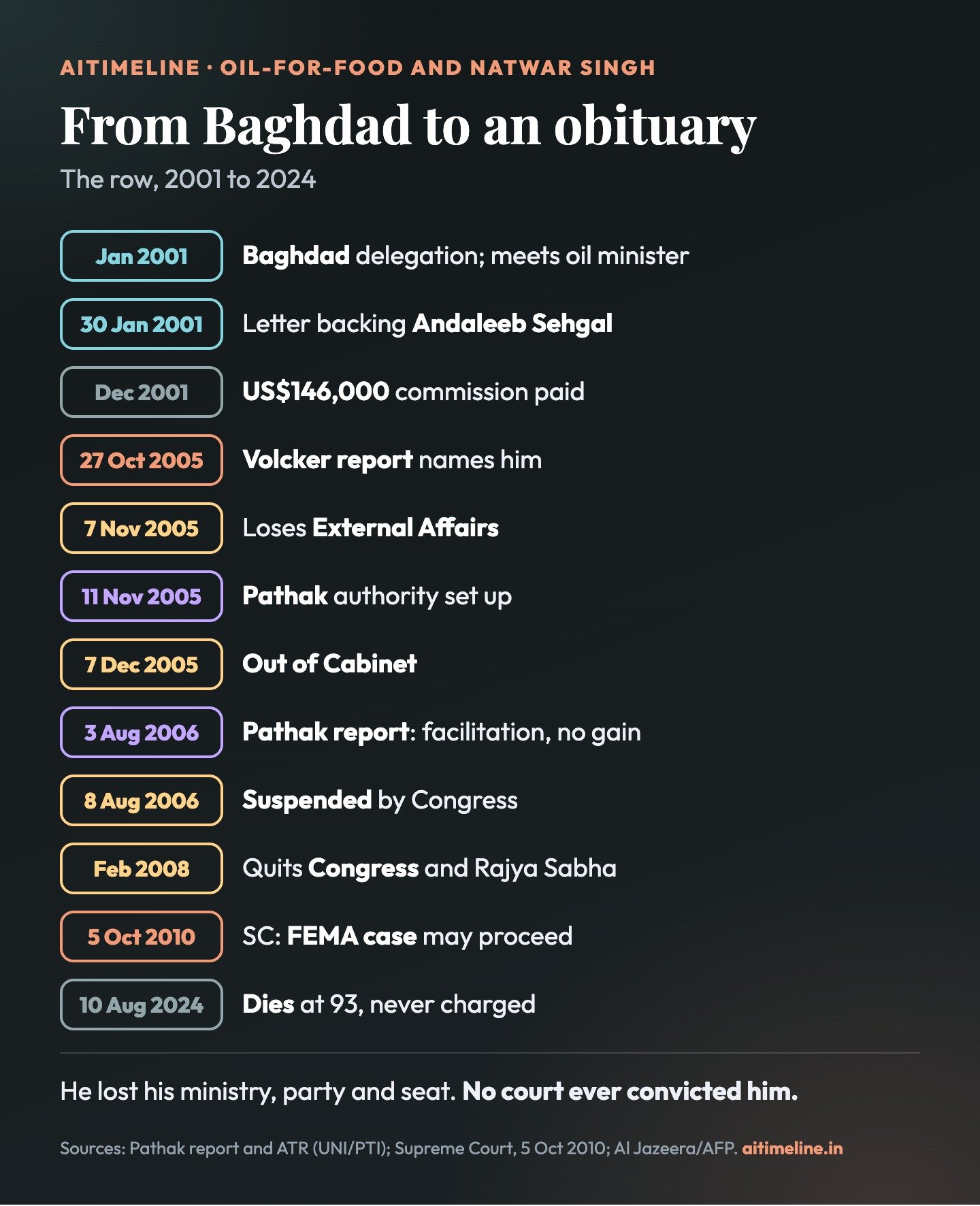
Natwar Singh Oil-for-Food Timeline: Newest First
Tagged by thread: the UN programme, the oil deals, the Pathak inquiry, politics, and the ED and courts.
Where the Oil-for-Food row stands ED & courts
No criminal case: Natwar Singh was never charged with a criminal offence over the oil allocations. The Indian follow-up was a fact-finding inquiry and a civil foreign-exchange proceeding, not a prosecution.
The inquiry finding: The Justice R.S. Pathak Inquiry Authority found in 2006 that he had influenced and facilitated the contracts, but that there was no material to show he derived any financial or other personal benefit. It found no evidence linking the Congress party to the deals.
The FEMA case: The Enforcement Directorate’s case under the Foreign Exchange Management Act was cleared to go ahead by the Supreme Court in October 2010. We found no published final adjudication order. Natwar Singh died on 10 August 2024.
Natwar Singh dies at 93 Politics
The death: K. Natwar Singh died at Medanta hospital in Gurugram after a prolonged illness. He was 93. He had been born on 16 May 1931 in Bharatpur, Rajasthan.
The career: He joined the Indian Foreign Service in 1953, served as ambassador to Pakistan, entered the Lok Sabha from Bharatpur in 1984 and was External Affairs Minister from May 2004 until November 2005.
The legacy: Obituaries recorded that the Oil-for-Food row ended his ministerial career and his half-century link with the Congress. He always denied wrongdoing.
Jagat Singh wins Nadbai for the BJP Politics
The win: Natwar Singh’s son Jagat Singh, named alongside him in the 2006 Pathak findings, won the Nadbai Assembly seat as the BJP candidate, defeating Congress’s Joginder Singh Awana by 15,767 votes.
The path: Jagat Singh had been a Congress MLA in 2006. He and his father briefly joined the Bahujan Samaj Party in 2008, and he later moved to the BJP.
The record: The Pathak report said there was no evidence that he or his father monetarily benefited from the contracts, but found that they used their positions to help Andaleeb Sehgal and Aditya Khanna.
The RTI fight over the Dayal file ED & courts
The request: RTI applicant Arun Agrawal had asked for the government file, including note sheets, on the report of special envoy Virendra Dayal, who had coordinated with the UN on the Volcker material.
The order: The Commission had directed the Enforcement Directorate, an organisation exempt under the RTI Act, to produce its file so the Commission could decide on disclosure. The ED challenged that, and the Supreme Court declined to interfere.
The delay: The matter stalled through changes of Chief Information Commissioner. In November 2012 Chief Information Commissioner Satyananda Mishra ordered notices to be issued to the ED.
Supreme Court: the FEMA case must proceed ED & courts
The question: Natwar Singh and Jagat Singh argued that before the FEMA inquiry began they were entitled to every document the adjudicating authority held, not only those the ED relied on.
The allegation: The ED complaint said they and others, without RBI permission, dealt in US$898,027.79 of foreign exchange on two oil contracts with Iraq’s State Oil Marketing Organisation, paid US$748,550 into an account at Jordan National Bank as a SOMO precondition, and moved a US$146,247.23 commission to a Barclays account in London.
The ruling: Justices B. Sudershan Reddy and S.S. Nijjar dismissed the appeals with costs, said the demand appeared aimed at obstructing an inquiry begun in 2006, and directed the authority to decide the complaint as expeditiously as possible.
From Congress to the BSP, and out again Politics
Leaving Congress: Natwar Singh resigned from the Congress in February 2008, announcing it at a BJP-organised Jat rally in Jaipur where he shared the stage with Chief Minister Vasundhara Raje.
Leaving Parliament: On 22 February 2008 he resigned his Rajya Sabha seat, six weeks before his term ended, while a Congress petition to disqualify him was pending before Chairman Hamid Ansari.
The BSP: Later in 2008 he and Jagat Singh joined Mayawati’s Bahujan Samaj Party. Within months the BSP expelled them, citing anti-party activities.
Supreme Court stays the FEMA proceedings ED & courts
The order: A bench of Justices B.N. Agrawal and G.S. Singhvi stayed the ED’s FEMA proceedings against Natwar Singh and Jagat Singh and issued notice to the ED.
The argument: Senior advocate Harish Salve, for the father and son, argued that the ED was using documents selectively, ignoring material that showed their innocence, and that the case was politically motivated.
What it meant: The stay froze the adjudication for more than two years, until the Supreme Court decided the appeals in October 2010.
Delhi High Court rejects the document plea ED & courts
The bench: Justices T.S. Thakur and Kailash Gambhir heard appeals against a single judge who had held that Natwar Singh and Jagat Singh were entitled only to the documents the ED relied on.
The ruling: The bench dismissed the appeals, holding that the adjudicating authority had followed the rules: it issued a show-cause notice, supplied the documents relied upon, explained the charges on 19 March 2007 and heard counsel.
Next step: It directed the parties to appear before the adjudicating authority on 24 April 2008. The father and son went to the Supreme Court instead.
High Court pauses the ED case ED & courts
Background: A single judge, Justice Badar Durrez Ahmed, had dismissed petitions by Natwar Singh and Jagat Singh seeking all the papers collected by the ED.
The stay: Hearing their appeal, a bench of Justices T.S. Thakur and Kailash Gambhir restrained the ED from going ahead with the FEMA proceedings until further orders.
Outcome: The same bench dismissed the appeal on 28 March 2008, ending the stay.
ED issues FEMA show-cause notices ED & courts
The notices: The ED issued fresh notices to Natwar Singh, Jagat Singh and four others for alleged violations of the Foreign Exchange Management Act, giving them until 14 September to reply.
The basis: The government had forwarded the Pathak report to the ED, the Central Board of Direct Taxes and the Central Board of Excise and Customs a month earlier.
The nature: FEMA cases are civil adjudications that can end in monetary penalties. A show-cause notice is an allegation to be answered, not a finding.
Congress suspends Natwar Singh Politics
The decision: A committee headed by A.K. Antony suspended Natwar Singh from primary membership of the Congress for indiscipline and asked him to show cause why he should not be expelled.
The triggers: He had given notice of a privilege motion in the Rajya Sabha against Prime Minister Manmohan Singh over the leak of the Pathak report, and had attacked the party leadership. The notice also asked him to explain three letters written on AICC letterhead.
His grievance: He said he had been made a scapegoat while the party, also named by Volcker, had been exonerated.
Pathak report tabled; government accepts it Pathak inquiry
Tabling: Finance Minister P. Chidambaram in the Lok Sabha and Minister of State Pawan Kumar Bansal in the Rajya Sabha laid the 87-page report and a three-page Action Taken Report, amid uproar over its leak to a TV channel.
On Natwar Singh: The report said he “was a beneficiary in so far that the role played by him in influencing and facilitating the procurement of the contracts had fructified”, but that there was “no material” that he “derived any financial or other personal benefit from the contracts”.
On the Congress: There was “not a shred of evidence” linking the party to the transactions, apart from the fact that Natwar Singh and Jagat Singh were members. The reference to the party in contract M/10/57 was “not justified at all”.
Justice Pathak submits his report Pathak inquiry
Submission: Justice R.S. Pathak, former Chief Justice of India and former judge of the International Court of Justice, handed his report to Prime Minister Manmohan Singh.
Who was examined: The Authority questioned Natwar Singh, Jagat Singh, then a Rajasthan MLA, and Aniel Matherani, whose public comments had brought Jagat Singh and his friends into the inquiry.
The leak: Its conclusions reached a television channel almost immediately, which became a fresh political row in Parliament. On 4 August the Delhi High Court declined to stay publication.
Natwar Singh quits the Cabinet Politics
The resignation: Natwar Singh, by then a minister without portfolio, resigned from the Union Cabinet. “I reiterate that I am completely innocent,” he told reporters, adding that he did not wish to be the excuse for the Opposition to stall Parliament.
The pressure: The BJP had been blocking Parliament for days. The final push came from fresh disclosures by Aniel Matherani, India’s ambassador to Croatia and a Congress member of the January 2001 Baghdad delegation, who was recalled to Delhi.
The claim: Matherani said the Iraqis had rewarded Natwar Singh with an oil allotment for his “personal service”. The Pathak inquiry later exonerated Matherani himself of wrongdoing.
Pathak Inquiry Authority set up Pathak inquiry
The order: The single-member Justice R.S. Pathak Inquiry Authority was set up by an official order of 11 November 2005, after Cabinet approval on 10 November.
The terms: It was to examine the two contracts in which the Volcker report named Natwar Singh and the Congress, judge whether the Volcker documents were authentic and reliable, whether the oil transactions were genuine, whether the references to Indian entities were justified, and who received the payoffs.
The envoy: Separately, former UN Under-Secretary-General Virendra Dayal had been appointed special envoy to obtain the underlying documents from the UN and other sources.
Natwar Singh loses External Affairs Politics
The decision: Natwar Singh asked Prime Minister Manmohan Singh to relieve him of the External Affairs portfolio, and the PM accepted. He stayed in the Cabinet as minister without portfolio; the PM took charge of the ministry himself.
Two inquiries: The same weekend the government named Justice R.S. Pathak to head a judicial inquiry and appointed Virendra Dayal as special envoy to the UN material.
The stated condition: Reports at the time said he would get the portfolio back if the Pathak inquiry cleared him. It never did, and he never returned.
Volcker report names Natwar Singh and Congress UN & Volcker
The report: The Independent Inquiry Committee led by Paul Volcker released its report on how Saddam Hussein’s government manipulated the programme. It put illicit payments at about US$1.8 billion: some US$229 million in oil surcharges and about US$1.55 billion in kickbacks on humanitarian contracts.
The Indian names: In its table of oil allocations, it listed Natwar Singh and, separately, the Congress party as “non-contractual beneficiaries”. The contracting company in both cases was the Swiss firm Masefield AG. Reports put each allocation at four million barrels.
Indian companies: More than 120 Indian firms were also named over payments on humanitarian supply contracts. Counts in Indian reporting ranged from 123 to 130; many disputed the charges.
The UN sets up the Volcker inquiry UN & Volcker
The trigger: After press reports, starting with an Iraqi newspaper list in January 2004, of people allegedly given oil vouchers by Saddam Hussein’s government, UN Secretary-General Kofi Annan announced an independent inquiry.
The mandate: The Security Council endorsed it on 21 April 2004. Paul Volcker, former chairman of the US Federal Reserve, led it with Justice Richard Goldstone of South Africa and Professor Mark Pieth of Switzerland.
The output: It issued interim reports from 3 February 2005, a final report on UN management on 7 September 2005 and the report on programme manipulation on 27 October 2005.
Programme handed over after Saddam UN & Volcker
The invasion: The US-led invasion of March 2003 ended Saddam Hussein’s government. Security Council Resolution 1483 of 22 May 2003 lifted most sanctions and ordered the programme wound down within six months.
The handover: On 21 November 2003 the UN handed its remaining responsibilities to the Coalition Provisional Authority.
The records: Iraqi ministry records captured after the fall of Baghdad, including SOMO’s allocation lists, became central evidence for the Volcker committee.
The commission is paid The oil deals
The payment: The Pathak inquiry found that Andaleeb Sehgal and Aditya Khanna received a total commission of US$146,000, about 5 cents a barrel, into the account of INDRUS Trading Company Limited in Jersey, Channel Islands.
The split: It was to be divided 4:1 between Sehgal and Khanna. US$68,293 reached Sehgal’s companies Hamdaan Exports and Sehgal Consultants in India; Khanna kept US$32,558 in the INDRUS account.
Who they were: Sehgal was a cousin of Jagat Singh; reports also called him a relative of Natwar Singh. Khanna was his business associate. INDRUS was described as a joint venture for oil trading with Russia.
Two contracts and the surcharges The oil deals
The contracts: The Volcker report tied Natwar Singh to contract M/09/54 and the Congress to contract M/10/57. Both were lifted through Masefield AG, with Sehgal’s Hamdaan Exports in the chain.
The surcharges: According to the Pathak findings, US$498,518 in surcharges was paid on M/09/54 and US$250,032 on M/10/57. These were the illegal payments Iraq demanded outside the UN escrow account.
The total: Together they make US$748,550, the same figure the ED later alleged was paid into Jordan National Bank as a SOMO precondition for the allocations.
Letters to Iraq’s oil minister The oil deals
The first letter: Writing on AICC letterhead to Iraqi Oil Minister Amer Mohammed Rasheed, Natwar Singh said: “I am sending this letter with Mr Andaleeb Sehgal. He was present when I called on you on January 22, 2001.” Sehgal, he wrote, “enjoys my full support and confidence”.
The second letter: A further letter, dated 26 April 2001, was handed over through Jagat Singh.
Why it mattered: The Pathak report said this showed Natwar Singh used his presence in Iraq not merely for a party goodwill mission but to help procure an oil allocation for Sehgal.
The Congress delegation in Baghdad The oil deals
The delegation: Natwar Singh, then head of the Congress’s foreign affairs cell, led a four-member party delegation to Iraq. Aniel Matherani was a member.
The extras: Jagat Singh and Andaleeb Sehgal travelled with the group.
The meeting: On 22 January 2001 Natwar Singh called on the oil minister. The Pathak inquiry concluded that Jagat Singh and Sehgal were present at that meeting.
Iraq starts demanding surcharges UN & Volcker
The scheme: Saddam Hussein’s government began requiring oil buyers to pay a surcharge of a few cents a barrel into Iraqi-controlled accounts, outside the UN escrow.
The allocations: It also handed oil allocations to politicians, parties and sympathisers abroad, who could sell the rights to traders for a commission.
The effect: That allocation system is what produced the term “non-contractual beneficiary” in the Volcker report.
Oil-for-Food begins UN & Volcker
The design: Resolution 986 let Iraq, under sanctions since its 1990 invasion of Kuwait, sell oil and spend the proceeds on food, medicine and other civilian goods through a UN-controlled escrow account.
The start: Iraq accepted the terms in a memorandum of understanding in May 1996. The first oil flowed in December 1996, and the first food arrived in March 1997.
The scale: It became one of the largest humanitarian programmes the UN ever ran.
What Was the Oil-for-Food Programme?
A humanitarian scheme that Iraq turned into a source of hidden cash.
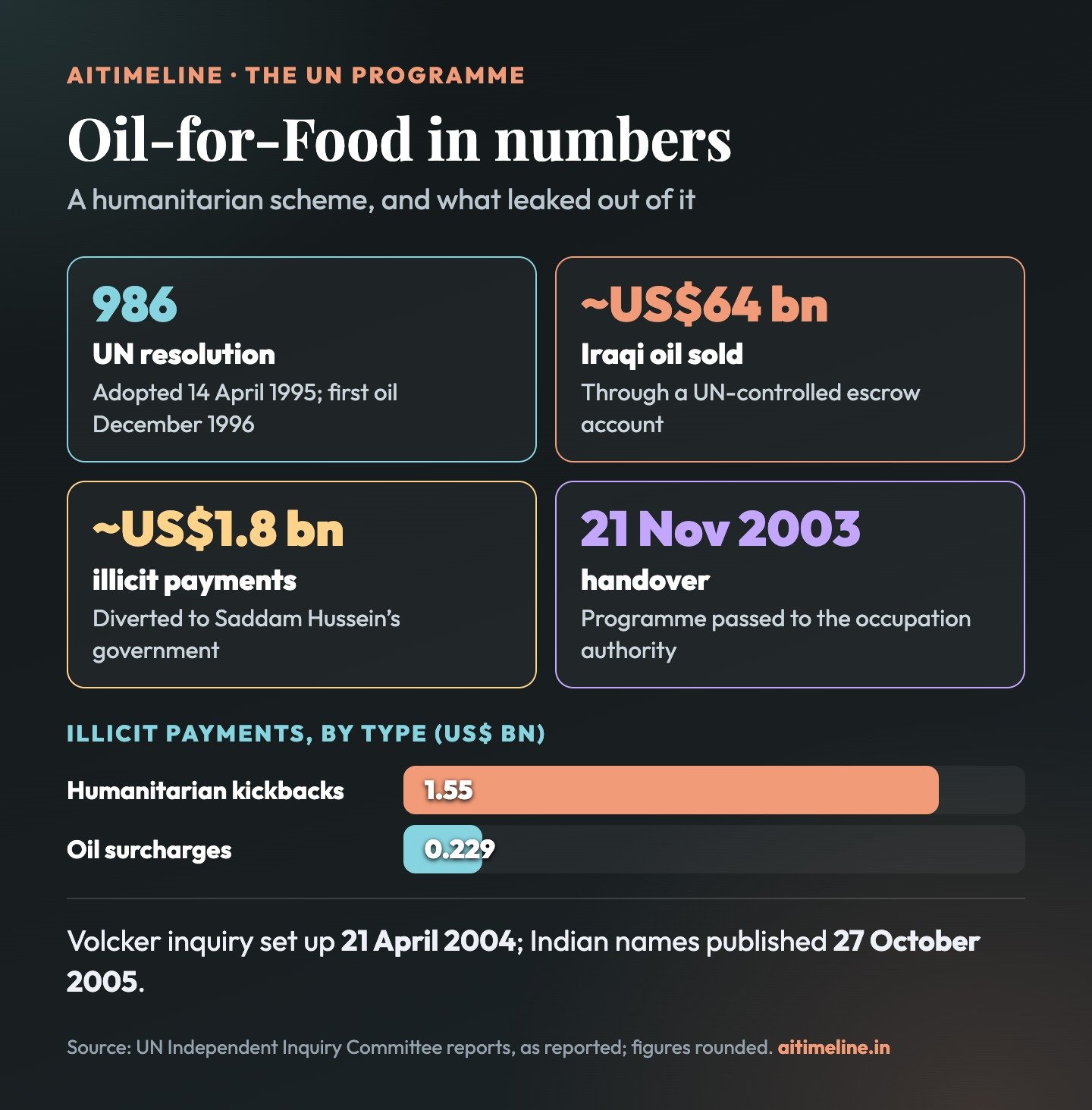
The idea. After Iraq invaded Kuwait in 1990, the UN imposed sweeping sanctions. As shortages hit Iraqi civilians, the Security Council passed Resolution 986 on 14 April 1995, letting Iraq sell oil and spend the money on food, medicine and other civilian goods. Revenues went into a UN-controlled escrow account, so the government could not freely spend them. Iraq accepted the terms in May 1996, and oil began to flow that December.
The manipulation. Iraq still chose who could buy its oil and who could supply its goods. From late 2000 it demanded surcharges of a few cents a barrel from oil buyers, paid outside the escrow, and kickbacks from suppliers disguised as after-sales or transport fees. It also handed oil allocations to sympathetic politicians and parties abroad. They rarely bought oil themselves: they passed the rights to traders, who paid them a commission.
The investigation. After Saddam Hussein’s fall in 2003, Iraqi records surfaced and the UN set up the Independent Inquiry Committee on 21 April 2004. Its 27 October 2005 report put illicit payments at about US$1.8 billion and named the beneficiaries of oil allocations in dozens of countries. India’s entries were Natwar Singh and the Congress party.
The Money Trail
What the Pathak inquiry and the ED said happened to the money.
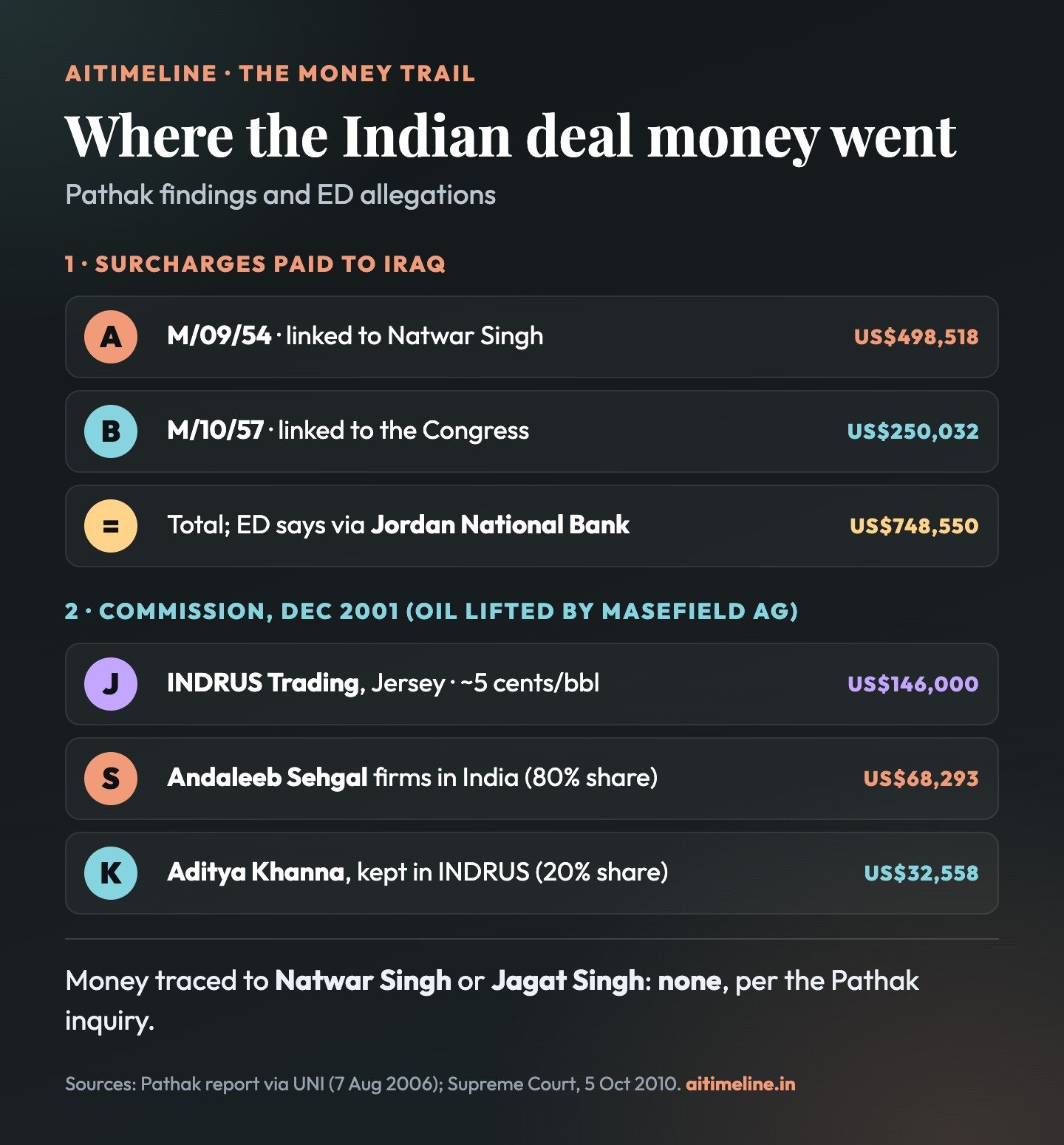
The surcharges. The Pathak findings record that US$498,518 was paid in surcharges on contract M/09/54 and US$250,032 on M/10/57. These were the illegal payments Iraq demanded outside the UN account in return for the oil. The ED’s complaint put the same total, US$748,550, as paid into an account at Jordan National Bank “in fulfillment of precondition imposed by SOMO”, Iraq’s State Oil Marketing Organisation.
The commission. For their part, the Pathak report said, Aditya Khanna and Andaleeb Sehgal received US$146,000, about 5 cents a barrel, into the account of INDRUS Trading Company Limited in Jersey, Channel Islands. It was to be split 4:1 in Sehgal’s favour. US$68,293 reached Sehgal’s companies in India; Khanna kept about US$32,558 in the INDRUS account. The ED’s complaint put the commission at US$146,247.23, sent to an account with Barclays in London.
What was not found. The Pathak inquiry said it could find no material to show that Natwar Singh derived any financial or other personal benefit, and no evidence that he or Jagat Singh monetarily benefited. That gap is why the inquiry described him as a beneficiary only “in so far” as his influence had worked.
Volcker Report vs Pathak Inquiry
One named the beneficiaries; the other asked whether the names were justified.
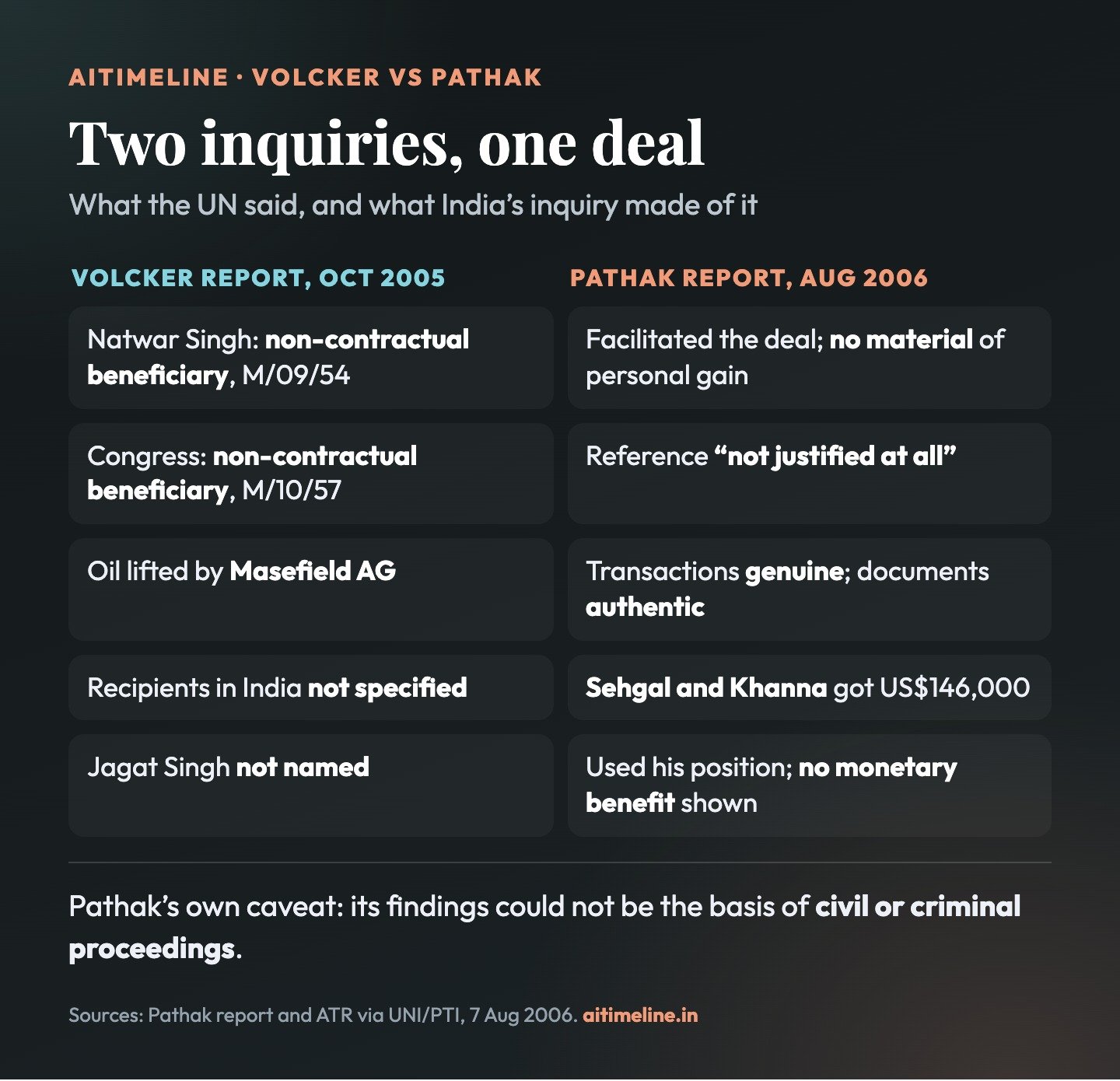
| Question | Volcker report (Oct 2005) | Pathak report (Aug 2006) |
|---|---|---|
| Natwar Singh | Non-contractual beneficiary, M/09/54 | Reference justified “in the sense explained”: facilitation, not personal gain |
| Congress party | Non-contractual beneficiary, M/10/57 | “Not justified at all”; no evidence of involvement |
| Documents | Drawn from Iraqi SOMO records | Authentic and reliable |
| Oil transactions | Lifted by Masefield AG | Genuine |
| Who was paid | Not specified for India | Andaleeb Sehgal and Aditya Khanna, US$146,000 |
| Jagat Singh | Not named | Used his position to help associates; no monetary benefit shown |
The ED Case and the Courts
A civil foreign-exchange case that spent four years on a question of documents.
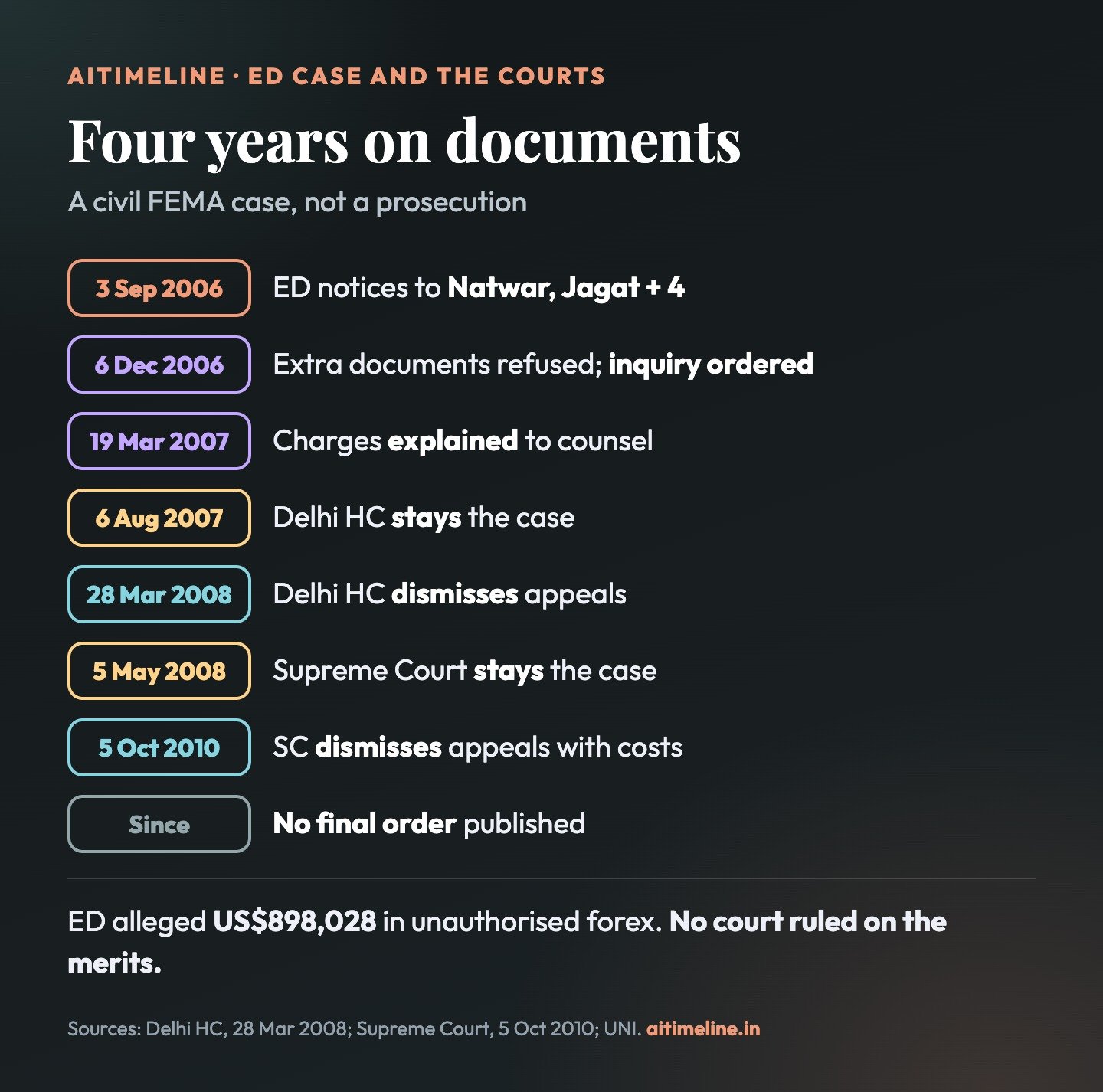
The case. After the Pathak report, the government sent it to the Enforcement Directorate, the income-tax board and the customs and excise board. The ED filed a complaint under the Foreign Exchange Management Act, which provides for civil penalties, not prison. On 3 September 2006 it issued notices to Natwar Singh, Jagat Singh and four others.
The document fight. The father and son demanded every document the authority held, including those it did not rely on. The adjudicating authority refused on 6 December 2006 and again on 1 March 2007. A single judge of the Delhi High Court upheld that; a division bench stayed the proceedings on 6 August 2007 but dismissed the appeals on 28 March 2008. The Supreme Court then stayed the case on 5 May 2008.
The Supreme Court ruling. On 5 October 2010 Justices B. Sudershan Reddy and S.S. Nijjar held that a noticee is entitled to the documents relied on, not to everything in the authority’s possession. They called the demand vague and noted the inquiry begun in 2006 “still did not even commence”. They dismissed the appeals with costs and directed quick disposal, adding that they had expressed no opinion on the merits.
After 2010. We could not find a published final order on the FEMA complaint. That is the honest state of the public record: the case was allowed to proceed, but its outcome has not been reported.
The Political Fallout
A Foreign Minister, a party loyalist of five decades, out within three years.
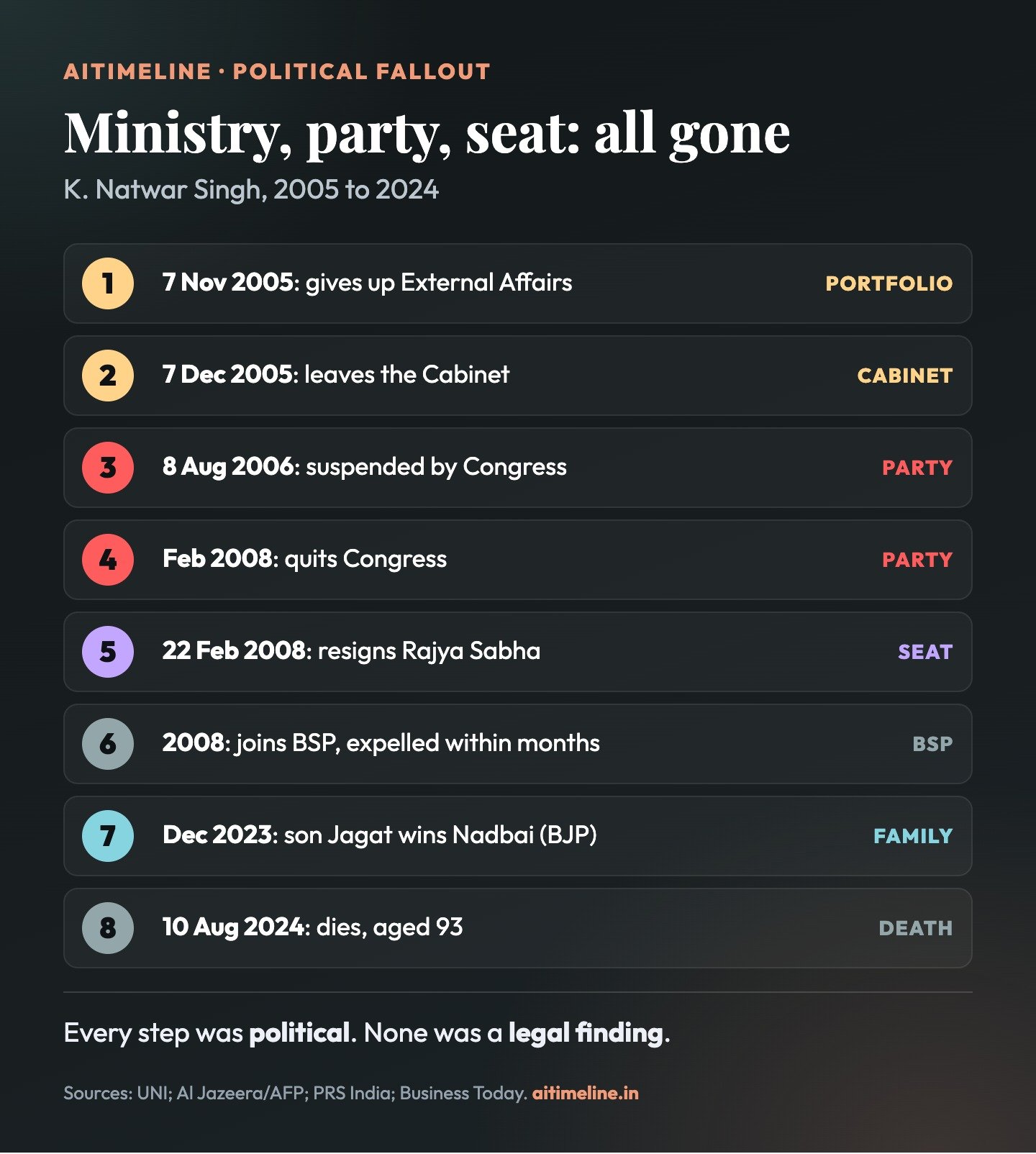
The minister. Natwar Singh was a career diplomat turned Congress politician and close to the Gandhi family for decades. As soon as the Volcker report came out, the Opposition demanded his resignation. On 7 November 2005 he gave up External Affairs, staying on as minister without portfolio. A month later, after Aniel Matherani’s claims, he quit the Cabinet.
The party. The Pathak report cleared the Congress and put the weight on Natwar Singh and his son. He reacted with a privilege notice against the Prime Minister over the report’s leak and open attacks on the leadership. The party suspended him on 8 August 2006. He left in February 2008, gave up his Rajya Sabha seat on 22 February, and had a brief spell in the BSP.
The parliament. The row cost the UPA weeks of disrupted sittings in late 2005 and again in August 2006, when the leak of the Pathak findings to a television channel became an issue of its own.
What Was Established, and What Was Not
The record, read carefully.
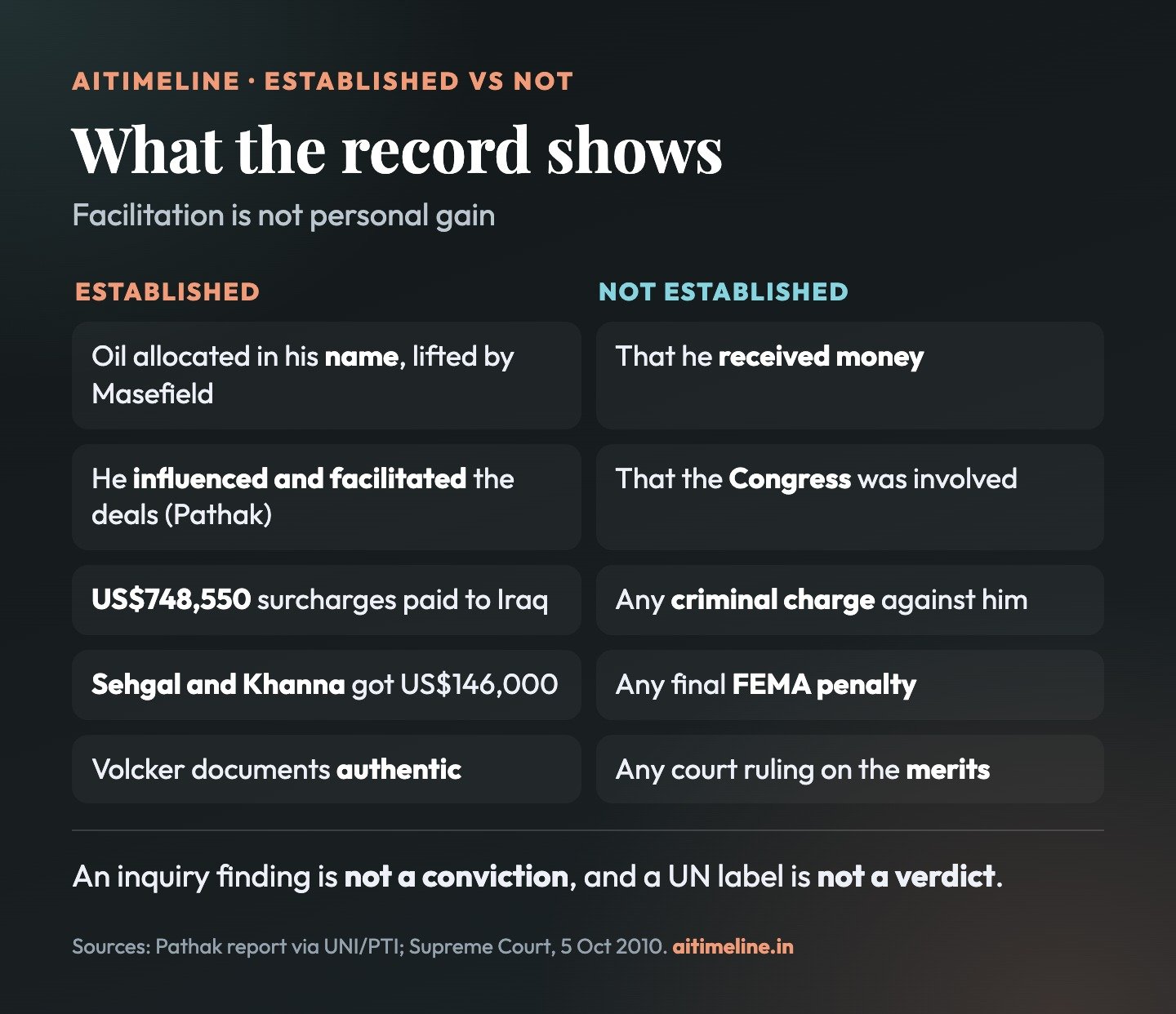
| Question | What the record establishes |
|---|---|
| Was oil allocated in Natwar Singh’s name? | Yes, per the Volcker report; the Pathak inquiry found the documents authentic. |
| Did he help win the contracts? | The Pathak inquiry found he influenced and facilitated them. |
| Did he receive money? | No material found, per the Pathak inquiry. |
| Did the Congress benefit? | No evidence, per the Pathak inquiry. |
| Who received the commission? | Andaleeb Sehgal and Aditya Khanna, US$146,000, per the Pathak inquiry. |
| Was he criminally charged? | No. |
| Was he penalised under FEMA? | No final order has been published. |
| Did any court rule on the merits? | No. The 2007-2010 orders were about documents and procedure. |
Who Were the Key People?
Politicians, intermediaries and investigators.
K. Natwar Singh
External Affairs Minister, May 2004 to November 2005. Named by Volcker; found by Pathak to have facilitated the deals but not to have gained. Died 2024.
Jagat Singh
Congress MLA in 2006; present at the Baghdad meeting per Pathak; co-respondent in the ED case. BJP MLA for Nadbai since December 2023.
Andaleeb Sehgal
Jagat Singh’s cousin; owner of Hamdaan Exports and Sehgal Consultants; received the larger share of the commission, per Pathak.
Aditya Khanna
Sehgal’s business associate in INDRUS Trading; received the smaller share of the commission, per Pathak.
Paul Volcker
Former US Federal Reserve chairman who chaired the UN Independent Inquiry Committee, 2004-05.
Justice R.S. Pathak
Former Chief Justice of India and ICJ judge; sole member of the 2005-06 Inquiry Authority.
Aniel Matherani
Member of the 2001 delegation and ambassador to Croatia in 2005; his claims hastened the resignation. Exonerated by Pathak.
Manmohan Singh
Took charge of External Affairs in November 2005, set up the Pathak inquiry and accepted its report.
| Person or body | Role in the record |
|---|---|
| Masefield AG | Swiss trader; contracting company for both allocations |
| Amer Mohammed Rasheed | Iraqi oil minister; met Natwar Singh 22 Jan 2001; recipient of his letters |
| Virendra Dayal | Former UN Under-Secretary-General; special envoy for the Volcker documents |
| INDRUS Trading Co. | Jersey company of Sehgal and Khanna that received the commission |
| Enforcement Directorate | Brought the civil FEMA complaint |
| A.K. Antony | Chaired the Congress Disciplinary Committee that suspended Natwar Singh |
What the Row Exposed
A label is not a verdict
“Non-contractual beneficiary” described an allocation. It was widely reported as if it were a finding of bribery.
Facilitation still counts
The Pathak inquiry treated helping relatives win oil rights as reaching the Volcker standard, even without personal gain.
Resignation without charge
A senior minister lost office on the strength of a foreign inquiry, before any Indian body had examined the evidence.
Slow enforcement
The ED case spent four years on a dispute about documents before the inquiry proper could even begin.
Locked files
The government’s own file on the Dayal report was still being fought over under the RTI Act in 2012.
A worldwide scandal
India was one of dozens of countries whose politicians, parties and companies appeared in the Volcker tables.
Did You Know?
- Five cents: the commission came to about 5 cents a barrel, according to the Pathak report.
- IND + RUS: INDRUS, the company that took the money, was named for India and Russia.
- Party letterhead: Natwar Singh’s letters to Iraq’s oil minister were on AICC stationery.
- Opposition trip: the Congress was in opposition when the 2001 delegation went to Baghdad.
- Six weeks early: he gave up his Rajya Sabha seat six weeks before his term would have ended.
- Same district: his son now represents Nadbai, in the Bharatpur district where Natwar Singh was born.
Explore More Timelines
People Also Ask
Frequently Asked Questions
Based on the Pathak findings, court judgments and reporting to 17 November 2026.
⚠️ Editorial Note: What We Corrected and What We Could Not Confirm
This page rests on the Supreme Court’s 2010 judgment and the Delhi High Court’s 2008 judgment, read in full via Indian Kanoon, and on contemporary reporting of the Pathak report and its Action Taken Report. The brief we started from had several errors. Natwar Singh died on 10 August 2024 aged 93, not on 12 August aged 95. Resolution 986 was adopted in April 1995; oil began flowing in December 1996. Virendra Dayal was appointed with the Pathak inquiry in the first week of November 2005; the Authority was formally set up on 11 November. Aniel Matherani was India’s serving ambassador to Croatia, and his claims came in early December 2005, just before the resignation. The ED notices of 3 September 2006 came after the Pathak report, not before. We found no source for the brief’s claim that Jagat Singh was suspended from the Congress with his father, for ED questioning on 17-18 February 2006, or for a 2013 Information Commission ruling, and have not used them. The figure of “135 Indian entities” is replaced with the range in contemporary reporting. Inquiry findings and ED allegations are not court findings, and nothing here implies the guilt of anyone not convicted.
Related Reading on AiTimeline
Sources & further reading
Every dated entry above was checked against these references. Last reviewed 17 November 2026.
- Supreme Court of India: Kanwar Natwar Singh v. Directorate of Enforcement, Civil Appeals 8601-8602 of 2010, judgment dated 5 October 2010 (via Indian Kanoon)
- Delhi High Court: Kanwar Natwar Singh v. Director of Enforcement, judgment dated 28 March 2008 (via Indian Kanoon)
- UNI via Oneindia: Clean chit to Congress; no financial benefit to Natwar, says Pathak report and ATR (7 August 2006)
- UNI via Oneindia: Relative of Natwar, his associate recipients of oil payoff (7 August 2006)
- UNI via Oneindia: Text of Natwar Singh's letters to Iraqi Oil Minister Amer Mohammed Rasheed
- UNI via Oneindia: Pathak Authority submits report to PM (3 August 2006)
- UNI via Oneindia: Congress suspends Natwar Singh for indiscipline (9 August 2006)
- UNI via Oneindia: Natwar, son issued fresh notices by ED (3 September 2006)
- UNI via Oneindia: HC stays proceedings against Natwar, Jagat (6 August 2007)
- UNI via Oneindia: SC stays FEMA proceedings against Natwar Singh and son (5 May 2008)
- UNI via Oneindia: Natwar quits Rajya Sabha (22 February 2008)
- Al Jazeera/AFP: Indian minister quits over Iraq scandal (6 December 2005)
- Al Jazeera: Indian foreign minister stripped of post (7 November 2005)
- PTI via Business Standard: CIC to issue notices to ED in oil-for-food scam (18 November 2012)
- Business Today: K Natwar Singh, former External Affairs Minister, dies at 93 (11 August 2024)
- PRS Legislative Research: Jagat Singh, MLA, Nadbai (Rajasthan)
- Wikipedia: Oil-for-Food Programme