Armistice Day Six Hours: The Final Hours of World War I
Why did soldiers keep fighting after the WWI Armistice was signed at 5 a.m.? Minute-by-minute timeline to the 11 a.m. ceasefire and the last men killed.
Latest Story
At 5:00 a.m. on 11 November 1918, the First World War ended on paper. In a railway carriage in the Forest of Compiègne, German delegates and Marshal Ferdinand Foch signed the Armistice. But the agreement said fighting would stop at 11:00 a.m., six hours later. For those six hours the Western Front stayed live. Artillery kept firing, infantry kept attacking, and men kept dying: a British cavalryman at 9:30, a French runner at 10:45, a Canadian private at 10:58, an American private at 10:59. One estimate puts the day’s casualties on all sides at almost 11,000, including about 2,700 dead. This timeline follows those six hours minute by minute, and explains why soldiers kept fighting after the war was already over.
💡 Short Answer
The Armistice ending the First World War on the Western Front was signed at about 5:00 a.m. on 11 November 1918 in a railway carriage at Compiègne, France, but it took effect only at 11:00 a.m. The six-hour gap let orders reach every unit. Fighting went on until the deadline: Canadian Private George Price was killed at 10:58 and American Henry Gunther at 10:59. At 11:00 the guns stopped.
The Last Six Hours: Key Questions
The Six Hours in Ten Lines
- The Armistice was agreed at 5:00 a.m. on 11 November 1918 and took effect at 11:00 a.m. Paris time.
- It was signed in Foch’s railway carriage, number 2419 D, in a forest clearing near Compiègne.
- Germany had been given 72 hours from 8 November to accept terms it could not change much.
- The six-hour gap was for passing orders along the whole Western Front.
- Commanders were not ordered to stop attacking before 11:00, and many did not.
- British Private George Ellison died near Mons at about 9:30 a.m.
- French soldier Augustin Trébuchon was killed at 10:45; his death was later recorded as 10 November.
- Canadian George Price was shot at 10:58, American Henry Gunther at 10:59.
- Historian Joseph Persico estimated 10,944 casualties on the last day, including 2,738 dead.
- The Armistice was a ceasefire, not a peace treaty. The Treaty of Versailles came on 28 June 1919.
The Two Clocks of 11 November 1918
Diplomatic time stopped at 5:00. Battlefield time ran until 11:00.
The easiest way to understand the last morning of the war is to picture two clocks. The first is the diplomats’ clock. It stopped at about 5:00 a.m., when the last signatures went on the paper. The second is the soldiers’ clock. It kept running for six more hours, and on it every minute could still cost a life.
August–November 1918: How Germany Got to Compiègne
The six hours only make sense after the hundred days.
In spring 1918 Germany had looked close to winning. With Russia out of the war, it moved divisions west and launched the Spring Offensive on 21 March, gaining more ground than either side had managed since 1914. But the attacks exhausted its best troops, and American soldiers were now arriving in France in huge numbers.
On 8 August 1918 the Allies struck back at Amiens. The German commander Erich Ludendorff called it the “black day” of the German army. It began what became known as the Hundred Days Offensive: a rolling series of Allied attacks that pushed German forces back across France and Belgium. On 26 September the American First Army opened the Meuse-Argonne Offensive, the largest American operation of the war, which continued until the last morning.
Germany’s allies then fell away one by one. Bulgaria signed an armistice on 29 September. The Ottoman Empire signed one at Mudros on 30 October. Austria-Hungary signed at Villa Giusti on 3 November, effective the next day, as its empire split into new states.
At home, Germany was coming apart. Sailors at Kiel mutinied in early November and revolt spread to other cities. On 9 November the Chancellor, Prince Max of Baden, announced the Kaiser’s abdication and a republic was proclaimed in Berlin. Wilhelm II crossed into the Netherlands the next day. The German delegation now in France was negotiating for a government that had changed under it.
8–11 November: Inside the Railway Carriage
Three days in a forest clearing.
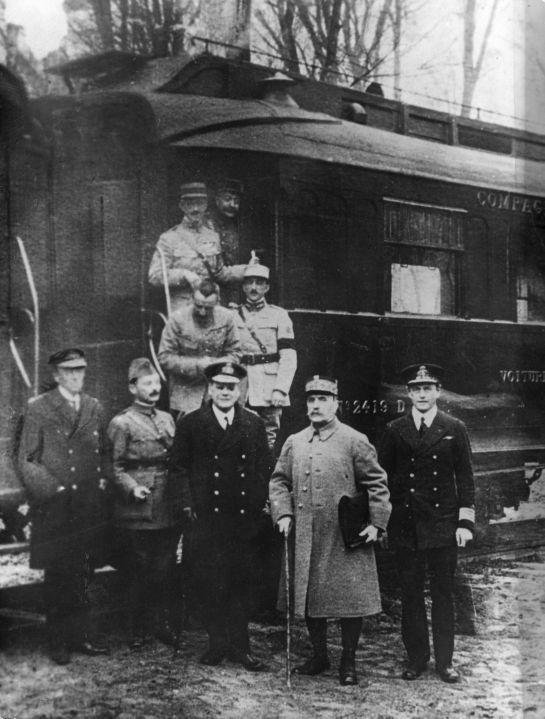
The German delegation, led by the Catholic Centre Party politician Matthias Erzberger, crossed the lines and arrived in the Forest of Compiègne, about 80 km north-east of Paris, on the morning of 8 November. Marshal Foch received them in his own railway carriage, a converted Wagons-Lits dining car, number 2419 D, parked on a siding near Rethondes. Foch had chosen the spot for its seclusion.
There was little real negotiation. Foch read out the Allied terms and gave Germany 72 hours to accept. The delegates asked for an immediate ceasefire while they talked; Foch refused. The fighting went on during all three days of talks.
The German side won a few changes, including fewer machine guns to surrender and some relief on food supplies, but nothing fundamental. Late on 10 November, with Berlin’s authorisation, they prepared to sign. The final session began after 2 a.m. on 11 November. The Armistice was agreed at 5:00 a.m. and signed in the minutes that followed; 5:00 is the time the document records. It would take effect at 11:00 a.m. Paris time, which was noon in Germany.
Four men signed for Germany: Erzberger, the diplomat Count Alfred von Oberndorff, Major General Detlof von Winterfeldt and naval Captain Ernst Vanselow. Two signed for the Allies: Foch and Britain’s First Sea Lord, Admiral Sir Rosslyn Wemyss.
Why Wait Six Hours to Stop a War?
A ceasefire is only as fast as the slowest order.
By 1918 the Western Front stretched about 700 km, from the Belgian coast to Switzerland. Millions of men were spread along it in armies, corps, divisions, brigades, battalions and companies, many of them out of reach of any telephone. An order to stop had to go from Foch’s headquarters to each national commander, then down every link in the chain, finally by field telephone, runner or messenger to men in shell holes.
That was the reason for the gap. Foch’s order was short: “Hostilities will be stopped on the entire front beginning at 11 o’clock, November 11th.” Troops were to stay on the line they reached at that hour and not advance beyond it without further orders.
News travelled faster than orders. At 6 a.m. in Paris, US envoy Edward House cabled President Woodrow Wilson: “Armistice signed 5 o’clock this morning. Hostilities to cease 11 a.m. today.” Within hours the news was spreading by radio and telegraph around the world, while in the Meuse valley men were still being killed.
What the order did not say was just as important. It did not tell commanders to stop attacking before 11:00. So each commander decided for himself. Some held their men in place for the morning. Others, reasoning that the war was still legally on and that ground taken now would be ground held under the Armistice, kept attacking.
The Countdown: 5:00 to 11:00 a.m.
Tap each time to open what happened. All times are Paris time.
NightThe final session begins in the carriage
Some time after 2 a.m., the German delegation, now authorised by the new government in Berlin, returns to Foch’s carriage. The last round goes through the text article by article.
5:00The Armistice is signed
Agreement is reached and signatures follow. The official time is 5:00 a.m. The ceasefire is fixed for 11:00 a.m. Erzberger reads a statement that the German people will not perish. Foch replies only “Très bien.”
5–7Orders start to move
Foch’s headquarters sends the ceasefire order to the Allied commanders-in-chief. From there it is copied down by telegraph and telephone, army by army. Some front-line units hear before 7 a.m.; others only in the last hour.
6:00Washington is told
Edward House cables President Wilson from Paris: “Armistice signed 5 o’clock this morning. Hostilities to cease 11 a.m. today.”
DawnMons and the Meuse
Canadian troops complete their capture of Mons in Belgium, the town where the British Army first fought in August 1914. In the south, American units, including US Marines who had crossed the Meuse overnight, are still attacking as the Meuse-Argonne Offensive enters its final morning.
9:30George Ellison is killed near Mons
Private George Edwin Ellison of the 5th Royal Irish Lancers, a regular who had fought at Mons in 1914, is shot by a sniper on patrol on the edge of the town. He is generally recorded as the last British soldier killed in action.
10:45Augustin Trébuchon is killed on the Meuse
A French runner of the 415th Infantry Regiment, carrying a message about the midday food ration at Vrigne-Meuse, is shot and killed. He is usually named the last French soldier killed in action.
10:58George Price is killed; a camera records the wait
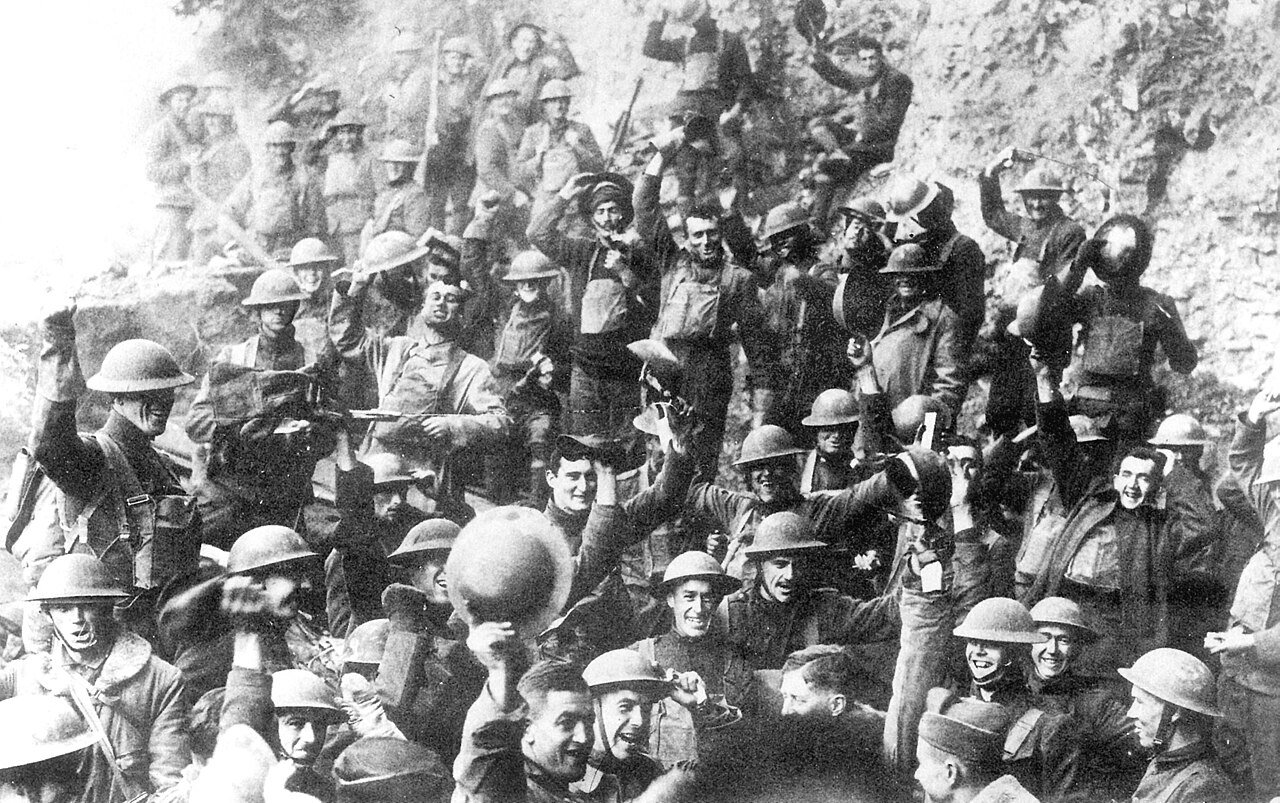
Canadian Private George Lawrence Price is shot in the chest by a sniper at Ville-sur-Haine, near Mons. Far to the south, a US Army photographer near Stenay photographs men of the 353rd Infantry waiting for hostilities to end; the caption records the time as 10:58.
10:59Henry Gunther charges a machine gun
At Chaumont-devant-Damvillers, American Private Henry Gunther runs at a German machine-gun post. The Germans, knowing the war is about to end, try to wave him back. He keeps coming and is shot dead.
11:00The guns stop
The Armistice takes effect. Along the Western Front firing dies away. Men later described a silence so complete they could not believe it. Troops stay where they stand, as ordered.
The Last Men to Die
Four soldiers, four armies, the same final morning.
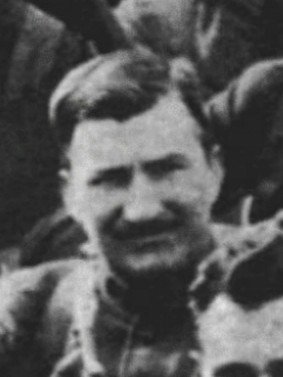
Henry Nicholas Gunther, 313th Infantry, 79th Division
Born in Baltimore in 1895 to German-American parents, Gunther was drafted in 1917 and made supply sergeant. He was busted to private after an Army censor read a letter home in which he urged a friend to avoid the draft. On the last morning, against the shouts of his own sergeant, he charged a German roadblock at Chaumont-devant-Damvillers. The German gunners, aware of the ceasefire, tried to wave him off, then fired. Pershing’s Order of the Day named him as the last American killed. His sergeant’s rank was restored after his death, and he was awarded the Distinguished Service Cross. He is buried in Baltimore.
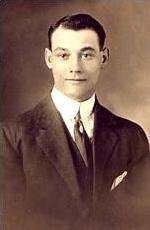
George Lawrence Price, 28th (Northwest) Battalion
Born in Falmouth, Nova Scotia, in 1892, Price was working in Saskatchewan when he was conscripted. On 11 November his company was clearing houses at Ville-sur-Haine to secure bridges over the Canal du Centre. As he stepped out of a house, a German sniper shot him in the chest. He died two minutes before the ceasefire. Canada recognises him as the last Canadian soldier killed on the Western Front, and he is widely counted as the last soldier of the British Empire killed in combat. He is buried at St Symphorien Military Cemetery near Mons.
George Edwin Ellison
5th Royal Irish Lancers. A veteran of the 1914 retreat from Mons, killed on patrol outside Mons on the last morning. His grave at St Symphorien faces that of John Parr, the first British soldier killed in the war.
Augustin Trébuchon
415th Infantry Regiment. A runner killed at Vrigne-Meuse. The French Army recorded his death, like those of other French soldiers killed that day, as 10 November.
Where first and last lie
The small cemetery near Mons holds Parr (killed August 1914), Ellison and Price. The first and last deaths of Britain’s war on the Western Front lie a few metres apart.
The Cost of the Last Morning
A famous estimate, and why exact numbers are hard.
In his book Eleventh Month, Eleventh Day, Eleventh Hour, the American historian Joseph Persico estimated that 10,944 men became casualties on all sides on 11 November 1918, of whom 2,738 died. His figures are an estimate built from unit records, not an official count, but they are the ones most often quoted.
Exact figures are hard for three reasons. Some units recorded deaths only by date, not time. Men wounded before 11:00 died of their wounds later that day, or weeks afterwards. And, as Trébuchon’s case shows, the French Army recorded soldiers killed on 11 November as having died on the 10th. No order for this has ever been found; the most common explanation is that it spared families, and the army, the idea that men had died on the day of victory.
11 November 1918: two sides of the same order
Why Were American Troops Still Attacking?
The argument that followed the Armistice home.
General John J. Pershing, commander of the American Expeditionary Forces, distrusted the Armistice. He had argued that the Allies should fight on until Germany surrendered unconditionally, so that no one in Germany could later claim the army had not been beaten. He did not order his divisions to stand down before 11:00, and several American units attacked that morning, some across the Meuse.
Supporters of the decision made two arguments. First, the war had not ended until 11:00, and an army that stopped early risked giving the enemy an advantage if talks broke down. Second, ground held at 11:00 would set the line from which Germany had to withdraw.
Critics asked the obvious question: what was worth a man’s life in a war that everyone knew would end at a fixed time that morning? In 1919 a subcommittee of the US House Military Affairs Committee held hearings on the last-day casualties. Pershing defended his generals. The hearings produced no action, but the question never went away, and it is why the six hours are still argued about today.
It is fair to remember that the decision was not only American. British, French and Canadian units also attacked that morning. None of the Allied high commands ordered a halt before 11:00.
🤔 A question worth sitting with
If you knew the war would end in six hours, would you still attack? This is a history question, not a quiz with one right answer. Commanders that morning were operating under orders, with an agreement they did not fully trust, in a war that had not yet legally stopped. Most soldiers, asked later, said they wanted only to stay alive until eleven.
What the Armistice Actually Required
Not “stop shooting”, but a disarmament Germany could not reverse.
The Armistice ran to 34 articles. It was designed so that Germany could not restart the war even if peace talks failed. It had to evacuate occupied land, hand over much of its heavy weaponry and transport, and accept Allied troops on the Rhine.
| Term | What Germany had to do |
|---|---|
| Evacuate the west | Leave Belgium, France, Luxembourg and Alsace-Lorraine within 15 days |
| The Rhineland | Withdraw from the Rhine’s west bank within 31 days; Allied bridgeheads at Mainz, Koblenz and Cologne, 30 km deep |
| Weapons | 5,000 artillery pieces, 25,000 machine guns, 3,000 trench mortars, 1,700 aircraft |
| Transport | 5,000 locomotives, 150,000 railway wagons, 5,000 lorries |
| Navy | Surrender all submarines; intern the main surface fleet in Allied ports |
| Prisoners | Release all Allied prisoners of war at once, without reciprocity |
| The East | Renounce the Treaty of Brest-Litovsk with Russia |
| Duration | 36 days, renewable; it was extended three times until peace came into force |
11 November Did Not End Everything
A ceasefire in the west, not peace everywhere.
The Armistice ended the fighting between Germany and the Allies on the Western Front. It did not end every war that grew out of 1914.
In East Africa, the German commander Paul von Lettow-Vorbeck had fought a guerrilla campaign for four years and was advancing in Northern Rhodesia (now Zambia). He learned of the Armistice from a British messenger only days later, stopped fighting, and formally surrendered at Abercorn (now Mbala) on 25 November 1918. His was the last German force in the field.
The peace itself took far longer. The Treaty of Versailles was signed on 28 June 1919, five years to the day after the assassination in Sarajevo, and came into force on 10 January 1920. Until then the Armistice was simply renewed. In eastern Europe, fighting over new borders, the Russian Civil War and wars involving Poland, Turkey and others went on for years.
The Carriage That Came Back
Compiègne, 1940.
After the war carriage 2419 D became a national relic. It was put on show in Paris and, from 1927, in a memorial building at the Compiègne clearing, known as the Glade of the Armistice.
On 22 June 1940, after Germany defeated France, Adolf Hitler had the carriage pulled out onto the same spot and made the French sign their own armistice in it. The carriage was then taken to Germany and displayed in Berlin. It was destroyed near the end of the Second World War. The museum at Compiègne today shows a carriage of the same series, fitted out as the original was.
India and the Armistice
A war India fought far from home.
More than a million Indian soldiers served overseas in the First World War, in France and Belgium, Mesopotamia, Egypt, Palestine, Gallipoli and East Africa. The Commonwealth War Graves Commission records around 74,000 Indian war dead. Indian infantry had helped hold the line in France in 1914 and 1915, and Indian cavalry served there until early 1918.
Their memorial stands in the middle of New Delhi. India Gate, originally the All India War Memorial, had its foundation stone laid in 1921 and was opened in 1931. It carries the names of more than 13,000 soldiers of the undivided Indian Army. Many of the men who survived 11 November 1918 came home expecting political reward for their service; the disappointment fed the national movement of the years that followed.
How 11 a.m. Became a Memorial
The eleventh hour of the eleventh day of the eleventh month.
The time chosen for practical reasons became the most famous minute of the war. On the first anniversary, 11 November 1919, King George V asked people across the British Empire to stop for two minutes’ silence at 11 a.m. The silence is still kept on Armistice Day and on Remembrance Sunday. In the United States, President Woodrow Wilson issued the first Armistice Day message the same day.
Britain buried its Unknown Warrior in Westminster Abbey on 11 November 1920, and unveiled the permanent Cenotaph in Whitehall that day. The US made 11 November a legal holiday, Armistice Day, in 1938. In 1954 Congress renamed it Veterans Day to honour veterans of all wars. Across the Commonwealth it is Remembrance Day, marked by the red poppy.
Armistice Full Timeline, 1914–1954
Newest first.
Armistice Day becomes Veterans Day
Congress amends the 1938 law, replacing “Armistice” with “Veterans” to honour veterans of all American wars.
Hitler reuses the carriage
France signs an armistice with Germany in carriage 2419 D, at the same spot. The carriage is later taken to Berlin and destroyed before the war ends.
US legal holiday
11 November becomes a legal holiday in the United States, “Armistice Day”, dedicated to world peace.
Unknown Warrior and peace in force
The Treaty of Versailles comes into force on 10 January, ending the Armistice period. On 11 November Britain buries the Unknown Warrior in Westminster Abbey.
The first Armistice Day
Two minutes’ silence at 11 a.m. across the British Empire at the King’s request; Wilson issues America’s first Armistice Day message.
1918
Lettow-Vorbeck surrenders
The last German force in the field formally surrenders in East Africa, two weeks after the Armistice.
Ceasefire on the Western Front
The Armistice takes effect. Troops hold the line they have reached.
Henry Gunther killed
The last American soldier killed in action, one minute before the ceasefire.
George Price killed
The last Canadian, and last British Empire, soldier killed in combat on the Western Front.
Augustin Trébuchon killed
The last French soldier killed in action; his death is officially dated 10 November.
George Ellison killed
The last British soldier killed in action, near where he had fought in 1914.
Armistice signed
Foch, Wemyss and four German delegates sign. Ceasefire set for 11:00.
1918
Charles I steps back in Austria
The last Habsburg emperor gives up “every participation” in state affairs, the same day as the Armistice. He avoids the word “abdicate”.
1918
The Kaiser’s abdication announced
Prince Max of Baden announces Wilhelm II’s abdication; a republic is proclaimed. Wilhelm goes into exile in the Netherlands the next day.
1918
Germans reach Compiègne
Erzberger’s delegation is handed the terms and given 72 hours to reply.
Germany’s allies quit
Bulgaria, the Ottoman Empire and Austria-Hungary each sign armistices.
1918
Meuse-Argonne Offensive opens
America’s largest battle of the war; it runs until 11 November.
1918
Amiens and the Hundred Days
The Allied attack Ludendorff called the German army’s “black day” begins the final advance.
The United States enters
Congress declares war on Germany; American troops reach the front in strength during 1918.
War, and the first battle at Mons
Germany invades Belgium. The British Expeditionary Force fights its first battle at Mons on 23 August, the town it returns to on the last morning.
Things Most People Don’t Know
- 11:00 a.m. in France was already noon in Germany, which kept Central European time.
- Edward House cabled the news to President Wilson at 6 a.m. Paris time, five hours before the ceasefire.
- Gunther’s parents were German immigrants; the machine gunners who killed him had tried to wave him away.
- The same carriage was used for France’s surrender to Germany in June 1940.
- The Armistice lasted 36 days at first and had to be renewed three times before peace arrived in January 1920.
- Lettow-Vorbeck’s force in Africa was never defeated in battle and surrendered two weeks after the Armistice.
Quiz: The Last Six Hours
Tap a question to reveal the answer.
1. What time was the Armistice signed?
2. Where was it signed?
3. Who was killed at 10:59 a.m.?
4. How long did Germany have to accept the terms?
5. When did the last German force surrender in Africa?
6. When did the US rename Armistice Day as Veterans Day?
Explore More Timelines
People Also Ask
Frequently Asked Questions
Related AiTimeline Stories
⚠️ Editorial Note
Times and facts are cross-checked against the US State Department’s published record of Edward House’s 6 a.m. cable (FRUS 1918), the National WWI Museum and Memorial, Veterans Affairs Canada, the US Army and Wikipedia’s articles on the Armistice, Henry Gunther, George Lawrence Price, George Edwin Ellison and Augustin Trébuchon. Signing accounts differ by a few minutes; 5:00 a.m. is the official time. Final-day casualty figures are Joseph Persico’s estimate. Corrections to our source brief: Charles I stepped back on 11 November 1918, not 10 November; Price was killed at 10:58, not 10:40; and the formal East African surrender was on 25 November. The National Archives notes that the 313th Infantry war diary records Gunther’s death at 10:58; 10:59 is the time usually given, including in Pershing’s order. Hour-by-hour times for events other than those named are approximate. This is editorial, AI-assisted content.
Sources & further reading
Every dated entry above was checked against these references. Last reviewed 27 September 2026.
- Wikipedia: Armistice of 11 November 1918
- US Office of the Historian (FRUS 1918): Edward House cable, 'Armistice signed 5 o'clock this morning'
- National WWI Museum and Memorial: The Armistice
- US National Archives: The last American death of World War I
- Veterans Affairs Canada: Canadian Virtual War Memorial, George Lawrence Price
- US Department of Veterans Affairs: History of Veterans Day
- Wikipedia: Henry Gunther